Introduction
Obsessive-compulsive disorder (OCD) is a chronic neuropsychiatric disorder which is characterized by obsessions and/or compulsions that are ego-dystonic. These phenomena cause significant distress to the patients which often interferes with their normal functioning. Lifetime prevalence of OCD in India and worldwide is about 1% to 3%, which is higher than that for Schizophrenia and Bipolar Disorder.Reference Gururaj, Math, Reddy and Chandrashekar 1 In most of the patients of OCD, both obsessions and compulsions maybe present at varying severity.Reference Fornaro, Gabrielli and Albano 2 OCD often takes an indolent and debilitating course, impairing the functionality of the patients. A large proportion of OCD patients show inadequate response to the currently available psychopharmaceutical and psychotherapeutic treatment regimens.Reference Janardhan Reddy, As, Narayanaswamy and Math 3
OCD was one of the first neuropsychiatric disorders in which an underlying impairment in function in a well-defined brain circuit was identified. The dysfunction in the cortico-striato-pallido-thalamo-cortical (CSGTC) loop in OCD has been well established.Reference Rotge, Guehl and Dilharreguy 4 , Reference Maia, Cooney and Peterson 5 Anterior cingulate cortex (ACC) and medial prefrontal cortex (mPFC) are key components of this loop, whose dysfunction has been consistently reported in neuroimaging studies.Reference Shang, Fu and Ren 6
Functional magnetic resonance imaging (fMRI) studies have demonstrated the abnormalities in the activation of various components of the CSGTC circuit. Several studies have reported either an increase or a decrease in the activation of ACC, mPFC, and the Caudate nucleus among other areas.Reference Hazari, Narayanaswamy and Venkatasubramanian 7 Increased activity during various cognitive tasks and a decreased activity at rest in the various components of the CSGTC are among the most consistent findings across various studies.Reference Bijanki, Pathak and Najera 8
Different components of the CSGTC circuit have been targeted using various brain stimulation methods to treat OCD. In deep brain stimulation (DBS), a surgically placed electrode stimulates Subthalamic Nucleus and Ventral Striatum,Reference Blomstedt, Sjöberg, Hansson, Bodlund and Hariz 9 whereas in repetitive transcranial magnetic stimulation (rTMS), dorsolateral prefrontal cortex (DLPFC), orbitofrontal cortex (OFC), and supplementary motor area (SMA) are targeted.Reference Blom, Figee, Vulink and Denys 10 While DBS is an invasive procedure with the risks of neurosurgery, rTMS has the limitation of depth of cortical stimulation.
dTMS can overcome the limitations of both these modalities. Conventional transcranial magnetic stimulation (TMS) coils produce magnetic fields capable of modulating cortical excitability up to a depth of 1.5 to 2 cm from the scalp.Reference Deng, Lisanby and Peterchev 11 In dTMS coils, multiple magnetic coils are strategically aligned in such a way that the summation magnetic field is able to penetrate deeper and stimulate broader area of the brain without having to use higher intensity of energy.Reference Deng, Lisanby and Peterchev 12 Typical dTMS coils produce magnetic fields which have a depth of penetration up to 6 to 8 cm from the scalp.Reference Roth, Amir, Levkovitz and Zangen 13 Thus, it can be used in a noninvasive fashion to target deeper brain structures, such as ACC and mPFC, which have been implicated in the origin of OC symptoms.Reference Shang, Fu and Ren 6 Studies from Europe examining the use of high-frequency (20 Hz) dTMS to ACC and mPFC have shown promising results in alleviating the OC symptoms.Reference Carmi, Alyagon, Barnea-Ygael, Zohar, Dar and Zangen 14 , Reference Carmi, Tendler and Bystritsky 15 In 2018, U.S. FDA approved the H7 dTMS coil for the treatment of OCD. 16 Recent post-marketing study evaluating the real-world efficacy of dTMS has further added to the growing support for the same.Reference Roth, Barnea-Ygael, Carmi, Storch, Tendler and Zangen 17 To the best of our knowledge, no study has evaluated the effects of dTMS on the functional activation of the targeted brain regions and any other regions connected with the targeted structures.
The aim of the current study was to examine the efficacy of adjunctive high-frequency dTMS in improving the symptoms of OCD as measured by activation of various brain regions using fMRI with an open-label design. The primary outcome variable of the study is the clinical improvement in the patients of OCD as recorded on the Yale-Brown Obsessive-Compulsive Scale (Y-BOCS) at the end of 2 weeks of high-frequency dTMS stimulation. The secondary outcome variables are the changes observed in the activation of various brain regions using a whole brain voxelwise analysis of the fMRI data.
Methods
Subjects and data collection
The study was conducted at the K S Mani Centre for Cognitive Neurosciences and the fMRI Centre, Central Institute of Psychiatry, Ranchi, India. It was a hospital-based, open-label trial with purposive sampling method. The data collection was done between July 2020 and September 2021. A priori power analysis was conducted with moderate effect size, power of 0.8, and P < .05 level using G*Power software for Windows. The total sample size was N = 27. Strict aseptic precautions and COVID-19 protocols were adequately followed during the data collection process.
We recruited patients from the outpatient department of the Central Institute of Psychiatry during their follow-up visits. Patients with a confirmed diagnosis of OCD according to the ICD-10 DCR 18 with ages between 18 and 60 years and a score of 15 or more on Y-BOCS were included in this study. Patients with any other comorbid neurological or psychiatric disorder (except mild-to-moderate depression) were excluded from the study. Patients were recruited to the study after their diagnosis was confirmed by a qualified psychiatrist at the institute. A written informed consent was obtained from all the participants. A total of 41 patients were initially assessed for the recruitment to the study, and a total of 24 patients were recruited to the study based on the inclusion criteria. Five patients dropped out after the initial assessment and recruitment process, and 4 patients did not complete the requisite 2-week dTMS treatment protocol (dropped out after 1, 3, 4, and 7 sessions) due to clash in schedules. Thus, a total of 15 patients were finally included in the current open-label study (see Supplementary Material 1).
Clinical procedure
Clinical and sociodemographic details of the participants were recorded in a semistructured interview format. Participants were assessed on the Yale-Brown Obsessive-Compulsive Scale and Checklist (Y-BOCS), Reference Goodman, Price and Rasmussen 19 Hamilton Anxiety Rating Scale (HAM-A) Reference Hamilton 20 , and Hamilton Depression Rating Scale (HAM-D) Reference Williams 21 , and were assigned to receive active dTMS 5 times a week for 2 weeks (total 10 dTMS sessions). Patients were reassessed on Y-BOCS, HAM-A, and HAM-D after 10 sessions of dTMS. Patients were also assessed on rTMS side effects checklist Reference Rossi, Hallett and Rossini 22 after each session of dTMS. Clinical assessments were performed by trained clinical raters. Patients received appropriate medications as decided by their treating physicians. Patients were recruited to the study at least 2 weeks after reaching stable dose of medications. During the 2 weeks of the study period, no changes were allowed in the medications to prevent spurious influence on the study outcome.
dTMS procedure
dTMS provides for a noninvasive method to stimulate the deeply placed brain areas whose dysfunction is associated with the symptoms of OCD. In our study, we used the PowerMag EEG 100 TMS stimulator (MAG & More GmbH, Munich, Germany) fitted with the H7 dTMS coil (Brainsway, Jerusalem, Israel). This coil is designed to maximally stimulate bilateral ACC and mPFC. The H7 coil is found inside a helmet which in turn is connected to a dTMS control setup. The setup includes a software which controls various stimulation parameters of the coil and another software which controls the electromyography (EMG) system used to measure the resting motor threshold (RMT). Using a figure-of-eight TMS coil, M1 area of the left motor cortex is stimulated and MEPs are measured with the active electrode of EMG placed on the right first dorsal interosseous muscle. This entire process is performed automatically by the RMT-determination software which delivers impulses and measures MEPs simultaneously based on a feedback system. After obtaining the RMT values, the system is set up to deliver impulses at 100% of RMT. The helmet with H7 dTMS coil is placed on the head of the patient. High-frequency dTMS stimulation is delivered at 20-Hz frequency. Fifty trains of 2-second train width, each separated by 20-second interval, are administered in each session. This accounts for a total of 2000 pulses per session of stimulation, and each such session lasts for about 18 minutes. Ten such sessions were administered to each of the patients over 2-week duration (5 sessions per week).
fMRI image acquisition
MRI of the Brain was performed using a 3 Tesla Magnetic Resonance Imaging scanner (Philips Ingenia, Best, The Netherlands). Standard head coil was used for the scans. 3D anatomical images were acquired using T1-weighted scan (slice thickness = 1.2 mm, slice gap = 0.6 mm, repetition time = 7.4 ms, echo time = 3.4 ms, field of view = 250 × 250 × 181, flip angle = 8°). Functional MRI was done using echo planar imaging sequence (repetition time = 3000 ms, echo time = 35 ms, flip angle = 90°, slice thickness = 4 mm, slice gap = 4.2 mm, field of view = 235 × 235 × 125, pixel bandwidth = 2041). A total of 90 dynamic scans were acquired while the patient performed the Color Stroop Task. The fMRI scan was performed using block-design paradigm containing 4 blocks of Stroop task each spanning 30 seconds separated by blocks of inactivity. The Stroop Color Word Test uses the principles of cognitive interference and response inhibition.Reference Stroop 23 Patients were shown words-“red,” “green,” “blue,” and “yellow” printed in incongruent color ink (eg, the word “yellow” is printed in green color) and were asked to name the color of the ink rather than reading the word. This creates a competition between more instinctual word-reading and less instinctual color-naming. Based on the instructions given, patients must consciously inhibit one of the two parallel mental tasks and perform the other. This activates regions implicated in response inhibition and multiple distributed attentional systems including the ACC and the mPFC.Reference Peterson, Skudlarski, Gatenby, Zhang, Anderson and Gore 24 The color words were presented to the patients using E-prime software on a mirror mounted on the head coil while they underwent the scanning. Patients were asked to perform the task mentally without saying the words out aloud. The responses or errors during the performance of the task were not recorded as the task was simply used as a paradigm to measure the activation of brain regions.
Baseline scan was done after the initial assessment and enrolment to the study, and the final scan was done within 24 hours after the completion of 10 sessions of dTMS.
fMRI analysis
CONN (functional connectivity toolbox) and statistical parametric mapping 12 (SPM 12) were used for the analysis of the fMRI data. Preprocessing using the CONN toolbox involved the following steps: functional realignment and unwarping, slice-timing correction, outlier identification, direct segmentation and normalization, and functional smoothing. Preprocessed images thus obtained were subjected to first-level analysis using the SPM 12 software. A general linear model was used to estimate each voxel of the whole brain for the effect of the Stroop task. Delayed box-car model convolved with the hemodynamic response function was used for the same. Fluctuations in the global mean may confound the data, and this was addressed by proportional scaling. A high-pass filter (128) was applied to eliminate the low-frequency noise. Pre-contrast vs post-contrast yielded a statistical parametric map of the t-statistic which were then normalized to Z scores for each voxel. Using these scores, a contrast image was created for each subject/scan for group analysis.
A random effects model was used to perform the between-group analyses to show the difference of activation areas between the two time points of scan (pre- and post-dTMS). A paired-samples t-test was applied to determine the areas that showed weaker or stronger activation in pre- compared with post-scans. We used an uncorrected voxelwise significance of P < .001 for the random effects model, and only clusters with more than 10 voxels were included).
Statistical analysis
Statistical Package for Social Sciences (SPSS) version 25 for Windows was used for the statistical analysis. Quantitative data were entered into an SPSS worksheet. Mean and Standard deviations of various quantitative data variables were calculated. Normalcy of the quantitative data was checked using Q–Q plots, histogram, and Shapiro–Wilks’s test, and was found to be normally distributed. Furthermore, a paired samples t-test was applied on the quantitative data to determine the statistical significance.
Results
Participant characteristics
The mean age of the study participants was 32 years (SD = 10.2 years). Eight of them were males, and 7 were females. All the participants had completed their primary and secondary education with an average of 13.5 years of education (SD = 2.9 years). The average duration of the illness was 9.2 years (SD = 8 years), and the mean age at onset of the illness was 22.6 years (SD = 10 years). All the 15 patients had been on stable dose of medications for at least 2 weeks prior to receiving the first session of dTMS. Prior to the recruitment to the current study, the participants were on drug treatment for an average duration of 4.3 years (SD = 3.6 years). Nine patients were on single anti-obsessive drugs, whereas 6 patients were on a combination of 2 drugs. Among the patients who were on 2 drugs, none of them were on Risperidone or any other second-generation antipsychotics (see Supplementary Material 2).
Clinical effects
At recruitment, 14 of the study participants had severe OCD (Y-BOCS score ≥ 26) and 1 had moderate OCD. All the study participants also had high scores on the HAM-A scale, and mild-to-moderate depression on the HAM-D scale. A 1-tailed paired samples t-test revealed that there was a significant difference between the Y-BOCS score before (m = 29, s = 3.6) and after (m = 15.6, s = 2.9) the dTMS procedure. t(5) = 11.64 and 1-tailed P-value of <.001 indicate a high level of statistical significance for the same. Mean Y-BOCS scores showed a 40.4% (SD = 7.09) improvement after 10 sessions of dTMS (Table 1).
Pre- and Post-dTMS Scores on Y-BOCS, HAM-A, and HAM-D (N = 15)

The bold values represent that the change observed with dTMS in the clinical rating scales was statistically significant.
Abbreviations: df, degrees of freedom; dTMS, deep transcranial magnetic stimulation; HAM-A, Hamilton Anxiety Rating Scale; HAM-D, Hamilton Depression Rating Scale; SD, standard deviation; Y-BOCS, Yale-Brown Obsessive-Compulsive Scale.
The scores on the HAM-A and HAM-D scales also showed a significant reduction with the dTMS procedure with t(5) = 10.18, P < .001, and t(5) = 10.08, P < .001, respectively. Mean scores on HAM-A showed 47.05% (SD = 7.29) improvement, whereas those on HAM-D showed 40.1% (SD = 8.62) improvement with 10 sessions of dTMS.
Effects on functional activation
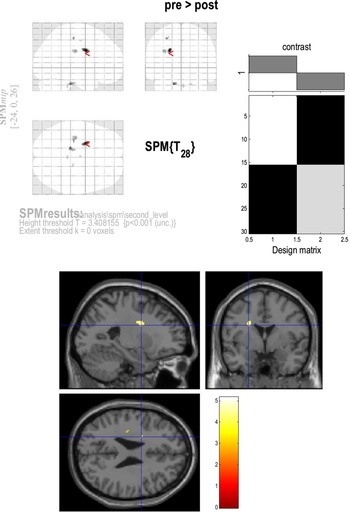
While performing the Stroop task at baseline and after 10 sessions of dTMS, functional activation in the targeted areas (ACC and mPFC) was not significantly different. However, group-level analysis revealed that the functional activation during the post-scans was significantly lower as compared to the pre-scans in the left caudate nucleus and the confluent white matter (see Figure 1). Similar but smaller decrease in the functional activation was also noted in the left SMA and left and right cerebellar white matter (see Supplementary Material 3). This may indicate the therapeutic effect of dTMS on the dysfunctional CSTC circuit. This is also in line with the improvement shown by patients on Y-BOCS scores.
Regions showing decreased activation during the Stroop task after dTMS.

Side effects
The dTMS treatment was generally tolerated well by the participants. Five participants reported mild scalp tenderness after stimulation which gradually decreased in intensity after each successive session. Four patients reported mild and transient headache after the initial few sessions of stimulation which did not need any medications and subsided within few hours. Three patients reported delayed sleep onset after the initial 2 to 3 sessions, and 1 patient reported increase in nighttime sleep duration after the treatment. However, sleep parameters came back to their baseline by the end of 10 sessions. Six participants did not report any side effects.
Discussion
Current open-label study examined the efficacy of adjunctive dTMS in patients who continue to have OC symptoms despite being on a stable dose of medications. Apart from the obsessive and compulsive symptoms, the study also examined the effect of dTMS on anxiety and depressive symptoms in these patients.
OCD often takes a chronic course with inadequate response to pharmacotherapy and psychotherapy in a big proportion of the cases. Predominantly compulsive type of OCD, long duration of illness, earlier age at onset, and poor insight are some of the established predictors of treatment resistance in OCD.Reference Franz, Paim and de Araújo 25 Strong biological underpinnings of OCD make it a good target for biological therapies such as rTMS, dTMS, tDCS, and so on.
All the 15 patients in the current study had both obsessions and compulsions. Dirt and Contamination was the predominant content of the OC symptoms in 8 of the 15 patients, whereas the remaining patients had thoughts about dog bite and rabies, thoughts about mundane daily events, and doubts about harming others and doing something wrong. Thirteen patients had good insight, and 2 patients had a fluctuating insight.
Total score on Y-BOCS had shown a significant improvement with 10 sessions of high-frequency dTMS (on an average, a 40% reduction in the total score on Y-BOCS). Among the individual domains of Y-BOCS, there was a significant and almost identical improvement in subtotals for obsessions and compulsions. The improvement in the OC symptoms with high-frequency dTMS is similar to that demonstrated in earlier studies.Reference Carmi, Alyagon, Barnea-Ygael, Zohar, Dar and Zangen 14 , Reference Carmi, Tendler and Bystritsky 15
Anxiety symptoms are commonly associated with OCD and present in the form of both psychic and somatic symptoms of anxiety.Reference Tükel, Polat, Özdemir, Aksuüt and Tuürksoy 26 The study participants showed high levels of anxiety as measured by the total score on the HAM-A. This showed a significant reduction with the dTMS treatment. This is in line with the earlier evidence for acute alleviation of anxiety symptoms by high-frequency dTMS treatment.Reference Kedzior, Gellersen, Roth and Zangen 27
Depressive symptoms are also often present in OCD patients.Reference Overbeek, Schruers, Vermetten and Griez 28 In many cases, it amounts to an independent diagnosis of major depressive disorder. Patients with scores higher than 22 on the HAM-D were excluded from the current study. Thus, the study participants had HAM-D scores ranging from 13 to 22. Irrespective of the baseline score on HAM-D, a significant improvement with dTMS treatment in the same was noted. Previous studies evaluating the response of adjunctive dTMS in major depressive disorder have shown a significant improvement in the depressive symptoms.Reference Berlim, Van Den Eynde, Tovar-Perdomo, Chachamovich, Zangen and Turecki 29 Thus, the improvement in the depressive symptoms demonstrated in the current study may be independent of the improvement in OC symptoms and may have different mechanisms altogether.
Our study has shown a significant decrease in the activation of the left caudate nucleus and the adjacent white matter after 10 sessions of dTMS. Previous studies have shown structural, metabolic, and functional changes in several brain structures following symptom control using various modalities of treatment such as medications, cognitive behavior therapy, rTMS, DBS, and neurosurgical interventions.Reference Hazari, Narayanaswamy and Venkatasubramanian 7 , Reference Bijanki, Pathak and Najera 8 , Reference Nakao, Okada and Kanba 30 Following symptom control in OCD patients using either Fluvoxamine or CBT, the hyperactivation in the prefrontal cortical structures decreased in symptom provocation paradigm of fMRI.Reference Nakao, Nakagawa and Yoshiura 31 A study also reported an increase in activation of right caudate following CBT although this did not correlate with the symptom improvement.Reference Freyer, Klöppel and Tüscher 32 To the best of our knowledge, no study previously examined the role of functional activation as a measure of change in symptom severity after dTMS in OCD. In lieu of the varied findings in the literature regarding the effects of various treatment modalities of OCD on symptom improvement and functional activation, our study offers novel findings. This may be important in elucidating the mechanism of successful symptom control in OCD using dTMS.
The biggest strength of our study is the inclusion of functional activation as a marker for treatment response in OCD patients. This helped us to show the possible mechanisms through which dTMS may work in decreasing the OC symptoms. Unlike the previous dTMS-OCD studies which recruited treatment-resistant OCD patients,Reference Carmi, Tendler and Bystritsky 15 we did not include treatment-resistance as one of the inclusion criterion. This helped us to study the functional correlates of the symptom control in a more naturalistic setting. Another strength of the study is that the average duration of the illness was 9.2 years, which is relatively long. Thus, the effect of dTMS on chronic OCD could be understood from the current study. However, the absence of a healthy control and treatment as usual groups makes it difficult to generalize the results. There were also no follow-up evaluations to assess the maintenance effect of the dTMS treatment.
Conclusion
Dysfunction (hyperactivity) of the CSGTC circuit has long been understood as a possible mechanism by which the OCD phenotype arises. Successful treatment of OCD symptoms leads to normalization of this dysfunction in the CSGTC circuit. Our study finds that the high-frequency dTMS can improve OCD symptoms possibly by decreasing the functional activation of the caudate nucleus among other structures. Studying the effects of adjunctive dTMS in a larger population of OCD patients may contribute novel findings to the existing literature in future. Follow-up assessments may be included without changing the initial medications and without starting any new psychotherapeutic interventions to see the maintenance effect of dTMS in OCD. Incorporation of multimodal neuroimaging techniques, such as MRS/DTI or electrophysiological recordings, using EEG or MEG may further help establish the mechanisms of action of dTMS in alleviating the symptoms of OCD.
Acknowledgements
We thank the participants of our study who gave consent and underwent the treatment and co-operated with all the necessary clinical evaluation and scans. We also thank the staff of the K S Mani Centre for Cognitive Neurosciences and the fMRI Centre, Central Institute of Ranchi, India, for their co-operation and support during the study.
Supplementary Materials
To view supplementary material for this article, please visit http://doi.org/10.1017/S1092852922000803.
Financial support
No sources of funding to be declared.
Author contributions
Conceptualization: N.G., U.S., and S.R.; Data curation: S.R.,N.G., and U.S.; Formal analysis: S.R.,C.R., N.G., and U.S.; Investigation: S.R., N.G. and, U.S.; Methodology: N.G., U.S., and S.R.; Project administration: N.G.; Resources: N.G., U.S., and S.R.; Software: S.R., and C.R.; Supervision: N.G. and U.S.; Validation: N.G. and U.S.; Writing—original draft: S.R.; Writing—review and editing: N.G., U.S., and S.R.
Disclosure
The authors do not have any conflicts of interest to declare.