SITE LOCATION AND ARCHAEOLOGICAL HISTORY
The existence of a Roman period villa at Warblington on the West Sussex/Hampshire border has been known since the 1920s following the discovery by a Dr Gedge of Roman tiles, tesserae and pottery in a field to the south of the Havant to Chichester road,Footnote 122 and the location was shown on subsequent Ordnance Survey maps. The site was investigated in 1960 by Mr A.J.C. Reger, a history master at Portsmouth Grammar School. He lived locally and trial-trenched the site as an exercise for the boys of his class. Reportedly, they were investigating a location where recent ploughing had revealed substantial foundations. They found a wall ‘made of erratic boulders and rubble bonded in cement, with a bonding course of Roman brick’ and ‘floors of Roman tile to north and south of the wall’.Footnote 123
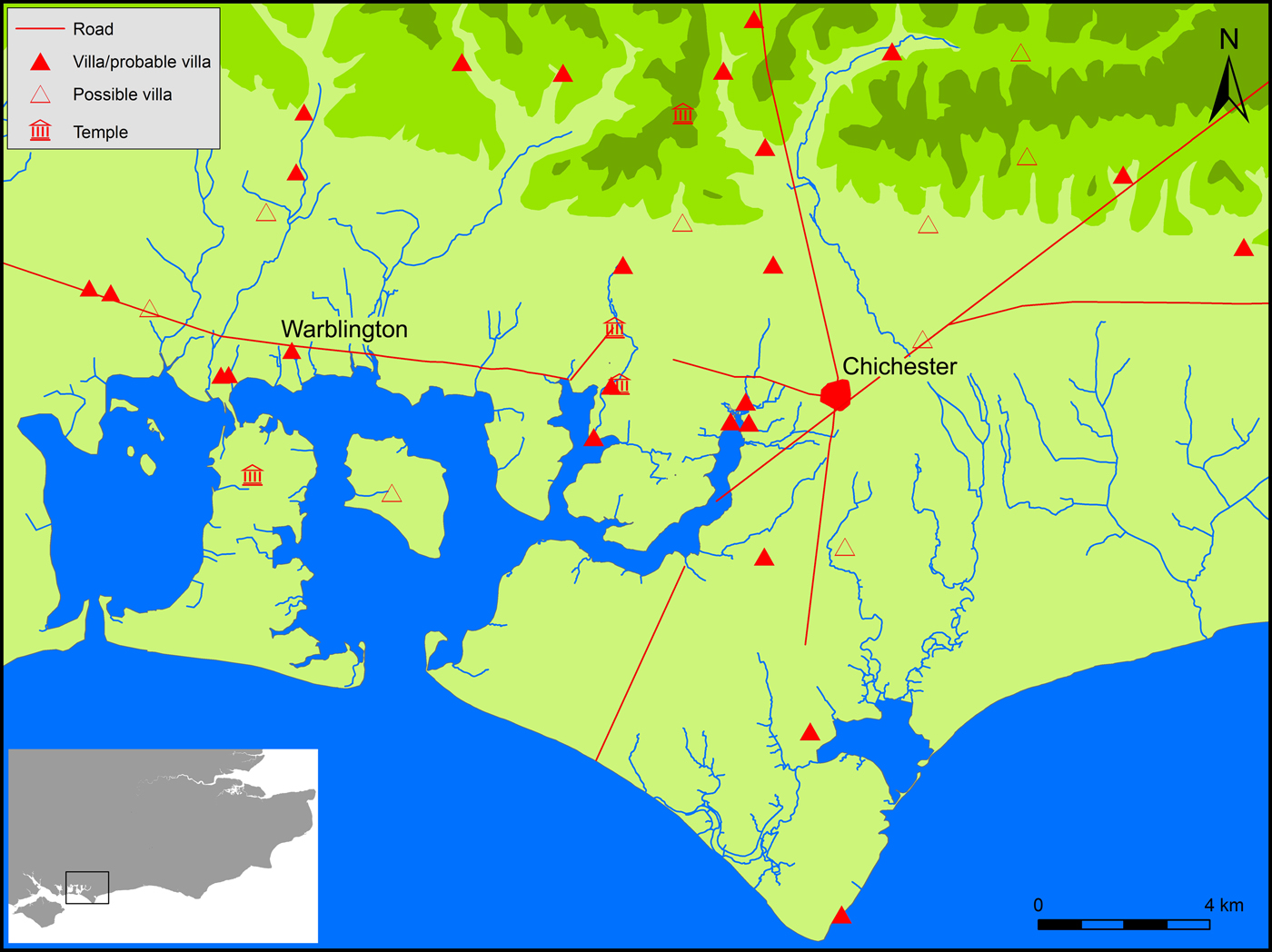
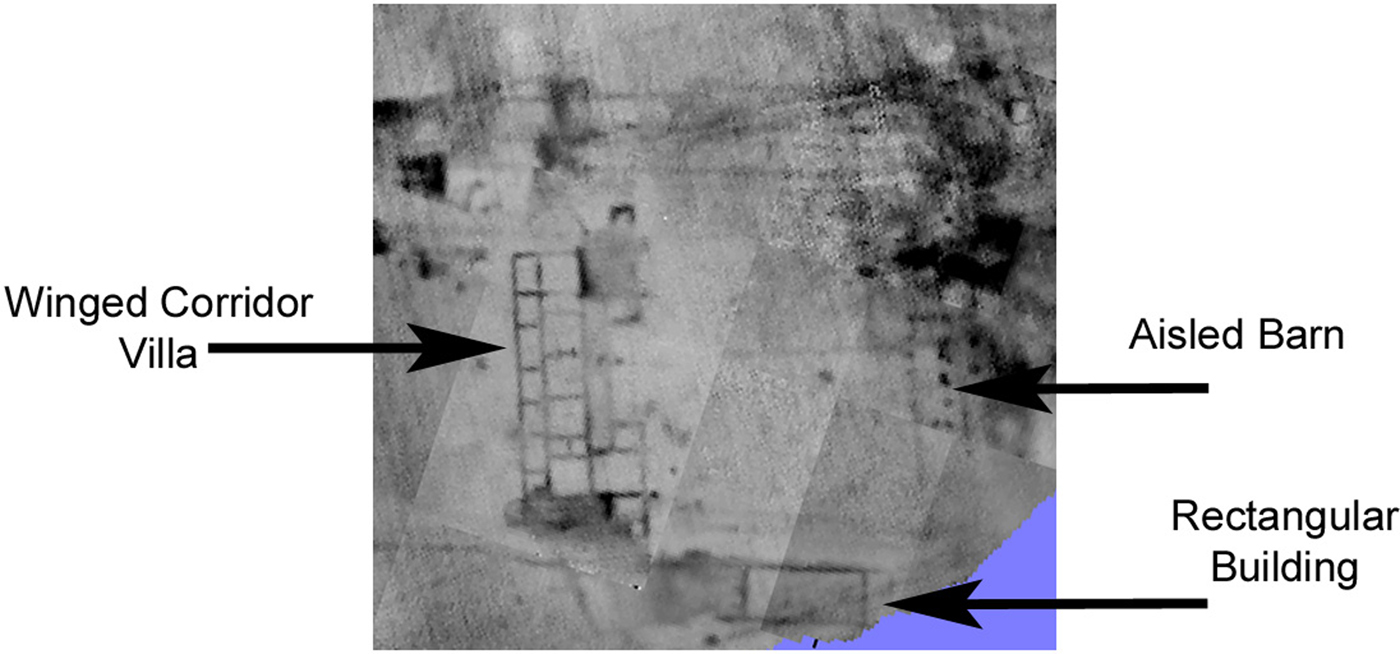
The site lies in a field on a slight rise between two natural north–south streams running down to Chichester Harbour. It is just south of the line of the Roman road between Chichester (Noviomagus Reginorum) and Southampton (Clausentum). A kilometre and a half across the water to the south is Hayling Island with its important Romano-Celtic temple (fig. 20). Although the field has been ploughed for many years, it is now part of a Natural England stewardship scheme and is only used for the production of silage. The site is owned by the Havant Borough Council, and stands within the Chichester Harbour Area of Outstanding Natural Beauty. Since 2008, with the Council's permission, Chichester and District Archaeology Society has undertaken a series of geophysical surveysFootnote 124 and excavations. These investigations included trial-trenching of the villa house, evidently a winged corridor villa with at least one small bath-suite, and of a timber-framed aisled building, probably a barn, to the east of the house. The 2014 excavation concentrated on the east end of what appeared to be a large rectangular building to the south of the villa house (fig. 21).
Location map. (Drawing: J. Kenny; © Chichester District Council)

A plan of the villa house and associated masonry structures, as indicated by the results of resistivity survey. (Illustration: T. Davies: © Chichester and District Archaeology Society)

EXCAVATION OF THE CIST
The rectangular building appears to be c. 35 m long and 8 m wide, incorporating a large central room, c. 18 by 8 m, with smaller rooms, c. 4 by 8 m, to its east and its west. Excavation demonstrated that the central room had walls c. 1 m thick, constructed of flint nodules set in lime mortar, whereas the footings of the east end room, of similar construction and apparently built at the same time, were only 0.7 m thick. It seems likely that the east wall of the central room formed the gable of a pitched roof whilst the east end room had a low, lean-to roof. General finds from the excavation indicated that the building had painted plaster walls and that it was roofed in Purbeck stone slabs; the strong implication being that it was used for accommodation rather than as an agricultural building. Coin finds indicated that it was occupied at least during the late third and early fourth centuries a.d.
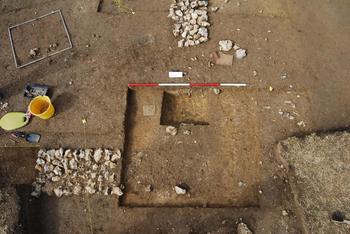
However, the whole site has been truncated by historic ploughing to the extent that no floor levels survive. Furthermore, the north-east corner of the building did not survive; the footings had been robbed away. It was during the cleaning of the ploughed surface around the robber trench in preparation for its excavation that what appeared to be a roughly-dressed, rectangular block of limestone was exposed, apparently set into the natural brickearth (fig. 22).
The robber trench at the north-east corner of the building, viewed from the east. The in-situ cist is below the south (left) end of the 2 m ranging rod. (Photo: J. Kenny; © Chichester and District Archaeology Society)

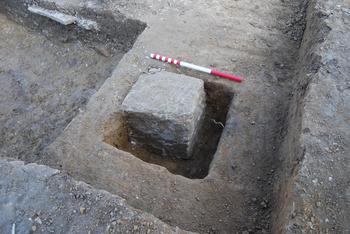
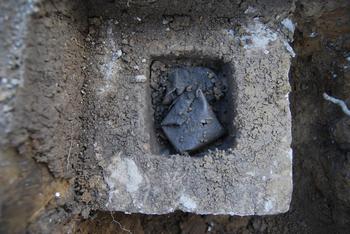
Following careful excavation around two sides of the block (fig. 23), it became clear that it was in fact a small cist comprised of a lid and base carved from the same block. When the lid was removed it exposed a small rectangular niche cut into the base, apparently containing two packet-like objects of greyish-brown metal (fig. 24). Following detailed recording the cist and its contents were taken to the nearest archaeological conservation laboratory, at Fishbourne Roman Palace, and eventually to the Conservation Science Laboratory at the UCL Institute of Archaeology, where a Master's student undertook the analysis and conservation of all the objects. Conservation involved excavation of the central niche, removal of the metal packages and any other material, opening and conservation of the packages, analysis of all the materials and the production of a full report.
The cist during excvation, with the natural brickearth excavated on two sides to facilitate removal. (Photo: J. Kenny; © Chichester and District Archaeology Society)

The metal objects within the cist. Note the thin layers of worm-cast soil around the cist and between its lid and base. (Photo: J. Kenny; © Chichester and District Archaeology Society)

THE CIST
The cist was formed from of a single rectangular block of Bembridge limestone, roughly squared with a pointed hammer before being cut, or split, in half. The niche was then cut into the lower block and the new upper and lower surfaces were carefully smoothed dead-flat to produce a tight join. The exterior sides, but not the top or bottom, were then dressed with a straight-bladed chisel 42 mm wide. When assembled the cist is almost cuboid: the upper block measures 195 by 180 mm and is 95 mm thick, the lower is 190 by 180 mm and 100–110 mm thick. The niche in the lower block measures 90 by 85 mm and is 40–50 mm deep.
The stone was identified as Bembridge limestone on the basis of characteristic fossil inclusions (gastropod Galba Longiscata and Charophyte Chara). Bembridge is on the Isle of Wight only approximately 20 km sailing distance from Warblington. Other fragments of Bembridge limestone have been discovered during excavations on the Warblington site, and it remains possible that the block was originally intended for use as a high quality building stone.
Because of truncation by ploughing there is no stratigraphic relationship between the cist and any other Roman structure or deposit. However, although its deposition prior to the construction of the building cannot be completely discounted, it seems likely that it was placed within the building, either beneath whatever floor it had or before the floor was laid. During excavation no evidence could be found of any material or void between the sides or base of the cist and the natural brickearth. Clearly the hole it was placed in was only slightly bigger than the cist itself. Moreover, when the lid was placed on the base it had been rotated through 90 degrees from its ‘natural’ and best fit position, which means the base is likely to have been placed in a carefully cut hole before the lid was put in place.
THE PACKAGES AND THEIR ANALYSIS
Samples of the corrosion layers covering the packages were analysed by X-ray diffraction and scanning electron microscope, through which the presence of lead, calcium, phosphorus and silicon was identified. The calcium and silicon probably derived from the stone cist, whilst the lead is the material from which the packages are made; the phosphorus was thought to derive from some phosphorus-rich material (such as bone) interred with or inside the packages. The packages were also analysed using an Olympus Delta hand-held XRF analyser, which appeared to indicate that the pouches were from slightly different alloys of lead.Footnote 125
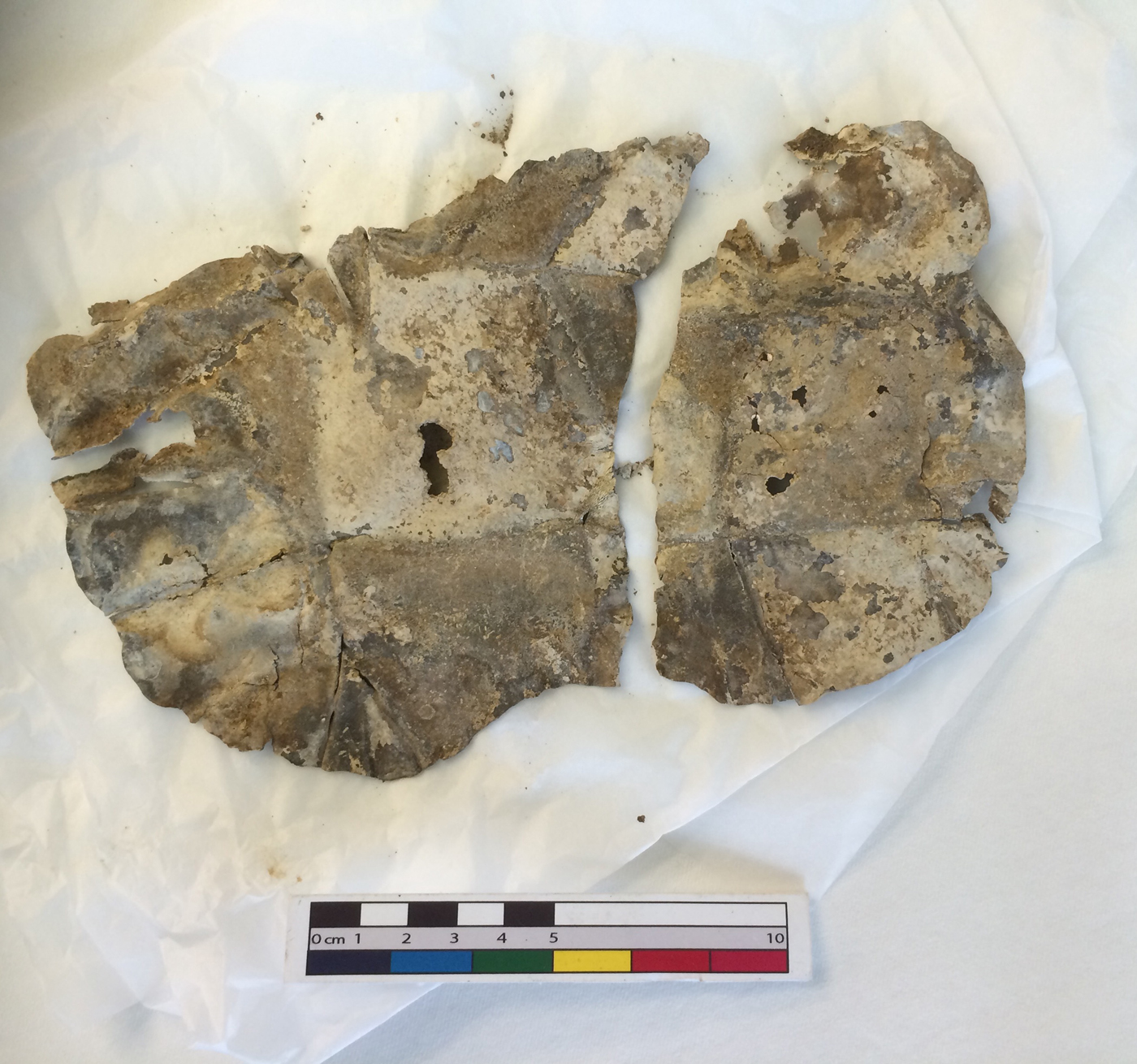
The lead packages were opened using a Chinese wooden stick and then fingers. They were left half-opened for four days before the opening process was completed to allow the self-annealing property of lead to work, and so reduce the risk of cracking. Once open, it became clear that the two pieces of lead had been cut from a single piece that had previously been used for another (unknown) purpose (fig. 25).Footnote 126 A number of XRF readings identified traces of calcium lead phosphate — a hint that the packages originally contained organic material. Despite close examination no evidence was found of any deliberate markings.
The opened lead packages arranged to show how they were cut from a single piece of lead. The folds relating to the original use, or to subsequent storage, can be seen crossing the two parts. (Photo: S. Cleverly; © Chichester and District Archaeology Society)

A small sample from each package was sent to the British Geological Survey for lead isotope analysis. Results indicated that it was likely to have been produced in the Mendips. The original use of the sheet is unknown; surviving fold-lines may indicate that it had formed a single rectangular shape, or may simply be evidence for it having been made smaller for ease of transport or stowage.
PARALLELS
There seem to be few close parallels in Roman Britain for the Warblington cist. A similar one on display in Bath Museum is described as: ‘A lidded box made of bath stone, containing cremated bones, probably a child's … It was found on the site of the Roman villa in Combe Down in 1854. The villa was large and a Latin inscription from nearby suggests it may have been the headquarters of the governor of southern Britain. The exact location of the villa is now unknown.’Footnote 127 The Bath cist measures 200 by 300 mm and is about 180 mm high to the top of its slightly domed lid, which is slightly inset into the base. The cist contains what appear to be cremated bones, although these seem not to have been analysed. There is no indication that it ever contained anything else.
Continental parallels are more common. An example seen by one of the authors in the Seville Archaeological Museum, which displays a similar standard of workmanship to the Warblington cist, is approximately 200 by 300 mm and 200 mm high.
It is possible that this cist is a smaller relative of the large stone cists containing Roman adult cremation burials that have been found locally at, for example, the Roman cemetery at Densworth Farm, Funtingdon, West Sussex.Footnote 128
DISCUSSION
It is virtually certain that the cist was deliberately located within the footprint of the building. It was placed below the floor in a purpose-made cavity either prior to or during the construction of the building. Whether it was intended to be accessible, like a safe, or to remain hidden, like a foundation deposit, is not certain. However, the care with which it was placed in the location within the building and the difficulty of regaining access would seem to suggest that it was not intended to be retrieved, or even revisited. The probability that the base of the cist was positioned before the lid makes it likely that this was in order that the metal packages could be deposited in situ, perhaps as part of a ritual.
The cist and its contents appear to have been manufactured from materials that were available on or close to the site, utilising skills that would have been available locally. There was no attempt to use special materials, and the skill of execution was quick and effective but relatively crude, apparently intended for deposition rather than permanent display.
The possibility that the cist contained an infant burial must be considered. The careful placement of infant burials in a domestic context, particularly adjacent to structures and, when within the building, often in the corners of the room, seems to have been a common practice in Roman Britain that may have had its origins in traditions already firmly established in the Iron Age.Footnote 129 It has been suggested that it was the maintenance of the particular status of the new-born as a component of the maternal entity that necessitated burial within or close to the domestic sphere. Perhaps there was a belief that the spirit of the dead infant might benefit fertility — or even that it might be reborn into women of the same family.Footnote 130
Burial was the preferred ritual upon the death of an infant, even at the time when that of an adult was cremation.Footnote 131 Nevertheless there is an example of the fourth-century cremation of an adult and a child.Footnote 132 The Warblington cist contained two lead packages that were too small to have contained either the remains of an adult cremation or the bones of an infant. Whilst there are traces of calcium lead phosphate present in the cist, there is no direct evidence that this was derived from the cremation of human bones.
In the absence of any other evidence it seems more likely that the cist represents some form of ritual, perhaps as a foundation deposit for what appears to be a domestic building or to mark some event in the lives of its inhabitants. The lead packages within the cist could have been intended to operate in a similar manner to curse tablets, but in spite of intensive searching, no inscription has been found on them. However, it has been suggested that it is not necessary to have an inscription for the tablet to do its work.Footnote 133 Lead is seen as particularly useful for curse tablets because it is heavy and cold.Footnote 134 Natalias provides evidence that previously used pieces of lead were thought to enhance the impact of the curse, as were associated objects.Footnote 135 In this case we must presume that the contents of the packages were significant and their lack of preservation is because they were of delicate organic material.
If the lead packages in the cist were effectively curse tablets, then the deposition within a secure location would seem to suggest that it was placed there in response to an ongoing crisis — for example, in response to serious illness. It is difficult to believe that the placement of the cist and its contents under the floor was carried out secretly. If it was done openly, one possible implication is that the influence of the curse tablets and their contents was seen to have a positive rather than a negative effect.
ACKNOWLEDGEMENTS
The authors acknowledge the help we have received in the excavation and conservation of this object, especially from Havant Borough Council, who own the land and the finds; Chichester Harbour Conservancy, who have responsibility for the Area of Outstanding Natural Beauty within which the Warblington Villa is situated and who have supported both the excavations and the cost of the conservation process; Hampshire County Council, who have supported the cost of the conservation process; Hampshire Cultural Trust who advised on the cist's conservation prior to analysis; David Hopkins, Hampshire County Archaeologist; Dr John Merkel and Luciana Carvalho at the Conservation Science Laboratory at the UCL Institute of Archaeology; David Bone, a specialist in the geology of Sussex and Hampshire who examined the stone; Henry Young, who farms the land, and the members of Chichester and District Archaeology Society, who excavated the site and also supported the cost of the conservation process.