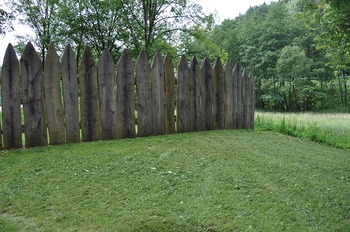
In 2002, excavations in the village of Hammersbach-Marköbel about 30 km north-east of Frankfurt uncovered remains of the wooden palisade on the Upper German limes. Stumps of oak posts which, according to their dendrochronology, represented timbers felled in the winter half-year of a.d. 119 had been preserved in the damp subsoil of the floodplain. This discovery dates the improvement of the obstacles along the limes on the eastern edge of the Wetterau to an exact year. This singular discovery confirms the well-known passage in the imperial biography in the Historia Augusta, which states in connection with Hadrian's first tour of the provinces that: Per ea tempora et alias frequenter in plurimis locis, in quibus barbari non fluminibus sed limitibus dividuntur, stipitibus magnis in modum muralis saepis funditus iactis atque conexis barbaros separavit. (HA Hadr. 12.6) (‘During this period and on many other occasions also, in many regions where the barbarians are held back not by rivers but by artificial barriers, Hadrian shut them off by means of high stakes, planted deep in the ground and fastened together in the manner of a palisade’.)Footnote 1
UPPER GERMANY AT THE BEGINNING OF HADRIAN'S REIGN
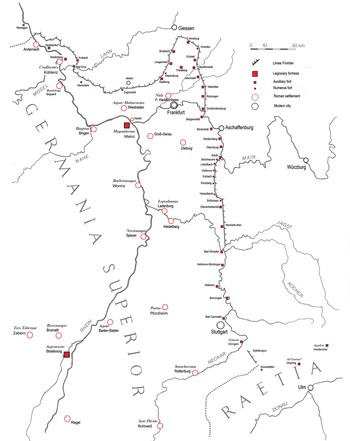
No military campaigns had taken place along the River Rhine in the provinces of Lower and Upper Germany or on the Upper Danube in neighbouring Raetia since Domitian's war against the Chatti (a.d. 83–85 and 89). The army had subsequently been greatly reduced in size and largely lost its offensive tasks. At the same time, Domitian had transformed the two previous military districts into the provinces Germania Superior and Germania Inferior, whereupon a systematic build-up of civil administration had begun, which continued under his successors in the following decades. This was accompanied, especially in Upper Germany, by the disentanglement of military and civilian structures. With the exception of the legionary fortresses in the provincial capital Mogontiacum/Mainz and in Argentorate/Strasbourg, 185 km up the Rhine, the military left almost all its bases in the hinterland. Both legionary fortresses were converted into stone, and the troop concentrations of auxiliary units which surrounded them were dissolved. At the few places where auxiliary forts were maintained, they were also rebuilt in stone. The recorded number of auxiliary units, which was 18, remained stable during the period between Domitian and Hadrian.Footnote 2 Archaeologically, the construction of civilian infrastructure can be easily traced in the form of road building and the founding of municipia or civitates. We see concessions of city rights along with the creations of civitates. These activities seem to have been still in progress under Hadrian in places like Forum Hadriani/Voorburg in Lower Germany, Aquae Mattiacorum/Wiesbaden, Nida/Frankfurt-Heddernheim and Civitas Auderiensium/Dieburg in Upper Germany or Aelia Augusta/Augsburg in Raetia (fig 1).Footnote 3 The frontiers in southern Germania Superior and in western Raetia were moved forward respectively to the east and to the north in a clearly complex process which unfortunately is not recorded by written sources.Footnote 4 The River Neckar, whose upper course and estuary had been firmly in Roman hands since Flavian times, was now also monitored in its middle section by a chain of forts forming a riverine frontier or ripa. To the north, a likewise newly constructed limes through the Odenwald connected the two frontier sections along the Main and Neckar. Further up the Neckar, various routes were apparently tried out over several decades in order to improve and shorten the line of communication between Germania Superior and Raetia. The tactical intention was to create a continuous running frontier zone secured with forts.Footnote 5 The strategic background for this extensive movment of frontiers, at least south of the Main, was the shortening of the route between Mogontiacum and Aelia Augusta, i.e. from the Rhine to the Danube.
Settlements and military installations along the frontier zone in Upper Germany at the end of Hadrian's reign (based on Baatz Reference Baatz2000, with modifications).

The beginning of these measures and thus also of the construction of auxiliary forts in the Westerwald, at the edge of the Wetterau, along the Main and in the Odenwald, as well as the chain of forts along the Neckar, was traditionally dated to the early a.d. 90s, immediately after the end of the so-called (second) Chattan War, which in fact was a brief military uprising lasting 42 days against the emperor Domitian and led by the governor of Germania Superior, L. Antonius Saturninus.Footnote 6 As a result it was considered necessary to install an unmistakable demarcation to support the establishment of the new province of Germania Superior.Footnote 7 The dating of these developments once depended primarily on samian ware from the earliest occupation phases in the forts.Footnote 8 However, in 1998 another approach, now widely adopted, dated all sections of the Upper German limes considerably later, i.e. not until the time of Trajan, using statistical investigations based on the range of coins recovered from the individual sites.Footnote 9 According to this evidence, the fertile areas north of the Main, which had been occupied since the early first century, were protected not before a.d. 110 by the construction of the Taunus and Wetterau limes and the chain of forts along the Main. The construction of the Odenwald limes seems to have followed a few years later, and the river frontier along the Neckar belongs to the years around a.d. 110/115.The earliest dendro-chronological date from the Neckar limes, which is a.d. 111, does not contradict the chronology set out above.Footnote 10
Although there are still unresolved questions, especially about the later history of some Augustan sites in the northern part of the Wetterau or along the Main, this revised chronology has had a major impact on our understanding of the history of the frontier system in Upper Germany and Raetia. The new concept of frontier protection can no longer be dated to the reign of Domitian, but was a policy initiated and implemented under Trajan. If we accept that it was the duty of the garrisons to control the frontier, the new forts date the establishment of the whole frontier system. In regions where rivers could not offer natural frontier courses, the military laid out artificial lines in the form of cleared strips in the forests or roads. These limites were created between the stretches of ripae along the Rhine, the Main, the Neckar and finally the Danube, and were monitored completely and continuously. Previous advanced positions, such as at the crossings over the Taunus ridge or in the northern Wetterau, were integrated or in turn themselves determined the course of the Trajanic frontier. Except for small-scale corrections, the limes north of the Main now took the form maintained until the third century. We may assume therefore that it accorded with the priorities of Roman frontier policy.Footnote 11 Forts of the auxiliary units were probably distributed right along the edge of the Roman-controlled territory like a string of pearls – analogous to the already existing river frontiers along the Lower Rhine and the Danube. By constructing a chain of forts along the new limites in Upper Germany and Raetia, Trajan had secured their entire course by major roads, lines of watch towers, or at least cleared strips in the forests. Thus, onwards from the late Trajanic period if not earlier, the eastern frontier of the province of Upper Germany was clearly defined and completely monitored in the sense of a genuine limes. However, the system was flexible: some sections were strongly fortified with barriers to access such as banks and ditches (see below), while others at this stage featured only wooden watchtowers.
At the beginning of his 21-year reign (a.d. 117–138), Hadrian found in Upper Germany a province that was still in the process of being established. Imminent danger to the frontiers in the form of military threats had occurred a generation earlier, but there seem to have been no such difficulties during his reign. This is reflected for example by the reference to the investiture of a king among the Germanic tribes (HA Hadr. 12.7), which follows immediately after the quotation mentioned above which decribes the construction of the limes palisade: Rome's power obviously extended far beyond the limes. Moreover, Germania Romana was not a territory new to Hadrian. He had already become acquainted with the Rhine in a.d. 97/98, when he was stationed as a military tribune (tribunus laticlavius) with legio XXII at Mogontiacum. In October a.d. 97, he delivered congratulations to Trajan on his adoption by Nerva. Shortly afterwards, at the end of January or the beginning of February, he travelled along the Rhine to the Colonia Claudia Ara Agrippinensium/Cologne to convey to Trajan the news of Nerva's death (HA Hadr. 2.2–4.6; Cass. Dio 69). From this time on, he was part of the immediate retinue of the newly installed emperor. Hadrian then appeared again with military responsibilities in the Dacian Wars. At the beginning of the Second War in a.d. 105, he commanded legio I Minervia as legatus legionis on campaign; the legion had joined the war coming from its base in Bonna/Bonn in Germania Inferior. The following year he became governor of the newly created frontier province of Pannonia Inferior. Hadrian next returned to Upper Germany five years after his accession to power (HA Hadr. 10.1–2). For his visit to Germania Superior as part of his first major tour of the Empire, Hadrian had probably prepared specific plans for the frontier.Footnote 12 The record in the Historia Augusta about his activities during his months in Germany concentrates only on his efforts to strengthen military discipline.Footnote 13 The same is true for Dio's account. Nevertheless, it is striking that Hadrian went to the Rhine first, although this part of the empire had not been the focus of Rome's military interest since Domitian's campaigns against the Chatti and the failed coup of Saturninus. Neither cursus honorum of the two recorded governors of Germania Superior in this period, Kan[us Iunius Niger?] (a.d. 116 or 117) and C. Quinctius Certus Poblius Marcellus (sometime between a.d. 121 and 129) indicates that they had been involved in major military operations during their careers; they seem to have been routine appointments.Footnote 14 In general, the departure from Rome is placed in the summer of a.d. 121 and the arrival in Upper Germany in the spring of 122 at the latest. However, where Hadrian spent the winter is disputed. It is widely assumed that the emperor wintered in Lugdunum/Lyon.Footnote 15 It has also been suggested that he was at one of the capitals of the German provinces, Mogontiacum or the Colonia Agrippinensis.Footnote 16 Considering the four different provinces, Upper and Lower Germany, Raetia and Noricum, which Hadrian is presumed to have visited and the time needed for travelling, there would, however, hardly have been enough time for long stays at any of these places, and the sources give neither the locations the emperor toured nor details of his programme. Hadrian was familiar with all four provinces from his active service in the legions under Nerva and Trajan. He had already spent a winter at Mogontiacum as well as at the Colonia Aggripinensis 20 years previously and had travelled through Raetia and Noricum on his way to the Dacian War. Additionally, his retinue in a.d. 121/122 comprised advisors (comites ) who were familiar with this part of the empire, such as M. Atilius Bradua, ‘governor of one of the German provinces and then in Britain in the later part of Trajan's reign’.Footnote 17 However, these considerations are of secondary importance to the question of a visit by Hadrian to the actual frontier. On the basis of the account in the the Historia Augusta, it is usually concluded that the emperor was present where there were new frontier works. This is reasonable, because in the listing of his military efforts during his stay in Germany we are told that Hadrian also selected sites for the construction of forts (locum castris caperet). Both the Historia Augusta and the account of Dio (HA Hadr. 10.6; Cass. Dio 69.9.1) tell us that he moved forts to more suitable sitesFootnote 18. These are, of course, topoi for any good general in antiquity, but this account seems credible considering the wide range of ongoing frontier-activities under Hadrian.
Nevertheless, Hadrian did not reach Upper Germany until after the date of the felling of the palisade timbers at Marköbel in a.d. 119. Assuming that the work on the limes palisade can be traced back to his direct orders, the instruction to start must have reached those responsible in the province long before the emperor's departure from Rome. The development of the road system that Hadrian used on his way to the Rhine also fits in with this statement.Footnote 19 The exact route, initially along the Rhone, seems to be traceable from the inscriptions on the milestones found in the province of Aquitania, which date between the end of a.d. 120 and the end of 121 (CIL 13.8906, 8910). Inscriptions of the same date are also found in Germania Superior (CIL 13.9045, 9047 and AE 1979, 417) and Gallia Belgica (AE 1935, 160; CIL 13.9133). Not only the places to be visited but also the planned course of Hadrian's journey must have been communicated well in advance so that the governors concerned were able to react and arrange for the road works. Of course, this is not contradicted by the fact that milestones as well as scientific data prove road construction in the two German provinces again in later years of Hadrian's reign.Footnote 20 Assuming that Hadrian stayed in the provincial capital of Mogontiacum during his journey to Upper Germany and wanted to visit the newly constructed limes palisade from there, his route may have actually led him to the limes section around Marköbel in the eastern Wetterau. A milestone (CIL 13.9124) set up in a.d. 121/122 comes from Mainz-Kastel, which is located opposite Mogontiacum, the provincial capital. The site is on the so-called ‘Elisabethenstraße’, the main Roman connection between Mogontiacum and the Wetterau. Another milestone from the Wetterau (CIL 13.7393) can also be attributed to Hadrian, but because of its poor preservation a more precise dating is not possible. The stone stood on a road connecting the milliaria fort at Friedberg with the limes at Ober-Florstadt. The frontier in the eastern Wetterau along the line from Ober-Florstadt in the north via Altenstadt, Marköbel, Rückingen to Großkrotzenburg forms the only substantial section of the Upper German limes apparently laid out not before the very end of Trajan's reign and certainly under construction under Hadrian (see below).Footnote 21 In these areas, our imperial visitor could have inspected two ongoing measures of frontier development in one go.
DEVELOPMENT OF THE FRONTIERS IN UPPER GERMANY AND RAETIA
As mentioned above, the course of the frontier in Upper Germany was essentially already in existence at the beginning of the second century. Hadrian neither changed the established pattern of troop distributions nor did he make large-scale corrections to the course of the frontier, though in some ways he tried to bring the system to perfection. The fortresses of legio XXII Primigenia at Mogontiacum and legio VIII Augusta at Argentorate remained on the Rhine, but the forts for the auxiliary units were nearly all lined up along the frontier in the east. The army now abandoned almost all of its remaining positions at the rear. This direct transfer of units to the limes is usually interpreted as a subordination of military needs to administrative priorities. Common sense suggests that there was still no military threat to Upper Germany in this period. This is demonstrated by the fact ‘that the new line – neither at the front nor at the back – was not secured by advanced posts nor by defence in depth’.Footnote 22 Only the fort of the cohors I Flavia Damascenorum, a highly mobile unit of archers, remained at Friedberg in the heart of the Wetterau. In two, most probably late, sections of the Trajanic frontier which followed dead straight lines, we can see the most sophisticated manifestation of the artificial frontier: that is, the eastern section of the Wetterau limes and the southern half of the Odenwald limes (see below).
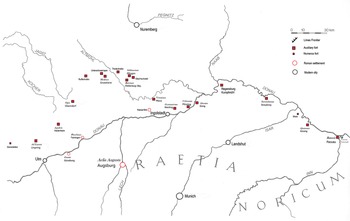
As far as can be discerned, the course of the limes in Upper Germany, which had existed since Trajanic times, underwent only sporadic, mainly local changes under Hadrian (fig. 2). Because of their small scale, they probably reflect the leeway in decision-making of the governor or even the regional military commander, rather than specific imperial orders.Footnote 23 At the same time, it remains difficult to distinguish Trajanic from Hadrianic forts on the basis of their archaeological finds. The method of dating sites by numismatic statistics alone is problematic where a place might have started as a fortlet for a few tens of soldiers and became a regular cohort fort later on.Footnote 24 Nevertheless, we can regard most of the forts discussed here as Trajanic foundations with some certainty.
Settlements and military installations along the frontier zone in Raetia at the end of Hadrian's reign (based on Baatz Reference Baatz2000, with modifications).

The Upper German limes began not far from the border with the neighbouring province of Lower Germany at Rheinbrohl, 25 km downstream from Koblenz in Rhineland-Palatinate. From here, it initially followed the Rhine valley at a distance of about 10 km to the east, thus completely enclosing the fertile landscape of the Neuwied Basin. The first 30 km or so of the limes were protected by the cohort forts of Heddesdorf and Koblenz-Niederberg, each garrisoned by 500 men; Bendorf, which lay in between, had been abandoned by this time. East of the Lahn near Bad Ems, the frontier line then followed the northern foothills of the Taunus. Over a length of more than 90 km, the section was monitored only by four numerus forts at Arzbach, Bad Ems, Marienfels and Zugmantel, together occupied by a total of about 500 men. Many of the men from these so-called national numeri, small independent units with a strength of about 120, came from the British province during the reigns of Domitian or of Trajan at the latest. Under Hadrian they acted as a new element along the frontier in Upper Germany, probably to replace larger auxiliary units at less vulnerable places.Footnote 25. According to their coin lists, Marienfels and Bad Ems were most probably built under Hadrian around a.d. 130.Footnote 26 On the heights at the Zugmantel fort, northwest of Wiesbaden, the limes turned east and ran along the Taunus ridge. Here, in Hadrianic times, the previously existing cohort forts of Saalburg and Butzbach, situated at a comparatively great distance from each other, were complemented by the numerus fort at Kapersburg and the fort of the cohors I Biturigum Aquitanorum equitata at Langenhain,Footnote 27 respectively 10 km and 14 km north of the Saalburg.
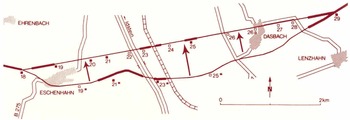
The course of the Roman frontier across the southern fringes of the Westerwald and over the ridge of the Taunus hardly changed during the entire limes period. The forts, towers and obstacles there were indeed renewed, converted and strengthened over time, but with the exception of small-scale corrections, the Roman military retained the frontier demarcation that had originated in the late first century until the end of the limes in the middle of the third century.Footnote 28 One of the few small-scale changes in the course of the frontier, however, is probably connected with the construction of the palisade in Hadrianic times: between the fort at Zugmantel and the fortlet at Heftrich, the limes crossed the Idsteiner Senke, an area of natural subsidence in the west-to-east course of the Taunus ridge. This particularly vulnerable spot had apparently already been fortified with a bank-and-ditch system over a length of 6.3 km in pre-Hadrianic times; however, the construction of a palisade cannot yet be proved for this system. In the course of straightening, the frontier in this section was slightly shifted to the north. Since wooden towers and palisades were only built at this time, this short straightening of the limes near Idstein seems to belong to the Hadrianic period (fig. 3).Footnote 29
Sequence of the limes at the ‘Idsteiner Senke’ on the Taunus ridge: a dead straight section replaced the older course (after Baatz Reference Baatz and Thiel2008, fig. 3).

The topographical situation changes at the north-eastern edge of the Taunus, where the limes left the heights and enclosed a part of the Wetterau in a sweep far northwards. At the valley incision of the small River Usa, the mountain ridge of the Taunus ends and gently rolling hills begin. In this bulge, the course of the limes now encompassed the fertile basin landscape of the Wetterau. Loess soils, numerous watercourses including the eponymous Wetter, and the temperate climate, made this region one of the granaries for supplying the frontier army in Roman times. The immediate hinterland within the bulge of around 500 km2 was filled with numerous estates from the second century onwards. At the centre of the Wetterau, and connected to the limes forts by military roads in all directions, lay the most important fort site, Friedberg, base of the previously mentioned cohors I Flavia milliaria Damascenorum sagittaria. The place belongs to the sites first occupied during Augustus’ campaigns and seems to have been held because of its perfect setting as the only fort in the hinterland of the limes. The course of the limes at the edge of the Wetterau had already been protected since Trajanic times by a dense chain of forts, most of which were for cohorts. The fort of cohors I Biturigum Aquitanorum at Langenhain, already noted, possibly represented a Hadrianic reinforcement. Apart from later, small-scale corrections,Footnote 30 the course of the frontier had not changed here either. The section of the limes around the fort of Arnsburg advanced furthest to the north and lay opposite the Germanic-populated Giessen Basin. This natural gateway into Roman territory was also the location of various military installations from the time of Augustus.Footnote 31 The frontier in the north of the Wetterau was further protected by forts at Inheiden and Echzell.Footnote 32 Here, too, wooden barriers were probably already in place before a.d. 120, as the Reichs-Limeskommission was repeatedly able to present findings that were interpreted as the remains of a wooden fence, which stood in a trench like the palisade later on.Footnote 33 Individually standing posts at a distance of a double or a single pace (65–80 cm or 1.30–1.50 m) were connected with wickerwork or thin tree trunks. Therefore it seems that, at least in some individual sections of the frontier in the northern Wetterau, a different type of obstacle preceded the construction of the Hadrianic palisade.
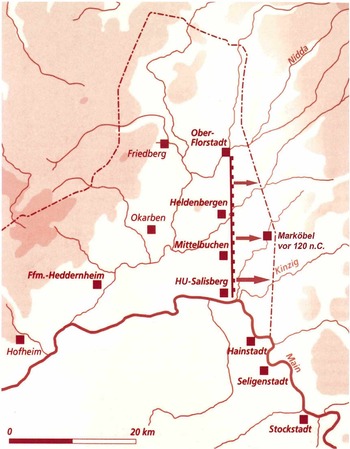
Between the numerus fort of Inheiden in the north and the cohort fort of Ober-Florstadt in the south, the north-eastern section of the limes in the Wetterau seems to have deliberately followed the course of the small River Horloff. Its marshy reed bed was certainly only passable in a few places and thus offered natural protection to the east. It is noticeable that in the frontier section between Inheiden and Ober-Florstadt the forts lie to the west of the Horloff, while the frontier line itself runs to the east. Obviously, the floodplain served as a natural barrier in a first phase of the construction of frontier obstacles. Between them, two military units may have been stationed together in Echzell, with an area of 5.2 ha one of the largest forts on the limes; in addition to an infantry unit, probably for monitoring the adjacent frontier, a 500-man strong ala quingenaria seems to have performed supra-regional tasks at the same time. The following section of the limes near Hammersbach-Marköbel – the place where the palisade timbers were found – is one of the frontier sections in Upper Germany that were first established under Hadrian. An earlier section of this frontier, probably still surviving from the time of Domitian and stretching for 35 km between the fort sites of Ober-Florstadt, Heldenbergen, Hanau-Mittelbuchen and Salisberg, was abandoned in the Trajanic period and moved forward by about 12 km to the east to the line of Ober-Florstadt, Altenstadt, Marköbel, Rückingen and Großkrotzenburg (fig. 4).Footnote 34
Pushing forward the limes in the eastern section of the Wetterau (after Baatz Reference Baatz and Thiel2008, fig. 1).

Characteristic of these newer forts is their proximity (c. 300 m) to the line of the palisade, whereas Trajanic sites were from 1.5 to 2.5 km distant from it. However, it seems that the forts, which were laid out very densely in the most recent expansion phase at almost regular intervals of no more than 8 km, were not moved forward at the same time. Finds from Altenstadt and Marköbel suggest an earlier occupation,Footnote 35 while the two forts of Rückingen and Großkrotzenburg, located in the south, apparently only came into being in Antonine times.Footnote 36 Nonetheless, dating evidence is scarce so far, so predecessors in the form of smaller numerus forts cannot be ruled out here, given the lack of research.Footnote 37 In any case, it may be assumed that a demarcation line already established in Trajanic times was not left unmonitored. Investigations of the palisade and watchtowers north of Rückingen indicate that both were erected here under Hadrian.Footnote 38
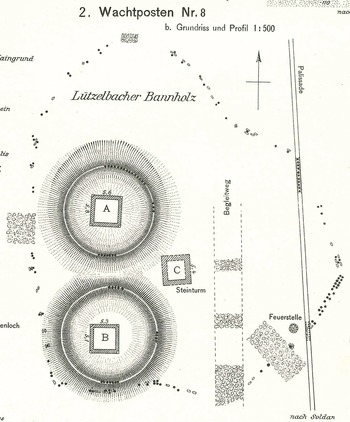
Beyond the Wetterau limes, the Main served as a riverine frontier. For about 50 km, the river valley formed an unmistakable line of divison without the need for artificial obstacles. Roman military installations were limited to the western side of the valley. We might assume that there had been at least some short-lived military installations here in Augustan times, as is suggested by the temporary double-legionary fortress further upstream at Markbreit.Footnote 39 But the fort sites of the later Main limes have no evidence of occupation so far which dates to before the Domitianic–Trajanic expansion phase. In Hadrianic times there were already forts at Seligenstadt, Stockstadt, Niedernberg and Obernburg. The fort of Wörth am Main might have originated as part of a Domitian military chain on the Main according to recent investigations.Footnote 40 All the sites along the river were connected by a military road, and the course of the river was likely to be important as a traffic route, not only for supplying the forts, but also for transport from and into Germania Magna. It is quite certain that the artificial land frontier through the Odenwald built around a.d. 110/115 under the emperor Trajan began in the Main valley to the south at Wörth, although the exact spot has yet to be located. The Odenwald limes crossed the 80 km long land bridge between the Main in the north and the Neckar in the south and formed the earliest artificial frontier line south of the Main. Excavations, especially those carried out by the Reichs-Limeskommission, show that the course of the limes palisade takes into account the locations of the watchtowers which stand about 30 m behind the palisade. The findings suggest that the towers were already in existence when the course of the palisade was marked out: tower site Wp 10/8 is a striking example (fig. 5). For this reason, the towers are dated to the Trajanic period. The route of the frontier works and the distribution of units along the Odenwald limes show a division into two different schemes. The northern part from Wörth am Main to Schlossau passed through the highlands of the Odenwald. Adapted to the terrain, it followed a distinctive ridge in many twists and turns. The frontier was monitored by numerus forts at Lützelbach, Vielbrunn, Eulbach, Würzberg, Hesselbach and Schlossau, all of which were laid out at a distance of about 5 to 7 km from each other. They were located in hollows between the hilltops that were by default controlled by watchtowers. The southern half of the Odenwald limes, from Schlossau to the Neckar valley, however, was guarded by three cohorts located at Oberscheidental, Neckarburken and Bad Wimpfen. The southern section of the Odenwald limes, which is about 35 km long, repeatedly changed direction slightly, but the individual sections were largely laid out in a dead straight line through the gently rolling hill country. The linear alignment of the limes south of Schlossau thus resembles the construction of the Outer Upper German limes in the Antonine period. The southern end of the Odenwald limes is unclear. Recent research suggests that the artificial frontier-line did not end at the Neckar. Geophysical investigations rather indicate a palisade line east of the river course, secured with fortlets and towers, which accompanied the Neckar at a distance of about 4 km.Footnote 41 It is conceivable that this limes ran further south for at least 30 km and thus included large parts of the Neckar valley on its right-hand side, which was favourable for settlement, in the provincial territory. This would mean that the course of the Neckar between Bad Wimpfen in the north and Grinario/Köngen in the south is not to be understood as a classic river frontier, but as a mixture of a ripa and a limes: its eastern bank was fortified with continuous barriers from Hadrianic times at the latest. The river itself was not a sufficient obstacle and not of much use as a physical barrier. Due to its winding course, it was also completely useless for effective frontier control.Footnote 42 The total of six known fort sites on the western bank of the river between Bad Wimpfen and Köngen were thus located several kilometres behind the frontier line itself. In any case, the evidence of a continuous palisade makes it probable that also along the Neckar Hadrian sought to ‘separate the barbarians’ from the Romans as conveyed by his biographers.
Footprint of the wooden watchtower WP 10/8 in the Odenwald as recorded in the Reichs-Limeskommission excavations (after Fabricius Reference Fabricius1935, pl. 3.2).

The Neckar frontier followed the course of the river for about 100 km to Köngen, where it turned south-east towards Raetia. According to the more recent dating of military installations in Upper Germany,Footnote 43 it must be assumed that the forts of Bad Wimpfen, Heilbronn, Walheim, Benningen, Bad Cannstatt and Grinario along the river were in existence by around a.d. 110/115 at the latest. Apart from the construction of a continuous palisade on the eastern bank of the river, already mentioned, no changes can be detected on the Neckar in Hadrianic times. Presumably under Hadrian the existing forts were reconstructed in stone and the frontier thus took on an increasingly static character. Just outside the cavalry fort of Stuttgart-Bad Cannstatt, an elaborately and very carefully built wooden substructure for the main vicus road was found. The oaks for its boards and beams, cut in the years a.d. 111, 118/119 and in the spring of 123, were reused around a.d. 129.Footnote 44 The context of the find points to the preliminary use of the timbers in a military context. Together with the construction of a proper vicus road, the most recent felling date could thus indicate extensive structural changes in the fort itself, possibly its rebuilding in stone. Upstream on the Neckar, at the cohort fort of Grinario, findings also point to its reconstruction in stone in early Hadrianic times.Footnote 45
In the region east of the Neckar, the interface with the neighbouring province of Raetia was apparently no longer secured by any further military installations on the Upper German side. Here, the land frontier obviously was identical with the course of the road from Mogontiacum to Augusta Vindelicum. This route was of strategic importance as the shortest long-distance connection between the Rhine and the Danube. At a distance of 50 km from the Neckar, the nearest known Raetian fort site is Ad Lunam(?)/Urspring, located in the Swabian Alb. However, no watchtowers or fortlets are known here. A notable exception is the barrier in the valley of the River Lauter, to the south-east of Stuttgart–Bad Cannstatt which had existed since Domitianic/Trajanic times, the so-called ‘Sybillenspur’/‘Sybil's track’, or Lautertal-Limes. When this structure, only about 1 km in length but certainly of two phases, was built is unknown. It was abandoned in the Hadrianic period at the latest (fig. 6).Footnote 46 On the whole, however, frontier protection in this section of Upper Germany, as in neighbouring Raetia, does not seem to have been organised along a defined line. Apparently, along the ridge of the Swabian Alb a kind of frontier zone allowing control in depth continued to be maintained here.Footnote 47
Reconstruction of the so-called ‘Lautertal-Limes’, covering a gap between the river Neckar and the ridge of the Swabian Alb (after Planck Reference Planck and Planck2005, 63).

For neighbouring Raetia, the effects of Hadrian's frontier policy or even the emperor's presence in the province can only be inferred indirectly. Raetia was already known to the emperor, who passed through it on his way to Trajan's wars in Dacia. The most obvious and certainly best-known result of his visit during his first tour through the provinces in a.d. 121/122 was the official granting of city rights to Augsburg, which was elevated to the status of municipium Aelium Augustum under Hadrian. In Trajanic times, the former military site on the River Lech had already developed into a city-like settlement. Tacitus (Germ. 41.1) praises it as ‘splendidissima Raetiae provinciae colonia’. Its connection with the long-distance road network developed in the Claudian and Domitianic periods contributed significantly to this statement. Under Hadrian at the latest, the governor of Raetia, a procurator Augusti, may have moved his official residence from Cambodunum/Kempten to Augsburg.Footnote 48 However, there is no evidence of any military presence in Aelia Augusta at this time. Hadrian's stay in the city, as in Raetia generally, is not mentioned in any written sources. But because of the bestowal of his name on the emerging provincial capital, it can be assumed that Hadrian was present. His visit to Raetia may also be considered as certain on the basis of the coinage.Footnote 49 In addition to Augsburg, Hadrian might also have visited the northern frontier of the province. This is quite likely, as the newly built long-distance road from Mogontiacum to the Danube through the Raetian limes area was the shortest connection. From the emphasis in the coinage on the inspection of the Raetian army, it is obvious that Hadrian visited the most important military location in the province, Aquileia/Heidenheim, for this purpose. At the time, the highest-ranking unit of the Raetian army, the ala II Flavia milliaria, was stationed here. There is archaeological evidence of extensive building work in the fort area around a.d. 120.Footnote 50 Nevertheless, the rebuilding of of the defences of the cavalry fort in stone, which was not founded until the reign of Trajan, seems to have taken place much later.Footnote 51 Another striking feature of the Heidenheim site is the complex stone buildings to the east in front of the fort area. Immediately after their discovery, they were described as official buildings.Footnote 52 A definite identification of their function has yet to be made. Their unusual size when compared to other buildings typical of military vici, and the fact that their individual components were apparently only used for a short time, have led to the suggestion that the complex might be associated with the emperor's visit.
Archaeology can only give unsatisfactory answers when it comes to any further effects of Hadrianic frontier policy in Raetia. While older research assumed that the reference in the Historia Augusta also applied to the palisade in western Raetia, it has now been possible to prove that the Raetian obstacles were built much later, not before the later years of Antoninus Pius’ reign.Footnote 53 Based on this recent approach, the dating of the Raetian limes to around a.d. 160 implies that for the whole Hadrianic period the northern frontier of this province was only secured by patrols that guarded the roads between the different frontier posts. In contrast to the two German provinces, the immediate frontier foreland of Raetia was not inhabited; the nearest Germanic settlement area was several days’ journey away. Compared to Upper Germany the threat level was lower, which probably slowed down the overall expansion of the frontier.Footnote 54 Another restraining effect might be seen in the absence from the province of a legion with its supply of skilled personnel.
The several advances of the westernmost end of the Raetian frontier between Domitian and Antoninus Pius may have been a direct consequence of the extension of the Upper German limes. The construction of the Neckar limes shortened not only the distance between the Rhine and the Danube, but also the section of the frontier that had to be monitored by the Raetian army. This process began under the Flavians and continued over the following decades, so far without showing definable stages. On the Upper Danube, the military probably withdrew in around a.d. 95.Footnote 55 The forts of Ad Lunam(?)/Urspring and Aquileia/Heidenheim, the westernmost military sites of Raetia, were now able to take over frontier protection. The forts north of the Danube were connected by a 135 km long road from Arae Flaviae/Rottweil to Aquileia, which ran over the south-west to north-east ridge of the Swabian Alb and has been wrongly called the Alb-‘Limes’. It was presumably a supply route that started from the administrative and military centre around Arae Flaviae. With the gradual advance to the Alb, it was extended further and further to the north-east in the two decades between a.d. 95 and 115. In addition to protecting the long-distance road from Mogontiacum to the Danube, another focus was on the Raetian limes in the Nördlinger Ries. As the numerous Roman estates of later times illustrate, this fertile impact crater of a meteor served as the granary of the province. The province name ‘Raetia’ is probably preserved in today's name ‘Ries’. The Ries was probably secured from later Trajanic times with forts at Opia/Oberndorf, Nördlingen, Munningen and Biriciana/Weißenburg.Footnote 56 Forts were probably moved up to 20 km further north, but perhaps not until late Hadrianic times: in the central section of the Raetian land frontier, findings from the fort sites show the temporal succession of Theilenhofen, Ruffenhofen and Sablonetum/Ellingen and thus an emergence of the eastern section of the Raetian land frontier.Footnote 57 Units stationed here were partly mounted. This massing of mobile troops at the most northerly part of the projecting bulge of the Raetian frontier around Weißenburg is strongly reminiscent of the clusters in the distribution of the auxiliary units in Upper Germany during the Domitianic period. This also included the fort of Germanicum/Kösching on the northern side of the Danube but in the hinterland of the frontier, which continued in existence until the middle of the third century guarding the important road north of the Danube. Further to the east, a road less strongly secured by the forts of Vetoniana/Pfünz and Celeusum/Pförring connected the Ries to the Danube.
THE ARCHAEOLOGICAL RECORD AT MARKÖBEL
It is surely a stroke of luck that a historical event handed down in literature can be confirmed so clearly by the archaeological record. The excavation site is located at the Krebsbach on the eastern outskirts of Marköbel, a district of the municipality of Hammersbach (Main-Kinzig-Kreis, Hesse). From the time of Trajan, the 3.3 ha cohort fort probably secured a prehistoric traffic route from the Rhine–Main region through the eastern Wetterau into Germania Magna. The place was well connected with the road network of the Wetterau. However, an assumed limes crossing here has not yet been confirmed. The limes barriers reach the district from a north-westerly direction, make a slight bend about 300 m east of the fort and extend from here in an almost exact north–south direction to the Main. In the eastern Wetterau, this is the frontier's only change in direction.
The development of a new housing estate in a meadow significantly called ‘In den Graben’ (‘inside the ditches’) made it necessary to carry out rescue excavations during the construction work in June 2002. The modern name of the field probably does not refer to the remains of the Roman frontier obstacles, but to an artificial mill canal and the creek of the Krebsbach, which runs almost parallel to the ancient barrier. In two trenches, each 4 m wide, it was possible to record the V-profile of the limes ditch, the ‘Pfahlgraben’, which was up to about 5 m wide. Running parallel to the ditch at a distance of 1.4 m was the palisade trench which was 0.4 m wide.
Within the small trench numerous wooden remains were found, which were well preserved due to the high groundwater level. At a distance of about 0.25 m to 0.35 m, there were post stumps with a diameter of 0.27 m to 0.37 m. Next to them, other timbers were found, which often showed traces of processing. They were mainly branch wood, which probably originated from the finishing of the palisade posts, and there were only a few fragments of split planks and squared timbers. The logs must therefore have been felled in the immediate vicinity and debranched on site.Footnote 58
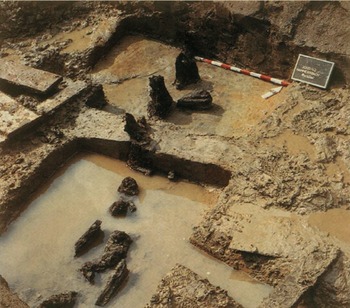
As shown by subsequent scientific investigations at the University of Frankfurt, halved oak trunks, i.e. oak trunks split lengthwise, were used for the palisade (fig. 7). Their lower ends were worked off smoothly and placed in the previously dug small trench. The flat split side of the trunks faced east in the direction of Germania Magna. The other fragments of wood, also of oak, lay in the trench as rubbish without any recognisable order. There are no indications of previous constructions or later repairs. However, the excavated section was very small. Of the recovered timbers, 11 could be determined precisely to the year on the basis of their surviving bark edges (wane). According to these determinations, the oaks were felled in the winter of a.d. 119/120 and used while still green. The summer forest edges of the year a.d. 120 were preserved in two timbers from the backfilling, not the palisade. This waste wood thus seems to indicate when the palisade was built, the posts of which had been cut and trimmed only a few months earlier. So far this is the only dendrochronological date for the construction of the palisade in this section of the Upper German limes. The only other dated timbers from the frontier works in Upper Germany are from the Outer limes, built in the reign of Antoninus Pius.Footnote 59
Stumps of oak posts in Hammersbach-Marköbel revealed during the excavation in 2002 (photo: HessenArchäologie, Wiesbaden Finds in Hammersbach).

If the dates of the Marköbel timbers are applied generally to the palisade on the Upper German limes, they confirm and indeed narrow down the previously assumed date for its construction.Footnote 60 The findings at Marköbel are further proof of the credibility of ancient literary sources. Looking specifically at Hadrian's visit to the province, it becomes clear that construction had begun two years earlier. Planning and preparation are certainly to be placed even earlier than the beginning of the implementation. Furthermore, during his inspection of the province, Hadrian could have satisfied himself about the progress of construction and possibly even seen the completion of at least the barriers in the Wetterau,Footnote 61 a construction that at this point in time may have already reached from the Rhine to the Neckar and thus had a total length of almost 300 km.Footnote 62
HADRIAN'S PALISADE ON THE UPPER GERMAN LIMES
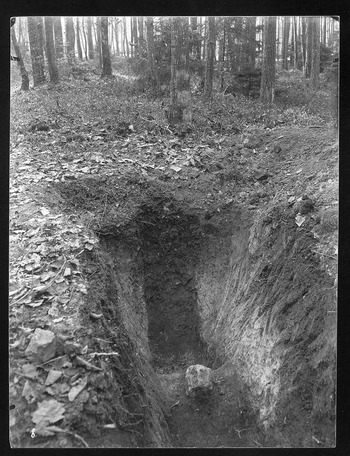
It may be assumed that the Hadrianic palisade was constructed without gaps from the Rhine through the Westerwald and the Taunus around the Wetterau to the Main and presumably also on the section of the Odenwald limes south of the river between the Main and the Neckar. As the information in Hadrian's late antique biography demonstrates, the construction of this uniform palisade was not a measure the provincial army would carry out on its own initiative. The explicit mention of the palisade by Hadrian's biographer and his detailed description of its construction is understandable for two reasons. First, this massive frontier barrier ‘in the form of a wall-like fence’ (in modum muralis saepis) represents a remarkable structure despite its perishable material. The palisade trench almost always stands out clearly in numerous excavations of the Reichs-Limeskommission (fig. 8). The posts, each flattened at the bottom, stood on the bottom of the trench, their flat sides placed against the outer edge, and they were often wedged in position with larger stones. In sections where there was no evidence of wedging stones, their absence was probably due to the lack of appropriate stone sources on site. The results of more recent investigations confirm the conclusions drawn about the appearance of the palisade. Thus in the limes section near Erlensee-Langendiebach and in Pohlheim-Grabenteich, halved oak trunks were represented by the impressions of the palisade timbers. Here also, the individual posts were placed on the bottom of the trench and set against its outer edge. Where wedging stones were found in the palisade trench, no waste wood seems to have been incorporated into the backfill. According to the numerous well-observed features, the palisade posts stood as close to each other as possible in a U-shaped trench sunk at least a metre into the ground. However, depths of 1.5 m were also measured. As practical experiments with replicas have repeatedly shown, the distances of 0.25 to 0.35 m between the oak stumps observed in Marköbel result from the natural slight curvature of the trunks used. The aim was to set the posts as close together as possible.Footnote 63 The stable anchoring of the individual posts in the ground suggests that the palisade rose at least twice as high, probably to a height of 2.5 to 3 metres. Wooden crossbars connected the logs to each other and prevented removal of individual posts. The smooth side of the split logs always faced outwards, so that from the Germanic side the impression was of a continuous wall, taller than a man. This impression was probably reinforced by the fact that the palisade ran as a straight line and took no account of the topography of the terrain. Specialist land surveyors were certainly commissioned to lay out the lines of the barrier as exactly as possible.Footnote 64 As far as we know, the palisade ran without any gaps and was thus the only component of the limes installations that was executed uniformly everywhere, from steep slopes to swamps.
Profile through the palisade ditch in the Taunus region, Reichs-Limeskommission excavations (photo: Limesarchiv, Römisch-Germanische Kommission, Frankfurt).

Moreover, the amount of construction work should not be underestimated. In northern Upper Germany, the main features of the frontier had already been established before a.d. 120. Patrol routes, watchtowers and, at least in many places, the fences mentioned above already existed. The construction of the palisade in large parts of the Westerwald and the Taunus was therefore a genuine extension of the frontier obstacles and not merely a way of disposing of the timber produced, for example, by clearing the line of the limes. For one kilometre of palisade, an estimated 700 trees had to be felled, debranched and split lengthwise. In addition, the trunks had to be transported to the frontier and the tree tops disposed of. At the same time, the use of the massive trunk wood of 100- to 200-year-old oaks also meant an enormous economic investment, as this wood would have been excellently suited for other building purposes.Footnote 65 It is therefore understandable that this construction project had remained in the memory of posterity.
The palisade as a whole possibly gave the barriers along the frontier in the two provinces their modern name. In many regions along the limes, the Latin word ‘palus’ for palisade lives on in its Germanised form of ‘Pfahl’ (stake) or ‘Pfahlgraben’ (stake ditch) in today's place and field names. The modern word ‘Pfahl’ can be derived via Old High German ‘Phal’. A mention dating to a.d. 889 in the forest donation in the royal estate of Weissenburg in Bavaria is considered the oldest known record to date. Another indication that for the ancient contemporaries the limes palisade was an impressive component of the frontier barriers, as a wall of wood extending from horizon to horizon, is provided by Ammianus Marcellinus as late as the middle of the fourth century. According to his contemporary account of the campaign of the emperor Julian against the Alamanni on the right bank of the River Rhine, he reached ‘regio, cui Capellatii vel Palas nomen est’ – an area whose name was ‘Capellatii’ or ‘Palas’. This term apparently refers to the term for the Upper German limes, which was named after the ‘cut-off posts’ (from Latin ‘cappellare’ = to cut off and ‘palus’ = stump or post) built along it.Footnote 66 The land frontier, which had been defined and controlled since Trajanic times in the form of a cleared strip or, at best, a paved road, merely formed a visual separation of the Roman and the Germanic territories. Only the Hadrianic ‘wall of wood’ also physically separated the two spaces from each other.Footnote 67 It not only marked the empire more clearly than ever before; it also indicated the limits of the empire. ‘It was surely Hadrian's way of making plain that the policy of expansion really was at an end’.Footnote 68 This admission might not have been popular in Rome, but it seemed to be the message people in the provinces liked to hear. It is probable ‘[…] that this visible enclosure was intended to evoke a kind of sense of security – “securitas”. It was clear to everyone that between the wild and barbarian, non-Roman territory and the Roman province stood the limes and its facilities and soldiers’.Footnote 69 This wooden wall was clearly visible not only to Germanic tribes and Roman soldiers but to all people who came to the limes. Finally, it should be noted that Hadrian's technical concept of a linear barrier must have proved itself in practice. At least, this is indicated by the fact that Hadrian's successor Antoninus Pius, when advancing the limes around a.d. 160, also constructed an apparently identically designed palisade on the newly drawn Outer limes line between the Rivers Main and Rems and on the Raetian limes up to the Danube.Footnote 70
The construction of the palisade has plausibly been seen as the second of four phases in the development of the Upper German limes,Footnote 71 as follows:
1) cleared strips/wooden towers
2) palisade/wooden towers
3) palisade/stone towers
4) stone towers/rampart or stone towers/wall.
Describing the palisade as the second stage in the construction of the limes might give the impression that Hadrian has started to ‘close’ the frontier. The schematic enumeration of the limes phases can obscure the fact that the frontier barriers by no means underwent a development that led from an originally open frontier directly to a continuous barrier line. Rather, there are regional peculiarities, logical breaks and even general changes in strategy within the upgrading of the limes. Therefore, it should first be pointed out that, just as Hadrian did not invent the concept of barriers along the frontiers, the limes between Rhine and Danube was not completely fortified during his reign. The latter was the achievement of Antoninus Pius, who moved the limes forward in Upper Germany and Raetia and for the first and perhaps only time in the history of the limes actually built obstacles without gaps. Structures which could not be assigned to any of these development phases received less attention in research. Such comparative neglect, for example, applies to the frontier-fences mentioned above, which do not quite fit in with the statements in the Historia Augusta that it was Hadrian who created artificial barriers in order to ‘separate barbarians’ from Romans. Rather, their existence raises the question of whether the first limes phase existed at all. Was the frontier ever completely unfortified and only monitored by patrols or men stationed in the towers?
It became apparent at an early stage in research that that the oldest sections of the limes largely followed a militarily stronger line than the straight sections laid out under Hadrian and in later times. Fabricius had concluded from the course of the earliest limes lines, which were adapted to the terrain, that there was initially a greater need for security than later, in Hadrian's time and afterwards.Footnote 72 It would therefore make sense if, at the same time as the earliest wooden towers were built, exposed sections of the limes were secured with barriers in the form of fences. How much the soldiers of the frontier army stationed on the limes felt personally threatened is shown, for example, by the extensive wooden enclosure around watch tower WP 10/8 on the Odenwald limes (cf. fig. 5). A fence, clearly older than the palisade, ran around the oldest wooden tower at a distance of 10 to 30 m.Footnote 73 It indicates that the garrison attempted to improve fortifications of the watchtower itself as well as taking measures to prevent illegal trespassers from crossing the limes.
THE FUNCTION OF THE PALISADE
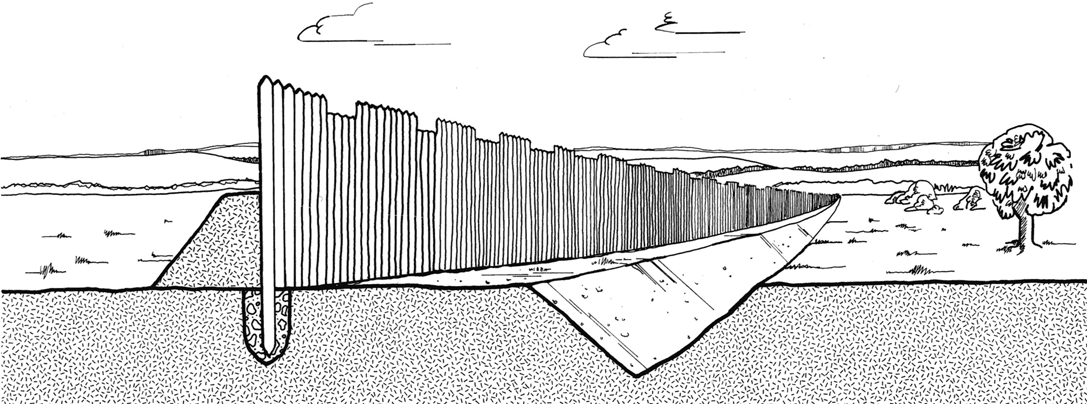
To what extent can we assume that the construction of increasingly elaborate and effective obstacles was intended to make it more difficult or even impossible to cross the frontier? First of all, a 3 m high, almost smooth ‘wall’ is indeed an effective physical barrier (fig. 9). It would take time to overcome it, regardless of the means used. This does not mean, however, that we are looking at a true fortification. An individual transgressing the palisade would certainly not be held up long enough for the soldiers in the nearest towers to intervene, and the two small detachments of soldiers from the adjacent towers would hesitate to confront a larger group. The palisade was not the place for an ad hoc interception. At the same time, the palisade was also unsuitable as an entrenchment or defensive bulwark in positional warfare. Its stubbornly straight course meant that a Roman defender was very often in a much less favourable position than a Germanic attacker, for example where the terrain rises in front of the palisade. Therefore, there is widespread agreement today that neither the palisade nor its later successors were suitable for combat operations. Their military value should nevertheless not be underestimated; of course, the limes could not halt campaigns, but this was not the issue in this period. Instead, plundering gangs would have been hindered. As often shown, a barrier such as a palisade slows down crossings, makes unnoticed incursions unlikely and blocks retreat. It allows time for action to confront the intruder and, if successful, has a deterrent effect. Accordingly, the palisade was able to increase security along the limes itself as well as in its hinterland. In contrast to Hadrian's Wall with its much wider military zone acting as a buffer, the countryside in Upper Germany was densely populated right up to the limes. Anyone who crossed the frontier entered the province's affluent area with numerous and rich estates. As the army became more and more static, soldiers became familiar with the local population and many veterans stayed in the area of their service. Given that from Trajanic times, there was a switch to more and more local recruitment,Footnote 74 the soldiers of the frontier forts must have been alarmed even if only minor incursions penetrated the hinterland. Bearing in mind the benefactions and donations Hadrian gave to the provinces,Footnote 75 it might even be possible that a direct request was made to the emperor to remedy a real or anticipated threat in Upper Germany.
Modern reconstruction of the palisade made of split oak timbers (photo: author).

Hadrian was not the first Roman emperor to erect structural barriers on the frontier of Upper Germany. The bank and ditch system at the Idsteiner Senke in the Taunus, the sectional obstacles east of Hanau and the closure (clausura) of the Lautertal limes near the border with neighbouring Raetia were even more massive obstacles that can be documented from the time of Trajan at the latest. What was new, however, was the effort to fortify all parts of the land frontier. Hadrian was thus the first emperor consistently to secure the frontier of a province with uniform construction measures. It remains an open question whether he developed this concept himself on the basis of his personal experience of the situation in Germany or whether he was influenced by third parties. Technical advisors in the emperor's own retinue and the needs or ideas of those responsible for frontier protection in the province conceivably contributed to his policy. As shown by a glance at neighbouring Raetia, whose northern frontier remained open, the Hadrianic conception of frontier protection remained inconsistent from region to region. If different solutions were applied to suit specific provinces, the palisade perhaps became even more a carefully considered gift from the emperor reflecting Hadrian's ‘attitude towards the provinces’.Footnote 76 In any case, a certain pragmatism is expressed in the choice of wood as a building material, which was quickly and almost universally available in the densely wooded areas along the German frontier. The palisades running parallel to the Neckar seem to indicate that Hadrian wanted more than an unmistakable demarcation line. The massive and elaborate construction demonstrates that a barrier that would increase the physical challenge of crossing its line was intended. The Hadrianic frontier construction on the Upper German limes should therefore not be understood as mere symbolism, even if such considerations certainly played a role and we may even assume that there was some architectural elaboration in certain places (fig. 10).Footnote 77 A short time later, the construction of a stone wall across the isthmus between Tyne and Solway in Britain, which bears the name of the emperor, shows that the construction of the limes palisade in Upper Germany was not a purely regional provision of increased frontier protection. The scope of the measure and the prior instruction to extend the frontier, combined with the announcement of a subsequent inspection by the emperor on the spot, speak against this. Assuming that essential sections had already been completed when Hadrian came to Germany in a.d. 121, it can be concluded that they would have had a propagandistic effect both internally and externally, though one for which no record survives. The construction of the palisade and the emperor's visit were, however, connected in two ways. Just as his policy sought to emphasise the importance of each province for the Roman Empire, Hadrian aspired to eliminate problems in the provinces he visited. Ideally, this was done through building measures to improve infrastructure or security: ‘a visit plus construction of some sort seemed to be the usual pattern of Hadrian's journeys’.Footnote 78 In Upper Germany, he was at least partially successful. The massive frontier obstacles strengthened military security, and at the same time the limes palisade was noted by contemporaries and found its way into the historical record.
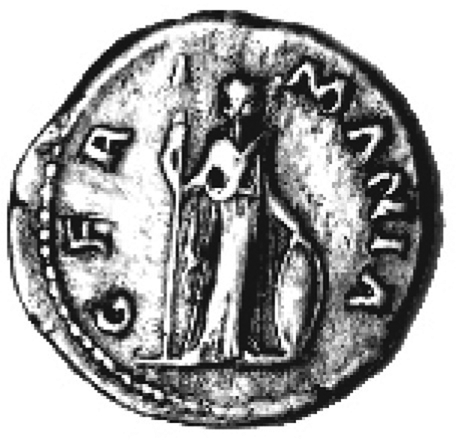
Sestertius of Hadrian (RIC 303 rv): Germania standing with weapons (photo: Landesmuseum Württemberg, Stuttgart).