Childhood language disorder (LD) is associated with significant emotional and behavioral problems in adolescence, but little is known about its association with mental health trajectories from adolescence to adulthood (Beitchman et al., Reference Beitchman, Wilson, Johnson, Atkinson, Young and Adlaf2001). Research on psychological outcomes of LD in early adulthood has largely reported on small clinical samples or has not used validated psychiatric assessments; results have been inconsistent across studies (Clegg, Hollis, Mawhood, & Rutter, Reference Clegg, Hollis, Mawhood and Rutter2005; Schoon, Parsons, Rush, & Law, Reference Schoon, Parsons, Rush and Law2010). Longitudinal studies on mental health trajectories during early adulthood in the general population are also lacking. Although cross-sectional population studies have reported lower psychiatric disorder prevalence among adults aged 25 to 34 than those aged 18 to 24, cross-sectional designs cannot track changes over time or examine factors associated with trajectory patterns (de Girolamo et al., Reference de Girolamo, Polidori, Morosini, Scarpino, Reda and Serra2006; de Graaf, ten Have, van Gool, & van Dorsselaer, Reference de Graaf, ten Have, van Gool and van Dorsselaer2012).
Recent literature on emerging adulthood outlined developmental changes characterizing the transition from adolescence to adulthood, underscoring the need for longitudinal research in emerging adulthood extending to age 30 (Schulenberg & Zarrett, Reference Schulenberg, Zarrett, Arnett and Tanner2006; Tanner et al., Reference Tanner, Reinherz, Beardslee, Fitzmaurice, Leis and Berger2007). In one of the only community-based longitudinal studies tracing psychiatric status to age 30, Tanner et al. (Reference Tanner, Reinherz, Beardslee, Fitzmaurice, Leis and Berger2007) reported a substantial decrease in psychiatric disorder rates from ages 21 to 30, but they did not address contextual factors related to disorder trajectories.
Childhood and adolescent factors shown to predict adult psychopathology include maltreatment history, nonintact family structure, and maternal psychological problems (Hayatbakhsh et al., Reference Hayatbakhsh, Clavarino, Williams, Bor, O'Callaghan and Najman2013; Keyes et al., Reference Keyes, Eaton, Krueger, McLaughlin, Wall and Grant2012; Pirkola et al., Reference Pirkola, Isometsä, Aro, Kestilä, Hämäläinen and Veijola2005). In addition, LD is uniquely associated with challenges in academic functioning, including increased risk of specific learning disorder, which may affect developmental course (Taanila et al., Reference Taanila, Ebeling, Tiihala, Kaakinen, Moilanen and Hurtig2014; Young et al., Reference Young, Beitchman, Johnson, Douglas, Atkinson and Escobar2002). Youth with LD may also experience different school environments due to special education placements (Durkin, Simkin, Knox, & Conti-Ramsden, Reference Durkin, Simkin, Knox and Conti-Ramsden2009). Special education is associated with higher rates of mental health problems, even among youth not referred for emotional/behavioral issues (Isohanni et al., Reference Isohanni, Järvelin, Nieminen, Jones, Rantakallio and Jokelainen1998; Pastor & Reuben, Reference Pastor and Reuben2009). Few studies have examined special education experiences of youth with LD or their psychosocial impacts. Simkin and Conti-Ramsden (Reference Simkin and Conti-Ramsden2009) surveyed youth with LD who received special education and found that most youth with LD reported generally positive experiences in special education due to enhanced learning supports; however, they also reported negative experiences focused on interpersonal difficulties related to their placements.
This paper examines childhood and adolescent risk factors' associations with mental health trajectories from late adolescence to young adulthood. The Ottawa Language Study is a five-wave longitudinal study following a cohort of children with childhood communication disorders from age 5 to age 31. Psychiatric disorder prevalence was higher among participants with LD than among typically developing controls at age 19 but was similar between the two at age 31 (Beitchman, Brownlie, & Bao, Reference Beitchman, Brownlie and Bao2014; Beitchman et al., Reference Beitchman, Wilson, Johnson, Atkinson, Young and Adlaf2001). Here, we examine the trajectories of psychiatric disorder from ages 19 to 31 in relation to LD and other early contextual factors that are either known risk factors for psychological problems (maltreatment history, maternal psychological distress, and nonintact family structure) or factors particularly relevant to individuals with LD that may impact mental health over and above the direct effects of communication difficulties (specific learning disorder and special education).
Methods
Participants
Participants were recruited at age 5 as part of a three-stage epidemiological study of communication disorders (Beitchman, Nair, Clegg, Ferguson, & Patel, Reference Beitchman, Nair, Clegg, Ferguson and Patel1986). A one-in-three sample of kindergarten children (N = 1,655) in the Ottawa–Carleton region of Canada completed a speech/language screening; speech–language pathologists further assessed children who failed the screening. In total, 180 children were diagnosed with speech disorder and/or LD, and 142 had parental consent for further participation. A group of 142 children without language or speech disorders, matched on age, sex, and classroom, was also selected. Details on sampling, screening, and assessment are available elsewhere (Beitchman et al., Reference Beitchman, Nair, Clegg, Ferguson and Patel1986). These 284 children were the Wave 1 participants of the study and were contacted for follow-up waves at ages 12, 19, 25, and 31. Participation rates were 86%, 91%, 85%, and 80%, respectively, at each wave.
Ethics approval was obtained from the research ethics boards of the Royal Ottawa Hospital (first wave), the Clarke Institute of Psychiatry (second and third waves), the Hospital for Sick Children (fourth wave), and the Centre for Addiction and Mental Health (fifth wave).
Definitions of language and speech disorders
Participants diagnosed with LD (LD cohort) met one or more of the following criteria: –1 SD on the Peabody Picture Vocabulary Test (Dunn & Dunn, Reference Dunn and Dunn1981), –1 SD on the Test of Language Development (TOLD) spoken language quotient (Newcomer & Hammill, Reference Newcomer and Hammill1977), –2 SD on any language subtest of the TOLD, or –2 SD on both the content and sequence subtests of the Goldman–Fristoe–Woodcock Test of Auditory Memory (Goldman, Fristoe, & Woodcock, Reference Goldman, Fristoe and Woodcock1970). Among the 103 participants diagnosed with LD, 58 met more than one criterion. Participants diagnosed with speech disorder met one of the following criteria: –2 SD on the word articulation or word discrimination subscale of the TOLD; or a clinical diagnosis of voice disorder, childhood-onset fluency disorder, or dysarthria by the speech–language pathologist completing the assessment. Speech and language tests used to define speech and LDs at age 5 are listed in Table 1.
Tests and measurements

The 142 participants with communication disorders included 103 in the LD cohort (67 with LD only, 35 with language and speech disorders), and 39 in the speech disorder only cohort (SD-only cohort). Because of low statistical power and the similarity in adolescent outcomes of the SD-only and control cohorts (Beitchman et al., Reference Beitchman, Wilson, Johnson, Atkinson, Young and Adlaf2001, Reference Beitchman, Brownlie and Bao2014), the SD-only cohort was excluded from all analyses.
Age 19, 25, and 31 samples
In 1995–1997, participants were invited to take part in the third wave of the study (age 19); 258 agreed to participate, including 84/103 of the LD cohort, 39/39 of the SD-only cohort, and 135/142 of the control cohort. Attrition was greater in the LD cohort (18.5%) than in the control cohort (4.9%), χ2 (1, n = 245) = 11.50, p < .01. Compared to participants, nonparticipants had significantly lower age 5 parental socioeconomic status (SES), t (272) = –3.25, p < .01, lower nonverbal IQ, t (277) = –2.92, p < .01, and higher likelihood of a single-parent family structure at age 5, χ2 (1, n = 278) = 18.50, p < .001. Participants and nonparticipants did not differ significantly on parent-rated behavioral problems.
In 2002–2003, participants were invited to take part in the fourth wave of the study (age 25); 242 agreed to participate, including 74/103 of the LD cohort, 36/39 of the SD-only cohort, and 132/142 of the control cohort. Attrition was greater in the LD cohort (28.2%) than in the control cohort (7.0%), χ2 (1, n = 245) = 19.88, p < .001. Compared to participants, nonparticipants had significantly lower age 5 parental SES, t (272) = –2.25, p < .05, lower nonverbal IQ, t (277) = –4.49, p < .001, and higher likelihood of a single-parent family structure at age 5, χ2 (1, n = 278) = 9.16, p < .01.
In 2008–2010, participants were invited to participate in the fifth wave of the study (age 31); 226 agreed, including 68/103 of the LD cohort, 35/39 of the SD-only cohort, and 123/142 of the control cohort. Attrition was greater among the LD cohort (34.0%) than among the control cohort (13.4%), χ2 (1, n = 245) = 14.74, p < .001. Similar to ages 19 and 25, compared to participants, nonparticipants were characterized by lower age 5 parental SES, t (272) = –2.30, p < .05, lower nonverbal IQ, t (277) = –4.35, p < .001, and higher likelihood of a single-parent family structure at age 5, χ2 (1, n = 278) = 10.95, p < .01.
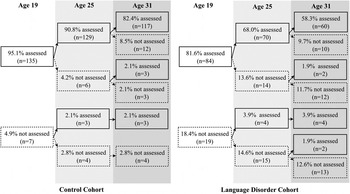
The attrition pattern across ages 19, 25, and 31 follow-up waves is illustrated in Figure 1. Participants in the control cohort were more likely to be present at all three adult waves (82%) compared to the LD cohort (58%), χ2 (1, n = 245) = 17.35, p < .001, and were more likely to be present at any of the three adult waves (97%) than the LD cohort (87%), χ2 (1, n = 245) = 8.89, p < .01.
Attrition at ages 19, 25, and 31 by cohort.

Measures
Psychiatric disorders
The University of Michigan Composite International Diagnostic Interview (UM-CIDI), a structured psychiatric diagnostic instrument, was administered by trained interviewers (World Health Organization, 1990). The UM-CIDI showed good test–retest reliability and validity for most diagnoses (Wittchen, Reference Wittchen1994). DSM-III-R diagnoses were adopted to allow comparison across waves (American Psychiatric Association, 1987). Current (12-month) diagnoses assessed included major depression, dysthymia, bipolar disorder, social phobia, simple phobia, panic disorder, agoraphobia, generalized anxiety disorder, schizophrenia, and substance-related disorders (dependence or abuse; 9 substances and not otherwise specified). At ages 25 and 31, the DSM-IV posttraumatic stress disorder module of the CIDI was administered.
The Global Assessment of Functioning Scale was completed by trained interviewers to assess participants' overall functioning level (American Psychiatric Association, 1987; Endicott, Spitzer, Fleiss, & Cohen, Reference Endicott, Spitzer, Fleiss and Cohen1976). To ensure that individuals identified by the CIDI as having a disorder were at least mildly affected by the symptoms in their daily lives, a Global Assessment of Functioning Scale score of less than 70, representing mild functional impairment, was included as a diagnostic criterion (Bird et al., Reference Bird, Canino, Rubio-Stipec, Gould, Ribera and Sesman1988).
Risk factor variables
In addition to LD, five childhood/adolescent risk factors were examined. Maltreatment history included physical and sexual abuse prior to age 19. Physical abuse was defined as parental physical abuse, reported by participants in a semistructured interview at age 25. Sexual abuse was defined as endorsement of sexual molestation or rape on the posttraumatic stress disorder module of CIDI (ages 25 or 31; World Health Organization, 1990) or behaviorally specific nonconsensual sexual experience items from the Childhood Sexual Abuse Questionnaire (age 31; Hulme, Reference Hulme2000) before age 18. Nonintact family structure was defined as experience living in a single-parent household prior to age 19, and was derived from semistructured interviews with parents at ages 5, 12, and 19 and with participants at age 19. Maternal psychological distress was defined as mother scoring in the clinical range on the global severity index of the Brief Symptom Inventory (Derogatis, Reference Derogatis1993), a self-report questionnaire, at the age 5 interview. The Brief Symptom Inventory shows strong convergent validity. Two-week test–retest correlation for the global severity index was 0.90 (Derogatis, Reference Derogatis1993). Special education history in primary or secondary school, including full-time placement, part-time placement, resource help, and academic skill support, was derived from semistructured interviews with parents at ages 12 and 19 and with participants at age 19. Specific learning disorder risk (SLD) was defined as scoring below the 25th percentile cutoff (a) at age 12 in reading, math, or spelling on the Kaufman Test of Educational Achievement (Kaufman & Kaufman, Reference Kaufman and Kaufman1985) and (b) at age 19 in reading or mathematics on the Woodcock–Johnson Test of Academic Achievement—Revised (Woodcock & Johnson, Reference Woodcock and Johnson1989) or in spelling on the Wide Range Achievement Test—Third edition (Wilkinson, Reference Wilkinson1993). All three academic measures had strong concurrent validity and test–retest correlations exceeding 0.80 (Kaufman & Kaufman, Reference Kaufman and Kaufman1985; Wilkinson, Reference Wilkinson1993; Woodcock & Johnson, Reference Woodcock and Johnson1989). The measures used to derive the risk factor variables are listed in Table 1.
Age 12 characteristics
Five widely used well-validated measures collected at age 12 (listed in Table 1) were used to examine characteristics of participants with special education history, including academic achievement (Kaufman Test of Educational Achievement Battery composite; Kaufman & Kaufman, Reference Kaufman and Kaufman1985), language functioning (TOLD-2 spoken language quotient; Hammill & Newcomer, Reference Hammill and Newcomer1988), nonverbal IQ (Wechsler Intelligence Scale for Children—Revised performance IQ score; Wechsler, Reference Wechsler1974), behavioral problems (Teacher Report Form sum T score), and social problems (Teacher Report Form social problems T score; Achenbach, Reference Achenbach1991).
Demographics
Age 5 parental SES was coded with Blishen occupational coding, combining income, education, and occupational prestige associated with occupations (Blishen & McRoberts, Reference Blishen and McRoberts1976).
Statistical analysis
All analyses included LD and control cohorts only. The LD cohort had significantly lower parental SES than the control cohort at age 5 (Beitchman et al., Reference Beitchman, Hood, Rochon, Peterson, Mantini and Majumdar1989). Accordingly, age 5 parental SES was included as a control variable in all analyses. Removing SES as a covariate yielded no significant changes in results.
Statistical analyses were performed using STATA 12.0 (StataCorp., 2011). Multiple-imputation based generalized estimating equation (MI-GEE) was used for all trajectory analyses (link function: logit; assumed dependent variable distribution: binomial; working correlation matrix: unstructured; Liang & Zeger, Reference Liang and Zeger1986). MI-GEE assumes that the data are missing at random (MAR); that is, the differences between observed and missing values are nonrandom but can be accounted for by a combination of observed data. This assumption is less stringent than that for GEE without MI, which assumes that data are missing completely at random (Shen & Chen, Reference Shen and Chen2013).
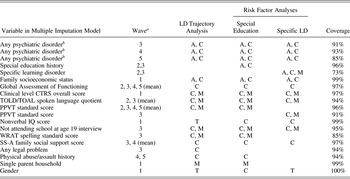
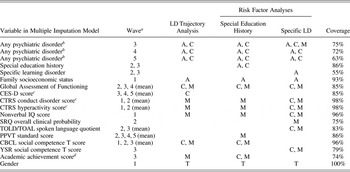
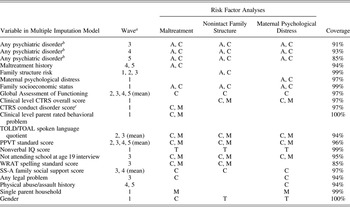
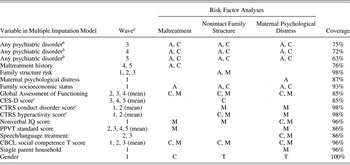
For each MI-GEE analysis, multiple imputation using chained equations was used, and 500 imputed data sets were generated. MI models were constructed for LD and control cohorts separately. All models consisted of analysis variables and auxiliary variables. Auxiliary variables, selected from multiple domains (mental health, language, academics, traumatic events, legal involvement, social support, and family background), included both variables highly correlated with analysis variables (r > 0.5) and variables that significantly predicted missingness of analysis variables (p < 0.05; White, Royston, & Wood, Reference White, Royston and Wood2011). Only variables with values for at least 40% of missing cases in the relevant analysis variable were included in the MI models. The MI models are presented in Tables A.1–A.5 in Appendix A; the measures used to derive the variables in these models are provided in Table A.5. All MI models included gender and age 5 nonverbal IQ, as well as three binary variables indicating the presence of a psychiatric disorder diagnosis at ages 19, 25, and 31, respectively.
The dependent variable in all MI-GEE analyses was a binary variable indicating whether the participant had a psychiatric disorder diagnosis or not at a particular age (wave). All MI-GEE analyses were performed three times (age 19 vs. 31, age 19 vs. 25, and age 25 vs. 31), with age (wave) coded as a dummy variable where 1 represented the older age (i.e., later wave). To examine the change in the probability of having a psychiatric disorder over time (i.e., disorder trajectory) and to examine how disorder trajectory related to the various risk factor(s), all MI-GEE analyses included an Age × Risk Factor interaction term as an independent variable, and the interaction effect was illustrated with marginal effects of the independent variables. Marginal effect is robust to sample size and has been shown to be a more appropriate measure of how variables interact in relation to the probability of the outcome variable than the coefficient of the interaction term in the regression (Bergtold, Yeager, & Featherstone, Reference Bergtold, Yeager and Featherstone2011; Berry, DeMeritt, & Esarey, Reference Berry, DeMeritt and Esarey2010). The slope of the disorder trajectory was reflected by average marginal effects of age (MEA), the estimated population differences in the probability of having a psychiatric disorder between the two ages. The MEA were derived in Stata after the MI-GEE regression using the mimrgns command, with the risk factor variable(s) set to 0 for absent or 1 for present. The relationship between the risk factors and the disorder trajectory was examined by contrasting the MEA in the presence of the risk factor(s) with the MEA in the absence of the risk factor(s).
In the LD trajectory analysis, cohort (LD vs. control), age, Cohort × Age interaction, and SES were entered as independent variables in a MI-GEE model. Post hoc analysis was used to derive the MEA for each cohort.
For all other risk factors, a three-way interaction among cohort, age, and risk factor (present vs. absent), as well as all lower level interactions, main effects, and SES, were entered into an MI-GEE regression. For each cohort, the MEA was derived separately for the absence of risk factor condition and the presence of risk factor condition. The average marginal effect of risk factor (MER) was also derived for each cohort at each age, demonstrating the association between the risk factor and the probability of having a psychiatric disorder at a particular age for each cohort. The MER were derived in Stata after the MI-GEE regression using the mimrgns command, with the age variable set to 0 for the earlier age (wave) or 1 for the later age (wave).
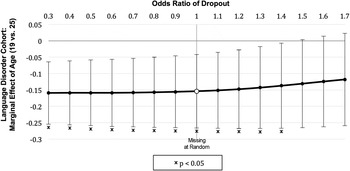
Finally, the MI-GEE models described above assume that the data were MAR; however, it is possible that the data were missing not at random; that is, the differences between missing and observed values is nonrandom and cannot be accounted for by any observed data. A sensitivity analysis using a reweighting model was performed to examine how susceptible the LD trajectory analysis results were to deviations from the MAR assumption (Héraud-Bousquet, Larsen, Carpenter, Desenclos, & Strat, Reference Héraud-Bousquet, Larsen, Carpenter, Desenclos and Strat2012). Under the MAR assumption, the odds ratio of dropout (OR drop; odds of dropout for participants with a disorder vs. odds of dropout for those without a disorder) equals 1. Hypothetically increasing the OR drop explores the conditions where participants with a disorder are more likely to dropout from the study than those without a disorder; hypothetically decreasing OR drop explores the reverse attrition pattern. To demonstrate a range of conditions, OR drop was increased/decreased from the MAR condition incrementally by intervals of 0.1. This process was stopped when a further change in OR drop (increase or decrease) resulted in either 1 of the 500 imputed data sets weighted 50% or more, or fewer than 5 imputed data sets weighted above the average weight (0.02; Héraud-Bousquet et al., Reference Héraud-Bousquet, Larsen, Carpenter, Desenclos and Strat2012). These criteria were set to prevent excessive influence from a tiny subset of imputed data sets (Héraud-Bousquet et al., Reference Héraud-Bousquet, Larsen, Carpenter, Desenclos and Strat2012).
Results
Relationship between LD and disorder trajectory
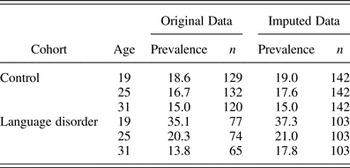
Table 2 displays the prevalence rates of psychiatric disorders for both cohorts at ages 19, 25, and 31 (original and MI data, without adjusting for the effect of any factors). The prevalence rates between the MI and original data appeared to be comparable.
Psychiatric disorder prevalence rates by cohort and age

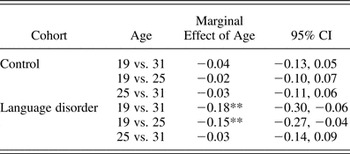
To examine the relationship between LD and disorder trajectory, LD trajectory analyses were performed, and the MEA derived from these analyses are presented in Table 3. From ages 19 to 31, the probability of having a psychiatric disorder decreased significantly among the LD cohort (p < .01). This decline was also significant from ages 19 to 25 (p < .01), but not from ages 25 to 31 (p = .624). There was no significant change in the probability of having a disorder among the control cohort between any two adult waves.
Marginal effects of age by cohorts

**p < .01.
Relationship between other risk factors and disorder trajectory
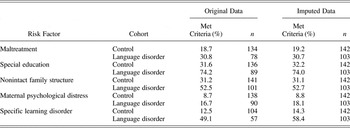
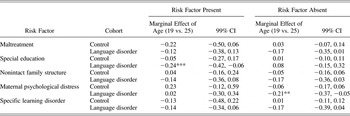
For all risk factors other than LD, the proportion of participants who met the criteria is presented in Table 4 by cohort. Both original and MI data are shown. The MEA derived from the risk factor trajectory analyses are shown in Table 5 (age 19 vs. 31) and Table 6 (age 19 vs. 25). Similar to the LD trajectory analysis results, no significant change in the probability of having a psychiatric disorder from age 25 to 31 was found in the LD or control cohort, regardless of the status of any of the five risk factors. Therefore, the age 25 to 31 risk factor trajectory analysis results are not shown in the risk factors analyses below.
Risk factor descriptive statistics by cohort

Marginal effects of age (19 vs. 31) by cohorts and other risk factors

Note: Familywise α = 0.05: *p < .05, **p < .01, ***p < .001. Adjust for five comparisons, testwise α = 0.01: *p < .01, **p < .002, ***p < .0002.
Marginal effects of age (19 vs. 25) by cohorts and other risk factors

Note: Familywise α = 0.05: **p < .01, ***p < .001. Adjust for five comparisons, testwise α = 0.01: **p < .002, ***p < .0002.
Maltreatment history
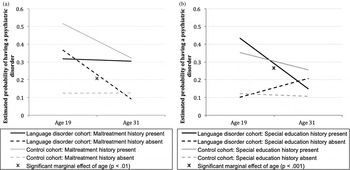
The estimated age 19 to 31 disorder trajectories by maltreatment history and cohort, derived from post hoc analysis following the MI-GEE regression, are illustrated in Figure 2a. From ages 19 to 31, participants with a history of maltreatment in the LD and control cohorts showed no significant change in the probability of having a psychiatric disorder. However, when maltreatment was absent, participants in the LD cohort experienced a significant decrease in the probability of having a disorder (p < .002), while no significant change was observed among the controls (p = .993), which was congruous with the overall age 19 to 31 disorder trajectories for the two cohorts. In addition, in the control cohort, the positive association between maltreatment and the probability of having a psychiatric disorder was significant at age 19 (MER = 0.39, SE = 0.10, p < .001) and marginally significant at age 31 (MER = 0.20, SE = 0.10, p = .041); in the LD cohort, the association between maltreatment and (higher) probability of psychiatric disorder was not significant at age 19 (p = .660) and only approached significance at age 31 (MER = 0.21, SE = 0.12, p = .066). When the age 19 to 25 disorder trajectory was examined in relation to maltreatment, the MEA in the absence of maltreatment in the LD cohort was only marginally significant (p = .017).
Estimated psychiatric disorder trajectories by risk factors and cohort.

Special education
The estimated age 19 to 31 disorder trajectories by special education history and cohort, derived from the MI-GEE regression, are illustrated in Figure 2b. From ages 19 to 31, the probability of having a psychiatric disorder declined significantly among the LD cohort who had special education (p < .0002), but it did not change significantly among controls who had special education (p = .248). For those without special education, there was no significant change in the probability of having a disorder in either cohort. This pattern of results was also found when the age 19 to 25 disorder trajectory in relation to special education was examined.
Further analysis showed that, among the LD cohort, special education was significantly correlated with increased risk of psychiatric disorder at age 19 (MER = 0.33, SE = 0.09, p < .001) but not at age 25 (p = .889) or age 31 (p = .558); among the control cohort, the positive association between special education and risk of psychiatric disorder was significant at age 19 (MER = 0.23, SE = 0.08, p < .01), and marginally significant at age 25 (MER = 0.19, SE = 0.08, p = .019) and age 31 (MER = 0.15, SE = 0.08, p = .048).
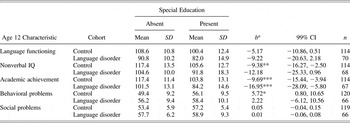
Because participants could receive special education for various reasons, age 12 characteristics were compared for those with and without special education history. Each age 12 characteristic was regressed on special education and SES for the two cohorts separately, and the results are presented in Table 7. Among the LD cohort, special education was associated with poorer academic achievement only, whereas among the controls, special education was associated with more behavioral and social problems, lower nonverbal IQ, and poorer academic achievement.
Special education history by cohort: Age 12 language, cognitive, academic, behavioral, and social functioning

Note: Familywise α = 0.05: *p < .05, **p < .01, ***p < .001. Adjust for five comparisons, testwise α = 0.01: *p < .01, **p < .002, ***p < .0002.
a Coefficient of the binary special education variable; age 5 parental socioeconomic status controlled.
Maternal psychological distress
From ages 19 to 31, when maternal psychological distress risk was present, there was no significant change in the probability of having a psychiatric disorder in either cohort; when absent, consistent with the overall disorder trajectories for both cohorts, the probability of having a disorder declined significantly among the LD cohort (p < .01) but not among the control cohort (p = .237). This pattern of results was also found when the age 19 to 25 disorder trajectory in relation to maternal psychological distress was examined. Subsequent analyses revealed no significant correlation between maternal psychological distress and the probability of having a disorder for either cohort at age 19, 25, or 31.
SLD and family structure
For SLD and nonintact family structure, the age 19 to 31 disorder trajectory findings were the same as those for maternal psychological distress (i.e., significant decline only for the LD cohort with risk factor absent). For the age 19 to 25 disorder trajectories, the MEA for the LD cohort with risk factor absent was only marginally significant (p = .037 for SLD and p = .025 for nonintact family structure).
Sensitivity analyses
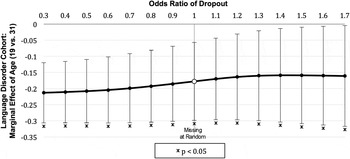
Sensitivity analyses were performed for the LD trajectory analyses. The OR drop was incrementally adjusted to examine the robustness of the results to deviations from the MAR assumption. For the LD cohort, the range of OR drop and their corresponding MEA are shown in Figure 3 (age 19 vs. 31) and Figure 4 (age 19 vs. 25). Within the LD cohort, MEA from ages 19 to 31 remained significant regardless of the change in OR drop; from ages 19 to 25, MEA remained significant when participants with a psychiatric disorder were assumed to be less likely to drop out than those without a disorder (OR drop < 1). When participants in the LD cohort with a psychiatric disorder were assumed to be more likely to drop out than those with no disorder (OR drop > 1), MEA (age 19 vs. 25) remained significant until OR drop reached 1.5. This indicated that when the odds of dropout for participants with a disorder was 1.5 times the odds of dropout for those without a disorder (40% of nonparticipants assumed to have a disorder) or more, the decline in the probability of having a disorder among the LD cohort from ages 19 to 25 (0.39–0.25) was not statistically significant. In this hypothetical scenario, the difference in the probability of having a disorder was significant at age 19 (MER = 0.15, SE = 0.06, p < .05) but not significant at age 25 (MER = 0.04, SE = 0.07, p = 0.58). For the control cohort and the ages 25 to 31 analyses, the MEA remained nonsignificant, assuming data missing not at random (i.e., regardless of OR drop).
Language disorder cohort: marginal effects of age (19 vs. 31) by hypothetical odds ratio of dropout (assuming data missing not at random).

Language disorder cohort: marginal effects of age (19 vs. 25) by hypothetical odds ratio of dropout (assuming data missing not at random).

Discussion
Few studies have used longitudinal data to examine childhood LD in relation to mental health trajectories from adolescence to adulthood. The present study addressed this research gap and found that LD was uniquely related to a developmentally limited course of psychiatric problems, with the probability of having a psychiatric disorder decreasing significantly from late adolescence to young adulthood among individuals with childhood language difficulties. In contrast, the typically developing control cohort showed no significant change in the probability of having a disorder throughout early adulthood. This finding differs from the observed large decrease in psychiatric disorder prevalence from ages 21 to 30 in a general population sample reported by Tanner et al. (Reference Tanner, Reinherz, Beardslee, Fitzmaurice, Leis and Berger2007). This discrepancy could have arisen from differences in diagnostic criteria. Unlike Tanner et al. (Reference Tanner, Reinherz, Beardslee, Fitzmaurice, Leis and Berger2007), the current study included a functional impairment criterion in assigning diagnoses; when this criterion is removed, prevalence rates for the control cohort in the present study, 44% at age 19 and 28% at age 31, became comparable to those reported by Tanner et al. (Reference Tanner, Reinherz, Beardslee, Fitzmaurice, Leis and Berger2007), 43% at age 21 and 17% at age 30. It is also worth noting that although the difference in the probability of having a psychiatric disorder between the two cohorts was not significant by age 31, the LD cohort was still more likely than the control cohort to report lower level of self-reported physical health (Beitchman et al., Reference Beitchman, Brownlie and Bao2014). Sensitivity analyses at age 31 also could not rule out higher rates of substance use and/or affective disorder in the LD cohort when rates of disorder among the missing LD participants were assumed to be very high (Beitchman et al., Reference Beitchman, Brownlie and Bao2014).
Associations between other childhood and adolescent risk factors and disorder trajectory were also examined. Participants with a history of maltreatment were consistently at high risk of having a psychiatric disorder throughout early adulthood. In the absence of maltreatment, the probability of having a disorder remained low among the controls throughout early adulthood but significantly decreased over time among the LD cohort. Congruous with other studies, these results indicated that maltreatment was associated with the development and/or maintenance of psychiatric disorders in early adulthood regardless of LD history, underscoring the importance of prevention and early intervention when maltreatment has occurred (Keyes et al., Reference Keyes, Eaton, Krueger, McLaughlin, Wall and Grant2012).
In contrast, special education history was related to differential disorder trajectories between cohorts. In the LD cohort, participants with special education had high probability of having a psychiatric disorder at age 19 followed by a significant decline, whereas in the control cohort, participants with special education had a flat disorder trajectory throughout early adulthood with consistently higher risk of psychiatric disorder than those without special education.
These distinct trajectories associated with special education between cohorts were unexpected, and multiple mechanisms that could explain these results were examined. First, participants could have received special education referral because of their preexisting psychiatric issues. Teacher-rated behavior problem scores in preadolescence, a good indicator of psychiatric issues, were compared between those with and without special education (Mesman & Koot, Reference Mesman and Koot2000). While the results suggested that special education might have been an indicator of preexisting psychiatric issues in the control cohort, this hypothesis was not supported in the LD cohort. However, age 12 measurements do not reflect issues arising during adolescence. Second, because of the significant correlation between special education and academic difficulties, the differential trajectory patterns between cohorts could have been a result of the differential effect of academic difficulties on those with and without a history of LD. However, the presence of a SLD, which is closely related to academic difficulties, did not show a similar pattern of association with psychiatric disorder trajectory as special education. On the contrary, a decreasing trajectory among the LD cohort was only observed in the absence of SLD. Controlling for the main effect of SLD in the special education trajectory analysis also failed to negate the significant correlation between special education and psychiatric disorder, suggesting that the relationship between special education and disorder trajectory was due to factors other than SLD. Third, some aspects of the special education experience, combined with LD, could have negatively impacted mental health at late adolescence and subsequently dissipated as participants exited the school system. However, the current study design precludes the assessment of causal relationship.
In addition, it is important to recognize that special education experiences reported by this 1977 birth cohort occurred prior to 1996 and do not reflect current special education practices. Since the late 1990s, Ontario educational policy has shifted toward placing students with special needs in regular classrooms with special education services rather than in segregated classrooms (Dworet & Bennett, Reference Dworet and Bennett2002). There also has been an increased focus on tailoring the education plan to the individual needs of the students in the special education program as well as assessing the students' progress on an ongoing basis (Zegarac, Reference Zegarac2008). Nevertheless, our results suggested that special education experience might play a unique role in the development or resolution of psychiatric symptoms among adolescents with a history of communication difficulties. Continued attention to the educational experiences of youth with LD is warranted.
In regard to SLD, maternal psychological distress, and nonintact family structure, the results were similar. The presence of each of these risk factors was associated with flat disorder trajectories with no significant change over time. When these risk factors were absent, the probability of having a psychiatric disorder significantly decreased among the LD cohort but did not change significantly among the control cohort, suggesting that these risk factors were associated with disorder trajectory in early adulthood among the LD cohort. Subsequent investigation revealed no significant correlation between any of these risk factors and the probability of having a disorder in late adolescence or at the beginning of young adulthood for either cohort or for the combined sample as a whole. This may be a result of low statistical power or may be indicative of a weak association between these risk factors and mental health beyond adolescence or an association evident only in the presence of a second factor.
When the span of disorder trajectory was reduced to the period from late adolescence to the mid-twenties, the risk factor analysis results were congruous with those from the ages 19 to 31 analyses, except that the decrease in the probabilities of having a psychiatric disorder over time in the absence of certain risk factors in the LD cohort was smaller and only marginally significant when controlled for multiple comparisons.
The consistent difference between trajectory analysis results from ages 19 to 25 and those from ages 25 to 31 indicates that the decrease in the probability of having a psychiatric disorder in early adulthood among the LD cohort did not occur in a linear fashion; instead, it occurred much faster from ages 19 to 25 than from ages 25 to 31.
In order to address attrition in the adult waves, this study also explored how the association between LD and psychiatric disorder trajectory might change when participants with and without psychiatric problems were assumed to drop out from the study at different rates. From ages 19 to 31, the LD cohort was consistently characterized by a significantly decreasing disorder trajectory regardless of the changes in the assumed dropout rate. However, from ages 19 to 25, the LD trajectory analysis results are less robust to the dropout rate: the LD cohort was shown to have a significantly decreasing disorder trajectory except under hypothetical scenarios in which participants with a disorder were assumed to drop out at a substantially higher rate than those without a disorder, at which point the change in the probability of having a disorder over time became nonsignificant among the LD cohort. It is important to note that even in this scenario, LD was still significantly associated with a higher probability of having a psychiatric disorder at age 19 but not at age 25, indicating that correlation between LD and psychiatric disorder was attenuated by age 25.
There are several limitations to this study. First, special education and maltreatment were retrospectively reported, making them vulnerable to inaccuracies due to memory difficulties and selective reporting. To compensate, all information sources were combined to form indicator variables. Second, sensitivity analyses were only performed for LD trajectory analyses and not for the analyses involving additional risk factors. The reweighting method adopted is only appropriate when the majority of imputed values are for a single analysis variable. However, for all risk factors other than LD, both outcome and risk factor variables in the analyses had noticeable missing data. Extensions to current modeling approaches, capable of simultaneously accounting for nonrandom missingness assumptions for multiple analysis variables, are needed.
As one of very few longitudinal studies in early adulthood, this study demonstrated a unique mental health trajectory from late adolescence to young adulthood associated with childhood LD. Additional studies are needed to explore the underlying mechanisms for this phenomenon. Furthermore, because of the unique relationship among special education history, childhood LD, and disorder trajectory identified here, future prospective studies focusing on interactions between childhood LD and risk factors associated with educational environments are warranted.
Appendix A
Tables A.1–A.4 list variables used in multiple imputation models, and Table A.5 provides the full names and references for the tests that were used.
Multiple imputation model variables–control cohort: LD trajectory analysis and risk factor analyses for special education history and specific LD

Multiple imputation model variables–LD cohort: LD trajectory analysis and risk factor analyses for special education history and specific LD

Multiple imputation model variables–control cohort: risk factor analyses for maltreatment history, nonintact family structure, and maternal psychological distress

Multiple imputation model variables–language disorder cohort: risk factor analyses for maltreatment history, nonintact family structure, and maternal psychological distress

Tests in multiple imputation models (Tables A.1–A.4) with references