Introduction
Improving antibiotic use is a core strategy to optimize patient safety and combat antimicrobial resistance. The expansion of outpatient telemedicine during the COVID-19 pandemic created new opportunities to improve antibiotic use. Previous studies have described telemedicine antibiotic prescribing and identified limitations of virtual physical examination and challenges with laboratory testing, which are important for appropriate diagnosis and antibiotic prescribing. Reference Shi, Mehrotra, Gidengil, Poon, Uscher-Pines and Ray1,Reference Ray, Shi, Gidengil, Poon, Uscher-Pines and Mehrotra2 However, these studies were conducted in a single health system or platform, prior to the COVID-19 pandemic, or focused on specific age groups. Reference Linder, Persell and Kelley3,Reference Suzuki, Marra and Hasegawa4 This study analyzes outpatient antibiotic prescribing using two large national claims databases to identify opportunities for improving antibiotic use in telemedicine settings.
Methods
Data sources and study population
We examined outpatient antibiotic prescribing during January–December 2021. For patients ages 0–64 years, we used the Merative MarketScan Commercial Database 5 (Merative, Ann Arbor, MI, USA) which includes claims from a convenience sample of privately insured individuals with employer-sponsored coverage. Previous studies have used these data to describe outpatient antibiotic prescribing. Unique MarketScan visits were identified by service date and enrollee identification number (ID). For patients ages ≥65 years, we used 100% Medicare Part B carrier claims and Part D prescription drug event files, identifying beneficiaries enrolled in both programs. Unique Medicare visits were identified using beneficiary ID, first expense date, National Provider Identifier, and provider tax ID. Reference Venkatesh, Mei and Kocher6 Outpatient visits were defined as those to retail clinics, urgent care centers, emergency departments, and physician offices (Appendix Table 1). In-person visits were outpatient visits without telehealth procedure code modifiers, while telemedicine visits were identified by place of service codes and procedure code modifiers (Appendix Table 2). For both data sources, we identified unique outpatient telemedicine visits with ≥1 oral antibiotic prescribed ≤3 days after a visit. Patients could contribute >1 visit during the study period. Same-day prescriptions with the same generic name were counted as one prescription. We excluded refills not linkable to a visit. Claims were excluded if they (a) occurred on the same day as hospitalizations, (b) lacked International Classification of Diseases, Tenth Revision, Clinical Modification (ICD-10-CM) codes, or (c) had unknown visit region or patient age. For MarketScan, we excluded patients without continuous coverage. For Medicare, we excluded Medicare Advantage beneficiaries, those ≤ 64 years, those outside of the U.S., or those not continuously enrolled in Medicare Part B and Part D.
Outpatient telehealth visit characteristics, Marketscan, and centers for medicaid and medicare services (CMS) Part D claims data, 2021*

*Outpatient visits totaled n = 150,778,775 for Marketscan visits for which 6,365,439 visits resulted in an antibiotic (4.2 prescriptions per 100 visits). For Medicare Part D data, there were n = 230,820,425 total visits, for which 12,120,000 visits resulted in an antibiotic (5.3 prescriptions per 100 visits).
**CMS urban-rural status is based on beneficiaries’ mailing ZIP codes and the rural-urban commuting area crosswalk (RUCA). Urban was defined as RUCA codes 1–7 and rural was defined as RUCA Codes 8–10. MarketScan urban-rural status is based on Metropolitan Statistical Area.
***US Census Regions based on beneficiaries’ state of residence.
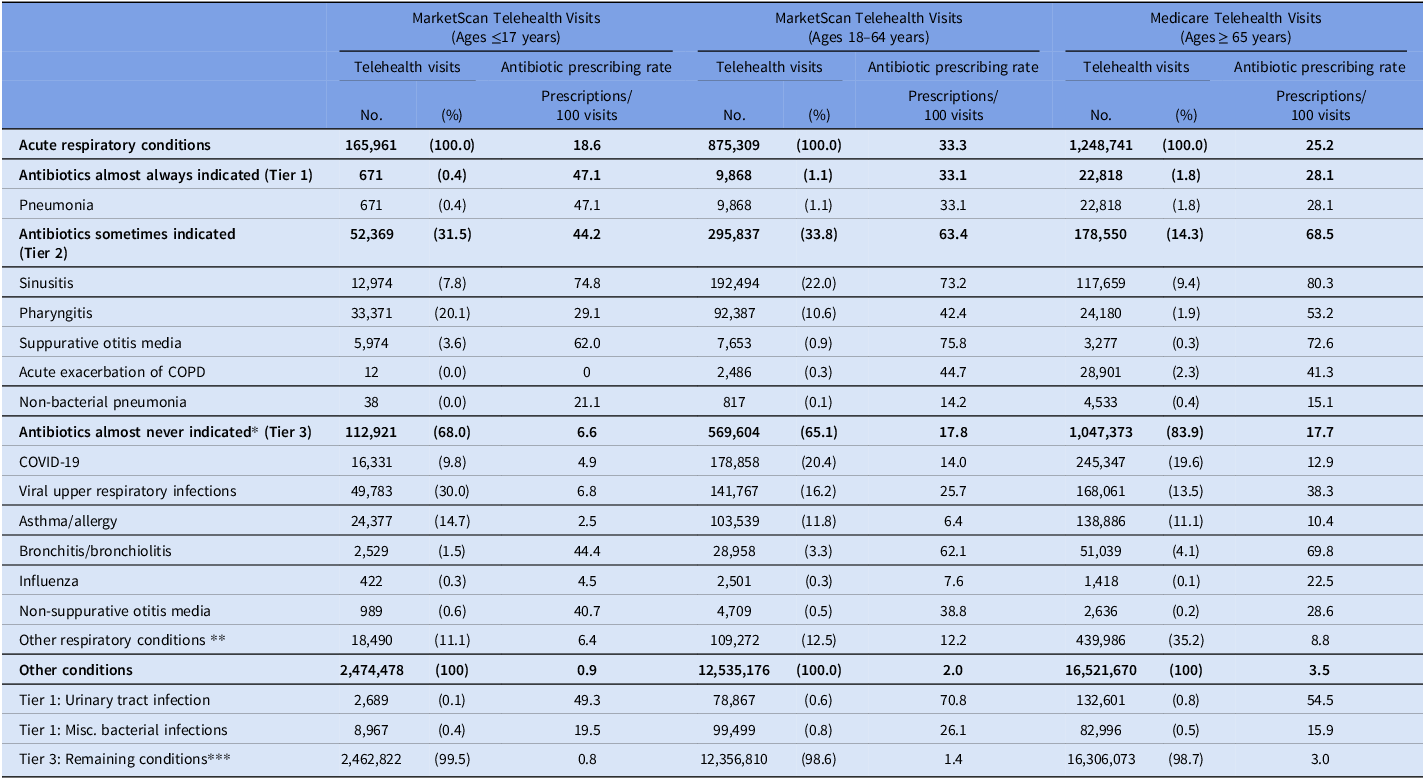
Outpatient telehealth visits and antibiotic prescribing by condition and age group, MarketScan, and Centers for Medicaid and Medicare Services (CMS) Part D claims data, 2021

*Asthma/allergy, bronchitis/bronchiolitis, non-suppurative otitis media, viral upper respiratory conditions.
**Other respiratory conditions excluding acute respiratory conditions, listed above.
***Remaining conditions exclude all respiratory conditions, urinary tract infection, and miscellaneous bacterial infections.
Analysis
We applied a tiered-diagnosis system, Reference Hersh, King, Shapiro, Hicks and Fleming-Dutra7 assigning a single diagnosis category per visit based on the most likely indication for an antibiotic. Tier 1 contains conditions for which antibiotics are almost always indicated (e.g., pneumonia). Tier 2 contains conditions for which antibiotics are sometimes indicated (e.g., sinusitis). Tier 3 contains conditions for which antibiotics are rarely indicated (e.g., bronchitis). Diagnoses were assigned based on the first-listed, lowest-tier condition (Tier 1 being the “lowest” tier). We characterized visits involving antibiotic prescribing by age, sex, U.S. Census region, and clinical condition category. We calculated and compared annual telehealth visits, visits with oral antibiotics, and antibiotic prescribing rates (prescriptions per 100 visits). Analyses were performed using SAS version 9.4 and SAS Enterprise Guide. This activity was reviewed by the Centers for Disease Control and Prevention (CDC) and was conducted consistent with applicable federal law and CDC policy (See e.g., 45 C.F.R. part 46; 21 C.F.R. part 56; 42 U.S.C. §241(d), 5 U.S.C. §552a, 44 U.S.C. §3501 et seq).
Results
During 2021, approximately 3.7 to 5% of telemedicine visits resulted in an antibiotic. Among commercially insured patients aged ≤64 years in 2021, 9.3% of outpatient oral antibiotic prescribing originated from telemedicine visits. Among adults ≥65 years of age with Medicare Part B fee-for-service and Part D coverage, 7.1% of outpatient antibiotic prescribing originated from telemedicine visits. The overall antibiotic prescribing rates among all patient visits were lower during telehealth visits compared to in-person visits (3.7 versus 4.2 prescriptions/100 visits among ages ≤64 years, respectively; and 5.0 versus 5.3 prescriptions/100 visits among ages ≥65 years, respectively). Telemedicine antibiotic prescribing rates were higher among visits by patients ≤64 years in the South compared to other regions (5.8 versus 3.1, 2.4, and 2.6 prescriptions/100 visits among Midwest, Northeast, and West regions, respectively), and in rural compared to urban settings (6.4 versus 3.5 prescriptions/100 visits, respectively). Clinical conditions with the highest visit volume and antibiotic prescribing rate across age groups were respiratory conditions, followed by genitourinary conditions (Table 1).
Among telemedicine visits for children (≤17 years), the highest visit volumes were reported for viral upper respiratory infections (URIs) and pharyngitis. Among acute respiratory conditions, the highest antibiotic prescribing rates were observed for sinusitis (74.8 prescriptions/100 visits), suppurative otitis media (62.0 prescriptions/100 visits), and pneumonia (47.1 prescriptions/100 visits). Among telemedicine visits for acute respiratory conditions among adults (18–64 years) and older adults (≥65 years), the highest visit volumes were observed for COVID-19 and viral URIs, with the highest antibiotic prescribing rate for sinusitis (73.2 prescriptions/100 visits for adults and 80.3 prescriptions/100 visits for older adults).
Discussion
In 2021, during the COVID-19 pandemic, 7–9% of outpatient visits with an antibiotic prescription were conducted via telemedicine, emphasizing the importance of including telemedicine as a focus for outpatient stewardship efforts. This analysis highlights opportunities to improve prescribing for acute respiratory conditions, where up to one-third of visits were associated with antibiotic prescriptions, consistent with studies examining in-person visits. Reference Hersh, King, Shapiro, Hicks and Fleming-Dutra7
We observed high levels of antibiotic prescribing for visits with codes for respiratory conditions for which antibiotics are not indicated, including acute bronchitis and viral URIs. For sinusitis, where antibiotics are often unnecessary, Reference Chow, Benninger and Brook8 about 75% of visits resulted in an antibiotic, regardless of age group. Even when antibiotics may be warranted for sinusitis, there are often opportunities to optimize drug selection or treatment duration, which were not assessed in this study. Diagnostic limitations are a common challenge in telemedicine. Studies have shown, that during telemedicine visits, Group A streptococcal testing for pharyngitis and tympanic membrane visualization for the diagnosis of otitis media are rare. Reference Ray, Shi, Gidengil, Poon, Uscher-Pines and Mehrotra2,Reference Ray, Martin and Wolfson9 In our analysis, the volume of pharyngitis visits exceeded those for otitis media, suggesting that pharyngitis may be a more impactful target for improving antibiotic prescribing in telemedicine visits. These diagnostic limitations, in addition to elevated antibiotic use among older adult and rural populations, highlight key opportunities to improve telemedicine-based diagnosis and antibiotic prescribing. Antibiotic stewardship interventions used for in-person healthcare visits can be adapted to telemedicine visits, including audit and feedback and clinical decision support tools. Reference Sanchez, Kabbani and Tsay10 Implementation research can inform effective and sustainable approaches to improving telemedicine antibiotic prescribing.
Some of the differences reported may not persist if adjusted for patient-level characteristics. Since limited to individuals ages ≤64 years with commercial health insurance and individuals ≥65 years with Medicare Part B fee-for-service coverage with Medicare Part D prescription drug coverage, results may not be generalizable. Data collection occurred during the COVID-19 pandemic, and prescribing practices may have changed during subsequent years. We did not distinguish between visits for an initial diagnosis and follow-up visits. Finally, we did not exclude visits for both outpatient and telemedicine within the same 3-day period, which could have led to the misattribution of antibiotics prescribed during this window.
Telemedicine visits are a distinct healthcare delivery format for which this analysis highlights opportunities to improve antibiotic use. As virtual healthcare delivery continues to evolve, additional implementation studies can inform efforts to optimize telemedicine antibiotic prescribing.
Supplementary material
The supplementary material for this article can be found at https://doi.org/10.1017/ice.2025.10250.
Acknowledgements
None.
Financial support
This work was supported by the Centers for Disease Control and Prevention.
Competing interests
All authors report no conflicts related to this article.
Disclaimer
The findings and conclusions in this report are those of the authors and do not necessarily represent the official position of the Centers for Disease Control and Prevention.