Aim
Breast cancer is the most common occurring cancer in women worldwide.Reference Ghoncheh, Pournamdar and Salehiniya 1 Although the incidence of breast cancer has increased globally over the last several decades, the greatest increase has been in Asian countries.Reference Leong, Shen and Liu 2 In Asia, breast cancer incidence among women peaks in their 40s while it peaks after 60 year old among women in the United States and Europe.Reference Hortobagyi, de la Garza Salazar and Pritchard 3
Three main modalities have been used for treatment of breast cancer including surgery, systemic therapy and radiotherapy (RT). 4 After surgery, the next step in managing early-stage breast cancer is to lower the risk of recurrence and to eradicate any remaining cancer cells. Although these cancer cells are undetectable, it seems that they are responsible for both local and distant recurrence of cancer. Postoperative RT is strongly recommended after breast cancer surgery. Whole breast RT reduces the risk of local recurrence by two-thirds and an additional boost gives a further 50% risk reduction. 5 Furthermore, RT has a beneficial effect on survival rate.Reference Buchholz 6 In contrast to the beneficial impact on increasing survival rates, RT also has some adverse effects that can be observed due to irradiation of other structures and organs in the treatment fields that may negatively impact on the patient’s quality of life.Reference Akın, Ergen, Unal and Bese 7 In recent years, many oncology clinics have changed their practice from using standardised field planning to more individualised computed tomography (CT)-based treatment techniques in patients.Reference Prabhakar, Rath, Julka, Ganesh, Joshi and Manoharan 8 The aim of CT-based treatment arrangements represents a more precise definition of the target volume and can minimise the adverse outcomes of the radiation treatment.Reference Prabhakar, Rath, Julka, Ganesh, Joshi and Manoharan 8 , Reference Charaghvandia, Yoo, Asselen, Rodrigues, van den Bongard and Horton 9 For postoperative irradiation of breast cancer, heart, lungs, contralateral breast are usually considered as organs at risk and the organs are evaluated and doses are reported with the use of dose–volume histograms (DVH).Reference Pignol, Olivotto and Rakovitch 10 – Reference Correa, Das and Litt 13
Although the thyroid gland is not usually considered as one of the major organs at risk for postoperative breast irradiation, it has been reported that hypothyroidism (HT) can be seen in patients whose glands were exposed to irradiation.Reference Akın, Ergen, Unal and Bese 14 – Reference Tell, Lundell, Nilsson, Sjödin, Lewin and Lewensohn 17
Several studies showed a marked increase in the development of HT after multimodal treatment of breast cancer patients who received adjuvant RT.Reference Smith, Smith and Giordano 18 , Reference Reinertsen, Cvancarova and Wist 19 Other studies showed that supraclavicular fossa (SCF) nodal irradiation in patients with breast cancer was associated with a higher incidence of HT and reduction in the size of the thyroid gland.Reference Kikawa, Kosaka and Hashimoto 20 , Reference Alhosainy, Mohamed and Elattar 21
However, insufficient data are available regarding the dose delivered to the thyroid tissue during RT of SCF field.Reference Alhosainy, Mohamed and Elattar 21 , Reference Akyurek, Babalioglu, Kose and Gokce 22 Previous studies showed that HT after RT develops at a median interval of 1·4–1·8 years, but it has been reported even 3 months or 20 years after RT.Reference Akyurek, Babalioglu, Kose and Gokce 22 , Reference Mercado, Adelstein, Saxton, Secic, Larto and Lavertu 23
To the above study, any reduction of dose to the thyroid gland leads to lower damage to thyroid cells and subsequently prevention of clinical change resulting in HT.Reference Alhosainy, Mohamed and Elattar 21 As the SCF region is treated with RT in some females with breast cancer and this can lead to exposure of the whole or parts of the thyroid gland.Reference Johansen, Reinertsen, Knutstad, Olsen and Fossa 24 The aim of this study was to evaluate the absorbed dose in the thyroid gland in patients diagnosed with breast cancer treated with two different beam radiation energies of 15 MV for anterior field and 6 MV for posterior field, compared with 15 MV energy for both anterior and posterior fields.
Most previous studies have shown the dose absorbed by the thyroid gland during RT and its impact on the thyroid gland dysfunction, but to the best of our knowledge there are few studies that examine the absorbed dose to the thyroid gland in different energy fields with different photon beam energies. In this study it is believed that by changing the radiation energy field at SCF region while dose distribution to the lymph nodes is suitable, a lower dose is absorbed by the thyroid gland.
Material and Methods
Sampling procedure
In this study, all patients with breast cancer referred to Reza Radiotherapy and Oncology Center in Mashhad City, Iran, between the years 2015 and 2016 were used as candidates for this evaluation.
To exclude confounding factors, patients with the following characteristics were excluded from the study:
1. Patients with primary thyroid disease.
2. Patients who had history of thyroid surgery.
3. Patients who had previous RT treatment.
4. Patients with age >75 years old.
After excluding patients using the above criteria, 29 patients with breast cancer were included in the study. All participants were informed about the study and their individual written consent was obtained.
RT treatment
Adjuvant RT to the whole breast or chest wall and SCF lymph nodes to a total dose of 50 Gy/25 fractions (2 Gy/fraction/day, five fractions per week), using Conformal RT technique, 3D conformal radiotherapy, was performed for each participant. Patients were positioned supine, with both arms extended above the head and immobilised using a breast board (ORFIT, Wijnegem, Belgium). The radiation dose was evaluated from a DVH using treatment planning system (Version 5.5, Prowess Panther, Concord, CA, USA). The treatment volume of axillary and supraclavicular area was determined by a physician. The SCF region was treated with parallel opposed fields and only in cases where the target was superficial, the volume was planned with a single anterior field. The inferior of SCF region matched to tangentially opposed fields. The gantry angle was between 10° and 15° forward to contralateral site for Spinal cord sparing. The photon beam energy of the anterior field was 6 MV and 15 MV for the posterior field. The weighing for the parallel opposed filed was defined by checking the dose distribution in SCF region and to ensure full dose coverage of SCF and axillary nodes. Two plans were created for each patient for the SCF, one for photon beam energy – 6 MV for anterior field and 15 MV for posterior field – and a second plan using 15 MV beam energy for both fields using a gantry angle of 10°–15° for spinal cord sparing. From the plans the thyroid gland dosimetric measurements were evaluated including, mean dose (Gy), minimum and maximum doses (Gy), and V20, V30, V40 and V50 (percentage of thyroid volume receiving ≥20, ≥30, ≥40 and ≥50 Gy, respectively).
Thyroid gland size measurement
Thyroid gland size was calculated after contouring of the thyroid gland on CT slices (3 mm) of patient by physician. The measurements were considered from the thyroid greatest diameter in the axial plane and from the lateral border of the trachea to the medial border of common carotid artery.
Statistical analysis
Statistical analysis was performed with a Statistical Package for the Social sciences for Windows (version 22.0; SPSS, Chicago, IL, USA). All values are expressed as means and Standard deviations (SD). Categorical data were analysed by using paired sample t-test. p-Values<0·05 were considered significant.
Results
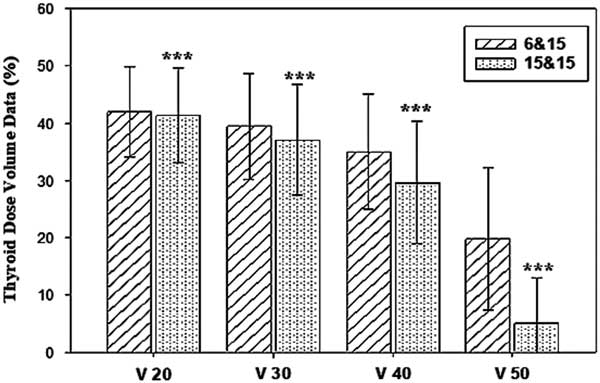
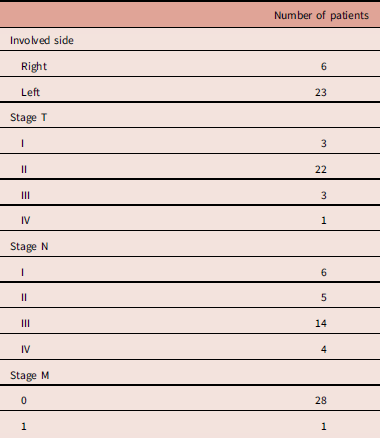
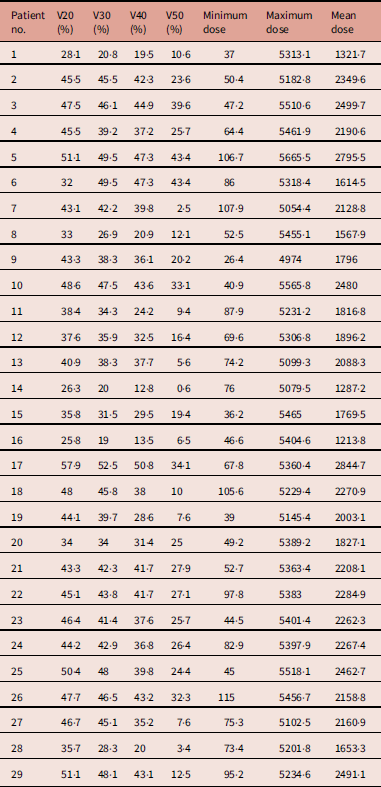
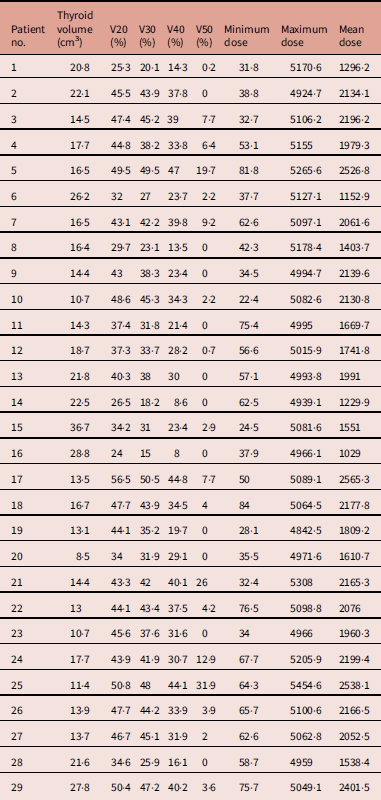
In this study, 29 subjects with a mean age of 53·4±9·4 and minimum and maximum ages of 30 and 78 years old have been studied. The baseline characteristics of patients are illustrated in Table 1. In total, 23 subjects were diagnosed with breast cancer on the left side in contrast to six subjects with right side involvement. In respect of the staging of the cancer only one subject had been diagnosed with metastasis. Tables 2 and 3 show rate of absorptions, minimum, maximum and mean doses at 6–15 and 15–15 MV energy fields of treatment, respectively. The results obtained from paired sample t-test for analysis of significant discrepancy between two different fields of treatments in the case of rate of absorption (%) of radiation by thyroid gland has been shown in Figure 1. The results show in all doses of V, at 15–15 MV energy field, there was significantly lower dose absorption by the thyroid gland was observed in contrast to their counterparts treated with the 6 and 15 MV fields.
Comparison of thyroid dose–volume data (%) for dose levels 20, 30, 40 and 50 Gy between 6–15 and 15–15 energy fields.

Baseline characteristics of patients with breast cancer

Measured thyroid volume (cm3), thyroid dose–volume data (%) for dose levels of 20, 30, 40 and 50 Gy, and minimum, maximum and mean dose at 6–15 MV energy field

Measured thyroid volume (cm3), thyroid dose–volume data (%) for dose levels of 20, 30, 40 and 50 Gy, and minimum, maximum and mean dose at 15–15 MV energy field

Findings
Several reports regarding thyroid function after the exposure of a large portion of the thyroid gland during irradiation of the chest wall and SCF nodes in postoperative breast cancer patients have been published. These authors reported radiation-induced HT in 40% of patients after 4–5 years.Reference Jereczek-Fossa, Alterio, Jassem, Gibelli, Tradati and Orecchia 16 , Reference Wolny-Rokicka, Tukiendorf, Wydmański, Roszkowska, Staniul and Zembroń-Łacny 25 , Reference Ronjom, Brink and Bentzen 26 The majority of changes in thyroid function were recorded after 6 months post irradiation. Previous studies found that mean thyroid dose ≥34 Gy and V20–40 has a significant impact on the development of HT. Also in another study, the critical absorbed dose for radiation-induced HT has been estimated to vary between 26 and 40 Gy.Reference Alhosainy, Mohamed and Elattar 27 , Reference Kuten, Lubochitski, Fishman, Dale and Stein 28 Some authors suggest that the percentage of thyroid volume receiving ≥30 Gy (V30) is a possible predictor of HT.Reference Alhosainy, Mohamed and Elattar 21 As it can be seen in this study, using 15–15 MV energy fields significantly demonstrates lower absorption by thyroid gland in contrast to 6–15 MV energy fields.
During breast cancer treatment, the RT to head and neck region and also SCF region leads to significant doses of radiation to the thyroid gland as the whole or large part of the thyroid gland is located within or near to the target and HT may be a late consequence of irradiation. In this study according to the obtained results it can be concluded that using 15–15 MV energy filed for RT leads to significant lower absorption of thyroid gland during breast cancer treatment and consequently decreases the risk of HT in these patients.
Acknowledgements
All authors appreciate patients and staffs at Reza Radiotherapy and Oncology Center due to their kindly cooperation for accomplishing this study.
Financial support
There is no financial support for the current study.
Conflicts of interest
The authors have no conflict of interest in the current study.