Introduction
Urban environmental history is a new sub-field in historical studies. Environmental history emerged in the United States in the 1970s, but the studies of the time focused primarily on issues related to the wilderness and its colonization by Europeans.Footnote 1 The first urban environmental history studies were published in the 1980s. Environmental history emerged in Europe later than in the United States, and with the exception of a few pioneering studies works on urban environmental history began to be published in the 1990s.Footnote 2 Today, the study of urban environmental history includes historical changes in perceptions and practices concerning the soil, waterways, open spaces, animal populations and atmosphere in cities.Footnote 3 Some studies have also discussed the global development of urban environmental history itself.Footnote 4
However, existing research in urban environmental history in the US, Europe and other continents, some of it very extensive in terms of time and geography, is often characterized by a narrow viewpoint or limited material reflecting the rationalist approach typical of white, middle-aged, middle-class and educated men.Footnote 5 This approach and the resulting material is typified by a broad field of study, measurable indicators, material analysed using logical – and often quantitative – deduction, as well as impersonal reporting. There are justifications for the rationalist materials and approach, seeing that its representatives in the fields of natural sciences, technology, medicine, public administration and political decision-making have held and continue to hold an undisputed, central position in studying and solving environmental matters in cities, in particular.
In addition to its apparent benefits, the rationalist approach also has its downsides. Urban environmental history research based on rationalist sources risks overlooking the viewpoint of the majority of urban dwellers: ordinary men, women, children, the elderly and different ethnic groups. Excluding the views of these population groups from urban environmental history research is a form of socio-political discrimination that gives a distorted picture of the man–nature relationship. The urban environmental history of women, children, the elderly and ethnic groups should not be treated as the special history of distinct, possibly isolated, groups. Childhood, youth, old age, gender and genetic diversity are all essential parts of the cycle of life, the most important process in nature. This is why also environmental history should study human life, paying attention to the main life stages from childhood to old age – from cradle to grave.
The purpose of this article is not to criticize the value of the rationalist approach, but rather to find complementary approaches. I focus on the urban environmental history of children, because childhood forms the foundation for our relationship with nature and its development. Nevertheless, very little research has been done on children's environmental history outside Helsinki, the capital of Finland.Footnote 6 To date, Bernard Mergen is the only one to have studied the topic in any greater detail, proposing themes for further research.Footnote 7 This article aims to take the first step in the direction indicated by Berger: empirical research on the environmental history of children.
The study follows the new paradigm in childhood studies that looks at children as active, creative social agents who produce their own unique children's cultures and environments.Footnote 8 I will analyse how under-19 year-old children experienced their immediate environment in the past and how they tried to modify and utilize it for their own purposes in their leisure time. In this context, environment means the urban environment and the soil, air, waterways, flora and fauna inherent to it. In my view environmental history should attempt to study childhood experiences with reference to these elements, while also taking environmental pollution and protection into account. This distinguishes children's environmental history from generic studies of childhood environments, which have been carried out, for example, in psychology, ethnology and historical studies of childhoodFootnote 9 and urban children.Footnote 10 The environmental aspect has been actively studied mainly in children's environmental psychology and sociology, but these studies have given less attention to history.Footnote 11 City children seem to be academic orphans.
The scarcity of sources is a special problem in research on the urban environmental history of children. The rationalist source material produced by experts or the authorities – material collected by adults about adults and for adults – does not deal much with the environment from the point of view of children. In history research, childhood history has been discussed through personal histories. In some cases, the authors have also touched on environmental matters. Writings and drawings produced by children, especially school essays, can be treated as important source materials, but their availability and use in history research involve obvious problems. Old photographs feature surprisingly many children in cities, but their role is usually to ‘give life’ to the pictures. The children are rarely photographed in their natural environment engaged in their own hobbies.Footnote 12 Newspapers seem to write little about children, and when they do, children play only a minor role in the articles. The problem with the existing material is that it mainly describes the upper and middle classes and rarely deals with children from the working class who, after all, were often in the majority. How, then, can one get socially representative source material on the urban environmental history of children? How can a voice be given to children who lived in past urban environments?
Helsinki is so far the only European capital that has been the subject of an extensive city-specific study in the field of environmental history.Footnote 13 Also, our study was mainly based on rationalist material. In conjunction with the project, we did, however, carry out a small-scale survey, which aimed to collect and store city dwellers’ reminiscences about the urban environment. Otherwise, they would have been lost forever. Information about the survey was distributed in a questionnaire as well as in several small advertisements and articles published by local newspapers. We received around 100 written responses, some of which were complemented with additional written queries, interviews and written materials.Footnote 14 This survey is presumably the first one to focus specifically on reminiscences related to urban environmental history.
My objective is to test how well these reminiscences collected in the Helsinki environmental history project could be used as sources for the environmental history of children. The age of the respondents ranged from 40 to over 90, but most of the respondents were over 50 and under 80 years of age. Two-thirds of the respondents were women. Most of the responses deal with the years from the 1920s to the 1950s, which is the period that this article also focuses on. Approximately half of the narrators represented the working class, and the other half the middle class. As far as different neighbourhoods are concerned, reminiscences related to the centre of Helsinki, which included both working-class and middle-class housing areas, are amply represented. A focus on the downtown is natural, since the administrative area of Helsinki was located in the current city centre until the extensive annexation carried out in 1946, which led to a fivefold increase in the city area.
Memories of youth and childhood should not be interpreted in too straightforward a manner since they are often recounted through an adult filter. It may be easier for people to recall memories that have proved to be significant later in life than those that seemed to be important to them as children.Footnote 15 People's recollections of their own experiences may also be affected by general notions and collective myths of the era. The world of childhood memories may never have existed in the first place, and the truth of the recollection becomes a personal belief. Collecting reminiscences and drawing conclusions from them is like piecing together a jigsaw. The image becomes more complete with every piece, and the more material available, the more representative the result.Footnote 16
Today Helsinki is a modern Nordic city with around half a million inhabitants. In the early 1900s, however, the city had barely 100,000 inhabitants and was characterized by economic and social hardship. The Finnish Civil War was fought in 1918, and Helsinki was involved in the bitter final battles between the Reds and the Whites. The city recovered slowly in the 1920s only to be hit by the Great Depression in the early 1930s. World War II brought an end to the consequent economic recovery and despite gradual improvement in the standard of living in the post-war period, livelihoods remained relatively meagre up into the 1960s. During the research period, Helsinki was on top of its industrial development as deindustrialization did not begin until the 1960s. Physical work was common in the industrial city, and adults worked long years, weeks and days. Owing to the lack of time and space, children were expected to keep out of the way and to play outside. Therefore the outdoors environment had a greater significance for children in those days. Play connected children and the urban environment.
This article is grouped into five main elements of the city, i.e. the grey, green, blue, black and brown city. These colourful elements reflect the gradual expansion of the world of children in cities from yards (the grey city) via parks and shores (the green and blue city) to industrial areas (the black city) and the animal world (the brown city) as they grow older. As a result, certain functions may be mentioned in several sections. I will first discuss the grey city, i.e. the home environment, which encompasses residential buildings, courtyards and neighbouring streets. Secondly, I describe the green and the blue city, excursions that children made from their homes to nearby open spaces, such as parks, forests, cliffs, water areas and ice-covered sea. These areas are characteristic of Helsinki, which is situated on the coast of the Baltic Sea. Thirdly, I deal with the black city, that is, children's adventures farther away in polluted and prohibited areas. Fourthly, I present the brown city, comprised of pets, domestic animals and urban wildlife. I finally discuss the usefulness of reminiscences for urban environmental history studies. In the end, I also review the city of reminiscences from the point of view of today's children: has the industrial city of the past been lost for good as a childhood environment?
The grey city
‘The apartment was dark and mazelike, in one word: dismal. The sun never shone through our first-floor windows at the bottom of the shaft-like spaces surrounded by buildings . . . We couldn't see a single tree or plant from our windows: only concrete, stone, and asphalt.’ This is how a local resident described his home in the centre of Helsinki in the 1950s.Footnote 17 But such descriptions of the dismal courtyards made of ‘concrete, stone, and asphalt’ did not signify that the children thought of the yards as boring. On the contrary, houses seem to have been more exciting and interesting to children in the past than they are today. For example, house cellars formed a mysterious world filled with action. In the memories, coke trucks dumped their content ‘down the scary abyss that led deep down into the innards of the house’.Footnote 18 Boiler rooms were hot cellars, where ‘the pipes hissed and the smell was musty and acrid’ or the furnaces blazed with flames as the ‘mouths of Moloch’. Cellars often had laundry rooms with a cauldron in which clothes were boiled and sheets and pillowslips were washed in smelly lye fumes. The dim and steamy laundry rooms, along with their specific sounds, were part of the yards’ ‘underworld’.Footnote 19 Above all the apartments there was the ‘dark attic that inspired your imagination’ and was often used to dry the wash.Footnote 20 Attics and cellars seemed frightening especially when homeless or drunk people slept there.Footnote 21
Back street boys on an urban Odyssey? The expanding journeys of children started from their own backyards. The continuous conquest of new lands resembled classical heroic epics – or rather did the epic tales resemble childhood development?
Source: Photo Archives of the City Museum of Helsinki.

Children met up in the yards to play. In the summer, metre-long logs were stored in the corners of the yard or in the families’ woodsheds to wait for the winter. The high piles were forbidden but exciting places to play, and inside of them were long corridors where the children built hide-outs, dugouts or fortresses that ‘armies’ would fight for. Drunks, tramps and authorities moving around the log piles just added to the excitement.Footnote 22 Snow was not always cleared from the inner yards due to the low number of cars, and the snow banks, sometimes several metres high, were real winter oases for the children's snow games: fooling around in the snow, skiing, making snowmen and snow castles with walls up to four to five metres high, and of course snowball fights.Footnote 23 City children had a winter wonderland in their own yards.
The materials brought to houses eventually had to be disposed of. For this purpose, ‘the yards in both of my childhood homes had a garbage container made of concrete and equipped with a lid, whose contents the garbage collectors had to dump on to the back of a truck’.Footnote 24 The emptying of the containers, however, was a revolting experience:
After the war, the container was emptied by the Viljanen crap collector, which is the name we gave to the company. They drove the car into the yard, jumped into the container, and began to fork waste on to the back of the car. The containers were emptied by the Viljanen boys, who lived nearby. They were fond of drink and loitered in our neighborhood, drunk, in the evenings after work. Sometimes they had a noseless guy helping them with work. He wore a filthy rag under his eyes where his nose should have been. That guy terrified us.Footnote 25
In lieu of stereos and televisions, sounds created by various human activities characterized the world of the inner yards. Sounds from factory machines, the hollow boom of ship engines, the whining of circular saws, the ‘terrifying and horrible’ rumble of mangles, the ‘chugging’ of printing presses and even the clatter of horses’ hooves travelled over structures and the yard. People's voices also belonged to yards in those days, more so than nowadays. Rag buyers came to the yard with their carts, yelling: ‘All rags accepted!’Footnote 26 ‘In the autumn, we got a man there with his horse cart and potatoes, and we could hear him yelling all the way to the fifth floor: pootaaatoooes!’Footnote 27 Up to the early 1960s, there were also singers, players or organ grinders, that is, street musicians who wandered from yard to yard. People threw them money or food from the windows or took it down to them.Footnote 28
The small number of cars is a salient feature in reminiscences of the street scenery. ‘In the 1950s our district was still ours, I mean the children's. We ruled over the yards and streets.’Footnote 29 ‘My parents, originally from a small town, told us children to look left and right before crossing a horse street.’Footnote 30 On the other hand, if cars did not create risky situations, children created them on their own. They hitched rides on the back bumpers of buses, and boys competed to see who would be the last to dare to dash in front of streetcars.Footnote 31 Accidents were unavoidable in these self-made Mean Streets.
In the past, inner yards and the outbuildings in them were used for many functions vital to everyday life. There were woodsheds, saunas, laundry rooms, places to hang your wash to dry, workshops, sheds and, of course, outhouses, garbage cans or containers.Footnote 32 By observing all the activities in the yard, children learned the practical meaning of sustenance and building maintenance. Heating the building; procuring, handling and storing food; and taking care of waste management and recycling were all routine tasks which most children helped with in one way or another.
Today, houses, courtyards and streets are very different. Cellars and attics are rarely used any more. There is no more firewood, coal or ‘mouths of Molochs’ in cellars, which became quieter with the arrival of district heating.Footnote 33 Courtyards were turned into parking lots that are cleared of snow in the winter. Children's yards were changed into adults’ yards, and nowadays the inner yards are nearly empty and silent. On the other hand, the previously relatively empty and safe horse streets have become busy, noisy, smoggy and dangerous for children due to constantly increasing motor traffic.
The green and blue city
The city of Helsinki had numerous open spaces consisting of parks, forest areas, meadows, rocks and boulders, sports grounds and bays. Outings to nearby parks were often made with the family. ‘Our Sunday family picnics always took us first to the city garden.’Footnote 34 Parks were not the only green areas near the city. Children took long walks and went biking, for example, in graveyards where, as one narrator remarked, ‘my family had its only plot of land’.Footnote 35 Allotment gardens became familiar to many children, especially in and after the war years, when there was a shortage of food.Footnote 36 People also turned to the woods around Helsinki for food. ‘In the summer we picked strawberries and blueberries and threaded them on a grass stalk.’Footnote 37 ‘In the autumn, my mother seated me on the back of the bike, and we headed off along the road to pick mushrooms.’Footnote 38
City children, mainly those from upper- and middle-class families, grew familiar with nature through school. Up to the end of the period studied, upper-graders in grammar school had to collect around 120 plant specimens over a summer, dry and name them and compile the information in a herbarium. Consequently, many urban pupils had an excellent knowledge of plants. According to one respondent, it was possible to ‘find a touch-me-not and small balsam, herb Paris, lily of the valley, chickweed wintergreen, cowslip, wood anemone, black baneberry, yellow iris, true forget-me-not, and a tufted and yellow loosestrife in the grove’.Footnote 39 Girls also picked flowers without permission. ‘There was a big garden in front of what is now the sports centre. That's where we kids ran to snatch flowers. And were we in a hurry to run back home! We got maybe one or two flowers, that's all there was. But oh, was it fun to go thieving together!’Footnote 40
Rocks and boulders were important in Helsinki, a city built on granite cliffs surrounded by bays. It was no accident that the biggest working-class neighborhood in the city centre was called Kallio (‘Rock’). Drying clothes became a way for children to get to know the rocky urban environment surrounding them.Footnote 41 The rocks attracted both girls and boys, above all because they were dangerous. ‘It was also possible to play in the narrow yard. There was a high, vertically excavated rock behind the long woodshed, where we were not allowed to go. Well, we were given a whipping once.’Footnote 42 The high rocks also offered good views. ‘When we grew older, we began going even farther, to rocks, woods, to the harbour to look at ships, and even to see airplanes.’Footnote 43 In brief, children headed farther out in search of adventure.
In Helsinki, located on the shores of the Gulf of Finland, inhabitants have at least in principle had ready access to swimming beaches, sea and nearby archipelago. Beaches that were open to all and which the city maintained were set up near the city centre from the 1930s onward: ‘We walked along a birch-lined path to the beach to spend the summer days. Nature surrounded us everywhere, in rain and sun, in rocks and bushes of different colours, and in the seaweeds.’Footnote 44 Trips to the islands were usually made with the family, the fathers included. Many narrators had sweet memories of the urban archipelago: ‘The islands were our summer and, sometimes, winter paradises . . . The Social Democratic association arranged similar kinds of activities there, and I believe the Salvation Army also organized events to save the children from the asphalt jungle.’Footnote 45 The municipality and the Lutheran church also arranged summer camps in the countryside for children. ‘We had to go to summer camp so that mother could put aside some of her pension for our clothes.’Footnote 46 Poverty affected both human relationships and relationships to nature in the industrial city.
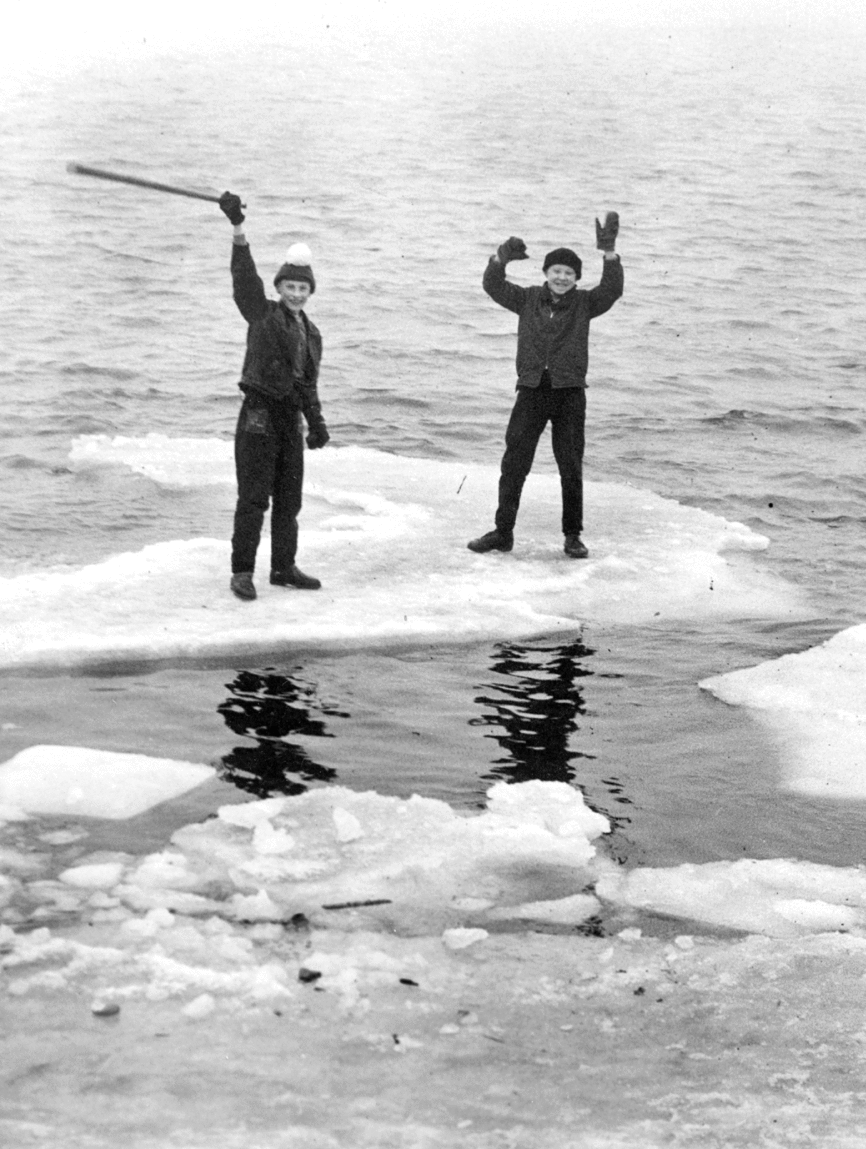
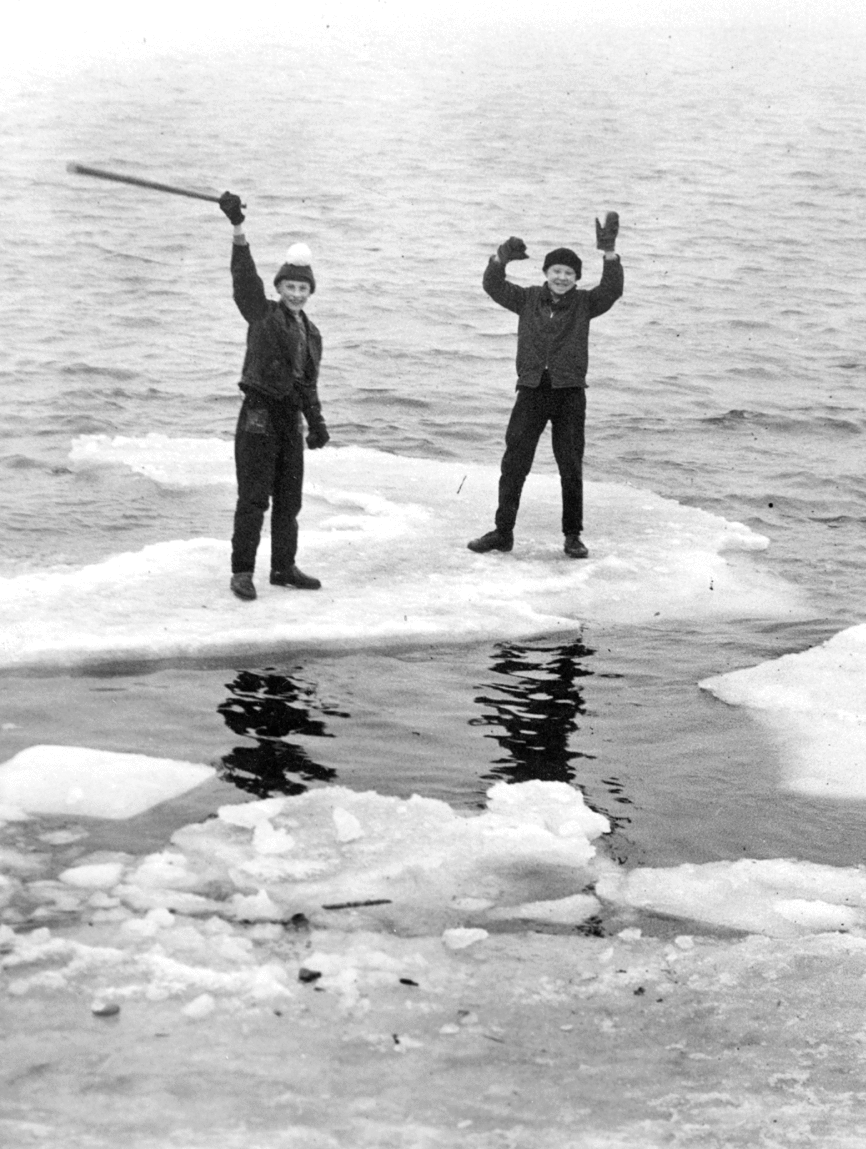
One of the foolhardy favourite activities of children on the northern shores was sailing on ice cakes. ‘We cut off a two-by-two-metre cake and headed off on it toward the island where the zoo is . . . until a police boat stopped and took us back to the shore.’Footnote 47 In winters when the sea froze over but snow was scarce, the youth took advantage of the weather and set off on the ice on skates or kicksleds. To give the sleds more speed, children wore spiked ice shoes. Older boys built ice barks to sail out into the ‘ice desert’ in front of the city centre.Footnote 48 The frozen sea provided a huge white space, a common yet perilous playground in front of the city.
Farewell, life! One foolhardy tradition of children of northern shores was sailing on ice cakes. A good city for children should include both safe and perilous environs.
Source: Lehto, 4 Mar. 1959, Photo Archives of the City Museum of Helsinki.
In brief, rocks and boulders often formed paths that started from the home yard and along which children proceeded step by step, leaving the home's circle of influence. As the children grew older, rocks became also more popular than parks as playgrounds. Reminiscences emphasize rocks, shores and other unbuilt sites as exciting and popular places, areas in which children came face to face with nearly untouched nature right in the heart of the city. These green, blue, and white open spaces were the children's first own domain outside the yard.
The black city
As children began to expand their territories from the yards and rocks, adventures were sought along railways, in industrial areas, at dumps and in wastelands, all areas that were normally out of bounds to children. Since adults kept away from these areas, children took control of them. Forbidden zones were considered to be interesting places where many fascinating and agreeable things could take place.
The intriguing buildings, activities and people in areas in which adults had forbidden children to enter formed a network that even girls found interesting. ‘There was a run-down, longish wooden house that you were supposed to stay clear of, because “it was a house of bootleggers”. Of course we always snuck up to it.’Footnote 49 Railways offered other types of attraction. Children would gather on the bridge over the tracks to wait for steam trains and ‘enjoy the thick cloud of smoke and steam let off by the engine’, which often concealed the entire bridge. Adults obviously found the trains’ emissions disgusting and disapproved of the behaviour.Footnote 50 ‘I know that one of the boys in our class fell down onto the tracks, was run over by a train, survived, but lost a leg.’Footnote 51 Dramatic events and fatal accidents stuck in children's minds for the rest of their lives.
Children used polluted environments for their games and play, and this was reflected in the names given to places. ‘There was a stream that flowed down into the northern end of the bay. We went there in the spring to play with bark boats and other boats. If I remember correctly, we called it the Shit Stream.’Footnote 52 A waste ditch, known as the Shit Canal, ran into another bay. Children competed in skipping over the ditch. Anyone who fell into the canal was in for a walk home in smelly clothes – and often for a spanking.Footnote 53 ‘The sea water in the city bays was very dirty, musty, dim, and full of algae. Nevertheless, we children sat over there on the pier, using hooks to catch three-spined little fish.’Footnote 54 Although the coastal waters were polluted in those days, the children swam in them.Footnote 55 Children living upstream of the river that ran through the city of Helsinki made polluting it into a fun game. ‘We would sometimes shit in the river water and laugh at the thought of people in the city centre drinking the same water.’Footnote 56
The bays on the eastern side of Helsinki were terribly polluted in the 1950s. Yet, these easterners had no problem enjoying fishing, companionship and modern urban landscape on a sunny summer day.
Source: T. Norjavirta, The Finnish Labour Archives.

Sewers were used for play in many ways. Sometimes, boys fooled around on top of the brown-green waste piles accumulated in front of the sewers – until one of them slipped through the pile into smelly sludge.Footnote 57 Boys from a working-class family described their childhood games in the following way:
We drank the last drops from booze bottles, our favourite was Crème de Menthe. Then we took the empty import bottles to the beach, threw them into the sea, and stoned them once they had fallen to the bottom. Since the wastewater flowing from the sewers gradually carried the bottles farther away from the beach, we got very good at throwing stones.Footnote 58
The port in the city centre was located near the Presidential Palace, and young boys would lie on the pier by the beach waiting for ‘the President's shit to come out of the sewer’.Footnote 59 Also the increased use of condoms in the 1950s could be clearly detected around the sewer outlets:Footnote 60 ‘I once saw a fish inside a condom and wondered what it was doing there. But it was eating sperm, of course’, says one respondent, who later became a marine scientist.Footnote 61
Garbage scavenging and treasure hunts were an essential part of children's lives. In the city centre, children could make interesting finds around small industrial enterprises. Cutting waste from printing houses contained, for example, type metals, empty colour pots, as well as paper and cardboard of different colours. Sometimes the garbage cans contained empty film rolls and foreign envelopes from which children soaked off special stamps. Devices thrown away by radio repair shops found new owners and uses. Pieces of sheet metal and bits of wire, which could be used for slingshots, were found in front of workshops. Bottle caps made of cork abandoned by the brewery were used as floats, and worms were found in parks and compost heaps.Footnote 62 Girls gathered ‘diamonds’, beautiful, colourful glass bits, along the railway tracks. Common to all these finds and their collection was that everything was free. Children could even earn money by collecting waste. Waste paper earned children one penny per kiloFootnote 63 and enabled children to get themselves toys, such as the legendary Meccano construction sets, silver coffee spoons or even their first wristwatch.Footnote 64
Children explored the numerous dumps and landfills around the city. Nothing valuable could be found in meagre times, but children still wanted to know whether the candy factory truck had come by recently. ‘In the 1920s the load sometimes contained left-over chocolates wrapped in paper . . . and these were a great delicacy since we didn't have enough money for chocolate.’Footnote 65 When times got better, so did the ‘offerings’ of dumps. In the 1950s, children could find, for example, discarded comic books at dumps.Footnote 66 In the 1950s children also occasionally went to the dump to eat bananas, dates or ice cream that the local ice cream factory had rejected as unfit for sale.Footnote 67 Girls had different pleasant memories of dumps: ‘There was a dump nearby which attracted us. We had been forbidden to go there, but we still did. It was so exciting. I had a classmate, Helmi, who made up stories. She and I went through the trash and dreamed about Shirley Temple, the child star.’Footnote 68
Industrial areas and dumps sent also cold shivers down the children's spines. ‘The big, terribly smelly slaughterhouse storeroom with bones, intestines, and entrails was an exciting place. Our route along the beach also took us past the old Russian military graveyard, which was another exciting place.’Footnote 69 ‘The morgue was by the railway tracks. Trains brought in bodies, and the trip continued toward the cemetery. My 12-year-old cousin was also brought in. I remember being terribly frightened seeing black cars drive up and candles flickering by the door.’Footnote 70 In conclusion, banned industrial areas were a great source of horror, fantasy and joy for girls and boys.
Due to the deindustrialization that started in the 1960s, few industrial plants are left in the contemporary city, and the remaining facilities are relatively clean due to new technology and strict environmental requirements. There is not a single dump or waste water sewer left in the city. The main municipal waste incinerator has been closed down for decades. There are very few chimneys that are in use any more. The air in the city and the coastal waters have become considerably cleaner. Consequently, there is very little left of the black city, its landscapes – and excitements.
The brown city
The brown city consisted of pets, domestic animals and urban wildlife. In the early twentieth century, houses had insects that have, fortunately, grown rare nowadays. ‘Construction companies had come up with a way to save money by inserting woodchips and moss from old demolished houses in the intermediate floors. This infested the houses with a strain of bedbugs that thrived and actively reproduced.’Footnote 71 Not only vermin but many other insects, too, could be found in the city. The local sugar plant had big cockroaches, which boys collected as pets.Footnote 72 Fish such as ten-spined sticklebacks and frogs were collected in neighbouring areas and kept in big glass jars.Footnote 73 Other children had moles, beetles or even swifts and fieldfares as pets.Footnote 74 Surprisingly few children seem to have had cats or dogs as pets. The obvious reason for this was lack of space, as most families with children in the 1950s still lived in very small flats consisting of a kitchen and one or two rooms.Footnote 75
Middle-class boys looking for treasures. During scarce times dumps provided necessary materials, experiences and dreams. Dumps proved to be urban islets of liberty, fraternity and equality for boys and girls as well.
Source: Eino Heinonen, Photo Archives of the City Museum of Helsinki.

There were, however, domestic animals in Helsinki prior to the 1960s. On the outskirts of the city, stables with horses, carts, sleds, hay and typical stable odours were still common. This made for an atmosphere clearly different from that of the city centre. Some people also kept horses in the very centre, which could be seen in city traffic as late as the 1950s and even 1960s.Footnote 76 Livestock could still be seen in the city centre in the 1930s. ‘If you were awake early enough, you could see slaughter animals being taken from the train station along the streets. The city slaughterhouse was located behind a high board wall near the current crematorium.’Footnote 77 Rabbits, chicken and piglets became more common in the city, especially during the war years.Footnote 78
Children paid attention to the unique sounds of nature in the capital: ‘You could hear the lions roaring in the city zoo all the way to our place. It gave me cold shivers!’Footnote 79 Inhabitants walking on ice were sometimes frightened by the howl of wolves, which had been nearly exterminated from the whole country.Footnote 80 Despite this, one of the women interviewees said: ‘I liked to visit the zoo in the winter. The animals were more alert, especially my favourites, the wolves. I believe I even petted them in secret.’Footnote 81 The rest of the city's animals were also peculiar. Organ grinders visiting the yards in the city centre were accompanied by monkeys that raised a small, black top hat when they received notes.Footnote 82 A visiting circus brought elephants and other exotic animals.Footnote 83 Helsinki had the country's most versatile selection of animals. But above all, one species had a special position in the city's fauna.
There were many rats in the old wooden houses, especially those with stables. You could see rats around the stables and even more often in the fire corridors encircling the wooden houses. Whenever you went there, you would always find rats in the cesspit or running along the walls. You could also hear the rats'screeching, which grew into the sound of fights from every hole.Footnote 84
The poor condition of buildings and the prevalence and uses of outbuildings contributed to the great number of rats. Rats ate and spoiled food. ‘Rats destroyed my mother's summer toil by eating the jams in the cellar. That made my mother cry.’ Rats also destroyed other property. ‘The Karlsson family began to keep bunnies in the stable, but the big rat population made the venture unprofitable. Rats broke into the cages and ate the bunnies.’Footnote 85 Above all, girls had vivid memories of rats found in the outbuildings and garbage cans of the yards. ‘We took the trash in a bucket to a stationary, concrete garbage can, where you could come across rats.’Footnote 86 ‘There were rats all over the place, and pigeons too. The yards and dark nooks of every wooden house held rats, big and frightening, the size of cats in my mind.’Footnote 87 ‘There was a sausage factory in the house in the 1930s. Bones were kept in the inner yard in a waste bin, with big gaps. The rats were well fed, like lambs, terribly big. It was too frightening to go to the outhouse in the evening.’Footnote 88 What made the situation even scarier was that yards and outbuildings were usually dark. Moreover, adults exaggerated the size and abilities of rats: ‘My father said that a rat could hit your forehead with a piece of wood.’Footnote 89 In fact, rats did not always avoid people, and were known to bite.Footnote 90
Besides the adults, children, cats and some dogs took part in the rat wars. Cats sometimes lost an ear in a rat battle or died of a ‘work-related illness’ after eating rats stunned by poison. Boys tried to kill rats with sticks, and they always had an arsenal of stones nearby. In one reminiscence, someone even tried a fishing net. Children tried to kill rats by dropping bricks on them from balconies. Airguns were used in the pursuit as well.Footnote 91 Girls also liked the rat hunts: ‘It was a bit frightening, but the suspense felt good.’Footnote 92 The fear of rats and the fight against them was a part of city children's everyday life. Small wonder that special urban legends were also associated with rats:
Rats were of great interest to boys. They talked about rats and discussed problems related to them. We had heard that you could get a [bounty] of ten pennies for a rat tail at the police station. What we didn't know was what the police did with the tails. Frani said he knew that they were used to make nightsticks with which police officers hit drunkards.Footnote 93
Children's attitudes to animals ranged from one extreme to another: from protection and care to cruelty and killing. It was common to throw stones at birds, shoot them with slingshots, and destroy the nests of birds, such as fieldfares and crows, often with parents’ and authorities’ permission.Footnote 94 Burning insects with a magnifying glass and ripping off wings were common hobbies. Sometimes, boys would attach a piece of cork to the spikes of ten-spined stickleback. This prevented the fish from diving into the water and forced them to swim in circles on the surface. Sometimes children made a hole at one end of a match box for the head of a small fish and another for the tail, and then put the fish in the water to watch how it moved ahead in ‘funny’ curves. Bigger boys pierced fish with sticks and threw them back into the water. Rats were also thrown into the water. When the rats swam back to the beach, they were thrown into the water again. This continued until the rats drowned.Footnote 95 Girls, luckily, often put an end to the cruelty to animals, and all ended well.Footnote 96
Like the other previously mentioned sectors of the city, the brown city, the urban animal farm, has also changed over recent decades. The incidence of bedbugs, lice, mice and rats has decreased dramatically. Horses and livestock have vanished from the streets, and pigs, rabbits and hens have disappeared from backyards. The number of traditional urban pets such as cockroaches, ten-spined sticklebacks or frogs has plunged, while due to the improved standard of living, children have more cats or dogs as pets than before.Footnote 97 Today, children may have exotic fishes, birds and reptiles as pets. Paradoxically, even rats are accepted as pets – because of their rarity.Footnote 98
Has the city of the past been lost for good?
Childhood, adulthood and old age are three basic temporal elements in the environmental relationships of each generation. To understand environmental changes over the twentieth century, it is necessary to pay attention to the environmental history of children as well. Children's environmental history is, however, a particularly challenging theme due to the lack of sources. In this article, I proposed to answer the question of sources by analysing children's urban environmental history on the basis of reminiscences. I did not want to deny the value of the rationalist approach or material, but tried to find complementary views and source materials that would take the children's role in environmental history more into consideration.
Despite being limited in scope and fragmented in time, the environmental reminiscences collected in the project in principle offer fruitful material for the study of children's urban environmental history. The material covers almost a century. It enables the past of both girls and boys to be described equally. In addition, the reminiscences are socially equal. Environmental reminiscences complement rationalist material because they contain descriptions of phenomena, periods and areas of the everyday environment unknown to rationalist sources. Reminiscences offer the everyday experiences of the majority residing ‘down below’ as an addition to the rationalist approach, which as a rule looks at society from ‘above’. City dwellers describe the urban environment as an entity formed by the different senses, which includes past sensations (sight, touch, sound, taste and smell) and feelings (e.g. suspense, sorrow and joy) rarely found in rationalist materials. Taken together, the impressionistic rationalist material and the expressive reminiscences form an entity, a living city.
It is important to note that children grew familiar with their environment as members of a community: they were introduced to the city first through their family members, relatives and other adults. Girls and boys became familiar with parks and garden patches with their mothers. Fathers did not play a significant role in this respect, but they did take children fishing. Trips to the islands usually involved the entire family. Adult organizations, such as co-operatives, workers’ associations or the Salvation Army, sometimes took working-class children on nature excursions. The Scouts, the secondary school and nature clubs took care of the environmental education, if one may say so, of middle- and upper-class children. When the children grew older, girls and boys wandered farther away in groups, looking for adventure.
The industrial city was in essence a dialectic place for children. On the one hand, children needed secure human relations with their family, relatives and friends, but on the other hand, they also looked for terrifying figures such as janitors, drunkards, bootleggers, tramps, handicapped persons, authorities, frightening machines and animals and carcasses. They searched for safety and solidarity but also for excitement, fear and even pain. Hence the kind of play and the places that children chose were of a dialectic nature as well. Children looked for open, healthy and colourful nature but also for dark and closed environments. Children took care of each other and of other creatures as well, but sometimes their plays also included bullying, injuring, torturing and killing. In addition to venting their frustration on weaker parties, it should be noted that what the children did in practice was learn about the behaviour and anatomy of the organisms and practise catching and putting down prey in the city. Hence, hunting is one of the reasons why children belong to and run in packs, even in cities.
Pollution is characteristic of cities, and in general, it may be assumed that city dwellers’ relationship with nature deteriorates when the environment becomes polluted. This, however, is not the case in the history of Helsinki because the children's understanding of out-of-bounds places was the opposite of that of adults. It was the adults who defined pollution as a negative phenomenon. In contrast, children often found banned areas to be very attractive places that offered opportunities for play. In financially meagre times, garbage cans, sewer outlets and dumps were also sources of useful material, ‘treasures’, pets and rare delicacies. In these areas, girls could, if they wanted to, play war, kill rats, go fishing, build huts and get involved in audacious games just like boys did. Needless to say, in these areas all the children were able to learn in private necessary social skills such as swearing, smoking, drinking, fighting and getting to know the opposite sex. Such islets of equality, liberty and fraternity enabled children to test their skills and limits physically and mentally. In other words, even if a relationship with uncontaminated nature may have been weak in the case of some city children, most of them nurtured a deepening bond with their forbidden polluted environment.
It should also be emphasized that in the end children assessed different areas and phenomena as parts of the whole urban environment. A respondent who lived in one of the wealthier areas emphasized the connection between her neighbourhood and its environment: ‘You might imagine that nature played no part in the lives of us “asphalt kids”, but that was not the case.’Footnote 99 ‘The shaft-like spaces surrounded by buildings that adults complained about were anything but dreary to the boys racing around them. They were highly valued playgrounds, although the sea and park admittedly brought variety to our neighbourhood.’Footnote 100 The overall image of the urban landscape was crucial to contentment also in the working-class neighbourhoods: ‘Overall, that [working-class neighbourhood] was a great place to live for a young boy. There were parks and open spaces, mazes and different kinds of yards, the sea, movies, and so on.’Footnote 101 In addition, many children also had experience of the countryside, as well as the urban environment. This gave the early twentieth-century ‘asphalt kids’ a more holistic understanding of nature than children living in rural areas.
An improved standard of living, deindustrialization, deanimalization, environmental protection and social reforms such as the introduction of compulsory nine-year comprehensive school education and the five-day working week have fundamentally changed parenthood and childhood since the 1960s and 1970s. Consequently, the relatively free, collective wandering of children in uncontrolled areas has gradually been replaced by individualistic hobbies controlled by adults. Whereas children earlier moved about in surprisingly wide areas, their circles have now shrunk, sometimes to one tenth of earlier days.Footnote 102 Paradoxically, the growing cities have become smaller for most contemporary children.
The city centre described in reminiscences no longer exists. Previously the city centre housed some 240,000 inhabitants, which included a great number of children, compared to slightly over 100,000 inhabitants, which includes few children.Footnote 103 The exciting, adventurous places known to the children of previous generations have disappeared. Nowadays, the cellars, attics and inner yards are locked. The outbuildings, woodpiles and most of the rats have disappeared, while cars have taken over the yards and streets. Unbuilt rocky terrain and open spaces are scarce. There are no chimneys, sewer mouths or dumps in the city anymore. Pests and pets originating from the local urban environment have been substituted with imported species sold in pet shops. Efficient social and medical services and extensive energy, water and waste management networks now hide the city's life cycle: raw materials, production, reproduction, birth and growth, as well as rubbish, illness, decay and death – matters that have always been meaningful to children. Consequently, not only the city and its environs but also childhood and our memories have been sanitizied.
However, external changes in the urban environment have not changed people's inner needs. City children still have an inherent need to test their own abilities and limits and experience the entire cycle of life. In order to develop, children need to feel safety and love but also excitement and fear. But has the city of the past been lost for good? Is there any adventure left in the modern, highly organized city, cleansed of all the dangers and risks of earlier days? Where today is the dialectic city that children need for their development?
The matrix city
I claim that older generations and modern-day children have their adventures in the same city, that of images and recollections. Modern times offer children a new way to play, to feel excitement and fear and to test their limits in the forbidden parts of town. I argue that most young people, especially boys, experience the joys and dangers needed for development in a new kind of a city, in the virtual city. There are clear resemblances between children's experiences and perceptions in the computer and console game environment and the city environment of the past. Both past industrial and contemporary virtual cities are built by adults, by large-scale industry, but in both places children attempt to act according to their own rules. In both worlds one can find the dialectic grey, green, blue, brown and black urban elements. Both involve care and solidarity but also ever expanding and more daring explorations into unchartered areas, searching for treasures, avoiding traps, making allies and meeting human and non-human enemies in clashes. Also common to both cities is the absence of adults. This is why the adventures that end well, often concealed from parents, are rewarded by new and more daring adventures. Often when parents find out that their children have visited forbidden places or played forbidden games, they punish the children by restricting them from making their odysseys. Despite the fact that the generation gap has also expanded to a digital gap, it is obvious that the contemporary genres of computer and console games are essentially based on history in general and urban history in particular.
I argue that one major reason for the popularity of computer games is the digital spatial turn, that is, the drastically reduced play space of contemporary children in the real world is increasingly compensated by the ever expanding voyages in the exciting virtual worlds. The other most striking feature of contemporary computer games is violence. Simultaneously, as this half of the dialectic environment is being eradicated from our everyday life, the stronger it is presented in contemporary media culture. I argue that the global popularity of violent computer games is based on the deep-rooted needs of children, above all boys, to experience both sides of the dialectic environment in order to live a balanced life. Only a dialectic environment – whether the prehistoric jungle, the industrial city or a virtual fantasy world – provides the extreme conditions that enable children to train the basic physical and mental skills that evolution has proved to be essential for survival. However, to develop these abilities, above all reaction speed, children need to repeat their games on progressively demanding levels. Therefore, children play the same games over and over again – repetition with variation is the essence of play. But where in the sanitized modern city can children try and train skills and rituals related to ‘killing’ and ‘dying’? In my view, most children who play violent computer games represent another generation of healthy young people who are trying to learn the very basic issues of life and death. In concert with other powerful natural forces natural selection and evolution continue to affect life in cities.
In summary, I argue that a computer game is essentially an updated version of the past grey, green, blue, black and brown city that in turn was a modern-day version of the primeval dialectic landscape which was the original matrix for human evolution. The main difference in the city experiences is that in the past children experienced the city environment physically, while today's children can only have mental experiences in a virtual city. Common to the forbidden cities of the older and younger generations is the fact that neither exists in reality. The childhood city of the older generations lives on in memories, the younger generation's city is a virtual reality, but the past as well as the contemporary childhood cities are based on the matrix created by the industrial era. Thus, both generations of urban children spend part of their childhood in imaginary, non-existent cities – one in traces of memory, the other in virtual computer worlds – and both dialectic cities with related play, games and memories are equally important to their explorers, to young and old asphalt kids.