Introduction
Notwithstanding the improvements achieved in the field of assisted reproductive technology (ART) in the last decade, the availability of viable embryos remains one of the main limiting factors for achieving in vitro fertilization (IVF) success.
Abnormal fertilization represents an unexpected complication of both conventional IVF and ICSI and the issue concerning the fate of abnormally fertilized oocyte is a crucial matter of debate. Normal oocyte fertilization foresees the extrusion of the second polar body (PB2) and the formation of two haploid pronuclei (2PNs): the male and female PN. Their appearance is synchronous in most cases and occurs 3−20 h after insemination. In contrast, when zygotes show a single or more than two PN, they are considered abnormally fertilized (1PN, 3PN, 4PN…) and even if these embryos are capable of development in vitro, they are usually discarded because of a high risk for ploidy defects (Alpha Scientists in Reproductive Medicine and ESHRE Special Interest Group of Embryology, 2011).
Different factors have been related to abnormal fertilization such as advanced maternal age and severe sperm abnormalities. However, controlled ovarian hyperstimulation (COH) seems also to exert a central role. COH has been studied in IVF cycles mainly concerning ovarian hyperstimulation syndrome (OHSS) (Delvigne, Reference Delvigne2009; Rizk, Reference Rizk2009). The correlation between different COH protocols and embryological parameters and IVF outcomes has also been investigated. However, only a few large multicentre randomized controlled trials (RCT) have been conducted beyond those organized by pharmaceutical companies. Evidence in the literature shows that COH protocols are the main factor responsible for the maturation of retrieved oocytes (Scott & Rosenwaks, Reference Scott and Rosenwaks1989; Ectors et al., Reference Ectors, Vanderzwalmen, Van Hoeck, Nijs, Verhaegen, Delvigne, Schoysman and Leroy1997; Nogueira et al., Reference Nogueira, Friedler, Schachter, Raziel, Ron-El and Smitz2006) but they have also been related to abnormal fertilization (3PN) (Sachs et al., Reference Sachs, Politch, Jackson, Racowsky, Hornstein and Ginsburg2000; Rosen et al., Reference Rosen, Shen, Dobson, Fujimoto, McCulloch and Cedars2006; Li et al., Reference Li, Xue, Zhang, Li, Zhao, Ren and Shi2015) and aneuploidy rate (Baart et al., Reference Baart, Martini, Eijkemans, Van Opstal, Beckers, Verhoeff, Macklon and Fauser2007).
The incidence of 1PN zygotes ranges from 5−27% (Palermo et al., Reference Palermo, Joris, Derde, Camus, Devroey and Van Steirteghem1993) following ICSI against the 2−6% for IVF (Staessen et al., Reference Staessen, Janssenswillen, Devroey and Van Steirteghem1993). Karyotype studies have highlighted that 1PN embryos resulting from conventional IVF are in fact diploid in 49–62% of cases (Plachot, Reference Plachot1991; Staessen et al., Reference Staessen, Janssenswillen, Devroey and Van Steirteghem1993, Sultan et al., Reference Sultan, Munne, Palermo, Alikani and Cohen1995; Staessen & Van Steirteghem, Reference Staessen and Van Steirteghem1997) and in such case they can be the result of three different mechanisms: asynchrony during pronuclear formation (Munné et al., Reference Munné, Tang, Grifo and Cohen1993; Staessen et al., Reference Staessen, Janssenswillen, Devroey and Van Steirteghem1993; Sultan et al., Reference Sultan, Munne, Palermo, Alikani and Cohen1995); premature pronuclear breakdown (Azevedo et al., Reference Azevedo, Pinho, Silva, Sá, Thorsteinsdóttir, Barros and Sousa2014); formation of a single pronuleus (syngamy or karyogamy) enclosing both the maternal and paternal genome (Levron et al., Reference Levron, Munné, Willadsen, Rosenwaks and Cohen1995); and early PN fusion (Van der Heijden et al., Reference Van der Heijden, van den Berg, Baart, Derijck, Martini and de Boer2009). However, oocyte parthenogenetic activation is also present, as karyotype studies performing sexing analysis have reported a small percentage of haploid embryos (Munné et al., Reference Munné and Cohen1998).
In contrast, only the 10–30% of the ICSI-derived 1PN showed a diploid chromosome constitution due to one of the mechanisms described previously. The majority of these (70%) contained an abnormal genetic composition: they are haploid zygotes containing only the maternal PN with the presence of sperm in the ooplasm but with the absence of sperm head decondensation (Sultan et al., Reference Sultan, Munne, Palermo, Alikani and Cohen1995; Lim et al., Reference Lim, Goh, Su and Yu2000; Van der Heijden et al., Reference Van der Heijden, van den Berg, Baart, Derijck, Martini and de Boer2009).
While different authors have investigated the correlation between 3PN occurrence and clinical or laboratory factors, only few analyses have been conducted concerning the formation of monopronucleated zygotes (1PN).
The aim of this study was to investigate if there was one or more factors that could lead to these abnormal responses at fertilization, examining demographic characteristics of patients and different clinical and laboratory aspects.
Materials and methods
Study design and patient selection
This retrospective comparative study investigated ICSI cycles performed at the FertiClinic–Casa Villa Margherita from January 2012 to December 2014. Cycles were reviewed and analyzed according to the occurrence of 1PN−2PB zygotes at fertilization. The total number of enrolled cycles was 341 and these were divided into two groups: cycles with no 1PN−2PB (control group, A n=240) and cycles with one or more 1PN–2PB (study group, B n=101). Age, stimulation protocol, infertility factor, amount of gonadotropin administered, peak estradiol levels, number of follicles, oocytes retrieved and mature oocytes, time between retrieval and injection and sperm characteristics were compared between groups.
Stimulation protocol
Ovarian stimulation was conducted using a gonadotropin-releasing hormone (GnRH) short antagonist protocol in the large majority of the cases. In a few cycles, patients underwent a long agonist protocol. Recombinant follicle-stimulating hormone (rFSH) was mainly used for stimulation, but in several cases it was combined with recombinant luteinizing hormone (rLH). Ovulation was induced either with human chorionic gonadotropin (HCG) or with the use of the agonist Decapeptyl (Ipsen) or recombinant HCG at the time when two or three follicles of 18–20 mm diameter were observed by ultrasound examination, and blood 17β-oestradiol levels exceeded 1000 pg/ml. All oocyte retrievals were performed 35 h after oocyte maturation was triggered under transvaginal ultrasound-guided follicular puncture.
Laboratory procedures
After retrieval, cumulus−corona complexes (COCCs) were incubated in fertilization medium (SAGE, Origio) until denudation was performed by brief incubation for 18 s in HEPES-buffered medium containing 20 IU/ml of hyaluronidase followed by mechanical removal of cumulus and corona cells by use of plastic pipettes (stripper tips, 170 and 145 μm, EZ-Tip, RI). MII oocytes were then subjected to microinjection immediately after denudation, between 38 and 40 h post hCG administration, as described elsewhere (Rienzi et al., 1998) and then cultured in single medium (SAGE 1-Step™, Origio) without refreshment until embryo transfer was performed. Embryo culture was performed under oil at 37°C, with 5.5% CO2 and 5.5% O2 in a humidified atmosphere.
Assessment of fertilization
Fertilization was assessed 17±1 h post injection (Alpha Scientists in Reproductive Medicine and ESHRE Special Interest Group of Embryology, 2011) using the scoring system developed by De Placido and colleagues (Reference De Placido, Wilding, Strina, Alviggi, Alviggi, Mollo, Varicchio, Tolino, Schiattarella and Dale2002). A second observation of the single pronucleated oocytes was carried out 4−6 h after the initial observation to confirm the absence of a delayed appearance of the second PN to allow a distinction to be made between asynchrony of pronuclear formation and parthenogenetic activation. In no case was the second PN observed.
Ethics
Board approval was not obtained as the study was a retrospective analysis of previously recorded data.
Data sets and statistical analysis
SPSS Statistic 21 software was used to perform statistical analysis. The distribution of continuous variables was determined using the Kolmogorov−Smirnov test and graphic methods. Statistical significance for parametric data was assessed using Student’s t-test, and Mann−Whitney U-test was used for non-parametric data. Differences between proportions were computed by using chi-squared test or the Fisher’s exact test, as appropriate. Stepwise multivariable logistic regression (exit value P=0.1) was performed to confirm all the associations. All variables with association (P<0.1) at univariable level were included in the final model. The final model includes astenozoospermia, number of oocytes retrieved, number of mature oocytes, and time to injection. Power analysis on the final model shows a power >80% for each parameter. Statistical significance was set at P<0.05.
Results
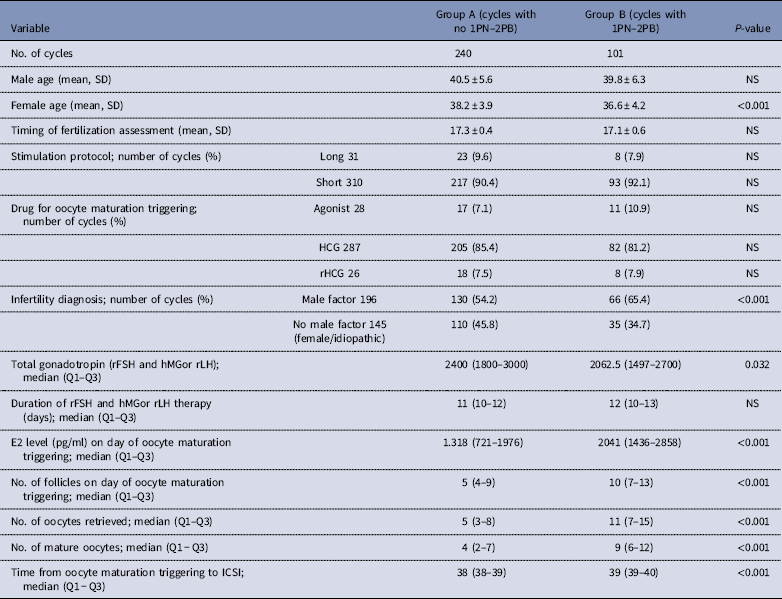
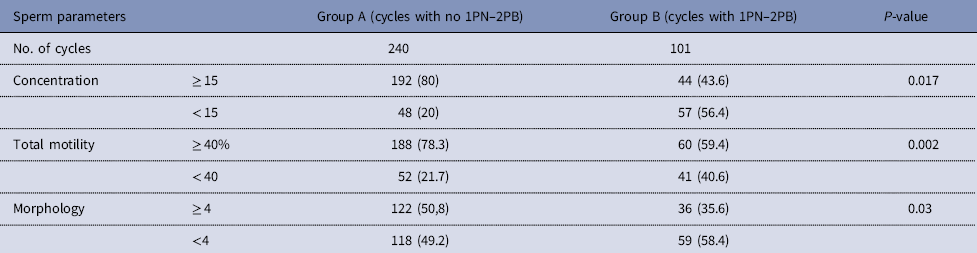
In total, 341 ICSI cycles were analyzed in the study: 101 cycles were characterized by the presence of zygotes with 1PN (group B) whereas no occurrence of monopronucleated zygotes was observed in 240 cycles (group A). Firstly, clinical variables were observed. Groups did not differ for male age, timing of fertilization assessment, type of stimulating protocol, drug for triggering oocyte maturation, days of gonadotropin therapy and sperm sources (ejaculated or surgically extracted). However, compared with group A, patients in group B showed a lower female age, higher incidence of male factor infertility, higher level of E2 on day of oocyte maturation triggering, longer duration of therapy, higher number of follicles on day of oocyte maturation triggering, more oocytes retrieved at pick-up, more mature oocytes (MII) and longer time interval between drug administration for triggering oocyte maturity and ICSI (Table 1). The association between the occurrence of 1PN–2PB and male factor infertility was further investigated analyzing single sperm variables: either concentration, motility or morphology resulted to be pathological in the great majority of the patients in group B (Table 2).
Clinical variables in cycles with 1PN zygotes and those without 1PN zygotes

Analysis of sperm parameters in cycles with 1PN zygotes and those without 1PN zygotes
The final logistic multivariable model confirmed the following associations: group B showed a higher incidence of asthenozoospermia (OR 2.15, 95% CI=1.20–3.86, P<0.010), a higher number of oocytes retrieved (OR 1.12, 95% CI=1.07–1.17, P<0.001), higher number of mature oocytes (OR 1.18, 95% CI=1.11–1.25, P<0.001) and longer time to injection (OR 2.13, 95% CI=1.50–3.03 P<0.001) compared with group A.
Discussion
The occurrence of 1PN zygotes, either with 1 or 2 PBs, has dramatically increased with the advent of ICSI for the treatment of male factor infertility, ranging from 5 to 27% (Palermo et al., Reference Palermo, Joris, Derde, Camus, Devroey and Van Steirteghem1993) following ICSI against the 2 to 6% for IVF (Staessen et al., Reference Staessen, Janssenswillen, Devroey and Van Steirteghem1993). The present study was designed specifically to identify any possible risk factor for 1PN formation and our analysis revealed that 1PN seems to be associated with different variables.
Firstly, our data showed a lower mean female age at oocyte retrieval in cycles with 1PN, which is in contrast with other authors who found no difference in the mean age of the patients (Balakier et al., Reference Balakier, Squire and Casper1993; Staessen et al., Reference Staessen, Janssenswillen, Devroey and Van Steirteghem1993). However, our result is consistent with the fact that patients with 1PN zygotes received also statistically significant fewer total number of ampoules of gonadotropins and showed higher level of E2 and higher number of follicles on day of oocyte maturation triggering, suggesting that this group of patients exhibits a heightened response to gonadotropin stimulation which generally occurs in patients with low mean age.
We also observed a correlation between the occurrence of 1PN and male factor infertility, confirmed by the further association with single sperm variables: either concentration, motility or morphology resulted to be pathological in the great majority of the patients in the 1PN group. Furthermore, the multivariable logistic regression strongly confirmed the association with asthenozoospermic patients (OR 2.15, 95% CI=1.20–3.86, P<0.010). Also, in this case, our result was in contrast with other authors reporting that the occurrence of 1PN was independent of the cause of infertility (Balakier et al., Reference Balakier, Squire and Casper1993; Staessen et al., Reference Staessen, Janssenswillen, Devroey and Van Steirteghem1993). However, our finding can explain those cases in which ICSI-derived 1PN (70%) are haploid zygotes containing only the maternal PN with the presence of sperm in the ooplasm but in which sperm head decondensation has not occurred (Sultan et al., Reference Sultan, Munne, Palermo, Alikani and Cohen1995; Lim et al., Reference Lim, Goh, Su and Yu2000; Van der Heijden et al., Reference Van der Heijden, van den Berg, Baart, Derijck, Martini and de Boer2009). Indeed, it has been demonstrated that asthenozoospermic men generally displays a high percentage of spermatozoa with chromatin packaging abnormalities, which contributes to a failure in the decondensation process compared with normozoospermic men (Griveau et al., Reference Griveau, Charbonneau, Blanchard, Lescoat and Le Lannou1992). Furthermore, different studies have shown that human spermatozoa from infertile patients are more likely to exhibit anomalies related to protamine deposition during spermatogenesis, one of the major factors leading to chromatin packaging problems in spermatozoa (Balhorn et al., Reference Balhorn, Reed and Tanphaichitr1988; Belokopytova et al., Reference Belokopytova, Kostyleva, Tomilin and Vorob’ev1993; de Yebra et al., Reference de Yebra, Ballescà, Vanrell, Bassas and Oliva1993). In fact, the advent of ICSI has removed numerous barriers of sperm selection that were necessary to choose the fittest spermatozoon. Whereas IVF depends on gamete membrane interaction, allowing a strict sperm selection, ICSI bypasses this step, relying largely on the capabilities of the oocyte to carry out sperm decondensation. This can easily explain the reason why most of the 1PN embryos resulting from conventional IVF are in fact diploid in 49–62% of cases (Plachot, Reference Plachot1991; Staessen et al., Reference Staessen, Janssenswillen, Devroey and Van Steirteghem1993, Sultan et al., Reference Sultan, Munne, Palermo, Alikani and Cohen1995; Staessen & Van Steirteghem, Reference Staessen and Van Steirteghem1997) while the majority of ICSI-derived 1PN are haploid, containing only the maternal PN and a still condensed sperm head (Sultan et al., Reference Sultan, Munne, Palermo, Alikani and Cohen1995; Lim et al., Reference Lim, Goh, Su and Yu2000; Van der Heijden et al., Reference Van der Heijden, van den Berg, Baart, Derijck, Martini and de Boer2009).
Our findings are partially in agreement with a previous report by Balakier and colleagues (1993) with regard to the higher number of oocytes retrieved at pick-up in the 1PN group and the negative correlation with stimulation protocol. However, the incidence of 1PN did not correlate with the duration of gonadotropin stimulation, male age and type of drug used for oocyte maturation triggering.
Finally, our analysis revealed a strong correlation between the occurrence of 1PN formation and the time of sperm injection: patients with 1PN showed a longer time interval between maturation triggering and ICSI. We speculate that this delay in microinjection is associated with a process of aging of these oocytes in vitro, which make them able to activate themselves after ICSI, but defective to induce or support male PN development. Indeed, it has been widely demonstrated that parthenogenetic activation is more common in aged human oocytes (Balakier & Casper, Reference Balakier and Casper1991; Plachot & Crozet, Reference Plachot and Crozet1992; Balakier et al., Reference Balakier, Squire and Casper1993) and that extended culture produces ultrastructural damage in human metaphase II oocytes, including changes in structure of the PM, zona pellucida, cytoskeleton, mitochondria, displacement of the spindle, misalignment of chromosomes, dispersion of centrosomal material, displacement of PB1 and CGs, as well as premature exocytosis of CGs (Miao et al., Reference Miao, Kikuchi, Sun and Schatten2009).
The possibility of anomalies in babies born from 1PN-derived embryos remains a concern for many clinics but, for some patients, the transfer of these embryos represents the only chance of obtaining a pregnancy when no other ones are available. Preimplantation genetic testing (PGT) of all chromosomes for 1PN embryos is strongly suggested to ensure biparental inheritance before clinical use. Capalbo and colleagues reported the first systematic clinical application of an enhanced genetic approach for the rescue of abnormally fertilized oocytes by direct assessment of their ploidy (Capalbo et al., Reference Capalbo, Treff, Cimadomo, Tao, Ferrero, Vaiarelli, Colamaria, Maggiulli, Orlando, Scarica, Scott, Ubaldi and Rienzi2017). They found that most of the 1PN blastocysts followed for ploidy complement were diploid in 69.2% of the cases, a finding in contrast with Mateo et al. who reported only a 2.3% euploidy rate. Capalbo and colleagues pointed out that 1PN-derived blastocysts could also be triploid, suggesting that additional caution is required when considering the clinical use of genetically untested 1PN embryos without the monitoring of their ploidy constitution.
A common finding in the literature is the reduced blastocyst formation rate (BFR) for 1PN zygotes. Different authors described that when 1PN-derived embryos are extensively cultured, they showed a low developmental potential, especially when generated by ICSI: Bradley and colleagues reported a 14.8% BFR after IVF vs. 6.6% after ICSI (Bradley et al., Reference Bradley, Traversa, Hobson, Gee and McArthur2017), Mateo and colleagues (2017) reported that BFR was 3.4% for ICSI 1PN. Finally, Capalbo and colleagues (2017) found a BFR similar to that one reported by Bradley et al., namely 6.5% after ICSI. These results are in agreement with previous works (Mateo et al., Reference Mateo, Parriego, Boada, Vidal, Coroleu and Veiga2013; Campos et al., 2007), however other authors have reported that no embryos reached the blastocyst stage (Otsu et al., Reference Otsu, Sato, Nagaki, Araki and Utsunomiya2004).
Even if some authors leave open the possibility of considering embryos derived from 1PN for transfer in case a PGT diagnosis of euploidy was obtained (Capalbo et al., Reference Capalbo, Treff, Cimadomo, Tao, Ferrero, Vaiarelli, Colamaria, Maggiulli, Orlando, Scarica, Scott, Ubaldi and Rienzi2017; Mateo et al., Reference Mateo, Vidal, Parriego, Rodríguez, Montalvo, Veiga and Boada2017), others clearly recommend discarding these embryos as they consider them not suitable for reproductive purposes, either for transfer or cryopreservation (Munné & Cohen, Reference Munné and Cohen1998; Mateo et al., Reference Mateo, Parriego, Boada, Vidal, Coroleu and Veiga2013; Azevedo et al., Reference Azevedo, Pinho, Silva, Sá, Thorsteinsdóttir, Barros and Sousa2014). Therefore, there is still an open debate on this issue. However, the prevention of 1PN formation represents the main challenge to provide patients better chances of success.
This study demonstrates that risk factors for the formation of 1PN exist and their occurrence can be associated with different clinical and laboratory factors such as lower female age, higher level of E2 and higher number of follicles on day of oocyte maturation triggering, higher number of asthenozoospermic male patients, more oocytes retrieved at pick-up, more mature oocytes (MII) and longer time to injection. However, an important limitation of this study is its retrospective nature. Randomized controlled studies in which the influence of 1PN zygotes on clinical outcomes is examined should also be conducted to understand if their occurrence has a prognostic value to predict the fate of the remaining cohort of zygotes and the final outcome of the cycle.
Financial support
This research received no specific grant from any funding agency, commercial or not-for-profit sectors.
Conflicts of interest
None.
Ethical standards
Not applicable.