Introduction
Given the need to reduce pesticide use in modern agriculture, natural enemies have been widely studied as a possible alternative to control pests in agro-ecosystems. In the case of the rosy apple aphid (RAA), Dysaphis plantaginea Passerini (Hemiptera: Aphididae), naturally occurring levels of its predators and parasitoids do not provide satisfactory pest regulation (Miñarro et al., Reference Miñarro, Hemptinne and Dapena2005; Brown & Mathews, Reference Brown and Mathews2007; Dib et al., Reference Dib, Simon, Sauphanor and Capowiez2010a ). Hence, ways to enhance natural enemy levels, especially through augmentative methods, are needed. However, augmentative releases of the coccinellid Adalia bipunctata L. (Coleoptera: Coccinellidae) in early spring (Wyss et al., Reference Wyss, Villiger, Hemptinne and Müller-Schärer1999) and autumn (Kehrli & Wyss, Reference Kehrli and Wyss2001) did not significantly reduce RAA populations, attributed to ecological factors, including unfavourable weather and predation loss due to cannibalism and intraguild predation (Wyss et al., Reference Wyss, Villiger, Hemptinne and Müller-Schärer1999; Kehrli & Wyss, Reference Kehrli and Wyss2001). Such studies illustrate the difficulty of successfully using augmentative biological control for pest control under orchard conditions (Collier & Van Steenwyk, Reference Collier and Van Steenwyk2004).
One of the most abundant predators associated with RAA colonies (Brown & Mathews, Reference Brown and Mathews2007; Dib et al., Reference Dib, Simon, Sauphanor and Capowiez2010a , Reference Dib, Sauphanor and Capowiez b , Reference Dib, Sauphanor and Capowiez2016) is the European earwig (EE), Forficula auricularia L. (Dermaptera: Forficulidae). EEs have many characteristics that make them good putative agents for control of RAA (Kölliker & Vancassel, Reference Kölliker and Vancassel2007; Moerkens et al., Reference Moerkens, Gobin, Peusens, Helsen, Hilton, Dib, Suckling and Leirs2011; Boos et al., Reference Boos, Meunier, Pichon and Kölliker2014): they are well known predators of various species of aphids in fruit orchards in France (Dib et al., Reference Dib, Simon, Sauphanor and Capowiez2010a , Reference Dib, Sauphanor and Capowiez b ), Belgium (Moerkens et al., Reference Moerkens, Leirs, Peusens and Gobin2009), Spain (Piñol et al., Reference Piñol, Espadaler, Pérez and Cañellas2009a , Reference Piñol, Espadaler, Pérez and Beven b ), New Zealand (Burnip et al., Reference Burnip, Daly, Hackett and Suckling2002), Australia (Nicholas et al., Reference Nicholas, Spooner-Hart and Vickers2005) and the USA (Brown & Mathews, Reference Brown and Mathews2007). The efficacy of EE was evaluated on citrus by Piñol et al. (Reference Piñol, Espadaler, Pérez and Cañellas2009a ) and it appeared to be a more efficient aphid predator than species within the family Coccinellidae or order Heteroptera.
However, the real potential of EE for the biological control of aphids remains poorly studied, in part due to its nocturnal feeding behaviour (Sauphanor et al., Reference Sauphanor, Chabrol, Faivre d'Arcier, Sureau and Lenfant1993). Additionally, EE typically appears naturally late in the development of RAA colonies in apple orchards (Dib, Reference Dib2010; Dib et al., Reference Dib, Simon, Sauphanor and Capowiez2010a , Reference Dib, Sauphanor and Capowiez b ) which may limit its control potential. In laboratory conditions, Dib et al. (Reference Dib, Jamont, Sauphanor and Capowiez2011) showed that EE, in theory at least, could be effective in regulating RAA numbers in early spring when field RAA populations are beginning to build up. The objective of this study was, therefore, to study the effects of early release of EE on the development and abundance of RAA colonies under field conditions.
Materials and methods
Study sites
The study was carried out during the 2009 spring season within two experimental apple orchards oriented in an east–west direction and located near Avignon in Southeastern France (43°56′55″N, 4°48′30″E). The first orchard was planted in 2007 with the cultivar Ariane (M.9 rootstock) in six rows of 58 trees each, branched trees in succession with stem trees (fig. 1), whilst the second orchard consisted only of one row of 14 trees of 7-year-old of Golden Delicious (M.9 rootstock). No pesticides, fungicides or herbicides were applied on these orchards during the experimental period. During the sampling period, no horticultural management practices were carried out in the orchards except for mowing of herbaceous strips between tree rows on 14 May.
Illustration shows the arrangement of the three experimental treatments (release, exclusion and control) within the two studied orchards: (A) Ariane and (B) Golden.

Earwig rearing
EE mass-rearing was established from about 200 adults trapped using corrugated cardboard strips in autumn of 2008 in apple orchards located near Avignon. Earwigs were reared outdoors under a shelter at natural temperature, photoperiod and humidity. Individual adult pairs were isolated in plastic cages (5 cm diameter and 2 cm high) with a 1.5 cm ventilation hole covered with an insect-proof net in the centre of each lid. Wet sand was put in each cage to provide overwintering refuges and egg-laying sites. The sand was re-humidified weekly. Insects were fed weekly with ground pollen which is known to be a satisfactory alternative food source to support oviposition (Sauphanor et al., Reference Sauphanor, Blaisinger and Sureau1992, Reference Sauphanor, Chabrol, Faivre d'Arcier, Sureau and Lenfant1993). The pollen was collected by our INRA colleagues working on bees’ ecology (their bees foraged on sunflowers but a small proportion of the pollen came perhaps from other flowers in the surroundings). When eggs were laid, males were removed to accelerate nymph emergence, and egg-laying cages were transferred to a growth chamber operated at 20 ± 1°C, 60 ± 10% relative humidity (RH), and L16:D8h photoperiod (light intensity of 5000 lux). EE have four nymphal stages (Lamb & Wellington, Reference Lamb and Wellington1975). After the first moult, the second instar nymphs were transferred to plastic boxes (25 × 25 × 10 cm3), the inner sides of which were coated with liquid Teflon (Fluon) to prevent escape. Using this rearing technique, the survival of nymphs was very high (exceeding 96%). Nymphs were fed on artificial medium following the method described by Sauphanor et al. (Reference Sauphanor, Blaisinger and Sureau1992). As EE is nocturnally active and hides during the day, small corrugated cardboard bands rolled into cylinders were included in the rearing boxes to provide suitable shelters.
Experimental design
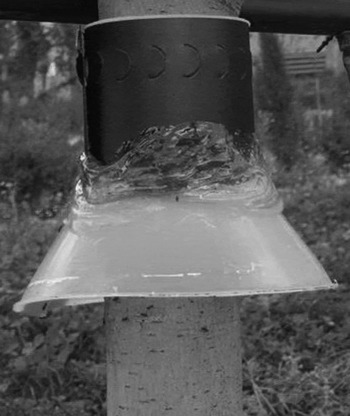
There were three treatments in this study (fig. 1): (i) a ‘release treatment’ where we confined released EE within the canopy using a barrier system (consisting of a sticky strip and a funnel coated with liquid Teflon/Fluon to prevent insects from escaping down the trunk (fig. 2); (ii) an ‘exclusion treatment’ where we blocked free access of earwigs into the canopy using the same barrier system; and (iii) a ‘control treatment’ that represented the natural situation without trunk barriers or earwig releases.
A barrier system consisting of a sticky strip and a funnel coated with liquid Teflon/Fluon to prevent insects from escaping down the trunk and/or accessing tree canopy.

For the Ariane orchard, we selected three rows (blocks) and divided each row into three plots, assigning an experimental treatment to each plot (fig. 1). Each plot consisted of 15 adjacent trees, but only the eight branched trees were sampled (i.e., 24 branched trees were sampled in each treatment). For the Golden orchard, the single row was divided into seven plots of two adjacent trees each, giving two plots for each of the three treatments. A seventh plot (a third replicate of the exclusion treatment) was used to separate the three plots of the two blocks (fig. 1).
Dib (Reference Dib2010) showed that under the field conditions of Southeastern France, movement of EE first brood third instar nymphs (N3) into trees occurred around the first week of May. Therefore, for the augmentation treatment, N3 were released at an earlier date of 15 (Golden orchard) and 29 April (Ariane orchard), respectively, coinciding with the first appearance of RAA infestations. Twenty laboratory-reared N3 were placed in artificial shelters consisting of corrugated cardboard (40 cm long × 5 cm wide) rolled to form cylinders (5 cm diameter) which were inserted into metal cylinders. One shelter was attached (using metal wire) per tree canopy in the release treatments. A total of 480 and 80 N3 were released, using 24 and four shelters, in the Ariane and Golden orchards augmentation plots, respectively.
Assessment of arthropod population dynamics
At the beginning of the experiment, all shoots naturally infested by RAA were marked using coloured ribbons. In total, 183 (Ariane orchard) and 100 (Golden orchard) shoots were marked. For the treatments, 57 and 38 (exclusion), 64 and 34 (release) and 62 and 28 (control) shoots were marked in the Ariane and Golden orchards, respectively. The presence of RAA, its naturally occurring enemies, and ants were assessed on these shoots by visual counts at 3–4-day intervals during the observation period from the start of the experiment within each orchard to 2 June, when RAA emigration to its secondary host plant, Plantago spp. began. In total, Golden and Ariane orchards were sampled 15 and 10 times, respectively, and aphid infestation classified into six classes (A = no aphid; B = 1–5; C = 6–25; D = 26–50; E = 51–125; F = more than 125 aphids). The presence of ants was also estimated using five classes (I = no ant; II = 1–5; III = 6–25; IV = 26–50; V = more than 50 ants). The presence of any potential natural enemy was also noted and recorded as a count. Natural enemies considered to be aphidophagous and monitored during the study were recorded under six taxonomic groups (syrphids, coccinellids, earwigs, spiders, parasitoids and other insect predators). Parasitism was estimated from the number of parasitoids and the number of mummies.
Sampling of earwig population dynamics in the artificial shelters
In addition to artificial shelters used for earwig releases, one additional shelter was located within each sampled tree across all treatments and both orchards (72 in Ariane and 14 in Golden orchards, respectively). Shelters were attached horizontally to tree trunks (with wire), 40–50 cm above the soil and under the exclusion systems when present. Sampling of EE in all artificial shelters in canopies and on trunks started 5 days after the shelter installation. We sampled earwig populations every 3–4 days from 20 April (Golden orchard, coinciding with the third sampling of RAA) and 4 May (Ariane orchard, coinciding with the second sampling of RAA) to 2 June. Earwigs were sampled nine times in Ariane orchard and 13 times in Golden orchard, respectively.
Statistical analysis
RAA and ant abundances were computed as the mean number of the recorded classes. The highest class of RAA and ant abundance was taken to be 200 and 75, respectively. The abundances (total and at each sampling date) of different arthropods (RAA, ants and natural enemies) computed in each treatment were compared using XLSTAT (Version 2009/05/01). Data were log10(x + 1) transformed to reduce heteroscedasticity. Homogeneity of variance and normality were then checked using Bartlett's and Shapiro–Wilk tests, respectively. When these requirements were met, we applied the analysis of covariance (ANCOVA) for randomized block design with initial abundances of different arthropods (RAA, ants and natural enemies) as a covariate. Otherwise, we used a non-parametric Kruskal–Wallis (the abundances were hence reduced by the initial abundances). In all cases, the significance level was set to 5% and post hoc comparison tests were then used.
Results
RAA colonies
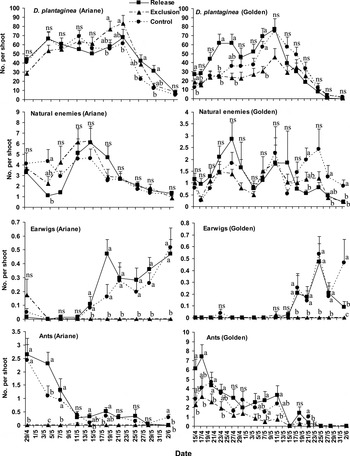
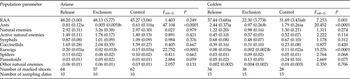
In the Ariane orchard, no significant differences in the total RAA abundance over the whole sampling period were observed among the three treatments (table 1). No significant differences among treatments were observed on individual sampling dates, except on four dates when the RAA abundance was significantly lower for the control treatment than the other two treatments (fig. 3). In the Golden orchard, the marked shoots in the release treatment had significantly higher RAA abundances both as total seasonal counts (table 1) and on three dates (fig. 3) than in the exclusion treatment.
Temporal evolution of arthropod abundance (mean per shoot + SE) observed on the marked shoots in the three studied treatments (release, exclusion and control) during spring 2009 in the two apple orchards (Ariane and Golden). Arthropods were: the rosy apple aphid (D. plantaginea), natural enemies, earwigs and ants. Different letters indicate significant differences at the 5% significance level (each date was tested separately). ‘ns’ means non-significant difference (P > 0.05).

Comparison of the total abundances (mean per shoot (SE)) of arthropods observed on the marked shoots in the three studied treatments (release, exclusion and control) during spring 2009 in the two apple orchards (Ariane and Golden). Arthropods were: rosy apple aphid (RAA), ants, natural enemies, active natural enemies (only the stages directly involved in aphid consumption), common predator groups and parasitoids.

Differences among the studied treatments were tested with ANCOVA or Kruskal–Wallis tests. Values followed by different letters within the same row represent the significant differences on the same orchard at the 5% significance level.
In general, the abundance of natural enemies and different taxonomic groups in the two orchards did not differ significantly among treatments, except for earwig populations (table 1; fig. 3). The total number of earwigs on trees in the exclusion treatment was significantly lower than on the other two treatments (table 1) from mid-May (fig. 3). Similarly, the presence of ants in the exclusion treatment was significantly lower than for the other two treatments in the two orchards (table 1; fig. 3).
Artificial shelters
In the Ariane orchard, the number of earwigs observed in artificial shelters in canopies used for release were significantly higher than in the shelters placed on tree trunks in the three treatments (total abundance: F = 17.2; df = 3; P < 0.0001; figs 4 and 5). In the Golden orchard, these differences were not significant (total abundance: F = 2.0; df = 3; P = 0.178; fig. 4) except on the first three dates when the release treatment had generally the highest earwig populations (fig. 5).
Comparison of the abundances (mean per shelter + SE) of earwigs observed in the artificial shelters installed in the canopies (release treatment) and attached to tree trunks (three treatments: release, exclusion and control) in the two apple orchards (Ariane and Golden). Different letters indicate significant differences at the 5% significance level.

Temporal evolution of the abundance (mean per shelter + SE) of earwigs observed in the artificial shelters installed in the canopies (release treatment) and attached to tree trunks (three treatments: release, exclusion and control) in the two apple orchards (Ariane and Golden). Different letters indicate significant differences at the 5% significance level (each date was tested separately). ‘ns’ means non-significant difference (P > 0.05).

Discussion
Contrary to expectations, the EE augmentation treatment did not reduce the RAA populations in our experiment. RAA populations were in fact highest within this treatment for the Golden orchard. These results are in disagreement with an earlier study which found that EE suppressed populations of aphids in apple orchards of temperate areas in Europe (Solomon et al., Reference Solomon, Cross, Fitzgerald, Campbell, Jolly, Olszak, Niemczyk and Vogt2000). We observed that the exclusion system we used did prevent EE from accessing tree canopies. EE numbers observed in artificial shelters attached to trunks (under the exclusion systems when present) were similar among treatments, but earwig numbers in RAA colonies were significantly lower in the exclusion treatment. Another result was also somewhat surprising; although the exclusion system prevented ants from crawling up the trees in the exclusion treatment, the ant numbers in RAA colonies in the release treatment were not significantly different from those in the control treatment, despite the use of the same exclusion systems. To explain these results, we propose several scenarios based on two alternative hypotheses:
-
(A) Earwig predators are the main predators in RAA colonies.
-
(i) The presence of the exclusion system in the release treatment prevented naturally occurring earwigs from climbing into tree canopies to enhance the released individuals and thus provide RAA control.
-
(ii) The exclusion system may have had the opposite effect than we intended. EE released into tree canopies may fall to the ground (to escape by dropping, seeking shelter during the day or because of unfavourable weather conditions, such as low temperatures or strong winds) and thereafter, would have been unable to crawl back up the trees. Although winged, earwigs are rarely documented to fly (Lamb & Wellington, Reference Lamb and Wellington1975).
-
(iii) The presence of some contact points between the tree canopy and the ground (e.g., some growing apple shoots, tall weeds, etc.) may have provided access to the tree canopy for crawling insects, especially ants, in the release treatment. As the presence of ants improves aphid colony hygiene and defence against natural enemies (Reimer et al., Reference Reimer, Cope and Yasuda1993), this may have had a negative effect on the predation activity of the released earwigs.
-
(iv) The polyphagous feeding behaviour of earwigs may have allowed them to maintain high population levels even when there is no prey (Sauphanor et al., Reference Sauphanor, Chabrol, Faivre d'Arcier, Sureau and Lenfant1993). This behaviour may also have led some earwigs to disperse from RAA colonies to prospect for other food sources.
-
(v) The method used for monitoring and studying the earwig population dynamics (artificial cardboard shelters) does not reflect the real density of earwigs in orchard trees. Although the suitability of these shelters is controversial (e.g., Burnip et al., Reference Burnip, Daly, Hackett and Suckling2002; Logan et al., Reference Logan, Maher, Connolly and Pettigrew2007) and the attempts to find new sampling methods (Suckling et al., Reference Suckling, Burnip, Hackett and Daly2006), cardboard shelters, remain to date the only sampling method adapted to this kind of study. These shelters stimulate earwig aggregation because of the emission of a volatile aggregation pheromone (Walker et al., Reference Walker, Jones and Fell1993).
-
(vi) Insufficient quantity of the released earwigs could have reduced the possibility of successful RAA control. The choice of the quantity of earwigs to be released was the subject of discussion before the start of the experiment. The quantity of the released earwigs (20 earwigs per tree) corresponds to a current cost-benefit estimate. This threshold does not take into account possible lower costs in the future as a result of an increased demand or the success of other released densities against RAA. However, when this number will be increased, the increased possibility of cannibalism and intra-guild predation phenomena (Moerkens et al., Reference Moerkens, Leirs, Peusens and Gobin2009) must also be taken into account.
-
(vii) Proper timing may be crucial when administering augmentation. Piñol et al. (Reference Piñol, Espadaler, Pérez and Beven2009b ), in a proposed model of aphid abundance as controlled by sedentary (specifically EE) vs. non-sedentary predators, show that EE may be key predators if they are already present in the canopies when the first migrant aphids arrive. This is, perhaps, more parsimonious hypothesis that could also explain the absence of effect of the augmentation treatment. Simply, they were added too late in the season, when RAA populations were already well established and growing. However, we should take into account the question ‘may the very early release of earwigs prevent good development of the released individuals?’
-
-
(B) Earwigs are not the main predators in RAA colonies.
-
(i) Other natural enemy groups, especially flying insects, were favoured in our experiment by the presence of the exclusion systems. Exclusion devices allowed such predators to exert control without the disruption usually caused by ants or other crawling predators (e.g., earwigs). This design also freed such predators from the potential effects of intraguild predation or competition with other predator groups (e.g., Lucas, Reference Lucas2005).
-
(ii) Although the positive interaction between ants and aphids is well known (Völkl, Reference Völkl1992; Stadler & Dixon, Reference Stadler and Dixon1999), some studies have shown that some species of ants can actually act as aphid predators instead of mutualists (Skinner & Whittaker, Reference Skinner and Whittaker1981; Sunderland, Reference Sunderland, Minks and Harrewijn1988). However, this seems unlikely as we did not witness any predatory behaviour by ants on RAA during the study period (personal observations).
-
Our results do not demonstrate a positive role for earwigs in suppressing RAA populations in the studied orchards. This highlights the complexity of achieving augmentative biological control under orchard conditions (Collier & Van Steenwyk, Reference Collier and Van Steenwyk2004). Our findings suggest that to successfully control RAA, with earwig releases in open orchard conditions, improvements to existing release methods or development of new approaches are needed. Among these methods may be the Alt'Carpo exclusion nets being developed in Southeastern France (Romet & Severac, Reference Romet and Severac2008; Dib et al., Reference Dib, Sauphanor and Capowiez2010b ) for physically controlling populations of the codling moth, Cydia pomonella L. (Lepidoptera: Tortricidae). The presence of these nets creates closed conditions and can help achieve augmentative releases comparable with those commonly used in greenhouses (e.g., van Lenteren et al., Reference van Lenteren, Roskam and Timmer1997). The nets reduce dispersal of the released organisms, especially in the case of highly mobile natural enemies which are difficult to retain in tree canopies. Moreover, these nets have a demonstrated negative effect on the presence of ants and RAA but not on earwigs and could enhance the biological control of RAA (Dib et al., Reference Dib, Sauphanor and Capowiez2010b ).
In further studies, it will also be useful to determine the separate effects of ants and EE on RAA populations. It is certainly difficult to carry out experiments in field conditions which affect ants and earwigs differently, as both insects share so many characteristics. However, these experiments seem to be possible, taking advantage of the large size of earwigs compared with ants, for example, by using mesh around the tree trunks of a small size (Piñol et al., Reference Piñol, Espadaler, Pérez and Cañellas2009a ; Romeu-Dalmau et al., Reference Romeu-Dalmau, Espadaler and Piñol2010).
Before beginning this experiment, we were aware of the complexity of field systems and the experiment outcome indicates that more sophisticated experimental methods need to be adopted. In addition to the experiment itself, we describe a successful EE rearing method with high nymphal survival rates which offers the possibility of commercial mass-rearing.
Acknowledgements
We would like to thank Odile Mascle for technical assistance. Thanks as well to members of the EPI team for their assistance in collecting earwig adults.