INTRODUCTION
Isopod crustaceans belonging to the Anthuridea, a suprafamilial taxon whose status is currently being debated (Brandt & Poore, Reference Brandt and Poore2003), are found inhabiting a variety of marine habitats, ranging from deep-sea soft bottoms to shallow vegetated biotopes (Negoescu & Wägele, Reference Negoescu and Wägele1984). Most species of Anthuridea occur in shallow tropical water (Negoescu, Reference Negoescu1997), a fact that is attributed by Poore (Reference Poore, Kensley and Brusca2001) to the vast extension of this marine habitat. As regards the Italian seas, most knowledge of the group is based on studies by Wägele (Reference Wägele1979a, Reference Wägeleb, Reference Wägele1980, Reference Wägele1981a, Reference Wägeleb, Reference Wägelec).
In the course of a survey aimed at the detection of non-indigenous species in the harbour of Salerno (Tyrrhenian Sea, Italy), a number of anthuridean isopods assignable to the genus Mesanthura Barnard, 1914 have been found (Gambi, Reference Gambi2001; Dappiano, Reference Dappiano2005). Subsequently, more specimens belonging to the same genus have been found in the harbour area of Taranto (Ionian Sea, Italy) (Lorenti, Reference Lorenti2006). Mesanthura is a well-characterized taxon comprising 45 species (Schotte et al., Reference Schotte, Kensley and Shilling1995 onwards), predominantly from tropical to warm temperate seas, living mainly in shallow cryptic habitats (Müller, Reference Müller1993). Species of Mesanthura are traditionally distinguished on the basis of dorsal pigmentation patterns, although the combination of more subtle morphological characters is increasingly considered in their taxonomy. Prior to the above records, this genus had never been reported from Italian waters (Argano & Campanaro, Reference Argano and Campanaro2006), or, in general, from the western Mediterranean Sea. The only earlier record of Mesanthura (as Mesanthura sp.) in the Mediterranean of which we are informed is from Lake Burollus, a brackish lagoon situated on the northern coast of Egypt (Samaan et al., Reference Samaan, Ghobashy and Aboul Ezz1989). While the knowledge of Italian Anthuridea is far from satisfactory, a number of circumstances, among which the lack of previous records on a basin scale, and the fact that present specimens were collected in harbour areas and their vicinity, are suggestive of a possible exotic origin of the taxon found and of its introduction in relatively recent times (ICES, 2006). Confined areas of the Mediterranean Sea, including harbours, experience a steady influx of alien organisms (Galil, Reference Galil2000; Occhipinti Ambrogi, Reference Occhipinti Ambrogi2000); one major vector for the introduction is international shipping (through ballast water/sediments and ship hull fouling), while domestic translocations may take place subsequently by commercial fishing and recreational vessels or by marine farming, thus promoting a wider dispersal. In the present study, we focus on the significance of the occurrence of Mesanthura found in Italian waters in relation to its ecology and possible bio-geographical relationships.
MATERIALS AND METHODS
Study areas
The port of Salerno is located at 40°40′N 014°44′E on the Tyrrhenian coast (Figure 1). The harbour area of Taranto (Ionian Sea, 40°25′N 017°14′E; Figure 1) includes an inner basin (Mar Piccolo) and an outer embayment (Mar Grande) comprising the harbour roadstead and the commercial port. Both the port of Salerno and the port of Taranto host considerable commercial ship traffic, as well as recreational and fishing ship activity.
Locations of sampling areas. (A) Locations of sampling stations in the Salerno harbour area; (B) location of sampling stations at Taranto.

Sampling
Samples from Salerno were collected in March and September 2000 by quadrat (20 × 30 cm) scraping of quay walls and concrete blocks at seven stations, each including three depth levels (−2, −4 and −6 m). Station 1 was located outside the end of the outer breakwater, while Stations 2–7 were located within the inner harbour area (Figure 1A). Scraped material, mostly consisting of macroalgae, encrusting organisms and large ascidians, was transferred as thoroughly as possible into a 400-μm mesh bag with drawstring mouth, brought to the surface and then preserved in 4% formaldehyde for subsequent sorting. Sorted animals were transferred to 70% ethanol.
At Taranto, samples were collected at two stations located respectively at the western limit of the harbour roadstead near the opening of the so called ‘Mar Grande’ into the Ionian Sea (Station 1, island of San Pietro), and at its eastern end (Station 2, Cantieri Greco) (Figure 1B). At Station 1, sampling was conducted in August 2004 at 9 m depth in a meadow formed by the endemic Mediterranean seagrass Posidonia oceanica. Shoot-bearing stems of the seagrass (N = 30 at each visit) were hand-collected by SCUBA divers and examined for the presence of borers and/or burrows in dead sheaths. At Station 2, a qualitative scraping of fouling on shipyard structures at 4 m depth was performed in July 2005.
RESULTS
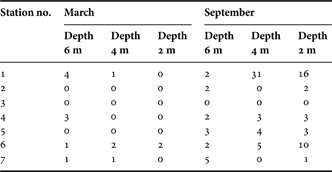
A total of 109 specimens identified as belonging to the genus Mesanthura were collected at Salerno (Table 1) in the two sampling periods. Individuals ranged in size from about 2 to 8.5 mm; developmental stages from mancae to embryo-carrying females were represented, including four males characterized by large eyes, brush-like antennulae and a disperse pigmentation pattern. At the Taranto site, two specimens were found in Posidonia oceanica sheaths at Station 1, both being breeding females; at Station 2, the scraping sample yielded ten individuals, including both adults and juveniles.
Distribution and abundance of Mesanthura sp. specimens in the harbour of Salerno.

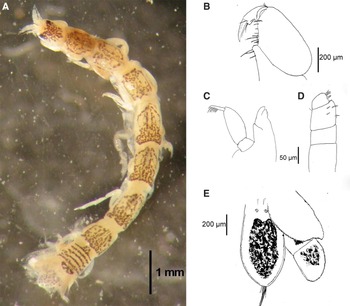
The combination of morphological characters typical of Mesanthura was found in all examined individuals; among them, most outstanding are the colour pattern persistent in alcohol, the pereiopod 1 propodus palm with a step, the mandibular palp of three articles, the terminal one being provided with a spine row, and the maxillipedal palp of three articles. Specimens from Salerno and Taranto (except for the large-eyed males which were found only at Salerno) share a number of key features which led to identification of them as belonging to the same species. For adult individuals, these characteristics can be summarized as follows. Total length ranging between ~6.0 and 8.5 mm. Colour pattern as shown in Figure 2A, consisting of brown to dark-brown extensive dorsal patches on cephalon, pereon, telson, uropod endopod and, in one large specimen, on uropod exopod; the pleon has five transverse bands, plus a butterfly-shaped patch on the sixth free pleonite. Mandibular palp with six setae on article 3 (Figure 2C). Pereopod 1 with a distally truncate, ridged carpus, a sub-proximal shallow step (projection) on the propodus palm and a toothed process at the base of unguis (Figure 2B). Telson (Figure 2E) about twice as long than wide, with four pairs of setae on the posterior margin. Uropod endopod with crenulated margins and numerous marginal setae, about one-sixth longer than the basal width; exopod about twice as long as maximum width, with a rather shallow subapical notch, crenulated margins and numerous plumose setae. Differences between specimens from Salerno and those from Taranto other than those related to different developmental stages are negligible. The only conspicuous difference is that in the individuals from Salerno the colour is lighter, but this is possibly due to a longer preservation time in fixatives.
Specimen of Mesanthura sp. from Salerno; female. (A) Whole animal in dorsal view; (B) pereopod 1 (propodus, dactylus and unguis); (C) mandible; (D) maxilliped; (E) telson and uropod (uropodal setae not shown).

Specimens from Salerno were collected from fouling material scraped at all three depth levels in most of the stations sampled, except for Station 3 (Table 1). Highest abundances of anthurids were reached in the outermost station (1 in Figure 1A) where the fouling community was the richest and best structured (Dappiano, Reference Dappiano2005). This station is indeed characterized by the highest values recorded for the fouling mass in terms of wet weight, ranging from a minimum of 970 g in winter at 6 m depth, to a maximum of 1850 and 1860 g in summer at 2 and 4 m depth, respectively, on a 20 × 30 cm surface. The most abundant species forming bio-concretions, or potentially providing structurally complex habitats to small invertebrates, were the macroalgae Corallina elongata, Jania rubens, Peyssonnelia squamaria, Halopteris filicina and Lithophyllum incrustans; the encrusting bryozoans Schizoporella errata and Schizobrachiella sanguinea, and the tunicates Microcosmus exasperatus, M. polymorphus, Pyura dura and Phallusia fumigata. At stations located in the inner harbour, additional habitat-forming species were constantly present, among which the bivalves Mytilus galloprovincialis, Ostrea edulis, Anomia ephippium and Arca noae, and the barnacles Balanus perforatus and B. amphitrite (Dappiano, Reference Dappiano2005). The much lower number of individuals found in March (15 versus 94 in September) may be related to the lower mass of fouling organisms (Gambi, Reference Gambi2001) recorded in winter in all studied stations.
Individuals from Station 1 at Taranto were found inside the empty burrows made by eunicid polychaetes into Posidonia oceanica dead sheaths. At Station 2, fouling was dominated by the large bryozoan Schizobrachiella sanguinea, which is a major component of encrusting communities in the harbour area (G. Costantino, personal communication).
DISCUSSION
Records in the harbours of Salerno and Taranto constitute the first account of the presence of the genus Mesanthura in the western Mediterranean and the second account for the entire basin, provided that the identification of a Mesanthura sp. from the coasts of Egypt is correct. A number of considerations, which are discussed in this section, would support the hypothesis of a recent introduction to sampled locations. Although the genus is considered ‘cosmopolitan’ by Poore (Reference Poore, Kensley and Brusca2001), it is mostly distributed in tropical and subtropical regions. Even though Italian coasts have been insufficiently sampled for cryptic isopods, it is reasonable that the presence of relatively conspicuous animals such as members of Mesanthura would have been noticed, for example by Wägele (Reference Wägele1979a, Reference Wägeleb, Reference Wägele1980, Reference Wägele1981a) in the Gulf of Naples, close to Salerno. No specimens identifiable as Mesanthura were found in collections of isopods made in the 1980s to 1990s from the Gulf of Naples and Taranto and examined by one of our team (M. Lorenti, unpublished data).
The species of Mesanthura with which the one discussed here shares the highest number of major taxonomic characters is M. romulea described by Poore & Lew Ton (Reference Poore and Lew Ton1986) on the basis of two individuals from the coasts of New South Wales (Australia). The pigmentation of cephalon and peraeonites (terga) of the Italian specimens is quite similar to the drawing provided by the Australian authors, while that of pleon differs in being less thick. The first pereopod of adults corresponds fairly well with their description and figures, in particular in the palm being oblique and concave and in the complex toothed structure of dactylus and unguis which is considered by them to be diagnostic. The overall length of adults is also in the same range. At this stage, a more thorough comparison is not practicable, in view of the lack of details on several morphological features in the original description and of the fact that, to our knowledge, M. romulea has never been recorded again since the type material description.
Within and just outside the port of Salerno, where the more extensive survey was conducted, the species of Mesanthura found constitutes a numerous and well structured population, indicative of a successful establishment in the harbour environment and in its immediate vicinity. One striking feature is that the two individuals on which Poore & Lew Ton (Reference Poore and Lew Ton1986) based the description of M. romulea sp. nov. come from areas (Port Jackson and Port Stephens) characterized by boat and ship traffic. It is interesting that the Mediterranean and the temperate Australian waters are among the most affected by biological invasions (Ruiz et al., Reference Ruiz, Carlton, Grosholz and Hines1997; Galil, Reference Galil2000).
Also assuming that the present species is not identifiable as M. romulea, it is still highly probable that it has been transferred to Italian harbours from a different bio-geographical region. A possible Erythrean origin was initially considered, although the record of one Mesanthura sp. from Egypt is anecdotal and needs confirmation through specific surveys. Criteria adopted to define non-indigenous peracarid species, as listed by Chapman (Reference Chapman1988), include the association with other introduced taxa. In fact, in samples from the harbour of Salerno another abundant species of isopods is the sphaeromatid Paracerceis sculpta, native to the north-east Pacific, whose human-borne spread on a global scale is well known (Hewitt & Campbell, Reference Hewitt and Campbell2001) and whose first record from Italian coasts dates back to 1981 (Occhipinti Ambrogi, Reference Occhipinti Ambrogi2000). The species has been recorded also from the harbour of Taranto (Forniz & Maggiore, Reference Forniz and Maggiore1985). Mesanthura shares with P. sculpta the occurrence in harbour fouling. In addition to P. sculpta, a number of other non-indigenous species have been recorded in the harbour of Salerno during the same sampling campaign, including macroalgae (Caulerpa racemosa and Codium tomentosum), polychaetes (Branchiomma luctuosum and Spirorbis marioni), the opisthobranch mollusc Bursatella leachi (Gambi, Reference Gambi2001) and the ascidian Microcosmus squamiger (Mastrototaro & Dappiano, Reference Mastrototaro and Dappiano2005). Also the harbour and the roadstead of Taranto represent an area favourable for the establishment of exotic species, many of which have been documented to form dense populations; among them are Caulerpa racemosa (Buia et al., Reference Buia, Petrocelli and Saracino1998), Branchiomma luctuosum (Licciano et al., Reference Licciano, Giangrande and Gambi2002), both present also at Salerno, the bivalve mollusc Musculista senhousia (Mastrototaro et al., Reference Mastrototaro, Matarrese and D'Onghia2003) and the ascidian Polyandrocarpa zorritensis (Brunetti & Mastrototaro, Reference Brunetti and Mastrototaro2004).
Anthuridean isopods are considered poor dispersers (Negoescu, Reference Negoescu1997; Poore, Reference Poore, Kensley and Brusca2001), and the possibility that one species may dramatically expand its distribution range over a global scale by natural means is remote. However, cryptic invertebrates such as anthurids may be co-transported with biotic habitats associated to ship hull fouling. Biotic habitats, as constituted by e.g. sponges, ascidians, bryozoans, barnacles, macroalgal thalli, polychaete tubes, provide a relatively stable environment in which considerable numbers of mesofaunal-sized individuals may occur (Thiel, Reference Thiel1999) and travel long distances. Fouling of artificial structures in the ports of Salerno and Taranto is substantial and includes several of the exotic forms listed above, which, at least in part, may have been transported on ship hulls. A further trait typical of cryptic mesofauna is the response to gradients in habitat complexity, here intended as the amount of habitat space coupled with the heterogeneity of the habitat structure, which may explain the high abundance recorded at Salerno in Station 1, characterized by a high fouling biomass and diversity. At Taranto, in addition to the presence in the fouling community, individuals of Mesanthura were found to occupy empty burrows inside dead sheaths of Posidonia oceanica. Burrows made by some invertebrate forms (eunicid polychaetes, limnoriid isopods) into seagrass tissues constitute a peculiar biotic microhabitat (Gambi et al., Reference Gambi, Tussenbroek and Brearley2003) which is occasionally occupied by other cryptic animals (Guidetti et al., Reference Guidetti, Bussotti, Gambi and Lorenti1997).
In summary, although its identity remains to be determined, the attributes of the present species of Mesanthura by which an introduced origin is suggested (based on Chapman, Reference Chapman1988) are as follows:
– lack of previous records on a basin scale and a disjunct distribution with respect to other members of the genus;
– restriction to ports and their neighbourhood;
– association with introduced species, in areas characterized by a massive occurrence of exotic taxa;
– lack of dispersal capabilities which may account for a natural range expansion;
– association with cryptic habitats (fouling) which are liable to be human-borne.
ACKNOWLEDGEMENTS
This study is part of a larger investigation funded by the Ministry of the Environment and Territory through the Italian Society of Marine Biology. Thanks are due to Professors Giulio Relini and Anna Occhipinti Ambrogi, coordinators of this programme. Thanks are also due to Bruno Iacono and Andrea Dell'Acqua for help in sampling and sorting of the material, and to Gaetano Costantino and Francesco Mastrototaro for providing Posidonia material and scraping samples from Taranto. Our fond remembrance goes to the memory of Cristiano Mare Ielasi, a professional diver and a friend, who performed the sampling in the harbour of Salerno.