Introduction
Hoary alyssum [Berteroa incana (L.) DC.] is an annual, biennial, or short-lived perennial mustard that is native to Eurasia (Warwick and Francis Reference Warwick and Francis2006). It was first observed in North America in 1893 in Ontario, Canada. Since then, it has been found in 39 U.S. states (Early Detection and Distribution Mapping System 2017) and all Canadian provinces except Newfoundland and Prince Edward Island (Warwick and Francis Reference Warwick and Francis2006), spreading primarily through contaminated lawn and forage seed. Currently, it is listed as a noxious weed in California, Idaho, Michigan, Montana, Oregon, Washington, Wyoming, Alberta, British Columbia, and Saskatchewan (Parkinson et al. Reference Parkinson, Mangold and Jacobs2017). Berteroa incana is prevalent in disturbed areas such as trails, roadsides, and gravelly river banks, as well as in pastures. In rangeland settings, B. incana can be toxic to horses if it comprises 30% or more of their diets (Geor et al. Reference Geor, Becker, Kanara, Hovda, Sweeney, Winter, Rorick, Ruth, Hope and Murphy1992). It also has relatively few palatable carbohydrates and proteins compared with native vegetation, making it undesirable forage (Hastings and Kust Reference Hastings and Kust1970). Berteroa incana propagates exclusively by seeds, which are produced concurrently with its flowers throughout the frost-free season (Warwick and Francis Reference Warwick and Francis2006).
Research on B. incana management is limited. In greenhouse experiments, fertilization and mowing were not effective at reducing B. incana (Stopps Reference Stopps2012). Although somewhat effective in cropping systems, tilling is not a practical option in pastures (Warwick and Francis Reference Warwick and Francis2006), and there are no biocontrol agents for B. incana (Parkinson et al. Reference Parkinson, Mangold and Jacobs2017). Additionally, there is limited information on chemical control of B. incana (Dutt et al. Reference Dutt, Harvey and Fawcett1983; Kust Reference Kust1969; Richardson and Zandstra Reference Richardson and Zandstra2005), and no studies have been conducted in rangeland or grass pasture.
Chemical control recommendations suggest that herbicide applications before B. incana flowering may be most effective (Jacobs and Mangold Reference Jacobs and Mangold2008). However, B. incana is hard to identify at its vegetative stage, and many invasive plant managers do not treat the weed until it has flowered (J Ansley and S LaMont, personal communication). Unfortunately, when plants are flowering and easier to identify, they may also be producing seeds. Understanding the effect of herbicide management practices on seed biology of flowering B. incana is critical to improving control of this weed. The objective of this research was to examine how current herbicide management practices used by invasive plant managers affected seed production and viability of flowering B. incana the year of application as well as population density the following year. We hypothesized that herbicides applied by invasive plant managers would reduce seed production and viability, but we were uncertain as to what extent. We also hypothesized that herbicide applications would decrease B. incana density at 1 yr postapplication.
Materials and Methods
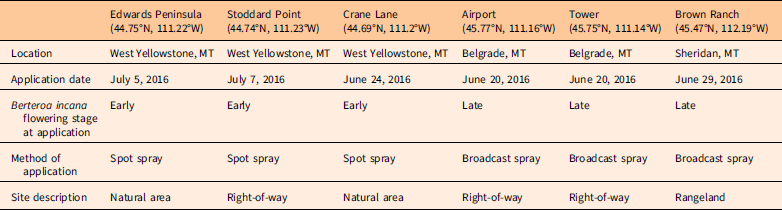
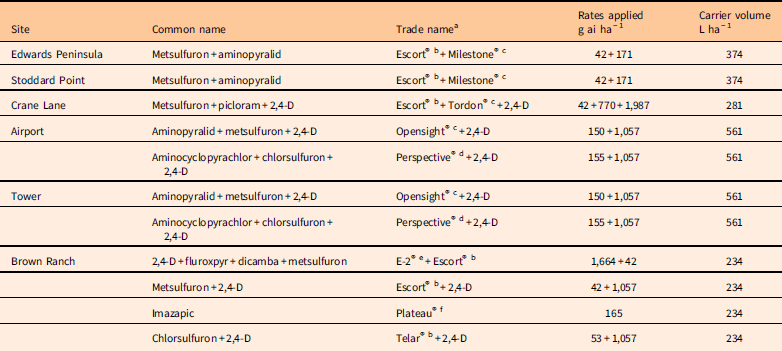
To determine the efficacy of B. incana herbicide management practices, we cooperated with invasive plant managers in southwestern Montana who sprayed B. incana between June and July 2016 at six sites located near Belgrade, Sheridan, or West Yellowstone, MT. Sites were located in rights-of-way, natural areas, or rangelands (Table 1). Managers selected herbicides that emulated their regular management practices and applied all herbicides according to label directions (Table 2). All herbicides were applied with a nonionic surfactant. Managers recorded B. incana growth stage at time of herbicide application (i.e., vegetative or flowering). If flowering, they classified B. incana as being at an “early” or “late” flowering stage. If seed pods covered less than 50% of the average B. incana plant’s flowering stem, the infestation was described to be at an early flowering stage. If seed pods covered more than 50% of the average B. incana plant’s flowering stem, the infestation was described to be at a late flowering stage. In all cases, managers applied herbicides in the last 2 wk of June or the first week of July when B. incana was flowering (Table 1). Berteroa incana was at an early flowering stage at half of the sites and at a late flowering stage at the other half of the sites (Table 1). Managers also set aside a nonsprayed area at each site to serve as a control. The size of sprayed and nonsprayed areas varied within and among sites, but none were less than 28 m2.
Site information for six sites where invasive plant managers sprayed Berteroa incana in southwestern Montana in 2016.

Herbicides applied by invasive plant managers at six sites in southwestern Montana where their effects on Berteroa incana seed production and viability in 2016 and population density in 2017 were evaluated.

a No manufacturer provided for 2,4-D, because invasive plant managers used varying formulations.
b DuPont, Wilmington, DE, www.dupont.com.
c Dow AgroSciences, Indianapolis, IN, www.dowagro.com.
d Bayer, Research Triangle Park, NC, www.bayercropscience.us.
e Nufarm, Alsip, IL, www.nufarm.com.
f BASF, Research Triangle Park, NC, www.bettervm.basf.us.
We collected B. incana plants at each site approximately 4 wk after herbicide applications in 2016 to use for seed production and seed viability analyses. We followed a cluster sampling design by randomly locating five non-overlapping rectangular 0.1- to 12-m2 sampling plots along a transect that we placed within each sprayed or nonsprayed area, leaving a 1-m buffer on each side of each sampling plot. Transect lengths differed between herbicide applications and sites, ranging from 7 to 176.5 m to adequately represent the area sprayed. Because we were characterizing the effect of herbicide applications on seeds, if a sampling plot was placed in an area with no B. incana, we randomly relocated it along the same transect. Each sampling plot was divided into four equally sized quadrats, 0.025 to 3 m2, and we randomly selected two quadrats for sampling. If there were no B. incana plants within a quadrat, we randomly selected another quadrat within the same sampling plot. The variation in transect, sampling plot, and quadrat size was due to differences in the size of the sprayed and nonsprayed areas and the patchy distribution of B. incana at each site. All B. incana plants within the two selected quadrats were clipped at ground level, and each plant was placed in a separate bag. Due to the large number of plants collected within some quadrats, we randomly selected three plants from each quadrat to count all seeds and determine average seed production. If there were fewer than three plants growing in a quadrat, we used one or two plants to calculate seed production.
Seed viability was determined by conducting tetrazolium tests on seeds from all sites except Crane Lane, where there were not enough seeds to perform tests. Seeds from the seed production assessment were composited by site and herbicide application. Four replications of 110 seeds from each herbicide application were imbibed on blotter paper, wetted with deionized water, and placed within a sealed petri dish for 1 to 6 h to soften their seed coats. Then we made a small nick along the edge of each seed and placed the seeds in a 1% solution of 2,3,5-triphenyltetrazolium chloride for 24 h at ~21 C. We assessed the viability of 100 seeds from each replication following the protocol for the Brassicaceae Group 2 in the Tetrazolium Testing Handbook (Miller Reference Miller2010).
We sampled population density of B. incana at all sites during mid-May to early June 2017 to assess effectiveness of herbicide management practices the following year. We placed five 20 by 50 cm frames along the 2016 sampling transects used for seed production and seed viability analyses and measured the density of B. incana stems or rosettes within each frame. To avoid calculating density where B. incana had been cut in 2016 for our seed production and viability assessments, each sampling frame was placed adjacent to a 2016 sampling plot.
For seed production, seed viability, and population density, we analyzed each site separately because of the variation in herbicide management practices. Herbicide applications at each site were analyzed separately by comparison with the nonsprayed control. We compared the effects of herbicide applications on B. incana seed production within each site using Poisson generalized linear mixed models, with random effects for sampling plot and quadrat nested within sampling plot to account for our cluster sampling design (Dobson and Barnett Reference Dobson and Barnett2008). We examined the effects of herbicide applications on B. incana seed viability within each site using contingency tables and Fisher’s exact tests, which compared the overall proportion of nonviable seeds to viable seeds for each herbicide application (Agresti Reference Agresti2013). We assessed the effects of herbicide applications on B. incana population density within each site using quasi-Poisson generalized linear models, using the log-area of our sampling frame (size=0.1 m−2) as an offset to enable statements about plants on a per square meter basis (Dobson and Barnett Reference Dobson and Barnett2008). We conducted these analyses using R Software (R Core Team Reference R Core2016) and the ‘plyer’ and ‘PropCIs’ packages.
Results and Discussion
Seed Production
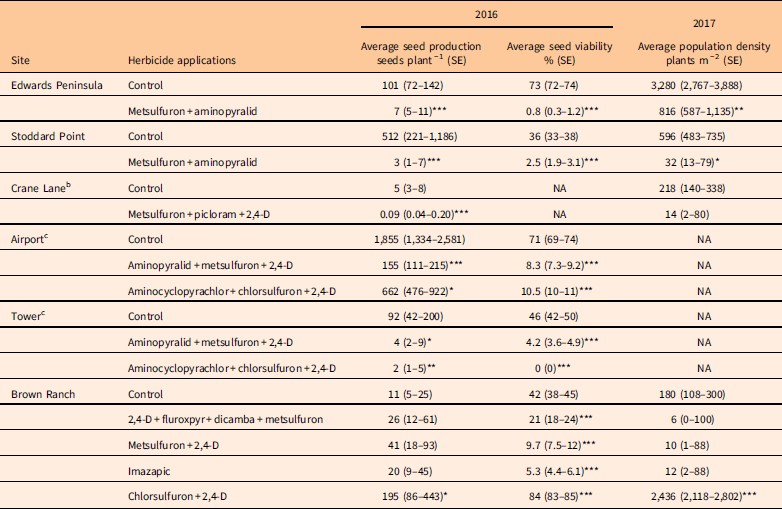
All herbicide management practices at Edwards Peninsula, Stoddard Point, Crane Lane, Airport, and Tower reduced seed production (Table 3). At sites where herbicides were spot sprayed when B. incana was at an early flowering stage (Edwards Peninsula, Stoddard Point, and Crane Lane), the reduction in seed production ranged from 93% to 99% (Table 3). Specifically, at Edwards Peninsula, metsulfuron+aminopyralid reduced seed production from 101 seeds plant−1 in the nonsprayed area to 7 seeds plant−1, a 93% reduction. At Stoddard Point, the same herbicide reduced seed production from 512 seeds plant−1 in the nonsprayed area to 3 seeds plant−1, a 99% reduction. At Crane Lane, metsulfuron+picloram+2,4-D reduced seed production from 5 seeds plant−1 in the nonsprayed area to less than 1 seed plant−1, a 98% reduction.
Berteroa incana seed production and seed viability in 2016 and population density the following year in 2017 at six sites in southwestern Montana.Footnote a

a Stars next to individual herbicide applications indicate the level of significance when compared with the control within a single site:*P-value<0.05;**P-value<0.01;***P-value<0.001.
b Unable to conduct viability tests at Crane Lane, because too few seeds were produced.
c Unable to analyze population density at Airport and Tower with quasi-Poisson generalized linear models due to excess zeros with certain herbicide applications.
At two sites where herbicides were broadcast sprayed at a late flowering stage (Airport and Tower), seed production decreased 64% to 98% (Table 3). At Airport, aminocyclopyrachlor+chlorsulfuron+2,4-D reduced seed production from 1,855 seeds plant−1 in the nonsprayed area to 662 seeds plant−1, a 64% reduction. The same herbicide application at Tower reduced seed production from 92 seeds plant−1 in the nonsprayed area to 2 seeds plant−1, a 98% reduction. At Airport, aminopyralid+ metsulfuron+2,4-D reduced seed production from 1,855 seeds plant−1 in the nonsprayed area to 155 seeds plant−1, a 92% reduction. The same herbicide application at Tower reduced seed production from 92 seeds plant−1 in the nonsprayed area to 4 seeds plant−1, a 98% reduction.
At another site where herbicides were broadcast sprayed at a late flowering stage (Brown Ranch), three of the four herbicide management practices did not affect seed production: 2,4-D+fluroxypyr+dicamba+metsulfuron, metsulfuron+2,4-D, and imazapic applications averaged 26, 41, and 20 seeds plant−1, respectively, compared with 11 seeds plant−1 in the nonsprayed area. Conversely, chlorsulfuron+2,4-D increased B. incana seed production from 11 seeds plant−1 in the nonsprayed area to 195 seeds plant−1, a nearly 20-fold increase. This increase in seed production was surprising, but it may have been due to grass injury from chlorsulfuron (Derr Reference Derr2012). A loss in grass vigor could have reduced competition between grasses and B. incana, with a resulting increase in B. incana seed production.
Across our six sites, nonsprayed B. incana produced 5 to 1,855 seeds plant−1 and averaged 429 seeds plant−1 (Table 3). Seed production also varied greatly among individual plants within sites. For example, one individual at Airport produced 319 seeds, while another produced 5,632 seeds. Seed production of nonsprayed plants in our study was lower than that reported by Reichman (Reference Reichman1988) and Stevens (Reference Stevens1932), the only other studies we found that reported B. incana seed production. Stevens (Reference Stevens1932) reported 2,530 seeds plant−1, whereas Reichman (Reference Reichman1988) recorded a range of 116 to 2,640 seeds plant−1. The differences between these studies and ours could be due to study location (Montana vs. Minnesota and North Dakota) and the nature of the studies. Our study took place in naturally occurring populations of B. incana, whereas Reichman (Reference Reichman1988) transplanted B. incana into disturbed soil with varying degrees of competition from other species of plants, and Stevens (Reference Stevens1932) selected a single plant growing with little competition. Our study adds to the body of knowledge regarding B. incana seed biology, suggesting that seed production can be highly variable both within and across sites.
Seed Viability
When averaged across five sites where we tested seed viability (Crane Lane was not assessed because of too few seeds), 53% of nonsprayed seeds were viable with viability ranging from 36% to 73% (Table 3). All herbicide management practices decreased B. incana seed viability compared with nonsprayed seeds at their respective sites, except the chlorsulfuron+2,4-D application at Brown Ranch, where viability increased (Table 3). Where B. incana was spot sprayed at an early flowering stage (Edwards Peninsula and Stoddard Point), herbicide applications reduced average seed viability 93% to 99%. Specifically, metsulfuron+aminopyralid reduced average seed viability at Edwards Peninsula from 73% in the nonsprayed area to <1% (Table 3). At Stoddard Point, the same herbicide application reduced average seed viability from 36% in the nonsprayed area to 2.5%.
Where B. incana was broadcast sprayed at a late flowering stage (Airport, Tower, and Brown Ranch), herbicide applications reduced average seed viability 49% to 100%, with the exception of the chlorsulfuron+2,4-D application at Brown Ranch. At Airport, aminopyralid+metsulfuron+2,4-D reduced average seed viability from 71% in the nonsprayed area to 8.3%. At Tower, the same herbicide application reduced average seed viability from 46% in the nonsprayed area to 4.2%. At Airport, aminocyclopyrachlor+chlorsulfuron+2,4-D reduced average seed viability from 71% in the nonsprayed area to 10.5%. At Tower, the same herbicide application reduced average seed viability from 46% in the nonsprayed area to 0%. At Brown Ranch, 42% of seeds in the nonsprayed area were viable. Metsulfuron+2,4-D reduced seed viability to 9.7%; 2,4-D+fluroxypyr+dicamba+metsulfuron reduced seed viability to 21%; and imazapic reduced seed viability to 5.3%. However, chlorsulfuron+2,4-D increased seed viability to 84%, which was two times higher than seed viability in the nonsprayed area. This result parallels seed production, where chlorsulfuron+2,4-D also led to an increase in the number of seeds produced.
The reduction in seed viability across all sites and all herbicide management practices, except for the chlorsulfuron+2,4-D application at Brown Ranch, was promising, given that applications occurred when B. incana was flowering and seed pods were present. Our results support other studies that showed herbicide applications during flowering and early seed formation can impede production of viable and germinable seeds across a variety of weedy species (Asghari and Evans Reference Asghari and Evans1992; Mashhadi and Evans Reference Mashhadi and Evans1986; McDaniel et al. Reference McDaniel, Wood and Murray2002; Nurse et al. Reference Nurse, Darbyshire and Simard2015). This is encouraging news for invasive plant managers who are unable to identify B. incana before it flowers or do not have the resources to spray multiple times per season due to the weed’s prolonged flowering period. Because B. incana propagates only by seed (Warwick and Francis Reference Warwick and Francis2006), controlling viable seed production is critical for effective management.
Population Density One Year after Herbicide Application
In our analysis of population density at four sites (Edwards Peninsula, Stoddard Point, Crane Lane, and Brown Ranch), the herbicide application of metsulfuron+aminopyralid at Edwards Peninsula and Stoddard Point was the only herbicide management practice that resulted in a reduction in B. incana population density the following growing season (Table 3). At Edwards Peninsula, metsulfuron+aminopyralid reduced population density from 3,280 plants m−2 in nonsprayed areas to 816 plants m−2 in spring 2017. At Stoddard Point, the same herbicide application reduced population density from 596 plants m−2 in nonsprayed areas to 32 plants m−2. The only other herbicide application that differed from nonsprayed areas occurred at Brown Ranch, where we observed a higher population density of B. incana in the area where chlorsulfuron+2,4-D was applied compared with the nonsprayed area (2,436 v. 180 plants m−2; Table 3). None of the other herbicide management practices at Brown Ranch and Crane Lane affected B. incana population density the following year. We were unable to statistically analyze population density data from two sites (Airport and Tower) due to zero-inflated data.
Our work found that few of the herbicide management practices that invasive plant managers were using for B. incana in southwestern Montana reduced population density the following growing season, suggesting that managers should expect reoccurring infestations at least 1 yr after application. Although we did not differentiate B. incana density across life-history stages when sampling in 2017, many of the observed individuals were seedlings or small rosettes that we suspect emerged from seeds in the soil seedbank after herbicide applications in 2016. Berteroa incana can build up large seedbanks in the soil, as demonstrated in a field study in Canada, where up to 132 million B. incana seeds ha−1 were found in the soil; those seeds remained viable for 2 yr (Stopps Reference Stopps2012). Regardless of B. incana’s ability to accumulate an impressive seedbank (Stopps Reference Stopps2012), even a small number of viable seeds may be adequate to sustain an infestation. For example, a life-history analysis of spotted knapweed (Centaurea stoebe L.), which also reproduces only via seed production, showed that as little as 1% and 20% of seeds entering the seedbank in the fall went on to emerge as seedlings that fall and the following spring, respectively (Jacobs and Sheley Reference Jacobs and Sheley1998). If invasive plant managers are reducing but not completely eliminating viable seed production, B. incana may persist.
Conclusions and Management Implications
This study was conducted to determine the impacts of current management practices used by invasive plant managers on B. incana seed biology and control. Consequently, we were unable to control some variables that could have affected our results. For example, Brown Ranch was grazed by cattle, while other sites were not. Differential grazing pressure could have affected plant competition and subsequent B. incana growth and could have interacted with some herbicide applications to increase seed production and viability. Additionally, all managers who treated their B. incana infestations at early flowering stages spot sprayed, whereas all managers who treated their infestations at late flowering stages broadcast sprayed. It is possible that the more consistent reductions in seed production observed when herbicides were applied at early flowering stages were influenced by application method. Finally, we were unable to make direct comparisons between herbicide active ingredients and application methods, because our study was cooperator-driven, and cooperators used herbicides that fit their individual management needs.
Products containing the active ingredients metsulfuron or 2,4-D are currently recommended for use on B. incana (Parkinson et al. Reference Parkinson, Mangold and Jacobs2017; Prather et al. Reference Prather, Miller and Hulting2016). Of the 11 herbicide applications used by invasive plant managers in southwestern Montana, 7 contained metsulfuron and 8 contained 2,4-D. Because managers chose their herbicides, tank mixes that contained multiple active ingredients were often used. Future studies could examine these recommended herbicides in isolation to determine which is more effective. Our work highlights that a reduction in viable seeds is possible with several different herbicide applications, even though applications occurred when B. incana was flowering and seed pods were present. However, few herbicide management practices resulted in a reduction in B. incana population density the following year, suggesting that invasive plant managers may need to monitor and re-treat B. incana populations for several years if there is an established B. incana seedbank. Managers may benefit from mapping infestations while B. incana is flowering so that infestations can be easily located in the vegetative stage and herbicide applications can be more effectively applied in subsequent years.
Acknowledgments
Funding for this research was provided by the Montana Noxious Weed Trust Fund and the Montana State University Undergraduate Scholars Program. We would like to thank the cooperating land managers: Susan LaMont (U.S. Forest Service), Ray Shaw (Ruby Resources), Julie McLaughlin (The Nature Conservancy), John Ansley (Gallatin County Weed District), and Mike Jones (Gallatin County Weed District). We would also like to thank Brad Bauer, formerly Gallatin County Extension, for contributing to project design and coordination. We are also grateful to the Montana State Seed Laboratory; the Montana State University Statistical Consulting and Research Services; and Rachel Flowers, Eric Friesenhahn, and Todd Schlotfeldt for field and laboratory assistance. No conflicts of interest have been declared.