Today well-being is widely accepted as an integral part of health definition. World Health Organization (WHO) since its beginnings, has defined health as a state of complete physical, mental and social well-being; however, only recently well-being has been considered as a health priority by this organization (WHO, 2013).
Nowadays it is extensively accepted that well-being entails both the experience of feeling good and an optimal psychological functioning. Subjective Well-Being (SWB; Diener, Suh, Lucas, & Smith, Reference Diener, Suh, Lucas and Smith1999) and Psychological Well-Being (PWB; Ryff, Reference Ryff2014) are the most relevant empirical developments of these two well-being conceptualizations respectively. SWB includes an emotional component that implies the frequent experience of positive affect and rarely negative one, and a cognitive component that concerns to life satisfaction judgments.
PWB integrates the most relevant features of the optimal psychological functioning such as autonomy or sense of self-determination, self-acceptance or to have positive attitudes toward oneself, purpose in life or the pursuit of meaningful goals, to have positive relations with others, personal growth or the ongoing development as a person, and environmental mastery or the ability to manage complex environments to suit personal needs and values.
Evidence shows that well-being is affected by multiple factors such as having positive outlooks, avoiding social comparison and negative self-evaluations, being optimistic or feeling efficient (Lyubomirsky, Sheldon, & Schkade, Reference Lyubomirsky, Sheldon and Schkade2005). The use of certain ways of coping and the pursuit of goals aligned with personal values, motives and interests have proven to be especially relevant for well-being (Estes & Sirgy, Reference Estes and Sirgy2017; Litman & Lunsford, Reference Litman and Lunsford2009).
The effect of imprisonment on the well-being of prisoners has been studied mostly by ill-being indicators such as anxiety, depression, post-traumatic stress, irritability, insecurity perception, low self-esteem, loneliness, and self-destructive behaviors (Listwan, Colvin, Hanley, & Flannery, Reference Listwan, Colvin, Hanley and Flannery2010).
Although few studies have examined directly well-being, these have shown that well-being decreases during incarceration (Gullone, Jones, & Cummins, Reference Gullone, Jones and Cummins2000) and it is recovered after the release (Wildeman, Turney, & Schnittker, Reference Wildeman, Turney and Schnittker2014), but well-being does not return to pre-imprisonment levels (Gullone et al., Reference Gullone, Jones and Cummins2000).
As we have pointed out above, coping plays an important role in well-being. Coping describes the efforts people make to manage life´s daily demands (Lazarus & Folkman, Reference Lazarus and Folkman1984). Although coping effectiveness is a complex issue since it depends on several factors such as the context in which it occurs, or the controllability level of the event, there are some strategies that are more often efficient, reduce stress to a larger extent, and are more constructive than others. Thus, strategies aimed at changing the situation such as the problem solving (PS) coping (e.g., active coping and planning strategies), and those that consist of changing the perception of situations such as the positive cognitive restructuring (PCR) coping (e.g., acceptance and positive reappraisal strategies), have been systematically associated with a greater well-being. Conversely, the avoidance coping (e.g., denial, behavioral disengagement or emotional amplification) is negatively related to well-being (Litman & Lunsford, Reference Litman and Lunsford2009; Wolgast & Lundh, Reference Wolgast and Lundh2017). Relationships between the social support (SS) coping and well-being are controversial. Instrumental SS includes actions aimed at seeking information and advice to solve a stressful event, while the emotional SS refers to action aimed at achieving comfort and affection of others. Therefore, instrumental support is positively associated with well-being, while some forms of emotional support are not, as when these consist merely in venting of feelings, which could be considered as an avoidance strategy (Ben-Zur & Zeidner, Reference Ben-Zur and Zeidner2012; Carver, Scheier, & Weintraub, Reference Carver, Scheier and Weintraub1989; Litman & Lunsford, Reference Litman and Lunsford2009).
Prison adjustment, which depends to a large extent on coping, has shown to be positively associated with well-being in prison (Picken, Reference Picken2012). Control perception, which is a key factor for the implementation of the PS coping, is very limited in this context, in which the behavior is totally regulated by external norms (Blevins, Listwan, Cullen, & Jonson, Reference Blevins, Listwan, Cullen and Jonson2010). Therefore, in the prison context, coping strategies most suitable for well-being are those directed at modifying the problem perception, that is, the PCR coping (Mefoh, Okafor, Ezeah, & Odo, Reference Mefoh, Okafor, Ezeah and Odo2015; van Harreveld, van der Pligt, Claassen, & van Dijk, Reference van Harreveld, van der Pligt, Claassen and van Dijk2007). As in the general population samples, the use of avoidance coping by prisoners is negatively associated with their well-being (Mefoh et al., Reference Mefoh, Okafor, Ezeah and Odo2015).
The social support that inmates can count consists in a limited number of visits, telephone calls and written correspondence. A number of studies have shown that outside social relations (Picken, Reference Picken2012), perceived support from prison staff (van der Laan, & Eichelsheim, Reference van der Laan and Eichelsheim2013), or from other inmates (Huey & McNulty, Reference Huey and McNulty2005) are positively related to prisoners’ well-being.
As indicated, besides coping, motivation has an important role on well-being. A number of studies have shown that goal progress and goal achievement play an important role in well-being (Sheldon & Elliot, Reference Sheldon and Elliot1998). However, Sheldon and colleagues (Sheldon, Ryan, Deci, & Kasser, Reference Sheldon, Ryan, Deci and Kasser2004) have highlighted that this effect is largely due to the motivation underlying the goals. Self- Determination theory (SDT; Ryan & Deci, Reference Ryan and Deci2000) distinguishes between autonomous and controlled motivation. Autonomous motivation underpin actions made in a willingly way either because they are personally important (identified motivation), or because they are congruent with its own values (integrated motivation). On the other hand, controlled motivation drive actions that are made because of external pressures like avoiding a loss or a punishment or achieving a gain (external motivation), or because of a self-imposed obligation to avoid feeling guilty or ashamed (introjected motivation).
In this regard, Sheldon and colleagues (2004) suggest that only the attainment of autonomously motivated goals would result in higher well-being. This idea has been confirmed in studies carried out in different contexts such as health care or sports, which have shown several benefits, including increased well-being, linked with the pursuit of goals for autonomous motivation (Shah, Majeed, Walck, & Lin, Reference Shah, Majeed, Walck and Lin2017; Smith, Ntoumanis, Duda, & Vansteenkiste, Reference Smith, Ntoumanis, Duda and Vansteenkiste2011).
Inmates’ motivation and its relation with well-being have been scarcely studied. Kasser (Reference Kasser1996) analyzed the impact of imprisonment on both the inmates’ goal content set and their well-being. Results showed that the pursuit of certain goals, which are associated with well-being outside prison, does not follow the same pattern inside.
Conversely, several studies have examined motivation in mandatory treatment, mainly on drug problems and within community settings (Wild, Cunningham, & Ryan, Reference Wild, Cunningham and Ryan2006; Wild, Newton-Taylor, & Alletto, Reference Wild, Newton-Taylor and Alletto1998). Taken together those studies suggest that coercion is an important source of motivation in pre-treatment stages, because connects the individual with the therapeutic resources. But they also emphasize that it is crucial that controlled motivation turn into an autonomous one to achieve an authentic involvement, to accomplish the therapeutic objectives, and the maintenance of results. The fact that the treatment is imposed is not as decisive as the individual fully identification with the treatment purposes and that voluntarily agrees to participate in it (Wild et al., Reference Wild, Cunningham and Ryan2006). This issue has a major and positive effect during all phases of treatment and upon its completion.
This study aims to deepen the knowledge on well-being, motivation, and coping in prison settings. Among the contributions of this study, we highlight that it has been developed in a prison environment. In addition, most of the existing evidence is provided by investigations conducted in other countries with different correctional systems, being a novelty examining these variables in Spanish prisons. On the other hand, this is one of the few studies that consider the joint contribution of motivation and coping on well-being and the first to do it with inmates. Finally, previous studies have analyzed well-being as the absence of negative aspects such as anxiety or depressive symptoms, while in this study, well-being is analyzed through its positive aspects, such as positive affect or self-acceptance.
One of our objectives was to explore, in a group of inmates, their well-being levels, the motivation that guides their goals and the coping strategies they use to achieve them. We also wanted to examine the joint contribution of coping and motivation to well-being. According to the findings of earlier works, we hypothesize that inmates would experience appropriate levels of SWB and PWB as well as they would pursuit their goals predominantly by controlled motivation. We also expect a more frequent use of SS and PCR coping and less PS and avoidance coping. Moreover, we hypothesize that autonomous motivation, PS, PCR and SS coping would be positive predictors of positive affect, life satisfaction, self-acceptance, purpose in life, and personal growth, and negative predictors of negative affect. In addition we expect that avoidance coping would be a negative predictor of positive affect, life satisfaction, self-acceptance, purpose in life, and personal growth, and a positive predictor of negative affect.
Method
Participants
One hundred seventy-five people (143 males and 32 females, mean age = 37.14, Standard Deviation = 9.71, range from 20 to 73 years) who served prison sentences in different Spanish prisons participated in the study. Regarding job status, 27.4% of the participants were working in the different paid employment possibilities that exist in the penitentiary facilities (works assignments and prison support jobs), while 71.4% were not active. In relation to educational level attained, 45.7% had finished elementary school, 43.4% had finished high school and 10.3% were holders of a university degree.
Procedure and Measures
Inmates were offered the opportunity to participate in the study, and those who voluntarily accepted signed an informed consent. Prior to the start of the study, permission was obtained to carry it out by the competent authority of Spanish General Secretary for Penitentiary Institutions.
For data collection, the participants were asked to complete the following questionnaires:
Motives were measured according to the procedure followed by Sheldon and Elliot (1998; Spanish version by Sanjuán & Ávila, Reference Sanjuán and Ávila2016). Participants were asked to expound three personal goals they were trying to achieve currently. Through 12 items (4 for each of the goals) with 7-point Likert scales, participants rated the degree to which they pursued each of their 3 goals for the external (“because of the external rewards such as money, grades, or status that the goal may produce”), introjected (“because you would feel ashamed, guilty, or anxious if you did not have this goal”), identified (“because you truly believe that is an important goal”), and intrinsic (“because of the enjoyment or stimulation that this goal would provide you”) motivation, being the “0” equal to “nothing” and “6” to “strongly”.
A controlled motivation score was obtained by averaging the scores given to items evaluating external and introjected motivation, while autonomous motivation score was obtained by averaging the scores given to items evaluating identified and intrinsic motivation.
A relative autonomy composite was computed by subtracting controlled motivation from autonomous motivation. The variable obtained from this subtraction was called “relative autonomy of motivation” (RAM). The higher is this score, the higher prevalence of autonomous motivation in pursuing goals. In the current sample alpha coefficient were .78 and .71 for controlled and autonomous motivation respectively.
Coping Strategies were assessed using the Brief Coping Operations Preference Enquiry (B-COPE; Carver, Reference Carver1997; Spanish adaptation by Morán, Landero, & González, Reference Morán, Landero and González2010). This questionnaire measures 14 coping strategies using 28 items. Participants were asked an overall report on how often they used these different strategies to cope with the difficulties encountered in pursuing all the goals listed in 7-point Likert type scales ranging from “0” (“I haven’t been doing this at all”) to “6” (“I’ve been doing this a lot”).
From these 14 subscales, and following Carver’s recommendations (1997), we select those that are most interesting for our objectives. We grouped them into four broad categories based on the results of previous studies (Morán et al., Reference Morán, Landero and González2010). The first category, labelled as PS coping, included active coping and planning strategies (4 items). The second category, called PCR coping, included positive reinterpretation and acceptance strategies (4 items). The third category was SS coping and included both instrumental and emotional strategies (4 items). Finally, the fourth category included coping strategies based on avoidance (denial, substance use, behavioral disengagement, self-blame and venting) (10 items). Four scores were computed by averaging item scores included in each of these 4 categories, with higher scores indicating greater use of these different strategies. In the current sample alpha coefficient were .51 for PS, .61 for PCR, .82 for SS and .71 for avoidance coping.
Positive and Negative Affect was measured using the Positive Affect and Negative Affect Schedule (PANAS; Watson, Clark, & Tellegen, Reference Watson, Clark and Tellegen1988; Spanish adaptation by López-Gómez, Hervás, & Vázquez, Reference López-Gómez, Hervás and Vázquez2015). This is a 20-item measure that evaluates 2 dimensions: Positive affect (10 items) and negative affect (10 items). The response scale was a 7-point Likert-type. Respondents were asked to report how they usually felt. Positive and negative affect scores were computed by averaging items of positive or negative affect scales respectively. In the current sample, positive and negative affect scales reached alpha coefficients of .80 and .81 respectively.
Life satisfaction was evaluated with the Satisfaction with Life Scale (SWLS; Pavot & Diener, Reference Pavot and Diener1993; Spanish adaptation by Vázquez, Duque, & Hervás, Reference Vázquez, Duque and Hervás2013). This is a 5-item measure of global life satisfaction, or a person’s satisfaction with life as a whole, rather than any specific domain. Respondent are asked to rate the extent of their agreement to these items across a 7-point Likert-type scale ranging from 0 (strongly disagree) to 6 (strongly agree). A score was computed by averaging the 5 items of scale. Higher scores on the SWLS reflect greater life satisfaction. Alpha coefficient in current sample was .75.
Psychological well-being was assessed with the Psychological Well-Being Scales (PWBS; Ryff, 1989; Spanish adaptation by Díaz et al., Reference Díaz, Rodríguez-Carvajal, Blanco, Moreno-Jiménez, Gallardo, Valle and van Dierendonck2006). This is a 29-items self-report instrument that evaluates the six facets of psychological well-being proposed by Ryff: Self-acceptance (4 items), positive relations with others (5 items), autonomy (6 items), environmental mastery (5 items), purpose in life (5 items), and personal growth (4 items). Items are scored on a 7-point scale ranging from 0 (strongly disagree) to 6 (strongly agree). We use only the subscales of self-acceptance, purpose in life and personal growth in order to avoid possible conceptual confusions between the subscales of autonomy, environmental mastery and positive relationships with basic psychological needs of autonomy, competence and relatedness proposed by the SDT (Ryan, & Deci, Reference Ryan and Deci2000). In the current sample alpha coefficient were .37 for personal growth, .64 for self-acceptance and .67 for purpose in life.
Data analysis
As preliminary analysis, we calculated Pearson’s correlations to determine the possible relationships between socio-demographic (age, sex, occupational status and educational level) and psychological variables (RAM, well-being dimensions and coping categories). Those socio-demographic variables that maintained significant correlations with the psychological variables were subsequently included as covariates in the analyses of variance and as predictor variables in the regression analyses, in order to control for their effect, when these psychological variables were analyzed.
To study possible differences between emotional dimensions of SWB as well as coping categories, different repeated measures analyses of variance were conducted. Etas partial squared (η2p) were also calculated as indices of effect size.
Finally, in order to examine the joint contribution of motivation and coping on well-being, we performed different multiple regression analyses, one for each of the well-being dimensions (positive affect, negative affect, life satisfaction, self-acceptance, personal growth and purpose in life), which constituted the criterion variables, and with RAM and coping categories as predictor variables.
In all the analyses p values less than .05 were considered, but since the sample is not very large and to avoid Type II error, the marginal statistical significances (.05 < p < .09) were also considered (Banerjee, Chitnis, Jadhav, Bhawalkar, & Chaudhury, Reference Banerjee, Chitnis, Jadhav, Bhawalkar and Chaudhury2009).
Results
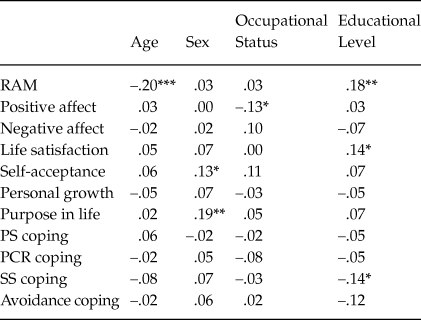
The correlations between socio-demographic and psychological variables can be seen in Table 1.
Correlations between Sociodemographic and Psychological Variables

Note: RAM = Relative Autonomy of Motives; PS = Problem Solving; PCR = Positive Cognitive Restructuring; SS = Social Support; Sex: 1 = men, 2 = women. Occupational status: 1 = employees, 2 = not employees; Educational level: 1 = elementary, 2 = secondary, 3 = higher education.
* p = .06 ** p < .05 *** p < .01
According to these correlations, RAM decreases as age increases, women report higher levels of purpose in life and self-acceptance (although the last correlation only with marginal significance), and the inmates who are active report higher levels of positive affect (this correlations also with marginal significance). In relation to the educational level, the higher the level reached, the greater the autonomous motivation and life satisfaction and the lower the use of SS coping (this last correlation also with marginal significance).
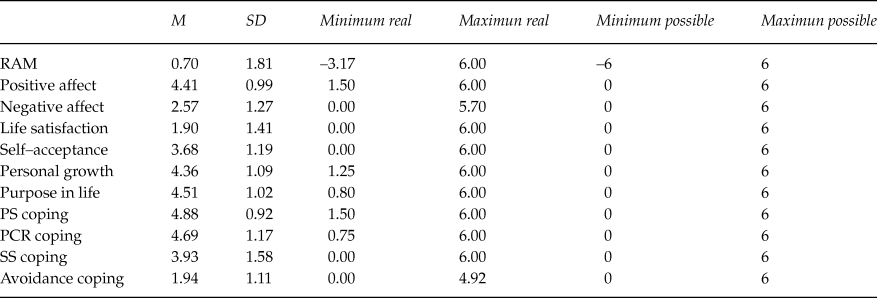
Descriptive statistics of the psychological variables can be seen in Table 2. Taking into account the data of the general population with which each of the questionnaires used has been validated, scores obtained show that the inmates (1.90) report significantly less life satisfaction than the general population (4.47) (Vázquez et al., Reference Vázquez, Duque and Hervás2013), t(431) = 20.50, p < .001. Inmates scores on self-acceptance (3.68), personal growth (4.36) and purpose in life (4.51) do not show statistically significant differences with those obtained by the general population (4.31, 4.57, and 4.47 respectively) (Díaz et al., Reference Díaz, Rodríguez-Carvajal, Blanco, Moreno-Jiménez, Gallardo, Valle and van Dierendonck2006), t(640) = 1.70, 1.20 and 0.51 respectively, all ps > .30]. In addition, the motivation that guides your goals, although it is predominantly autonomous because its value is greater than zero (0.70), it differs significantly from that obtained by the general population (2.31) (Sanjuán & Ávila, Reference Sanjuán and Ávila2016), t(378) = 8.94, p < .001.
Descriptive Statistics of Analysed Variables

Notes: RAM = Relative Autonomy of Motives; PS = Problem Solving; PCR = Positive Cognitive Restructuring; SS = Social Support.
The results of the analyses of variance also indicated, after controlling for the effect of occupational status, that inmates experienced significantly more positive than negative affect, F(1, 172) = 29.30, p < .001, η2p = .15. Likewise, we found statistically significant differences in the frequency of use of the different coping categories, F(1, 173) = 72.42, p < .001, η2p = .30. The post hoc analyses indicated that inmates used the PS and PCR coping with the same frequency, and both forms of coping rather than SS and avoidance coping. The latter was the less frequently employed.
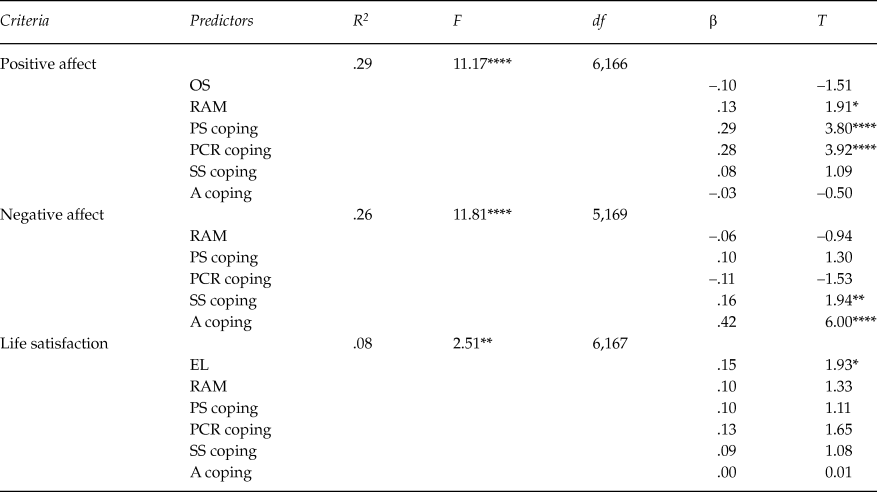
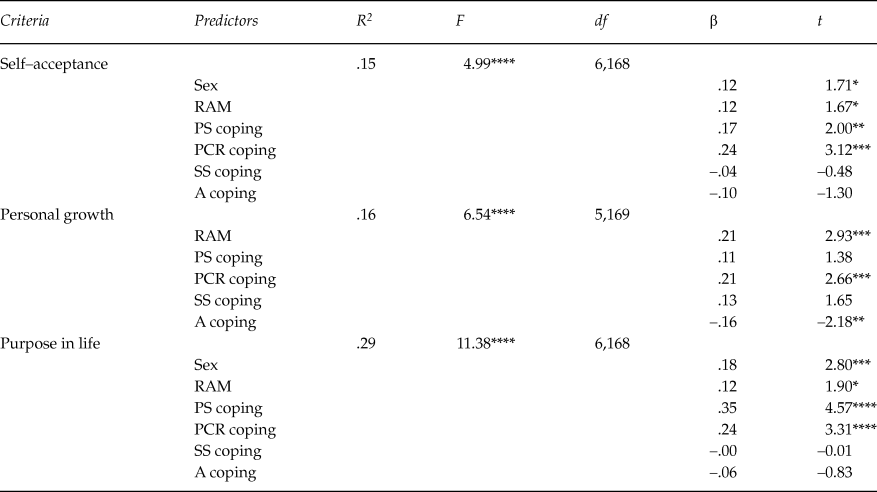
In Tables 3 and 4 we can see the results of the regression analyses performed to study the joint contribution of motivation and coping on different well-being dimensions.
Results of Regression Analyses to Predict Subjective Well-Being Components

Note: OS = Occupational Status; EL = Educational Level; RAM = Relative Autonomy of Motives; PS = Problem Solving; PCR = Positive Cognitive Restructuring; SS = Social Support; A = Avoidance. Occupational status: 1 = employees, 2 = not employees; Educational level: 1 = elementary, 2 = secondary, 3 = higher education.
* p = .06. ** p < .05. *** p < .01. **** p < .001.
Results of Regression Analyses to Predict Psychological Well-Being Dimensions

Note: RAM = Relative Autonomy of Motives; PS = Problem Solving; PCR = Positive Cognitive Restructuring; SS = Social Support; A = Avoidance. Sex: 1 = men, 2 = women.
* p = .06. ** p < .05. *** p < .01. **** p < .001.
After controlling for the specific socio-demographic variables that maintained significant correlations with each of the well-being dimensions, positive affect, self-acceptance and purpose in life were positively predicted by the PS and PCR coping as well as by the RAM (although in the latter case the significance was marginal). Personal growth was positively predicted by the PCR coping and RAM, and negatively by avoidance coping; and negative affect was positively predicted by SS and avoidance coping.
Discussion
The purpose of this study was twofold: First, to assess well-being, motivation and coping in a sample of inmates; and second, to examine in this sample the joint contribution of coping and motivation to well-being.
Concerning the first purpose, with regard to well-being, our hypotheses are partially confirmed. As expected, inmates report acceptable levels of positive affect, self-acceptance, personal growth and purpose in life. These results support, in a correctional context, the proposal of some researchers that suggest that individuals are prompt to experience a positive and overall level of well-being (Diener, Kanazawa, Suh, & Oishi, Reference Diener, Kanazawa, Suh and Oishi2015). However inmates report a low life satisfaction. It is understandable that inmates are not pleased with their lives if we consider that life satisfaction reflects the evaluation of their actual conditions with regard to a standard, being imprisonment a circumstance rarely viewed positively.
Furthermore, taking into account that prison setting offers little chances of personal decisions, that confinement is a punishment, and that correctional system is based on contingent reinforcement in form of achieving benefits according behavior and participation in activities, we might say that prison does not promote an autonomous motivation. Therefore, we expected a prevailing controlled motivation. However, our results show that incarceration does not override autonomy since participants are mainly autonomously motivated. Due to the lack of information about pre-prison levels of motivation, we cannot know the way this environment impact on motivation, though its small intensity, near zero, and the difference maintained whit that of the general population, lead us to believe that it is indeed influenced.
With regard to coping, it was our understanding that changing personal perception of situation would be easier and hence more used that modifying situation in itself, since much of the problems during incarceration cannot be solved because stem from prison conditions, and the fact that coping actions are constrained by this environment. This idea is supported by previous studies in correctional settings that have shown a positive relation between the PCR coping and well-being (Mefoh et al., Reference Mefoh, Okafor, Ezeah and Odo2015; van Harreveld, et al., Reference van Harreveld, van der Pligt, Claassen and van Dijk2007). As we expected, participants use the PCR coping more often than avoidance coping. Nevertheless, they employ the PS more than we anticipated, with the same frequency as the PCR, and more frequently than the SS coping.
Lazarus and Folkman (Reference Lazarus and Folkman1984) suggest that when the situations are perceived as manageable is more likely to use problem-focused coping, and that emotion-focused strategies are more likely used with low controllability perceptions. The fact that in our study inmates experience well-being and use more often the PS than the avoidance coping could be revealing certain levels of control. Although conclusions drawn by previous studies (Blevins et al., Reference Blevins, Listwan, Cullen and Jonson2010) indicated that there is a loss of personal autonomy and perceived control associated with imprisonment.
When motivation and coping strategies are studied together, as we expected, and in accordance with evidences of different contexts from prison (Hortop, Wrosch, & Gagné, Reference Hortop, Wrosch and Gagné2013), inmates’ well-being is positively predicted by the degree of autonomous motivation (although with marginal statistical significance for some well-being dimensions) as well as by the use of coping strategies adaptive in this environment (Mefoh et al., Reference Mefoh, Okafor, Ezeah and Odo2015; van Harreveld et al., Reference van Harreveld, van der Pligt, Claassen and van Dijk2007).
Specifically, as we anticipated, the autonomous motivation, and the PS and PCR coping were positive predictors of all positive well-being dimensions, except for personal growth in which the PS coping was not a significant predictor, and for life satisfaction, in which none of these variables taken together could predict it. Our findings show, as we expected, that the PS coping is related to well-being but the PCR coping is associated with a greater number of well-being facets. Therefore, it could be suggested that the PCR coping plays a more crucial role in an optimal psychological functioning in prison setting, in the same vein as previous research (Mefoh et al., Reference Mefoh, Okafor, Ezeah and Odo2015; van Harreveld et al., Reference van Harreveld, van der Pligt, Claassen and van Dijk2007).
The fact that life satisfaction was not predicted by any of the psychological variables when these were considered together suggests that other variables of more contextual character might be more relevant in this sample of prisoners. On the other hand, our data reveal that, even taking into account these psychological variables, the educational level, although with marginal significance, maintains its capacity to predict life satisfaction, confirming in this type of sample, what other studies have shown (Diener et al., Reference Diener, Suh, Lucas and Smith1999), that the higher the educational level, higher life satisfaction is reported.
When variables were analyzed together, contrary to expectations, negative affect was not negatively predicted by the RAM, PS and PCR coping, whereas it was positively predicted by the SS coping and, as we expected, also by the avoidance coping. In other words, when the inmates look for social support to cope with their problems or avoid them, they experience negative affect.
Previous research carried out in different settings from prison (Caunt, Franklin, Brodaty, & Brodaty, Reference Caunt, Franklin, Brodaty and Brodaty2013), as well as in correction departments (Listwan et al., Reference Listwan, Colvin, Hanley and Flannery2010), have shown that the SS coping is related to general well-being and better adjustment to this context. However, our results seem to be consistent with the statements of some researchers (Litman, & Lunsford, Reference Litman and Lunsford2009) that consider the SS coping as a dynamic process not necessarily perceived as beneficial, suggesting that these strategies can have both positive and negative relationships with well-being. In our study, the negative relationship that the seek for support maintains with well-being may be due to several causes: a) The joint analysis of instrumental and emotional support, because while the former has systematically been associated with well-being, the latter does not (Ben-Zur & Zeidner, Reference Ben-Zur and Zeidner2012; Carver et al., Reference Carver, Scheier and Weintraub1989; Litman & Lunsford, Reference Litman and Lunsford2009); b) the seek for support does not imply that the support is received; and c) the fact of have to seek for support to cope with the situations can decrease the perception of self-efficacy and personal autonomy perceptions, which could increase the discomfort in the inmates (Lindquist, Reference Lindquist2000).
The present research has some limitations that should be taken into account in future studies. It should be note that the use of a cross-sectional design has not allowed us to establish causal relationships between the variables examined, nor to control the effects of other variables such as goal progress that has shown to be associated with well-being (Diener et al., Reference Diener, Suh, Lucas and Smith1999). Future examinations of these topics would benefit from the use of longitudinal designs.
Regarding sex, though we have controlled its effect, we cannot analyze the potential sex-based differences in the psychological variables due to the underrepresentation of women in our sample. Even though this reflects the current reality, in which females represent about 7.6% of Spanish’s prison population in 2015 (Ministerio del Interior Español, 2016), a larger number of women would have allowed us to create groups and examined this issue.
The combined use of both quantitative and qualitative methodologies would have helped us to understand more precisely some unexpected results as those found with regard to SS or PS coping. Similarly, if we had included some contextual factors (length of the sentence, point of the sentence), we could have examined its potential effect on and relationship with the variables analyzes.
In relation to the measures, it should also be noted that, although most of the self-reports employed have shown adequate reliability, some subscales, such as personal growth, have not reached sufficient internal consistency coefficients, so it would be essential to corroborate the results obtained using measures with greater reliability.
Finally, it should be noted that most research conducted in prison have been mainly carried out in countries other than Spain, with correctional systems different from ours. For this reason, their conclusions must be applied to our reality with caution.
As a summary, we can highlight that this study shows that prisoners report acceptable levels of subjective and psychological well-being and that they pursue their goals with a certain degree of autonomous motivation. The latter fact together with the frequent use of the PS coping seem to indicate that they maintain a certain level of personal control, although there are a loss of autonomy and personal control associated with incarceration.
Autonomous motivation together with the use of PCR coping are those factors that most predict well-being, while the use of avoidance coping is associated with negative affect. The seek for social support is also associated with negative affect, possibly because seeking support does not imply this support is necessarily achieved and / or because the need for others to solve problems can lead to decrease the self-efficacy perception of prisoners.
The results suggest that well-being promotion programs in prison settings should encourage the pursuit of goals by autonomous motivations and the use of PS and PCR coping to achieve these goals. Our results have implications for the possible implementation of evidence-based well-being promotion programs in prison settings.