Endoscopic procedures are among the most commonly performed procedures for inpatients and outpatients. They are essential to the diagnosis and management of common conditions such as gastrointestinal bleeding, complicated ventilator-associated pneumonia, and colorectal cancer screening. Multiple guidelines have been published on the cleaning, disinfection, and sterilization processes for endoscopes.Reference Banerjee, Shen and Nelson 1 – 5 Endoscope-associated infections are considered rare events and are largely related to failure to follow a proper reprocessing technique. Routine culture of endoscopes after disinfection is not the standard practice in the United States. However, a recent series of outbreaks of endoscope-associated infections have raised concerns over the safety of these procedures.Reference Jorgensen, Bojer and Boll 6 , Reference Marsh, Krauland and Nelson 7 The persistence of contamination on endoscopes after adequate reprocessing is well documented.Reference Ofstead, Wetzler and Doyle 8
The search is ongoing for safe and cost-effective endoscope reprocessing techniques.Reference Kovaleva, Meessen and Peters 9 One of the biggest challenges therewith is assuring the removal of biofilm from the lumen of the endoscope, especially following lengthier, more complicated procedures. Reported endoscope-related outbreaks, in the absence of obvious processing errors, likely represent only a fraction of the total number of disinfection failures.Reference Gastmeier and Vonberg 10 , Reference Srinivasan, Wolfenden and Song 11 Repeated use, duration of procedure, and time to reprocessing are potential causes of disinfection failures. Furthermore, mechanical removal of biofilm is essential, and high-level disinfection (HLD), or even ethylene oxide sterilization (ETO), may not guarantee biofilm eradication.Reference Kovaleva, Peters, van der Mei and Degener 12
A biofilm is defined as the firm adherence of polysaccharide substance produced by the organisms to a surface, in this case the endoscopic lumen. A biofilm is hard to sterilize without actual mechanical removal. Endoscopes have elaborate designs, with long, narrow lumens and complex distal tip structures (eg, an elevator plate, as in endoscopic retrograde cholangiopancreatography [ERCP]). Delays in the reprocessing of endoscopes and complicated, long procedures can favor biofilm formation within the endoscope lumen. In addition, any interior (even minor) mechanical damage could support biofilm formation and increase the risk of subsequent transmission of microorganisms.
ETO sterilization after HLD has been reported to be successful in terminating an outbreak.Reference Epstein, Hunter and Arwady 13 ETO sterilization after HLD has also been reported to reduce bacterial colonies more effectively than HLD alone. Longer enzymatic soaking may additionally expedite the reduction of bacterial counts and allow scopes to be adequately reprocessed using HLD. Furthermore, presoaking is recommended by the manufacturer when delays in processing are anticipated.Reference Epstein, Hunter and Arwady 13 , 14
The culturing of endoscopes is a complex undertaking in terms of both procedure and interpretation. Optimizing the sensitivity of cultures is essential in detecting any residual bacterial contamination after reprocessing. The “flush, brush, flush” approach has been accepted widely, but few data are available on the sensitivity of its steps.Reference Kovaleva, Peters, van der Mei and Degener 12 , Reference Gazdik, Coombs, Burke and Lopansri 15 The aim of this study, therefore, was to develop a model for the evaluation of reprocessing and culturing of endoscopes using a disposable endoscope (DB) model.
METHODS
Assessment of Endoscope Procedures
At our 495-bed academic urban medical center in Pittsburgh, Pennsylvania, we first collected and reviewed data on the duration of different endoscopic procedures: duodenoscopies (ERCP), endoscopic ultrasound (EUS), esophagogastroscopy (EGD), colonoscopy, and bronchoscopy. The majority of the lengthy procedures in our facility involved ERCP and EUS. The most commonly performed endoscopic procedure was bronchoscopy followed by EGD.
Bronchoscopic procedures had the longest duration times among all endoscopic procedures. The mean duration times for all endoscopic procedures reviewed was 61 minutes for bronchoscopies, 44 minutes for EUS, 32 minutes of ERCP, 16 minutes for colonoscopies, and 10 minutes for EGDs. Bronchoscopic procedures performed in the operating room were found to have longer procedure times. Advanced thoracic surgery procedures could last for 4 or more hours, and the bronchoscope could be used off and on for the same patient during these lengthy procedures. Times to reprocessing were especially variable for bronchoscopic procedures performed in the operating room, the endoscopy suite, and the intensive care units (ICUs). Bronchoscopic procedures were also performed emergently on weekends and after hours. We noted that delay in the processing of bronchoscopes was more common than for any other endoscopes. This problem was addressed prior to the study, with significant improvement in reprocessing time resulting from monthly reporting and feedback.
Study Design
This pilot study was designed with 3 objectives: (1) to determine the effect of time between simulated use and reprocessing (range, 1–4 hours) on residual microbiological contamination using a disposable bronchoscope, (2) to determine the effect of longer enzymatic detergent soaking time (30 minutes) versus standard detergent soaking time (<5 minutes) on the level of microbiological contamination following reprocessing, and (3) to compare the effectiveness of ETO sterilization and HLD on microbial contamination using varying times to reprocessing and enzymatic detergent soaking time.
Preparation and Processing of Bronchoscopes
Commercially available DBs (Ambu aScope 3; Ambu, Ballerup, Denmark) were used. 16 DBs use a video camera rather than fiber optic technology. DBs are for single use only and are not to be processed for reuse. This DB has been used by critical care and thoracic surgery services at our medical center and is considered to be of appropriate quality for use in patient care in terms of quality of images, ease of maneuvering, and functionality that closely matches that of nondisposable bronchoscopes.
Contamination of the scopes was performed using a mixture of 1×10¹¹ CFU/mL bacterial suspension of extended-spectrum β-lactamase (ESBL)–producing Escherichia coli ATCC 30218, Pseudomonas aeruginosa ATCC 27853, vancomycin-resistant Enterococcus faecalis ATCC 51299, and carbapenemase-producing Klebsiella pneumoniae strain BAA-1705 in tryptic soy broth. Also, contamination of 8 DBs and an ERCP scopes was performed using spores of Clostridium difficile ATCC 43255 in a 1×10¹¹ CFU/mL bacterial suspension.Reference Muscarella 17
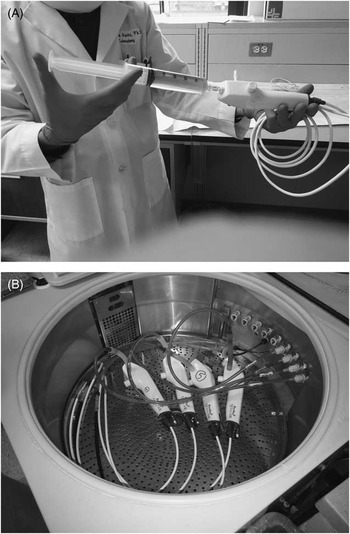
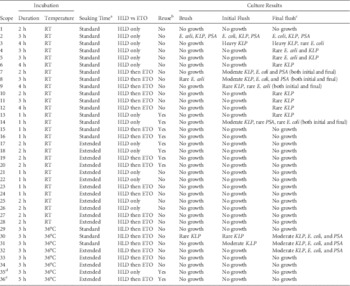
The scopes were contaminated using 50 mL of the bacterial suspension as shown in Figure 1A. The scopes were left at room temperature or were incubated at 36°C for defined periods. Duration of contamination and details of incubation for all scopes are summarized in Table 1. The scopes were then taken to the endoscopy suite for reprocessing per the manufacturer’s instructions for fiber optic bronchoscopes. All of the scopes were cleaned, flushed, and brushed per routine endoscopic processing. Dual-enzyme protease and α amylase enzymatic cleaning were performed using CareFusion V Mueller (Cat. 25132, Becton Dickinson, San Jose, CA). Soaking was performed with a new, freshly diluted solution each time. HLD was then performed for all scopes using an automated HLD machine (Figure 1B). The HLD was performed using Cidex Ortho-Phthalaldehyde (OPA, Advanced Sterilization Products, Ethicon, Somerville, NJ) 0.55% via Custom Ultrasonics System 83 (Custom Ultrasonics, Warminster, PA). The reprocessing was performed at the clinical endoscopy suite and was identical to the reprocessing of fiber optic endoscopes at our institution. Longer soaking (30 minutes) in the enzymatic detergent was performed on 20 scopes before HLD or ETO sterilization (Table 1).
Disposable bronchoscope contamination and processing. Panel A: contamination of scopes with 50 mL of bacterial suspicion. Panel B: automatic ultrasonic high-level disinfection (HLD) processing of scopes after manual processing.

Summary of Endoscopic Contamination, Incubation, Processing, and Culture Results

NOTE. HLD, high-level disinfection; ETO, ethylene oxide sterilization; RT, room temperature; KLP, Klebsiella pneumoniae; PSA, Pseudomonas aeruginosa.
a Soaking time: standard time <5 min; extended time=30 min.
b Reuse: recontaminated the negative culture scopes for the second round of experiments.
c Scopes 35 and 36 are duodenoscopes.
d A final flush was done after HLD and another flush was performed after ETO.
e C. difficile spores and vegetative were added to the bacterial suspension and additional flush was performed to culture for C. difficile.
The scopes were transferred to the microbiology laboratory for culturing. ETO sterilization was performed either immediately after HLD (4 DBs) or after culture (16 DBs and an ERCP). If ETO was performed after HLD, only the terminal flush was performed (brushes and initial and final flushes had already been performed after HLD). ETO cycles averaged 14–15 hours, with temperatures ranging from 54.27°C to 54.94°F and a sterilization cycle of 1 hour.
Culturing of Disposable Bronchoscopes
After the cleaning procedures, DB cultures were obtained using the standard “flush, brush, flush” technique. For the pre-brushing cultures, antegrade flushing of DBs was performed with 50 mL of sterile water. The post-flush water was collected in a sterile container and passed through 0.45-µm polyethylene analytical filter (Nalgene polyethylene analytical filter ware, Thermo Scientific, Waltham, MA). Upon completion of filtration, the membranes were aseptically placed on blood agar plates and incubated at 36°C for 24–48 hours. Any growth was subcultured on blood agar and MacConkey plates and incubated for growth and identification.
Endoscope channels were then brushed with sterile single-use swabs (FLOQSwabs CLASSIQSwabs in a pouch, Copan Diagnostics, Murietta, CA). In total, 3 swabs from biopsy, water, and air channels were inoculated into 3 1.0-mL brain–heart infusion (BHI) broth tubes, respectively. An additional tube was used for the ERCP plate. The 10-µL plastic calibrated loops were used to inoculate blood agar and MacConkey agar plates after mechanical shaking and were incubated for 24–48 hours. A final flush was then performed similarly to the initial flush.
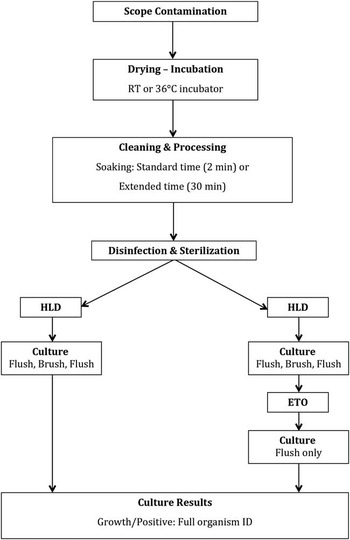
Cultures aimed at recovering C. difficile (vegetative cells and spores) were also conducted for 8 DBs. Suspensions of C. difficile spores and vegetative forms were prepared at a concentration of 10 5 CFU/mL and were used to contaminate the scopes as described above. The same analytical filters were used for collection of C. difficile. Cycloserine-cefoxitin fructose agar with taurocholate and lysozyme (CCMA-tal) selective culture medium was used to culture for C. difficile. Reference Kawata, Tanaka and Kakushima 18 A summary of the study protocol is shown in Figure 2.
Summary of study protocol.

In total, 36 experiments were performed: 26 experiments with new DBs, 8 experiments with recontaminated DBs, and 2 experiments with a single ERCP (model TGF-160VF; Olympus, Center Valley, PA). All scopes were subjected to manual processing and automated HLD according to the standard of care for fiber endoscope processing. ETO sterilization was performed on 21 scopes (20 DBs and 1 duodenoscope). Extended enzymatic soaking (30 minutes) was performed on 18 DBs. Contamination times and incubation details of all scopes are summarized in Table 1. Statistical analyses were conducted using Stata v14.1 software (StataCorp, College Station, TX) for frequency and strength of associations.
RESULTS
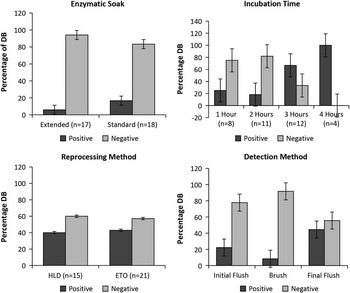
A total of 108 brush and 88 flushed-water cultures, including 44 initial flushes and 44 final flushes, were performed for the 36 contaminated endoscopes. Figure 3 summarizes the relations between positive cultures and different incubation, processing, and methods.
Analysis of positive cultures in relation to different incubation, processing and culture method. The relation between positive culture and (A) enzymatic soaking, (B) incubation time, and (C) method of disinfection and sterilization (high level disinfection [HLD] vs HLD + ethylene oxide sterilization [ETO]), and (D) the yield of different methods of culture.

Longer soaking for 30 minutes was effective, yielding only 1 positive culture among 18 scopes tested (6%). With standard soaking, 3 of 18 scopes (16.7%) yielded positive cultures (P<.001) (Figure 3A).
The yield of positive endoscope cultures increased as the incubation time from contamination to soaking increased (Figure 3B). Of 8 DBs, 2 were positive after 1 hour of incubation (25%); 2 of 11 DBs were positive after 2 hours of incubation (18.1%); 8 of 12 DBs were positive after 3 hours of incubation; and all 4 DBs tested were positive after 4 hours of incubation. The positive culture results between 2 hours or less of incubation and longer than 2 hours were significantly different (P<.001). Scope cultures were positive in 9 of 21 scopes (43%) that underwent ETO sterilization. Cultures of scopes after HLD were positive in 6 of 15 scopes (40%). There were no significant differences in positive culture rates when ETO was added to HLD (P=.83) (Figure 3C).
Brushes yielded positive cultures from 3 scopes (8%), while flushes yielded positive cultures from 8 and 16 (22% and 44%) of the initial and final flushes, respectively. The difference between the yields of brushing and final flush was statistically significant (P=.044). Thus, flushing of the scopes was the most effective method of detecting bacterial contamination post reprocessing in this study (Figure 3D). All scopes that yielded positive brush cultures also yielded positive flush cultures but not vice versa.
Gram-negative bacteria, particularly K. pneumoniae, were difficult to eradicate; they grew on all 16 DBs after HLD or HLD and ETO sterilization. In contrast, none of the cultures grew E. faecalis after reprocessing (0 of 36), and C. difficile did not grow from any of the cultures (0 of 8).
DISCUSSION
Endoscopic procedures are an increasingly recognized source of hospital-acquired infections. This transmission may occur endogenously secondary to translocation of pathogens into the bloodstream as in the case of ERCP for obstructive cholangitis or secondary to injections of variceal bleeding. As the rates of significant bacteremia after endoscopic procedures vary widely, recommendations regarding antibiotic prophylaxis remain controversial after high-risk procedures.Reference Kawata, Tanaka and Kakushima 18 , Reference Thosani, Zubarik and Kochar 19 On the other hand, exogenous infection is transmitted from previous endoscope use due to residual organic material that was not adequately removed and should be preventable.Reference Ofstead, Wetzler and Doyle 8 Given the increasing concern for endoscope-associated transmission of infectious agents and uncertainties regarding the optimal disinfection method to prevent residual bacteria, the present study was conducted to establish an endoscope disinfection model using DBs, to compare the effects of various incubation times and soaking times, and to investigate the role of ETO in bacterial eradication.
Our study is the first to establish a DB model for the evaluation of endoscope processing and microbiological methods. Our findings highlight the value of flushing of scopes compared to brushing; flushing after brushing yielded the most positive cultures. The reason for the low yield of the brush cultures is not clear. We hypothesize that brushing loosened the bacteria adhering to the scope lumen, making it easier to be captured by the final flush. Overall, the commonly reported 3-step culture method appears to be an adequate approach that could be simplified further without compromising the yield by limiting the cultures to the final flush.Reference Ribeiro and de Oliveira 20 , Reference Schnabel, Van der Velden, Osinski, Rohde, Roekaerts and Bergmans 21
Some endoscope-associated infections have been associated with deficiencies during processing or mechanical failure of the scopes.Reference Srinivasan, Wolfenden and Song 11 However, our findings support recent reports suggesting that this is not necessarily the case. In our study, surveillance cultures were positive from 44% of the scopes despite the use of mechanically intact scopes (mostly new DBs) and strict monitoring of reprocessing. Bronchoscope-associated bacteremia may occur in up to 7% of patients with respiratory complications documented in up to 25% of patients undergoing this procedure.Reference Rutala and Weber 22 It is difficult to ascertain whether these endoscopy-associated complications are exogenous infections due to inadequate endoscopic processing or endogenous procedure-related complications. Nonetheless, the high rates of positive cultures after adequate disinfection procedures support the argument for expanded surveillance cultures of endoscopes.
Pathogenic organisms were more likely to persist on the scopes after contamination, when they were incubated for 2 hours or longer (80% vs 21% for 2 hours or less). Our experiments used a constant inoculum of 1×10¹¹CFU/mL; it is likely that the inoculum may be higher in real-life scenarios. Furthermore, lengthy, complicated procedures may pose additional risk due to the presence of blood or other organic materials that were not simulated in our experiments.
Longer soaking (30 minutes vs <5 minutes) effectively reduced contamination, presumably because it facilitated removal of debris adhered to the lumens. However, further studies are needed to answer these questions definitively. Manufacturers recommend longer soaking for delayed processing or heavily soiled scopes, especially when blood is present. 14 In our institution, we routinely perform longer soaking for all scopes not processed within 60 minutes. However, consistent tracking of specific scopes that underwent longer procedures or heavy soiling is often challenging to integrate into the workflow of the hospital. Furthermore, endoscopic procedures are commonly performed by residents and fellows in multiple areas of the hospital at any time of the day or week at teaching hospitals like ours, which could result in increased mechanical malfunctions and/or delayed processing.
A recent large outbreak of carbapenem-resistant Enterobactericiae (CRE) in a large academic center was traced back to contaminated ERCP scopes.Reference Epstein, Hunter and Arwady 13 This outbreak was contained only after an additional step of ETO sterilization was added after HLD.Reference Epstein, Hunter and Arwady 13 , Reference Rutala and Weber 22 This outbreak event prompted the US Food and Drug Administration to issue multiple alerts regarding the steps of endoscopic processing. 23 , 24 However, ETO sterilization did not provide a significant benefit in our study. Thus, many questions remain regarding how best to implement endoscope processing procedures that ensure patient safety while managing resource utilization.
The limitations of this study include the small number of scopes and the design difference between fiber optic endoscopes and DBs. Certainly, DBs are meant to be used once and are not meant to be reprocessed. This characteristic of DBs is very different from the fiber optic bronchoscopes, which are designed for multiple uses and reprocessing, and the findings may not be generalizable to fiber optic bronchoscopes. Also, C. difficile contamination was not detected after endoscope processing in any of the experiments, but the number of experiments was small, and the results need to be interpreted with caution.
In summary, this work provides a useful model for examining the association of disinfection or sterilization procedures and residual contamination of endoscopes, and these findings indicate the value of routine surveillance cultures in preventing endoscope-associated transmission of commonly encountered bacteria.
ACKNOWLEDGMENTS
Financial support: This project with supported by a grant from Beckwith Foundation with a similar support from the healthcare facility.
Conflict of interest: All authors report no conflicts of interest relevant to this article.