‘Adji Betty c Fanta. Je deux fille moi. Tu es au courant.’ (Adji Betty, it is Fanta. I have two daughters. You are up to date now.) So wrote the daughter of a family that I had lived with during my fieldwork research trips to Dakar.
Our Facebook conversation in broken French continued as I replied, ‘What? You have two daughters now?’
And in Wolof Fanta replied, ‘Bb nungi fii amna trois mois. Envoi des habits pr bb. Habit pr bb ke tu mave donne dafa bakh. Sama dome mougui sol yereyi ba legui.’ (My baby is three months old. Send me some clothes for my baby. The clothes that you gave me were good. My child is still wearing them.) She was referring to clothing that I had given to her first child, born two years earlier.
Through these brief Facebook conversations I kept in touch with women that I had come to know through fieldwork in Dakar, Senegal since the early 1990s. Cheaper than the phone cards I once bought and the cost of using Skype internationally, Facebook allowed us to exchange photographs of our families and to chat online. It had become part of my daily routine, logging on to Facebook to post photographs of my two daughters and checking to see if anyone had posted any new pictures from family events, parties, or religious holidays. I also kept up with members of this family who had settled in Montreal, Hartford (Connecticut), Brooklyn, and Houston, and started their own families. This had become my daily habit and an everyday activity engaged in by many of my friends in Dakar, who had internet access thanks to a migrant sibling. Yet I sensed that I, and probably they too, often forgot that these daily postings were really snapshots of momentary highs and not representative of the strains of everyday life, or even the stress of getting that perfect shot to post on line or put in an album. However, I contend that the endless stream of photographs disguises this unremarkable reality. Facebook is the perfect medium for women engaging in this social work, for it transfers to a digital medium what women have been doing for a long time: making and looking at each other's photo albums, the subject of this article.
In what follows I discuss the predicament of two women in the same family, Fanta and her sister-in-law, Amina. I show how these young women extemporize their respectability in a time of fiscal uncertainty through personal photography. Potentially, albums can reveal social networks: number and frequency of invitations; density of social network; intensity of circulation; and the budget to purchase clothing and pay for pictures documenting this social activity. It is not only the albums that are expensive; so also are the social events that are worthy of photographs. A photograph involves more than just sitting in front of the camera – it entails particular ways of moving from place to place, such as by taxi rather than public transport; or making one's way through the city with a particular rhythm requiring the kinds of shoes and stacking bracelets that make the right sound; and the meaning of every step has an economic dimension. Successful albums index social networks that are constituted in and through ritual moments such as marriages, childbirth and religious festivals. As I demonstrate in this article, the making and meaning of these images develop out of various influences including colonial postcards, urban imagery and Muslim iconography, and reveal the extent to which these photographic practices are from their very inception global and transnational. Yet, rather than archives of the past, these albums, when they are successful, create social futures.
If albums can show the social possibilities and moral qualities of their bearer, they can also express inequality within the family, the neighbourhood, and the global. How do women like Fanta and Amina deal with economic and social disparity as they see it within their families, the various communities to which they seek to belong, and globally? The neighbourhood of Khar Yalla is an improvised, interconnected, and multilayered space settled by families removed from the city centre during clean-up campaigns between 1960 and 1970, by families escaping conflict in Casamance and Guinea-Bissau, and by recent rural migrants. And if Khar Yalla is an improvised neighbourhood, it is also a space of improvisation. When women pose for, display, and pass around portraits of themselves at key moments in their lifetimes, whether in the medium of social networking sites or photo albums, they reveal as much as they conceal the elements of individual and social life.
When women perform for the camera they index their urban neighbourhoods not as peripheral, but as central to the city at large and to the lives and imaginations of their families abroad. Urban spaces, and especially the quartier populaire of Khar Yalla, are talked about by men and women in Dakar as loud, unruly and fraught spaces with vast inequalities and incommensurabilities. How do women in these neighbourhoods actively shape and construct contemporary urbanity in terms of ‘social infrastructure’ (Simone Reference Simone2001)? Personal photography points to a social infrastructure and use of new technologies that connect where material infrastructure is disconnecting.
I had last seen Fanta during a visit to Dakar in December 2011. Since I had missed the birth of her first daughter less than a month before and the baby-naming celebration, or ngénte, held seven days after, Fanta retrieved the slim vinyl photo album for me. I opened the album expecting to see the elaborate cutwork, multiple exposures, and artistic photomontages commonly produced by commercial photographers across West Africa, and which I had seen in countless albums during previous periods of fieldwork. Instead, the album sleeves held single 4×6 inch photographs of Fanta's marriage, which had taken place two years before, in 2009, and her recent baby-naming celebration. As I looked through the album, some of the other family members in the room became quiet, some looked away toward the television, and a few left.
The album contained mainly portraits of Fanta alone and with her sisters and nieces seated on a couch facing the camera. Several of the photographs had been printed on stock paper with a simple red rose at the edge or a scroll. There were a few other images including her mother shaving the infant's head for the naming ceremony, and a group shot of the men assembled. The style of the album conflicted with what I knew of Fanta, whom I had first met as a ‘sob’ (active) five-year-old in the spring of 1992. In contrast to her current style, which was youthful, edgy, and sometimes a bit shameless, these photographs portrayed a woman who might very well go unnoticed at a social event. In all, the photo album was consistent with the developments in Fanta's life that I had already heard about from her siblings over the past couple of years: the baby was born while the husband chosen for her continued to work in Spain's shrinking construction industry. The newly-wed period was turbulent; the ngénte had taken place only in the morning, without the gathering of women in the afternoon to exchange gifts of cloth. Moreover, Fanta was never brought into her husband's compound, an essential stage in the marriage process. Rather, she was in limbo – so her niece offered to share her bed with Fanta and the infant. Fanta's niece had been moved into Fanta's parents' house when Fanta's eldest sister divorced and left for the United States, almost ten years earlier.
I asked her if she put her album together herself, ‘Déedéet,’ she replied, ‘photokat mo ko def.’ (No, the photographer did it.) Then she added, ‘Maay na ay photo bi après.’ (I have given some of the photographs away.) In fact, women often swap 4×6 portraits of themselves with their close friends by removing them from their album sleeves and replacing the empty spot with a friend's portrait. This is one of the ways in which women index social networks and make them visible to other audiences. Through these photo albums women look forward, creating and expanding networks, rather than keeping family histories.
Fanta said that she wore three different outfits for the album and only two of them on the morning of the baby-naming ceremony; these were dresses made from ten metres of locally dyed cloth known as a grand boubou. I told her that I thought the ensembles were ‘Rafet na’ (beautiful). In response, she then brought out another piece of her outfit that was not visible in the portraits, which were threequarter-length bust shots. She showed me a single piece of locally woven strip cloth called sër-u-rabbal, six bands of cotton cloth sewn together to form a wrapper. She explained that her mother's sister gave her the wrapper to commemorate the birth of this first child. It was deep aubergine cotton, woven with silver Lurex thread.Footnote 1 It was the first of many such wrappers that a woman aspires to accumulate and redistribute during the baby-naming ceremonies, weddings and funerals that measure her lifetime.
I asked to interview Fanta's photographer. Fanta's niece and her sister-in-law, Amina, who had remained in the room, replied in unison, ‘Baay ko’ (Leave it), to indicate that I should let the subject drop. This is a phrase I had heard many times, spoken to myself and to others, as a warning to pull back or to retreat from a line of argument. I chose not to inquire further, understanding that the marriage process and the baby-naming ceremony had been modest affairs given the fraught nature of Fanta's marriage. I surmised that the family was pointing me towards more successful unions and celebrations, events that brought them more joy and pride. I thought this because Fanta's niece and Amina then directed me to Amina's photographer's work, which they described in contrast to Fanta's photographer's work as ‘Baax ne’ (Good). They explained that, unlike many commercial photographers who rented their cameras from studios, Amina's photographer, Alpha, had acquired a studio space in Khar Yalla. Though he took pictures in his studio against various backdrops featuring tropical themes and silk flowers, and offered a panoply of props to his clients, these three women with social aspirations (Fanta, Amina, and Fanta's niece) said such practices were old-fashioned, ‘démodé’ or ‘xewwi na’, and left the practice to older men and women and new migrants to the city.Footnote 2
The young women said that they preferred to have their photographs taken against the backdrop of their own living room to show potential audiences their handsome things, ‘Meubles yi, rideaux yi, lampe bi’ (like furniture, curtains and lamps). As Fanta said this, she pointed around the room and explained that her brothers had purchased many of these items after going abroad. Indeed, many of the valued objects owned and displayed by women were the product of complex social networks and negotiations of buying, borrowing and gifting. Thus a photograph could demonstrate a woman's social sense or skill in managing social relations and acquiring new things.
Amina then climbed the stairs to her room and brought down one of her albums. She explained to me that many women might have as many as three albums to hold photographs of their first child, and that with subsequent children there might be less effort and expense. She handed me her album and I realized that its weight required both of my hands to receive it. She laughed and asked, ‘Diis na?’ (Heavy?) Amina had brought me her wedding album. Bound in imitation leather, the album contained 8×10 s, 5×7 s and 4×6 s. Almost all of the images were taken at her in-laws' home, where she now lived with her husband. There were three-quarter-length bust portraits focused on her face and shoulders, with lighting that illuminated her skin against the backdrop of heavy curtains, velvet-upholstered couches and silk flowers. As I thumbed through the double and multiple exposures of Amina, including one in which there were seven of the same portraits arranged in a montage, Fanta's niece said several times, ‘Waay yo, Amina, danga jekk!’ (Hey you, Amina, you are elegant!) There were similar poses with sisters and sisters-in-law appearing singly and then in multiples, as though they were looking through a disco ball or a set of mirrors. Sometime they appeared in symmetrical oppositions, and on other pages Amina was at the top of the hierarchy of repeating images. There were also portraits of Amina in various poses that I saw commonly among Dakar women. She posed in a squatting position with her chin on her hand or she lounged on a bed. There were also full-length portraits of her as though she were walking into the room, affording a sense of movement to the static image.Footnote 3
PHOTO ALBUMS AND CREATING A SPACE OF RESPECTABILITY IN KHAR YALLA
Over the decades that I have worked in Khar Yalla since the 1990s, Dakar has been a locus of economic volatility wrought by structural adjustment plans, privatization schemes and liberalization of the economy. And nowhere is that volatility keener than in Dakar's improvised settlements: Colobane, Grand Yoff,Footnote 4 Pikine, and many others. The current administration of President Macky Sall continues to be plagued by political and economic problems: land grabs, building collapses, political mendacity, a swelling of ranks of unregulated peddlers and child talibe,Footnote 5 and a disproportionate share of wealth flowing to a few fortunate Senegalese. Young women, like Fanta, seem most vulnerable to misfortune. Where many have fashioned their productivity and respectability through membership in the Murid Sufi congregation and their overseas trade circuits, not all young women have enjoyed the option to travel. Though many sought to be married to these transnational traders, by the 2000s such marriages had ceased to guarantee the evidence necessary to demonstrate middle-class respectability, as they once did. Many of these marriages were not to the prosperous traders who are frequent fliers and customers of shipping companies who move their goods, but to the young men who risked their lives on the high seas in dangerous open wooden pirogues headed for Spain. So these young women sought other ways to achieve respectability.
A portrait, unlike a snapshot, is the way in which a subject presents herself to the world. The desire to present an image of respectability, as expressed through the concepts of am kersa (restraint), jekk (elegance), or rafetlu (beauty), is one of the reasons that women give for making albums. Women strive to maintain social decorum and to be jekk, despite the ups and downs of their personal finances and the turbulent times in which they try to stay afloat. As a project of fantasy, these albums are less about archiving the past than demonstrating potential. The success and failure of Amina and Fanta show how women aspire to use photo albums to create a space of respectability for themselves in an urban milieu that offers many distractions to young women. A well-posed photograph held the power to persuade others of one's well-being and self-possession. Young women can turn to properly composed portraits to alleviate a family's anxiety that, left unattended by husbands abroad, or remaining unmarried past a respectable age, one might become sexually promiscuous.
One can look at the circulation of portraits as a network, and an album is a particular kind of network. Where infrastructure may have broken down or be disorderly, or conventional forms of citizenship and belonging difficult to identify, these social networks provide a different view of urban life. Photography has come to reflect not only the changing fortunes of individuals and families, but transformations in urban landscape itself. These performances, and the networks they constitute, shape and are shaped by their subjects' relationship to the capital city. Khar Yalla's early residents were evicted from the city centre of Dakar between 1960 and 1970 as the city razed self-built structures for middle-class housing. Rather than being bound by the peripheral nature of their neighbourhood, Khar Yalla, women's performances are both motivated and constituted by diverse links to middle-class and expatriate neighbourhoods in other parts of the city; to Tuba, the rural capital of the Murid Sufi congregation and now Senegal's second largest city after Dakar; and to cities overseas in Europe and North America.
African urban spaces are often depicted as sites of atrophy and decay (Davis Reference Davis2006; Watts Reference Watts2005), yet they are vibrant centres of cultural production and places where residents ingeniously deal with economic uncertainty. People appreciate pictures of themselves looking good because everyone knows the hardships that they are all up against, regardless of where they are on the economic ladder. In their visual practices and use of new technologies, such as digital photography, social networking sites, and cellphone cameras, these urban spaces are progressive sites of inspiration and invention (Mbembe and Nuttall Reference Mbembe and Nuttall2004). That creativity may often be both inspired and tempered by hard times wrought by a long history of encompassing global volatility (see, for example, Makhulu et al. Reference Makhulu, Buggenhagen and Jackson2010), for many of these visual practices and the circulation of new technologies take place outside the official economy. Thus the relationship between new media and technology, on the one hand, and the articulation of new spaces of operation beyond the official economy, on the other, suggests yet another strategy for dealing with economic uncertainty (Larkin Reference Larkin2008; Simone Reference Simone, Fisher and Downey2006).
Photo albums make visible at home a vast circulation of wealth (or the image of wealth at least) produced by Murid overseas traders through unregulated economic networks. Many Murid women of diverse economic means seek to create their social and moral selves through photographs, despite their daily sense of privation. Through photo albums women endeavour to create a space of respectability and reputability, especially when the conventional means to do so are unobtainable. These photographs mediate, or create meaningful links, between their experience and the broader economic transformations into which they are thrust. Through such processes of mediation persons create and contest value and meaning (Brennan Reference Brennan2010; Hirschkind and Larkin Reference Hirschkind and Larkin2008; Mazzarella Reference Mazzarella2004). By focusing on how women control the circulation of images to reveal and conceal the proceeds of migrant work we can understand how women create value over a transnational space in the context of the longer history of turbulence that characterizes West African economies (Appadurai Reference Appadurai and Appadurai1986; Comaroff and Comaroff Reference Comaroff and Comaroff2001; Foster Reference Foster and Fajans1993, Reference Foster and Tilley2006; Guyer Reference Guyer2004; Keane Reference Keane and Meyers2001; Mauss Reference Mauss1990 [1950]; Munn Reference Munn1992; Strathern Reference Strathern1988; Weiner Reference Weiner1992). Moreover, we can also understand the city as a complex, varied, and multilayered space of different possibilities and impossibilities.
One of the layers of urbanity in Dakar is the influence of Islam. I focus on how Muslim women consider the efficacy and aesthetics of personal photography in relation to Sufi concepts of luck (warsek) and religious grace (baraka). In so doing I build on the work of other scholars of Islam (Eickelman and Anderson Reference Eickelman and Anderson2003; Eisenlohr Reference Eisenlohr2006; Hirschkind Reference Hirschkind, Meyer and Moors2006; Larkin Reference Larkin2008; Meyer and Moors Reference Meyer and Moors2006; Schulz Reference Schulz, Meyer and Moors2006) whose concern with media practices in Muslim communities extends recent work on media ethnography (Ginsburg et al. Reference Ginsburg, Abu-Lughod and Larkin2002; Wilk and Askew Reference Wilk and Askew2002) by demonstrating local religious meanings of a universal technology. I also argue that rather than seeing photography as an instrument of colonization, we might consider how Muslim women in Dakar use photography to create a space of respectability.
Scholars of Senegal and the Gambia have focused on photography in the studio (Buckley Reference Buckley2000), in fashion (Mustafa Reference Mustafa, Kaspin and Landau2002; Rabine Reference Rabine2010), in the political imagination (Bajorek Reference Bajorek2010), and among Muslims (Roberts and Roberts Reference Roberts and Roberts1998). Photographs are documentary, commemorative, a form of reportage, persuasive, and everlasting (Mustafa Reference Mustafa, Kaspin and Landau2002: 172). They concretize vast social networks of circulation as well as themselves becoming objects that circulate. Muslim women's portraiture expresses the paradox of ‘keeping-while-giving’ (Weiner Reference Weiner1992); for the danger in making wealth visible, or allowing it to circulate, is that it can be lost. Other qualities can be lost as well such as a family's good repute.
THE HISTORIES IN SENEGALESE PHOTOGRAPHS
The last century has seen two photographic revolutions that have led to the expansion of photography in Africa and elsewhere: the Kodak revolution at the beginning of the twentieth century and the digital revolution at its end, both of which accentuated the qualities of movability and reproducibility that Walter Benjamin (Reference Benjamin and Arendt2001, writing in 1936) used to differentiate photography from art. Focusing on these qualities leads us away from looking at African photography as art in the service of colonialism, as much of the extant literature on photography in Africa does (Landau and Kaspin Reference Landau and Kaspin2002), to see how the camera and photography have become at each turn a form of everyday material culture. Contemporary photographic practices have emerged out of a complex visual economy with multifaceted historical and spatial references, including colonial postcards, Islam and studio portraiture, and transnational collaborations with links to very different spheres of value. As I will argue, the reproducibility of colonial postcards and religious images has contributed to their current circulation and their influence over contemporary images.
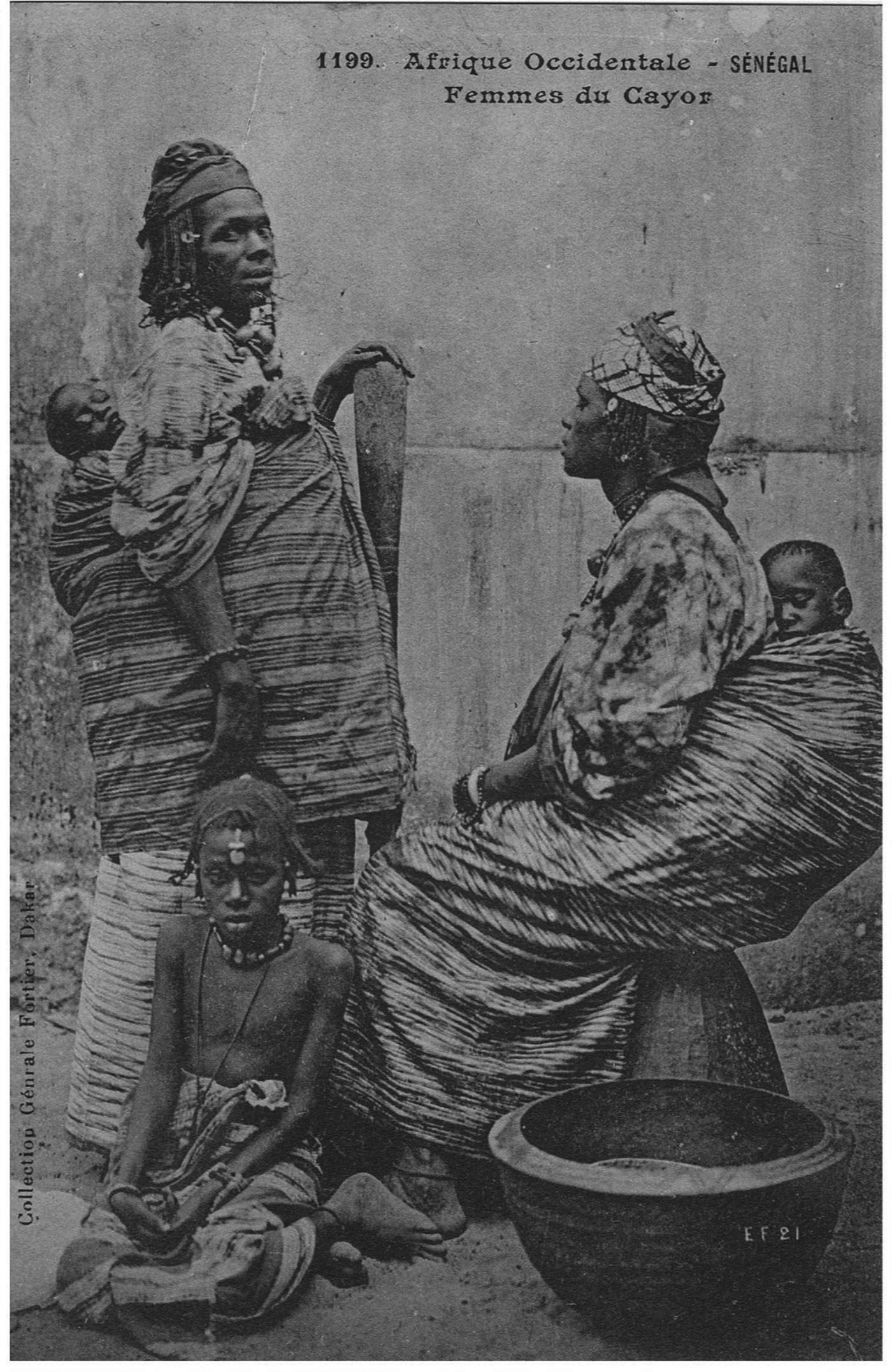
My approach to visual economies in Muslim Senegal, then, breaks with the conventional distinction analysts make between photographer, subject, and viewer. This distinction has been important in terms of bringing to light power relations between colonizer and colonized and the role of the visual in such regimes of power. If a portrait is a way in which the sitter presents herself to the world, its opposite is the colonial postcard in which the sitter is presented to the world as an object to be looked upon (Prochaska Reference Prochaska1991: 46). As early as the 1840s French adventurers, missionaries and ethnographers were ‘instrumental in affirming visual codes and stereotypes through which the West interpreted Africa and its peoples’ (Lamunière et al. Reference Lamunière2001: 13). In West Africa, the French produced 8,740 postcards; of those 7,210 were produced in the period 1901–18. There were 310 studies of women and girls in so called ethnic dress (Mustafa Reference Mustafa, Kaspin and Landau2002: 175). Many images portrayed women as partially nude, reclining, or posing in similarly sexualized ways, and were often accompanied by commentary that was at once romantic, racist and sexist. One of the largest producers of postcards in Africa from 1899–1920 was François-Edmond Fortier (see Figure 1). Reproductions of these postcards still circulate globally, contemporary postcards for sale in Dakar still reference these images, and contemporary artists working in the medium of photography often play with and comment on these earlier influences on the trajectory of photography in the country.
‘Femmes du Cayor’, postcard image by François-Edmond Fortier dating from 1890–1905 (© Trustees of the British Museum)

Other images in contemporary circulation include those taken by French colonial officers to document the activities of Muslim shaykhs who were suspected of resistance. These images were appropriated and invested with new meanings by the disciples who used these images in their devotional practices. For example, the French only snapped one photograph of the founding figure of the Murid way, Amadou Bamba, and its singularity over time became the basis of its reproduction as a devotional image in wall murals, hanging photographs and necklaces (Buggenhagen Reference Buggenhagen2010). These images ‘get things done … they are endowed with baraka … Mouride visuality is above all directed toward practice’ (Roberts et al. Reference Roberts2003: 76). For Murids, images of Bamba are talismanic. Bamba's imagery attracts grace and thus prosperity. These images draw on the tension between zahir, the visible, and batin, the invisible (ibid.: 95).
Photography, once central to the civilizing mission of the French, in time came to define the civilized classes in the four communes, and especially in Dakar. Personal portraiture differs from its colonial predecessor in that it can be understood best not in terms of the relationship between photographer, subject, and viewer, but rather through the complex negotiations that take place between photographers and their clients (Bigham Reference Bigham1999). Moreover, unlike the generic nature of colonial postcard portraits, which were often reprinted, African portrait photographers usually produced a singular image to commemorate a particular event. Throughout the late nineteenth and early twentieth century Senegalese metis known as signare were sitting in high-backed Victorian chairs for portraits in their homes in St Louis (Jones Reference Jones2013: 93). As early as the 1860s, St Louis had Senegal's first daguerreotype studio (Chapuis Reference Chapuis, Saint, Leon, N'goné and Chapuis1999: 49). By 1912 personal photo albums had become popular among urban residents of St Louis through the work of the Senegalese photographer Meissa Gaye. In the 1940s Mama Casset opened his studio in the Medina neighbourhood of Dakar, African Photo. Casset learned photography from Oscar Lataque after joining the French airforce and taking aerial photographs during the Second World War. Unfortunately Casset's studio burned down and the only available photographs are from the negatives supplied by Madame Casset for a volume published by Editions revue noire.
As West African photographers turned cameras on their own societies, the novelist Aminata Sow Fall remarked,
The arrival of photography must have been seen as a gift from the gods, to conspire against the grotesque and often insulting caricatures produced by the colonists. We could finally all enjoy looking at ourselves in a snapshot of happiness; immortalized on a card … a photograph should only reflect the beautiful, admirable, dazzling side of our existence. That is why we were photographed for major ceremonies. (Fall Reference Fall, Saint Leon, Fall and Chapuis1999: 64)
Portraits worked their way into wedding exchanges through the practice of xoymet. When the bride entered her groom's home for the first time, she would encounter his room decorated with images of her borrowed from friends and family (Mustafa Reference Mustafa, Kaspin and Landau2002: 176).
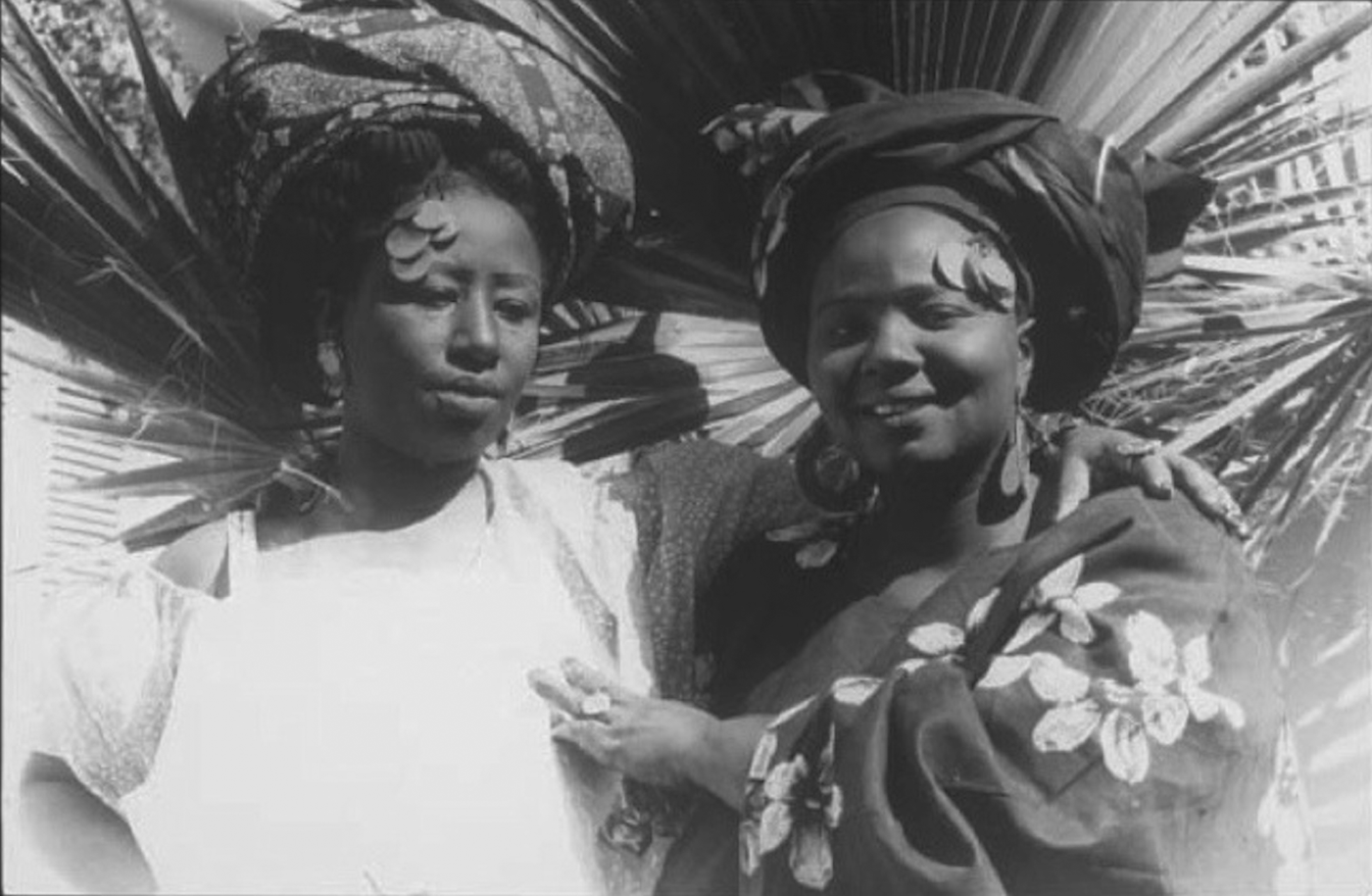
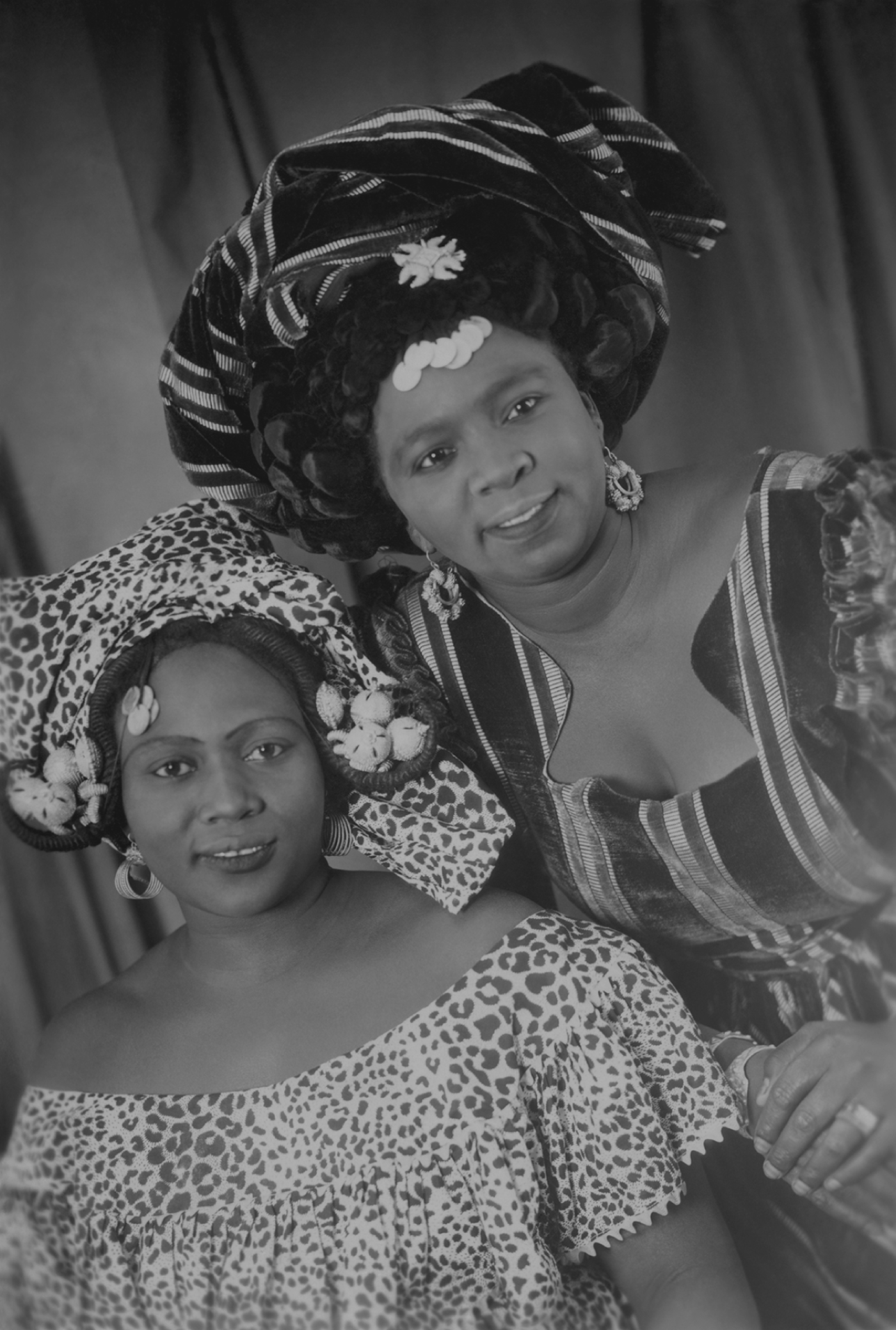
Senegalese photographers partly adhered to the standard conventions of studio portrait photography, including ‘compositional centrality, full-length figures shown frontally, shallow pictorial space and the incorporation of backdrops and accessories’ (Lamunière et al. Reference Lamunière2001: 14). However, Senegalese portrait photographers also tended to focus on the upper body and the face, which was illuminated with the artificial lights of the studio. Women's hands were often posed to frame their faces, and to accentuate their eyes. Casset's portraits, like those of other photographers of the era, are characterized by tight framing, structured composition, a preference for slants and diagonals, the skilful arrangement of cloth and clothing, and attention to bodily expression (see Figures 2 and 3). Mama Casset, like his contemporary the Malian photographer Seydou Keita, employed the angled bust portrait; ‘in this pose the sitter's face was captured in a three-quarter view, with the body appearing to lean toward the edge of the picture frame’ (Lamunière Reference Lamunière2001: 29) or to ‘lean out of the frame’ (Mercer Reference Mercer1995, quoted in Bell et al. Reference Bell, Enwezor and Tilkin1996: 30).
Image from the IFAN (Institut Français de l'Afrique Noire) collection, Dakar, Senegal (No further information is available on this photograph, taken in the 1950s)
Image (4 April 1954) from the Mama Casset collection (© Editions revue noire)
PORTRAITURE, PERFORMANCE, AND URBAN SPACES
Social discourse in Khar Yalla focuses on disconnections – electrical outages, water shut-offs, and the absence of garbage collection, paved sidewalks and streets – viewed as failures of the state to recognize the neighbourhood in its entirety, including its unofficial settlements. The rappers Xuman and Keyti, on their weekly television show Journal Rappé, refer satirically to the electric utility SENELEC as COUPELEC – from couper (to cut), since power outages in various city neighbourhoods are so frequent. ‘Investissez dans le sondeel!’ (Invest in candles!), they urge their audiences. Yet residents create other networks that overlay this decaying, dormant, or deficient infrastructure. African urban spaces are comprised of an assemblage of networks at once technological and cultural, the hard infrastructure that links up places across the globe and the social networks along which goods and ideas circulate (Larkin Reference Larkin2008: 6), or what I referred to above as ‘social infrastructure’ (Simone Reference Simone2001).
Khar Yalla women have had to perform the work of creating social networks with ever more inventive ways of looking glamorous, making social payments, and pulling off family celebrations (Buggenhagen Reference Buggenhagen2011). Through photography, women perform their connections to the multilayered urban spaces of Dakar, which provide both the content and the context of their images (for further discussion of photography and the African city, see Magee Reference Magee2007). Behind the multiple visual layers these images also reveal the overlapping of religious, economic, and social spheres that characterize urban life. Photographs, as performances of reputation and social station, suggest vitality in an urban setting that is often described as jaffe, or difficult, and that has come to be defined by its vast disparities in wealth and welfare. Performances, for the camera and for other women who view their albums, index the networks through which women construct their neighbourhood as part of the urban fabric of Dakar – a cosmopolitan capital city – rather than as peripheral to it.
The time that women spend with each other is often spent looking at photo albums and these albums are an especially important part of meeting new people. Thus the album and its viewing creates a spatio-temporal space. Viewing these pictures is pleasurable; often women recount the taking of the photograph of themselves at the family or religious event more eagerly than their experience of the event itself, thus demonstrating how a photograph can come to be an essential element of the self. There is a temporal dimension to these still images; the self women are most interested in is not who they were in the past; rather, they see and show their potential selves. As projects of potential social futures, portraits convey a notion of future time, of concern for reciprocity over time. Dakaroise are proficient at looking, sizing each other up, and speculating on the limits and possibilities of each other, whether in the market or at a family ceremony or religious festival. Through these performances, of looking and being looked at, of indexing this network culture through personal photographs, women anticipate une retombée, a positive effect or spin off a payback (see Grabski Reference Grabski2011 for further discussion of the idea of Dakar as a network culture).
The process of viewing albums involves a narration by the subject herself to provide context for the event and the meaning of the image. Through this performance, women control how their images are viewed. Rather than detailing the event – ‘and then I was married’ or ‘just after I had the baby’ – women make a visual argument for their social ascent. Moreover, albums juxtapose multiple images of a social actor – portraits of the subject in various social contexts over time – thus projecting a visual argument about her social standing in society and her capacity for redistribution. For example, as I mentioned at the outset, when Fanta was showing me her album she described the outfits and their origin – ‘and this is the ensemble my aunt gave me’, and ‘this is the ensemble my in-laws provided’ – and then retrieved for me the items that were not visible in the picture, such as the woven wrapper. Effectively, Fanta had set forth a narrative of relations of reciprocity for me as the viewer, so placing herself in the social context she desired.
Photographers, studios and album aesthetics
For many young women, producing an album is close to an economic impossibility and this imposes a corresponding difficulty in performing respectability for oneself and one's family. Unmarried women rarely have albums; they usually have packets of photographs or individual portraits propped on their bureau or tucked in a mirror frame. Women buy these photographs from itinerant photographers who take their pictures at family celebrations and religious festivals. In contrast, a family may hire a photographer for an event that they are hosting and have an album made afterwards. Most of the photography takes place in the social setting of the home, with the exception of several portraits that may be taken at the beauty salon. Each occasion is framed by a typical aesthetic, and these particular styles tend to influence other images. For example, women returning from the Hajj would have a portrait of themselves wearing all white, with a large white scarf draped over their head and shoulders, and women who had yet to go on the Hajj would also drape a large white scarf over their head and shoulders for religious events. A woman heading out to a family celebration may also choose to wear all white, as it is associated with Muslim virtue. Such images may stand in for an image of oneself returning from the Hajj that has yet to be obtained.
Digital cameras, first introduced in the 1990s, have expanded the unofficial economy of commercial photographers who are self-taught, as the technologies allow them to take many more images in order to get one good one. These photographers rarely own their own studios or equipment; they rent their cameras from studios often owned by East Asians who came to Dakar in the 1980s and 1990s. These enterprising photographers take to the street in search of an event worth photographing – tell-tale signs are a large tent erected in front of a home, livestock tethered to a post, or the beat of sabar drums and a sound system broadcasting Muslim litanies.
The photographer can charge in many ways. A single photograph in 2000 could cost 500 CFA francs.Footnote 6 A photographer hired for an entire day for an event could charge at least 100,000 CFA. A photographer could also charge the client by the number of photographs; an album of 80 photographs typically cost 70,000 CFA, one of 60 about 50,000 CFA (Fabienne Ngoone Diouf, personal communication, June 2013). Of course, there are other costs. The cost of the clothing could run to US$100 for top-quality fabric hand-dyed in Mali, or US$100 for an outfit that has already been tailored and embroidered from an inferior dyed cloth, plus accessories, a trip to the salon, a gift for the event, and taxi fare – as a woman cannot arrive in a car rapide or on foot.
As I mentioned, rather than viewing African photography in terms of photographer, subject, and viewer, personal photographs are the result of complex negotiations between clients and photographers. The ways in which photographers work with their clients, the ways people view and appreciate photographs, and the aesthetics of photographs have all changed as economic prospects have fluctuated over the decades. In post-war Senegal and The Gambia photographers might have their own studios, their own cameras, and even some professional training. These photographers sought to capture their subject's jikko, or persona, through their skilful touch, arranging the body in a pleasing way.
Today, photographers avoid handling their subject's jikko, which they describe as too volatile or dangerous (Buckley Reference Buckley2000: 73). The skilful arrangement of the body has been replaced by the strategic positioning of props and backgrounds. In Khar Yalla, clients are more concerned to capture the contexts in which the photograph is taken, and so instantiate their social position. As Fanta told me just after her marriage in 2009, ‘I would never have my picture taken in a photo studio. Everyone would know that backdrop was full of studio props. In my home, everyone knows that the items belong to me.’ Although studio photography may not be thriving for urban women who seek to distinguish themselves as those who have ties to migrants abroad, rural migrants to Dakar continue to visit studios to have their portraits made. The professional photojournalist and artist Djibril Sy described the return of Serer migrants to their natal villages in this way: ‘They line up their chariots (horse carts) and each head of the family has with him his photo album and they continue in this progression out of Dakar toward their rural residences’ (Djibril Sy, personal communication, 2011).
Young urban women also appreciate the surface appearance of the photograph, such as the montage, rather than the photograph's capacity to convey their authentic selves or moral personhood – in short, their jikko. Thus, Senegalese personal photography, as elsewhere on the continent, tends to favour multiple exposures, cutwork and photomontage (Behrend Reference Behrend2010; Buckley Reference Buckley2000). Photographers often reproduce many copies of the same image to collage together, manipulate the image through cutwork with a razor upon the surface of the print, or use digital manipulation to produce signage, repetition and montage. For example, popular images include double or multiple exposures, a montage of twins or co-wives, a mother and her daughter, a child and their deceased parents, and religious figures. Photographers also make photo collages incorporating magazine clippings into the finished images. Wedding albums often feature images of the bride or of the bride and groom with romantic sayings and motifs such as hearts and flowers cut into the surface of the printed image with a razor blade. Double exposures are especially common among migrants. One young woman in her teens in Dakar had created a digital image of herself with her mother, who had been in the US for over ten years, sitting behind her shoulder, and posted it on Facebook.
Because Senegal is 95 per cent Muslim, many of the images that appear in women's albums show their presence at religious festivals. Commercial photography is highly influenced by dynamic Sufi visual practices emphasizing repetition and montage. These images play with Sufi ideas of the hidden (batin) and the seen (zahir); they reveal as much as they conceal the elements of individual and social life at different moments in time.
Multiplying surfaces
A good photographer is as essential to a woman's social prominence as a good tailor and good hairdresser. Photographers, like griots, hold the power to make or break reputations and are paid for and sought out by powerful women. As much as photographers vary in their skill, so too do their clients vary in the their social proficiency. Amina's album, which contained multiple exposures, a dizzying array of cutwork and signage, and showed the skilful hand of a talented photographer, also displayed her own social aptitude. Amina married a son from a successful family who lived across the street before she was twenty years old; in this way she protected her propriety. Both families were invested in the success of the marriage. Her husband had built a private suite for her in his parents' home so that she had both her privacy and prestige, but also the support of the larger household in carrying out mundane tasks like cooking, housework and childcare, thus freeing her for social activities. Since her marriage, Amina had given birth to several children, two boys and a girl. Unlike many of his elder brothers, who had gone overseas, Amina's husband remained with her in Dakar managing an elder brother's tile shop. Amina's album reflected the investments that others had made in her, the photographer who had standing in the community, her husband, and their two families.
In contrast, family members described Fanta's marriage as jaffe, or difficult, because ‘Adja? bare na dox. She got around.’ Some families will marry a girl swiftly if they become concerned about her protecting her modesty. Fanta was something of a disquette, a young woman who delighted in fashion, music and parties. The families had hastily arranged her marriage to a distant relative on her mother's side of the family (not the preferential marriage for Wolof, which would be to her father's brother's son), a Murid man working in Barcelona's construction industry until he suffered financially from the global downturn that bankrupted Spain. The austerity of Fanta's album reflected our conversations about the shaky nature of her marriage, which she had tried to exit several times in the three years since it had been tied at the mosque. In fact, during my visit in December 2009 they had separated because he was often unable to reach her on the cellphone that he bought her and became suspicious. He soon ceased financial support and eventually they stopped speaking. Fanta had first shown me the album privately in 2009, because her family had concluded that her husband would divorce her.
In Amina's album one can see a performance of the self and an explicit attempt to ‘come out better’, which was the result of a productive collaboration between Amina and her photographer Alpha. In relation to Stephen Sprague's (Reference Sprague1978) work on Yoruba images, Christopher Pinney remarks upon subjects' ‘concern with the surface of the image and its production after its photographic moment is manifest’ (Reference Pinney, Pinney and Peterson2003b: 218), and how in Indian photography subjects seek to ‘come out better’. Similarly, rather than seeing Fanta's and Amina's photo albums as ‘a window on reality’, I would argue that their personal portraits are ‘a surface, a ground, on which presences that look out toward the viewer can be built’ (ibid.: 219). Thus one cannot easily separate the subject of the photograph from the viewer, as the former is actively trying to influence the latter through her performance and later her narration of what is to be seen. Many of the images in Fanta's and Amina's albums, and indeed in many of the albums I have viewed over the decades, have a quintessential shallow picture space common among African photographers that brings attention to the substance, or what emerges after the moment that photograph is taken (Oguibe Reference Oguibe, Bell, Enwezor, Tilkin and Zaya1996, quoted in Bell et al. Reference Bell, Enwezor and Tilkin1996: 246). Thus viewers often comment on ‘the mysteries of exterior appearance’ (Wendl Reference Wendl, Saint Leon, Fall and Chapuis1999: 154 quoted in Buckley Reference Buckley2000: 71), and photographers seek to produce ‘multiplying surfaces’ (Buckley Reference Buckley2000: 83).
Alpha has successfully managed to ‘multiply surfaces’ and to produce multiple views, and thus meanings, by cutting the portraits of Amina into montages. His work was in the style of many of the portrait artists of religious leaders in Senegal. A common photograph that Murid disciples use as a talisman can be bought in the market. It is a collage that depicts all of the Murid shaykhs, from the founding figure of Amadou Bamba, who died in 1927, to the presentFootnote 7 (see Figure 4). The montage of Murid shaykhs creates a spatio-temporal domain in which disciples and guides can dwell simultaneously in and out of time. Similarly, when disciples have images of themselves with religious figures in the mix, a visual relationship is created between the two subjects. Such proximity to the divine then lends itself to the receipt of baraka.
A photograph of Murid shaykhs bought in Sandaga market in Dakar (Photographer unknown)
The meaning of these images is not fixed; images gather new meanings as they circulate in new contexts and are viewed by different audiences. Yet, every time Amina brought out her album to show to a visitor to her home, she augmented her reputation of not only being the recipient of wealth, but also in a position to distribute it on future occasions. As a memento, or future reminder, then, she might offer to give her viewer one of her photographs. The multiple images of herself were the product and the potential of her abundance. This relationship between ‘discursive formations and image worlds’ (Freedberg Reference Freedberg1989: 35, quoted in Roberts et al. Reference Roberts2003: 22) is ever shifting allowing for what Pinney (Reference Pinney, Pinney and Peterson2003a: 6) calls the ‘transformational potentialities’ and ‘volatility’ of photographic practices.
Just posing?
The silence surrounding Fanta's album on the two occasions that I viewed it in 2009 and 2011 was telling. In our conversations, Fanta seemed to be struggling with the idea of marriage as the only path to social respectability. Rather than expressing her concern to come out better in her portraits, the album expressed her family's efforts to repair the rupture caused by a marriage gone awry by producing a photo album that showed a linear progression from marriage to motherhood. Men often provide financial support for women's social endeavours because they are concerned about family reputation, which is primarily in women's hands in their absence.
In their portraiture, women perform sañse, or dressing up (Heath Reference Heath1992: 23). Through portraiture, women convey an image of themselves as smartly dressed and favoured by their husbands, who may already have – or desire to have in the future – other wives (see Figure 5). Thus they position themselves with the potential to bestow that wealth on others. Beauty and generosity are a sign of inner grace, or baraka.
A wedding portrait taken in 1999 (Photographer unknown)
In fact, personal portraits in women's albums – from religious rites surrounding weddings, baby-naming ceremonies, holidays and festivals – have many influences, including that of Islam. The practice of photography and the meanings attached reflects the shift from Murid engagement in a rural sphere of agricultural production to the urban sphere of exchange through transnational networks. Murid women's portraits are influenced by Sufi thought and practice, including the possibility of une retombée, or positive effect or spin off from a successful performance of respectability; these images, like photographs used as religious talismans, hold the potential to be generative of something else. Photographs, like many aspects of Sufi life, are thought to ‘possess a secret side’, or batin, ‘the insightfulness of not seeing, then, is often believing’ (Roberts and Roberts Reference Roberts, Roberts and Nelson2000: 47). It is this relationship between ‘display and secrecy [that is] essential to Mouride visuality’ (ibid.: 80). The relationship between visibility and invisibility, the known and the unknown, can be understood by looking at the shift from capturing one's jikko, or inner essence, to presenting one's surface, through which one hopes to ‘come out better’.
Portraiture has much to do with love and beauty, but also with neglect, despair, and the attempt to conceal inequality (see, for example, Poole Reference Poole1997). I started this article with Fanta's album to convey this point. The flip side of sanse, or dressing well, is pukaare, or posing, which reveals too much. Many Senegalese women cannot sustain their reputations, except in their photographic representations. Women accused of pukaare often obtain money from outside lovers or rack up insurmountable debts with usurious vendors. For this reason discretion, or sutra, is central to concealing debt and making visible wealth, honour and restraint. Thus the portraits convey their inner secrets, their batin, or the unseen workings of the divine, and their indiscretions, or their proclivity to debt.
Rather than focusing on these portraits as a means of displaying the wealth of Murid circuits, one could also see what is being concealed. The threequarter-length bust portraits and grandes boubous that reach the floor obscure the strip woven wrappers that serve as the basis of women's wealth and as exchange objects. Wrappers rarely appear in photographs today, which is in contrast to how prolifically they appear in Fortier's postcards and their occasional appearance in mid-century studio photography as bed coverings, backdrops or wrapped around the upper body. One might focus on Robert Foster's (Reference Foster and Fajans1993) notion of ‘revelation’ rather than reciprocity, as wrappers are a form of wealth that can be highly visible – as in the moment of circulation during a family ceremony – or invisible, as when they are stacked in a closed armoire or worn on the lower half of the body under a voluminous boubou. In revealing wealth, portraits persuade: ‘by covering themselves with gold, then, kings persuade others to cover them with gold as well’ (Graeber Reference Graeber1996: 9). In concealing wrappers, portraits allow women to withhold this valuable resource from circulation: ‘the things kept allow a person to circulate other things’ (Weiner Reference Weiner1985: 222).
As the appearance of wealth among families in Dakar's varied urban neighbourhoods has become disconnected from sources of production abroad through Murid trade, wealth and the images of wealth have become distorted. The means through which women and men make a living and earn enough money to send back as remittances to their families is not often visible to those at home. As such, personal portraits speak to the promise of prosperity, a promise that is associated with transnationally connected urbanity, but often remains unfulfilled. Yet, this promise, rather than the actual transfer of wealth, is often sufficient to fulfil expectations of families and friends. Thus, through successful portraits women can connect to other women who hope to become the recipients of their future gifts, even when those gifts often do not, or cannot, materialize.
CONCLUSION
Commercial photographic practices reflect and remake the changing fortunes of young urban women from Murid families in Dakar's peripheral neighbourhoods. Popular photographic practices aimed at coming out better point to the precariousness of social subjects, their finances, and their sense of prospects for the future. The preference for repetition and montage in photographic practices reflects young urban Muslim women's attempts to multiply their grace as part of ‘coming out better’. These images are both the motivation for and the outcome of a vast circulation of valuables and money, including cloth and religious offerings among other things, that underpins translocal circuits of wage labour and capital organized under the aegis of Tariqa Murid (the Murid Way).
In this article, I have analysed how Muslim women in urban spaces attempt to achieve respectability through the production and circulation of valued objects, such as photographs. Through field-based research in the Khar Yalla neighbourhood of Dakar, I analysed how women invest value in others and how valued objects come to stand for ideal social relations that both point to and constitute a transnationally embedded community and its future. I have also suggested that the point is not whether or not those ideal social relations are realized, but rather, the creative forms of action that women adopt in their pursuit.
Photographs, as valued objects and elements of visual culture, mediate, or create meaningful links, between subjective experience and encompassing economic changes. They help young Muslim women such as Amina and Fanta make sense of and make do with the vast disparities they see in incomes and social possibilities in Dakar. In these everyday photographic practices photographers and their subjects collaborate to create new forms of value and meaningful action that characterize Africa's urban spaces. Dakar, like most African cities, has inequalities in access to wealth, education (both Western and Muslim), technology and media, and work. Yet young women create meaningful social worlds in spite of the financial troubles they experience through the production and circulation of self-portraits and family photographs aimed at capturing and projecting an image of their happiness, luck (warsek) and religious grace (baraka). Muslim women such as Fanta and Amina seek to create and remake their social and moral personhood in tandem with these changing times. Their portraits succeed when they bridge the gap between what they see and what they experience, between themselves and others who are ‘coming out better’, and when they enable them to deal with the inconsistencies and incoherences that confront young women in urban life.
ACKNOWLEDGEMENTS
I would like to thank my interlocutors in Dakar for their generosity and good will. To respect their privacy I have changed their names or not mentioned them specifically. My thinking about this manuscript has benefited from the numerous conversations with colleagues: the students and faculty at the African Studies Workshop at the University of Chicago including Beth Brummel, Claudia Gastrow, Kate McHarry and Jay Schutte; my colleagues at Indiana University including the Department of Anthropology, the African Studies Program, and the Mathers Museum of World Cultures; and Fabienne Ngóone Diouf, Wolof Associate Instructor and doctoral candidate at Indiana University. I would like to thank the editors of this special issue and the two anonymous reviewers for their thoughtful comments. All errors of fact or interpretation are entirely my own. Funding for this research was provided by a Faculty Curatorship at the Mathers Museum of World Cultures, and grants from the Office of the Vice President for International Affairs at Indiana University in 2010 and 2012. I would also like to thank the photographers and artists: Boubacar Toure Mandemory, George Osodi, Kaan Si, and Djibril Sy.