Introduction
Maize was probably introduced to Asia in its native wild-type form during the 16th century from Central America. Soon, amylose-free (waxy) mutants were cultivated as a common vegetable and staple food. This closely follows old consumer preferences for amylose-free rice in Asia that dates back 2000 years (Olsen and Purugganan, Reference Olsen and Purugganan2002). Selection for the recessive waxy allele can be attributed to a strong preference for soft grains with more desirable cooking and flavour properties (Fergason, Reference Fergason and Hallauer2001). Waxy maize were used by majority and minority ethnicities in Southeast Asia for different food applications resulting in hundreds of landraces (LRs). Nowadays, modern feed maize hybrids, based on North and Central American germplasm, prevail in Southeast Asia and the old waxy LRs disappear. CIMMYT with its global mandate for maize germplasm did not include Asian waxy maize in its genebank. Thus, the coverage in these regions and the maintenance of the waxy germplasm is poor (Anonymous, 1983). Fortunately, two regionally representative collections of waxy maize LR were available that had been collected decades ago in Thailand and Vietnam.
During the extensive domestication of crops, yield continuously increased. One key component for yield is starch, as it contributes up to 80% of the seed mass. This is reflected in the selection for genes involved in starch metabolism during domestication of maize (Whitt et al., Reference Whitt, Wilson, Tenaillon, Gaut and Buckler2002) and rice (Tian et al., Reference Tian, Qian, Liu, Yan, Liu, Yan, Liu, Gao, Tang, Zeng, Wang, Yu, Gu and Li2009). Additionally, humans selected for different starch quality traits, influenced by eating and cooking preferences (Tian et al., Reference Tian, Qian, Liu, Yan, Liu, Yan, Liu, Gao, Tang, Zeng, Wang, Yu, Gu and Li2009).
Starch is the major storage carbohydrate in plants. Storage starch synthesized in heterotrophic organs, such as tubers, roots or seeds, provides a central nutritional resource for humans and animals. Starch consists of two glucose polymers, amylose and amylopectin that are assembled into semi-crystalline granules. Amylopectin is a branched polymer in which the glucose units are linked via α-1,4-glucosidic bonds to form linear chains. These chains are linked via α-1,6-glucosidic bonds, so-called branch points (Buleon et al., Reference Buleon, Colonna, Planchot and Ball1998; Zeeman et al., Reference Zeeman, Smith and Smith2007). The resulting structure varies in details depending on the botanical origin (e.g. Morell et al., Reference Morell, Samuel and O'Shea1998; Streb and Zeeman, Reference Streb and Zeeman2014). Amylose is a linear polymer of glucose units linked almost exclusively via α-1,4-glucosidic bonds.
Starch synthesis requires a complex orchestration of enzymes to generate the amylopectin structure and granule morphology. More than 20 gene products, mainly several isoforms of starch synthases, branching and debranching enzymes, are known to be involved and alteration of their expression often results in altered starch. Amylose synthesis is mediated by the granule bound starch synthase (GBSS). Cereals have two isoforms – GBSSII expressed in autotrophic tissues and GBSSI mostly restricted to the endosperm. GBSSI is encoded by the WAXY gene. Loss-of-function mutations in GBSS, abolish amylose synthesis, but does not alter crystallinity of amylopectin or starch granule synthesis (Tsai, Reference Tsai1974; Shure et al., Reference Shure, Wessler and Fedoroff1983).
We hypothesized that eating preferences might have resulted in selection for additional differences in starch properties, structure or granule morphology. We investigated genetically and biochemical the putative waxy LR, for changes in starch quality.
Materials and methods
Maize varieties
The waxy maize LRs used here included a core set of 29 Thai and 12 Vietnamese LR, representing the main cultivation zones in both countries; it was multiplied in Thailand during the dry season to avoid disease infestations in 2008/2009 (for names see online Supplementary Table S1). For genetic and quality tests the LR core set plus a commercial waxy hybrid (WxH; PR38A22, DuPont/Pioneer) was grown and self-pollinated in a glasshouse of the ETH Zurich until seed maturity from September 2009 to January 2010. Pots of 8 litres size were filled with a fertilized loamy soil and sand mixture and planted with three homozygous waxy seedlings. On average a day/night temperature of 22/20°C was maintained, with a minimum light intensity of 250 µmol photons/m2/s during 14 h/d. After germination a small endosperm part was dissected and stained with iodine to select against amylose containing genotypes those plants that stains dark-blue. Plants were self-pollinated as flowering dates between single plants in the greenhouse were too different for cross-pollination between plants of the same variety. This was in conformity with our goals because intra-varietal differences were small. Mature seeds were stored at room temperature for further analysis together with a commercial WxH (PR38A22, DuPont/Pioneer) as control (see Table 1).
Amylose content and DSC transition parameters of starch from different LRs

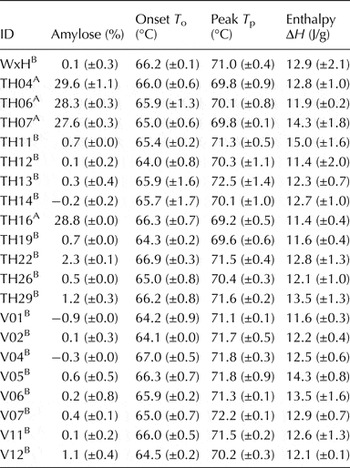
LRs with WAXY/WAXY (A) or waxy/waxy (B) genotype. Values represent the average from two individual plants. Highest and lowest values differ from the average (±). Negative amylose values result from technical variation of amylose-free starch.
Agronomic traits
A field experiment was carried out with all LR at Suwan Farm, Thailand (14.5°N, 101°E, 360 m above sea level; lowland climate; Rhodic Kandiustox Oxisol (USDA taxonomy) during the dry season of 2009/2010. The LRs were evaluated in a randomized complete block design with three replications. Each plot included four rows 5 m long with 0.75 m between rows and 0.25 m between hills. Two seeds per hill were planted and plants were thinned to a single plant per hill after two weeks of planting. The final plant density was 5.3 plants/m2. Prior to sowing, 25 kg N/ha and 30 kg P/ha were applied, with an additional 115 kg N/ha 1 month after sowing. Herbicides and insecticides were applied as required according to local practices. The experiments were sprinkler-irrigated four times during the first 3 weeks after sowing; thereafter 40 mm water was supplied by furrow irrigation weekly. The inner two rows were used for measurements; the two border rows were hand-pollinated within each entry for further seed multiplication. Time to silking was recorded as the number of days from sowing to the day when at least 50% of the plants in the two centre rows had extruded anthers or silks. Ears in the two central rows were hand-harvested, shelled, the grain number counted, then dried at 105°C and weighed. The thousand kernel weight was calculated from the primary data.
Starch extraction
For amylose quantification, differential scanning calorimetry (DSC) and starch granule size distribution, starch was extracted from five kernel per plant ear, following the protocol from (Gutierrez et al., Reference Gutierrez, Campbell and Glover2002). Thereafter, the starch was stored at −20°C in sealed tubes.
Amylose content
The method for measurement of amylose content was adapted from (Hostettler et al., Reference Hostettler, Kolling, Santelia, Streb, Kotting and Zeeman2011). Dried starch was suspended in 90% dimethyl sulfoxide to an end concentration of 5 mg/ml. The starch suspension was heated for 30 min at 90°C. Approximately 50 µg of the suspension were mixed with 20 µl Lugol solution (KI/I2, Fluka) and made up to 200 µl. Absorbance was measured at 700 and 524 nm with a Tecan infinite M1000 plate reader. The readings from standard curves of pure potato amylose and maize amylopectin were introduced to calculate the amylose content: Amylose % = (OD700/OD524 − 0.235446)/0.017286.
Starch granule size
Starch granule size was quantified by digital image analysis coupled to light microscopy (Wilson et al., Reference Wilson, Bechtel, Todd and Seib2006). Purified starch was stained with Lugol solution (KI/I2, Fluka) and mounted on microscopy slides. More than ten starch granule pictures, corresponding to more than 1000 granules, were taken with a Zeiss Axio Imager Z2 and analysed with the ImageJ software. Starch granules with a circularity >0.7 and a diameter >3 µm were filtered. Size distribution was reported on the basis of the per cent volume fractions. Starch granule volume was calculated based on the spherical formula (4/3 × π × r 3), where r is the radius.
Differential scanning calorimetry
Gelatinization temperature and gelatinization enthalpy (ΔH, J/g) of starch suspensions were determined using a differential scanning calorimeter (DSC 2010) from TA instruments (Jacquier et al., Reference Jacquier, Kar, Lyng, Morgan and McKenna2006). Approximately 10 µl of a 20% w/v aqueous starch suspension was hermetically sealed in aluminium pans. Scans were performed from 30 to 100°C, with a rate of 5 °C/min. Onset temperature (T o), peak gelatinization temperature (T p) and ΔH (J/g) were measured from two individual plants per LR.
Chain length distribution (CLD) of amylopectin
Starch was isolated from individual kernels using perchloric acid as described by Hostettler et al. (Reference Hostettler, Kolling, Santelia, Streb, Kotting and Zeeman2011), with the exception that kernels were homogenized frozen with a bead mill (2010 Geno/Grinder). From four individual kernels 100 µg of starch was boiled in 200 µl water for 10 min prior enzymatic digestion. Debranching reactions with Pseudomonas amyloderamosa isoamylase (Sigma-Aldrich, Buchs, Switzerland) and Klebsiella planticola pullulanase (Megazyme) were carried out for 2 h at 37°C in 10 mM Na-acetate, pH 4.8. The resulting linear glucans were analysed by HPAEC-PAD as described previously (Streb et al., Reference Streb, Delatte, Umhang, Eicke, Schorderet, Reinhardt and Zeeman2008)
Mutation identification
Overlapping gene regions of the WAXY gene (X03935) were amplified by PCR using Primers covering the whole gene (online Supplementary Table S2). Amplified DNA were separated, purified and directly sequenced. Mutations were named I2 (KP705071), E5/I5 (KP705070), E7/I7 (KP705073) and E10 (KP705072).
Statistical analysis
Data of field trials was analysed according to a randomized complete block design. Pearson product–moment correlation coefficient (r) for the relationships and the level of significance (p) for two-tailed test were calculated in excel. For starch properties the average value for each parameter and LR were used to calculated correlation coefficient (r) and significance (p).
Results
Field vigour
The main aim was to examine the agronomic fitness and the ear components of the 41 LR complete set (online Supplementary Table S3). The female flowering time (silking date) was on average 67 d after planting, with a wide range from 58 to 80 d. Grain yields per plant were 59 g on average, calculated per hectare around 3.1 tonnes, varying from 21 to 98 g. Modern maize hybrids have kernel row numbers between about 12 and 16. However, here seven waxy maize LRs had numbers below 10. The average was slightly below 12, ranging from < 8.5 to more than 14. The size of the grain, as represented by the thousand kernel weight was 222 g on overall average, with individual LRs ranging from an unusually low 149 g to a quite high 344 g, when compared with commodity feed maize.
LR purity
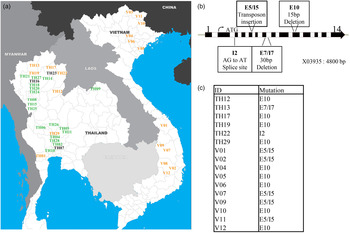
First, we assessed the purity of the 41 LR complete set, self-pollinated ears and harvested mature grains in a greenhouse. From each plant, starch of six individual seeds was iodine stained for amylose quantification. In cases all seeds were free of amylose the mother genotype was classified as waxy/waxy, in cases of segregation as WAXY/waxy. Seed material from 39 LR could be propagated, 32 LR had at least one pure waxy mother genotype, four LR contained only mother plants with a WAXY/waxy segregation; in three LR no waxy phenotype was detected, i.e. these LR were falsely classified as waxy before (Fig. 1). All 12 LR collected in Vietnam were pure waxy/waxy.
Origin and waxy alleles of Thai and Vietnamese LRs. (a) Map of south-east Asia and origin of the different LRs used in this study. Amylose-free LRs (waxy/waxy) are shown in yellow, LRs with mixed background (WAXY/waxy) in green and wild-type plants (WAXY/WAXY) in black. (b) Mutations in the WAXY gene found in LRs. Different alleles are named responding to the mutation site. I2 has a 4 bp deletion in intron 2, changing the splice site (AG to AT), E5/I5 is an transposon insertion in exon 5, E7/I7 is a 30 bp deletion in exon 7 and intron 7 and E10 is a 15 bp deletion in exon 10 both described earlier for Chinese LRs (Fan et al., Reference Fan, Quan, Leng, Guo, Hu, Ruan, Ma and Zeng2008). (c) List of pure amylose-free LRs and the identified waxy alleles.

Genomic background of the waxy phenotype
In the present germplasm, the WAXY locus from 16 pure waxy LRs was amplified by PCR and the overlapping stretches were sequenced. Four different mutations were identified (Fig. 1(c)), all likely to result in a dysfunctional GBSS protein (Fig. 1(b)). Two known mutations previously described in Southwest China maize LR (Fan et al., Reference Fan, Quan, Leng, Guo, Hu, Ruan, Ma and Zeng2008) were identified in our LR-populations. A 15 bp deletion had occurred in nine LRs in exon 10 of the WAXY gene and therefore called E10. The second mutation, found in one LR, had a 30 bp deletion in the WAXY gene at the end of exon 7 and beginning of intron 7 (E7/I7) resulted in a 4 bp shorter exon 7 and the incomplete splice out of intron 7 in the mRNA. Additionally, two previously unknown waxy alleles were detected. In one LR, the intron 2/exon 3 boarder showed a 4 bp deletion (I2). The removal of the splice acceptor site (AG) in intron 2 results in incorrectly processed mRNA, leading to an alternative splicing within exon 3. The fourth mutation (E5/I5) was observed in five LR. Exon 5 contained the LTR sequence of a retrotransposon (AF434192), likely to interfere with the correct transcription/translation of the WAXY gene. In all 16 amylose-free LR the mutation was found to be in the WAXY locus.
Amylose content
We quantified amylose content from 32 LR, where we obtained starch from at least two independent self-pollinated mother plants. We verified the semi-quantitative prediction for the purity grade of the mother plant (online Supplementary Table S4). For 20 LR at least two homozygous mother plants, either waxy/waxy or WAXY/WAXY could be isolated and used for amylose quantification and further starch properties analysis. Starches from 13 pure waxy LR and the commercial WxH contained <1%, three pure waxy LR had <3% apparent amylose content, while the relative amylose content of the four wild-type LR was between 25 and 30%, as expected (Table 1). All iodine-starch absorbance spectra fell unambiguously to either wild-type LR or waxy LR groups.
Gelatinization of starch
DSC was applied to characterize the gelatinization of starch by recording the onset and peak temperatures, as well as the energy required for the melting the crystalline starch structure in excess water. Table 1 summarizes the results of the thermal analysis of starch from pure 16 waxy LR, four wild-type LR and the commercial WxH. T o and T p of all the samples were within a close window (64.0–67.0 and 69.2–72.5°C, respectively). The average peak temperatures of starch from the 16 waxy LR (71.2 ± 0.8°C) was higher than that of the four wild-type starches (69.8 ± 0.4°C), while the T o varied little between wild-type (65.8 ± 0.6°C) and waxy starches (65.4 ± 1.0°C). ΔH (J/g) were not significantly different between wild-type (12.6 ± 1.3°C) and waxy starches (12.7 ± 1.0°C). The physicochemical parameters T o, T p and ΔH showed a significant (P < 0.01) positive correlation with each other over all samples analysed (online Supplementary Table S4). In detail; T o with T p (r = 0.52, P < 0.01), T o with ΔH (r = 0.47, P < 0.01) and T p and ΔH (r = 0.44, P < 0.01). This relation was reported before for maize (Sandhu and Singh, Reference Sandhu and Singh2007) and rice (Singh et al., Reference Singh, Kaur, Sandhu, Kaur and Nishinari2006) starch. Further, we observed a strong negative correlation between amylose content and T p (r = −0.51, P < 0.01), in agreement with previously published results (Inouchi et al., Reference Inouchi, Glover, Lafayette and Fuwa1995; Singh et al., Reference Singh, Singh, Kaur, Sodhi and Gill2003).
Fine structure of amylopectin
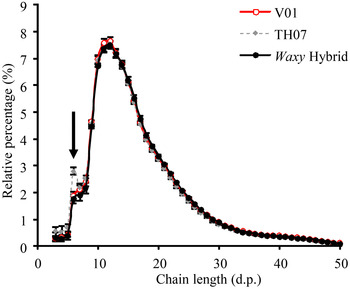
The method of CLD profiling was used for characterizing the fine structure of amylopectin. The CLD profiles of all LR looked very similar (online Supplementary Fig. S1). However, a more detailed examination of the distributions showed a modest increase of chains of degree of polymerization (d.p.) 6 (i.e. six glucose units) of wild-type amylopectin as compared with waxy amylopectin (Fig. 2, online Supplementary Fig. S1). The CLD profiles of all waxy LR overlapped with that of the WxH (online Supplementary Fig. S1). Such differences in CLD have not been reported before. The profiles of waxy LR amylopectin overlapped perfectly with the profiles of amylopectin from the commercial WxH control (Fig. 2).
Fine structure of amylopectin synthesized in LRs. CLD of starch in two representative LR, one wild-type WAXY/WAXY, TH07 (dotted grey line, diamond) and one amylose-free waxy/waxy, V01 (red line, empty circle), plotted against the waxy/WxH (black line, filled circle). Arrow indicates d.p. 6. Peak areas were summed and the areas of individual peaks calculated as a percentage of the total ± standard error of four biological replicates.

Starch granule size
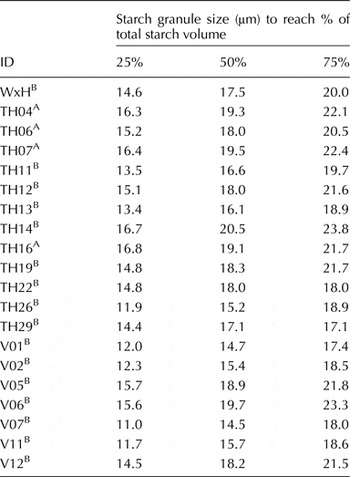
We investigated the size distribution of starch granules in the LR. We chose a semi-automated image-based method, where granules stained with diluted Lugol were simultaneously imaged with both bright-field and polarized light microscopy. Only single starch granules displaying the typical Maltese cross when viewed with polarized light microscopy were counted and measured. The size distribution of starch granules as expressed by relative volume is presented in Table 2. Fifty per cent of the total starch volume was found between 15.2 ± 0.7 and 22.4 ± 0.8 µm in wild-type LR, while for waxy LR these values were between 11.0 ± 1.7 and 23.8 ± 1.9 µm. In general, starch granule size distributions varied little between the LR and no correlation with amylose content was observed.
Size distribution of starch granules in LR based on the relative starch granule volume

Granules partitioned based on their contribution to the total starch volume into three groups. Individual granule volumes to reach 25, 50 and 75% were summed up, and the larges granules size in diameter (μm) is given. LRs with WAXY/WAXY (A) or waxy/waxy (B) genotype.
Discussion
Chinese waxy LRs and modern waxy inbred lines are genetically quite diverse (Zheng et al., Reference Zheng, Wang, Yang, Wu, Shi, Cai, Xu, Wu and Luo2013); phylogenetic analysis showed that inbred lines had an independent origin and evolution process compared with Chinese LR. In the present study, we sought to determine whether eating preferences of the local populations in Southeast Asia led to selective breeding of LR with special starch properties.
As waxy is the recessive allele of the WAXY gene, the maintenance of pure waxy LR is no trivial task after conventional feed maize has been introduced with great success about four decades ago. Some undetected hybridizations had been expected as the original collections had not been tested for waxy purity at the time of collection and no information existed on multiplications after storage. By testing the amylose contents of the LR, it could be shown that the more recent Vietnamese collection was pure waxy. Within the Thai collection three LR were wrongly classified as waxy, while some others were mixed. As it was not the goal to investigate the history of the collection, a practical approach was successfully taken to regenerate pure waxy genotypes within the mixed LR.
We investigated the genetic cause of the amylose-free phenotype from 16 LR covering all major regions of cultivation in Thailand and Vietnam. Currently, two mutations are known which can result in the abolishment of amylose synthesis (Seung et al., Reference Seung, Soyk, Coiro, Maier, Eicke and Zeeman2015). Either the starch synthase required for amylose synthesis (GBSS) or a protein required to target GBSS to the starch granule (PTST) could result in amylose-free starch. As all known amylose-free mutants in crops result from a dysfunctional GBSS, we investigated the WAXY locus by sequencing. Indeed, four different mutations were identified (Fig. 1(b)), all likely to result in the lack of function of the encoded GBSSI protein. Two mutations are known from South Chinese germplasm (Fan et al., Reference Fan, Quan, Leng, Guo, Hu, Ruan, Ma and Zeng2008). The other two ones have been first found here in Southeast Asian LR.
Waxy varieties from Asia were first described (Collins, Reference Collins1909; Weatherwax, Reference Weatherwax1922) and later on used for the production of quality feed. The existence of at least four different mutations in the WAXY locus in a relative small number of 16 LR occurring in <300 years suggest a strong and parallel selection for amylose-free varieties by local farmers, similar to that observed in Southwest China LR (Fan et al., Reference Fan, Quan, Leng, Guo, Hu, Ruan, Ma and Zeng2008). Consequently, this suggests that starch properties were a trait under strong selection (Whitt et al., Reference Whitt, Wilson, Tenaillon, Gaut and Buckler2002; Tian et al., Reference Tian, Qian, Liu, Yan, Liu, Yan, Liu, Gao, Tang, Zeng, Wang, Yu, Gu and Li2009), which was in agreement with our working hypothesis. While it would be ambitious to claim that our set of LR cover all genetic variability in the region, as more than 50 ethnic minorities cultivated waxy maize, the set gave us the right tool to test our working hypothesis. We examined the starch in the LR for indications that additional modifications of the starch metabolic pathway were selected for.
First, apparent amylose content was quantified (Table 1). All waxy LR contained <3% amylose, whereas wild-type LR contained between 25 and 30% – which are typical values for regular maize (Yeh et al., Reference Yeh, Garwood and Shannon1981). This shows that all waxy mutations effectively suppress amylose synthesis. Additionally, the absorbance spectra of the iodine/starch mixture obtained during amylose quantification were similar between all waxy LRs. This suggests the absence of major alterations in amylopectin structure, which are sometimes detectable using this method (Knutson, Reference Knutson2000).
Second, we determined starch granule size and morphology. No obvious differences were observed in granule morphology between LR and the commercial WxH control. Starch granule size varied little between LR, and amylose content had no impact on size (Table 2). Fifty per cent of the total starch volume was found on average in starch granules smaller than 19.0 µm in wild type and 17.2 µm in waxy LR, respectively. Both values are in the expected range (Li and Yeh, Reference Li and Yeh2001).
Third, we characterized the gelatinization properties of starch by DSC. The gelatinization of starch has a large influence on the culinary quality of cooked maize kernels. Thermal analysis can provide a measure of amylopectin crystallinity, which could indicate potential differences in amylopectin structure among the different maize LR (Singh et al., Reference Singh, Kaur, Sandhu, Kaur and Nishinari2006; Sandhu and Singh, Reference Sandhu and Singh2007). However, no consistent differences were observed between the LR for T o, which marks the start of crystal melting, or for enthalpy (−ΔH), which is the melting energy (Table 1). Both parameters are expected to increase with increasing crystallinity. For the T p, which is the mean melting or gelatinization temperature, starch from waxy LR had slightly higher T p than wild-type (Table 1), similar to previous observations (Singh et al., Reference Singh, Singh, Kaur, Sodhi and Gill2003). However, the temperature differences between waxy and wild-type maize starch are usually small and sometimes inconsistent during these thermal analysis (Li and Yeh, Reference Li and Yeh2001). Overall, the DSC analyses of waxy LR and the commercial WxH gave no evidence that additional changes in granule crystallinity occurred in waxy LR.
Last, to detect potential alterations in amylopectin synthesis, the fine structure of amylopectin was characterized by CLD profiles. These profiles were similar for all LR. However, waxy amylopectin had slightly less chains of six glucose units compared with wild-type amylopectin (Fig. 2). This small difference in amylopectin structure of waxy maize starch has not been reported previously, despite extensive studies on starch structure and waxy maize starch in particular. Interestingly the trait was shared by the commercial WxH and it will be interesting to determine if it is universal to waxy alleles and, if so, what exactly causes it. The changes in the abundance of chains with six glucose units could result from a slightly altered orchestration of the amylopectin synthesis machinery, e.g. starch synthases, branching enzymes or debranching enzymes (Streb and Zeeman, Reference Streb and Zeeman2012). For example, branching enzyme IIb prefers to transfer short chains of six or seven glucose units (Nakamura et al., Reference Nakamura, Utsumi, Sawada, Aihara, Utsumi, Yoshida and Kitamura2010) and starch synthase I prefers to elongate them (Fujita et al., Reference Fujita, Yoshida, Asakura, Ohdan, Miyao, Hirochika and Nakamura2006). A slight increase in enzyme activity or substrate availability in the wild-type LR could result in the observed differences in amylopectin structure. However, the changes in d.p. 6 are small and the overall amylopectin structure is likely unaffected.
Although maturity dates and yield parameters varied widely in the field, all LR displayed a normal vigor, with grain yields far below the level of regional commodity maize. No principal differences were observed between the Thai and Vietnamese LRs as might have been expected due to the north–south mountain barrier. This is also illustrated by the even distribution of the different waxy alleles across both countries (Fig. 1(a)). Further, the selection for amylose-free varieties seems not to have resulted at the expense of yield, as no negative correlation had been observed.
In conclusion, Thai and Vietnamese farmers selected very effectively in a short period of time for diverse waxy maize LRs adapted to various regions and eating habits but with similar starch properties. Although we observed small alterations in the CLD of amylopectin in the LR, and differences of gelatinization properties, these changes resemble the European commercial WxH. We could not find indications of further selection on additional starch traits in our set of LR. Although our LR originates from different regions, they represent only a small fraction of all LRs in this area. Therefore, it is still possible that LRs exist with additional different starch properties. It is conceivable that these are less common in the region as they might require the amylose-free starch background to become identifiable for the breeders and therefore would have taken more time to select for. Alternatively, mutations affecting starch properties might also cause a yield penalty. Selection against them might have prevented a region wide establishment of these traits. However, considering our observations we reject our starting hypothesis that the farmers selected region wide for additional starch traits, which would have had further pronounced effects on starch properties.
Supplementary material
The supplementary material for this article can be found at https://doi.org/10.1017/S1479262116000101.
Acknowledgement
We thank David Seung (ETH Zurich, Zurich, Switzerland) for critical reading of the manuscript.