

In activity theory and in sociocultural and ecological theories, the individual and social levels are interlinked. In activity theory, for instance, activity cannot be understood or analysed outside the context in which it occurs (Jonassen & Rahrer-Murphy, Reference Jonassen and Rahrer-Murphy1999). Sociocultural theorists have underlined the interdependence between individual and social processes in the construction of knowledge (John-Steiner & Mahn, Reference John-Steiner and Mahn1996). Also, ecological theory researchers have argued that the first step in attempting to understand the behaviour of the individual is to examine the opportunities and constraints of their environments (Wicker, Reference Wicker1984). In the light of the above-mentioned theories, the motivation of individuals, and thus their level of achievement, is seen as being influenced as much by environmental considerations as it is by personal characteristics. However, research is needed into the extent to which components of these factors can predict achievement.
The new model, known as the the Actiotope Model of Giftedness (AMG; Ziegler, Reference Ziegler, Sternberg and Davidson2005), adopts the same perspective as the above-mentioned theories because, like other systemic approaches, it differs from models that focus on personality traits and contextual models in that it defines giftedness as a certain probability that domain-specific excellence will be achieved. In addition to the individual, this model also takes into account the material, social and informational environment in which s/he acts and interacts (Ziegler, Stoeger, Balestrini, Phillipson, & Phillipson, Reference Ziegler, Stoeger, Balestrini, Phillipson, Phillipson, Dixon and Moon2014).
This model has three perspectives: the component (comprising action repertoire, goals, environment and subjective area space); the dynamic (the individual's learning period and the analysis of learning episodes); and the systemic (endogenous and exogenous resources). In the systemic perspective, exogenous resources describe educational capital, while the endogenous resources describe learning capital (Ziegler, Vialle, & Wimmer, Reference Ziegler, Vialle, Wimmer, Phillipson, Ziegler and Stoeger2013).
Educational and learning capitals are essential for the identification of gifted individuals as the AMG focuses on resource orientation, while other identification methods focus on the inherited traits of the individual (Stoeger, Reference Stoeger, Phillipson, Stoeger and Ziegler2013). Recently, Ziegler and Baker (Reference Ziegler, Baker, Phillipson, Ziegler and Stoeger2013) have proposed that each of these capitals has five different forms. Educational capital consists of external resources (economical, cultural, social, infrastructural and didactic), while learning capital consists of endogenous resources (organismic, actional, telic, episodic and attentional). Using these resources, individuals can build up the effective action repertoire that is crucial for excellence.
Educational and Learning Capitals
-
1. Economical educational capital is defined as ‘every kind of wealth, property, and money as well as any other valuables that can be used in society to sustain educational and learning processes’ (Ziegler & Baker, Reference Ziegler, Baker, Phillipson, Ziegler and Stoeger2013, p. 26). From the macro level (the government's education budget) to the micro level (the family's budget for education), this capital encompasses all financial support. Some research has revealed that as a result of the increase in the amount set aside for education in Turkey, students recorded higher achievements in the PISA for 2009 (Çelen, Çelik, & Seferoğlu, Reference Çelen, Çelik and Seferoğlu2011). In addition, meta-analytic studies have found a correlation between families’ socio-economic status and their children's achievement (r = .73; White, Reference White1982).
-
2. Cultural educational capital refers to ‘value systems, ways of thinking, larger outlooks and other such resources that can facilitate or hinder the achievement of learning and educational goals’ (Ziegler & Baker, Reference Ziegler, Baker, Phillipson, Ziegler and Stoeger2013, p. 27). For instance, in a culture holding a common belief that females should get married and raise children without working or being educated, successful female CEOs or scientists are rarely found. As Çolak and Ardor (Reference Çolak and Ardor2001) indicated, cultural and traditional stereotypes regarding appropriate gender characteristics for certain jobs play a key role in the persistence of discrimination in the Turkish labour market. Kerr (Reference Kerr1985) also noted that the reasons for gifted women's failure to realise their full potential include discrimination and lack of resources.
-
3. Social educational capital ‘includes all persons and social institutions that can directly or indirectly contribute to the success of learning and educational processes’ (Ziegler & Baker, Reference Ziegler, Baker, Phillipson, Ziegler and Stoeger2013, p. 28). For example, all people involved in the education of gifted students (e.g., teachers, mentors, psychologists, academicians) can provide social support. Non-profit-making institutions, such as the Global Center for Gifted and Talented Children (GCGTC, 2008), also serve as a social resource for gifted students and their parents.
-
4. Infrastructural educational capital ‘relates to materially implemented possibilities for actions that permit learning and education to take place’ (Ziegler & Baker, Reference Ziegler, Baker, Phillipson, Ziegler and Stoeger2013, p. 28). This capital comprises all physical resources providing appropriate areas for education and learning (e.g., playgrounds, gymnasiums, laboratories, observatories). For example, Turkey's Special Art and Science Centers (MEB, 1993) offer gifted students various educational opportunities.
-
5. Didactic educational capital means ‘the assembled expertise involved in the design and improvement of educational and learning processes’ (Ziegler & Baker, Reference Ziegler, Baker, Phillipson, Ziegler and Stoeger2013, p. 29). This can be the contributions to education made by technological innovations (e.g., tablets) that are becoming progressively integrated into the Turkish education system (MEB, 2013); it can also be the gains (e.g., in experience) that a teacher makes every year. Borko and Livingston (Reference Borko and Livingston1989) reported that novices’ cognitive schemata are less elaborate, interconnected and accessible than those of experienced teachers, and that the former's pedagogical reasoning skills are less developed.
In addition to educational capitals, there are also five learning capitals that stem from the individual:
-
1. Organismic learning capital ‘consists of the physiological and constitutional resources of a person’ (Ziegler & Baker, Reference Ziegler, Baker, Phillipson, Ziegler and Stoeger2013, p. 29). As Ericsson, Krampe, and Tesch-Romer (Reference Ericsson, Krampe and Tesch-Romer1993) pointed out, physical activity and extensive practice influences the level of professional achievement. The amount of time spent practising by successful people in sports or music is cited as evidence of this.
-
2. Actional learning capital refers to ‘the action repertoire of a person, in other words the totality of actions they are capable of performing’ (Ziegler & Baker, Reference Ziegler, Baker, Phillipson, Ziegler and Stoeger2013, p. 30). Results have shown that the current action repertoire of a person is an excellent predictor of later performance (Ziegler, Reference Ziegler2008). These actions are dynamic: from the beginning of our lives we constantly extend our language skills and motor development (from crawling to walking).
-
3. Telic learning capital ‘comprises the totality of a person's anticipated goal states that offer possibilities for satisfying their needs’ (Ziegler & Baker, Reference Ziegler, Baker, Phillipson, Ziegler and Stoeger2013, p. 30). Here, ‘goals’ describes future states that need to be achieved. If a gifted child wants to write a book about various animals, s/he must achieve prior goals such as gathering and synthesising information. Every area of interest needs extending by first achieving lesser goals. Detailed knowledge and excellence will follow.
-
4. Episodic learning capital ‘concerns the simultaneous goal- and situation-relevant action patterns that are accessible to a person’ (Ziegler & Baker, Reference Ziegler, Baker, Phillipson, Ziegler and Stoeger2013, p. 31). Having a wide repertoire of actions is insufficient on its own: the individual must also know in what circumstances it will be best to use them. Practice and ‘learning by doing’ is vital, so in order to become an expert in any domain it is necessary to have 10,000 practice hours (Ericsson et al., Reference Ericsson, Krampe and Tesch-Romer1993).
-
5. Attentional learning capital ‘denotes the quantitative and qualitative attentional resources that a person can apply to learning’ (Ziegler & Baker, p. 31). Anderson (Reference Anderson2004) states that attention is the cognitive process of selectively concentrating on one aspect of the environment while ignoring others. Developing excellence requires focus and concentration on the correct stimuli.
Motivation and the Link With the Actiotope Model of Giftedness
Motivation is the psychological force that reinforces an action toward a desired goal (Schacter, Gilbert, & Wegner, Reference Schacter, Gilbert and Wegner2010). Early motivation theorists like White (Reference White1959) focused exclusively on one dimension: the inner forces. Harter (Reference Harter1981) expanded this to include outside forces, defining motivation as the combination of intrinsic and extrinsic forces.
Harter (Reference Harter1981) examined the classroom-learning situation as a context in which motivational orientation is relevant. She delineated five dimensions of classroom learning that apply to both intrinsic and extrinsic motivational poles: (a) learning motivated by curiosity versus learning in order to please the teacher; (b) the incentive to work for one's own satisfaction versus working to please the teacher and get good grades; (c) a preference for challenging work versus a preference for easy work; (d) a desire to work independently versus dependence on the teacher; and (e) internal versus external criteria for success or failure (Harter, Reference Harter1981).
The learning process requires that learners find the motivation to continually extend the limits of their capabilities. Although there are a number of studies examining the relationship between motivation components and other factors — such as economic status (Chiu & Xihua, Reference Chiu and Xihua2008), socio-economic perspectives (Winn, Reference Winn2002), teaching styles (Skinner & Belmont, Reference Skinner and Belmont1993), goal setting (Zimmerman, Reference Zimmerman2008) and attention (Lang, Reference Lang1995) — there are no studies using the holistic perspective of the AMG.
Recent studies of motivation in Turkey have tended to focus on the development or adaptation of questionnaires (Dede & Yaman, Reference Dede and Yaman2008; Yılmaz & Çavaş-Huyugüzel, Reference Yılmaz and Çavaş-Huyugüzel2007), on the relationship between motivation and achievement (Eryılmaz, Reference Eryılmaz2010), and on different school subjects (Deniz, Avşaroğlu, & Fidan, Reference Deniz, Avşaroğlu and Fidan2006). Since the AMG is currently a topic of discussion in Turkey (Leana-Taşcılar, Reference Leana-Taşcılar2014), it was thought desirable that research should be conducted into the influence of capitals and motivation on achievement.
Aim of the Study
The aim of this study was to determine the relationship between the AMG and motivation, and whether the components of the AMG and motivation were or were not predictors of student achievement. In order to provide better conditions for higher levels of achievement, we needed to investigate the exogenous and endogenous resources and their relationship with motivation. The main hypotheses of the study were: (a) There is a correlation between resources, motivation components and achievement, and (b) The components of the AMG, together with motivation, can predict achievement.
Method
Participants
The 440 students in this study comprised 206 students from the 4th grade (102 boys and 104 girls — mean age = 10.11 years, SD = .47) and 234 students from the 7th grade (131 boys and 103 girls — mean age = 13.04 years, SD = .33). The reliability and validity studies of the QELC have already been completed for the 4th to 10th grades (Leana-Taşcılar, in press-a; Vladut, Liu, Leana-Taşcılar, Vialle, & Ziegler, Reference Vladut, Liu, Leana-Taşcılar, Vialle and Ziegler2013), thus, one grade each from the primary and secondary levels was chosen as a sample (in the Turkish educational system, primary level is from the 1st to 4th grades and secondary level is from the 5th to 8th grades). The aim of the current study was to determine if there are correlations between resources, motivation and achievement and to find out whether resources and motivation can be considered as predictors of achievement in a broader sample. In the AMG, Ziegler (Reference Ziegler, Sternberg and Davidson2005) emphasised that ‘gifts and talents are not personal attributes’ (p. 418), and that ‘excellence is considered a result of self-organization and the adaptation of a highly complex system. So the focus is no longer on personal attributes, but on actions and their development within a complex system’ (p. 419). In addition, he stated that the goal of identification ‘is not to categorize persons as gifted, but rather to identify a learning path for an individual that leads to excellence’ (p. 431). Therefore, it was not considered necessary to have a gifted sample diagnosed by means of regular intelligent tests.
Procedure
The opportunity sampling method was used to select students from three different state schools in Istanbul. Permission for the administration was obtained from the Turkish Ministry of Education (TME). The questionnaires were administered in classrooms by teachers. Students completed the questionnaires during one lesson (45 minutes). All participants worked on the same materials, which consisted of three components. In the first, they were requested to provide personal data such as gender, age and grade. In the second, they received the QELC (Vladut et al., Reference Vladut, Liu, Leana-Taşcılar, Vialle and Ziegler2013). In the third, the Turkish version of the Scale of Intrinsic Versus Extrinsic Motivational Orientation in the Classroom (IVEMOCS; Gökçe, Öztuna, & Elhan, Reference Gökçe, Öztuna and Elhan2011) was administered. Achievement scores were collected. The students were volunteers and received nothing for their participation in the study. Since their names were not known (as is required by ethical considerations), they could not receive any personal feedback; instead, the results were shared with the schools’ psychologists and with students’ class teachers. Additionally, a workshop on the AMG, motivation and the influence of both of these on academic achievement was organised at each school by the researcher. The TME was then informed of the results in a report.
The SPSS statistical package was used to compute descriptive statistics, reliability, correlation and regression analysis.
Measurements
QELC
Developed using the AMG, the QELC consists of 10 subscales, each addressing one of the forms of capital described above (Vladut et al., Reference Vladut, Liu, Leana-Taşcılar, Vialle and Ziegler2013). Each subscale uses five items to measure one of the ten capitals, which consist of five forms of educational capital — economic (‘My family is willing to spend more money than others on education’), cultural (‘In my social environment, learning is very important’), social (‘My friends and family support me in my learning’), infrastructural (‘I have optimum learning opportunities’) and didactic (‘I use suggestions and tips on how to learn best’), plus five forms of learning capital — organismic (‘My physical condition gives me a good foundation for continuous learning’), actional (‘I always know exactly what I can learn’), telic (‘I have set myself a target to learn more and more’), episodic (‘Owing to various experiences, I know how I can achieve outstanding success’) and attentional (‘I can concentrate without distraction in order to achieve learning outcomes’).
All items on the QELC were answered on a 6-point Likert-type scale ranging from 1 (I disagree completely) to 6 (I agree completely). The range of scores was from 5 to 30, with higher scores reflecting the higher level of the capital dimension. However, in the recent study, the result was presented with the means of each capital in a 1–6 Likert scale. A cross-cultural study has shown that the QELC is reliable (Cronbach's alpha = .60 to .84 for the Turkish sample) and is a valid questionnaire, with fit indices of two-factor CFA model, χ2(26) = 248.16, p = .00, CFI = 0.95, TLI = 0.91, RMSEA = 0.13 (90% CI = 0.12–0.15), SRMR = 0.03, having high correlations with external variables (Vladut et al., Reference Vladut, Liu, Leana-Taşcılar, Vialle and Ziegler2013). The Turkish-language validity study has shown that the questionnaire is suitable for the Turkish sample (Leana-Taşcılar, in press-b). Therefore, in the current study, the Turkish version of the QELC was used.
IVEMOCS
Harter's (Reference Harter1981) scale asks students to indicate whether they see their everyday classroom actions as more like those of a group of students who are extrinsically motivated, or like those of an intrinsically motivated group.
In particular, Harter (Reference Harter1981) sought to assess three major dimensions in students’ reported intrinsic versus extrinsic motivational orientations: preference for challenge (i.e., a desire for challenging vs. easy tasks), curiosity (i.e., a focus on personal curiosity/interest vs. a focus on pleasing the teacher), and independent mastery (i.e., a desire for independent mastery vs. a dependence on the teacher for guidance and direction). This scale has been widely used to assess student motivation in elementary and middle school children.
In the current study, the Turkish version — by Gökçe et al. (Reference Gökçe, Öztuna and Elhan2011), for 3rd–8th graders — was used. The CFA made by Gökçe et al. (Reference Gökçe, Öztuna and Elhan2011) confirmed the unidimensional structure of the intrinsic component and the three-dimensional structure of the extrinsic component. The internal consistency of the intrinsic motivation component was found to be .91, whereas the internal consistencies of the subscales (desire for easy work, desire to please the teacher, dependence on the teacher) of the extrinsic motivation components were .78, .81 and .78 respectively. Two items (2 and 19) were removed from the final Turkish version owing to the lack of DIF (Gökçe et al., Reference Gökçe, Öztuna and Elhan2011).
Achievement
The Board of Education Committee is responsible for the curriculum in the Turkish education system; however, it does not decide on the type or content of assessment (MEB, 2014). Every school prepares its own exams in each subject, but there are no standard achievement tests. Consequently, for the achievement score, regression scores created by the grades obtained in three main subjects — Turkish, English and Mathematics — were from student report cards (DiStefano, Zhu, & Mindrila, Reference DiStefano, Zhu and Mindrila2009).
Results
Reliability
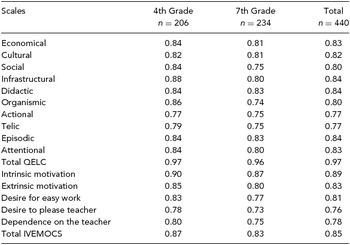
Reliability was assessed using Cronbach's alpha. The reliabilities of the QELC's subscales for all participants came within the range of 0.77 ≤ 0.84. The overall Cronbach's alpha for QELC was .97. The Cronbach's alpha for the IVEMOCS scales for all students was within the range of 0.76 ≤ 0.89, and the overall Cronbach's alpha was .85 (Table 1).
Reliabilities of QELC and IVEMOCS According to Grade Levels

Gender and Grade Differences
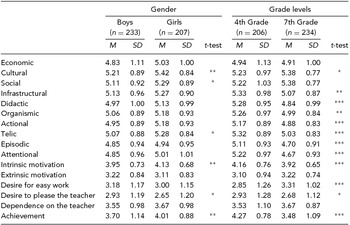
T-tests were performed in order to analyse gender differences in the QELC and IVEMOCS. In general, there was no gender difference between the resources except in cultural, social and telic capitals. In cultural (t = −2.58, p < .01), social (t = −2.06, p < .05) and telic (t = −2.56, p < .05) capitals, girls reported significantly higher levels. As for motivation components in the sample, there were significantly higher levels of intrinsic (t = −2.67, p < .01 in favour of girls) and desire to please the teacher (t = 2.42, p < .05 in favour of boys) components. In achievement levels, it was observed that girls obtained significantly higher scores than boys (t = −3.14, p < .01).
With respect to grade differences, 4th-graders reported significantly higher scores than 7th-graders in infrastructural (p < .05), didactic (p < .001), organismic (p <.01), actional (p < .001), telic (p < .001), episodic (p < .001), attentional (p < .001), intrinsic motivation component (p < .001), desire to please teacher (p < .05) and achievement (p < .001). In contrast, 7th-grade scores were higher in cultural capital (p < .05) and desire for easy work (p < .001). Means (M) and standard deviations (SD) of the QELC and IVEMOC subscales are shown in Table 2.
Means, Standard Deviations, t-Tests for the QELC and IVEMOCS Broken Down By Sex and Grade

Note: *p < .05, **p < .01, ***p < .001.
Correlations Between Capitals, Motivational Orientation and Achievement
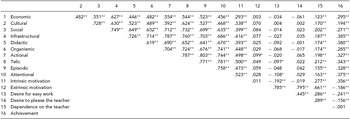
Table 3 shows zero-order correlations for the QELC, motivation components and achievement throughout the entire sample. The correlations ranged from −0.192 to 0.803. While all the resources, intrinsic motivation component, dependence on the teacher component and achievement exhibited positive correlations with each other, the extrinsic motivation component correlated positively with actional capital and negatively with achievement. The desire for easy work was negatively correlated with the telic and attentional resources and with achievement.
Zero-Order Correlations for the Subscales of the QELC With Motivation Components and Achievement for Total Sample

Note: *p < .05, **p < .01.
Regression Analysis
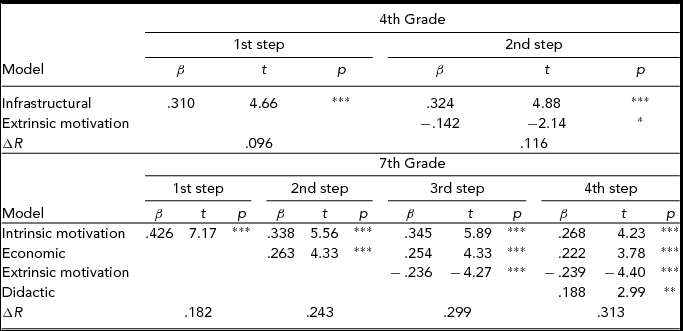
Further analysis to determine which capitals and motivation components predict achievement in different grades is shown in Table 4. It transpired that infrastructural capital and extrinsic motivation explained 11% of achievement in 4th grade. However, in the 7th grade, the results showed that intrinsic motivation, economic capital, extrinsic motivation and didactic capital together explained 31% of achievement.
Results of the Stepwise Regression Analysis of Capitals and Motivation Components on Achievement According to Grade Levels

Note:*p < .05,**p < .01, ***p < .001.
Discussion
The AMG gives importance to the individual and to the resources that the environment can provide for excellence (Davidson, Reference Davidson and Shavinina2009). At the core of the model lie the actions of individuals and the development of these actions (Ziegler, Reference Ziegler, Sternberg and Davidson2005). Therefore, these exogenous and endogenous resources not only provide a more fruitful ground for the growth of excellence but also actuate other psychological processes such as motivation (Ziegler, Fidelman, Reutlinger, Vialle, & Stoeger, Reference Ziegler, Fidelman, Reutlinger, Vialle and Stoeger2010). Intrinsic and extrinsic motivation have been widely studied, and the distinction between the two has shed much light on educational practices (Ryan & Deci, Reference Ryan and Deci2000).
The aim of the current study was to determine the relationship between capitals and motivational orientation, and the ability of these to predict achievement. The primary findings were that no gender differences were observed between the resources except in cultural, social and telic capitals. This indicates that girls consider cultural and social support, plus the ability to set goals, to be important resources. Results showed that even though girls have higher intrinsic motivation and achievement than boys, they need more cultural support to maintain that success in later years — especially in STEM fields. As San Roman and Rica (Reference San Roman and Rica2012) concluded, girls perform relatively better in math and reading in cultures where gender equality is enhanced. E-mentoring programs and programs designed to increase awareness among parents and educators of the importance of providing encouragement for girls might strengthen cultural support.
While girls had significantly higher intrinsic motivation, boys had significantly higher desire to please the teacher. These results were in line with previous studies (Vallerand et al., Reference Vallerand, Pelletier, Blais, Briere, Senecal and Vallieres1992; Vecchione, Alessandri, & Marsicano, Reference Vecchione, Alessandri and Marsicano2014). As anticipated, the observed results can probably be explained by gender-related differences in autonomy and relatedness (Deci & Ryan, Reference Deci and Ryan1985). Earlier studies found that female students perceive themselves as more autonomous in school activities than male students, and perceive teachers as being more supportive of autonomy (Belle, Reference Belle1989; Vallerand, Reference Vallerand and Zanna1997). In a recent study, Topçu (Reference Topçu2015) concluded that while there are gender differences in intrinsic motivation and desire to please the teacher in average students, the motivation types of gifted students do not exhibit any variation as regards gender. However, it must be emphasised that these gifted students are taking part in special education programs; thus, they appear to have the necessary supportive educational and learning capitals for the achievement of excellence.
The results of the study as regards differences in grade level were consistent with a prior study (Leana-Taşcılar, in press-a), which showed that younger students (4th grade) scored significantly higher than older ones (7th grade) in infrastructural and didactic educational capitals, as well as in all learning capitals. Age characteristics may account for this. In the current study, the older students were teenagers — an age group in which the development stage engenders a more critical attitude, and which is therefore less likely to be satisfied with their own and/or their teacher's capabilities. This age factor can lead to lower scores in all learning capitals and in infrastructural and didactic educational capitals. In view of the situation just cited, further research comparing different types of school (e.g., public and private) is recommended.
In line with the findings of Lepper, Corpus, and Iyengar (Reference Lepper, Corpus and Iyengar2005), the current study showed that intrinsic motivation was significantly higher in younger children, and that older children had a greater preference for easy work. Gillet, Vallerand, and Lafreniere (Reference Gillet, Vallerand and Lafreniere2012) also reported a systematic decrease in intrinsic motivation as age increases. Numerous studies have shown that students’ intrinsic motivation is linked to several positive educational outcomes: achievement, school satisfaction and persistence at school (Niemiec & Ryan, Reference Niemiec and Ryan2009; Vallerand, Reference Vallerand and Zanna1997). These two findings do not present a positive picture. Thus, the need arises to find preventative solutions. Since capitals have a positive influence on motivation, more emphasis needs to be placed on them — for instance, the support of government for appropriate infrastructure and the enrichment of didactic resources. In line with the aforementioned studies, the current study also revealed that younger students preferred to please the teacher more than older ones did. This finding is not in accordance with self-determination theory (SDT). Therefore, different elements of SDT (Niemiec & Ryan, Reference Niemiec and Ryan2009) might be introduced to those teachers who are responsible for students, with a view to improving self-determination.
The correlation analysis revealed that capitals correlated positively with intrinsic motivation and with dependence on the teacher, as well as with achievement. The highest correlations were between intrinsic motivation with attentional and telic capitals. Studies have shown that attention affects intrinsic motivation, and vice versa (Abuhamdeh & Csikszentmihalyi, Reference Abuhamdeh and Csikszentmihalyi2011; Robinson et al., Reference Robinson, Stevens, Threapleton, Vainiute, McAllister-Hamish and Gallagher2012). As Ames (Reference Ames1992) stated, systematic analysis of structures in the classroom and goal-setting (telic capital) increase intrinsic motivation. In line with earlier research (Lemos & Verissimo, Reference Lemos and Verissimo2014; Lepper et al., Reference Lepper, Corpus and Iyengar2005), the current study showed that achievement correlated positively with intrinsic motivation and negatively with extrinsic and its components. As motivation theorists have argued, interest and engagement in education results in better learning and achievement (Cordova & Lepper, Reference Cordova and Lepper1996). As all capitals foster motivation (which leads to success and to the path of excellence), it is crucial to increase awareness of capitals among educators and parents.
While for the 4th graders infrastructural capital and extrinsic motivation were the best predictors for achievement, for the 7th graders these were intrinsic motivation, economic capital, extrinsic motivation and didactic capital. In other words, younger students have higher learning capitals and intrinsic motivation than the older ones, so they need more external support to be more successful. On the other hand, for older students, besides the environmental support, intrinsic motivation is also needed. This conclusion adds credence to the AMG, which emphasises the importance not only of the individual (intrinsic motivation, which involves learning capitals) but also that of the environment (extrinsic motivation plus infrastructural, didactic and economic educational capitals) in the achievement of excellence. Since the current study is the first to focus on this topic, it must be stressed that further research is needed. It is especially important to investigate the situation of high achievers and gifted learners. If this is not done, there is a risk that brilliant individuals will be lost to society.
In closing, I would like to address the study limitations. Since pen-and-paper questionnaires are composed of self-report data, this may be considered one limitation (Barker, Pistrang, & Elliott, Reference Barker, Pistrang and Elliott2005). A second concerns school achievement: since there are no standard academic achievement tests in the Turkish language, achievement scores had to be calculated as regression scores. A third limitation is about the measurement invariance across gender. As Guay, Boivin, and Hodges (Reference Guay, Boivin and Hodges1999) suggest, the author assumed that there is measurement invariance across gender in achievement scores.
Finally, further studies on gifted samples are recommended to investigate how intelligence can serve excellence as an additional predictor. In addition, informative training programs for students, parents and educators on the influence of capitals and on how they can be improved are seen as desirable. Last but not least, further longitudinal researches could be undertaken to analyse in more detail the effects of improved capitals on motivation and achievement.
Financial Support
This research received no specific grant from any funding agency, commercial or not- for-profit sectors.
Conflict of Interest
None.
Ethical Standards
The authors assert that all procedures contributing to this work comply with the ethical standards of the relevant national and institutional committees (TME) on human experimentation and with the Helsinki Declaration of 1975, as revised in 2008.
Acknowledgments
The author wishes to thank all participating students and the teachers for their help: (in alphabetical order) Songül Dağlı, Neslihan Güngüder, Neval Türkeli. Special thanks are due to Dr Esra İşmen-Gazioğlu, Dr Erten Gökçe, Tobias Debatin, Dipl.Psych, and Dr Albert Ziegler. Additionally, the author would like to thank the TME for their permission to administer the questionnaires.