In her analysis of rape law reform in Canada, North America, and the United Kingdom during the 1970s and 1980s, Carol Smart claimed that such reform was characterized by “the failure of feminism to affect law and the failure of law to transform the quality of women's lives.”Footnote 1 Smart argued that rape law reform did not actually achieve any meaningful change, because the law is merely a patriarchal tool that is unresponsive to feminist interests. Engaging in law reform involves bestowing a degree of legitimacy on the prevailing criminal justice system, while ignoring the androcentric assumptions on which this system rests.Footnote 2 Whereas Smart's radical argument has been criticized as overlooking the usefulness of legal reform to the attainment of feminist goals,Footnote 3 nonetheless her claim offers a valuable starting point for examining the treatment of female rape complainants in the Irish criminal justice system between 1980 and 2017.Footnote 4
This article will first outline how rape emerged as a proprietorial crime committed by one man against another under common law, with this origin only being challenged in the past four decades with the evolution of a victim-centered approach in the criminal justice system and emergence of the antirape movement. Second, it will be posited that although attitudinal change toward rape complainants did emerge in the 1980s, as evinced through the DPP v Tiernan (1988) decision and criminalization of marital rape, procedural change has not been as forthcoming. The presence of low conviction rates in the system suggests that legal reform in the 1980s failed to have a practical impact through the operation of the courts. This article will conclude with a broader reflection on the nature of the Irish criminal justice system, suggesting that rape emerges as an exceptional crime that the existing legal system is ill equipped to address. The institutional resistance encountered by rape law reform indicates that the failure of the law to affect meaningful change rather than the failure of feminism to affect the law is what is culpable for the chronically low conviction rates in the Irish criminal justice system.
The History of Rape Under Common Law
To begin, it is necessary to briefly examine the history of rape under common law. The etymological origins of “rape” derive from the word “raptus,” which in early Roman law was a form of violent theft.Footnote 5 Correspondingly, rape first entered English statute books in 1275 as a property crime committed by one man against another.Footnote 6 The notion of women as property was particularly manifested in the law of criminal conversation, which meant that a husband could sue a man who had carnal relations with his wife; indeed, this law was only abolished in Ireland under Section 1 of the Family Law Act, 1981.Footnote 7 As a virgin attracted a greater market value as a potential bride, rape law was intended to help protect the male's possession from depreciation.Footnote 8 This statute imposed a penalty of 2 years’ imprisonment and ransom for raping a woman, and in 1285, rape was upgraded to a capital offense.Footnote 9 This 1285 law was only introduced in Ireland in 1613.Footnote 10 By 1841, transportation had replaced the death penalty for rape, as the presence of capital punishment meant that juries proved reluctant to convict.Footnote 11 Under Section 48 of the Offences Against the Person Act, 1861, penal servitude rather than transportation was introduced as the maximum penalty for rape, whereas Section 63 of this act asserted that proof of penetration rather than proof of ejaculation was required for a crime to be regarded as rape.Footnote 12 After this act, the law on rape remained largely unchanged for another 120 years in Ireland, with some minor exceptions in the form of Criminal Law Amendment Acts in 1885 and 1935. The 1885 Act was known as “Stead's Act” as it was largely passed as the result of a series of articles written by journalist William Stead in the pages of Pall Mall Gazette entitled “The Maiden Tribute of Modern Babylon.” This series concerned child prostitution and it caused outrage in Victorian Britain, leading to the age of consent being raised from 13 to 16 years.Footnote 13 The 1935 Act was similarly concerned with juvenile prostitution and was enacted as a result of the infamous Carrigan Report (1931), which was suppressed by the Cumann na nGaedheal government under William T. Cosgrave. The 1935 Act raised the age of consent from 16 to 17 years.Footnote 14 As these laws were primarily concerned with statutory rape and had no impact on the overall definition of rape, a discussion of these acts is outside the scope of this article.
During the period from 1861 to 1990, husbands were exempt from rape charges, based on the view that a wife constituted property, and “carnal knowledge” was construed as penile penetration, which cast the definition of rape from a patriarchal perspective. This definition was premised in the view that only penetrative rape causes pregnancy, and it failed to recognize that other violations of bodily integrity such as nonconsensual oral sex, sodomy, and manipulation of objects into bodily orifices were considered a form of rape by the majority of victims.Footnote 15 This narrow definition neglected to acknowledge that the potential consequences of rape do not detract from the inherent wrongfulness of the crime itself.Footnote 16 It is therefore difficult to refute the statement that until at least the late twentieth century, “the legal history of rape is the history of male domination.”Footnote 17
The position of women under the law as the chattel of their husbands and male relatives was slightly ameliorated in the nineteenth and twentieth centuries in Ireland. The Married Women's Property Act in 1882 permitted a wife to hold property, thus recognizing to an extent the legal identity of a wife, which had previously been rejected under Blackstone's unity theory in 1765. This unity theory was an extension of the feudal tenet of coverture. Blackstone wrote that the legal identity of a wife was incorporated into a husband's legal identity upon marriage. This meant that “a man could no more be charged with raping his wife than be charged with raping himself.”Footnote 18 The notion of women as legally separate beings from their husbands was consolidated under the Married Women's Status Act, 1957.Footnote 19 This recognition of the rights of women within the legal system coincided with changing attitudes among the judiciary in Ireland, which made judges more receptive to the rights of individuals, regardless of gender. In the 1960s, as a result of generational change and the influence of Patrick McGilligan, Professor of Constitutional Law at University College Dublin, who favored judicial review, judges moved from a positivist to a creative interpretation of the constitution.Footnote 20 Judges began to decipher the “spirit of the constitution,” which enabled the discovery of antecedent individual rights.Footnote 21 Collectively, these reforms were essential in recognizing the rights of married women as individuals, rather than viewing them as proprietorial objects, while assisting the legal shift toward examining the rights of the individual victim, which emerged in the 1980s.Footnote 22 By 1985, the first crime victimization survey had been conducted in Ireland while a victim support organization was established this same year,Footnote 23 underscoring the emergence of a more victim-oriented approach in the criminal justice system.
This changing conceptualization of rape from a crime committed against the property of a male to a violation of individual rights was also aided by the emergence of the antirape movement. The antirape movement first emerged in Ireland on July 26, 1977 when the Campaign Against Rape (CAR) held its inaugural meeting at Trinity College Dublin. This appears to be the earliest women's organization set up to directly address the issue of rape, and among the aims of this organization were equality for women in employment and education, free legal contraception, and the right of women to exercise full agency in matters pertaining to their sexuality.Footnote 24 The majority of members left CAR after a few months to set up the Dublin Rape Crisis Centre, and although the former continued to exist, it was soon overshadowed by the latter.Footnote 25 The Limerick Rape Crisis Centre soon followed in 1980, and by 1986, five additional centers in Cork, Galway, Waterford, Letterkenny, and Clonmel had been established.Footnote 26 These centers played a pivotal role in lobbying the government to introduce legal reform to improve the experiences of rape complainants in the courtroom, and the Criminal Law (Rape) (Amendment) Act, 1990 is viewed as a triumph for the movement.Footnote 27 This act made provisions for extending the definition of rape, criminalizing marital rape, replacing the category of indecent assault with aggravated sexual assault and sexual assault, extending the protection of anonymity to complainants in all sexual offenses trials, asserting that lack of physical resistance did not constitute consent, acknowledging that men as well as women could be raped, and recognizing that boys under the age of 14 were capable of committing rape.Footnote 28 Therefore, the combination of both a victim-centered approach in the criminal justice system and the lobbying pressure employed by the antirape movement contributed to an overhaul in Irish rape law by 1990.
Attitudinal Change
The increasing emphasis placed on victimology within the legal system marked a significant departure within the civil libertarian tradition of common law, which had previously focused on the rights of the defendant.Footnote 29 Prior to the 1980s, rape defendants were treated by the courts in a lenient manner, as evidenced through high acquittal rates and low custodial sentences. For example, in October 1959, the Dublin Circuit Court sentenced two men with previous convictions who were charged with an attempted gang rape to merely 15 months and 6 months respectively in prison.Footnote 30 Yet this cannot simply be regarded as indicating lack of concern with rape crime, but rather reflects the prevailing legal culture that the rights of the defendant must be protected from the exercise of state power.Footnote 31 Civil libertarian theories of the state, influenced by John Locke, stressed minimal state intervention while still protecting individuals and their property. Second-wave feminists, however, began arguing that “the personal is political,” and the antirape movement partook of this particular argument. In doing so, the movement sought to deconstruct liberal theory's portrayal of the home as a nonpolitical sphere, arguing that violence against women was not simply a personal problem. If the state did not play a credible role in protecting victims of sexual violence, then it was simply legitimizing male violence against women.Footnote 32 The subsequent legal reform generated in the 1980s led to a delicate rebalancing of the rights of the accused and rights of the victim, and in particular led to more empathetic judicial attitudes toward rape complainants. The Supreme Court decision in the Tiernan case of May 13, 1988 reveals most effectively the shifts in judicial attitudes that occurred during this period. Admittedly, this single judgment is an imperfect means of fully assessing changes in judicial attitudes. However, as records from rape trials during this period remain largely inaccessible to historians because of data protection laws, this decision offers the best insight into judicial mentalities surrounding rape crime in this period.
The Tiernan case concerned Edward Tiernan, one of three men who abducted and raped a 23-year-old woman in 1985.Footnote 33 The woman was sitting in a car with her boyfriend when the men forcibly entered it, locking the boyfriend in the boot of the car and dragging the woman to a nearby field.Footnote 34 Tiernan pleaded guilty to rape and was sentenced to 21 years in prison. An appeal was made to the Court of Criminal Appeal on the severity of his sentence, and although the sentence was affirmed by the court on January 13, 1986, a further appeal was made by the Attorney General. The Attorney General issued a certificate on March 9, 1987 pursuant to Section 29 of the Courts of Justice Act 1924, asserting that the case involved “a point of law of exceptional public importance”; namely, to decide whether sentencing guidelines should be issued for rape crime by the courts. According to the judgement of Finlay C.J., the courts should not set out sentencing guidelines, but rather each case should be decided on its individual merit. The main implication of the Tiernan decision was that in only “exceptional” cases could a noncustodial sentence for rape be granted. The decision also recognized that a guilty plea was a mitigating factor, as it saved the victim from cross-examination, and could also indicate the offender's remorse and the potential for rehabilitation. On this basis, the sentence of Edward Tiernan was reduced to 17 years. This was a 4:1 decision with McCarthy J. dissenting, claiming that the trial judge would have taken these considerations into account, and, therefore, that the original sentence should be upheld.Footnote 35
Finlay C.J. wrote in his judgement that rape is “one of the most serious offences contained in our criminal law, even when committed without violence beyond that constituting the act of rape itself.” This judgment recognized that rape was an inherently violent rather than a sexual act. It further articulated that lack of premeditation did not constitute a mitigating factor, and, therefore, the conceptualization of rape as an inadvertent result of uncontrollable sexual urges was rejected. Additionally it recognized that rape causes not merely “bodily harm” but also “emotional, psychological and psychiatric damage” and that it violated the dignity and bodily integrity of a woman.Footnote 36 These sentiments reveal a transference of consciousness between the antirape movement's understanding of rape crime and judicial understanding of the crime. Influenced by the writings of American second-wave feminists, particularly Susan Brownmiller, the antirape movement portrayed rape as a learned behavior premised in violence and a desire to degrade and humiliate the victim.Footnote 37 The Tiernan judgment appeared to be a largely victim-oriented decision, which sympathized with the impact of rape on the emotional and physical well-being of a woman. Yet it is important to note that there were elements of the decision that did not completely align with feminist views. For example, the decision highlighted the existence of victim precipitation by stressing that “the fact that [the victim] could be considered to have exposed herself by imprudence to the danger of being raped” did not constitute a mitigating factor.Footnote 38 Unlike the antirape movement, the judgement did not deny that victim precipitation occurs, but rather contended that such precipitation should not be considered a mitigating circumstance in terms of sentencing. Yet as the antirape movement would argue, if this evidence is irrelevant regarding sentencing, one must question its relevance in the trial procedure itself.
The degree to which judicial attitudes toward rape complainants changed during this period has been examined by Caroline Fennell, who has noted that the Tiernan case was a stereotypical rape case that included abduction, stranger rape, and gang rape.Footnote 39 A “real rape” is thought to occur outdoors, is perpetrated by a stranger with the threat of violence, and the victim offers physical resistance. This stereotype does not correspond with the reality of rape, as there is usually acquaintanceship between the victim and perpetrator, and the victim is often too frightened to fight back.Footnote 40 In addition, as Nicholas Groth has noted, whereas physical resistance may deter one type of rapist, it may encourage another.Footnote 41 Juries tend to be reluctant to convict in cases of relationship rape and, according to Fennell, judges exhibit greater levels of sympathy toward victims in stranger rape cases.Footnote 42 Fennell's argument suggests that had the Tiernan case involved acquaintance rape, the decision could have been very different. It is important to note that Fennell's assessment was written in 1993 at the time of the Lavinia Kerwick case, in which a 9-year suspended sentence was handed down to William Conry, Kerwick's boyfriend, who had pleaded guilty to raping her in the early hours of New Year's Day 1992 in Kilkenny. The controversy generated by this sentence led to the introduction of the Criminal Justice Act, 1993, which allowed the Court of Criminal Appeal to review sentences seen as unduly lenient and required courts to take victim impact statements into consideration.Footnote 43 Ironically, Kerwick could not use this legislation to appeal her own case as it only applied to future cases. She was the first rape complainant to waive her right to anonymity when she spoke on the Gerry Ryan radio show on July 17, 1992 about her experiences.Footnote 44 Justice Fergus Flood remarked that he was satisfied that the case was “within the exceptional category identified by the Chief Justice in the Tiernan case,” thus justifying the granting of a noncustodial sentence, and, therefore, in the case of acquaintance rape, the Tiernan decision did not appear to benefit the victim.Footnote 45 Yet Fennell's conclusion was premature, as an examination of the impact of the Tiernan decision on subsequent adult rape cases suggests that this decision has largely been applied in a manner that equally benefits complainants of both acquaintance and stranger rape.
These cases have been mainly uncovered through the Westlaw database, which covers the cases that have been reported in the Irish Law Reports Monthly since 1976, and also unreported judgments from 2000 onwards. This is not a complete guide to all adult rape cases that have occurred since 1988, but is a representative sample of the cases that attracted comprehensive coverage in legal reports. Cases that involve statutory rape, or in which the Tiernan decision was invoked in a criminal case in which rape was not one of the charges against the defendant have been excluded. Between 1995 and 2016, seven adult rape cases came before the Court of Criminal Appeal in which the Tiernan decision was used as precedent; DPP v Christopher Byrne (1995) 1 I.L.R.M. 279; DPP v John McLaughlin 25CJA/05; DPP v Adam Keane (2008) 2 I.L.R.M. 321; DPP v Stafford (2009) 11 I.C.L.M.D. 44; DPP v Owen Power (2014) IECA 37; DPP v Christopher Farrell (2014) IECA 51; and DPP v Magnus Meyer Hustveit (2016) IECA 271. Three of these, namely the Farrell, McLaughlin, and Byrne cases constituted stranger rape cases, whereas the remaining four cases involved acquaintance rape. The Tiernan decision was used in only one out of the seven cases, DPP v Owen Power, an acquaintance rape case, to reduce the original sentence of the defendant from 20 years to 7 and a half years. This was because Mr. Justice Birmingham regarded the case to be at the “lower range” of seriousness because of the previous good character of the youth, and the intoxication of both the victim and perpetrator. In four cases, half of which were acquaintance rape cases, the Tiernan decision was used to increase the original sentence. In the stranger rape cases of DPP v Christopher Farrell, Mr Justice Birmingham doubled the original 6-year sentence, whereas in DPP v John McLaughlin, a 3-year suspended sentence was replaced by a 4-year sentence with 3 years suspended. The acquaintance rape cases of DPP v Adam Keane witnessed an original 3-year suspended sentence replaced by a 10-year sentence with 3 years suspended, whereas in DPP v Magnus Meyer Hustveit, the defendant was required to serve 15 months compared with the 7-year suspended sentence previously imposed. The original sentence was upheld in the remaining two cases, in which the defendant had appealed for greater leniency, DPP v Christopher Byrne and DPP v Stafford, the latter of which was an acquaintance rape case. The Tiernan case was not the sole precedent cited in these judgements, and the various circumstances of each case do need to be individually taken into account. Nonetheless, these cases do suggest that the Tiernan decision had been applied to acquaintance and stranger rape cases in a nondiscriminatory manner, which renders Fennell's conclusion inaccurate.
Marital Rape
This tendency of judges since the Tiernan decision to treat acquaintance and stranger rape cases equally regarding sentencing decisions has been further aided by the criminalization of marital rape. The marital rape exemption was introduced by Sir Matthew Hale in 1736, namely that “the husband cannot be guilty of rape committed by himself upon his lawful wife, for by their mutual matrimonial consent and contract the wife hath given herself up in this kind unto her husband which she cannot retract.”Footnote 46 Whereas a husband could be prosecuted for battery, assault, or indecent assault, it was assumed that a wife gave irrevocable consent to sexual relations upon marriage, which could not be retracted and, therefore, that legally, a husband could not rape his wife.Footnote 47 Hale provided no legal precedent for this contractual theory, and as he had served as a judge at the witchcraft trial in Bury St. Edmonds in 1662, this may have contributed to a misogynistic view of women. On the other hand, Hale may simply have been reflecting the prevailing attitude toward marital relationships in the eighteenth century.Footnote 48 Nonetheless, Hale's contractual theory formed the basis of the marital rape exemption in Ireland.
The legal precedents contributing to the abolition of the marital rape exemption have been well documented.Footnote 49 It is sufficient to note that the abolition of this exemption in Ireland under Section 5 of the Criminal Law (Rape) (Amendment) Act 1990 was in large part a result of continuous lobbying efforts by the antirape movement throughout the 1980s.Footnote 50 Through the slogan “the personal is political,” sexual violence was portrayed by rape crisis centers not as an isolated incident that occurred to women of questionable character, but as a pervasive, institutionalized expression of male domination that could affect any woman regardless of class, age, or marital status.Footnote 51 This latter criterion in particular, the acknowledgement by the rape crisis centers that married women were often raped by their husbands, posed a direct threat to family life. It was reported in 1986 that 2.8% of women who attended the Dublin Rape Crisis Centre had been raped by their husbands, although this figure was stressed to be an underestimation.Footnote 52 The first major study on rape in marriage was conducted by Diana Russell and was published in 1982. Russell estimated that 14% of married women had been raped by their husbands.Footnote 53 Together with Women's Aid, which had opened a shelter for battered wives in 1974, the Irish rape crisis centers were providing an outlet for women to express their unhappiness with marriage.Footnote 54 Moreover, by offering women a place of refuge, and by fighting for legal reform to help women escape from their situations, the traditional notion of females as passive individuals was being overturned. Women no longer had to suffer through unhappy marriages in silence or remain confined in them. Instead, they could exert control over their own lives and own sexuality, which was at odds with Catholic social teaching.Footnote 55
The criminalization of marital rape was, therefore, largely influenced by the antirape movement and it revealed a significant shift in judicial attitudes toward rape. In the 1950s, a judge had ruled that it was desirable that “some gentle violence be employed” in order that the husband may achieve sexual gratification, regardless of whether the wife consents or not.Footnote 56 In contrast, in the first marital rape case in 1993, Justice Paul Carney directed the jury that the marital rape exemption no longer existed, as it was no different from any other form of rape. Rather, consent was the principal issue around which rape revolved, regardless of the marital status of the victim, suggesting that the tendency of the judiciary to view acquaintance rape as less serious than stranger rape had largely been obliterated.Footnote 57 Although there have been merely four marital rape cases brought before the courts since 1990, two of these cases were heard in 2016, which suggests that women are becoming more confident in recent years in bringing such cases forward. The first marital rape case in Ireland resulted in an acquittal for the defendant and the defendant in a 2006 case received a 6-year sentence, whereas in the two marital rape cases in 2016, a 12-year sentence with 2 years suspended and a 7-year sentence with 2 years suspended, respectively, were imposed.Footnote 58 This is roughly in accordance with the sentences imposed in nonmarital rape cases, although the conviction rate is higher than in nonmarital cases.
Although the relatively small number of marital rape cases coming before the courts hinders a definitive analysis, this small sample suggests that juries may be more sympathetic in such cases. It is not entirely clear why this may be the case. One possible explanation is that prosecutors recognize the extreme difficulty in obtaining a conviction for marital rape given the degree of intimacy between the victim and defendant. Therefore, the small number of cases that actually go forward for trial may comprise those that have been rigorously assessed and contain aggravating factors such a history of violent behavior by the husband. In this way, successful marital rape convictions may depend on how closely the case aligns with aspects of the real rape stereotype, although further research is required to test this hypothesis. Nonetheless, overall since 2006, sentences for rape cases, both marital and nonmarital, have been increasing to an average of 10 years. Granted, this falls to 8 years when suspended portions of the sentence are taken into account, but is nonetheless an increase compared with 2005 figures.Footnote 59 This trend is convergent with United Kingdom figures, with average custodial sentences for rapists in United Kingdom being 105.2 months, or just under 9 years, as of 2011.Footnote 60 It is rare in Ireland for a defendant to receive a noncustodial sentence for rape, and this is a direct result of the DPP v Tiernan decision stressing the seriousness of rape and its impact on victims. The criminalization of marital rape has further helped to challenge the myth of the stranger rape, and together with the Tiernan decision, judicial attitudes have demonstrably evolved.Footnote 61 Rape is no longer a crime that is viewed as less serious if committed by a boyfriend or husband, but rather is viewed as violating the bodily integrity of a woman regardless of her relationship with the perpetrator.
Practical Limitations of Legal Reform
Although rape law reform has evidently yielded a symbolic impact through solidifying a victim-centered approach in the criminal justice system, highlighting rape crime as an act of violence and also recognizing that acquaintance rape is equally as serious as stranger rape, in practical terms this impact has been limited. Apart from the elimination of the corroboration requirement under Section 7 of the 1990 Act, which means that judges are no longer obliged to warn the jury of the dangers of relying on the victim's unsupported testimony, procedural change has not been forthcoming.Footnote 62 This is expressed in numerous ways. First, there is a lack of separate legal representation of the victim. Under Section 26 (3) of the Civil Legal Aid Act, 1995, rape victims from the time they report the crime are entitled to free means-tested advice. Gardaí, however, are not obliged to inform victims of this provision and, therefore, many are unaware of it.Footnote 63 The 2001 Sex Offences Act further allowed for a limited form of legal representation for the victim, but only when the defense attempted to introduce sexual history evidence.Footnote 64 Second, the status of the victim is reduced to that of a mere witness for the state. The potential negative consequences of the diminished status of the complainant in a rape trial were demonstrated in a case in January 1977. A rape complainant from Nenagh was jailed by Justice Fawcitt for contempt of court when she decided for personal reasons that she did not want to give evidence against two men, ages 21 and 27, who were charged with her attempted rape. She was obliged as a state witness to give evidence, and when she would not she was placed in prison while her alleged rapists walked free.Footnote 65
Yet the intransigence of trial procedure is most notable regarding the admittance of sexual history evidence. Under common law, sexual history evidence was considered relevant for two reasons, namely to indicate the trustworthiness of the complainant and to indicate whether or not consent was given. This evidence was premised on the misogynistic assumption that a woman who had sex outside of marriage was likely to be untruthful and falsely claim that a rape had occurred. In recent years, empirical studies have demonstrated that women with extensive sexual histories are actually less likely to report rape crime, and that the level of false reporting of rape crime is estimated to be a mere 6%.Footnote 66 Under Section 3 of the Criminal Law (Rape) Act, 1981, which was amended by Section 13 of the 1990 legislation, evidence of a victim's sexual history can only be introduced with the permission of the judge. Yet in a 2009 study, sexual history evidence was used in thirteen out of thirty-five cases, whereas the victim was questioned about sexual behaviour in twenty-four out of thirty-five cases.Footnote 67 As Caroline Fennell has argued, although compromises have been made by the system in relation to sexual history evidence, the assumptions directing these procedures, such as that female sexual promiscuity signifies falsity of testimony, remain intact.Footnote 68 Trial procedures such as these suggest that although the state seems to condemn sexual violence against women, in reality it perhaps excuses it.Footnote 69
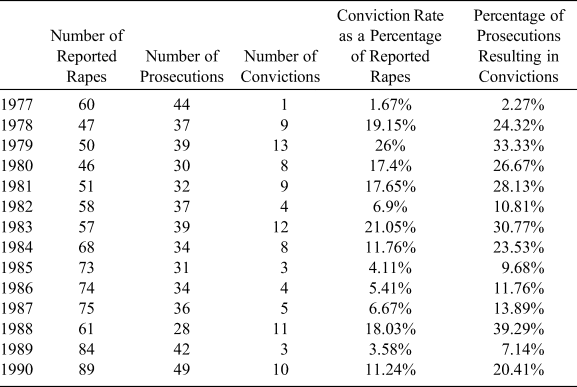
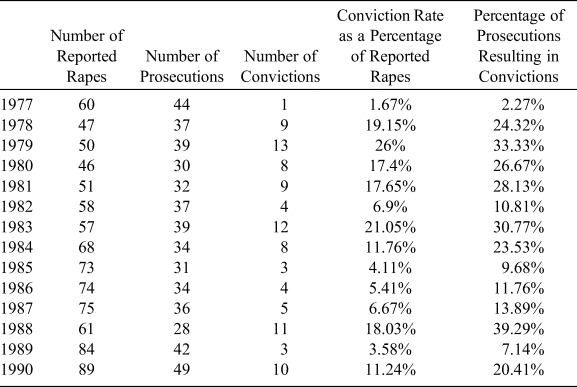
The presence of low conviction rates offers further support to the view that legal reform has had a limited impact on the criminal justice system. Table 1 demonstrates the changes in rape reporting, prosecutions, and convictions in the Republic of Ireland between 1977 and 1990.
Number of Reported, Prosecuted, and Convicted Rapes in the Republic of Ireland between 1977 and 1990.
Source: An Garda Síochána Annual Reports. http://garda.ie/Controller.aspx?Page=16448&Lang=1 (November 10, 2017).
In 1970, there were merely fifteen rapes reported, rising to thirty-eight by 1975 and to fifty by 1979. Yet coinciding with the emergence of the antirape movement, the number of reported rapes further rose to fifty-eight by 1982, to seventy-three by 1985, and and to eighty-four by 1989. These figures continued to increase to 137 by 1995 and to 292 by 1998, reaching 458 by 2005, convergent with trends in England/Wales.Footnote 70 These figures are not necessarily reflective of a rape epidemic in Ireland, but rather signify an increased tendency by complainants to make a formal report. The Sexual Abuse and Violence in Ireland Report in 2002 found that only 7.8% of female adult victims reported sexual violence to the Gardaí.Footnote 71 Although a corresponding figure for more recent years is difficult to obtain, Rape Crisis Network of Ireland statistics from 2015 have found that 36% of rape victims who attended eleven rape crisis centers had reported the crime to a formal authority.Footnote 72 This is admittedly a remarkable increase, but this statistic remains worryingly low. Nevertheless, this suggests that increasing numbers of rape victims have sufficient confidence in the legal system to make a formal report. It is also necessary to draw attention to the small percentage of prosecutions that actually result in a conviction. This figure never exceeded 40% during the period under scrutiny, which means that even if a rape case does proceed to court, on the balance of probabilities the defendant is likely to be acquitted.
Furthermore, there were 647 reported rapes between 1980 and 1989, and 343 rape cases went to trial resulting in sixty-seven convictions. The conviction rate as a percentage of reported rapes was 10.36%. In contrast, between 2005 and 2007, there was a conviction rate of merely 8%.Footnote 73 It appears that in spite the legal reform generated in the 1980s by the movement, this reform actually made it less likely that a conviction would occur. Since the Criminal Law (Rape) (Amendment) Act was passed in 1990, conviction rates have continued to fall well below the levels of the 1980s. By the end of the twentieth century, Ireland had the lowest conviction rate of twenty-one European Union countries.Footnote 74 It is essential to note that these statistics must be used cautiously. These Garda figures are subject to “counting rules,” whereby “a continuous series of offences against the same injured party involving the same offender counts as one offence.”Footnote 75 There is also a primary offense rule that only the most serious crime is reported if there are various crimes committed in a single episode. These figures therefore seriously underestimate not only the number of victims but also the type and number of incidents suffered by the victims.Footnote 76 In addition, the conviction rate only refers to convictions recorded in that particular year, although the trial of an offense recorded in one year may not occur until the following year.Footnote 77 The Gardaí record crime for operational use and, therefore, these statistics are not intended to reflect the total level of crime that occurs.Footnote 78 While bearing these limitations in mind, in general it appears as if the conviction rate has fallen since the 1980s.Footnote 79
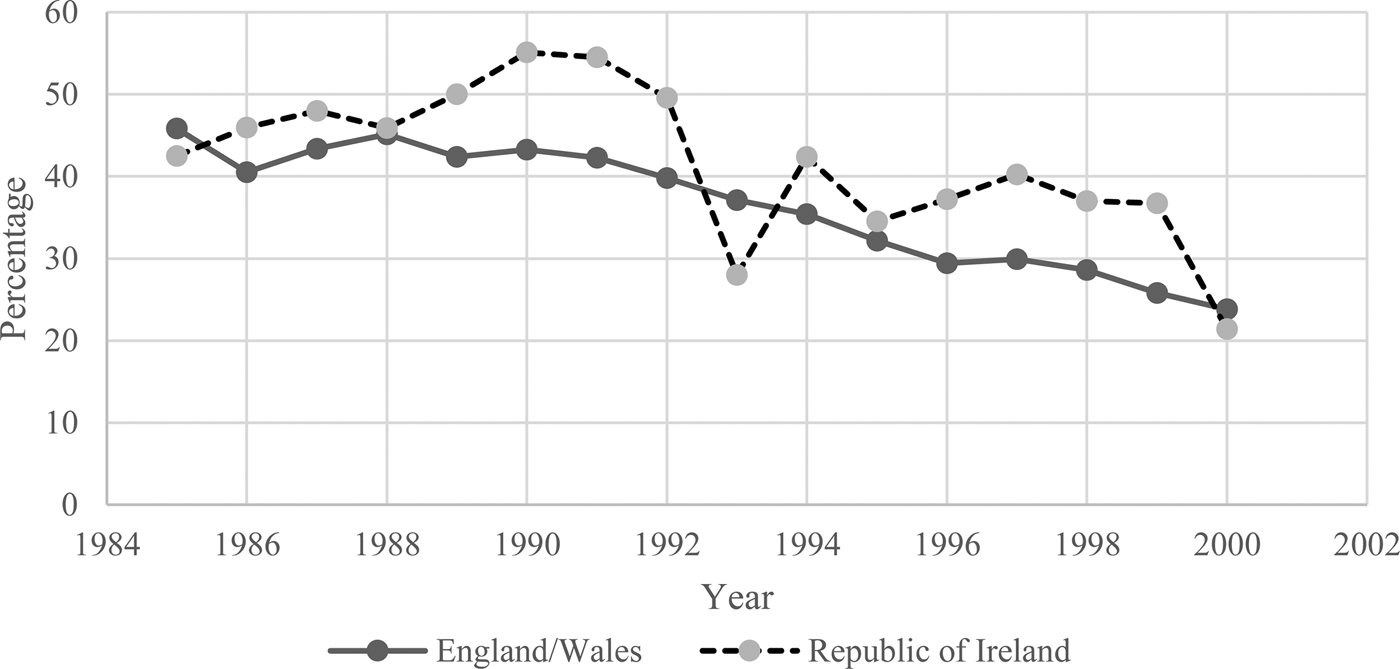
The extent to which the conviction rate has fallen is further supported by a comparative analysis of prosecutions and convictions for rape in England/Wales and the Republic of Ireland between 1985 and 2000 (Figure 1).
Percentage of reported rapes that result in prosecution for England/Wales and the Republic of Ireland, 1985–2000. Compiled from data provided by Linda Regan and Liz Kelly, Rape: Still a Forgotten Issue, Briefing Document for Strengthening the Linkages – Consolidating the European Network Project, London: Child & Woman Abuse Studies Unit, 2003. Available at: http://cwasu.org/resource/rape-still-a-forgotten-issue/ [accessed 10 November 2017]; An Garda Síochána Annual Reports. Available at: http://www.garda.ie/Controller.aspx?Page=16448&Lang=1 [accessed 10 November 2017].a

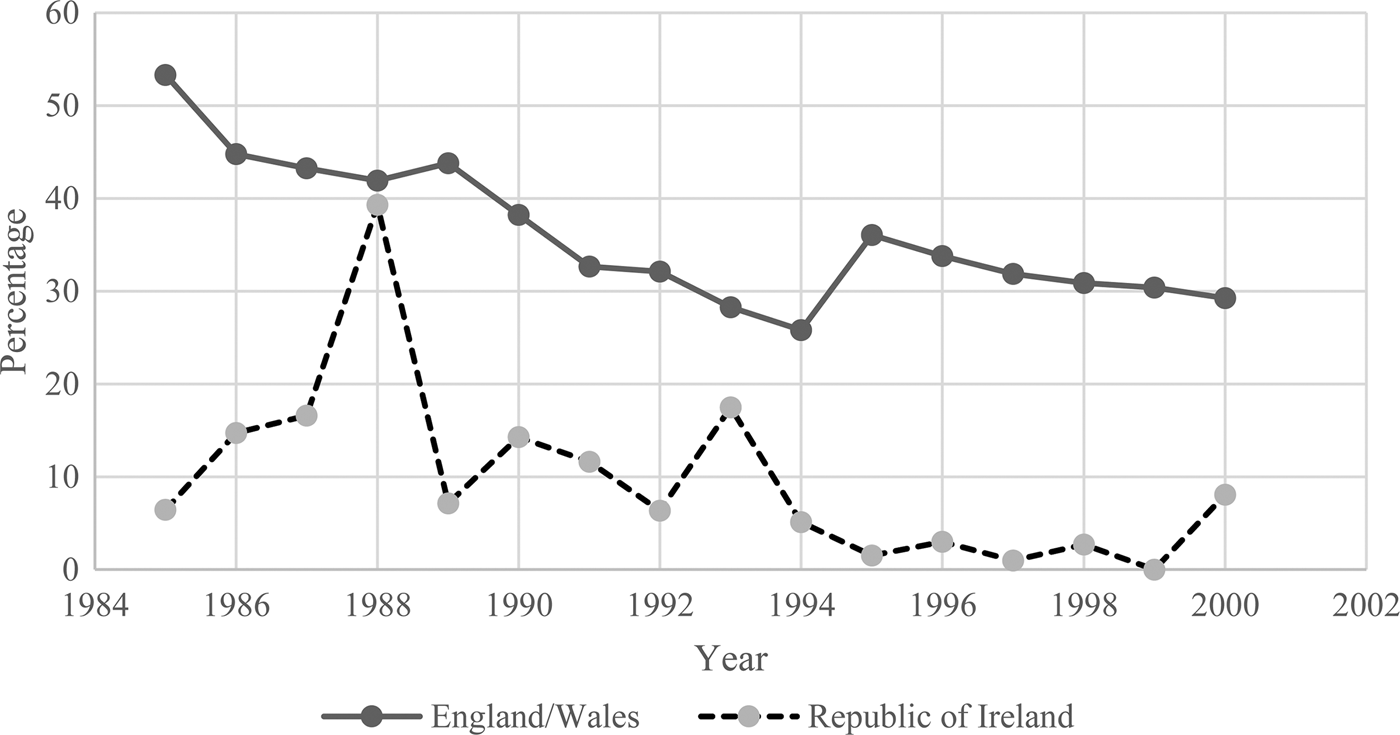
Figure 1 demonstrates that although the number of reported rapes resulting in prosecution has never exceeded 56% in Ireland, Ireland outperforms England/Wales in this aspect of the attrition process. This suggests that it is not the Gardaí or Director of Public Prosecutions that can be pinpointed as the main causes of the low conviction rate. Indeed, Ireland during this period was relatively successful in getting rape cases to trial. The opposite is true, however, when the next stage of the criminal justice system is examined; namely, the cases that come to trial but fail to obtain a conviction (Figure 2).
Percentage of prosecutions that result in conviction for England/Wales and the Republic of Ireland, 1985–2000. Compiled from data provided by Linda Regan and Liz Kelly, Rape: Still a Forgotten Issue, Briefing Document for Strengthening the Linkages – Consolidating the European Network Project, London: Child & Woman Abuse Studies Unit, 2003. Available at: http://cwasu.org/resource/rape-still-a-forgotten-issue/ [accessed 10 November 2017].b

The contrast between the conviction rate as a percentage of prosecutions between these two jurisdictions could not be more pronounced. Ireland consistently underperforms at this stage of the criminal justice process, which indicates that the key to low conviction rates lie within the trial process itself. To an extent, this validates the decision of the antirape movement to strive for legal reform during this period in order to alter procedural elements of the criminal justice system. Yet England/Wales and Ireland share a similar common law system, possess analogous definitions of rape as violations of bodily integrity, and introduced similar legal reforms throughout the 1980s. One possible explanation for this anomaly is provided by Susan Leahy; namely, that the social attitudes of Irish jurors rather than legal procedures per se are the root cause of low conviction rates for rape.Footnote 80 Although Leahy's argument is intriguing, further research is required to verify this hypothesis that Irish juries hold particular beliefs and values that discriminate against rape victims compared with their English counterparts.
It is pertinent to reiterate such a view, as under the Criminal Law (Sexual Offences) Act of 2017 a statutory definition of consent was introduced in Irish law.Footnote 81 The issue of defining consent was first proposed by the Law Reform Commission in 1988, but it has taken almost three decades for such a change to come about.Footnote 82 It is worth noting that this legislation was introduced by a female, feminist Minister for Justice and Equality, Frances Fitzgerald, who may have been more receptive to the demands of the feminist movement than some of her predecessors.Footnote 83 This would appear to offer collateral to proponents of substantive representation; namely, that female politicians are more likely to represent the voices of women and so bring about meaningful policy change.Footnote 84 Section 48 of the 2017 Act mirrors the recommendation of the 1988 Commission by offering both a positive and negative definition of consent. Consent is positively defined as “freely and voluntarily” agreeing to sexual intercourse, although it is also asserted that consent cannot be given in circumstances such as when the fear, threat, or actual use of force is present; when the individual is mentally incapacitated; or when the individual is incapacitated because of alcohol or drugs.Footnote 85 Although this definition of consent has been broadly welcomed by the Rape Crisis Network of Ireland who described it as a “fantastic beginning,”Footnote 86 the history of rape crime in Ireland as outlined by this article offers a more pessimistic forecast. Granted, defining consent may assist in bringing about further attitudinal change in the minds of judges, juries, legal practitioners, and the wider public, but analogous to the legal reform introduced in the 1980s, this definition is unlikely to have a direct effect on conviction rates, undermining the practical implications of this legislation.
The Exceptionality of Rape Crime
Overall, from a cursory glance, the findings of this article appear contradictory. Judicial attitudes have proven responsive to feminist thought, which is a testament to the success of the antirape movement, yet sexist assumptions about women as expressed through the continued use of sexual history evidence continue to dominate legal culture. The level of reporting of rape has risen, suggesting greater faith by women in the criminal justice system, yet conviction rates have fallen since the 1980s. Such tensions, as Shane Kilcommins has comprehensively outlined, reflect the complex negotiation between liberal and control-oriented ideologies embedded in patterns of crime control in Ireland.Footnote 87 Given these intriguing tensions, it is beneficial to provide some broader reflections on the interaction between rape and the criminal justice system. In particular, it is worth considering if rape may be regarded as an exceptional crime. Criminologist Gerald Robin has asserted that; “forcible rape is unique among crimes in the manner in which its victims are dealt with by the criminal justice system. Raped women are subjected to an institutionalized sexism that begins with their treatment by the police, continues through a male-dominated criminal justice system influenced by pseudoscientific notions of victim precipitation, and ends with the systematic acquittal of many de facto guilty rapists.”Footnote 88 It is worth briefly considering these five elements. First, it is inaccurate to claim that the criminal justice system engages in a systematic acquittal of rape defendants. Granted, it is estimated that 28% of homicide offenses known to the police result in conviction, compared with 7% of rape offences. Yet recent statistics from Ireland in 2014 suggest that merely 7% of burglaries recorded by the Gardaí result in a conviction, indicating that high acquittal rates are not necessarily the sole preserve of rape crime.Footnote 89 It is worth noting that this conviction rate is based on the number of recorded rather than reported crimes. It is estimated that 17% of crimes reported to Gardaí are not recorded on the Police Using Leading Systems Effectively (PULSE) system as of 2015.Footnote 90 Therefore, the conviction rate for burglaries as a percentage of reported crime may be even less than 7%.
Second, victim precipitation, although anathematic to the antirape movement, is not limited to rape cases. This term was popularized by Menachem Amir's pioneering criminological study in Philadelphia in which he asserted that a woman is somehow complicit in her rape through her actions or behavior, or otherwise.Footnote 91 This view has since been largely discredited as partaking of the rape myth that the rape victim must have been “asking for it.”Footnote 92 Yet victim blaming is also common during homicide trials, as the deceased is often put on trial in the sense that his or her character and motivations are called into question.Footnote 93 The very term “victim precipitation” was first introduced by Martin Wolfgang in 1957 in furtherance of his argument that victims often provoked their own homicide.Footnote 94 Another element identified by Robin is the treatment by police. This is an element of the criminal justice system that because of a lack of available data has regrettably remained invisible in this article. Unfortunately there is little information regarding the attitude and treatment by Gardaí of victims throughout this period. It was only following the 2009 report Rape and Justice in Ireland commissioned by the Rape Crisis Network of Ireland that research started to be conducted regarding the experience of victims who report to the Gardaí, and 2013 is the first year for which statistics are available, with 57% of victims expressing that they were treated in a sensitive manner by the Gardaí.Footnote 95 The jury is, therefore, out on whether or not treatment by police contributes to the exceptionality of rape crime.
The exceptionality of rape crime therefore lies in the remaining two points; namely, an institutionalized sexism within a male-dominated criminal justice system. These points may be dealt with concurrently. Although the issue of whether the criminal justice system is truly gender neutral is complex, research to date suggests that there is an institutional bias against women within this system.Footnote 96 This is particularly evident through the continued use of sexual history evidence, as this article has already outlined. Another example of the institutionalized gender bias of the criminal justice system is the marital rape caveat contained in Section 5(2) of the 1990 Act. This stated that the consent of the Director of Public Prosecutions was required for criminal proceedings to be launched against a married man in the case of rape.Footnote 97 The main fear of the government of the day, then a Fianna Fáil-Progressive Democrat coalition with Fianna Fáil Deputy Ray Burke handling the justice portfolio, was that wives would be more prone to making false accusations against their husbands, and, therefore, that any rape accusation by a married woman needed to be treated with extreme scepticism. Burke explained that this caveat was included in the legislation, as wives could potentially undertake “spiteful and mischievous” proceedings against their spouses.Footnote 98 Although an unmarried woman could initiate proceedings herself or instruct the Gardaí to conduct them on her behalf, married women were treated differently, which conveyed that rape in marriage is somehow distinctive from rape crime in general. Although the antirape movement had consistently argued that rape in marriage is just as serious as stranger rape, as both violate the bodily integrity of the female, the government refused to recognize this.Footnote 99 The abolition of the marital rape exemption could have signalled that the state was treating all female complainants of rape crime, regardless of marital status, as equal. Yet Section 5(2) revealed that although all rape complainants are equal, some are more equal than others. As Workers’ Party TD Pat McCartan articulated, “this notion…originated in paternalism, in male sexual and social superiority, that a woman spurned would be a woman sore.”Footnote 100 Of course, one could argue that the overall abolition of the marital rape exemption outweighed the limitations that Section 5(2) entailed. Nevertheless, the fact remains that the state, while appearing to improve the position of women in society, continued to view women from a patriarchal perspective.
Therefore, although individuals within the system might be responsive to feminist demands, the very institution of the criminal justice system is immersed in patriarchal traditions. Common law is not equipped to deal with rape, as the current feminist conceptualisation of rape as a violation of bodily integrity has only been grafted onto this system in the past 40 years. Considering that rape crime existed under common law as a property crime committed by one man against another for the vast majority of 800 years, rape law reform can at best only have an incremental effect. That is not to say, as Carol Smart's analysis implies, that legal reform is an exercise in futility or that the antirape movement was misguided in seeking legal reform. Legal reform did succeed in consolidating the conceptualization of rape as a violent act that could be committed by an acquaintance as well as by a stranger. Yet the failure of procedural elements of the law to improve the quality of the experiences of rape complainants in the courtroom suggest that the criminal justice system is not equipped to be regarded as the solution to rape crime.
In conclusion, this article has examined the interaction between rape and the criminal justice system, commencing with a history of rape under common law. The proprietorial nature of rape crime was challenged in the 1980s because of the evolution of a victim-centered approach in the legal system and emergence of the antirape movement. Such changes as accompanied by legal reform have succeeded in bringing about a sympathetic evolution in judicial attitudes, and recognition that rape is a violent crime committed with the intention of degrading and humiliating the victim. Procedural elements of the criminal justice system, however, have remained largely unchanged, and the presence of low conviction rates undermines the notion that rape law reform has had a practical impact. Rape is a crime that the common law system is insufficient to deal with, indicating that the failure of the law rather than the failure of feminism characterizes the issue of Irish rape law reform from the 1980s to the present day.