In their review article on the state of religious studies entitled “Getting Religion: Has Political Science Rediscovered the Faith Factor?”, Wald and Wilcox (Reference Wald Kenneth D. and Clyde Wilcox2006, 524) conclude that “apart from economics and geography, it is hard to find a social science that has paid less attention to religion than political science.” They trace back the sources of this perplexing neglect to a set of conditions that are rooted in the nature of religion as a research topic as well as the particular disposition of political scientists as researchers. Among other reasons, they contend that the lack of attention to religion in political science is rooted in (1) the difficulty of fitting religious issues into legal-institutional, behavioralist, empiricist frameworks; (2) the complexity of religion as a subject matter; (3) the issue attention cycle in the discipline; and (4) the secular background and world-view of political scientists (Wald and Wilcox Reference Wald Kenneth D. and Clyde Wilcox2006, 525–227).
The sobering conclusions offered by Wald and Wilcox are leavened, however, by an optimistic note: that the unprecedented salience of religious groups might be a catalyst to rediscover the lost faith factor in political inquiry. As such, despite the obstacles, they contend, the major political science journals, and thus conferences, are likely to reflect real-world developments that intrude on the attention cycles of political scientists. Although their critical assessment refers to all religions and religious issues, their emphasis on real world developments suggests that Islam should be receiving more attention due to its increasing salience on the stage of world politics.
In this analysis, we contribute to and expand the debate on the place of religion in political science by taking the predictions of Wald and Wilcox as our starting point. Following in their footsteps, we ask how political scientists have studied Islam since 2002 and identify the studies on Islam and Muslims at the flagship conference of the discipline, the annual meeting of the American Political Science Association (APSA). To this end, we assess not only the quantity of these analyses, but also the approaches employed by them.Footnote 1 In order to gauge the balancing of roles (or lack thereof) between the discipline and area studies, we also take a closer look at the Middle-East Studies Association (MESA), the largest association focused on the Middle East, and its annual meetings during the same period.Footnote 2 Among other findings, our review shows that despite the growing interest in Islam both the number and the scope of studies on Islam and Muslims remain limited. Echoing general trends in the discipline, the burgeoning accounts of Islamic groups and movements seems to be generating an approach that de-territorializes Islam, relying increasingly on large-n studies. Missing in these analyses are thorough analyses of domestic actors and institutions in a range of countries where Islam plays a critical role, as well as detailed studies of some countries (e.g., Yemen, Iran, or Saudi Arabia).Footnote 3 Perhaps more striking is the trend, described in more detail below that places Islam within an increasingly pervasive “securitization” paradigm.
Our review of the discussions at MESA meetings, on the other hand, shows that while political scientists place Islam within a security paradigm, discussions at MESA engage current political puzzles in a limited way, thereby falling short in offering regionally grounded data for new analytical perspectives. The persistent absence of some debates and case studies in APSA and the muted presence of political science puzzles in the MESA meetings encourage us to revisit the discipline's treatment of its presumed division of labor.Footnote 4 The void created by the absence of complementary studies in the discipline and the area studies suggests that, despite the presence of many insightful analyses, more than a decade after James Bill's (Reference Bill1996) review of the studies on Middle East between 1946 and 1996 many of the obstacles facing such studies that he identified remain largely relevant. Such a fragmented picture points to the need to better attend to the tenacity of the structural and intellectual factors that confine studies on Islam. Left unattended, such hurdles are likely to limit our ability to declare Bill's (Reference Bill1996, 501) observation that “we have learned disturbingly little after fifty years of heavy exertion” obsolete.
LOCATING ISLAM IN POLITICAL SCIENCE: A REFLECTION ON THE APSA ANNUAL MEETINGS
Since its foundation in 1903, the APSA has served as the main professional organization for political scientists, bringing together 15,000 members from more than 80 countries annually.Footnote 5 Accordingly, its annual meetings serve as one of the best venues to evaluate the field's prevailing standards and approaches. Likewise, a review of the organizational evolution of APSA can help us to capture the main intellectual shifts and transformations in the discipline.Footnote 6 Although an in-depth assessment of the APSA's organizational history is beyond the scope of this article, it is important to note that the establishment of Religion and Politics Organized Section in the APSA only came in 1986. Considering the impact of the Tocquevillian tradition and its attention to the historical political capacity of religious associations, the late date of this organizational decision can be seen as a sign of the discipline's reluctance to distinguish “religion” as a main theme of inquiry. This late recognition and thus the delay of concerted efforts to promote systematic inquiries into religion in the discipline needs to be taken into account when we discuss not only how often but also how we study Islam and Muslims in political science.
In order to mark the contours of the political science debates on Islam, the findings presented in this study draw on a content analysis of the papers presented at the APSA annual meetings from 2002 to 2008. During this period, 12,959 papers were discussed by the members of the discipline. Our preliminary analysis revealed that neither the titles nor the abstracts offer comprehensive descriptions of the papers' content. For instance, in 2002 “Islam,” “Muslim,” or their derivatives appeared in only nine titles and 17 abstracts. When we expanded our search to full-texts the number of articles increased drastically from 17 to 236. In order to base our conclusion on the broadest sample possible, we included every paper that included “Islam,” or “Muslim,” or their derivatives, at least once in its full-text. Using these keywords as our selection criteria allowed us to locate papers that are not bounded by regional, subfield, or strict thematic boundaries.Footnote 7 Despite our deliberate effort to include the highest possible number of articles into our analysis, our selection yielded 1,693 papers, 13.05% of the total number of papers presented between 2002 and 2008.Footnote 8
Our evaluation of the randomly selected articles from all the papers demonstrated that an assessment based only on the frequency of the word “Islam” or “Muslim” in a paper might be misleading. In some cases, papers that cited “Islam” or “Muslim” only a few times still provided some significant insight to the understanding of issues pertaining to Islam. For instance, an analysis entitled “What's Left of the Right? Measuring the Impact of Radical Right-Wing Parties in Western Europe on Institutions, Agendas and Policy” refers to “Islam” twice. Nevertheless, its discussion offers significant insight into the interplay of the public reactions to Muslim immigrants and radical right-wing legislative activism (Williams Reference Williams2002). Likewise, in “Towards Human Rights as a Basis for Transnational Solidarity,” Flynn (Reference Flynn2004) traces the emergence of intercultural dialogue and draws our attention to the contribution of Muslim theorists and their bottom-up approach in creating a global consensus on the universal legitimacy of human rights. Notwithstanding their ultimate analytical purchase, in general only one-third of the papers that discussed the issues of Islam and Muslims did so directly and exhaustively.
In order to explore how the APSA papers approached Islam, we coded the texts of the 1,693 papers according to (1) the main themes of their analyses, (2) the region or the country they studied, and (3) the subfield of political science into which they fell. In our codification of the themes, we did not use any a priori list of concepts or subjects and, instead, let the abstracts and full texts define the themes and thus identify the content of their presentations themselves. Our initial coding included a broad range of themes including decentralization, religious rhetoric, political myths, desecularization, inequality, poverty, welfare spending, clientelism, anti-globalization mobilization, neoconservatism, and counterterrorism. Our subsequent classifications grouped the topics first into 26 categories, then under four broad main themes: “Domestic Factors,” “Conflict,” “Theory/New Approaches,” and “Global and Economic Issues.”Footnote 9 To locate their main region or country of interest we used five geographical regions, viz., the United States, the Middle East and North Africa, Asia, Europe, and (sub-Saharan) Africa, to classify the papers.Footnote 10 To further analyze the regional foci, we also grouped the papers as single case vs. regional studies. Within single-case studies we paid special attention to those focused on countries in the Middle East.Footnote 11 Finally, to give readers a better understanding of the intradisciplinary distribution within Political Science, we have also placed the papers under conventional subfield boundaries. Our categories included “International Relations,” “Comparative Politics,” “Theory,” “American Politics,” and mixed cases that are named as “Theory, International Relations, and Comparative.”Footnote 12
FINDINGS
Themes
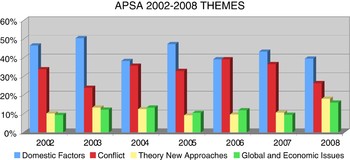
“Domestic Factors” constituted the broadest umbrella theme covering 11 major research areas that ranged from authoritarianism to gender. Deriving their conclusions primarily from the assessment of local factors, agents, and structures, these papers tackled political science puzzles such as the consolidation (or lack thereof) of democracy, domestic political transformations, social processes, shifting political loyalties, and contested identities. Despite its broad scope and central role in the discipline, the overall share of the papers under this theme, however, did not exceed 43.53 percent (Fig. 1).
(Color online) Distribution of APSA papers according to their main themes.
Source: 2002–2008 APSA Annual Meeting Programs (www.apsanet.org).

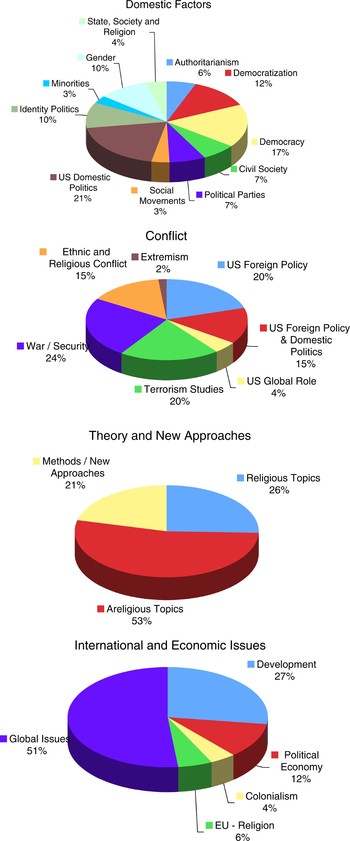
A closer look at the specific topics of papers under “Domestic Factors” evidenced the scant attention paid to some key issues in the discipline. For instance, questions of democracy and democratization, one of the key terms in political science analyses, appeared in slightly more than one-tenth of the total papers on Islam (Fig. 2). A set of popular terms (i.e., civil society, identity politics, state society relations, or minorities) appeared in another one-tenth. Perhaps more surprisingly, studies on political parties and social movements constituted less than five percent of the total papers.Footnote 13 We also paid special attention to “United States Domestic Factors” to weight the papers discussing issues such as the attitudes regarding national diversity, or the political attitudes and behavior of Muslim (often Arab-Americans) within the United States.Footnote 14 The studies of Islam in the United States constituted around one-fifth of the papers under “Domestic Factors.” Although the attention to Islam within the context of United States domestic politics is a promising research area, the increasing prevalence of issues derived from the United States context begs the question of whether this interest came at the expense of studies focusing on domestic factors in other regions.
(Color online) Topics covered by main themes.
Source: 2002–2008 APSA Annual Meeting Programs (www.apsanet.org).

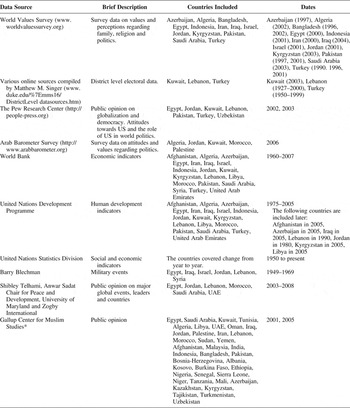
Major Data Sources on the Countries where Islam Plays a Critical RoleFootnote 1

*The number of questions that are used in conventional political science analyses is rather limited in these surveys.
One of the unexpected findings of our analysis has been not the prevalence of certain themes but the extent of their penetration in a wide range of studies. For instance, in our classification of the themes, we grouped all the studies with the following topics under “Conflict”: Terrorism, United States Foreign Policy, United States Hegemony, Ethnic and Religious Conflict, and Extremism. Although these papers had different foci and adopted different theoretical frameworks, they ultimately approached Islam as an issue of security and Muslims as potential agents of conflict (or agents of peace). Although this result could not only be anticipated but also appears to be indispensable in a political and intellectual environment marked by post September 11 scholarship the level of “securitization” of studies of Islam seems to have reached a startling level. One-third of the total studies fell into the category of “Conflict.” One might argue that this high overall number can be seen as a needed yet transient reaction to current events and as cultivating a broader and more comprehensive intellectual interest in the role of Islam as a multifaceted force in global politics. However, the shifts in the numbers of papers under conflict indicate that, instead of serving as a springboard to further in-depth analyses, this rather narrowly-defined approach continued to expand and set the tone of debates on Islam in subsequent APSA meetings. When we looked at the distribution of the themes from 2002 to 2008, the studies that located Islam in its global and international economic setting consistently emerged as one of the least frequently used analytical domains (approximately 11.75 percent). When all the papers on global and international issues are taken into account, only one-fifth of these papers are not conflict related.
It is important to note that in their assessment of studies of religion in political science, Wald and Wilcox (Reference Wald Kenneth D. and Clyde Wilcox2006, 525–228) underline the intricate relation between the studies of religion and theory, and draw our attention to their gradual divorce. Perhaps manifesting the entrenchment of this trend, theoretical approaches to Islam remained at a noticeably low level, although the share of studies under this group increased from a low of 9.15 percent of the papers presented in 2005 to its highest level of 18 percent of the papers in 2008. Given that it is often through theoretical debates that dominant explanations are questioned or controversial empirical patterns are better understood, this increase can be seen as a welcome shift. Content analysis of these papers, however, indicates that many of these theoretical debates serve simply to enhance the terms of the dominant approaches and especially security-related themes (e.g., the notion of enemy, the possibility of inter-civilizational dialogues, etc.) instead of generating new ground for discussions. The persistent absence of conceptual debates on the limits of our existing approaches to Islam and their alternatives suggests that if expanded, such a gap might eventually deprive other areas of much needed analytical and conceptual criticism and opening.
Regions/Countries
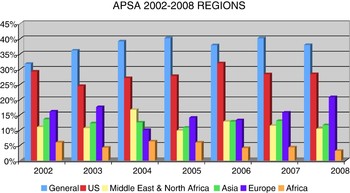
The geographical concentration of the papers reveals a rather unexpected picture. Decontextualized analyses of Islam (i.e., those without a definite regional boundary) or, in conventional terms, large-n analyses, dominate the landscape (Fig. 3). Within this group, papers often tackled questions such as the relationship between religiosity and attitudes toward democratic government by exploring a large set of countries. Many others used a range of fundamentalist groups to develop an explanatory model for terrorism. More general and abstract processes, such as religion's indispensable role in forming consent and in the subsequent use of force, formed the foundations of other papers.Footnote 15
(Color online) Distribution of APSA papers according to their regional focus.
Source: 2002–2008 APSA Annual Meeting Programs (www.apsanet.org).

Single-case studies on the Middle East constitute only 4.9 percent of all the papers in our analysis. This absence is especially significant considering that in-depth analyses of single cases can offer, for instance, a detailed description of civil society movements that escape macro-scale analyses of large-n studies. More often than not it is these studies that open doors to less recognized political transformations, such as the penetration of international human rights norms through unconventional and noncoercive means (Mokthari Reference Mokhtari2004). The absence of bottom-up and concept-generating or theory-infirming approaches marks a critical lacuna in the application of political science concepts such as civil society and their accustomed and unaccustomed manifestations in the region.
The underrepresentation of single cases becomes more important given that one-third of the single-case studies that were presented center on Israel and Turkey. These studies explain some less-known processes, such as the unintended consequences of electoral competition in Israel (Carla Reference Carla2006) or the necessity of moderate constituencies for the religious parties to make pro-Islamic parties' initial moderation sustainable in Turkey (Somer Reference Somer2007). However, the absence of papers on Syria, Yemen, Saudi Arabia, or the United Arab Emirates in these cases studies is of special concern given the significance of these countries for regional and global political processes. One would assume that region-centered studies would compensate for this lacuna. However, even with the inclusion of regional studies, the percentage of papers dealing exclusively with the Middle East reaches only seven percent. Although single-case studies are often criticized for their limited conclusions, often it is not deductive approaches but empirically grounded studies that breed analytical innovation. Especially in areas where the empirical data remain thin and conceptual debates need more “facts,” such studies serve as a key venue to enhance our understanding of the region (Anderson Reference Anderson2006; Bill Reference Bill1996; Lustick Reference Lustick2000; Mitchell Reference Mitchell2003).Footnote 16
When we look beyond the broad category of “General,” studies that take the United States as the main geographical focus consistently surface as the most frequent among papers adopting a regional perspective. Although Islam has a significant presence in Africa, manuscripts studying African countries constitute only 4.9 percent of the papers in our analysis. The distribution of papers is more or less equal among Europe, Asia, and the Middle East and North Africa (15.29, 12.28, and 11.75 percent, respectively). Typical examples of the studies on Europe are cross-country analyses of individuals' perceptions of and attitudes towards immigration in Europe.Footnote 17 In such analyses, individual- and country-level determinants of opposition to immigration are studied to weigh the relative impact of economic factors against cultural concerns.
The studies that use the Middle East as a geographic locus often address questions pertaining to democratization (or the lack thereof). The general characteristics of such studies are exemplified by those that question the commitment of Islamist political parties to democracy in countries such as Jordan, Egypt, and Algeria.Footnote 18 More than half of the papers on Asia centered their analyses exclusively on Southeast Asia. Among such studies, we find analyses that discussed the role of moderate Islamic organizations in the process of liberalization drawing on cases such as Malaysia or Indonesia. Only around seven percent of the analyses explored the countries in central Asia where Islam plays an increasingly pivotal role. Although Central Asian countries were also studied within the context of the former Soviet Union, studies on Central Asia remained limited to 4.5 percent of all papers.
Subfields
We used conventional disciplinary boundaries in our classification of the papers into different subfields. For instance, the papers that used the state as the unit of analysis, or delved into the questions of international organizations and norms, are assigned to the International Relations subfield. Similarly, studies that took United States politics as their primary reference are assigned to American Politics. The papers placed under Theory centered on conceptual debates or introduced us to new arguments and the critique of old ones. Among others, this category includes studies that address issues such as how viewing political power as “imaginative” differs from other forms of political power in its ability to transform and limit itself, or offer critical assessments of assumptions such as the inability of reason and revelation to refute each other. The papers that brought to the fore conceptual puzzles relating to international relations or comparative politics through the use of theoretical arguments are assigned to the hybrid group of “Theory/International Relations/Comparative.” Within this hybrid group are papers that attend to public opinion toward immigrants, such as those that pay special attention to immigration policy cooperation in the European Union. Bringing different debates together, some studies attempt to offer a new theory of identity formation and explore the influence of identity on international relations.Footnote 19
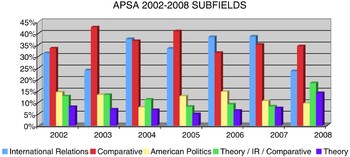
Perhaps due to their gravitation toward a small set of themes, the placement of papers into subfields proved to be rather difficult and yielded the following picture. The analyses that fell into the Comparative Politics subfield were most numerous (36.39 percent of all papers), followed by International Relations papers (32.38 percent). The percentages of papers under American Politics and the hybrid category of “Theory/International Relations/Comparative” amounted to 11.81 and 11.46 percent, respectively. One of the most noticeable findings of our study is the scarcity of papers under the theory subfield, which make up only 7.74 percent of the all papers presented on Islam. When the shifts are taken into account (Fig. 4), the increasing dominance of International Relations papers between 2004 and 2007 appears as one of the prominent patterns. Although this trend seems to be fading in 2008 it is important to note that “hybrid” papers (i.e., “Theory/International Relations/Comparative” papers) with strong international relations components increased this year. Given the scant number of such hybrid studies overall, this increase seems promising but begs the question of whether this new expansion translates into further hegemony of the securitization approach or is a sign of the emergence of a new intradisciplinary discourse on Islam and Muslims.
(Color online) Distribution of APSA papers across subfields.
Source: 2002–2008 APSA Annual Meeting Programs (www.apsanet.org).

The predominance of conflict-related papers within international relations appears one of the most resilient patterns over the years. 28.93 percent of international relations papers in our analysis fell under the category “terrorism studies” and another 34.64 percent focused on other conflict-related issues (Fig. 2b). Consequently, marginalized in the discipline of international relations are analyses of once popular topics such as international norms and organizations. In this underrepresented genre, one can find studies that question the existence of a global civil society and seek to find empirical evidence to evaluate its implications. By offering in-depth conceptual discussions, such studies keep their eye on non-conflict related societal groups such as civil society organizations and explain how these entities perceive themselves and how they define their goals, values, sources of legitimacy, rights, and responsibilities.Footnote 20
(DE) CONTEXTUALIZING ISLAM AND REPRESENTING THE MIDDLE EAST?
The weak presence of case studies in the APSA meetings can be explained in part by the delayed integration of Middle-East studies into scholarship in the United States as well as the long-lasting tension between the discipline of political science and area studies, and their deeper intellectual and methodological differences. In fact, the main journals and professional associations specializing on the Middle East only entered the American scientific scene in the early 1950s. The American Association for Middle-East Studies was founded as the first United States association for scholars analyzing the Middle East in the late 1950s. Perhaps more significant is political science's own development as a research area. The discipline's continuing commitment to generate if not “universally applicable theories” and “law-like generalizations,” then “mid-range theories” has reinforced research areas which privilege survey data, opinion surveys, census data or information on institutional structures that can be easily identified and analyzed over other, less systematic, more context-bound observations. This emphasis, however, has come at the expense of the marginalization of studies that generate much needed exploratory observations on new movements, parties, and ideas, thus depriving us of a thorough understanding of their characteristics and undermining explanatory studies that are built on them (Diamond Reference Diamond2002; Valbjørn Reference Valbjørn2004, 51). Valbjørn described this disciplinary approach as a result of the conflict between “culture-blind Disciplines, and culture-blinded Area Studies: one aiming for ‘universal’ knowledge, the other emphasizing the limits to generalization,” which often reduces the possibility of generating critical information and knowledge (Teti Reference Teti2007, 123).
In fact, our review of papers on political parties — one of the most popular disciplinary topics — draws our attention to what could be contradictory expectations for exploratory and explanatory accounts. Despite its prevalence in the discipline, only two percent of 1,693 papers focused on political parties. Of these, 65 percent centered on Europe and the United States; only 35 percent analyzed the parties in Asia, Middle East, South America, and Africa. This lopsided distribution draws our attention to some empirical data deficiencies such as the limited availability of conventional political science data in these regions. The discipline's attempts to expand explanatory studies implicitly presume that despite the difficulties, data collection does not pose an insurmountable hurdle. Nevertheless, a review of the reliable data sources indicates that they are in short supply. A quick account of the academic sources (Table 1) confirms that those who want to contribute to the ongoing debates are hamstrung by the insufficiency of available collectible and collected data on the region. The extent of the problem becomes clearer when we consider that even official election results are often contested in many countries where Islamic parties and movements have established themselves among the main contenders for power. Students of political parties in the Middle-East do not seem to have accessible Jordanian, Lebanese, or Algerian election data. Even in countries where data are more readily available, such as Turkey, one can hardly find surveys prior to 1980. Many census data do not include critical information on sectarian, religious, or ethnic affiliations. The epidemic data deficit and the search in the discipline to develop commonly shared rigorous standards creates a conundrum for political scientists: the field seeks to apply its standards to the studies of Islam to better assess them, but uncritical expansion of disciplinary standards risks privileging methodologically elaborate but substantively weak studies over others.
When we approach the weak presence of Islam in political science from a broader angle, the limited number of single-case studies or analyses of specific political actors may appear to some as an expected outcome of divisions within the social sciences between regional and general studies. As mentioned above, this often contested yet still influential epistemological rift relegates (and relies on) Area Studies to a “junior data generating partner” within the mainstream field (Anderson Reference Anderson2006; Diamond Reference Diamond2002; Teti Reference Teti2007, 133). After all thorough data collection and field research projects are not feasible for many political scientists who cannot acquire necessary language skills and conduct detailed country-specific research as quickly as some research questions demand. While specialists in area studies are often asked to make their findings more relevant to the theoretical debates in the discipline, many contend that area studies' greatest contribution lies in their ability to “serve as a testing ground for the universalization of the social sciences” (Mitchell Reference Mitchell2003, 8). However, this division of labor presumes continuing interaction between area studies and the discipline, and thereby a constant avoidance of the parochialism that can occur in various forms and be guided by various assumptions. The importance of these assumptions invites us to take a closer look at the MESA association meetings.
WIDENING THE GAP? POLITICAL SCIENCE IN THE MIDDLE EAST STUDIES
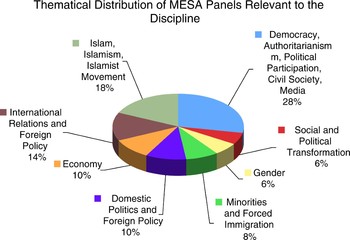
The debates on the tension between the discipline and area studies usually end on a positive note, emphasizing that both fields can eventually adjust themselves to address each other's insufficiencies.Footnote 21 In order to assess whether area studies can remedy the knowledge-deficit on the Middle East in political science, we expanded our analysis to MESA annual meetings. Given its broad range of issues, we reviewed panel descriptions and paper summaries to identify political science related panels. In 2008, for instance, out of 223 panels, the number of panels that had direct bearing on political science and looked at post-Second World War topics was limited to 50 (Fig. 5). When we included all possible topics that might contribute to the debates in the discipline only one quarter of the panels contained academic discussions that are relevant to political science.Footnote 22
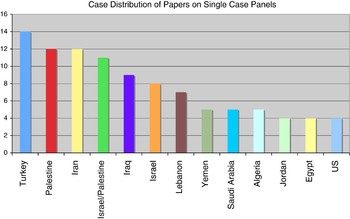
When we classified the panels according to their region of interest, 46 percent of the MESA papers focused on a single country. The focus on a single country has, however, some mixed analytical implications. Although these panels successfully convened scholars who work on the same country, many of these scholars not only come from different disciplines but also have drastically different research areas. For instance, a panel that promises to offer a “comparative perspective” on a country might include topics as diverse as the colonial land regime, United States foreign aid, and the moderation of Islamic parties. Given the broad range of research topics covered on such panels, one might question whether and how these panels serve as catalysts for broader discussions and help to contribute to the development of missing analytical frameworks. Perhaps more striking is that the countries underrepresented or absent in the APSA are also missing in MESA. When we looked at the panels that focus on a single case, the familiar cases of Turkey, Palestine, and Israel constitute 54 percent of the total cases. Iran and Iraq are debated in 21 percent of the papers, thereby contributing significantly to the analyses of these countries. The countries that did not receive much attention at the APSA (e.g., Yemen, Saudi Arabia, or Syria) received limited attention at MESA as well (Fig. 6).
(Color online) Thematic distribution of MESA panels relevant to the political science discipline.
Source: 2008 MESA Annual Meeting Programs (www.mesa.arizona.edu).

(Color online) Country focus of papers on single case panels.
Source: 2008 MESA Annual Meeting Programs (www.mesa.arizona.edu).

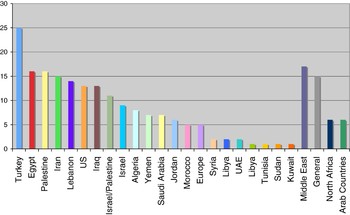
Mixed-region panels address topics such as authoritarianism, social movements, Islamic movements, and minorities and use diverse countries to probe these topics. Although offering promising contributions to ongoing debates, such panels constitute only around 12 percent of overall panels. When we combined all the panels and reclassified the papers according to their main country of interest, the papers on Saudi Arabia, Jordan, Morocco, Syria, Libya, United Arab Emirates, Tunisia, and Sudan constitute 14.73 percent of the papers (Fig. 7). Although these countries might have been studied extensively in other panels (i.e., panels that center on historical or anthropological analyses), their limited presence under panels directly relevant to political science suggests that the discipline's reliance on thick descriptions generated by area studies might be untenable. These overall findings suggest the presence of an emerging vicious cycle: the discipline marginalizes issues pertaining to Islam and the Middle East, and promotes a-historical, large-n, conflict-centered studies notwithstanding political scientists' increasing interest in current events. The MESA, in contrast, seems to marginalize political science topics despite its interest in the political questions in the region, due in part to its preoccupation with historical analyses.
(Color online) Geographical focus of MESA papers.
Source: 2008 MESA Annual Meeting Programs (www.mesa.arizona.edu).

ANALYZING ISLAM
Securing the Field against Monopolizing Tendencies
Just like any other region covered under political science, the dominant themes and concepts of the discipline make their mark in studies of the Middle East and Islam. This is why around 1950 social transformation and modernization theories offered the main framework for studies on Islam and the Middle East.Footnote 23 In the 1960s and 1970s, these dominant approaches were replaced by state-centered approaches.Footnote 24 The studies that originated in the 1980s paid more attention to institutions and their drastic transformation through military coups while the 1990s channeled many of the inquiries toward civil society.Footnote 25 In the 2000s, we have witnessed the expansion of literature on social movements, Islamic mobilization, and parties.Footnote 26 Given these shifts, the recent securitization of Islam can be seen as a natural expression of the dominant terms and questions of the discipline. Nevertheless, the dominance of “securitization” might be different from the prevalence of other research models and heuristic terms for various reasons. Securitization approaches often rest on and reinforce a limited set of assumptions about the origin and nature of conflicts (Anderson Reference Anderson2006; Sadowski Reference Sadowski2006). They altogether reduce politics to an arena of contestation between destabilizing and stabilizing forces. As a result, analyses embedded in the securitization paradigm, despite their informative discussions, are limited by their instrumental rationale and the quest to contain and control certain radical groups. This is why some scholars, such as Hurd (Reference Hurd2007), warn of how an unquestioned sense of lost “normalcy” and of the political manifestation of Islam as a challenge to normalcy — especially in the international order — colors studies of Islam, and invite us to question our epistemological premises to overturn such homogenizing conceptualizations.
Although political inquiries not engaged with current events create a significant analytical deficit, the dominance of studies tailored to current events to meet the needs of practitioners can be equally damaging. This is why Wald and Wilcox (Reference Wald Kenneth D. and Clyde Wilcox2006, 528), despite their optimistic note, also warn us that “whether dealing with the Christian Right in the United States, Muslim politics following 9/11 or other topics,” the “current events perspective” might risk steering analyses toward a framework that does not engage with the broad questions of the discipline. Consistent with Wald and Wilcox's warning, what we witness is the preponderance of conflict-centered analyses that fail to constitute a well-defined research field engaged with broad questions. To exacerbate this trend, many broad questions in various research areas are reduced to current event questions and, ultimately, to policy related questions, thereby falling victim to the homogenizing parameters of conflict related analyses.Footnote 27
In light of the broad trends in the study of issues pertaining to Islam, one might argue that, almost 50 years after Binder's (Reference Binder1958) call to open our inquiries to cross-fertilization between mainstream political science and area-centered analyses in order to enhance our understanding of the Middle East, this cross-fertilization remains limited and has had mixed outcomes. The blending of different approaches seems to be occurring only via the securitization of Islam in particular and the Middle East in general. This unique cross-fertilization seems not to serve as a catalyst to nuanced and finely tuned interdisciplinary perspectives, but rather it has a potential of thwarting the development of debates in some critical areas.
Getting Religion? : Conclusion
When the questions of how often, in what way, and where we study the political manifestations of Islam arise, the balance sheet points not only toward the difficulties of studying religion in general and Islam in particular but also toward the long-lasting, untreated quagmires of the social sciences. The ways in which political science seeks to understand Islam bring to the fore the tenuous nature of some of the discipline's assumptions as well as the intricacies of some of its approaches. As such, on the one hand, we need to treat issues pertaining to Islam just like other political science puzzles without treating them as sui generis issues. On the other hand, treating Islam and the regions in which it has its most permanent marks just like any other topic might result in some unrealistic expectations. Among other alarming trends the absence of single case studies and the dominance of large-n or “general” studies signal the emergence of a body of conceptually deductive or empirically thin quantitative studies. Paradoxically, the conduciveness of large-n studies to testing hypotheses and making generalizations comes at the expense of their inability to capture the complexity of the social phenomena.Footnote 28 Our findings outline a lack of blending empirical and theoretical studies, which ultimately runs the risk of handicapping studies of Islam and the Middle East. After all, it is a balancing of the “thin” concepts of large-n studies with the “thick” concepts of small-n analyses that promises to launch a corrective process and offer more nuanced explanations of political science puzzles (Coppedge Reference Coppedge1999).Footnote 29 Although conceptual stretching is a major problem in any research area, the accompanying weakness of theoretical debates, an area where reflections on conceptual tools are more common, serves as a warning that we might be making our inquiries increasingly susceptible to analyses dominated by thin concepts.
The state of research on Islam in the APSA and the overall review of the MESA suggest that unless carefully addressed, the prevailing patterns and what could be an unquestioned relegation of some important research findings about Islam to area studies and other disciplines is likely to result in a crippling knowledge gap among political scientists. The discipline's tendency to spend less effort to cultivate new approaches and to place methodologically “unfitting” issues to the margins of its debates requires careful reconsideration. The countervailing currents that stem from the discipline's desire to (1) set up rigorous analytical standards, (2) satisfy the urgent need to learn more about new issues derived from Islam, and (3) make sense of Islam's simultaneous, multiple political manifestations in a wide range of countries need to be carefully balanced. Privileging method-driven approaches, conflict-centered questions, and research frameworks grounded in international relations over others run risk of forging homogenizing analytical currents that prove to be fruitless (Anderson Reference Anderson2006). To avoid such shifts, what is perceived to be the paradox of Islam needs to be disentangled from the paradoxes of political science as a discipline. Such discernments and broad reflections on the ways in which we study Islam are especially important given the expanding interest in religion and languages such as Arabic and Persian. Such changes, although promising, cannot ipso facto better position political scientists to embark upon demanding field research and other data collection projects. Failing to untangle the questions on or about Islam from the questions about political science explanations may deprive us of much needed debate on how we study Islam, thereby undermining our efforts towards addressing the critical information gap and challenging the sand castles of explanation in the discipline.