Introduction
Turner syndrome is the most common sex chromosomal abnormality found in females and results from the deletion or non-functioning of one X chromosome. It occurs in approximately 1 in 2,500 live births and has a broad spectrum of features, including short stature, gonadal dysgenesis, renal abnormalities, and a webbed neck. Cardiovascular disease is a major contributor to morbidity and mortality in Turner syndrome. Acute type A aortic dissection (ATAAD) is a particularly severe complication, representing approximately 85% of dissections in this population and carrying a mortality rate exceeding 50%. Reference Cui, Cui, Shi, Luan, Zhou and Han1–Reference Silberbach, Roos-Hesselink and Andersen3 In addition, Turner syndrome is strongly associated with congenital cardiovascular anomalies such as bicuspid aortic valve (BAV) and aortic coarctation. Reference Gravholt, Viuff and Just4
Aortic dilation is recognised as a common precursor to dissection in Turner syndrome. However, the relative contributions of associated risk factors remain unclear, largely due to the low prevalence of Turner syndrome and the limited size of existing cohorts. Notably, Turner syndrome patients experience cardiovascular mortality at rates approximately three times higher than the general female population, underscoring the need for improved risk stratification and outcome characterisation. Reference Cui, Cui, Shi, Luan, Zhou and Han1
This study leverages a nationally representative inpatient database to evaluate the prevalence, risk factors, and perioperative outcomes of Turner syndrome patients with and without ATAAD.
Material and methods
Database
The National Inpatient Sample database is part of the Healthcare Cost of Utilisation Project and the Agency for Healthcare Research and Quality. 5 The National Inpatient Sample is the largest publicly available, all-payer, administrative claims-based database and contains inpatient data across 4,378 hospitals, which represents a 20% sample of non-federal hospitals in the United States. Weighted samples are used to produce US population estimates in this database. Institutional review, board approval, and informed consent were not required for this study, given the public availability and de-identified nature of the National Inpatient Sample database.
Study cohort
We surveyed the National Inpatient Sample database from January 2002 to December 2020 using the International Classification of Diseases, Clinical Modification (CM), and procedure codes from the 9th and 10th revisions. We first identified inpatient hospitalisations for Turner syndrome using ICD-9-CM (758.6) and ICD-10-CM (Q96.0–Q96.4, Q96.8, Q96.9). Next, we identified patients with records of hospitalisation for aortic dissection using ICD-9-CM (441.00–441.03) and ICD-10-CM (I71.00–I71.03) and ruptured aortic aneurysm using ICD-9-CM (441.1, 441.3, 441.5, 441.6) and ICD-10-CM (I71.1, I71.3, I71.5, I71.8) codes. We included these two pathologies given the significant clinical overlap in ATAAD. We then distinguished the ATAAD group using prior validated procedure codes, including open aortic surgery, valve surgery, operations on the vessels of the heart, and cardioplegia (Supplemental Table 1). Reference Zimmerman, Oderich and Pochettino6–Reference Sachs, Pomposelli and Hagberg8 A sensitivity analysis was conducted to ensure that the inclusion of both aortic dissection and ruptured aortic aneurysm codes, as opposed to aortic dissection alone, did not affect classification of ATAAD and further results.
In doing so, we created three groups for our analysis: (1) Turner syndrome patients who experienced Type A aortic dissection (TS + ATAAD+), (2) Turner syndrome patients who did not experience Type A aortic dissection (TS + ATAAD−), and (3) non-Turner syndrome patients who experienced Type A aortic dissection (TS-ATAAD+).
Primary and secondary outcomes
The primary outcomes of interest were ATAAD in-hospital admission rate and in-hospital mortality. Secondary outcomes included length of hospital stay and peri-operative complications including post-surgery sepsis, bleeding, and complete heart block.
Statistical analysis
We used the National Inpatient Sample recommendations for trend analysis, including the use of trend weights (2002–2011) and discharge weights after 2012. Using these weights, we produced population-level estimates for in-hospital admissions for all further analyses. Because the National Inpatient Sample is a cross-sectional inpatient discharge database that does not permit longitudinal patient-level follow-up, outcomes were assessed at the level of individual hospitalisations, and follow-up beyond the index admission was not available. Continuous variables were reported as medians with interquartile ranges, and a weighted t-test was used to compare the two groups at each time point. Categorical variables were reported as percentages, and a chi-squared test was applied to compare two groups at each time. All analyses were conducted using Stata (16.1, StataCorp LLC, College Station, TX).
Multivariable logistic regression was used to evaluate the association between potentially important clinical factors and the risk of developing ATAAD in the TS + cohort. The covariates included in the multivariable models were age, BAV, aortic coarctation, hypertension, coronary artery disease, diabetes, dyslipidemia, tobacco use, and alcohol use. Race and chronic kidney disease were excluded from the multivariable logistic regression model due to limited sample size within several racial subgroups and the overall disease group, respectively. Including them would have resulted in quasi-complete or complete separation and unstable estimates.
Results
Demographics
We identified 51,426 hospitalisation records for Turner syndrome representing ∼0.01% of non-transferred, female in-hospital admissions between 2002–2020 (Figure 1). Of these, a small proportion (137 hospitalisation records) presented with TS + ATAAD+ (Group 1), and the majority were TS + ATAAD− (Group 2). We also identified a cohort of TS-ATAAD+ records (Group 3). Among all non-transferred National Inpatient Sample female records, aortic dissection was present in 0.01% of the population.
Flow chart of study cohort selection for Turner syndrome and acute type A aortic dissection (ATAAD).

In sensitivity analyses, including both aortic dissection and ruptured aortic aneurysm codes, the overall ATAAD prevalence increased slightly in both TS+ (0.25% to 0.27%, +7.9%) and TS− (0.006% to 0.007%, +14.1%) groups (Supplemental Table 2). The adjusted association between Turner syndrome and ATAAD remained robust (odds ratio [OR] 39.3 [95% CI 33.0–46.8] vs 37.2 [95% CI 31.4–44.0], −5.4% change), with overlapping confidence intervals and preserved effect direction. These findings indicate that our results are not materially affected by inclusion of both aortic dissection and ruptured aortic aneurysm codes in classifying ATAAD.
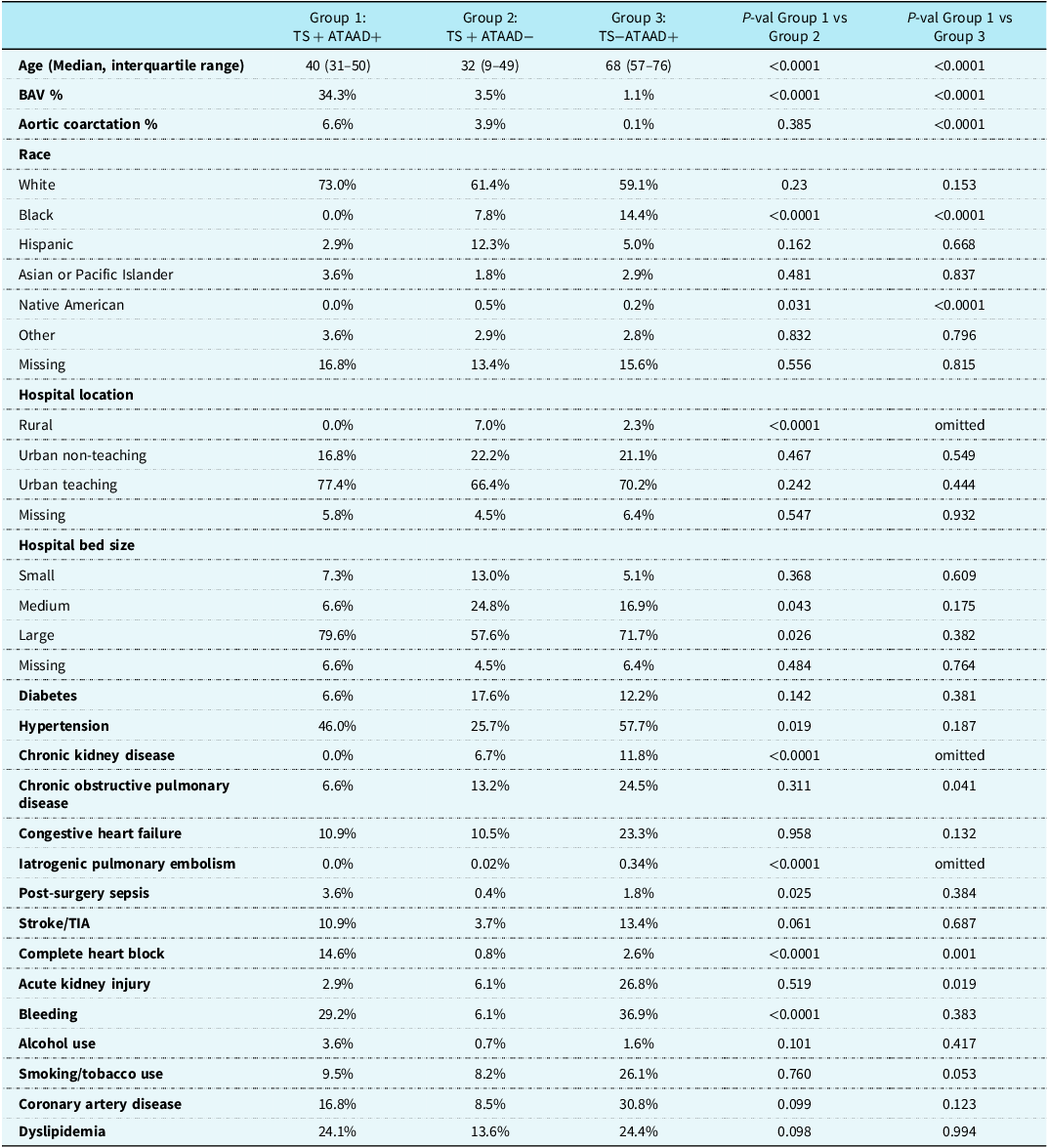
Across the three groups, the median age was 40 years (interquartile range 31–50) in Group 1, 32 years (interquartile range 9–49) in Group 2, and 68 years (interquartile range 57–76) in Group 3. Patients were predominantly white and admitted to large hospitals with urban teaching environments (Table 1).
Demographics and co-morbidities across the three groups of Turner syndrome and type A aortic dissection (ATAAD) hospitalisation records

Rates and outcomes of ATAAD amongst those with and without Turner syndrome
Overall, TS + ATAAD+ represented 0.27% of the TS+ population yet had significantly higher mortality (13.1% vs 2.1%, p < 0.001) and length of stay (8 days, interquartile range 5–13 vs 3 days, interquartile range 2–6, p = 0.002) when compared to TS + ATAAD− individuals. During univariable analysis, these TS + ATAAD+ records had significantly higher rates of BAV (34.3% vs 3.5%, p < 0.001), hypertension (46.0% vs 25.7%, p < 0.05), and complete heart block (14.6% vs 0.8%, p < 0.001).
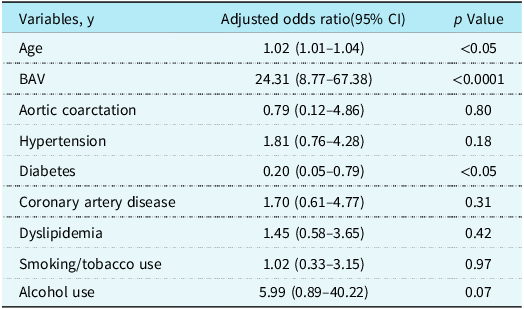
Multi-variable logistic regression analysis revealed that the presence of a BAV was associated with the highest odds of ATAAD amongst the Turner syndrome + cohorts (adjusted odds ratio, 24.31 [95% CI 8.77–67.38]; p < 0.001). Additionally, age had a direct association (adjusted odds ratio, 1.02 [1.01–1.04]; p < 0.05) and diabetes had an inverse association (adjusted odds ratio, 0.20 [0.05–0.79]; p < 0.05) with the onset of ATAAD (Table 2).
Multivariable regression for the onset of ATAAD amongst those with Turner syndrome

Comparing the TS + ATAAD+ and TS-ATAAD+ groups, age was significantly different (40 years, interquartile range: 31–50 vs 68 years, interquartile range: 57–76). The mortality rate (13.1% vs 21.8%, p = 0.26), length of stay (8 days, interquartile range 5–13 vs 10 days, interquartile range 6–17, p = 0.20), and rate of hypertension and perioperative bleeding were not significantly different between these groups. The rate of complete heart block was significantly different between these groups (15.7% vs 2.7%, p < 0.05). Overall, there was a higher annual admission rate of ATAAD amongst Turner syndrome hospitalisation records than amongst non-Turner syndrome hospitalisation records (Figure 2).
Annual hospitalisation rate per 100,000 people of ATAAD between 2002–2020. The two lines represent admission rates among the Turner syndrome population (blue) and non-Turner syndrome population (orange).

Discussion
In this study, we present data on the in-patient admission rate of ATAAD in a large sample of Turner syndrome inpatient records. Additionally, we characterise differences in demographics, risk factors, and outcomes between Turner syndrome records with and without ATAAD, and between Turner syndrome - ATAAD + records. The principal findings of this study are that Turner syndrome + ATAAD + patients were significantly older and had higher mortality and higher rates of BAV, hypertension, and complete heart block compared to hospitalised Turner syndrome + ATAAD − patients. When comparing ATAAD + records with and without Turner syndrome, TS + ATAAD+ patients were significantly younger and had a higher rate of BAV and complete heart block. However, mortality, length of stay, and the rate of hypertension were not significantly different between the two groups.
Overall, mortality differed between the Turner syndrome patients with and without ATAAD, which is understandable given the predominant risk of death that follows after an acute aortic dissection. However, what is unexpected is the similarity in mortality rates between TS+ and TS− patients with ATAAD. This difference exists despite the higher rates of BAV and aortic coarctation in the TS+ patients, suggesting that these factors predispose TS + patients to the onset of ATAAD rather than directly contribute to mortality.
The observed association between complete heart block among patients with Turner syndrome and ATAAD may reflect underlying conduction system vulnerability in this population. Turner syndrome is associated with congenital cardiac abnormalities and prior cardiac interventions, which may predispose to conduction disturbances, while acute aortic pathology, particularly involving the aortic root and adjacent septal structures, may further compromise the atrioventricular conduction system.
The finding that BAV presence was associated with the highest odds of ATAAD in patients with Turner syndrome is important for establishing risk factors for ATAAD in this population. A prior prospective study similarly observed increased odds of aortic dissection in Turner syndrome patients with BAV in a smaller sample of 198 Turner syndrome patients, of whom nine had aortic dissection. Reference Thunström, Krantz, Thunström, Hanson, Bryman and Landin-Wilhelmsen9 While BAV is often clinically benign, it may reflect underlying aortic wall vulnerability in Turner syndrome. Deficiency of the second sex chromosome in Turner syndrome can disrupt extracellular matrix homeostasis, including TIMP-1–mediated regulation of matrix metalloproteinases, which weakens the aortic wall. Dysregulation of these pathways may both predispose to BAV formation and increase susceptibility to aortic dissection, paralleling mechanisms seen in other genetically triggered aortopathies. Reference Corbitt, Morris and Gravholt10 These findings necessitate more frequent and individualised monitoring strategies in Turner syndrome patients with BAV to prevent ATAAD.
Similarly, the association of hypertension with ATAAD in Turner syndrome patients indicates another important and modifiable risk factor. Although pre-hospitalisation hypertension cannot be differentiated from in-hospital hypertension, given the nature of this large in-patient database, a prior study found that TS + ATAAD+ patients are more frequently on treatment for hypertension than TS + ATAAD− patients. Reference Thunström, Krantz, Thunström, Hanson, Bryman and Landin-Wilhelmsen9 Thus, blood pressure management should be prioritised in the outpatient care of patients with Turner syndrome.
Given that ATAAD is a surgical emergency, management should focus on routine, outpatient surveillance as well as effective inpatient management, especially in Turner syndrome patients. Current guidelines for monitoring risk of ascending aortic dissection in the general population vary based on baseline imaging, family history of high-risk conditions, genetic evaluation, and body surface size. Reference Isselbacher, Preventza and Hamilton Black11 In the acute setting, an aortic dissection detection prediction score exists that considers high risk conditions (e.g. Marfan syndrome and family history of aortic disease), clinical high risk pain features, and exam findings. Reference Nazerian, Mueller and Soeiro12 However, there are limited tools for outpatient monitoring of ascending aortic dissection risk. Mori et al. developed a screening score for ascending aortic aneurysm which performs well when including clinical variables such as age, history of aortic valve disease, body surface area greater than 2.2 m2, history of hypertension, history of arrhythmias, and family history of aortic aneurysm. Reference Mori, Gan and Deng13 This score aims to limit development of aortic dissection; however, there are limited screening tools for predicting aortic dissection risk. Ongoing work with machine learning and imaging hope to bridge this gap by using CT and MRI modalities to predict aneurysm growth. Reference Geronzi, Haigron and Martinez14,Reference Geronzi, Martinez and Rochette15
Current data on ATAAD monitoring in Turner syndrome are limited due to the low prevalence; thus, the use of a large inpatient database in this study aimed to address these knowledge gaps. In the outpatient setting, increased monitoring for ATAAD in patients with BAV and hypertension is warranted. This is reflected in the current screening guidelines, which recommend more frequent cardiologist exams and imaging for Turner syndrome patients with aortic coarctation, BAV, and hypertension. Reference Gravholt, Viuff and Just4 However, the current guidelines use age 15 as a cut-off, with screening guidelines remaining the same after 15 years of age. Given that the median age of inpatient presentation of ATAAD in patients with Turner syndrome is 40 years in our work, it may be useful to consider whether more clinically salient screening guidelines should be implemented once patients reach 30 years given that screening is suggested in up to ten-year intervals based on aortic size index. One may envision that monitoring for dissection risk should move beyond simply measuring aortic size index and include a risk score comprising age, hypertension, BAV, aortic coarctation, and other advanced imaging of aortic wall properties. A risk score that incorporates this clinical data and predicts progression to ATAAD would be clinically relevant and potentially lifesaving. Additionally, given the higher mortality and longer length of stay for TS + ATAAD+ patients, prompt recognition of ATAAD is necessary for timely surgical intervention. This study provides several helpful clues that can increase suspicion for ATAAD in a Turner syndrome patient.
We acknowledge several limitations inherent to using an administrative database. The data presented in this study reflect only in-hospital outcomes and do not capture disease extent before and after hospitalisation. Our findings should be interpreted as estimates of inpatient disease burden rather than true population incidence, as repeat hospitalisations for the same individual cannot be fully excluded. Additionally, this database relies on ICD-9 and ICD-10 codes, which are subject to coding errors and inconsistencies across hospitals. The database also lacks specific diagnostic codes for ATAAD, requiring the use of validated surrogate procedure codes to distinguish ATAAD from broader aortic dissection cases. While these diagnosis and procedure codes have been used in prior published studies, their continued use may still introduce errors in patient classification, including the potential misidentification of individuals with ATAAD who did not undergo surgical intervention.
Conclusions
ATAAD is highly lethal among those with and without Turner syndrome. Among patients with Turner syndrome, ATAAD is associated with a higher mortality rate and length of stay and is often co-incident with BAV, complete heart block, and hypertension. Improved clinical guidelines, including early monitoring for BAV and treatment for hypertension, may prevent inpatient complications of ATAAD in the Turner syndrome population.
Supplementary material
The supplementary material for this article can be found at https://doi.org/10.1017/S1047951126111949.
Author contributions
Research design: YD, KY
Data collection: YD
Data analysis: YD, AM
Writing and editing the manuscript: YD, AM, KY
All authors approve the final version of this manuscript.
Financial support
This research received no specific grant from any funding agency, commercial or not-for-profit sectors.
Competing interests
The authors have no relationships with industry relationships or conflicts of interest.
Ethical standards
Institutional review, board approval, and informed consent were not required for this study, given the public availability and de-identified nature of the National Inpatient Sample database.