Introduction
A group of symptoms including hallucinations, delusions, and thought disorganization form part of the diagnostic criteria for psychotic disorders (American Psychiatric Association, 1980; Lieberman & First, Reference Lieberman and First2018). These disorders remain a leading cause of disability and mortality worldwide, and are prominent in people living in homelessness or precarious housing (Ayano, Tesfaw, & Shumet, Reference Ayano, Tesfaw and Shumet2019; Fazel, Geddes, & Kushel, Reference Fazel, Geddes and Kushel2014; Global Burden of Disease Study, 2013 Collaborators, 2015; Jones et al., Reference Jones, Vila-Rodriguez, Leonova, Langheimer, Lang, Barr and Honer2015). In the absence of a defined psychotic disorder, individuals may experience clinically significant psychotic symptoms, associated with severe consequences such as involuntary hospitalization (Walker et al., Reference Walker, Mackay, Barnett, Sheridan Rains, Leverton, Dalton-Locke and Johnson2019) and suicidality (Bornheimer & Jaccard, Reference Bornheimer and Jaccard2017).
In recent years, network theory and analytic approaches helped re-conceptualize mental disorders as complex dynamic systems of interacting symptoms (Borsboom & Cramer, Reference Borsboom and Cramer2013). These models postulate that symptoms influence each other through complex interactions determined by underlying biological or psychological processes (Kendler, Zachar, & Craver, Reference Kendler, Zachar and Craver2011; Wichers, Reference Wichers2014). Network nodes represent symptoms and edges represent potentially causal relationships between symptoms. Symptoms that are central in the network are thought to play a pivotal role in influencing other symptoms and illness progression. Cross-sectional studies of psychopathology in patients with psychotic disorders used network analysis to examine psychotic symptoms along with multiple clinical features of illness (Chang, Wong, Or, Chu, & Hui, Reference Chang, Wong, Or, Chu and Hui2019; Esfahlani, Sayama, Froster Visser, & Strauss, Reference Esfahlani, Sayama, Froster Visser and Strauss2017; Galderisi et al., Reference Galderisi, Rucci, Kirkpatrick, Mucci, Gibertoni, Rocca and Pacitti2018; Hasson-Ohayon, Goldzweig, Lavi-Rotenberg, Luther, & Lysaker, Reference Hasson-Ohayon, Goldzweig, Lavi-Rotenberg, Luther and Lysaker2018; Isvoranu et al., Reference Isvoranu, Van Borkulo, Boyette, Wigman, Vinkers, Borsboom and Myin-Germeys2017; Levine & Leucht, Reference Levine and Leucht2016; van Rooijen et al., Reference van Rooijen, Isvoranu, Kruijt, van Borkulo, Meijer, Wigman and Bartels-Velthuis2018). Delusions and unusual thought content were the most central symptoms in symptom networks from patients with non-affective psychotic disorder (Isvoranu et al., Reference Isvoranu, Van Borkulo, Boyette, Wigman, Vinkers, Borsboom and Myin-Germeys2017; van Rooijen et al., Reference van Rooijen, Isvoranu, Kruijt, van Borkulo, Meijer, Wigman and Bartels-Velthuis2018).
Psychotic symptoms are dynamic, intrinsically fluctuating, and evolving over time; features that may be better captured in longitudinal rather than cross-sectional analyses (Nelson, McGorry, Wichers, Wigman, & Hartmann, Reference Nelson, McGorry, Wichers, Wigman and Hartmann2017). Recent advances in dynamic network modeling characterize symptom interplay over time, and separate within-individual symptom dynamics from stable patterns across individuals (Epskamp, Waldorp, Mõttus, & Borsboom, Reference Epskamp, Waldorp, Mõttus and Borsboom2018; Schuurman, Ferrer, de Boer-Sonnenschein, & Hamaker, Reference Schuurman, Ferrer, de Boer-Sonnenschein and Hamaker2016). In this multilevel network framework, interactions between symptoms may relate to the persistence of psychopathology. Global connectivity (density) reflects the efficiency of system activation in response to a perturbation such as a stressful life event (van Borkulo et al., Reference van Borkulo, Boschloo, Borsboom, Penninx, Waldorp and Schoevers2015; Wichers, Reference Wichers2014). When symptoms engage in mutual reinforcement or feedback loops, the system may become trapped in a state of prolonged symptom activation, shifting from a transient response to an acute psychotic episode. Symptoms with greater auto-regressive connectivity (i.e. self-loops) may persist long after the stressor has passed, and contribute to illness progression or chronicity (Koval, Kuppens, Allen, & Sheeber, Reference Koval, Kuppens, Allen and Sheeber2012). Symptoms with greater centrality may influence other symptoms, controlling the evolution of psychopathology more readily, or conversely may receive more input from other nodes. Multilevel network analysis is a promising approach to elucidate the complex temporal interplay between symptoms in order to improve the prediction and prevention of illness progression (Nelson et al., Reference Nelson, McGorry, Wichers, Wigman and Hartmann2017).
To date, there are no dynamic network studies of psychotic symptoms for people with or without psychotic disorders. Dynamic network analysis using experience-dependent sampling over periods of minutes, hours, or days was applied to psychopathology in depression (Bringmann, Lemmens, Huibers, Borsboom, & Tuerlinckx, Reference Bringmann, Lemmens, Huibers, Borsboom and Tuerlinckx2015; Wichers, Reference Wichers2014) and post-traumatic stress disorder (Greene, Gelkopf, Epskamp, & Fried, Reference Greene, Gelkopf, Epskamp and Fried2018). Klippel et al. (Reference Klippel, Viechtbauer, Reininghaus, Wigman, Van Borkulo, Myin-germeys and Wichers2018) examined momentary mental states including features of psychotic experiences. They found that individuals with a history of psychotic disorder were more likely to endorse suspiciousness or loss of control after a stressor.
Dynamic network analysis also provides an empiric approach to examine psychosis risk factors and targets for intervention. Individuals affected by multiple biopsychosocial risk factors may be particularly vulnerable (McKetin, Lubman, Baker, Dawe, & Ali, Reference McKetin, Lubman, Baker, Dawe and Ali2013; Zammit, Lewis, Dalman, & Allebeck, Reference Zammit, Lewis, Dalman and Allebeck2010). Individuals experiencing homelessness and precarious housing face substantial risk for psychotic disorders and premature mortality, with substance use, early-life adversity, and medical comorbidities potentially contributing to risk (Ayano et al., Reference Ayano, Tesfaw and Shumet2019; Fazel et al., Reference Fazel, Geddes and Kushel2014). A prospective study of a community-based sample of precariously housed or homeless people demonstrated that past history of psychotic disorder, ongoing methamphetamine, alcohol or cannabis use, and trauma combined to confer significant risk for psychotic symptoms over 1 year follow-up (Jones et al., Reference Jones, Gicas, Seyedin, Willi, Leonova, Vila-Rodriguez and Honer2020). This study sought to examine how these exposures influence dynamic symptom network structure and activation over 5 years. To understand how psychotic symptoms evolve over time in adults with or without a history of psychotic disorder, symptom networks were estimated for two groups established at study entry: participants with a history of a psychotic disorder diagnosis (herein history-positive group), and those without evidence of psychotic disorder prior to study entry (herein history-negative group). We sought to characterize and compare psychotic symptom dynamics between the groups using a multilevel dynamic network analysis approach. We expected greater psychotic symptom network connectivity in individuals with lifetime psychotic disorder and for delusions to be central in the network. Next, we explored the relationships between network connectivity, risk factors, and premature mortality.
Methods
Participants
Participants were recruited as part of the Hotel Study, an ongoing longitudinal community-based study designed to examine long-term multimorbidity among adults living in urban precarious housing, using psychiatric, psychological, and neuroimaging modalities (Honer et al., Reference Honer, Cervantes-Larios, Jones, Vila-Rodriguez, Montaner, Tran and Schultz2017; Vila-Rodriguez et al., Reference Vila-Rodriguez, Panenka, Lang, Thornton, Vertinsky, Wong and Honer2013). Precarious or marginal housing is defined as housing below Canadian standards for adequacy, affordability, or suitability (Gaetz et al., Reference Gaetz, Barr, Friesen, Harris, Hill, Kovacs-Burns and Marsolais2012). Participants were recruited from single-room occupancy hotels (310, 82.7%) and a local community court (65, 17.3%) in Vancouver, Canada from 1 November 2008 to 27 August 2012. All adults (age 18 or older) living in precarious housing who were able to communicate in English and provide informed written consent were eligible. Of the 515 potentially eligible, 375 (72.8%) met inclusion criteria and agreed to enroll. Consent was provided at each follow-up visit. The study design included a comprehensive baseline assessment and monthly follow-up interviews. Clinically significant findings were shared with participants and their healthcare providers.
Psychotic symptom assessment
At each monthly follow-up visit for a 5-year period after study entry, we examined five key psychotic symptoms from the Positive and Negative Syndrome Scale (PANSS) (Kay, Fiszbein, & Opler, Reference Kay, Fiszbein and Opler1987) that span the Diagnostic and Statistical Manual for Mental Disorders Fifth Edition criteria (DSM-5) description of psychotic features: delusions, hallucinations, conceptual disorganization (thought disorder), suspiciousness, and unusual thought content. The severity of each symptom was scored on a seven-point scale by a trained interviewer at monthly assessments. Previous item response analysis demonstrated the five items were reliable for discriminating symptom severity (Santor, Ascher-Svanum, Lindenmayer, & Obenchain, Reference Santor, Ascher-Svanum, Lindenmayer and Obenchain2007), and are relevant to clinical decision-making (Chen et al., Reference Chen, Hui, Lam, Chiu, Law, Chung and Honer2010; Hui et al., Reference Hui, Honer, Lee, Chang, Chan, Chen and Chen2018). PANSS item ratings demonstrated good to excellent inter-rater reliability in participants with same-day assessments by two independent interviewers including a research psychiatrist (weighted κ = 0.69, p < 0.01) (online Supplementary Table S1), similar to other studies of psychosis (Bebbington et al., Reference Bebbington, Craig, Garety, Fowler, Dunn, Colbert and Kuipers2006; Chen et al., Reference Chen, Hui, Lam, Chiu, Law, Chung and Honer2010).
Baseline psychiatric assessment
At study entry, study psychiatrists (OL, FVR, WJP, GWM) completed a semi-structured interview, mental status examination, and focused neurological exam. A Mini-International Neuropsychiatric Interview was completed by a trained research assistant. Healthcare records for previous psychiatric hospitalizations were obtained as part of the consent process. Social functioning was assessed by the Social and Occupational Functioning Assessment Scale (SOFAS) (American Psychiatric Association, 2000). Psychiatric diagnoses were made by study psychiatrists (WGH, OL, FVR) using all available clinical information according to the Diagnostic and Statistical Manual for Mental Disorders-TR Fourth Edition criteria (DSM-IV-TR) (American Psychiatric Association, 2000). Lifetime psychotic disorders included schizophrenia, schizoaffective disorder, bipolar disorder with psychosis, major depressive disorder with psychosis, delusional disorder, substance-induced psychosis, psychosis due to general medical condition, and psychosis not otherwise specified.
Risk factor and mortality assessments
Sociodemographic and housing information were reported at baseline. A modified Charlson Comorbidity Index (Quan et al., Reference Quan, Li, Couris, Fushimi, Graham, Hider and Sundararajan2011) was calculated for each participant according to reported medical conditions at baseline assessment (online Supplementary Materials S1). The Trauma History Questionnaire (THQ) (Mueser et al., Reference Mueser, Rosenberg, Fox, Salyers, Ford and Carty2001) captures the number of types of events (range 0–23) that occurred by age 18 involving the threat of death or serious injury to which the person reacted with extreme fear, horror, or helplessness, as per DSM-IV-TR criteria. Antipsychotic treatment was reported for the 28 days prior to baseline assessment and confirmed with PharmaNet, the province-wide records of prescription dispensation (κ = 0.71, p < 0.001). Adequacy of treatment for managing psychosis was determined according to the Clinical Handbook of Psychotropic Drugs guidelines (Procyshyn, Bezchlibnyk-Butler, & Jeffries, Reference Procyshyn, Bezchlibnyk-Butler and Jeffries2019) and reported adherence (i.e. depot or ⩾80% of past 28 days taking oral medication) in consultation with a psychopharmacologist. Mortality until 1 April 2019 was confirmed by Coroner's reports and hospital records.
Statistical analysis
Group comparison
The history-positive and history-negative groups were compared on sociodemographic and clinical variables. χ2 test was used for categorical variables and Kruskal–Wallis test was used for continuous variables. All statistical analyses were performed in R (R Core Team, 2017).
Multilevel network estimation
Given the hierarchical structure of the longitudinal psychotic symptom data (multiple symptom observations nested within individuals), a multilevel vector autoregression (VAR) modeling approach was employed (Epskamp et al., Reference Epskamp, Waldorp, Mõttus and Borsboom2018). Multilevel VAR models distinguish the between-individual and within-individual cross-sectional and temporal relationships in longitudinal data: the within-individual symptom dynamics (Temporal Network), the within-individual cross-sectional partial correlations (Contemporaneous Network), and stable between-individual partial correlations (Between-Person Network). First, the Temporal Network (matrix of lagged effects) and Between-Person Network (matrix of intercepts) were estimated, and, second, the matrix of model residuals was used to estimate the Contemporaneous Network (online Supplementary Materials S2). Stationarity assumption was assessed by the Kwiatkowski–Phillips–Schmidt–Shin unit root test and a detrending procedure was applied. Estimation and visualization were completed using mlVAR (Epskamp et al., Reference Epskamp, Waldorp, Mõttus and Borsboom2018), lme4 (Bates, Maechler, Bolker, & Walker, Reference Bates, Maechler, Bolker and Walker2015), and qgraph packages (Epskamp, Cramer, Waldorp, Schmittmann, & Borsboom, Reference Epskamp, Cramer, Waldorp, Schmittmann and Borsboom2012).
Similar to previous dynamic network studies (Bringmann et al., Reference Bringmann, Vissers, Wichers, Geschwind, Kuppens, Peeters and Tuerlinckx2013; Klippel et al., Reference Klippel, Viechtbauer, Reininghaus, Wigman, Van Borkulo, Myin-germeys and Wichers2018), each directed edge of the Temporal Network indicates the extent to which change in past-month symptom severity predicts change in next-month symptom severity (i.e. within-individual fluctuations around the person-specific mean severity), adjusting for all other symptoms in the network. The effect of a symptom on itself in the subsequent month (auto-regressive effects) and on other symptoms in the subsequent month (cross-regressive effects) were estimated. The Between-Person Network indicates the aggregate tendency for psychotic symptoms to be associated in the population. The Contemporaneous Network represents the co-occurrence of symptoms within an individual at a given time. Specifically, it conveys how much of the unexplained variance in symptoms at time t were explained by a co-occurring symptom, conditioning on other co-occurring symptoms.
Network centrality
Strength, closeness, and betweenness centrality measures were calculated for each symptom (Opsahl, Agneessens, & Skvoretz, Reference Opsahl, Agneessens and Skvoretz2010). Strength is the sum of edge-weights for each node and measures local structure. In the Temporal Network, the sum of outgoing edges is out-strength and is a measure of the symptom's influence on other symptoms. In-strength is the sum of incoming edges and indicates how ‘downstream’ a symptom is in the activation cascade. Closeness is the sum of the inverse shortest paths to other nodes and estimates the efficiency by which a symptom may exert its influence. Last, betweenness is the number of paths the symptom mediates, and represents its role as a gatekeeper, transmitting activation between other pairs of nodes. Centrality estimates were calculated by estimated values of significant edges.
Network accuracy and stability
We examined network accuracy and stability in several ways (Epskamp et al., Reference Epskamp, Waldorp, Mõttus and Borsboom2018). In the Temporal Network, edges that were not significant by false discovery rate of 5% were removed to reduce false positive error. Unstandardized and within-individual standardized estimates were compared by Spearman's ρ correlation of network adjacency matrices to test whether symptom variance contributed to observed network differences (Bulteel, Tuerlinckx, Brose, & Ceulemans, Reference Bulteel, Tuerlinckx, Brose and Ceulemans2016; Schuurman et al., Reference Schuurman, Ferrer, de Boer-Sonnenschein and Hamaker2016). Intervals between assessments were consistent, with mean (s.d.) interval of 30.8 (6.1) days. Non-significant edges were removed from the visualized network to prevent interpretation of spurious edges. Currently, there is no accepted approach to assess centrality measure stability for dynamic networks. The standard errors of the effect coefficients were used to determine the certainty of the edges.
Of the 14 622 monthly visits made (63.9% of possible 22 875 months), PANSS assessments were missing in 2.4% (online Supplementary material S3 and Table S2). A multiple imputation procedure was employed to estimate pooled parameters from ten imputed datasets using mice package (van Buuren & Groothuis-Oudshoorn, Reference van Buuren and Groothuis-Oudshoorn2011). These estimates were compared to complete-case analyses by Spearman's ρ correlation of network adjacency matrices to determine whether missing data affected network estimation.
Comparison of symptom network connectivity and structure
While there is not an accepted approach for empirical group comparison for multilevel VAR, we compared the Temporal Network structures between the history-positive and history-negative groups by applying two approaches (online Supplementary Material S4). First, we constructed omnibus lagged linear mixed effects model for all participants that included an interaction term between group membership and the cross-regressive and auto-regressive effects (Bringmann et al., Reference Bringmann, Vissers, Wichers, Geschwind, Kuppens, Peeters and Tuerlinckx2013). A symptom at time point t served as the dependent variable and the five lagged symptoms at time point t − 1 (past month) served as independent variables. Symptom scores were person-mean centered (Hamaker & Grasman, Reference Hamaker and Grasman2014; Wang & Maxwell, Reference Wang and Maxwell2015). The interaction term represents group differences in edge-weights. Second, we applied a permutation procedure proposed by Klippel et al. (Reference Klippel, Viechtbauer, Reininghaus, Wigman, Van Borkulo, Myin-germeys and Wichers2018) to estimate group differences in network connectivity and edge-weights. Group membership was reshuffled between participants and models were refitted 10 000 times. Group differences in network connectivity and edge-weights were compared to the permutation distribution.
Symptom network risk factors
Relationships between Temporal Network connectivity (dependent variable) and baseline psychiatric, social, and demographic features (independent variable) were assessed with multiple linear regression analysis using a stepwise model building procedure. Model residuals were visually inspected to ensure model assumptions were satisfied.
Symptom network connectivity and premature mortality
A left-truncated Cox proportional hazards model with age as the timescale was used to assess the relationship between psychotic symptom auto- and cross-regressive connectivity and mortality. This modeling approach accounts for deaths before or after study entry and the effect of aging on mortality. Violations of proportionality (i.e. significant Schoenfeld residual global test) were addressed by stratifying the sample using an age changepoint corresponding to the inflection point of the smoothing spline fit to Schoenfeld residual-by-age plots.
Results
Group characteristics
Sociodemographic characteristics of the sample are presented in Table 1. The history-positive and history-negative groups had similar sociodemographic characteristics, follow-up duration and the number of monthly assessments. Compared to the history-negative group, the history-positive group were younger, less likely to have completed high school, and had higher rates of cannabis and methamphetamine dependence. The history-positive group exhibited greater psychotic symptom severity and functional impairment.
Baseline and psychosis characteristics of participants

a History-Positive (Pos) group, past history of psychotic disorder diagnosis; History-Negative (Neg) group, No past history of psychotic disorder diagnosis; SOFAS, Social and Occupational Functional Assessment Scale; THQ, Trauma History Questionnaire; PANSS, Positive and Negative Syndrome Scale; NS, not significant, alpha = 0.05.
Multilevel network structure and centrality measures
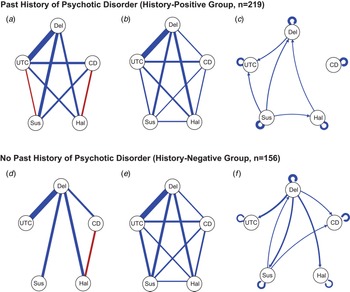
The Temporal, Contemporaneous, and Between-Person Networks were estimated for the whole sample (online Supplementary Fig. S1 and Table S3), and for the history-positive and history-negative groups (Fig. 1). The network structures demonstrated primarily positive significant edges, suggesting a system of positive reinforcement. In the Temporal Networks of both groups, there were significant auto-regressive effects for all symptoms. In both groups, the Contemporaneous Network was comprised of positive significant edges between all symptoms, with the co-occurrence of delusions and unusual thought content being the strongest association at a given moment. The Between-Person Networks exhibited patterns of co-occurring pairs of symptoms: delusions tended to co-occur with unusual thought content or suspiciousness symptoms, which themselves did not co-occur. In the history-negative group, conceptual disorganization co-occurred with delusions, but not when delusions co-occurred with hallucinations. In the history-positive group, conceptual disorganization co-occurred with unusual thought content or suspiciousness, but not when either symptom presented with a third symptom.
Dynamic network of psychotic symptoms over 5 years among adults living in precarious housing. Network structures estimated from time-series data of psychotic symptoms (60 assessments) among adults living in precarious housing. For participants with a history of psychotic disorder diagnosis (history-positive group, n = 219, 8280 observations), the (panel A) Between-Subject Network, (panel B) Contemporaneous Network, and (panel C) Temporal Network of psychotic symptoms are depicted. Panels D–F represent the Between-Subject, Contemporaneous, and Temporal Networks of participants without a history of psychotic disorder (history-negative group, n = 156, 6044 observations). Blue edges are positive and red edges are negative. Values and edge thickness represent edge weight. Edges with arrowheads demonstrate direction of lagged (lag-1) effects. Only significant edges are included (Panels C and F, by FDR 5%; and Panels A, B, D, and E by bootstrap procedure; see online Supplemental for details). Del, Delusions (PANSS item P1); CD, Conceptual Disorganization (PANSS item P2); Hal, Hallucinatory Behavior (PANSS item P3); Sus, Suspiciousness and Persecution (PANSS item P6); UTC, Unusual Thought Content (PANSS item G9).

Delusions and unusual thought content exhibited the greatest strength and closeness centrality measures in both groups' Between-Person and Contemporaneous Networks (Table 2). Temporal Network symptom centrality differed between the two groups. In the history-positive Temporal Network, suspiciousness exhibited greater out-strength and closeness centrality measures, while delusions exhibited greater in-strength. Conversely, for the history-negative group, delusions exhibited the greatest out-strength and closeness centrality, and suspiciousness, hallucinations, and unusual thought content the greatest in-strength. Conceptual disorganization may play a different role in the Temporal Network in each group: change in conceptual disorganization severity was not related to other symptoms in the history-positive group over time but was preceded by a change in delusions and suspiciousness severity in the history-negative group.
Psychotic symptom network centrality

PANSS, Positive and Negative Syndrome Scale; Del, Delusions (PANSS item P1); CD, Conceptual Disorganization (PANSS item P2); Hal, Hallucinatory Behavior (PANSS item P3); Sus, Suspiciousness and Persecution (PANSS item P6); UTC, Unusual Thought Content (PANSS item G9).
History-Positive Group (n = 219): participants with a history of psychotic disorder diagnosis. History-Negative Group (n = 156): participants without a history of psychotic disorder diagnosis.
Network accuracy and stability
Temporal Network estimates were similar when from complete datasets generated with the multiple imputation procedure (ρ = 0.968, p < 0.001).
Differences in network global connectivity
Permutation analysis revealed the Temporal Network of the history-positive group had significantly greater auto-regressive connectivity (history-positive: 0.900, history-negative: 0.766; p < 0.001) and similar cross-regressive connectivity (history-positive: 0.544, history-negative: 0.791; p = 0.049) than the history-negative group. Overall, the global network connectivity between groups was similar (history-positive: 1.444, history-negative: 1.557; p = 0.590).
Differences in network structure
The two methods for comparing Temporal Network edge-weights converged to reveal two edges that differed between groups after adjusting for multiple comparisons (online Supplementary Table S4). Participants in the history-negative group were more likely to have change in delusions predict the change in suspiciousness (omnibus: B = −0.085, p < 0.001; permutation: difference = −0.088, p = 0.002) or unusual thought content in the next month (omnibus: B = −0.075, s.e. = 0.030, p = 0.014; permutation: difference = −0.080, p = 0.017).
Risk factors of network connectivity
Greater global connectivity was independently associated with older age (B = 0.006, s.e. = 0.003, p = 0.019) and methamphetamine dependence (B = 0.135, s.e. = 0.052, p = 0.010), adjusting for sex and past psychotic disorder (online Supplementary Table S5). Methamphetamine dependence and early-life trauma were associated with greater cross-regressive but not auto-regressive connectivity, adjusting for age, sex, and past psychotic disorder (Table 3). Methamphetamine dependence was also associated with stronger ‘delusion-unusual thought content’ edge-weight (B = 0.030, s.e. = 0.009, p < 0.001), an edge unique to the history-negative group (online Supplementary Tables S6–S7). Auto-regressive effects were greater among male participants (Table 3). The magnitude of a symptom's auto-regressive effects was associated with greater severity of that symptom (online Supplementary Table S8), with the exception of delusions.
Risk factors for psychotic symptom network connectivity

THQ, Trauma History Questionnaire.
a n = 291.
b n = 282.
Network connectivity association with premature mortality
During 2295 person-years of observation (median 6.4, interquartile range 3.9–8.8 follow-up years), 75 (20%) participants died. Causes of death included physical illness (41.3%), accidental overdose (36.0%), trauma (6.7%), suicide (1.3%), or unknown (14.7%). The effect of auto-regressive connectivity on mortality interacted with age with a changepoint of age 55 separating younger and older groups. For participants younger than 55, greater auto-regressive connectivity was associated with premature mortality, adjusting for sex and Charlson Comorbidity Index (Table 4).
Association between psychotic symptom network connectivity and premature mortality

HR, hazard ratio; CI, confidence interval.
Discussion
This is the first dynamic network study of psychotic symptoms, examining the relationships among psychotic symptoms over 5 years in a community-based sample of adults living in precarious housing. Urban, socially marginalized communities struggle with high rates of psychosis, as well as multiple interrelated factors such as poverty, substance use, trauma, and medical comorbidity (Ayano et al., Reference Ayano, Tesfaw and Shumet2019; Fazel et al., Reference Fazel, Geddes and Kushel2014; Olfson et al., Reference Olfson, Lewis-Fernández, Weissman, Feder, Gameroff, Pilowsky and Fuentes2002). We applied an innovative analytic approach to understand psychosis, relevant risk factors, and consequences for mortality. Psychotic symptoms exhibited distinct co-occurrence patterns and positively reinforced each other over time. Delusions and unusual thought content were central in the networks. Participants with a history of psychotic disorder had greater network auto-regressive connectivity, suggesting greater symptom persistence from month-to-month. Auto-regressive connectivity was greatest in males and was associated with premature mortality in adults younger than 55. Cross-regressive connectivity was associated with methamphetamine dependence and trauma exposure, suggesting a potential mechanism of influence for these risk factors.
Delusions and unusual thought content were central to the multilevel network for participants with and without the past psychotic disorder. This finding corroborates and extends previous cross-sectional network studies of patients with psychotic disorder (Isvoranu et al., Reference Isvoranu, Van Borkulo, Boyette, Wigman, Vinkers, Borsboom and Myin-Germeys2017; van Rooijen et al., Reference van Rooijen, Isvoranu, Kruijt, van Borkulo, Meijer, Wigman and Bartels-Velthuis2018). The Between-Person Networks demonstrated that delusions were associated with unusual thought content or suspiciousness, which themselves did not co-occur. This aligns with phenomenological descriptions that consistently distinguish bizarre from persecutory delusions or paranoia (Cermolacce, Sass, & Parnas, Reference Cermolacce, Sass and Parnas2010; Kendler, Reference Kendler2017). The key distinction is in the content of the beliefs – whether it is considered outside the logical framework of the patient's culture and history, or within. This may be driven by independent cognitive mechanisms: unusual thoughts may be generated by impaired self-monitoring that removes agency from one's actions (Langdon, Ward, & Coltheart, Reference Langdon, Ward and Coltheart2010), whereas suspiciousness may be driven by attributional bias and aberrant salience of events (Kapur, Reference Kapur2003) or impaired theory of mind (Corcoran, Mercer, & Frith, Reference Corcoran, Mercer and Frith1995), whereby the mental states and behaviors of others are misinterpreted.
However, this study revealed a temporal relationship between suspiciousness and unusual thought content unique to participants with a history of psychotic disorder: change in suspiciousness severity was associated with subsequent change in unusual thought content severity. This is consistent with a cross-sectional network study of psychotic-like experiences that postulated two possible causal pathways: affective symptoms predicting suspiciousness predicting unusual thought content, or the reverse (Murphy, McBride, Fried, & Shevlin, Reference Murphy, McBride, Fried and Shevlin2018). Our study provides evidence for the former: in individuals with a higher risk for psychosis, suspiciousness may predict subsequent unusual thoughts, directly or mediated through delusional beliefs.
By applying a multilevel network analytic approach, we separated the within-individual temporal dynamics from individual cross-sectional and aggregated differences stable across time. This was critical for distinguishing the temporality and scale of the effects between symptoms. The estimated network structure may underpin a cascade of psychosis: perturbations in one symptom may lead to exacerbation of all other symptoms over the course of months (online Supplementary Fig. S2). Psychotic symptoms behaved differently on a month-to-month basis in adults with and without lifetime psychotic disorder. In the history-positive group, suspiciousness was found to be ‘upstream’ (i.e. greater out-strength), while changes in hallucinations and disorganization severity were more ‘downstream’ (i.e. greater in-strength). Indeed, suspiciousness worsened in the days preceding the onset of hallucinations and delusions in people with schizophrenia (Marneros, Pillmann, Haring, Balzuweit, & Blöink, Reference Marneros, Pillmann, Haring, Balzuweit and Blöink2005). Individuals with first-episode psychosis rarely reported experiencing hallucinations alone (Compton, Potts, Wan, & Ionescu, Reference Compton, Potts, Wan and Ionescu2012), consistent with greater in-strength. However, in the history-negative group, delusions had the greatest out-strength, suggesting this symptom's critical role for broader network activation. This model suggests, preventing exacerbation of suspiciousness in the history-positive group and delusions in the history-negative group, may prevent the activation of other downstream symptoms. While the course of psychosis is heterogeneous, characterizing the within-individual cascade at different timescales may inform our understanding of psychosis progression and future prevention strategies.
Substance use and dependence were common among participants. Methamphetamine dependence was associated with cross-regressive connectivity, strengthening relationships between symptoms over time. This novel finding indicates a mechanism for how transient methamphetamine-induced psychosis could evolve to persistent psychosis (McKetin et al., Reference McKetin, Gardner, Baker, Dawe, Ali, Voce and Lubman2016). Methamphetamine was also associated with the activation pathway from delusion to unusual thought content in the history-negative group. Indeed, methamphetamine is associated with exacerbations in delusions (thought interference, persecutory) and unusual thought (Bousman et al., Reference Bousman, McKetin, Burns, Woods, Morgan, Atkinson and Grant2015; McKetin, Baker, Dawe, Voce, & Lubman, Reference McKetin, Baker, Dawe, Voce and Lubman2017). Examining whether the treatment of methamphetamine dependence could alter network structure is an important area for future study.
Over time, psychotic symptoms were more likely to persist in the history-positive group, indicated by greater network auto-regressive connectivity. These observations contribute to our understanding of how symptom network connectivity may relate to the severity and progression of mental illness (Borsboom, Reference Borsboom2017; van Borkulo et al., Reference van Borkulo, Boschloo, Borsboom, Penninx, Waldorp and Schoevers2015). Interestingly, auto-regressive effects of each symptom were associated with that symptom's severity: worse symptoms were less likely to fluctuate or remit. Delusions were the exception: no matter the extent of crystallization or systematization, delusions tended to persist month-to-month. Delusions are challenging to modify, concordant with descriptions as the most persistent psychotic symptom among individuals with first-episode psychosis (Gunduz-Bruce et al., Reference Gunduz-Bruce, McMeniman, Robinson, Woerner, Kane, Schooler and Lieberman2005) or schizophrenia spectrum disorder (Johansson, Hjärthag, & Helldin, Reference Johansson, Hjärthag and Helldin2018). Importantly, auto-regressive connectivity was associated with premature mortality, controlling for comorbidities. Indeed, psychosis is an important risk factor for mortality in this population (Jones et al., Reference Jones, Vila-Rodriguez, Leonova, Langheimer, Lang, Barr and Honer2015) and globally (Global Burden of Disease Study, 2013 Collaborators, 2015).
There are four key limitations to the findings of this study. First, temporal effects may be underestimated as observations occurred monthly. Faster effects (days) were embedded in the Contemporaneous Network, and slower effects (years) were embedded in the Between-Person Network. However, dynamic processes for psychotic symptoms may operate on different timescales, including month-to-month, as captured in this study. Second, the Temporal Network examined one lag, neglecting more protracted effects. Third, while standardization is considered best practice for dynamic network modeling, this approach may underestimate auto-regressive effects (Bulteel et al., Reference Bulteel, Tuerlinckx, Brose and Ceulemans2016). Last, to capture the complex dynamic system of psychosis, other biopsychosocial factors could be included (Borsboom, Reference Borsboom2017; Kendler et al., Reference Kendler, Zachar and Craver2011), such as mood, negative symptoms, treatment, substance use, and/or brain injury. Communities, including the present sample, endure many factors that contribute to greater psychosis risk. Our study continues to apply innovative analytic approaches to understand complex brain structural (Gicas et al., Reference Gicas, Jones, Panenka, Giesbrecht, Lang, Vila-rodriguez and Honer2019), social (Knerich et al., Reference Knerich, Jones, Seyedin, Siu, Dinh, Mostafavi and Rutherford2019), and, as in this study, psychopathological networks to understand and improve the health of communities experiencing socioeconomic marginalization and compounding health challenges. While current analytic approaches permit a limited number of variables (Epskamp et al., Reference Epskamp, Waldorp, Mõttus and Borsboom2018), future tools may allow us to examine these complex, interacting systems and potentially mitigate risk for onset or progression of psychosis.
Supplementary material
The supplementary material for this article can be found at https://doi.org/10.1017/S0033291720004444
Acknowledgements
The authors thank the Hotel Study research assistants and volunteers. They are grateful for the individuals that participated in this study.
Financial support
This work was supported by the Canadian Institutes of Health Research (W.G.H., CBG-101827, MOP-137103), BC Mental Health and Addictions Services (W.G.H.), and the William and Ada Isabelle Steel Fund (A.E.T.). W.G.H. was supported by the Jack Bell Chair in Schizophrenia.
Conflict of interest
F.V-R. reports grants from Canadian Institutes of Health Research, grants from Brain Canada, grants from Vancouver Coastal Health Research Institute, grants from Michael Smith Foundation for Health Research, personal fees from Janssen Pharmaceuticals, and non-financial support from Magventure. R.M.P. has received consulting fees or sat on paid advisory boards for Janssen, Lundbeck, and Otsuka; is on the speaker's bureau for Janssen, Lundbeck, and Otsuka. G.W.M. has received consulting fees or sat on paid advisory boards for Apotex, AtraZeneca, BMS, Janssen, Lundbeck, Otsuka, Pfizer, and Sunovion. He also received fees for lectures sponsored by AstraZeneca, BMS, Janssen, Otsuka, and Eli Lilly, and has received grants from Janssen Pharmaceuticals. W.G.H. has received consulting fees or sat on paid advisory boards for the Canadian Agency for Drugs and Technology in Health, AlphaSights, Guiepoint, In Silico, Translational Life Sciences (TLS), Otsuka, Lundbeck, and Newron; and holds shares in TLS and Eli Lilly. A.A.J., K.M.G, S.M., M.L.W., O.L., A.C., T.B., D.J.L., W.J.P., A.M.B., and A.E.T. declare no conflicts of interest.
Ethical standards
The authors assert that all procedures contributing to this work comply with the ethical standards of the University of British Columbia and Simon Fraser University Clinical Research Ethics Boards and the Helsinki Declaration of 1975 as revised in 2008.