


It is something of a shock for a contemporary political scientist to find that the introductory essay in the fifth volume of the American Political Science Review in February 1911 was Woodrow Wilson's address as president—president of APSA (Wilson 1911). It is hard to imagine any modern president of the United States serving as president of APSA, or even publishing in or reading the journal. Clearly, much has changed in the profession, the journal, and American politics in the first 100 years of the Review.
As a consequence of these changes, one frequent complaint raised against the contemporary Review is that the journal, and the profession that it helps to shape, are not sufficiently “policy relevant.” Some critics argue this has been a consequence of the journal's turn toward sophisticated techniques such as formal modeling and statistical analysis and its emphasis on the “science” of politics (Smith 2002). Others argue that rigorous, formal, and theoretical work can be relevant to policymaking, but nonetheless lament that contemporary political science puts insufficient emphasis on policy relevance (Jentleson 2002; Putnam 2003).
We explore this critique by examining the relevance for American foreign policy of the international relations articles in the Review over the last 100 years. We first define a spectrum of policy relevance ranging from direct and immediate relevance for near-term policies to basic research that shapes the policy environment through a variety of mechanisms. We then provide an overview of the Review's evolution on this spectrum and analyze its changing relevance for key issues in American foreign policy over the last 100 years. Emphasizing contemporary issues such as the “democratic peace,” terrorism, and ethnic conflicts, we conclude that although the Reveiw has evolved from direct aspirations of policy relevance toward an emphasis on basic research, it nonetheless remains relevant for American foreign policy, as the results of basic research are often translated into policy changes through a variety of mechanisms in the long term.
This is not to deny the danger, evident in some of the more abstruse articles in the journal over the last decades, that the profession and the journal could move in directions that are too removed from policy concerns. We are confident, however, that the demands for policy relevance from our students, public officials, media, friends and neighbors, and not least, funding sources, together with the policy concerns that brought most of us into the profession in the first place, will keep the Review and the field from retreating to political science for political science's sake. Academic policymakers like Henry Kissinger, Zbigniew Brzezinski, Anthony Lake, Madeleine Albright, Joseph Nye, Condoleezza Rice, and Stephen Krasner, and the many students they have taught, surely think, teach, write, and act differently about the world from having read or contributed to the Review and journals like it.
THE EVOLUTION OF THE JOURNAL AND THE PROFESSION FROM 1906 TO 2006
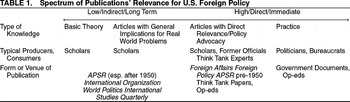
Following Lepgold (1998) we outline in Table 1 a spectrum of policy-relevant forms of knowledge, their producers and consumers, and the venues in which they are published.

On one end of the spectrum is scholarly work that aims at elaborating general theories about international relations. This work tends to take the form of abstract propositions that seek to provide a coherent explanation for a wide array of behaviors, such as elaborations of the basic logic of power balancing or cooperation under conditions of anarchy. General theory is typically not focused on specific problems, time periods, or geographic regions. This work aims at establishing the general concepts and causal mechanisms within the field and typically policymakers do not read it directly.
A second type of scholarly work focuses on building knowledge about particular puzzles and cases, in effect using and adapting general theory to explain specific types of behavior. Theory is used here to account for patterns among a set of cases. Research in this domain might examine, for example, variations in alliance behavior between democratic and nondemocratic states or variations across issue-areas in patterns of institutionalized cooperation. This puzzle-driven and explanation-oriented research tends to remain within professional academic journals but its direct engagement with specific issues and regions makes it more relevant to policy debates.
A third type of scholarly work directly bridges the policy divide. This work tends to ask questions from the perspective of policymakers and offers direct information that bears on policy choices. Some writings of this sort examine the specific impact of policies—for example, the impact of a free trade agreement on the prospects for security cooperation. Other work entails “area studies” expertise—for example, the impact of political–cultural attitudes on the foreign policy of specific countries. This type of knowledge is often generated within think tanks.
A final type of knowledge—occupying the other end of the spectrum—is produced directly by policymakers. This includes national security reports and planning documents as well as memos and position papers.
Each of these types of activities involves different—but also overlapping—communities of scholars and policy intellectuals. As we note below, after the 1950s, the output of each community has tended to find its way into different journals and publications. But knowledge flows across these communities through various mechanisms, including the college and graduate education of policymakers, dialogs and consultations between scholars and policymakers, mass media appearances or writings by scholars and policymakers, and the movement of scholars themselves into and out of government.
By these definitions, in its early years, the Reveiw aspired to both theoretical scholarship and direct and near-term relevance. It began as an omnibus journal that has now effectively become four journals. The first few decades of the journal contained a regular section on “Notes on Current Legislation,” much like the material now in journals like Congressional Quarterly. Other regular sections included “News and Notes” on the news of the day and news in the profession, the latter of which shifted to the journal PS: Political Science and Politics when it began publication in 1968. The Review also included book reviews, a function that moved over to Perspectives on Politics in 2003. It was thus only in the 1960s that research articles became predominant in the journal.
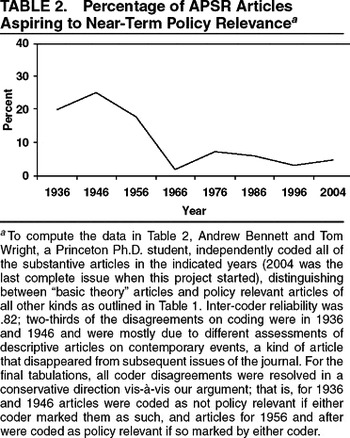
Over the decades the Review has published fewer and fewer articles aspiring to near-term or direct policy relevance. Using the admittedly general definitions above, we coded the percentage of the Review's research articles for one year of the journal each decade from 1936 to 2004 (including all the empirical subfields) that aspired to direct policy relevance or policy advocacy; that is, the articles fitting in the third column of Table 1, or those that addressed contemporary events with explicit attention to the implications for near term governmental policies. Our data reveal a sharp drop in such articles beginning in the 1950s (see Table 2).

Why this shift away from aspirations to direct policy relevance? Unfortunately, no documents from this period indicate conclusively whether this change was part of an intentional shift in editorial policy or a consequence of the changing mix of articles submitted to the journal. It does not appear that policy-relevant work was merely siphoned off to other venues, as the proliferation and growth of policy-focused journals and think tanks for the most part took place in the 1960s and 1970s, well after the change in the Review had begun. One intriguing clue that the changes in the Review were driven more by developments internal to the field, specifically the emerging behavioral revolution, comes from Harvey Mansfield's final report as editor of the Review when his tenure, which began in 1956, ended in 1965. Mansfield noted that the journal was receiving more “articles that rest heavily on mathematical methods of analysis.” Although the journal published a rapidly increasing number of such articles, Mansfield worried that “their political relevance is sometimes plain enough, and sometimes very difficult to see or assess, considering the heroic and unreal assumptions often necessary to present applications of the methods” (quoted in Patterson, Ripley, and Trish, 1988, 919).
The turn toward more advanced and technical research methods did not by itself make the Review less relevant to policy. There is no inherent incompatibility between rigor and relevance, or between good basic research and research with clear policy implications. Yet the increasing technical specialization of the profession has made it more difficult for policymakers and citizens to understand and make direct use of political science research. This specialization includes not only the use of formal and statistical methods but also the development of specialized concepts and terms. Words like “hegemony” and “anarchy” have profoundly different meanings in scholarly discourse and in common parlance.
Whatever the initial cause of the Review's turn away from analysis that explicitly aspired to near-term policy relevance, the wider changes in the marketplace of ideas and in the size, diversity, and professionalism of political science in the 1960s and 1970s irreversibly ensconced the Review in a specialized niche focusing on basic research. At the same time, the establishment of new policy-oriented journals like Foreign Policy and International Security in the 1970s developed a new “food chain” in scholarly work, with basic research in journals like the Review informing scholars' work in the policy journals as well as in newspapers, television, and the classroom.
In addition, practical limitations make it difficult for any journal to publish articles that have a direct impact on U.S. government policies. From the inception of an idea, to the writing and submission of an article, through the process of peer review, and then through the queue to publication in the Review, it requires at a bare minimum a period of nine months or so. In policy terms, especially in the foreign policy arena, this can be several lifetimes. If a scholar had tried to write for the Review on the politics of military intervention and occupation in the fall of 2002, for example, the Senate vote authorizing force against Iraq, the U.N. diplomacy that followed, and the first few months of the actual intervention would have passed before an article could have been published. This problem of timing, more than the problems of brevity and accessibility, makes it difficult even for dedicated foreign policy journals with less elaborate review processes than the Review to influence near-term policy debates within the government.
A recent survey of international relations scholars suggests a consensus that for various reasons, published research is neither the only nor the most important avenue toward policy relevance. One fourth of those surveyed rated policy analysis as the kind of academic work most useful to policymakers, followed by 17% for area studies, 15% for contemporary case studies, and 14% for theoretical models. When asked the most important ways in which political scientists and international relations scholars should contribute to the policymaking process, 66% cited the creation of new knowledge or information, 43% responded with the training or teaching of policymakers, 37% cited being advisors to policy officials, and 11% pointed to becoming active participants in the policy process. Other data from the survey indicate that the content that faculty teach in their classes is more focused on world events and policy debates than the research that faculty conduct (Peterson, Tierney, and Maliniak 2005).
Although it would be unrealistic to expect that research articles in the Review should aspire to or to achieve near-term or direct policy relevance, it is still worth asking whether the content of the journal achieves the kind of longer term and indirect effect on policy that it can realistically hope to attain by influencing how political scientists think about, teach, and do politics. We assess this issue in broad terms below by reviewing how the content of the international relations articles in the Review related to the foreign policy issues of the day over the first century of the journal.
ARTICLES IN THE REVIEW AND AMERICAN FOREIGN POLICY
The Early Years of the Review
To read early issues of the Review is to be reminded that aspiring toward policy relevance is quite different from achieving it, and that any policy influence the profession does achieve will not necessarily be in directions that future historians will find praiseworthy. Just as the Review and the political science profession in general failed to anticipate the collapse of the Soviet Union in the 1980s, the Review before 1914 conveyed little sense that a cataclysmic world war was imminent. The journal did publish an article on the Balkans (Harris 1913), but it did not focus on the larger power transitions taking place in Europe until publication of a rather realist analysis of “The Causes of the Great War” after World War I had begun (Turner 1915). In this same time period, the Review was filled with articles putting a favorable emphasis on international law as a means toward peace.
After World War I, the Review played a role in the “idealism-realism” debate of the 1920s (Carr 1940), largely favoring the idealist side with more than a dozen articles through the decade on the League of Nations or international law. Former President William Howard Taft, for example, launched a staunch defense of the League of Nations in the Review (Taft 1919). Only one article in the journal in the 1920s included the term “balance of power” in its title, and this article strongly criticized balance of power politics and argued that the building of international institutions was the best answer to the problem of war (Hoard 1925).

Henry Kissinger and Zbigniew Brzezinski.
In the 1930s, a handful of articles began to focus on the issues that would precipitate World War II, including the Manchurian crisis, nationalism, and the geographic bases of states' foreign policies, but no articles were fully dedicated to assessing the international implications of the rise of Hitler or Germany. Articles sympathetic to the League of Nations process, on the other hand, continued right up until the spring of 1939 (Myers 1939), although an article critical of international law appeared in 1938 (Wild 1938).
Starting in 1940, perhaps prompted in part by an address by Robert Brooks as president of APSA that strongly endorsed American rearmament and aid to the countries fighting against Hitler (Brooks 1941), articles in the Review finally turned to World War II, America's role in the war, and America's prospective role in the postwar world. For the first time, articles with a pragmatic or realist tone began numerically to rival those on international law and international organization.
The Postwar Period
In the late 1940s and 1950s, the Review published articles that grappled with the unfolding Cold War and the postwar transformation of geopolitics. One stream of research focused on the massive and growing Cold War military establishment. The planning and organization of defense, manpower, the role of the military in politics, and the impact of military assistance and foreign aid were prominent topics. A second wave of research dealt with the United Nations and international institutions. A third strand of research focused on the peace settlement, stabilization, and the emerging post-War politics of Germany and Japan.
Surprisingly, no articles in the early postwar decades attempted to make sense of the nuclear revolution. The pioneering work of Bernard Brodie, Thomas Schelling, and Albert Wohlstetter appeared elsewhere, and it was World Politics that published the seminal article of this era on this topic—John Herz's “Idealist Internationalism and the Security Dilemma” (Herz 1950). By the 1970s, however, Review articles began to focus on arms control negotiations and regimes.
The Review was also a site for renewed debate between realists and idealists, this time with realists taking the more prominent place. Hans Morgenthau's (1950) “The Mainsprings of American Foreign Policy: The National Interest versus Moral Abstractions” crystallized the debate (Morgenthau, 840). This article was followed by a series of exchanges where other scholars defended the “realism of idealism” (Cook and Moos 1952). Morgenthau's writings in the Review and elsewhere helped shape many scholars' views on the theory and policy in international relations, including Henry Kissinger and Zbigniew Brzezinski (Brzezinski 1956; Kissinger 1954).
The Behavioral Revolution and the Vietnam Era
Beginning in the 1960s, the Review prominently showcased the growing and diversifying field of security studies, publishing research on alliances, civil–military relations, strategic doctrine, and foreign-policy decision making. A great deal of this research was empirical and problem driven, examining the dilemmas and transformations of America's global security environment.
In the 1970s, the Review took up two key foreign policy developments. One was the growing controversy over the Vietnam War. Scholars were forced to ask how the world's most powerful state found itself losing a war in a small country half way around the world. One of the most prominent lines of inquiry focused on the American government itself—its bureaucracy, policy elites, and decision makers. Graham Allison's (1969) path-breaking article on bureaucratic politics and foreign policy probed the Kennedy administration's decision making during the Cuban missile crisis, but its larger significance was in stimulating debate on the decision making that led to Vietnam. This growing attention to the organization of decision making inside the “black box” of the state was also reflected in Alexander George's (1972) article on multiple advocacy in foreign policy advisory processes.
Relatedly, John Mueller's (1971) “Trends in Popular Support for Wars in Korea and Vietnam” helped shape a whole generation of scholars' and policymakers' views that the public was unwilling to tolerate casualties if America's goals in using force were ambiguous or unlikely to be attained. Mueller's analysis contributed to an important ongoing debate that most recently has seen Mueller and Peter Feaver contest their views on the conditions under which the American public is willing to risk casualties in the current war in Iraq, with Feaver directly advising President George Bush on how to frame the U.S. mission in Iraq in his public pronouncements (Baker and VandeHei 2005, A1; Feaver and Gelpi 2005; Mueller 2005).
A second area that gained prominence in the Review during the 1970s was the emerging subfield of international political economy. Here it was the steady rise of economic interdependence, the growth of multilateral corporations, the collapse of the Bretton Woods system, and the oil crises of the 1970s that brought international relations scholars into the study of the connections between markets and state power and problems of international cooperation. In an early effort, John Ruggie (1972) explored the logic of public goods provision and functional variations in issues and their implications for the prospects for cooperation. In the 1980s, the Review published articles on trade policy and relations between trade and alliances (Aggarwal, Keohane, and Yoffie 1987; Cassing, McKeown, and Ochs 1986). This work on political economy and international cooperation helped scholars and perhaps policymakers see how institutions—domestic and international—played a role in overcoming protectionist interests, establishing stable commitments and rules of the game, and facilitating cooperation.
From the New Cold War to the Cold War's End: The Review in the 1980s
In the 1980s, the Review became a leading journal for formal theoretical analyses of international relations. Bruce Bueno de Mesquita (1980) and others published a series of articles using expected utility theory to explain war and international conflict. Robert Axelrod's (1981) important “The Emergence of Cooperation among Egoists” reflected the new way in which game theory was informing theoretical debates (see also Snidal 1985; Wagner 1983).
As a fast-moving and rather novel approach to the field, some formal modeling efforts broadly influenced scholars' and policymakers' views. Axelrod's work on how even self-regarding actors in a Prisoner's Dilemma could get to cooperative long-term equilibria gained attention not only from scholars but also from policymakers and even to some degree the public. This research provided an intellectual basis for arguments about how cooperative regimes might be established with actors ranging from the Soviet Union to America's trading partners. Other works had more tenuous ties to policy or rested on more debatable assumptions.
In perhaps the clearest recent example of basic political science research that has influenced U.S. foreign policy, the Review published Michael Doyle's landmark “Liberalism and World Politics” in 1986. Doyle provided an updated rendering of the Kantian argument that democracies do not go to war with each other, identifying possible causal explanations and offering empirical validation of a democratic peace. Jack Levy argued in 1989 that the democratic peace is “as close as anything we have to an empirical law in international relations” (270), and in the years that followed, the debate on the democratic peace exploded with an outpouring of articles, including statistical and formal analyses that gave claims of a democratic peace considerable credibility (e.g., Lake 1992; Maoz and Russett 1993; Schultz 1998; for a skeptical view see Rosato 2003). As two measures of the influence of Doyle's article, the JSTOR database of journal articles provides not a single article citation for the term “democratic peace” from 1970 to 1986, but 75 citations for this term from 1987 to 2006, whereas the ISI “Web of Knowledge” database indicates that Doyle's article has been cited 295 times.
Doyle's article illustrates the “food chain” through which theoretical ideas get translated into policies. In addition to being cited numerous times in theoretical journals, Doyle's piece was cited in Foreign Policy in the spring of 1987 (Davis and Lynn-Jones 1987) and Foreign Affairs in the spring of 1991 (Gaddis 1991), the first of several citations in both journals. The democratic peace argument also quickly found its way into American foreign policy. President Bush and his Secretary of State Baker both used the term “democratic peace” in 1992, and after invoking this idea numerous times beginning in the 1992 campaign, President Clinton embraced the democratic peace as a central organizing idea of his “National Security Strategy of Engagement and Enlargement” (Clinton 1996). More recently, the Bush administration has also enshrined the Kantian notion in its vision of American power and democracy promotion. Political actors undoubtedly embraced the democratic peace argument in part because it fit their existing policy predilections, and they have often glossed over problems like the war-proneness of transitional democracies (Mansfield and Snyder 1995; Ward and Gleditsch 1998), the danger of “illiberal democracies” (Zakaria 1997), and the difficulty of fostering democracy in states dependent on rents generated by natural resources (Ross 2001). Even so the democratic peace literature's contribution to the policy thinking of a generation of scholars, pundits, and politicians is perhaps as ambitious and successful an example of policy relevance as a basic research journal like the Review can realistically expect.
The 1990s to the Present
Two contemporary foreign policy issues exemplify the continuing challenges and opportunities for the Review to influence American foreign policy: the problem of terrorism and that of civil conflicts. In retrospect the profession gave insufficient attention to the problem of terrorism in its leading journals. Bruce Jentleson has noted that the major international relations journals, including the Review, ran only one article on terrorism in the three years leading up to 9/11/2001 (Jentleson 2002), and that article, in International Studies Quarterly (Enders 1999), concluded that transnational terrorism was declining. Foreign policy journals like Foreign Affairs and Survival, he notes, did better, averaging close to one article related to terrorism per issue in the years before 9/11 (Jentleson, 171–72). On the other hand, the Review did publish an article in 1993 arguing that strategies focused on deterring one kind of terrorist attack or tactic could merely lead terrorists to change to other kinds of tactics, an argument with clear relevance for the post-9/11 world (Enders and Sandler 2003). The Review also published an article in 2003 analyzing the logic motivating terrorists (Pape 2003), and it is to be hoped and expected that more articles with relevance for the struggle against terrorism will follow.
The Review was arguably more consistent and prescient in publishing articles on civil and ethnic conflict that have relevance for ongoing U.S. policies. James Fearon and David Laitin (2003), for example, argued in the Review that the material factors that favor insurgency are better predictors of civil and ethnic conflict than measures of ethnic or religious diversity, an argument that has great relevance for U.S. military tactics and strategies in Iraq and Afghanistan. Also relevant here is Michael Doyle and Nicholas Sambanis's (2000) Review article maintaining that multilateral U.N. peace operations have proven to be positively correlated with the successful resolution of civil wars. These and other articles in the Review on civil conflicts and democratization contributed to a wider literature that made clear that Iraq would be a difficult case for democratization (Byman 2003), that it harbored many of the conditions conducive to civil conflict (Posen 1993), and that a largely unilateral intervention by the United States would have fewer prospects for success than a multilateral intervention (Doyle and Sambanis 2000; Edelstein 2004). Value judgments on the risks of using force in the face of imperfect information of course properly remain the domain of elected officials, and we cannot know the counterfactual scenario of the costs and risks to the United States and the world had the United States failed to intervene in Iraq, but in this instance the theories developed in the Review and other journals arguably anticipated that the occupation of Iraq would be difficult, costly, and lengthy and that there was a high risk that civil conflict would ensue.
CONCLUSIONS
The role of scholarly knowledge in the shaping of American foreign policy is difficult to pin down—and so too is the specific role of the Review as the leading professional journal of political science. It is clear that the impact of the Review is mostly indirect, operating through the teaching of students and the enrichment of the intellectual environment in which experts and public officials draw their policy ideas. Woodrow Wilson was perhaps unique in his experience as both a political scientist and president. But across the decades political scientists have found themselves in key foreign policy positions and have brought their scholarly knowledge to bear.
Our survey of 100 years of the Review confirms the widespread impression that it has indeed moved away from the focus on near-term policy relevance that marked its early decades. At the same time, this survey shows that the problems that basic scholarly research engages do evolve and respond to the long-term shifts in the global system itself, even if the literature often failed to anticipate these shifts. In the areas of international relations and American foreign policy, the Review has reflected these great transformations— the Cold War, the nuclear revolution, Vietnam, economic interdependence, civil wars, and the democratic peace. Over the long run, scholarly discourse does flow into the policy arena through a variety of means that policy makers themselves may not fully realize.
This conclusion is another way of saying that the linkages between good social science and useful policy-relevant knowledge still exist—and indeed there is no reason that they cannot be strengthened. Bruce Jentleson concludes that “Bringing policy relevance back in thus does not mean driving theory out,” and that the theoretical journals like the Review should continue to have distinct missions from policy journals like Foreign Affairs. Yet Jentleson (2003, 183) rightly warns that this distinction “should be in terms of how policy problems are approached, not whether attention is paid to them.”
Far more than in its early years, today's Review publishes basic social science research. But that research continues to infuse and inform the more policy-relevant writing published in the growing array of policy journals. An apt analogy here is the distinction between basic medical research and medical practice. Basic medical research informs the daily practice of doctors, but in its raw form it is ordinarily not very useful to them. Basic medical research usually affects medical practice only after research has converged with confidence on particular results, and after these results are transmitted to physicians through their medical training or through meta-analyses in practice-oriented medical journals that make sense of the potentially conflicting results of basic research. At the same time, although a few medical researchers might have the training, disposition, and experience to be practicing physicians, most basic medical researchers tend to be specialized in ways that would make them poor practicing physicians. Journals publishing basic medical research, and by analogy the Review, need to keep focused on research that may be of eventual use to practitioners. The occasional article with more immediate relevance is to be highly prized, but we should not set the unrealistic or even counterproductive expectation that every article should be immediately and directly relevant to informed practice.




Comments
No Comments have been published for this article.