INTRODUCTION
Nationalism puzzles Africanists for two main reasons. First, the boundaries of most modern African states were imposed by colonial powers and are thus unlikely to encompass people who share a common identity (Alesina et al. Reference Alesina, Easterly and Matuszeski2011). German Chancellor Otto von Bismarck convened the Berlin Conference of 1884–1885 where European delegates negotiated the ‘scramble for Africa’ by dividing territory on a map with straight lines and little regard for pre-existing social or political organisation. Although the significance of this singular event is often exaggerated,Footnote 1 it helped shape future states. African statesmen who inherited colonial boundaries forged customary rules to uphold the territorial status quo, even without being obligated by existing international laws to do so (Donaldson Reference Donaldson and Home2012; Ahmed Reference Ahmed2015).Footnote 2 Today, Africans almost always express nationalism in terms of colonial units – Tanzania, Congo, and so forth (Englebert Reference Englebert2009). A second reason why nationalism in Africa perplexes scholars is that African states often under-provide public goods and fail to extend their authority beyond capital cities (Herbst Reference Herbst2000). Greater economic development is associated with greater national identification (Robinson Reference Robinson2014), but Africans express national pride even in countries where poverty and violence are sometimes extreme: 95% of Sierra Leoneans and 88% of Congolese rank national unity above group interests (Englebert Reference Englebert2009: 198). Young (Reference Young, Dorman, Hammett and Nugent2007) summarises the nationalist paradox as the ‘naturalization of nationhood despite the historical artificiality and illegitimacy of the territorial partition in Africa’, which ‘flies in the face of the debilitated condition of a number of states’.
A substantial literature attempts to explain this paradox (Nolutshungu Reference Nolutshungu1996; Joseph Reference Joseph2003; Weiss & Carayannis Reference Weiss, Carayannis and Larémont2005; Young Reference Young, Dorman, Hammett and Nugent2007; Englebert Reference Englebert2009). Existing explanations emphasise the instrumental motivations of elites and citizens. Elites, including incumbents and office seekers, supposedly try to activate national identities in order to achieve their political goals (Bates Reference Bates1974; Miguel Reference Miguel2004). Potential payoffs of this ‘diversionary nationalism’ (Englebert Reference Englebert2009) include making the sovereign state appear natural or organic, concealing corruption and distracting foreign donors from leadership failures.Footnote 3 Citizens, meanwhile, supposedly coalesce around national identities in order to access public services or employment in the absence of alternative identities that can form minimum winning coalitions (Posner Reference Posner2004; Chandra Reference Chandra2012).Footnote 4 Citizens’ nationalistic claims can also serve to exclude out-groups from accessing scarce resources. Such strategies have been well documented in Côte d'Ivoire (Marie Reference Marie2002; Marshall-Fratani Reference Marshall-Fratani2006), Nigeria (Human Rights Watch 2006; International Crisis Group 2006) and Botswana (Nyamnjoh Reference Nyamnjoh2002).
Existing explanations for the nationalist paradox break down, however, because they presume an urban or peri-urban context where elites and citizens come into frequent contact, and where citizens realistically stand to benefit from government policies. The puzzle remains: in areas where the state is virtually absent, what can explain why people fly the national flag and vow never to change their citizenship? When the state has failed the population, why do citizens nevertheless maintain allegiance to their nation?
Our answer is that nationalism in marginalised communities expresses attachment to a family instead of to a state, making it logically consistent to be proud of one's nation even amid state neglect. By ‘marginalised’ we mean ‘being on the margins’ as a result of conquest, dispossession or migration (Hodgson Reference Hodgson2017: 39). Marginalised parts of Africa are often but not always rural, and are rarely the focus of theoretical or empirical studies (Hodgson Reference Hodgson2017). Focusing overdue attention on this milieu, we theorise that national pride connotes different attachments in marginalised and non-marginalised settings. Someone in the capital city of Niamey who says, ‘I am proud to be Nigerien’ might mean they are proud to be a citizen of a territorially defined country whose leaders distribute public goods. Someone in a remote village who utters the same words might mean that they are proud of their Nigerien lineage in an environment where relatives, and not the state, furnish sustenance and security (Banerjee & Duflo Reference Banerjee and Duflo2007). Expressing family membership in nationalistic terms makes sense when citizenship has historically been determined by ancestry, as is the case in a majority of countries in sub-Saharan Africa (Herbst Reference Herbst2000: 237). Nationalism becomes a ‘metaphoric kinship’ that ‘appropriates symbols and meanings from cultural contexts which are important in people's everyday experience’ (Eriksen Reference Eriksen2002: 107). Nugent & Asiwaju (Reference Nugent and Asiwaju1996) point out that while African leaders have followed ‘the standard fictions of international law’ within the modern nation-state system, ‘wholly new kinds of community have been created at the margins of national territory’. Those kinds of community include what we term familial nationalism – pride in a nation-family as opposed to a nation-state, which people can activate to reinforce claims to land rights, informal insurance, and other benefits. This phenomenon explains how nationalism can be strategic even when the state is absent.
We test our theory by capitalising on an unusual moment at the border between Burkina Faso and Niger in which an international court decision gave individuals the option to change their citizenship.Footnote 5 Like much of rural Africa, the borderland between Niger and Burkina Faso suffers from a scarcity of public goods and overall state neglect. Nomadic residents have no electricity, trek arduous distances for water, and are lucky to receive school teachers from the central government. They seldom interact with state representatives; many go years without travelling to a city or hosting urban visitors. Isolation reflects a combination of geographic remoteness (some villages have no road access at all) and electoral irrelevance (low population density does not bring national-level politicians courting voters).
It is noteworthy, then, that this zone became the centre of a major legal battle. In 2013 the United Nations International Court of Justice (ICJ) re-delimited a vague French colonial border and gave residents five years to choose their citizenship (BBC News 2013). This ruling constitutes a compelling case of the nationalist paradox. Surveys we conducted in 2016 revealed that Nigeriens overwhelmingly found the thought of changing their citizenship to be preposterous, and justified their views not in terms of access to public goods, but rather in familial terms of ‘blood and belonging’ (Ignatieff Reference Ignatieff1993). Every village surveyed on the Nigerien side of the border flew the national flag, usually in front of a school whose crumbling mud walls remained invisible to leaders in Niamey just a half-day's drive away.
The 2013 ICJ ruling is only one of many recurrent challenges to Africa's map in post-colonial times. There have been more than 100 boundary disputes involving African states (Somerville Reference Somerville2002), comprising 57% of all boundary dispute cases brought before the ICJ between 1960 and 2002 (Englebert et al. Reference Englebert, Tarango and Carter2002: 1101). Despite representing a wider trend, the Niger–Burkina Faso case offers two unique opportunities to study the nationalist paradox. First, this specific border dispute resolution let us measure survey respondents’ willingness to change their citizenship, which is a more objective indicator of nationalism than typical measures such as respondents’ ranking of national identity over ethnicity (e.g. Miles & Rochefort Reference Miles and Rochefort1991; Robinson Reference Robinson2014). Second, the movement of borders and people was concurrent with our data collection, thus minimising bias from bandwagoning and preference falsification (Beissinger Reference Beissinger2013: 5).
In the following sections, we describe how the nationalist paradox manifests itself in Niger, show how conventional explanations fall short, theorise and empirically demonstrate our alternative explanation, and propose agendas for researchers and policymakers.
THE NATIONALIST PARADOX IN NIGER
Niger typifies paradoxical nationalism. Scholars have long noted that Nigeriens adhere to their national identity despite the state's repeated failure to address record-breaking poverty, illiteracy and demographic pressures (Miles & Rochefort Reference Miles and Rochefort1991).Footnote 6 This is evident in the scatterplot in Figure 1, which illustrates the relationship between nationalism and development for Niger and 29 other African countries in 2015. The vertical axis displays the percentage of respondents who said they identify only with their nationality (as opposed to their ethnic group) on nationally representative Afrobarometer surveys (N ≈ 1000 per country).Footnote 7 This is an imperfect measure of nationalism, as it captures the importance of national identity relative to ethnic identity, and not national pride per se. Still, it is a reasonable proxy that is available for numerous countries. The Human Development Index, on the horizontal axis, is a composite statistic of life expectancy, schooling and per capita income from the United Nations Development Programme. There is a conspicuous inverse relationship between nationalism and development, consistent with ample anecdotal evidence of the nationalist paradox (Englebert Reference Englebert2009): the higher the development, the less nationalistic people are. Niger, highlighted in the upper-left corner of graph, lies above the best-fit line, indicating that Nigeriens are even more nationalistic than the average trend would predict given Niger's level of development. The same is true of 15 other countries in the Afrobarometer sample. One noticeable outlier is Guinea, where nationalist fervour may be a holdover from charismatic leader Sékou Touré’s successful campaign in the 1950s to make his country the only former French colony to choose complete and immediate independence rather than join the French Community (Schmidt Reference Schmidt2009).Footnote 9 In short, Figure 1 shows that Niger represents a broader pattern wherein nationalism co-exists with the failure of states to deliver prosperity, health and education. This has troubling ramifications for government accountability. Niger's leaders have been the targets of mounting criticism from humanitarian watch-groups for ignoring the basic needs of citizens, even as they channel more money toward counter-terrorism and counter-migration (Destrijcker Reference Destrijcker2016). Political scientists warn that nationalism could deter Nigerien citizens from demanding better performance from incumbents (Englebert Reference Englebert2009).
Nationalism and Human Development in Africa. Per cent Nationalist measures the per cent of respondents who said they identify only with their nationality (as opposed to their ethnic group). Sources: Afrobarometer surveys, 2014–2015 (N ≈1000 per country).Footnote 8

As further evidence of the nationalist paradox in Niger, we analyse original data providing a more direct measure of nationalism than Afrobarometer surveys: willingness to change citizenship. The state has been removed from the borderlands for most of Niger's history. Even local officials, including mayors and chefs de canton, often choose to live in Niamey.Footnote 10 Inhabitants of these areas weather adversity that the aggregate Human Development Index understates. Many urbanites have running water and electricity, but those luxuries are almost unheard of en brousse (in the ‘bush’), where nearly 64% of the country's poorest people live (those earning less than about $328 per year) (Yonlihinza Reference Yonlihinza2017). A recent international court decision to redraw the border and offer residents their choice of citizenship opens an opportunity to examine people's feelings toward their nation during a period of significant change, in which they are confronting – some for the first time – questions about nationhood and what it means to be Nigerien or Burkinabè. The shifting frontier between Burkina Faso and Niger thus presents a unique chance to study the persistence of nationalism in weak states. Before detailing our data on state neglect and nationalism in the borderlands, we give a brief background to the court ruling.
Background of the Niger–Burkina Faso border dispute
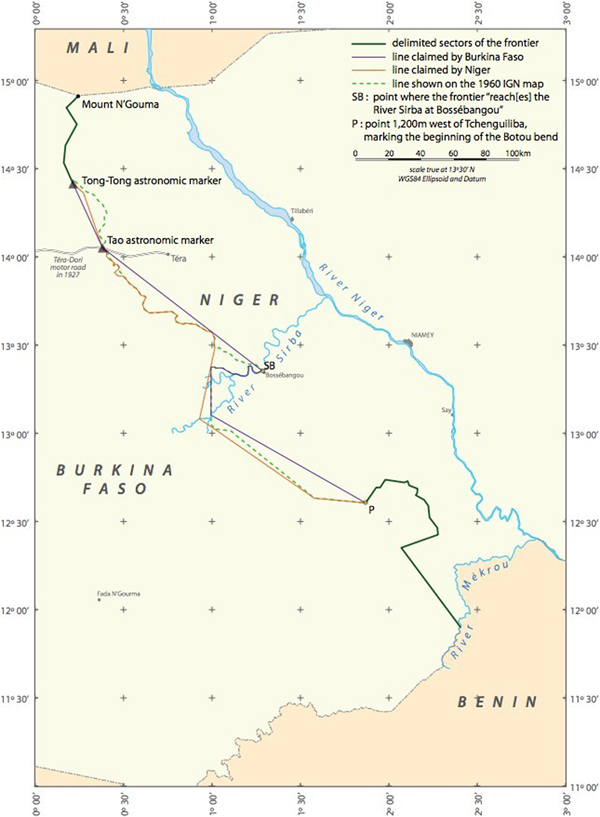
The border between Niger and Burkina Faso has remained contentious ever since the two countries gained independence in 1960. French colonisers demarcated only about one third of the border, governing what were then Niger and Upper Volta essentially as one region. The general border area was delimited by two French administrative arrêtés (decrees) in 1927, but leaders of Burkina Faso and Niger were unable to agree on how to interpret them. Over time, the physical boundary faded into the Sahelian landscape: colonial-era boundary stones have been buried under grass or sand, the etchings on them illegible. In 1987, leaders arrived at a consensus declaring that, in areas where the arrêtés remained insufficient for demarcating the border, they would defer to a line depicted on the 1960 edition of the French National Geographic Institute's 1:200,000 topographical map series (Oduntan Reference Oduntan2015). Despite such efforts, contention regarding the border's ‘true’ position wore on, and, in July 2010, the two countries jointly submitted their case to the International Court of Justice. Figure 2 depicts the parties’ claims and the 1960 French demarcation. Taking into account the 1987 Joint Technical Commission, the ICJ delimited the boundary between the astronomic marker of Tong-Tong in the north and the beginning of the Botou bend in the south (ICJ 2010).
Parties’ 2010 claims and line depicted on the 1960 IGN Map. ‘IGN’ refers to the French Institut géographique national, or National Geographic Institute. Source: ICJ.

The ICJ delivered its judgement in April 2013, mapping out roughly two-thirds of the land that was previously in dispute (Figure 3). The decision resulted in a significant exchange of territory: 786 square kilometres were assigned to Burkina Faso, and 277 square kilometres to Niger (The Guardian 2015). The court dispatched engineers to demarcate the new border over the course of five years. The agreement also provided for a series of town-hall style meetings to ‘sensitise’ residents near the border, who would be able to change their citizenship even if it meant belonging to a country where they did not reside. In May 2015, representatives from both countries accepted this decision. The Nigerien Justice Minister, Marou Amadou, stated publicly that the ICJ's decision seemed fair; the Burkinabè Minister of Territorial Administration and Security, Jérôme Bougouma, said that despite concerns over ‘security forces, patrols, and the collection of taxes’, Niger and Burkina Faso are ‘parting as good friends, very good friends’ (BBC News 2013).
Border as decided by the ICJ in 2013. Source: ICJ.

Public goods in the borderlands
We surveyed a sample of the population living near the Niger–Burkina Faso border, with the aim of gauging degrees of nationalism and public goods access. The sample consisted primarily of Nigeriens due to security constraints in Burkina Faso at the time of research (namely, the incursion of bandits and violent extremists from Mali). We surveyed 140 villagers as well as 67 civil servants in January 2016, using snowball sampling to reach hard-to-find populations dispersed across remote areas. This approach was appropriate given the lack of quality census data from the borderlands to serve as a sampling frame. We used different recruiters in different villages – usually the village chief – thereby mitigating bias that could result from recruiting the entire sample through a single person's social network.
Villagers derive their income chiefly from farming and herding. There are some natural resources in the area including gold deposits, which factored into the ICJ deliberations. However, the mining sector remains underdeveloped on the Nigerien side of the border; exploitation of the gold deposits is mainly limited to panning by hand. While Burkinabès have traditionally specialised in gold mining, the practice caught on in Niger only when a drought devastated the country's agricultural sector in 1983. To stave off a mass exodus to the capital, the government of Seyni Kountché asked local authorities to invest in mining to provide an alternative source of income for struggling peasants. A brief gold rush ensued, but Nigerien mining has disproportionately focused on more lucrative uranium, which is concentrated in the north of the country. A 2016 rise in gold prices revived gold mining somewhat in villages such as Komabangu, but Nigerien miners are at a disadvantage vis-à-vis their Burkinabè neighbours, who collectively have more savoir-faire in extraction techniques and operate in an institutional context more conducive to economies of scale. The Burkinabè state oversees gold extraction through a well-established permitting system that does not exist in Niger.Footnote 11
Indeed, besides court hearings at the Hague, Nigerien leaders pay little attention to the border. The area is sparsely populated and villages sit far apart from one another, never having been a meaningful bloc in national politics. Villagers consequently receive few material benefits to win their favour. Preeminent Franco-Nigerien scholar Olivier de Sardan (Reference Olivier de Sardan2004: 8) remarks how the ‘exterior signs of the state’ reveal ‘great weakness and the inability of public leaders to fulfil their missions … These officials generally have neither a budget, nor means of transportation, nor even an office’.
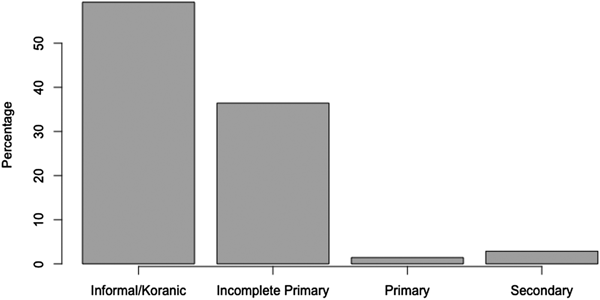
Table I displays villager perceptions of how well the national government provides resources. The data highlight inadequacies in several categories. Less than 15% of respondents report having enough access to electrical power, and less than 20% have enough water; the median respondent reports no reliable water or power whatsoever. Health care is even more limited, with less than 10% of respondents reporting adequate access. Although 41.7% are satisfied with access to education, this is not reflected in the actual education levels of respondents. As Figure 4 shows, almost no one has achieved a level of education past incomplete primary schooling. Despite a spurt of government attention during the border dispute, only about 20% of respondents report seeing any recent changes in access to public goods, with some citing worsening conditions. Further emphasising the literal and figurative distance between the border zone and the capital, the median respondent reports not having travelled to the capital in the past year. All of these indicators suggest that the state has a weak presence in the area.
Perceived Access to Resources in Borderlands

Source: Researcher-gathered survey data.
Education Levels of Border Residents. Source: Researcher-gathered survey data.

The above indicators are reports of resource provision given by respondents, whose opinions might carry some downward bias. To verify claims and provide additional measures of local development, we consulted the most recent (2012) national Demographic and Health Surveys (DHS) for Niger. These confirmed a pronounced degree of hardship in the Tillabéri region, which encompasses most of Niger's western border: 41% of Tillabéri households fall in the two lowest quintiles of economic wellbeing,Footnote 12 whereas 84% of urbanites and 92% of Niamey residents occupy the highest quintile.
As another cross-check of citizen reports, we asked enumerators to note signs of state presence by counting the number of public structures (e.g. schools, administrative buildings), government vehicles, police officers and national officials in the 24 villages where respondents live. They also interviewed 57 local officials and recorded information on subsidies to villagers from the central government, an important indicator for state involvement in rural areas. Table II summarises these village-level data. It shows that there are very few public structures, vehicles or police officers, and verifies that electricity is scarce. The presence of national officials is higher than anticipated, at approximately three per village. However, this includes positions that are inherently filled, such as village chief. Most local officials reported that the state provides subsidies to villagers, typically in the form of grains for livestock. The state is therefore not entirely absent from the area, but it is important not to overstate the amount of support villagers receive from subsidies. State efforts to address citizens' needs are disorganised and incomplete. The year after our surveys, Niger's Ministry of Education initiated a contentious audit of teachers, dismissing those who failed a credentialling exam and subsequently triggering a series of strikes by teachers’ unions. As of May 2018, teacher redeployment was proceeding in fits and starts as teachers systematically refused to move from Niamey to more remote and dangerous locales. Similar problems exist in the health sector.
Village-Level Resources

Source: Researcher-gathered survey data.
Villages straddling Niger and Burkina Faso stay marginalised even as Niger's other borderlands see heightened state presence amid an intensifying war on terror. During our enumeration period, the bulk of counter-terrorist activity was centred in the northern region of Agadez, where the United States military was building a drone base, and in the southern region of Diffa, where Boko Haram was wreaking havoc. Despite being closer to the capital, Tillabéri (where Niger borders Burkina Faso) received significant notice only after the 4 October 2017 Tongo Tongo Ambush in which militants from the Islamic State in the Greater Sahara killed five Nigerien and four American service members. While raising state interest in far-western Niger, the incident also made it a lower priority for incumbents to resolve the border dispute once and for all. The ICJ prescribed a five-year implementation of its ruling, but in the meantime national leaders became preoccupied with vanquishing violent extremists as opposed to replacing boundary markers and processing citizenship papers. Politicians also began turning their attention back toward Niamey as national elections approached and as urban opposition members took to the streets denouncing corruption and clampdowns on civil society.
Nationalism in the borderlands
Despite the near absence of the state, nationalism is conspicuous in the borderlands. Ninety-two per cent of enumeration villages displayed the national flag in a prominent location, such as outside a school. Some flags were tattered and flying near crumbling buildings – a powerful juxtaposition of national pride and state neglect. Although the Kountché military dictatorship from 1974 to 1987 required citizens to fly and salute the national flag, there is no such policy now. Villagers choose to raise flags on their own accord.
In addition to the symbolic resonance of ubiquitous flags, respondents in our surveys expressed nationalistic sentiments, as the statistics in Table III show. For example, only 25.5% of respondents stated that they value their ethnic group identification more than their national identity, suggesting that attachment to nation is stronger. When asked with what frequency the government treats their ethnic group unfairly, the median response was never. Most tellingly, when given the option to switch citizenship – a real possibility in the wake of the ICJ's decision, with which nearly the whole sample was familiar – practically nobody stated they would be willing to do so: of 110 respondents who answered the question, only six answered affirmatively, while seven said they were unsure. The rest said they would not switch citizenship, even if doing so might bring better access to resources.Footnote 13 These feelings persist despite the scarcity of public goods.
Nationalism among Border Residents

Source: Researcher-gathered survey data.
Hirschman (Reference Hirschman1970) famously theorised that people have three options when facing the decline of a state: exit, voice or loyalty. While northern Nigeriens have tended toward the exit option by migrating to Libya or Europe (Tinti & Reitano Reference Tinti and Reitano2017) and Niamey residents increasingly raise their voices in protest (Elischer & Mueller Reference Elischer and Mueller2018), marginalised people in the western borderlands seem to demonstrate loyalty toward the state.
Comparison with capital cities
We find further evidence for the nationalist paradox by comparing strength of national identity across urban and rural spaces. In addition to the border sample, we surveyed about 200 people in each of two capital cities: Niamey, Niger and Ouagadougou, Burkina Faso. One might expect urbanites to be more nationalistic than rural dwellers because they come into more frequent contact with the state and enjoy better access to public goods than people on the margins of society (DHS 2010, 2012). And yet, we observe the opposite: slightly more people place their national identity above their ethnic identity in the border sample (71%) than in either Niamey (65%) or Ouagadougou (68%). It is possible that nationality is more salient near the border as a result of the ICJ decision, and that its salience will decline over time. Nevertheless, temporal proximity to the court ruling does not explain why people in the borderlands feel so adamant about keeping their current nationality rather than adopting another.
CONVENTIONAL EXPLANATIONS
Conventional explanations for the nationalist paradox in Africa emphasise two main mechanisms: (1) Diversionary nationalism, meaning elites’ attempts to distract citizens from state weakness; and (2) exclusionary nationalism, meaning citizens’ attempts to secure exclusive access to public goods or patronage by asserting loyalty to the nation-state (Nolutshungu Reference Nolutshungu1996; Joseph Reference Joseph2003; Weiss & Carayannis Reference Weiss, Carayannis and Larémont2005; Young Reference Young, Dorman, Hammett and Nugent2007; Englebert Reference Englebert2009). These explanations fail to account for the robust nationalism we observe in Niger. There are few signs that elites have been indoctrinating people with nationalist beliefs or that citizens have been using national identity to make exclusionary claims on resources.
Nigerien elites did little to cultivate national unity during the supposed heyday of nationalism. In the 1950s, prospects for statehood expanded throughout French West Africa as France struggled to recover from World War II and Woodrow Wilson's doctrine of self-determination took hold in global politics (with key exceptions like Vietnam and Algeria). Colonial subjects debated whether to declare immediate and complete independence from France or to maintain ties with Paris by joining the new French Community. A rift formed between ardent nationalists such as Sékou Touré of Guinea and moderates such as Léopold Senghor of Senegal and Hamani Diori of Niger. Diori's Parti Progressiste Nigérien (Nigerien Progressive Party) pursued ‘customary aspirations’ – title, position, personal fortune and clientelist leverage – over democracy and national self-sufficiency (Charlick Reference Charlick1991: 42). After becoming president in 1960, Diori reinforced relations with France rather than encourage nationalism among urban or rural citizens. He used violence and a ban on opposition parties to suppress nationalists of the radical Sawaba movement, led by his cousin Djibo Bakary (van Walraven Reference van Walraven2013). In the early post-colonial period, Niger had ‘no development of a sense of a common culture and a common fate’ (Charlick Reference Charlick1991: 41) that could compare with, for example, Guinean and Tanzanian leaders’ aggressive top-down nation-building efforts based on education, language policy and propaganda (Miguel Reference Miguel2004; Schmidt Reference Schmidt2009).
General Seyni Kountché’s rise to power in 1974 through a coup d'état initiated a more nationalistic phase in Niger's history. Kountché touted the Conseil Militaire Suprême (Supreme Military Council, or CMS) as the guarantor of national unity, declaring, ‘The CMS plans to facilitate the emergence of such a society by mercilessly cracking down on any hint of regionalism or racism in our country, on any protest by ideological or political clans’ (Maidoka Reference Maidoka and Idrissa2008: 218). He further used the Association Islamique du Niger (Islamic Association of Niger, or AIN) to promote ‘Nigerien’ brands of Islam (Elischer Reference Elischer2015), and extended the state's presence in the countryside through civilian organisations like the Société de Développement (Development Society) and Samariya (Youth) corps (Robinson Reference Robinson1991).
Kountché’s heavy-handed policies may have introduced nationalistic rhetoric to the hinterland (Miles & Rochefort Reference Miles and Rochefort1991). However, successive regimes did relatively little to reinforce nationalism. Niger transitioned to multiparty politics four years after Kountché died in 1987. New leaders supplanted the vital pillars of Kountché’s nation-building project with democratic institutions including a legislature, a constitutional court, and, eventually, local governments. Democratisation also opened space for civil society organisations to proliferate. The AIN remained in place but came to compete with burgeoning religious groups ranging from multi-denominational Christian associations to Islamic societies of both orthodox and progressive stripes (Sounaye Reference Sounaye and Mazrui2009). Nigerien leaders continued employing nationalistic rhetoric, but directed it toward urbanites who threatened to mobilise opposition protests. As our data show, politicians from Niamey have negligible contact with people in the remotest villages. It is therefore doubtful that they are using nationalistic language and policies to distract marginalised populations from the state's patent failure to deliver adequate goods and services. This neglect, combined with the notorious under-funding of local governments, also rules out the possibility that residents of the borderlands identify with the nation-state because they are raking in patronage from state officials or brokers (Koter Reference Koter2013). Indeed, research on Niger suggests that the extent of clientelism is lower than political scientists assume (Mueller Reference Mueller2018).
Citizens do not look to be manufacturing nationalism any more than elites. There is scant evidence that they are attempting to access goods by proclaiming attachment to the state and denying the national belonging of rivals; there is no ‘Nigérienité’ analogous to ‘Ivoirité', the exclusionary nationalistic sentiment in Côte d'Ivoire (Marshall-Fratani Reference Marshall-Fratani2006). Niger has enjoyed unusual social harmony despite levels of poverty that would predict the outbreak of civil conflict.Footnote 14 The largest ethnic groups, Hausa and Zarma, largely live in peace, seemingly united by their shared Muslim faith. Nomadic Tuaregs mount occasional secessionist insurrections in the north, but these ‘troubles du nord’ have de-escalated in recent years. Although competition over land is intense (Sander Reference Sander2018), domestic land disputes revolve around appeals to heritage more than appeals to citizenship. Herders and farmers vying for scarce water and fertile land often base their claims on who descended from early settlers (‘sons of the soil’, in local parlance) and who descended from latecomers (‘conquerors who came on foot’) (Walther Reference Walther2012).
In sum, Nigeriens heartily assert their national pride, but research on the nationalist paradox does not explain why. In the next section, we propose a novel explanation for the strength of national identity in regions where diversionary and exclusionary nationalism are not at play.
A THEORY OF FAMILIAL NATIONALISM
Most African countries were formed by force and not by consent, giving Africa more ‘non-legitimate’ states than any other region of the world (Englebert Reference Englebert2000). Therefore, we cannot take for granted that all Africans imagine themselves as members of a territorial nation-state as opposed to a kinship network or some hybrid of the two. Nor can we assume that nationalism in Africa constitutes a ‘daily plebiscite’ on the state (Renan Reference Renan1882) or a ‘patriotic attachment to a shared set of political practices and values’ (Ignatieff Reference Ignatieff1993: 6). Particularly in marginalised areas, the nation-state might not be ‘politically thinkable’ (Schatzberg Reference Schatzberg2001: 32). We theorise that nationalism on the peripheries of African states comprises attachment to people of the same ancestry – that is, to a nation-family instead of to a nation-state.
Conventional explanations for the nationalist paradox rest on ‘the myth of the civic nation', which holds that political communities correspond to modern states as opposed to culturally distinctive intergenerational communities (Yack Reference Yack2012). This assumption stems from Enlightenment and liberal thought valuing connection to ‘rational’ (chosen) institutions like the state over ‘pre-political’ institutions like the family. But in reality, states are not purely rational or ‘culture-free sites for the construction of political identity’; they are bound ‘to take on the form of inherited cultural facts’ (Yack Reference Yack2012: 28). The colonial creation of Niger, for instance, did not occur in a vacuum but rather in an environment where a culture of family loyalty was already strong. Ekeh (Reference Ekeh1975) remarked that African political identities took shape within two contemporaneous publics: the civic public, imposed by colonisers, and the primordial public, inherited from ancestors. Urbanites are more likely to occupy the former and rural dwellers the latter. Historically, migration between the two publics infused the vocabulary of national identity into the countryside: ‘In the city, as well as through interactions in large-scale production sites, peoples drawn from different localities and for whom kinship ties may have been primary in rural society, acquired new (pan-ethnic) identities that they, in turn, transported back to the ‘ancestral’ homes’ (Eyoh Reference Eyoh, Kalipeni and Zeleza1999: 279). We contend that national identities did not completely supplant family identities in rural Niger; the two identities are intertwined. There is an awareness of being ‘Nigerien', but descent remains the dominant cognitive frame for understanding identity. The statement, ‘I am proud to be Nigerien’, conveys civic nationalism in Niamey and familial nationalism in the borderlands.
Following Feyissa (Reference Feyissa2010), we take a cognitive psychological approach to border studies. Specifically, theories of metaphors from linguistics and cognitive science offer useful models for making sense of how urban and rural nationalisms diverge. Employing a metaphor means ‘understanding and experiencing one kind of thing in terms of another’, not just as a poetic device in literature but also as a cognitive tool for processing daily realities (Lakoff & Johnson Reference Lakoff and Johnson1980: 5). Metaphors reflect local ‘conceptual systems’ – lived experiences and orientations toward political and cultural institutions (Lakoff & Johnson Reference Lakoff and Johnson1980: 147). ‘Nation’ can be a metaphor for the state or the family, depending on whether the state or the family is more present and consequential in someone's life.
A convincing explanation for the nationalist paradox must account for variation in the strength of different national identities without insinuating that poorer, rural people are less rational than more affluent, urban people. Familial nationalism is not irrational or arational; it can be just as strategic as civic nationalism, only with the family instead of the state as the benefactor. We thus distinguish familial nationalism from ethnic nationalism, which the literature links with xenophobia, expansionism and authoritarianism (Lichtenberg Reference Lichtenberg and Beiner1999). Familial nationalism is also different from cultural nationalism, wherein people instinctively unite around a common culture (Nielsen Reference Nielsen and Beiner1999). We do not assume that individuals automatically feel pride in their family and despise out-groups. Rather, they cement family relationships through ‘creative identity-work’, which involves ‘locating the self and related others within a kin system on the basis of notions of inheritance’ (Kramer Reference Kramer2011: 381). Kinship is a social relationship, albeit one ‘figured in terms of biological connection’ (Nash Reference Nash2005). Expressing pride in a nation-family is a way to declare membership in an extended hereditary network that provides material well-being.
Families allow people to share risk when they lack formal insurance. Trust among kin mitigates three specific problems in insurance markets: moral hazard, adverse selection and deception (Kotlikoff & Spivak Reference Kotlikoff and Spivak1981). Proximity and familiarity reduce costs of monitoring consumption patterns, contributing to local public goods, and complying with contracts (Grimard Reference Grimard1997). Even small families can substitute by more than 70% for a complete annuities market (Kotlikoff & Spivak Reference Kotlikoff and Spivak1981). The prospect of these benefits incentivises people to marry, bear children and strengthen family ties at festivals and social gatherings (Kotlikoff & Spivak Reference Kotlikoff and Spivak1981; Banerjee & Duflo Reference Banerjee and Duflo2007). Empirical research indicates that during times of crisis, rural Africans orient themselves away from political ‘big men’ and toward the family, a realm where they can exert more control to manage risk (McCauley Reference McCauley2008). The salience of family is magnified in precarious agrarian economies like Niger's, where moral codes and norms entitle community members to social safety nets (Scott Reference Scott1976; Booth Reference Booth1994; Jütting Reference Jütting2000).
Families provide food and housing in addition to insurance. Without public goods from the state or non-governmental organisations, people may depend solely on relatives for survival (Banerjee & Duflo Reference Banerjee and Duflo2007). Aligning with the family unit is a strategy for surviving harsh conditions such as droughts and floods, which climate change exacerbates (Andres et al. Reference Andres, Bodé, Yamba and Lebailly2014). This dependence, in turn, theoretically strengthens bonds to the nation-family. Familial nationalism is a stable equilibrium in marginalised communities due to chronic state neglect and restricted access to private markets.
This is not to insinuate that there is a one-to-one, causal link between poverty and attachment to the nation-family. Although economic theories make a compelling case for the material underpinnings of identity, there are undoubtedly individuals for whom identity feels instinctual rather than calculated. More than someone's ‘strategy in the politics of entitlement’, nationalism is ‘also embedded in their cultural worlds’ (Feyissa Reference Feyissa2010: 321). Put differently, nationalism can have strategic and emotional significance at the same time; it is ‘the instrumental passion’ (Kitching Reference Kitching1985).
Observable implications
We have theorised that nationalism in marginalised communities consists of attachment to a nation-family instead of to a nation-state. We hence expect to see that (a) the family is the main provider of basic resources in the borderlands; (b) borderland respondents express their nationalistic sentiments in terms of membership in a family unit rather than a state; and (c) respondents in capital cities are less likely than those in the borderlands to express nationalism in familial terms. Surveys confirm these observable implications, as we summarise below.
While we do not have data on insurance, we do have data on asset ownership. Land is the most critical resource to people living near the border, as agriculture and raising livestock are the primary (and often the only) sources of income. Corroborating earlier research on the abundance of assets among the poor (de Soto Reference de Soto2000; Banerjee & Duflo Reference Banerjee and Duflo2007), we find that almost every respondent owns land. As a result of the post-colonial Rural Code, which preserved customary land rights (Lund Reference Lund1998), family is the primary avenue for acquiring land: the vast majority of respondents said they came to own their plots through inheritance (Figure 5). These results signal the importance of hereditary networks for resource provision outside the state's reach.
Modes of obtaining land among border residents. Source: Researcher-gathered survey data.

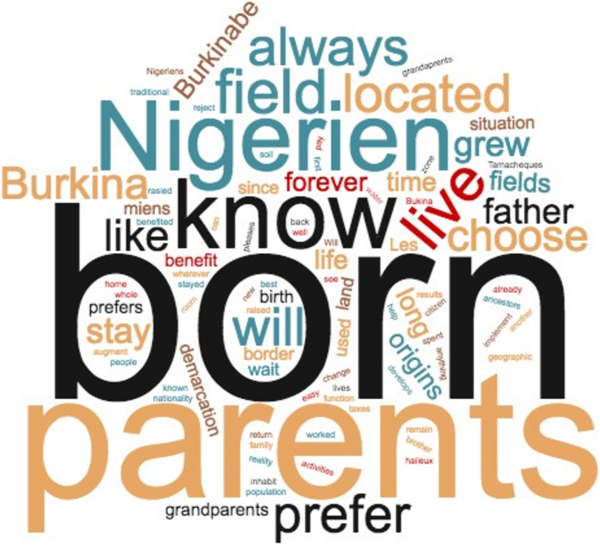
Further evidence for familial nationalism lies in respondents’ answers to the question of why they chose not to switch citizenship. Figure 6 depicts a word cloud, where the size of a word is proportional to its frequency in survey responses. Almost all respondents from the border sample phrased their decision to remain Nigerien or Burkinabè in terms of ancestry and family networks. The modal response was an approximation of ‘My parents are from Niger'. Common words included ‘born’, ‘parents', ‘father’ and ‘grandparents’. Devotion to nation seems to reflect devotion to family. Analogous to the African customary rule of preserving the territorial status quo (Ahmed Reference Ahmed2015), individuals are reasserting their prior (familial) attachments rather than inventing new ones.
‘Why would you not switch citizenship?’ (Border sample).

We can only theorise about exactly how Nigeriens came to think of the nation as an extension of the family – that is, how kinship, a local and face-to-face phenomenon, carried over to nationalism, a larger-scale and abstract phenomenon. One possibility is that Niger's idiosyncratic colonial and post-colonial histories agglomerated the concept of a local family with that of a broader nation. Prior to colonial rule, the territory that became Niger had few formal government structures to facilitate the spread of national, cross-cutting identities. Even Islam, today common to roughly 99% of Niger's population, did not take root until French administrators built governing units in the countryside and delegated authority to customary religious leaders (Idrissa Reference Idrissa2017). Government decentralisation, first under colonialism and later under post-colonial rulers, allowed the language of both nationalism and Islam to permeate the margins of society. Yet, this permeation was and remains partial (Olivier de Sardan & Alou Reference Olivier de Sardan and Tidjani Alou2009). In contrast with other colonies of French West Africa, Niger experienced an indirect style of colonial rule where central authorities deputised rural actors rather than assign representatives from the capital. This blended pre-existing kin-based identities with new ideas of a Nigerien nation. Villagers, in other words, could graft nationality onto local realities.
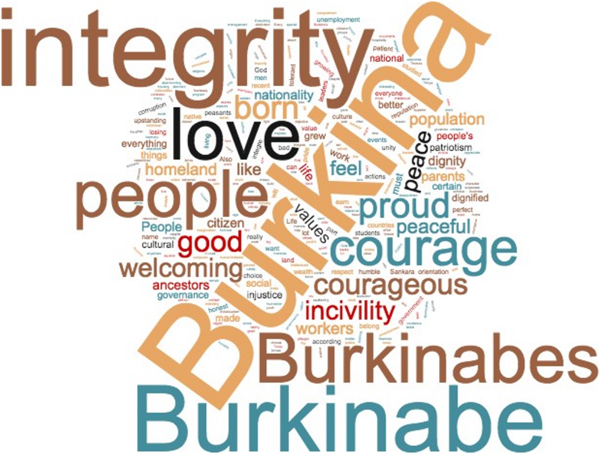
If family substitutes for the state as a source of livelihood, we should see fewer family references among people who live in capital cities, where public goods are more available. This is indeed what we observed when we asked people in the capitals of Niger and Burkina Faso why they are proud to be Nigerien or Burkinabè. Figures 7 and 8 contain word clouds from the Niamey and Ouagadougou samples, respectively. We offer some interpretations for patterns we see.
‘Why are you proud to be Nigerien?’ (Niamey sample).

‘Why are you proud to be Burkinabè?’ (Ouagadougou sample).

Family references were not absent from responses in Niamey (Figure 7). ‘Born’ was once again a common word in survey responses, and a participant in our Niamey focus groups affirmed, ‘I prefer to be Nigerien … above all because my grandparents are Nigerien’. However, the word cloud shows that references to ‘peace’ were more frequent. This might surprise scholars who follow Nigerien affairs, as international news coverage gives the impression of a country under steady assault from armed extremists. In focus groups, we probed why urban Nigeriens define nationalism in terms of peace. Participants insisted that the image of Niger as a war zone is merely a stereotype, and that terrorist attacks and riots are exceptional, temporary ills. ‘If you actually visit Niger, you don't see anything wrong. It's all media spin’, said one woman. ‘Insecurity is the fault of foreign groups', said another. Someone echoed, ‘Certainly the conditions in Niger are difficult, but we prefer them. We don't want to change nationality; we just want the conditions to improve. We are truly proud to be Nigerien.’ Heads nodded in agreement. One comment in particular highlighted the difference between urban and rural nationalisms: ‘On a personal level, Niger is a country that has given me everything: schooling, training, work, an identity, and rights that are more or less respected.’ These benefits of citizenship are markedly lacking in the borderlands.
Participants in the Niamey focus groups contrasted their country to others in West Africa, such as Mali and Côte d'Ivoire, where violence has transpired on a larger scale. One of them elaborated, ‘If I ever find myself abroad, I'll always return to Niger'. Another stressed that Nigeriens of the diaspora send their children back to Niger for school and register new births at the Nigerien embassy. These responses fit with survey data from Afrobarometer indicating that Nigeriens are more hopeful about the future of their country than people in other African countries, despite objectively trying circumstances. In the 2014–2015 round of nationally representative Afrobarometer surveys, more than three-quarters of Nigeriens said they expected their country's economic condition to be ‘better’ or ‘much better’ in 12 months’ time; only 40% of respondents across all 18 African countries in the sample said the same. A common refrain among Nigeriens is the phrase ‘inshallah’, or ‘God willing’, delivered with profound sincerity.
Respondents in Ouagadougou justified their nationalism in different, context-specific terms, often using the word ‘integrity’ (Figure 8). A typical response to our question of ‘Why are you proud to be Burkinabè?’ was, ‘C'est le pays des hommes intègres’ (‘This is the country of upright people’). In 1984, revolutionary leader Thomas Sankara replaced the country's French-colonial name of Haute Volta. Seeking to unite a culturally diverse people, he combined a word from the Mossi language, ‘Burkina’ (‘men of integrity’ or ‘upright people’), and one from the Diouala language, ‘Faso’ (‘fatherland’). Nostalgia for Sankara ran high when we fielded our surveys in 2016. People wore Sankara t-shirts on the streets of Ouagadougou and peddled Sankara biographies; graffiti on downtown buildings read, ‘la patrie ou la mort’ (‘the homeland or death’) and ‘vive la révolution’ (‘long live the revolution’). Two years prior, President Blaise Compaoré fled power amid mass uprisings led by outspoken Sankara apostle Serge Bambara (better known by his hip-hop stage name, ‘Smockey’). Some opponents implicated Compaoré in Sankara's 1987 assassination and saw his departure as belated revenge. Interestingly, respondents in Niamey did not link their nationalism to the legacy of nationalist leader Seyni Kountché. This implies that recent leaders of Niger have done more than their counterparts in Burkina Faso to dismantle the state's earlier nationalistic policies. In focus groups, however, some Burkinabès expressed concern that national integrity is waning, attributing this change to rapacious leaders who do not live up to Sankara's vision. ‘Things have changed’, said several of the more pessimistic participants. ‘People are no longer upright.’ Yet, others clung to hope that a renaissance of Sankarism remains on the horizon. ‘Maybe in 20 years his vision will succeed’, one suggested. ‘The youth have open minds.’
The sum of evidence is consistent with our theory that people in marginalised communities identify with a nation-family, whereas people in urban centres identify with a nation-state. The salience of the nation-family in the borderlands between Niger and Burkina Faso corroborates findings from the Gambella region between Ethiopia and Sudan, where the Anywaa people ‘are strongly attached to the sites where their ancestors lived and often tenaciously occupied them in face of extermination’ (Evans-Pritchard Reference Evans-Pritchard1940: 37).Footnote 15 Borders, even ‘arbitrary’ ones, are consequential as sites where people form and renegotiate political identities (Hoehne & Feyissa Reference Hoehne, Feyissa, Korf and Raeymaekers2013).
CONCLUSION
This paper addressed an unsolved mystery in the African studies literature: what explains fervent nationalism in marginalised parts of African countries? In such contexts, conventional explanations for the ‘nationalist paradox’ break down, because the state's near absence makes it unlikely that (a) incumbents are using nationalistic propaganda to distract citizens from their failures; or (b) citizens are using nationalistic claims to exclude others from state resources. We proposed a theory of familial nationalism whereby material reliance on hereditary support networks fosters attachment to a nation-family instead of to a nation-state. We observed anecdotal and systematic evidence of familial nationalism in the borderlands between Niger and Burkina Faso, where a court-mediated decision to give people the choice of citizenship let us measure nationalism in a novel way, as the willingness or unwillingness to switch citizenship. We used supplemental surveys and focus groups from the capital cities of each country to demonstrate differences in how marginalised and non-marginalised people conceptualise national belonging.
This paper thereby demystified the nationalist paradox and revealed how people across sectors of African societies identify with both pre-colonial (family) institutions and post-colonial (state) institutions. While nationalism in the capital city might reflect public approval of the state and its leaders, nationalism in the hinterland reflects a connection to family members who provide the livelihood and insurance that the state does not. We were able to detect this diversity in political identification only by eschewing the typical urban bias in Africanist research and studying Africa ‘from the margins’ (Hodgson Reference Hodgson2017).
The theory and the observable implications in this paper are preliminary steps. Future work should test the mechanisms of our theory, and more closely examine how fluctuations in state presence mediate local insurance markets and nationalist sentiment. How national identity translates into political engagement at local and national levels is important to examine as well. Ethnographers could further extend our work by studying how people in the borderlands form family ties across borders, not just on either side of them. This could better illuminate how familial and national identities come to align with one other.
To policymakers, we lend some hope that nationalism need not equal unmitigated loyalty to weak or failing states. Nation-building is a major goal of development policy, as strong national identities facilitate community cooperation and tax compliance (Herbst Reference Herbst1990; Wimmer Reference Wimmer2018). Policymakers also aim to ‘shorten the route of accountability’ between citizens and politicians, with an eye toward consolidating democracy (Helling et al. Reference Helling, Serrano and Warren2004). Our findings suggest that African people can be simultaneously proud of their nation-family and critical of their nation-state, thus preserving the advantages of national unity while exerting pressure on incumbents to uphold campaign promises. We hope to assuage fears that ‘exclusionary nationalism’ will necessarily divide citizens or that ‘diversionary nationalism’ will deter them from demanding better government performance (Englebert Reference Englebert2009). Another kind of nationalism, ‘familial nationalism’, can buttress informal ties that sustain communities amid state shortcomings. Finally, this paper indicates that nationalism does not have to result from invasive policies, but can grow organically over time within families.