INTRODUCTION
World production of arabica coffee (Coffea arabica) is still largely based on cultivars developed long ago by line selection within the typica and bourbon varieties, or in offspring of crosses between these two, for instance the Brazilian cultivar Mundo Novo. Semi-dwarf cultivars, such as Caturra and Villa Sarchi, originated as single-gene mutants (Krug and Carvalho, Reference Krug and Carvalho1951). These traditional cultivars are often renowned for their excellent cup quality, but most are very susceptible to the world-wide occurring coffee leaf rust (CLR), caused by Hemileia vastatrix, and coffee berry disease (CBD), caused by Colletotrichum kahawae and still restricted to Africa. The total economic damage in crop losses and costs of chemical control for these two diseases to world coffee production is estimated at US$ 2–2.5 billion annually, not counting the potential environmental hazards of copper-based fungicides in particular.
Efforts to obtain host resistance to CLR, with first results reported in India around 1920, have had a long history of initial successes followed by disappointments because of repeated appearances of new virulent races of the rust fungus. However, some lines of the cultivar Catimor, which was developed from crosses between Caturra and Hibrido de Timor (HdT), have shown complete resistance to all physiological races of the CLR pathogen in most countries. These results were obtained by breeding plans normally applied to self-pollinating crops, including recombination crosses followed by backcrossing, inbreeding and pedigree selection (Bettencourt and Rodrigues, Reference Bettencourt, Rodrigues, Clarke and Macrae1988; Carvalho, Reference Carvalho, Clarke and Macrae1988). The breeding programme in Kenya demonstrated the advantages of F1 hybrid cultivars also for arabica coffee, especially the simultaneous combination of compact plant type, high yield, good quality and different disease resistances (CBD and CLR) in one cultivar (Van der Vossen and Walyaro, Reference Van der Vossen and Walyaro1981). Subsequently, breeding strategies aiming at F1 hybrid cultivars in arabica coffee have been adopted elsewhere, e.g. in Ethiopia (Bellachew, Reference Bellachew1997), Tanzania (Teri et al., Reference Teri, Kilambo, Mtenga, Nyange, Nzallawahe, Chipungahelo, Kipokola and Kullaya2004) and in Central American countries (Bertrand et al., Reference Bertrand, Aguilar, Santacreo, Anthony, Etienne, Eskes and Charrier1997; Reference Bertrand, Vaast, Alpizar, Etienne, Davrieux and Charmetant2006).
Box 1. Comments from the international coffee industry
‘Catimor and other robusta hybrids, even with good disease resistances, often impart undesirable flavour to the cup. Farmers should reconsider before planting a Catimor cultivar. It has poor cupping quality in most places where it has been grown. It has ruined the coffee industry in Colombia and has been banned from planting in Costa Rica’ (Illy, Reference Illy2001).
‘In Kenya they are replacing the excellent cultivars SL28 and SL 34 with the disease resistant but poor quality Ruiru 11 strain.’ (Sweet Maria's, 2008).
The CLR resistant cultivars Catimor, Sarchimor and their (hybrid) derivatives have since been grown on hundreds of thousands of hectares in Latin America and elsewhere, while CBD (and CLR) resistant cultivars, like Ruiru 11 of Kenya, are now increasingly being planted in East and South Eastern Africa. They contribute to ecologically sustainable coffee production and to considerable socio-economic benefits for the coffee growers, by higher yields at much reduced production costs without necessarily affecting cup quality. Nevertheless, some representatives of the international coffee trade continue to denounce these modern cultivars for lack of flavour so typical of traditional varieties (Box 1). However, in additon to the genetic background of a cultivar, there are many environmental factors influencing bean and cup quality characteristics, such as the agro-ecosystem and post-harvest handling. This paper presents an overview of the considerable amount of scientific evidence accumulated over the years showing that, with all non-genetic factors at optimum level, these CLR and CBD resistant cultivars can produce coffees with quality characteristics of the beverage equal to those from the best traditional varieties according to professional cup tasting trials.
DEFINITION AND ASSESSMENT OF COFFEE QUALITY
Three main categories are distinguished in the coffee market (ITC, 2002): i) mainstream washed and natural (dry- and semi dry-processed) arabica and robusta coffees of fair average quality (FAQ), which account for 85–90% of world coffee consumption; ii) high quality washed arabicas and robustas and iii) coffees of top quality and often in limited supply, usually single-origin washed arabicas, some superior washed robustas, but also a few natural arabicas (e.g. Ethiopian Harar).
Bean size is determined mechanically using metal screens with round (normal bean) and slotted (pea berry) perforations varying in size, the presence of defective beans by counting and moisture content by moisture meters. Otherwise, coffee quality is entirely based on visual and sensory evaluation by expert coffee tasters. Green bean colour is a good indication of freshness, moisture content and homogeneity: a green-bluish colour of washed arabicas is a sign of high quality. Freshly roasted arabica coffee having a bright and even appearance with white and tight centre-cuts will usually produce a good quality beverage.
The beverage – generally an infusion of ground, freshly roasted beans (10 g) and hot water (150 ml) – is evaluated using the following major characteristics (Wintgens, Reference Wintgens2004):
• Fragrance: the smell of the dry roasted and ground coffee
• Aroma: smell in the cup a few minutes after pouring hot water on the ground coffee
• Acidity: a pleasing taste of the beverage, from low (sweet) to high (fruity/citrus)
• Body: mouth feel of the beverage
• Flavour: a combination of taste and aroma.
Flavour is the most important factor determining quality. Positive flavours are described in terms of winey, spicy and fragrant/floral; grassy, onion, woody and earthy are a few of many off-flavours (ITC, 2002). Low-quality natural arabica coffees often produce bitter and astringent beverages. Sometimes the aftertaste, which remains after the mouth is cleared, is scored separately. Finally, the coffee is given a total or weighted average score to classify the quality of the sampled coffee lot. The scoring system applied in the ranking of coffee quality is either ascending (1 = poor) or descending (1 = best, e.g. in East Africa). In this review all quality data have been adjusted to ascending scores.
Taste and flavour requirements vary considerably with market segments. For instance, in northern Europe there is a general preference for acidity, light body and pleasant flavour of the cup, while in the south the coffee should taste sweet with a full body and strong flavour (Barel and Jacquet, Reference Barel and Jacquet1994).
Green coffee beans consist mainly of endosperm with the following chemical composition: water (11–13 %), cellulose and other polysaccharides (40–55%), sucrose and reducing sugars (5–9%), lipids (13–17%), proteins and free amino acids (11–16 %), phenolic compounds including chlorogenic acids (10–15%), alkaloids including trigonelline (1–1.2%) and caffeine (0.7–3.5%), and minerals (4%). Arabica coffees are generally higher in carbohydrate, sugar, lipid and lower in caffeine contents than robustas (Clifford, Reference Clifford, Clifford and Willson1985). During roasting, the high temperature and pressure inside the beans trigger a large number of chemical reactions resulting in the dark colour and the 850 volatile and another 150 non-volatile compounds identified so far, many of which determine coffee aroma and flavour characteristics (Bonnländer et al., Reference Bonnländer, Eggers, Engelhardt, Maier, Illy and Viani2005). This complex situation has so far defied any analytical method of producing a quantitative chemical profile of green or roasted mild arabica coffees, which correlates well with the beverage quality as determined by cup tasting (Avelino et al., Reference Avelino, Barboza, Araya, Fonseca, Davrieux, Guyot and Cilas2005; Bertrand et al., Reference Bertrand, Vaast, Alpizar, Etienne, Davrieux and Charmetant2006; Viani, Reference Viani2000). However, Farah et al. (Reference Farah, Monteiro, Calado, Franca and Trugo2006) found a significant positive correlation between trigonelline and chlorogenic acid (mainly 3,4-dicaffeoylquinic acid) levels in green beans and cup tasting results for Brazilian natural coffees.
ENVIRONMENTAL FACTORS INFLUENCING COFFEE QUALITY
The agro-ecosystem
Arabica coffee originated from the highlands of southwestern Ethiopia and its mild and pleasant beverage is best preserved under similar growing conditions. High altitudes are critical for the successful production of high-quality arabica coffees in equatorial regions (Illy and Viani, Reference Illy and Viani2005). Lower temperatures, and their larger daily amplitudes, induce slower growth and more uniform ripening of the berries, and result in larger and denser beans, an increase of important precursors of aroma and flavour in the bean and superior beverage quality. Altitude has a significantly positive effect on acidity and aroma, while reducing bitterness (Avelino et al., Reference Avelino, Barboza, Araya, Fonseca, Davrieux, Guyot and Cilas2005; Bertrand et al., Reference Bertrand, Vaast, Alpizar, Etienne, Davrieux and Charmetant2006). Shade has a similar positive effect on coffee quality, particularly at medium altitudes, but also reduces yields (Decacy et al., Reference Decazy, Avelino, Guyot, Perriot, Pineda and Cilas2003; Guyot et al., Reference Guyot, Gueule, Manez, Perriot, Giron and Villain1996; Muschler, Reference Muschler2001; Vaast et al., Reference Vaast, Bertrand, Perriot, Guyot and Génard2006). Shade did not improve cup quality at very high (>1800 m) altitudes in Costa Rica (Avelino et al., Reference Avelino, Barboza, Davrieux and Guyot2007).
Rainfall requirements for arabica coffee production are at least 1200 mm per year with a maximum of 2500 mm. Coffee plants grow and yield better if exposed to alternate cycles of wet and dry seasons, and moreover, a period of water deficit is important to synchronize flower bud differentiation. Areas with excess precipitation, especially during crop maturation, have a tendency to produce lower quality coffee due to irregular cherry ripening and poor conditions for drying the crop after harvesting. In years of excessively long dry seasons, shoot dieback and premature ripening of the berries will result in light beans producing a liquor with immature and astringent notes.
Coffee can be cultivated on a wide range of soil types, provided these are at least 2 m deep, free-draining loams with a good water-holding capacity and a pH of 5–6, fertile and contain at least 2% organic matter. High-quality, acidic arabica coffees are mostly produced on soils of volcanic origin. A balanced nutrient status of the coffee tree is essential for the production of high quality coffee. Nitrogen is important for vegetative growth and influences the caffeine content, but excess N-fertilization may have a negative effect on cup quality. Potassium is a key nutrient during bean filling and influences total sugar and citric acid content. Phosphorus is required for root, shoot and fruit development. Excessive calcium and potassium produce a hard and bitter-tasting liquor. Iron deficiency gives amber beans and magnesium deficiency brown and soft beans. Boron influences flowering and fruit set and consequently yields. The effective control of pests and diseases is also essential for the production of quality coffee (Wintgens, Reference Wintgens2004).
Harvesting and post-harvest handling
Inherently high-quality coffee can easily be degraded by suboptimal harvesting, processing and storage practices. Only freshly harvested and fully ripe berries should be used in any of the three methods (washed, semi-dry and dry) of primary processing. This can be achieved by selective hand-picking or by mechanized techniques of separating the immature green from the ripe cherry before processing. Unripe coffee beans cause astringency, bitterness and a grassy off-flavour in the beverage. Delayed depulping and nipping of the beans due to faulty pulping machines, as well as prolonged fermentation can lead to onion flavour or still worse to ‘stinker’ beans, which cause very unpleasant off-flavours. The fermented off-flavour is usually caused by under-fermentation. There are many other causes of off-flavours due to inadequate processing, drying and storage (Illy and Viani, Reference Illy and Viani2005; Wintgens, Reference Wintgens2004).
The method of mucilage removal during wet processing, either by fermentation or mechanically, does not very much influence coffee quality. Wet fermentation may somewhat improve flavour, as does soaking under water for 24 hours after mucilage removal and washing (Wintgens, Reference Wintgens2004). Gonzales-Rios et al. (Reference Gonzales-Rios, Suarez-Quiroz, Boulanger, Barel, Guyot, Guiraud and Schorr-Galindo2007a; b) claim that the quality of green and roasted coffee, as measured by volatile aroma composition, was better after conventional fermentation than after mechanical mucilage removal. However, there were no data from sensory evaluation, which is the best means of determining quality of the coffee beverage. Besides, underwater soaking of the parchment after mechanical mucilage removal would probably have improved the quality of these coffees and so reduced the differences.
Beverage quality varies according to the processing methods applied. Washed arabicas from East Africa (Kenya, Tanzania, Ethiopia) and Latin America (Colombia, Guatemala, Costa Rica) are characterized by mild to pointed acidity, light body and intense aroma. Natural dry-processed arabicas from Brazil and Ethiopia have low acidity, less marked aroma, but much stronger body, which is sought after in espresso coffees (Illy and Viani, Reference Illy and Viani2005).
THE QUALITY OF DISEASE RESISTANT CULTIVARS
Selection for bean size and cup quality has received much attention in arabica coffee breeding programmes – in Kenya, Tanzania and Colombia in particular – because the quality of new disease-resistant cultivars should be at least equal to that of the traditional cultivars in order to uphold the country's high reputation and special position in the world coffee market (Van der Vossen, Reference Van der Vossen, Clifford and Willson1985; Reference Van der Vossen, Clarke and Vitzthum2001).
Kenya
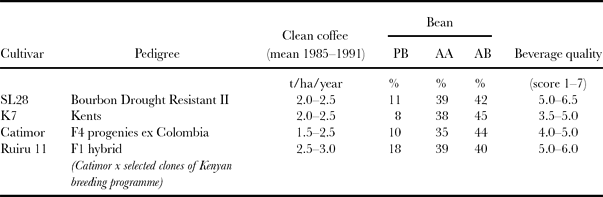
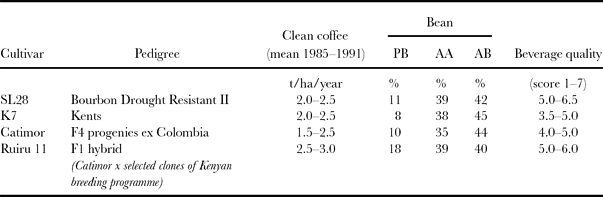
The beverage quality of the CBD and CLR resistant cultivar Ruiru 11 has been challenged by the coffee trade since its first release by the Coffee Research Foundation in Kenya in 1986. However, much evidence has been accumulated over the subsequent years, from national and international coffee tasting panels, showing that the beverage quality of Ruiru 11 does not deviate significantly from that of the best traditional bourbon-type cultivars like SL28 (Njoroge et al, 1989; Omondi, Reference Omondi2008). Nevertheless, due to prejudices of the coffee trade, Ruiru 11 coffee lots have been getting inferior quality scores and consequently lower prices at the coffee auctions in Nairobi. Interestingly though, a large plantation company managed to obtain premium prices for their Ruiru 11 coffee lots, but only after affixing coded labels without disclosing the true identity to prospective buyers (E. Delbar, 2008, personal communication). The prices received were equal to those of SL28 or other traditional cultivars and sometimes even slighly (4–5%) higher: US$ 3.8–4.8/kg coffee of grade AA (ICO June 2008 average for Colombian Milds: US$ 3.3/kg).
A summary of the performance of Ruiru 11 against other cultivars, for yield, bean size and overall beverage quality, is presented in Table 1. The hybrid vigour is clearly reflected in higher productivity, while bean size and beverage quality compare well with SL28. Ruiru 11 also saves the coffee growers at least 30% in total variable costs of production, otherwise spent on chemical control of CBD and CLR (Karanja, Reference Karanja1993).
Yield and quality of arabica cultivars in Kenya.
Note: Data from field trials at Coffee Research Foundation, Ruiru; plant density 3300 tr/ha.
Sl28 and K7 sprayed with fungicides to control CBD and CLR.
Beverage quality: scores 1 = poor to 7 = excellent.
Tanzania
The Tanzanian Coffee Research Institute has been releasing clonal hybrid cultivars with host resistance to CBD and CLR since 2004. In addition to displaying hybrid vigour for yield, these new cultivars have in most cases a beverage quality, as assessed by professional tasters of the Tanzanian Coffee Board and the private coffee sector, comparable to the best traditional cultivars like N39 and KP423 (TaCRI, 2005; Teri et al., Reference Teri, Kilambo, Mtenga, Nyange, Nzallawahe, Chipungahelo, Kipokola and Kullaya2004), although certain coffee buyers continue to be sceptical.
Colombia
In 1982, the National Coffee Research Centre (CENICAFE) released the cultivar Colombia, which is made up of a number of Catimor lines selected for CLR resistance, yield, bean size and quality. Despite critical comments from the coffee trade, the beverage quality was clearly similar to the traditional typica, bourbon and Caturra varieties (Moreno et al., 1996). Continued selection and breeding has resulted in the new composite cultivar ‘Castillo’. It is characterized by more durable CLR resistance and also a beverage quality, that should meet the high standards required for fine Colombian arabica coffees (Alvaredo et al., Reference Alvaredo, Puerta, González, Montoya Restrepo and Alarcón2008).
Origin and nature of the Hibrido de Timor (HdT) variety
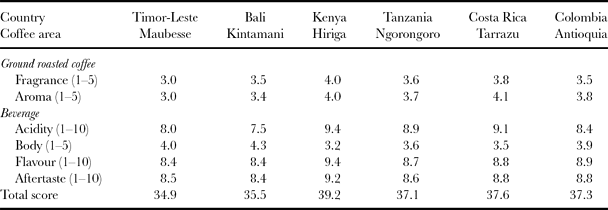
In the 1960s, about 40% of the coffee cultivated in Timor-Leste was robusta and 60% arabica coffee, of which 80% consisted of the CLR-resistant HdT variety (Krug and De Poerck, Reference Krug and De Poerck1968). Initially planted on one coffee estate in the 1940s to replace the highly CLR-susceptible typica coffee, HdT was assumed to have arisen from a spontaneous cross between arabica and robusta coffee (Rodrigues et al., Reference Rodrigues, Bettencourt and Rijo1975). The original typica coffee introduced by the Portuguese was wiped out by the CLR. Present day arabica coffee in Timor-Leste is nearly all produced from the HdT variety grown at altitudes above 1000 m asl, under forest shade, on some 50 000 ha of low-input smallholder farms yielding not more than 100–150 kg ha−1 of green coffee. The trees are of the arabica phenotype, variable in plant habit and leaf size, resistant to CLR, rather low yielding and the coffee has genuine arabica cup quality characteristics (Marsh, Reference Marsh2001). HdT is basically a typica arabica variety with some genomic material introgressed from robusta coffee at one time early in the 20th century, which has made it highly CLR resistant. However, the often heard assumption, that it is an interspecific hybrid and therefore should have many characteristics intermediate between arabica and robusta coffees including lower cup quality than a pure arabica, does not appear to hold. The fully washed arabica coffees from Timor-Leste, in particular those grown at higher altitudes, are considered speciality arabicas comparable to some of the best mild arabica coffees (Table 2). Apparently, the coffee trade has been unaware of the fact that practically all these coffees are produced by HdT trees.
Quality of Timor-Leste and other washed arabica coffees.
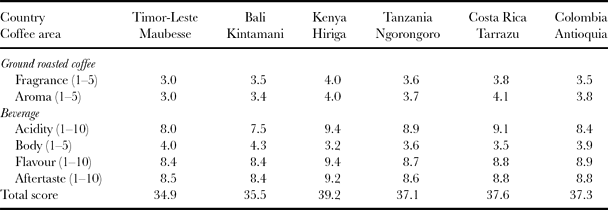
Scores: 1 = poor, 5 and 10 = exceptionally good.
Source: Sweet Maria's (2008).
CONCLUSIONS
The above-mentioned high quality of Timor-Leste arabica coffees clearly refutes the recurring references in coffee publications to HdT as an interspecific hybrid having robusta-like characteristics with negative consequences to the quality of disease resistant cultivars with HdT as one of the progenitors (Bertrand et al, Reference Bertrand, Guyot, Anthony and Lashermes2003, Reference Bertrand, Etienne, Lashermes, Guyot and Davrieux2005; Leroy et al., Reference Leroy, Ribeyre, Bertrand, Charmetant, Dufour, Montagnon, Maraccini and Pot2006).
Introgression of disease and pest resistances from related species is common breeding practice in many crops without necessarily resulting in permanent loss of quality. For instance, most modern tomato cultivars with excellent fruit qualities and taste have multiple disease and pest resistances derived from at least five different Lycopersicon species, but are never referred to as interspecific hybrids (Van der Vossen et al, Reference Van der Vossen, Nono-Womdin, Messiaen, Grubben and Denton2004).
What matters is that breeders get rid of negative side effects (genetic linkage drag) after interspecific crosses by repeated backcrossing and rigorous selection to ensure that the new disease-resistant cultivars have not lost on quality and other important properties. Coffee breeders in Kenya, Tanzania and Colombia have obviously succeeded in this, but a cultivar like CR95 in Costa Rica (Leroy et al., Reference Leroy, Ribeyre, Bertrand, Charmetant, Dufour, Montagnon, Maraccini and Pot2006) shows that in other coffee-producing countries this may not always have been the case. Coffee breeders should, therefore, continue to apply maximum selection pressure for high quality and refrain from premature release of new cultivars before exhaustive testing for cup quality
Coffee buyers and roasters often blame the ‘robusta blood’ present in the new disease-resistant cultivars for the deteriorating beverage quality of traditionally fine arabica coffees, whereas sub-standard crop management, harvesting and primary processing, sometimes in consequence of low farmgate prices, are frequently the actual factors behind poorer quality. Better information may help change their bias on quality and at the same time increase their appreciation for the ecological and socio-economic benefits of these new disease resistant cultivars.