Introduction
In Argentina, Anastrepha fraterculus (Wiedemann) (South American Fruit Fly) and Ceratitis capitata (Wiedemann) (Mediterranean fruit fly) (Diptera: Tephritidae) are by far the most economically important fruit fly species recorded (Aruani et al., Reference Aruani, Ceresa, Granados, Taret, Peruzzotti, Ortiz, McPheron and Steck1996). Ceratitis capitata is native to Africa and has a wide distribution, covering many tropical, subtropical, and temperate regions of the world (De Meyer et al., Reference De Meyer, Copeland, Wharton and McPheron2002). Ceratitis capitata was introduced to Argentina either accidentally via Buenos Aires, infesting peaches in 1905 (Vegiani, Reference Vegiani1952) or by dispersing naturally from Brazil (Gonzalez, Reference Gonzalez1978). The species A. fraterculus is native to South America. It is distributed from Mexico to Argentina. However, morphological and genetic evidence indicates that this putative species is actually a complex of at least seven cryptic species (Steck, Reference Steck1991; Hernandez-Ortiz et al., Reference Hernandez-Ortiz, Bartolucci, Morales-Valles, Frías and Selivon2012). Not all the species within this complex are pests (Aluja et al., Reference Aluja, Rull, Sivinski, Norrbom, Wharton, Macías-Ordóñez, Díaz-Fleischer and López2003). In Argentina, A. fraterculus is mainly distributed in regions with tropical and subtropical climates (Ovruski et al., Reference Ovruski, Schliserman and Aluja2003).
Tritrophic interactions among plants, herbivores, and natural enemies have always been of interest in view of the need to integrate host plant resistance and biological control into arthropod pest management (Tscharntke and Hawkins, Reference Tscharntke, Hawkins, Tscharntke and Hawkins2002). Within the natural enemies' complex, parasitoids are critical members of multitrophic food webs, and have a significant influence on ecological community structure and diversity (Godfray et al., Reference Godfray, Hassell and Holt1994). Similar to other insects, environmental temperature is essential in determining the dynamics of parasitoid populations, as well as the distribution in their suitable habitats (Walther et al., Reference Walther, Post, Convey, Menzel, Parmesan, Beebee, Jean-Marc Fromentin, Ove Hoegh-Guldberg and Bairlein2002). The bioclimatic envelope, which refers to the multidimensional climatic conditions of an area, is not necessarily the same for a parasitoid as for its host or hosts (van Baaren et al., Reference van Baaren, Le Lann, van Alphen, Kindlmann, Dixon and Michaud2010). Fully congruent host-parasitoid distributions appear to be rare and climate effects are the most likely explanation for the absence of specialized parasitoids throughout their host distribution (Hance et al., Reference Hance, van Baaren, Vernon and Boivin2007; Thomson et al., Reference Thomson, Macfadyen and Hoffmann2010). An example of an interesting multitrophic biological system is clearly represented by tephritid fruit flies attacking economically important host fruits. A wide diversity of natural enemies, especially parasitoids, have been associated with frugivorous tephritids (Hoffmeister and Vidal, Reference Hoffmeister, Vidal, Hawkins and Sheehan1994; Garcia et al., Reference Garcia, Ovruski, Suárez, Cancino and Liburd2020). Many parasitoid species have mostly been used as biocontrol agents against tephritid pests of fruit crops worldwide (Dias et al., Reference Dias, Zotti, Montoya, Carvalho and Nava2018; Garcia et al., Reference Garcia, Ovruski, Suárez, Cancino and Liburd2020). Within sympatric fruit fly parasitoid assemblages in tropical and subtropical areas, several species have exhibited different environmental requirements, which have enabled interspecific coexistence (López et al., Reference López, Aluja and Sivinski1999; Sivinski et al., Reference Sivinski, Pinero and Aluja2000; Schliserman et al., Reference Schliserman, Aluja, Rull and Ovruski2016). Of all Neotropical parasitoid species associated with tephritid fruit flies, 24% are widely distributed, 22% are more regionally distributed, and 53% are only known from a single location (Ovruski et al., Reference Ovruski, Aluja, Sivinski and Wharton2000; Sivinski et al., Reference Sivinski, Pinero and Aluja2000).
Ganaspis pelleranoi (Brèthes) (Hym: Figitidae, Eucoiline) and Doryctobracon areolatus (Hym: Braconidae, Opiinae) are two parasitoid species native from the Neotropical region (Aluja et al., Reference Aluja, Sivinski, Ovruski, Guillén, López, Cancino, Torres-Anaya, Gallegos-Chan and Ruíz2009) widely distributed throughout the American Continent (Ovruski et al., Reference Ovruski, Aluja, Sivinski and Wharton2000) (fig. 1). Both are koinobiont solitary larval-pupal endoparasitoids and primarily attack several species of true fruit flies (Tephritidae) in the genus Anastrepha. Both parasitoid species exhibit potential for biological control of fruit flies, given their relatively fast adaptation to laboratory conditions (Aluja et al., Reference Aluja, Sivinski, Ovruski, Guillén, López, Cancino, Torres-Anaya, Gallegos-Chan and Ruíz2009) and the fact that they can be mass-produced on irradiated host larvae (Cancino et al., Reference Cancino, Ruíz, Sivinski, Gálvez and Aluja2009). Thus, assessments of the suitability of areas for the potential distribution of these species might help developing or improving biological control or integrated pest management programs.
Maps of American distribution recorded for (a) G. pelleranoi, and (b) D. areolatus, including the new records from La Rioja province, Argentina.

In Argentina, both parasitoid species are thought to be restricted to the subtropical rainforests of the northwest and northeast, locally known as ‘Yungas’ and ‘Paranaense’ forests, respectively (Schliserman et al., Reference Schliserman, Ovruski, De Coll and Wharton2010, Reference Schliserman, Aluja, Rull and Ovruski2016). In those subtropical forests, both hymenopterans were recorded attacking the two fruit fly species of economic importance (Ovruski and Schliserman, Reference Ovruski and Schliserman2012).
Fruit flies developing in commercial fruit orchards and backyard trees from species introduced were widely spread after American Spanish colonization. The introduction of exotic commercial fruit species combined with artificial irrigation in semi-arid or arid areas is often the source of environmental disturbances that encourage the establishment and spread of invasive arthropod species, such as the exotic tephritid C. capitata, and enable the expansion of the distributional range of generalist native insect species, such as A. fraterculus and their associated parasitoids (Schliserman et al., Reference Schliserman, Aluja, Rull and Ovruski2014). Such expansion of frugivorous invasive species may influence the distribution patterns at other trophic levels, for instance, natural enemies, as is the case of the parasitoids. Thus, environmental changes have probably been playing a role in the presence registered of the parasitoids species recorded in the Monte eco-region.
In 1998, G. pelleranoi and D. areolatus were recorded at the semi-arid eco-region commonly known as Northwest Monte and Thistle of the Prepuna (Ovruski, Reference Ovruski2002) (Monte eco-region). This site has very different climatic conditions than northern Argentina's subtropical forests (Morello et al., Reference Morello, Matteucci, Rodríguez and Silva2012). The authors who found both parasitoid species in the eco-region mentioned above did not consider them as established. Instead, they suggested that the findings might have been the consequence of the accidental introduction or transport of fruit infested with fruit fly larvae and subsequently parasitized by G. pelleranoi and D. areolatus from other fruit-growing areas of Argentine (Ovruski, Reference Ovruski2002). Due to the arid climate of the Monte eco-region, fruit crops and backyard orchards are limited by artificial irrigation, conforming oases in a desert matrix that allow both pestiferous tephritid flies presence (Guillen and Sanchez, Reference Guillen, Sanchez, Vreysen, Robinson and Hendrich2007). This anthropic alteration could also be playing a role in the establishment and permanence of the parasitoid species.
Different methods have been used to empirically assess the species' distribution by correlating observed field distributions to environmental predictor variables (Guisan and Zimmermann, Reference Guisan and Zimmermann2000; Guisan and Thuiller, Reference Guisan and Thuiller2005). In such cases, data on species distribution can consist of species presence only, presence-absence, coming from empirical studies of species abundance, or natural history collections (Graham et al., Reference Graham, Ferrier, Huettmann, Moritz and Peterson2004). Climate is a driver of biotic systems, affecting individual fitness, population dynamics, species distribution, abundance, ecosystem structure, and function. Regional variation in climatic regimes produces selective pressures that may result in the evolution of locally adapted physiologies, morphological adaptations (e.g., color patterns, surface textures, body shapes, and sizes), and behavioral adaptations (e.g., foraging strategies and breeding systems). The two most common biological responses to climate variables are spatial and temporal changes in population dynamics (Parmesan et al., Reference Parmesan, Root and Willig2000).
Many living organisms' distribution ranges are primarily limited by climatic variables (Messenger, Reference Messenger1959; Grace, Reference Grace1987; Cooper, Reference Cooper, Lawton and May1995). Entomologists accept weather and climate as dominant drivers of insects' behavior, abundance, and distribution (Messenger, Reference Messenger1959). A bio-climate modeling approach can still provide a valid first approximation to the potential insects' species distribution (Pearson and Dawson, Reference Pearson and Dawson2003).
Considering the above, some new records out of a knowledge on species distribution could affect the suitable areas of distribution predicted by models.
In the last years, G. pelleranoi and D. areolatus were re-recorded at four localities of La Rioja province, belonging to the Northwest Monte and Thistle of the Prepuna. To corroborate the potential suitability of these oases for the permanence of both parasitoids, Species Distribution Models (SDM) using ‘maximum entropy’ (MaxEnt) (Phillips et al., Reference Phillips, Dudík and Schapire2018) at a continental scale were run. MaxEnt is a helpful technique for predicting species' geographical distribution based on the most critical environmental conditions (Phillips et al., Reference Phillips, Dudík and Schapire2004, Reference Phillips, Anderson and Schapire2006). The algorithm is deterministic and converges to the maximum entropy probability distribution (Berger et al., Reference Berger, Pietra and Della Pietra1996; Phillips et al., Reference Phillips, Anderson and Schapire2006; Baldwin, Reference Baldwin2009), establishing the relationship between species records at specific sites and their environmental and spatial characteristics (Elith et al., Reference Elith, Phillips, Hastie, Dudík, Chee and Yates2011). If the area has sufficient food resources (fruit fly larvae) to support the parasitoid populations, the environmental variables should be the only limiting factors influencing these species' presence or annual permanence. MaxEnt could elucidate the probability of these artificial ‘oases’ to harbor both G. pelleranoi and D. areolatus in this semi-arid eco-region of Argentina. Two possible scenarios could result: models will show as unsuitability of these oases for these species, supporting the idea of the accidental introduction from actual distribution areas, and the second, that the models may include these ‘oases’ as a suitable area of distribution. In this last case, it is possible to consider these oases as new areas for the species distribution.
Methods
Model data sources
Datasets were elaborated from two source types, the first, from field collections in new distribution areas, and the second from scientific literature. The methods for obtaining the records are detailed below.
New distribution areas and collecting methods
The new records correspond to five study sites (Aminga, Los Molinos, Anjullón, San Pedro, Santa Veracruz), located in the Monte and Thistle of the Prepuna eco-region (Monte eco-region), in the northwest of Argentina, La Rioja province). The native vegetation is characterized by xerophytic shrubs dominated by Zygophyllaceae, such as the genus Larrea, associated with the species of the genus Prosopis (Fabaceae) reduced in size. The fruit-growing areas are restricted to irrigated valleys shaping real oases, isolated from each other by wide desert plains, or high elevation mountains, where no native host plants for the economically important fruit fly species are found (Ovruski, Reference Ovruski2002). Altitude ranges from 1000 to 3500 m.a.s.l. The climate is continental, with a wide annual variation in temperature and atmospheric pressure. The temperature fluctuates between −9°C (June–July) and 42°C (November–February). Rainfall is scarce, concentrated in summer (i.e., December–March), and fluctuates annually between 60 and 120 mm (Morello et al., Reference Morello, Matteucci, Rodríguez and Silva2012).
Parasitoid presence for new localities was accessed through a collection of fruit infested by tephritids (Los Molino's locality), and direct parasitoids adult's collection by manual aspirator (other four localities).
According to the following plan, fruits were sampled: five American plum trees (Prunus americana Marsh, Rosaceae) from six orchards. A total of ten fruits were collected from individual trees, five directly from canopies, and five from the ground every week from December 2015 to January 2016. Prunus americana was chosen because it hosts both A. fraterculus and C. capitata fruit flies species. Each sample was placed in a plastic crate (48 × 28 × 15 cm) with slotted bottom and piled up over another plastic crate of the same size but with a non-perforated bottom lined with 3 cm sterilized sand as the pupation medium. Both crates were covered with an organdy lid. The second crate method was used to prevent the mix of sand and fruit, fungal growth, and bacterial contamination. Samples were kept in the darkroom for 20 days. The sand was sifted weekly to collect fly pupae, which were transferred into plastic cups (6.5 cm diameter, 8.5 cm deep) filled with sterilized moist vermiculite as the pupation medium and covered with a piece of organdy lid to allow breathing of pupae. The number of emerging parasitoids and flies was recorded, and non-emerged pupae were dissected to corroborate the presence of a fly or a parasitoid. Parasitism is a biological parameter that allows comparing the incidence of a fruit fly parasitoid on the pest tephritid species among different host fruit species or study sites, and also, throughout fruiting seasonality (Ovruski et al., Reference Ovruski, Schliserman and Aluja2004; Schliserman et al., Reference Schliserman, Aluja, Rull and Ovruski2016). Here the percentage of parasitism was calculated as follows:

where N p is the total number of parasitized pupae (emerged + non-emerged), and N pu is the total number of fruit fly pupae (parasitized and non-parasitized).
Adult parasitoids were collected using a manual aspirator in the other four localities studied (Aminga, Anjullón, San Pedro, and Santa Veracruz).
Collection was carried out from December 2016 to January 2017, December 2017 to January 2018, and December 2018 to January 2019 in the plum orchards.
Collected parasitoids and fruit fly adults were identified by the senior author. Voucher specimens were placed in the entomological collection of Centro Regional de Investigaciones Científicas y Transferencia Tecnológica de La Rioja (CRILAR), Anillaco, La Rioja, Argentina.
Dataset of species distribution and bioclimatic layers
Data sources for both G. pelleranoi and D. areolatus distribution extracted from the scientific literature are presented in Appendix 1 (Supplementary Material), covering mainly tropical and subtropical America, from Florida (USA) to northern Argentina. This area matches the native distributional range of tephritid species of the genus Anastrepha Schiner (Aluja and Norrbom, Reference Aluja and Norrbom1999), the native host of both parasitoids studied. All localities recorded represent only presence points.
Two data subsets were elaborated for each species under study; the first includes only data recorded in the scientific literature (DS1). The second is the literature data plus the new records at the Monte eco-region in La Rioja province (DS2), Argentina, here termed as new records.
The Wallace R-based GUI application for ecological modeling was used (Kass et al., Reference Kass, Vilela, Aiello-Lammens, Muscarella, Merow and Anderson2018) to clean the distribution dataset to avoid duplication of point records. The module Spatial Thin implements the R package spThin, which removes localities that record less than a specified geographic distance from other localities (Aiello-Lammens et al., Reference Aiello-Lammens, Boria, Radosavljevic, Vilela and Anderson2015); the distance used was 2 km.
Images were used as bioclimatic data layers for model development, based on a quasi-mechanistically statistic downscaling global circulation model output temperature and precipitation estimates of the ERA-Interim climatic reanalysis to a high resolution of 30 arcsec (~1 km) (Karger et al., Reference Karger, Conrad, Böhner, Kawohl, Kreft, Soria-Auza, Zimmermann, Linder and Kessler2017, Reference Karger, Conrad, Böhner, Kawohl, Kreft, Soria-Auza, Zimmermann, Linder and Kessler2018). Bioclimatic variables represent annual trends (e.g., mean annual temperature, annual precipitation), seasonality (e.g., temperature and precipitation annual range), and extreme or limiting environmental factors (e.g., the temperature of the coldest and warmest month; precipitation of wet and dry quarters) (table 1).
Chelsa bioclimatic variables are derived from min., max., and mean temperature, and mean precipitation values

They represent annual trends (e.g., mean annual temperature, annual precipitation), seasonality (e.g., annual range in temperature and precipitation), and extreme or limiting environmental factors (e.g., the temperature of the coldest and warmest month and precipitation of the wet and dry quarters). A quarter is three months period (1/4 of the year) (https://-climate.org/bioclim/).
The bioclimatic layers were cut to cover the maximum extension of the two species distribution knowing (−98.233, −34.683: −36.800, 29.383, SRC = EPSG: 4326 – WGS 84 – Geographic).
MaxEnt models
The open-source MaxEnt (3.4.1) (Phillips et al., Reference Phillips, Dudík and Schapire2018) was used to predict the suitability of the geographical areas for G. pelleranoi and D. areolatus presence through the American continent, between latitude 29° north and 34° south.
Four models were conducted, two for G. pelleranoi, one with DS1 (DS1-Gp) and the other with DS2 (DS2-Gp), and in the same way, two for D. areolatus, one for each dataset (hereafter named DS1-Da and DS2-Da).
Comparisons were made within each species, not between them. All models were run using the same parameters to corroborate differences produced only by datasets.
The background used for MaxEnt corresponds to a maximum of 10.000 random points within the species distribution extent (−98.233, −34.683: −36.800, 29.383, SRC = EPSG: 4326 − WGS 84 − Geographic). The software was run with the following parameters: random-seed for the test; cross-validate as replicate type and ten replicates performed; ten percentile training presence as threshold rule; 1000 maximum iterations; and the beta multiplier setting in 0.5 to minimize any possible overfitting. The feature type was set in auto feature for all the model runs and both species, considering that all the datasets contain more than 80 records (Elith et al., Reference Elith, Phillips, Hastie, Dudík, Chee and Yates2011). Furthermore, Morales et al. (Reference Morales, Fernández and Baca-González2017) concluded that sample size does not affect the output results between models using default settings and by models with parameters defined by users.
The AUC values were used to measure model fitting, comparing models resulting from both studied datasets. The variable importance was generated by jackknife, and the logistic output format was selected. Those variables with more than 10% of contribution were considered significant.
Visualization, map development, and measuring of suitable areas' extensions were worked with Qgis 3.18.2 version GNU software (Qgis.org, 2021). The extensions of suitable areas are expressed in km2. Binary maps were developed using the ten percentile training presence's logistic threshold, calculated as the average value of the ten replicates performed for cross-validation.
Results
The parasitoid G. pelleranoi was recorded in the four localities throughout the three seasons sampled. Eight specimens (five females and three males) were recovered from A. fraterculus pupae coming from fruits sampled at Los Molino's locality. Furthermore, 32, 26, 54, and 6 specimens were collected with manual aspirators from Los Molinos, Anjullón, San Pedro, and Santa Veracruz localities during the 2016/2017 and 2017/2018 fruiting seasons.
While in the case of D. areolatus, only two females were recorded from a fruit sampled in Los Molinos (only on season 2016/2017), no direct observation occurred. During the other two seasons, no parasitoids of this species were recorded.
The percentage of parasitism was 0.71 and 0.17% for G. pelleranoi and D. areolatus, respectively.
The search for data on distribution with geographical information of the two hymenopteran species resulted in 39 scientific papers scrutinized between the years 1981 and 2013, no results were found in the GBIF international online databases for records of G. pelleranoi, and only two unpublished data points were recorded for D. areolatus from 1984 (not included in the database used here). For G. pelleranoi and D. areolatus 98 and 123 geographical distribution points were recovered, respectively, from the scientific literature. After cleaning, datasets ended with the following record numbers: DS1-Gp = 98, DS2-Gp = 103 (fig. 1a), DS1-Da = 123, DS2-Da = 125 (fig. 1b).
Models from datasets of both species showed an excellent fitting. For G. pelleranoi, the models presented an AUC value of 0.916 ± 0.015 and 0.918 ± 0.023 (mean ± standard error) for DS1-Gp and DS2-Gp respectively; and for D. areolatus, the values were 0.931 ± 0.025 and 0.930 ± 0.026 (mean ± standard error) respectively for DS1-Da and DS2-Da.
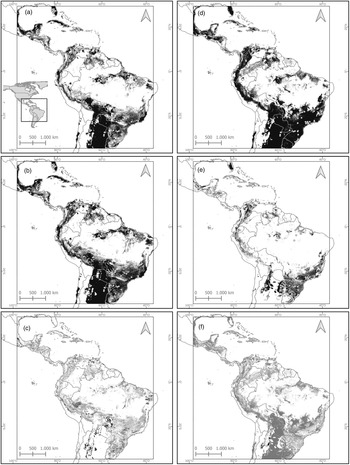
Incorporating the five new record points from La Rioja, for G. pelleranoi (DS2), and two points for D. areolatus (DS2) produced different models than those resulting from the DS1. Suitable areas of distribution generated by MaxEnt showed differences using the different datasets (Supplementary files S1–8, georeferenced maps for GIS visualization). For G. pelleranoi, the suitable distribution area suffered a reduction in 4,714,936 km2, 30.55% less using DS2-Gp. On the other hand, the suitable distribution area of D. areolatus was increased by 21.64%, corresponding to 1,140,028 km2 more using DS2-Da (table 2). Figure 2 shows the substantial reduction in the suitable area for the distribution of G. pelleranoi, using DS1-Gp (fig. 2a) and DS2-Gp (fig. 2b). Differences between maps for D. areolatus were less evident, but it was possible to show an increasing suitable area along the Andean mountains (Bolivia, Peru, Ecuador, and Colombia) and Venezuela, when using DS1-Da (fig. 2d) and DS2-Da (fig. 2e). Figure 2c and f show the differences between maps generated for each dataset and parasitoid species, the differences represent the areas added or eliminated when the DS2 is used for modeling; from them it is possible to show that the incorporation of the new records to the datasets affects with more intensity the suitable areas for distribution of D. areolatus (fig. 2f) than for A. pelleranoi models (fig. 2c).
(a) Binary maps for suitable distribution areas using the DS1-Gp; and (b) using the DS2-Gp datasets for G. pelleranoi; (c) map showing the difference in areas between maps (a) and (b) added areas in black and subtracted areas in gray; (d) binary maps for suitable distribution areas using DS1-Da; and (e) using DS2-Da datasets for D. areolatus; (f) map showing the difference in areas between maps (d) and (e) added areas in black and subtracted areas in gray. Gray circles represent the record points and dashed line the background boundaries.

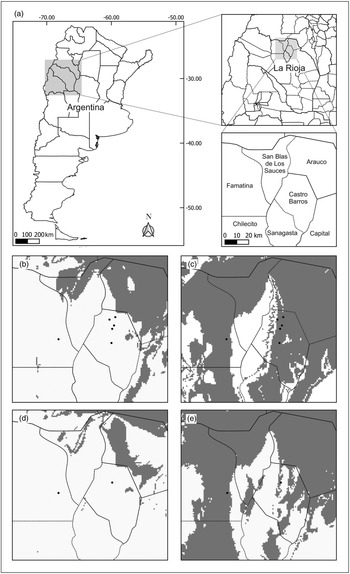
(a) Location of La Rioja province in Argentina and the specific sites where the new records were obtained; (b) suitable distribution areas using the DS1-Gp, and (c) using the DS2-Gp for G. pelleranoi; (d) suitable distribution areas using DS1-Da; and (e) using DS2-Da for D. areolatus. Black points correspond to the new distribution records for both species; suitable areas are shown in grey and unsuitable areas in white.

The predicted suitable area in square kilometers for both species G. pelleranoi and D. areolatus, using dataset without new records (DS1-Gp and DS1-Da) and including the new records (DS2-Gp and DS2-Da)

In the case of G. pelleranoi at a regional scale (Fig. 3a), the suitable area predicted by the model resulting from DS1-Gp did not include the new record points from La Rioja (fig. 3b); instead, the model produced with DS2-Gp shows the new record points into the suitable area predicted (fig. 3c).
The maps generated for D. areolatus with DS1-Da show the new record points out of the suitable area, as in the case of G. pelleranoi (fig. 3d), but with DS2-Da, the suitable area includes one of the points, and the other excluded of this area (fig. 3e).
From the 19 variables used for modeling distribution, only four climatic variables attained more than 10% of the contribution to the models for both species; these were: temperature of the wettest quarter (Bio8), precipitation of the driest month (Bio14), precipitation of driest quarter (Bio17), and precipitation of coldest quarter (Bio19).
The different datasets (DS1 and DS2) modified the percentage of contribution of the bioclimatic variables. These modifications were observed both in the values and in the order of importance of the variables for G. pelleranoi. However, in the case of D. areolatus, differences were only observed on values.
Model for G. pelleranoi with DS1-Gp shows that bio14 (38.2%) and bio19 (18.8%) were the most critical variables. While using DS2-Gp, the variables with the largest contribution to the model were bio08 (11%) and bio17 (25%). Instead, both models for D. areolatus had bio17 and bio 19 as the bioclimatic variables of importance (more than 10%), but it was possible to appreciate differences in values. Model using DS1-Da attained 27.9 and 28.7% values for bio17 and bio19, respectively, while the model using DS2-Da shows values of 33.9 and 18.7% for the same variables (table 3).
Percentage of contribution (% of cont.) and permutation importance (Perm. Import.) of the 19 environmental variables used for modeling distribution for both datasets (DS1 and DS2) of G. pelleranoi and D. areolatus distribution records

The numbers in bold show the percentage of contribution higher than 10%.
Appendix 2 show graphical results of jackknife of test gain, AUC and regularized training gain, for both species and datasets, and for the 19 bioclimatic variables used.
Discussion
The fruit fly parasitoids G. pelleranoi and D. areolatus are widely distributed throughout the American continent, but most records are from tropical and subtropical rainforests. Thus, both species' southernmost natural distribution range in Argentina occurs in the Paranaense subtropical rainforest of central-eastern, latitude −32.26 (Ovruski et al., Reference Ovruski, Oroño, Nuñez-Campero, Schliserman, Bezdjian, Van Nieuwenhove, Martin, Suguyama, Zucchi, Ovruski and Siviski2008). In this study, both parasitoid species were found in the Monte eco-region at Argentina's central-west desert, outside their putative natural distributional range. This finding raises the possibility that these two species are already established in this environment (Monte eco-region) despite the extreme weather conditions. This statement is supported by the first record of these two parasitoid species in 1998 in the eco-region mentioned above (Ovruski, Reference Ovruski2002) and the recent record reported in this study, with no previous evidence of these species in other semi-arid or arid regions of the American continent. Recently, Vanoye-Eligio et al. (Reference Vanoye-Eligio, Mora-Olivo, Gaona-García, Reyes-Zepeda and Rocandio-Rodríguez2017) found well-established populations of the Mexican fruit fly in highland semi-arid regions of Mexico, where they report associated populations of the braconid parasitoid Doryctobracon crawfordii (Viereck). These findings suggest that some fruit fly parasitoid species can track their hosts after range expansion and adapt to extreme and, at times novel areas, this is the case of environments in artificially irrigated areas.
Almarinez et al. (Reference Almarinez, Fadri, Lasina, Tavera, Carvajal, Watanabe, Legaspi and Amalin2021) present a bioclimate-based maximum entropy model for the parasitoid Comperiella calauanica Barrion from the Philippines, with good results using the 19 bioclimatic variables. Using these same 19 variables, our MaxEnt models for the parasitoids G. pelleranoi and D. areolatus constitute the first approximation to the suitable distribution areas for these species. Results here suggest a distribution expansion at least for one of these species (G. pelleranoi).
Considering that parasitoid distributions were modeled using the same parameter to run MaxEnt, and the same set of bioclimatic layers, with the only difference in the datasets used (DS1 and DS2 for each parasitoid), it is possible to ensure that, in this case, the addition of the new record points was sufficient to change the results. The critical changes recorded between models could result only if the few new records contribute essential information to the model without these points. If the information contained in the bioclimatic variables for these new points added in DS2 falls within the average values expected by a model with DS1, the results would not show significant differences.
Model differences due to incorporating the new records into the datasets showed that the oases from La Rioja province are suitable for G. pelleranoi distribution, indicating that the information provided for the environmental variables at these new record points was enough to produce deviance in the results. This last fact supports the idea that the maps incorporating the new records represented a better potential distribution area for G. pelleranoi. Its presence could be due to natural distribution or an accidental historical introduction with a posterior establishment at these oases.
In the case of D. areolatus, the conclusion is more complex. The oases from La Rioja do not seem to be a potential distribution area for neither of the two datasets used (DS1-Da and DS2-Da). Moreover, the low number of records and adult captures only occurred during one of the three sampled years, according to the results obtained here for the species.
Such finding highlights that potential distribution models based exclusively on climatic variables (mainly temperature and precipitation) could underestimate the prediction of suitable areas of distribution. One of the reasons is the challenge of incorporating artificially irrigated areas and humid microclimatic conditions within arid regions in models. Concerning this, Vanoye-Eligio et al. (Reference Vanoye-Eligio, Mora-Olivo, Gaona-García, Reyes-Zepeda and Rocandio-Rodríguez2017) found no correlation between climatic variables and fly population peaks, which were more related to particular host plants existence in suitable microclimates. A situation like this could be necessary for the distribution range of entomophagous insects. This emphasizes on the need to searching the entomophagous insects even out of the putative distribution; especially at the limit points of its known distribution.
The Monte eco-region is characterized by sizeable thermal amplitude, scarce precipitation, and low relative humidity (Morello et al., Reference Morello, Matteucci, Rodríguez and Silva2012). These conditions would not be favorable for the occurrence of G. pelleranoi, yet this species can enter diapause to overcome stressful environmental periods (Ovruski et al., Reference Ovruski, Schliserman and Aluja2015). Facultative diapause allows a given genotype of the insect population to attain a better emergence distribution over time, thereby enabling progeny to reproduce under more suitable environmental conditions or during periods of greater host abundance (Menu et al., Reference Menu, Roebuck and Viala2000). Therefore, diapause might be an essential biological mechanism determining G. pelleranoi persistence in the Monte eco-region.
However, this physiological mechanism may be one of the various strategies that insects display to overcome harsh conditions. For example, Vanoye-Eligio et al. (Reference Vanoye-Eligio, Mora-Olivo, Gaona-García, Reyes-Zepeda and Rocandio-Rodríguez2017) report that the fruit fly A. ludens pupates under moist leaf litter generated in gullies and creeks by its host plant Casimiroa pubescens; this behavior can also contribute to survival. Finally, parasitoid populations in the Monte could have become adapted to arid climates. For example, desiccation resistance is more significant in the desert inhabiting species Drosophila mojavensis and D. nigrospiracula than the cosmopolitan D. melanogaster and D. pseudobscura (Matzkin et al., Reference Matzkin, Watts and Markow2007). There is a considerable variation in desiccation resistance, and the trait can be rapidly selected within a population (Hoffmann and Harshman, Reference Hoffmann and Harshman1999). This resistance is known for the tephritid fly Anastrepha ludens (Tejeda et al., Reference Tejeda, Arredondo, Liedo, Pérez-Staples, Ramos-Morales and Díaz-Fleischer2016) and could be similar for parasitoids associated with this and other species in the same genus.
This new approximation to the extreme distribution of G. pelleranoi leaves a gateway to ecological studies in order to corroborate the factors involved that allow this parasitoid to establish itself in arid climate areas. Comparing physiological and behavioral traits between dryland and subtropical populations of parasitoids could foster understanding of desiccation resistance and perhaps facilitate rearing of parasitoids tailored to perform in particular environments (Hill and Terblanche, Reference Hill and Terblanche2014), in concordance with the recent interest in the potential of native Neotropical parasitoids to control fruit crop pests (Sivinski et al., Reference Sivinski, Aluja and Lopez1997; Ovruski et al., Reference Ovruski, Aluja, Sivinski and Wharton2000; Aluja et al., Reference Aluja, Sivinski, Ovruski, Guillén, López, Cancino, Torres-Anaya, Gallegos-Chan and Ruíz2009).
This result also highlights the importance of maintaining good record points of this species and insects in general. In some cases, records only represent country distribution levels, but local georeferenced points are essential for modeling more accurate species distribution maps. The online databases have scarce records despite the well-recorded distribution in the scientific bibliography and the large quantity of biological material conserved in scientific collections, this agrees with the problems stated by Rangarajan et al. (Reference Rangarajan, Schedl, Yook, Chan, Haenel, Otis, Faelten, Depellegrin-Connelly, Isaacson, Skrzypek, Marygold, Stefancsik, Cherry, Sternberg and Müller2011) that propose integrating journals and biological databases.
Supplementary material
The supplementary material for this article can be found at https://doi.org/10.1017/S0007485322000013.
Acknowledgements
This work was supported by the Agencia Nacional de Promoción Científica y Tecnológica de Argentina through Fondo Nacional de Ciencia y Tecnología (FONCyT) (Grants PICT/2013 No. 0604, PICT/2014 No. 2879) and Consejo Nacional de Investigaciones Científicas y Técnicas (CONICET) (Grant UE N° 0125). Special thanks to Carlos Bustamante (CRILAR – CONICET) for logistic field and laboratory biological material management.
Conflict of interest
None.