


E la prima coniettura che si fa del cervello d’uno signore, é vedere li uomini che lui ha d’intorno.
Niccolo’ Machiavelli, Il Principe, Ch. 22.
INTRODUCTION
Who should rule? Which individual characteristics are required for good and successful leadership? These questions are central to political writing and thought. They are addressed in Plato’s Republic and, perhaps most famously, in Machiavelli’s masterpiece Il Principe. A central contention of Machiavelli is that good governance stems from the characteristics of a ruler and that these determine political success. This view is shared by contemporary political scientists. Since Stokes (Reference Stokes1963), studies have recognized the importance to electoral success of a candidates’ valence—a term used to describe competence, talent, and good judgment, which are generally desirable qualities of a leader.Footnote 1
The personal attributes that contribute toward good leadership might be innate, as in the “great man” theory espoused by the social historian Thomas Carlyle (Reference Carlyle1841). Alternatively, they might be the product of education and training. Plato, for example, believed the education of future leaders to be a core function of the state. There is, however, a different view. Leadership characteristics may stem from the relations a leader enjoys with others in the governance process and the advice that she obtains from them. We find this perspective in Aristotle who, in Politics III.16, 1287 27–35, argues that advice from friends is central to a leader’s judgment:
“It would perhaps be accounted strange if someone, when judging with one pair of eyes and one pair of ears, and acting with one pair of feet and hands, could see better than many people with many pairs, since, as things stand, monarchs provide themselves with many eyes, ears, hands and feet. For they appoint as co-rulers those who are friends to themselves and to their rule. If they are not his friends, they will not do as the monarch chooses. But suppose they are friends to him and to his rule – well, a friend is someone similar and equal, so if he thinks they should rule, he must think that those who are equal and similar to her should rule like him.”
A related theme emerges in Machiavelli’s Il Principe. Our opening quote comes from chapter 22, where he writes on knowledge acquisition and making use of trusted advisers, and is translated as
“The first opinion that one forms of a prince, and of his understanding, is by observing the men he has around him.”
One interpretation, according to the idiom “a person is known for the company she seeks,” suggests that we infer a leader’s quality from the type of person she associates with. Another, perhaps more intriguing interpretation, is that a leader’s qualities arise because of those she associates with.Footnote 2 Machiavelli entertains this second interpretation, attributing the greatness of Pandolfo Petrucci, Prince of Siena, to the relationship he enjoyed with his valent minister Antonio da Venafro. Indeed, Machiavelli highlights that Pandolfo’s ability as a ruler depended upon the information and good judgment provided by Antonio.Footnote 3
In this article, we develop a novel theory of leadership that relates a leader’s judgment to the relations she forms with other group members whose advice she may benefit from. Such advice can help her form better judgment and so take more informed decisions. But, for this to be so, a leader must be able to trust the advice obtained. That is, the advice must be truthful. To explore this notion of leadership, we analyze a group that collectively chooses a leader who is granted authority to take a decision on their behalf. Players’ payoffs depend on an uncertain state of the world about which each is independently, privately, and imperfectly informed. Each, however, has different preferred outcomes that reflect their idiosyncratic ideological preferences. After the leader is chosen, but before the decision is taken, group members may advise the chosen leader, whoever she may be. Such advice takes the form of cheap-talk communication.
First, we study the endogenous formation of a leader’s network of trustworthy associates: those the leader can rely upon for truthful advice. The results are intuitive. We show that a leader can rely on truthful advice only from those whose ideological preferences are similar to her own. Taking the next step, we show that a leader’s judgment depends upon the number of trustworthy associates that she has. A larger group of such associates translates into more informed decisions. This intuitive result establishes our take on the Machiavellian lesson: A leader’s wisdom and judgment are determined by those she has around her. And it resonates with Aristotle’s claim: a good leader has many friends, who are ideologically similar to her, and whose advice she benefits from.
In light of these results, we then ask: What are the characteristics of a good leader? She is defined as the one that the group should choose when maximizing their joint welfare. In line with the classic texts, we find that moderation (or temperance) is desirable. Nevertheless, a good leader relies on her judgment, which is determined by the number of allies in her circle. Depending on the distribution of ideological views in the group, a moderate leader may be isolated in that she cannot rely on anyone’s advice. Thus, a tradeoff arises between moderation, on the one hand, and judgment on the other.
Our model delivers a simple mathematical equation that describes this potential tradeoff and the optimal choice of leader. This equation reveals that the tradeoff is related to different properties of the distribution of views in the group. A leader’s moderation is understood with respect to the entire spectrum of views. Her judgment, by contrast, depends upon the concentration of viewpoints similar to her own. Put otherwise, moderation refers to “global” properties of the ideology distribution, while judgment is related to “local” ones.
What then are the characteristics of the chosen leader? Since the majority choice is determined by the median player, one might expect a moderate leader to be chosen. On the other hand, a leader’s network is also an important consideration. Indeed we find, in line with common intuition and the practical wisdom of Aristotle, that a leader may be chosen because she has many friends. Here, a large network of friends translates into better judgment. A direct prediction stems from this. The group leader may, in fact, be relatively extreme. Indeed, this is so when ideological opinions are concentrated at the extremes.
Next, we compare the group’s choice of leader under majority rule with the optimal choice and so address an issue raised by Levi and Ahlquist (Reference Levi and Ahlquist2011) who note that “leadership does not always improve aggregate welfare and we need to know more about the conditions under which it does and it does not.” We show that the chosen leader maximizes aggregate welfare when the ideology of group members is evenly distributed or clustered around the median. However, when ideologies are clustered away from the median, then she fails to achieve maximal aggregate welfare. Deeper insights emerge once we recognize our model as one of implicit (strategic) delegation, as first analyzed by Schelling (Reference Schelling1960). The incentive of the median politician to delegate arises when another politician has more trustworthy associates and so will take a more informed decision. When choosing whether to delegate, however, the median considers only her own preferences. A surprising consequence is that she may delegate to a relatively extreme leader when a more moderate one (such as herself) would better serve the group interest. The upshot of this result is a reversal of the famous “ally principle,” which states that delegation should take place to an ally who is as close as possible to the principal.Footnote 4 A surprising implication, from a welfare perspective, is that the group choice places too much emphasis on a leader’s judgment, and too little on her moderation.
A useful exercise is to consider how the group’s choice of leader changes when the preferences of its members change. This might occur due to transition in the group’s membership or from exogenous shocks to members’ preferences. In models of collective choice that build on Black’s celebrated theorem (Reference Black1948), only the identity (and hence opinion) of the median (player or committee member) matters for decisions made. Consequently, any change to the distribution of views within a group that leaves the identity of the median unchanged has no effect on policy outcomes. Our comparative static analysis produces sharply different predictions. Changes in the ideological views of group members can affect leadership and hence policy choice even though they do not alter the identity of the “global” median player. This result stems from the fact that such ideological changes affect a leader’s network of trustworthy associates. If some players become more extreme (moderate) in their views, then a moderate (extreme) leader may lose important trustworthy allies. This affects her ability to exercise good judgment and hence her prospects of being chosen.
These new theoretical results shed light on empirical questions arising from applications of the spatial model in political science, such as, for example, work analyzing appointments made by the President to the Supreme Court that are approved by the Senate (Krehbiel Reference Krehbiel2007; Rohde and Shepsle Reference Rohde and Shepsle2007). In these models of complete information, based on Blacks’ theorem, a Senate member’s vote is based only on whether a proposed appointee changes the identity of the median court member. This reasoning does not sit well with common intuition that the viewpoints of all players are relevant to decision-making. Moreover, empirical evidence shows that extreme justices are less likely to have their nomination confirmed. Clark (Reference Clark and McGuire2012) reviews this literature and notes that the facts are difficult to reconcile with existing theoretical models. He argues that an explanation requires relaxing the complete information assumption that underpins those models. Our analysis of decision-making in small groups with incomplete information supports the common intuition that the viewpoints of all group members are relevant, and suggests that Clark’s conjecture is correct.
The main body of our article explores the idea that a leader’s judgment depends on her close associates and so, in turn, on the local distribution of preferences in the group. Next we check whether the empirical consequences of that assertion are robust when considering electoral competition between groups. To explore this, we study internal leadership contests (involving politicians, members, and/or registered voters) in two parties whose leaders then contest a general election after which the winner implements her preferred policies. A conjecture is that our surprising findings will disappear with competition that (as illustrated in the classic spatial model of Downs) provides incentives for parties to moderate their position. While that conjecture is correct in the absence of (strategic) communication within parties, it no longer holds true when a leader’s judgment depends upon advice obtained from others. Parties may choose relatively extreme leaders even when more moderate candidates are available and, moreover, doing so can enhance their chances of electoral victory. In fact, and surprisingly, our results are stronger as a consequence of competition. That is, there exist circumstances in which the most moderate available political candidate would be elected as leader in the absence of electoral competition (that is, if all politicians belong to a single group), whereas two-party competition would cause the election of relatively extreme leader.
A surprising comparative static prediction of our model involves the ideological direction of leadership change. A rightward shift in the ideology of a party politician can have an opposite effect on leadership choice, making it more likely that a leftist leader is chosen, and vice versa. This nonmonotonicity has further unexpected implications when considering party competition. We find that a party can turn a winning (losing) situation into a losing (winning) one when moderates (extremists) become more moderate (extreme). Moreover, we illustrate how a political leader can turn a potential winning situation into a losing one by moderating her policy position. In so doing, she reduces her leadership potential, becomes isolated and less well-placed to benefit from advice of others, and is unable to deliver informed policies.
Bringing these insights together reveals the importance of a party’s cohesion on its electoral success. Our results suggest that the electoral success of relatively moderate leaders is not due to their moderation per se, but to the fact that their parties are cohesive. Correspondingly, we argue that the success of moderate leaders (e.g., Tony Blair and Bill Clinton) can be related to the fact that key figures in their party had moderated their own opinions. Indeed, excerpts from Blair’s autobiography suggest that his judgment during his first term in office depended upon the advice that was provided by trustworthy allies (such as David Blunkett) who themselves had moved from the hard to the center left of the party.
OUR CONTRIBUTION TO THE RELATED LITERATURE
While we shall comment on and discuss our contributions throughout, here we precede our analysis by briefly pointing out some of the main related literature and themes. We contribute to a small but growing formal literature that develops different notions of leadership. For example, Hermalin (Reference Hermalin1998) develops the notion of leading by example whereby a leader provides a costly signal that aligns followers’ incentives with her own. Canes-Wrone, Herron, and Shotts (Reference Canes-Wrone, Herron and Shotts2001) draw a distinction between “leadership’—the act of implementing a policy that a leader believes to be correct—and “pandering” to a majority. Relatedly, Canes-Wrone (Reference Canes-Wrone2006) develops a notion of “transformative leadership”: in the context of an agenda-setting model, a leader (the President) strategically chooses whether to bring an issue to the public’s attention, anticipating that (the pivotal) member of Congress will move toward the public’s position. Dewan and Myatt (Reference Dewan and Myatt2007) develop the notion of focal leadership that draws on earlier work by Schelling (Reference Schelling1960) and Calvert (Reference Calvert, Banks and Hanushek1995). Here a leader is connected via a network to trustworthy associates who influence her judgment through truthful communication of privately held information.Footnote 5 Leadership emerges via majority decision taken by group members who anticipate the formation of a leader’s network. While the phenomena we describe—leadership, judgment, and trustworthiness—are macro-level processes (and subject to different interpretations), here they emerge endogenously from a model built on sparse assumptions.
We study verbal (cheap talk) communication between privately informed participants who provide advice to a leader anticipating that such advice may affect her decisions. Our insights are developed within the context of multi-player communication between imperfectly informed players as studied by Galeotti, Ghiglino, and Squintani (Reference Galeotti, Ghiglino and Squintani2013). There are numerous applications of multi-player communication in the political science literature: Patty and Penn (Reference Patty and Penn2014) study information transmission in small networks of decision makers; Patty (Reference Patty2013) determines the optimal exclusion and inclusion policies to maximize information sharing in meetings; Dewan et al. (Reference Dewan, Galeotti, Ghiglino and Squintani2015) investigate the optimal assignment of decision-making power in the executive of a parliamentary democracy; Penn (Reference Penn2016) studies the formation of stable aggregation of different units within an association; Dewan and Squintani (Reference Dewan and Squintani2016) analyze the formation of party factions. Our contribution is in developing the multi-player communication model to deliver a large set of distinctive findings on leadership and extending these in the context of party competition in which voters anticipate (multi-player) communication within parties.
Other models of leadership relate to individual characteristics such as honesty, courage, and/or generosity as in the “great man theory” mentioned in our introductory remarks and so share our focus on characteristics that make a leader desirable. Dewan and Myatt (Reference Dewan and Myatt2007, Reference Dewan and Myatt2008) contrast a leader’s judgment with her ability to communicate clearly.Footnote 6 Bolton, Brunnermeier, and Velkamp (Reference Brunnermeier, Bolton and Veldkamp2010) highlight the role of a leader’s “overconfidence.” Egorov and Sonin (2011) focus on the tradeoff between competence and loyalty to the leader. Besley and Reynal-Querol (Reference Besley and Reynal-Querol2011) show that democratically elected leaders are more likely to have higher academic credentials than unelected ones. Relatedly, Galasso and Nannicini (Reference Galasso and Nannicini2011) view talented leaders as a scarce resource and analyze party allocation of competent politicians, proxied by their education level, across electoral districts. We draw a distinction between a leader’s judgment and her moderation. A key contribution here is in studying leader characteristics that are derived from first principles.
As mentioned in our introductory notes, our model can be seen as one of implicit strategic delegation initiated by Schelling (Reference Schelling1960) to which more recent contributions include Harstad (Reference Harstad2010) and Chari, Jones, and Marimon (Reference Chari, Jones and Marimon1997). The question we ask is when and why a political leader would confer decision making authority to specialized or better informed bureaucrats (see Huber and Shipan Reference Huber and Shipan2002, for a review). According to perceived wisdom, a political principal would prefer delegating to a bureaucrat with views that are the most similar to her own. The logic behind this so-called ally principle has recently been challenged. Bendor and Meirowitz (Reference Bendor and Meirowitz2004) identify a tradeoff between a bureaucrat’s information and ideological proximity as a reason for its failure. Our work advances this insight in noting that, while politicians may delegate to bureaucrats with a mandate limited to policy implementation, they may also delegate the act of decision-making to other politicians due to the fact that they are better informed.
Finally, our model relates to a large literature on candidate valence defined as candidate’s characteristics that benefit all voters regardless of their ideology. Many formal theoretical models have analyzed the implication of valence on candidate policies and electoral outcomes (Ansolabehere and Snyder Reference Ansolabehere and Snyder2000; Groseclose Reference Groseclose2001; Aragones and Palfrey Reference Aragones and Palfrey2002; Callander and Wilkie Reference Callander and Wilkie2007; Bernhardt, Câmara, and Squintani Reference Bernhardt, Câmara and Squintani2011). We provide a derivation from first principles of electoral candidate’s valence, in the form of good judgment. In the standard definition of valence, it is independent of ideology. Here, in our microfoundation, a leadership candidate’s valence is related to, and partly determined by, the ideological distribution of politicians in her group.
MODEL
This section sets out our basic model of leadership in a group of politicians who value informed decisions and hold ideological preferences. The distinctive feature of our model is that a leader gathers advice from politicians before making her decision.
Our players are a group of politicians N = {1, . . ., n} who are faced with a decision  $\hat{y}\in \mathbb {R}$. One amongst them—a leader—makes the decision on the group’s behalf. The utility of each politician i depends on how well
 $\hat{y}$ matches an unknown state of the world θ. Politicians are ideologically differentiated and so the utility of i depends also on her ideological bias b i. Bringing these elements together in a familiar quadratic loss form, we suppose that, were she to know θ, politician i’s payoff
 $u_{i}\left(\hat{y},\theta \right)$ would be a function of
 $\hat{y}$ according to
 $$\begin{equation*}
u_{i}\left( \hat{y},\theta \right) =-\left( \hat{y}-\theta -b_{i}\right) ^{2}.
\end{equation*}$$
With this specification, each politician i’s ideal policy is θ + b i: she would like the policy implemented to be related to the state while accounting for her idiosyncratic bias. We assume without loss of generality, that b 1 ≤ b 2 ≤ . . . ≤ b n, and use the notation βi = b i + 1 − b i, for all i = 1, . . ., n − 1. The vector of ideologies b = {b 1, . . ., bn} is common knowledge. The unknown state θ is uniformly distributed on [0, 1].
Each politician i has some private information on θ. Specifically, conditional on θ, i holds a signal s i, which takes the value one with probability θ and zero with probability 1 − θ. Politicians can communicate these signals to the leader before the decision is taken. A player’s willingness to provide truthful advice may depend on who among them is selected as the leader. For example, a player i may be unwilling to truthfully reveal a signal s i = 1 if her ideology b i is to the left of the group leader’s ideology. Supposing that player j is selected as the leader, we say that each politician i may send a message 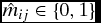 $\hat{m}_{ij}\in \lbrace 0,1\rbrace$ to her. A pure communication strategy of player i to j is thus a function m ij that depends on s i. Given leader j, let m − j be the profile of communication strategies m ij of players i ≠ j. After communication takes place, the leader chooses
 $\hat{y}$ so as to implement her preferred policy. We denote a decision strategy by leader j as
 $y_{j}:\lbrace 0,1\rbrace ^n\rightarrow \mathbb {R}.$
For a given leader j, an equilibrium consists of the strategy pair (m − j, yj) and a set of beliefs that are consistent with equilibrium play. Our equilibrium concept is pure-strategy Perfect Bayesian Equilibrium. Up to relabeling of messages, each equilibrium pure communication strategy m ij from a player i to a leader j may be either truthful, in that i reveals her signal to j, so that m ij(s i) = s i for s i ∈ {0, 1}, or “babbling” (that is, uninformative of s i), and in this case m ij(s i) does not depend on s i.Footnote 7 We interpret the politicians who adopt the truthful strategy with respect to j as the trustworthy associates of that leader.
Fixing a leader j, there may be multiple equilibria (m − j, yj). For example, the strategy profile where all players “babble” is always an equilibrium. Because of equilibrium multiplicity, the ranking of leaders and the leadership selection depend upon the choice of equilibrium: for the same leader j, different equilibria yield different player payoffs. To avoid ambiguities, we assume that for a given leader j, politicians coordinate on the equilibria (m − j, yj) that provide the highest expected payoffs to all politicians.Footnote 8 The selection of these equilibria is standard in games of communication and allows us to focus attention on leadership selection.
We consider two forms of leader selection.
The first one addresses our normative question: Which leader would maximize politicians’ welfare if chosen? Following the utilitarian principle, the welfare W(m − j, yj) associated with an equilibrium (m − j, yj) is the sum of players’ expected payoffs:
 $$\begin{equation*}
W(\mathbf {m}_{-j},y_j)=-\sum _{i\in N}E[(y_{j}-\theta -b_{i})^{2}].
\end{equation*}$$
We denote W*(j) as the maximal equilibrium welfare when j is chosen as leader, and define the optimal leaders as the players j who maximize W*(j).
The second determines which player will be elected by majority rule. When j is the leader, each player i’s payoff in an equilibrium (m − j, yj) is
 $$\begin{equation*}
U_{i}(\mathbf {m}_{-j},y_j)=-E[(y_{j}-\theta -b_{i})^{2}].
\end{equation*}$$
We denote as U*i(j) the payoff associated with the equilibrium that maximizes each player’s payoff among the equilibria induced by j. The Condorcet winner is the player j who defeats any other player k in a direct vote among alternatives j and k. As this winner need not be well defined when n is even, (then, the majority vote may result in a tie), we restrict attention to groups with an odd number of politicians.
A LEADER’S TRUSTWORTHY ASSOCIATES
In our model, a leader is informed via communication from members of the group. This takes the form of costless, or so-called cheap talk, messages. As no one member of the group is perfectly informed, a politician becomes better informed the more other members truthfully reveal their signals to her in equilibrium. Such politicians form her circle of trustworthy associates. We first define and characterize this concept before calculating its size for an arbitrary leader j. We show that the circle of equilibrium trustworthy associates is related to key primitives of our model, namely the ordering of ideological biases within the group. Therefore, we can relate a leader’s judgment to the same ordering.
A Leader’s Judgment
The equilibrium strategies (m − j, yj) given any chosen leader j are easily derived from the analysis leading to Corollary 1 in Galeotti, Ghiglino, and Squintani (Reference Galeotti, Ghiglino and Squintani2013). Given the received messages  $\mathbf {\hat{m}}_{-j}$ and her signal s j, by sequential rationality, the leader j chooses
 $\hat{y}$ to maximize her expected utility. Because of the quadratic loss specification of players’ payoffs, she chooses
 $$\begin{equation}
y_{j}(s_{j},\mathbf {\hat{m}}_{-j})=b_{j}+E[\theta |s_{j},\mathbf {\hat{m}} _{-j}].
\end{equation}$$
Let dj(m − j) be the number of politicians willing to truthfully advise j, were she to lead the group. These politicians form the group of trustworthy associates of j. We prove (in the Online Appendix) that the profile m − j is an equilibrium if and only if, whenever i is truthful to j,
 $$\begin{equation}
\left|b_{i}-b_{j}\right|\le \frac{1}{2\left[ d_{j}(\mathbf {m}_{-j})+3 \right] }.
\end{equation}$$
An important consequence of the equilibrium condition Equation (2) is that truthful communication from politician i to leader j is possible only if the ideological positions of i and j are sufficiently close. We use this result to derive how informed politician j would be in the event where she becomes leader.
First we note that the term dj(m − j) is a function of the equilibrium communication strategies m − j deployed by group members. In particular, whenever i can be truthful to j in equilibrium, then there is another equilibrium in which i “babbles” when communicating with j: since she babbles j will ignore her, and given this response there exists no profitable deviation for i. Fixing j’s leadership, the equilibria (m − j, yj) that provides the highest expected payoffs to all politicians are such that j’s information dj(m − j) is maximal. That is, we consider the most information that j could obtain when any politician who could communicate truthfully in equilibrium will in fact do so.Footnote 9 This allows us to define d*j as the maximal size of the group of politician who form j’s trustworthy associates. Straightforwardly, we can relate the maximal size of this group to a leader’s equilibrium judgment.
Next we derive this leadership characteristic from first principles. In particular, we can define it as a consequence of j’s ideological position relative to that of other politicians in her party. To do so, we define the function  $N_{j}:\mathbb {R}\rightarrow \mathbb {N}$ as the ideological “neighborhood” function of politician j. For any real number b, the quantity N j(b) is the number of politicians whose ideology is within distance b of her own; that is, the number of politicians whose ideology is in j’s ideological neighborhood of size b. To formally define the function N j, we exploit the fact that politicians are ordered according to their bias, so that
 $$\begin{eqnarray*}
N_{j}\left( b\right) & = & \max \lbrace i\in N:|b_{i}-b_{j}|\le b\rbrace \\
&& - \, \min \lbrace i\in N:|b_{i}-b_{j}|\le b\rbrace ,
\end{eqnarray*}$$
for any real number b. For example, if the group of players who are truthful to leader j = 5 is {3, 4, 6, 7}, then N j(b) = 7 − 3 = 4. We use the function N j(·) combined with the equilibrium condition Equation (2) to calculate the maximal size of any politician j’s network of trustworthy associates:
 $$\begin{equation}
d_{j}^{\ast } = \max \left\lbrace d \in \mathbb {N} : N_{j}\left( \frac{1}{2\left( d+3\right) }\right) \le d \right\rbrace .
\end{equation}$$
This provides a simple rule to calculate d*j by counting the number of politicians other than j that are ideologically close to her. For example, suppose that b j = 0 and the three politicians closest to j have bias distance less than 1/12 from b j; that is, they have a bias in the interval (− 1/12, 1/12). These politicians would provide truthful advice to j were she to be selected as leader. For j to have one more trustworthy associate, it must be that no member of that circle has a bias further from b j = 0 than 1/14. Interestingly, the size of the ideological neighborhood of leader j (to which a politician needs to belong to be trustworthy to j) decreases in the number of associates truthful to j. For example, a politician i with bias b i of distance within 1/10 and 1/8 to b j will be truthful to j if and only if j has no other trustworthy associate.Footnote 10
SELECTING THE LEADER
Having defined the size of a leader’s network of trustworthy associates, we now turn to the question of leadership selection. We define the optimal leader as one who maximizes group welfare. In the absence of a mechanism that ensures the first best choice, it is natural to ask which leader would be chosen by the group when each casts a vote with the outcome determined by majority rule. Using the result of the previous section, we show that the characteristics of optimal and majority-preferred leadership can be derived from first principles.
The Optimal Leader
We first show that optimal leader selection involves trading off a politician’s ideological moderation and her judgment. To formalize this insight, we denote politician j’s moderation as −|b j − ∑i ∈ Nb i/n|, the contrary of the distance between b j and the average ideology  $\bar{b} \equiv \sum _{i\in N}b_{i}/n.$ We have defined d*j as the maximal size of a leader’s network of trustworthy associates. It is but a small step to relate this number to her judgment, the second critical and endogenous leadership characteristic. When combining the information obtained from others with her own view, a leader forms an independent judgment of the best course of action. Thus a leader’s judgment is (strictly) increasing in the number of informative signals she obtains from her trustworthy associates.
In fact, and armed with these definitions, we can prove that the equilibrium ex ante sum of players’ payoffs W*(j) can be rewritten as
 $$\begin{equation}
W^{\ast }\left( j\right) =-\sum _{i\in N}(b_{i}-b_{j})^{2}-n\frac{1}{ 6(d_{j}^{\ast }+3)}.
\end{equation}$$
Equation (4) decomposes the welfare function into two elements: the aggregate ideological loss ∑i ∈ N(b i − b j)2 associated with the decision taken by j, and the aggregate residual variance of her decision  $n\frac{1}{6(d_{j}^{\ast }+3)}$. Evidently, a more moderate leader, whose bias is closer to average ideology
 $\bar{b}$, makes the aggregate ideological loss ∑i ∈ N(b i − b j)2 smaller. Further, the residual variance
 $\frac{1}{6(d_{j}^{\ast }+3)}$ is inversely related to the size of the leader’s maximal informant set d*j and hence to her judgment.Footnote 11 The optimal leader j maximizes W*(j). Thus, optimal leader selection takes into account each politician’s moderation and her endogenous judgment that are related to the core primitives of our model, namely the ideologies of members of the group.
Leader j’s moderation can be understood spatially as the relative position of j’s bias b j with respect to the whole ideology distribution b = {b 1, . . ., bn} in the group. In fact, every element of b, even extreme ones, matters for the determination of the average ideology  $\bar{b}$. In this sense, moderation is a “global” property of j’s ideology b j with respect to the distribution b = {b 1, . . ., bn}.
On the other hand, judgment is a “local” property of j’s ideology b j within b = {b 1, . . ., bn}: it depends only on how many other politicians are ideologically close to j, in the sense defined by Equation (3). The leader’s understanding is thus defined by those close to the leader, or adopting Machiavelli’s text, by “the men he has around him.” This analysis of the role played by the local ideological distribution is, to our knowledge, novel in the large contemporary and formal literature on collective choice; though it echoes the insights of Machiavelli made in Il Principe 500 years ago.
We summarize our findings as follows.
Proposition 1. The optimal leader j is determined by ideological moderation, the proximity of b j to the average group ideology  $\bar{b}$, and by good judgment, her number d*j of close-minded associates.
Electing the Leader
We now determine which politician is elected as leader by a simple majority decision taken within the group. Each player i’s utility as a function of the leader’s identity j is
 $$\begin{equation}
U^*_{i}(j)=-(b_{i}-b_{j})^{2}-\frac{1}{6(d_{j}^{\ast }+3)}.
\end{equation}$$
As in Equation (4), the first term on the right-hand side illustrates the ideological loss −(b i − b j)2 suffered by each member of the group i when j is chosen as leader. The second term illustrates player i’s preference for an informed leader j, as it increases in the judgment d*j. We note that player utilities are not single-peaked with respect to a leader’s identity: a politician who is ideologically distant may in fact be better informed, and so have better judgment, than one who is ideologically similar. While Black’s theorem does not apply in this setting, so leadership choice under majority rule is far from straightforward, we can, nevertheless, make progress by showing that utility functions are single-crossing.
Lemma 1. The utility functions U*i(j) are single crossing in i and j : if i < i′ and j < j′, then U*i′(j) > U*i′(j′) implies U*i(j) > U*i(j′); and if i > i′ and j > j′, then U*i′(j) > U*i′(j′) implies U*i(j) > U*i(j′).
As a consequence of this result, we appeal to Theorem 2 by Gans and Smart (Reference Gans and Smart1996) to show that the player with median ideology will determine the outcome of the election. The unique Condorcet winner of the election game is the politician j who maximizes the expected payoff of the median player.
Proposition 2. The group elects as leader the player j who maximizes the utility U*m(j) of the median politician m ≡ (n + 1)/2. The collective choice considers the ideological proximity of any player j to m, as well as j’s judgment d*j that is determined by her number of close-minded associates.
Having established the outcome of a majority election, we can compare it with the optimal leader selection by inspecting Equations (4) and (5), the latter for i = m. As in the earlier case, there is a tradeoff between moderation and judgment: the Condorcet winner j keeps both the ideological loss (b m − b j)2 and the residual variance  $\frac{1}{6(d_{j}^{\ast }+3)}$ as low as possible. Just as with optimal leadership, the majority choice involves a tradeoff between the desire for a moderate leader and that for a leader with good judgment, which, in turn, stems from having a large group of close-minded associates. Beyond this similarity, there is a critical difference and it is this: whereas a majority preferred leader makes this tradeoff decision by considering only her own payoff, by contrast, an optimally selected leader would consider the preferences of the entire group. Straightforwardly, and as the weights placed on these two features of good leadership are different in our key expressions, the majority choice of leader may not be optimal. As we shall see, the implications are surprising in that we identify instances in which the median politician’s utility U*m places less weight on moderation (and more on judgment) than the group’s welfare W*. Thus, majority choice may be inefficient because it places too much weight on the leader’s judgment.
WHAT MAKES A GOOD LEADER?
Our analysis relates the characteristics that define good leadership—moderation and judgment—to the communication structure that emerges in the equilibrium of our model. The importance of the former is well known. Indeed, it is easy to see that if there were no informative signals (or just no communication) in this game, then the chosen leader would be the median politician m, while the optimal one would be the one whose bias is the closest to the average bias  $\bar{b}$. On the other hand, the role played by judgment, that in turn is related to a leader’s trustworthy associates, is novel and central to the results that follow.
Moderate Leadership
A natural question to ask our model is thus: Under which conditions on the primitive parameters (the ideology distribution b) is the most moderate politician the optimal leader and the majority-preferred one? Evidently, this is the case when there are only three politicians in the group. For then the median is the most moderate politician and she cannot be less informed than either of the others: If she is willing to communicate truthfully with her neighbors, then at least one of them is willing to be truthful to her.Footnote 12
Moving beyond the three-player case, we illustrate sufficient conditions such that the optimal leader is also the most moderate politician. Doing so, we consider the situation in which politicians are distributed at even distances with respect to their ideology on the line. Because n is odd, and by symmetry of the ideological distribution, the median m is the most moderate and has at least as many trustworthy advisers as any other politician. Then there is no tradeoff between a leader’s moderation and her judgment. As the median politician is as informed as anyone else she should take the decision on behalf of the group and, indeed, she would be the unique choice of the majority.
We formalize this insight in the following proposition that proves a stronger result. We show that the median politician m is elected by the majority as leader and is also the optimal leader when the ideology distribution is symmetric around m and “single peaked” at m, in the sense that politicians are weakly more ideologically clustered as they get closer to m. Formally, we define the ideology distribution b as single peaked and symmetric at m when for every i = 1, . . ., m − 1, βi = b i + 1 − b i weakly increases in i and βi = βn − i. Evidently, the case in which politicians’ ideologies are evenly distributed on the line (i.e., there is a constant β > 0 such that b i + 1 − b i = β for all i = 1, . . ., n − 1) is a limit case covered by the definition of b as single peaked and symmetric at m.
Proposition 3. When politicians’ ideologies b are single peaked and symmetric at m, the median politician m also has the best judgment. She is the optimal leader and will always be elected as leader by majority.
The result is depicted in Figure 1 for n = 5 and ordered left-right biases b 1 to b 5. In the figure, for each of three politicians j = 2, 3, 4, their maximal amount of equilibrium information is d*j = 2. Then the optimal leader, and the one who is indeed chosen by the group, is player 3.
Proposition 3 relates the core characteristics of leadership to reveal that, with biases single-peaked and symmetric at m (as in the case of equidistant biases depicted in Figure 1) the most moderate politician is also (weakly) better informed and so has better judgment. The significance of our result lies in the fact that, when ideologies in the group are single-peaked and symmetric at m, there is no tradeoff between moderation and the capacity to gather reliable advice. This underlines that a necessary condition for a politician who is not the most moderate to be the optimal leader or the elected one is that ideologies are clustered away from the median.Footnote 13 We explore this tradeoff next, focusing on the case of five politicians for ease of exposition.
Leadership Choice with Equidistant Bias. This figure depicts the case where b i + 1 − b i = β for all politicians i = 1, . . ., 4 and 1/12 < β ≤ 1/10. An arrow linking two politicians illustrates that truthful communication is sustained between them.

The Case with Five Politicians
To explore the tradeoff between moderation and judgment, we study in-depth the case of five politicians, parametrized by the bias differences βi = b i + 1 − b i for players i = 1, . . ., 4. Our case is suitably rich (allowing us to identify properties of the ideology distribution that provide novel and interesting findings) yet simple (so that we can do so in a clean and clear manner).
First we note that it can never be optimal that 1 and 5 lead the group and neither will they be elected by the group as leaders. Players 2 and 4 can be chosen as leaders if and only if they have better judgment than player 3. Also, interchanging β1 with β4 and β2 with β3 then players 2 and 4 are symmetric to each other. Hence, it is with no loss of generality that we restrict attention to parameter values for which W*(2) ≥ W*(4), so that welfare is strictly greater when 2 is the leader rather than 4, and for which U*3(2) ⩾ U 3*(4), so that the only possible Condorcet winners are 2 and 3.
Player 2 has better judgment than 3 when she can count on more trustworthy associates, that is when d*2 > d 3*. Using condition Equation (3), we calculate (in the Online Appendix) all cases for which the condition d*2 > d 3* holds, and determine the restrictions each one of them imposes on the parameters βi, i = 1, . . ., 4. Here, we illustrate our findings in the case in which d*2 = 2 and d*3 = 1. This holds when β1 ≤ 1/10, β2 ≤ 1/10 but β3 > 1/10. In this case, players 1 and 3 are sufficiently close to 2 to be trustworthy, whereas the median politician 3 can trust only 2, but not 4. So politician 2 has better judgment, while 3 is more moderate. This scenario is illustrated in Figure 2, where β3 = b 4 − b 3 is such that (in contrast to Figure 1) player 4 can no longer communicate truthfully with 3. As the player ideologies are not distributed at even distances there may be a tradeoff between judgment and moderation and, moreover, surprising consequences of ideological shifts (such as that of player 4 in Figure 2 relative to Figure 1), which we discuss below.
Leadership Choice with Nonequidistant Bias. In this figure, β1 ≤ 1/10, β2 ≤ 1/10 and β4 ≤ 1/10 < β3. All immediate neighbor pairs truthfully communicate, with the exception of 3 and 4.

The Tradeoff between Judgment and Moderation
Whether the choice between the more moderate politician 3 and politician 2, who has better judgment, is resolved in favor of either depends upon β2 = b 3 − b 2. This determines how extreme 2 is relative to 3. This pins down the majority choice: if 2 will make a more informed decision than 3, then 3 would be happy for her to do so, so long as the ideological distance between them is not too large. This allows us to define a majority threshold with respect to β2. In fact, we can relate the optimal choice and the majority choice between politician 2 and 3 according to the size of β2 relative to the other primitives of the model, as demonstrated by the lemma below that allows us to define a welfare threshold. Let δ = b 5 − b 3 + b 4 − b 3 − (b 2 − b 1) be the sum of the ideological distance from 3 of the players to the right of 3 (that is, 4 and 5) net of the distance from 2 of player 1, the only player to the left of 2.
Lemma 2. Consider the case of five politicians, with the above restrictions: W*(2) ≥ W*(4), U*3(2) ⩾ U 3*(4), β1 ≤ 1/10, β2 ≤ 1/10, β3 > 1/10 (and hence δ > 1/10).
• If
 $\beta _2 < \frac{1}{2\sqrt{30}} \approx 0.0913,$ then the Condorcet winner is politician 2, else, the most moderate politician 3 wins the majority choice.
• If
$\beta _2<\tau (\delta )\equiv \sqrt{\delta ^2+1/24}-\delta ,$ then the optimal leader is 2, otherwise it is 3.• There is a unique
$\bar{\delta }>1/10$ such that $\tau (\delta )>\frac{1}{2\sqrt{30}}$ for all $\delta <\bar{\delta }$ and $\tau (\delta )<\frac{1}{2\sqrt{30}}$ for all $\delta >\bar{\delta }$.


The result defines a welfare threshold, τ(δ). The group is better off when player 2 takes the decision if and only if β2, the ideological distance between players 2 and 3, is below τ(δ). Intuitively, it is optimal that 2 leads the group when her better judgment, combined with the benefits to those the left of the spectrum (b 2 − b 1) are not outweighed by the ideological loss incurred by those to the right (b 4 − b 3 + b 5 − b 3). We prove in the Online Appendix that τ is strictly decreasing in δ, with τ(1/10) > 1/10 and τ(δ) → 0 for δ → ∞.
Lemma 2 also defines the majority threshold  $\frac{1}{2\sqrt{30}}$. This takes a simpler form as it depends only on the median player. She may obtain a more informed outcome when 2 takes the decision and this yields a constant addition to her utility. This comes at an ideological cost β2. Thus the group chooses 2 as leader if and only if β2 is below a threshold given by the constant
 $\frac{1}{2\sqrt{30}}$.
The final part of Lemma 2 reveals that, in equilibrium, the welfare threshold τ(δ) can either be larger or smaller than the majority threshold  $\frac{1}{2\sqrt{30}}$, depending on how large δ is. In the former case, we can distinguish three possibilities on the basis of β2: for small β2, i.e.,
 $\beta _2 < \frac{1}{2\sqrt{30}},$ the non-moderate politician 2 is both the Condorcet winner and the optimal leader; for large β2, specifically, β2 > τ(δ), the most moderate politician 3 is both the Condorcet winner and the optimal leader; in the intermediate case
 $\frac{1}{2\sqrt{30}} < \beta _2 < \tau (\delta )$, the optimal leader is the most informed politician 2, whereas the majority elects politician 3. This identifies an instance in which majority voting leads to a moderate but inefficient choice of leader.
A perhaps more interesting and unexpected case arises when  $\tau (\delta ) < \frac{1}{2\sqrt{30}}$. Again, for small β2, the non-moderate politician 2 is both the Condorcet winner and the optimal leader, and for large β2 it is politician 3. Now inefficiency arises in the intermediate case in which
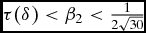 $\tau (\delta ) < \beta _2 < \frac{1}{2\sqrt{30}}$. Although the optimal leader is the most moderate politician 3, the majority elects instead a relatively extreme leader in politician 2.
The logic behind this result is simple. The median politician may trade off moderation and judgment in a way that differs from the optimal choices made by a social planner. Starting from her ideal point, she may sacrifice a policy more in line with her bias for a more informed outcome. In our five-player example, she will indeed do so when β2 is sufficiently small and d*2 > d 3*. Choosing a leftist leader then benefits the median and of course leftist members of the group. But it harms the right-wing members 4 and 5, who bear costs (b 4 − b 2)2 and (b 5 − b 2)2 respectively. Because the ideological loss function (b i − b j)2 is convex in the ideological distance |b i − b j|, the leadership move from 3 to 2 is more harmful to rightwing politicians than it is beneficial to the leftist ones. Then it may be the case that a social planner would force the median politician to take the decision, if only she could.Footnote 14
Comparative Statics
Further analysis of the five-player case uncovers some interesting comparative statics results. Our comparative static exercise is as follows. We first consider leadership choice with a given set of primitives (players ideological biases) and then consider what happens to leadership choice when a player changes her ideology from right (left) to left (right). We show that this can in fact induce a shift in leadership in the opposite direction.Footnote 15
To illustrate, consider a benchmark case with players ideologies evenly distributed apart and where politicians 2, 3, and 4 can all count on the truthful advice of their ideological neighbors, so that βi is constant in i = 1, . . ., 4, and 1/12 < βi ≤ 1/10. Then following Proposition 3, politician 3 is (strictly) most moderate and has (weakly) better judgment among the five; hence she is elected as leader and this choice is also optimal for the group. Suppose now that the ideology of the center-right player 4 moves rightward and so away from that of the median player 3 and that, as a consequence, they are no longer truthful to one another (that is, suppose that β3 increases so as to become larger than 1/10). Now politician 3 has lost a (previously) trustworthy associate. It is now possible that the center-left politician 2 is the Condorcet winner of the election game—3 will delegate authority to her, despite not being the most moderate politician. Indeed, by Lemma 2, we know that this is the case when  $\beta _2 < \frac{1}{2\sqrt{30}}.$ Hence, the ideological movement of a player towards a more extreme position may induce a leadership change in the opposite direction.
Conversely, suppose that the five politicians are such that, in the benchmark case with evenly distributed ideologies, there is no truthful communication across players; that is, βi is constant across i < n and βi > 1/8. Suppose now that the leftist politicians 1 and 2 become more moderate, so that now politician 2 can count on the truthful advice of players 1 and 3 (formally, suppose that β1 and β2 decrease, so that they both become smaller than 1/10). Because player 4 is still not truthful to 3, leadership switches from the median player 3 to the center-right player 2, again, when  $\beta _2 < \frac{1}{2\sqrt{30}}.$ Here, the rightward ideological movement of leftist players moves leadership choice (and hence policy outcomes) in the opposite direction. Thus moderation allows them to capture control of leadership of the group.
In both cases, and unexpectedly, a change in the ideological distribution by which politicians (weakly) move right leads to a shift in the group decision to the left.
We summarize our findings for this section in the following result.
Proposition 4 When the distribution of ideologies is not single peaked and symmetric, a politician other than the most moderate one can be the optimal leader and the majority choice.
Relative to the group of politicians, the median player weighs judgment more than moderation: she may lead when it is in the group’s interest that another with better judgment is chosen, and she may not be chosen when it is optimal that she leads.Footnote 16
If politicians become more moderate (extremist), they capture (lose) control of the group, and turn the group policy closer to (away from) their views.
Discussion
The findings of our positive study of leadership highlight the predictive importance of judgment. The fact that the majority choice may place too much weight on this characteristic is perhaps surprising, the more so when interpreting the decisive median vote in the election as a decision to delegate authority to leaders with specific characteristics. This notion goes back to Schelling (Reference Schelling1960) who, in his seminal book The Strategy of Conflict, discussed the use of delegates with particular characteristics as a way to credibly commit a negotiating party to a position. He suggested that agents in bargaining situations may transfer power to stubborn negotiators.Footnote 17 Seen in this context, we note that our model is one where the median player can choose either to take the decision herself or delegate to another politician. She chooses the latter option when another member of the group has more information and so better judgment. The surprising, and we believe novel, finding is that the median may delegate to another when it is in the group’s interest that she executes the decision herself.
As noted in our earlier discussion of related literature, when viewing our model as one of implicit delegation, Proposition 4 reveals a failure of the “ally principle,” that states that the principal will always delegate to an agent who is ideologically closest to her. Indeed, it has been noted that when viewing the set of possible principals and agents as heterogenous groups rather than as unitary actors, and when agents are imperfectly informed, then the ally principle may not hold. Our model combines these elements—multiple players with different preferences—and reveals conditions on the primitives of our model under which the ally principle holds and those where it does not and, moreover, provides a framework within which to understand the welfare consequences of the failure of the ally principle.
Beyond this normative perspective, our analysis has consequences for the empirical analysis of a number of institutional settings operating under majoritarian principles, where, following Black, the decisive player is the median. We mention two possible applications of our ideas.
A large body of literature has explored the process of nominations and appointments to majoritarian institutions. For example, Krehbiel (Reference Krehbiel2007) and Rohde and Shepsle (Reference Rohde and Shepsle2007) have analyzed the process by which nominations are made to the Supreme Court by an ideologically disposed President and majority approved (or not) by a Senate, in which senators anticipate the consequences of such an appointment on court decisions that are likewise made under majority rule. As the situation involves multiple interdependent institutions, as well as multi-player interactions with each of these institutions, the set of possible strategies to consider is large. These models are tractable, however, due to the assumption that within the Senate and the courts, the pivotal player (politician, judge) is the one with the median preference. Appointments can then be considered with respect to whether or not they change the identity of that player, and, hence, these models go by the description of “move the median” games. Specifically, a rational Senate member considers whether a proposed appointee changes the identity of the median court member. She is the critical player, since, “an opinion must gain the assent of five justices, the median justice and four justices on one side or another” (Rohde and Shepsle Reference Rohde and Shepsle2007). Our analysis suggests, by contrast, that it is not just the identity of the median that is important in determining a groups choice under majority rule. This implies that the results of the “move the median” game may be different when considering preferences that depend on private information.
A second and related research topic is the writing of the Supreme Court decision. The exact procedure is elaborate, but again things simplify if one assumes that the opinion is either directly written by the median justice (referred to as the median justice model) or must be approved by her as part of a bargaining process. A straightforward extension of our five-player group, depicted in Figure 2, to a nine-member court would yield different insights. Specifically, our analysis suggests that the opinion of a justice other than the median may achieve majority support. As already noted in our introductory remarks, in his review of the field, Clark suggests that relaxing the complete information assumption in standard models may yield new insights. Indeed our analysis would appear to confirm that this is in fact the case.
We postpone a more extensive application of our ideas to these cases to future research. Here, instead, we focus attention on an immediate and, we believe, first-order extension of our model. As already noted, our analysis of group choice of leader provides insights that differ from those provided by an easy application of Black’s Theorem. A noted application of Black’s ideas is via the workhorse spatial model of party competition. We study a version of that model with two parties who each choose a leader who then competes in a general election.
A MODEL WITH ELECTORAL COMPETITION
The analysis in the previous section reveals that a relatively extreme leader may be chosen if she has good judgment. Also, it highlighted a peculiar nonmonotonic comparative static result: a rightward ideological shift by a politician can induce a leftist choice of leader, and vice versa. Next we explore whether these surprising effects survive political competition. Will political groups such as parties choose relatively extreme leaders when their candidates face an electoral test in the form of a general election?
To explore this, we analyze a model of two-party competition that incorporates different democratic selection methods. We consider a world where each party first chooses an electoral candidate (who we identify as the party leader, although this is not needed for our arguments) via an internal election involving politicians, members, and/or registered votes. Party leaders then compete in a general election. As in the now standard citizen candidate model of Osborne and Slivinski (Reference Osborne and Slivinski1996) and Besley and Coate (Reference Besley and Coate1997), the winner of the election implements her ideal policy. The difference (with the standard model) is that she does so only after consultation with other informed politicians in her own party. We assume that politicians and the electorate as a whole value informed decisions made by elected office holders, but are ideologically differentiated and anticipate final outcomes when casting their votes.
Model
Suppose that there are two parties, A and B. The top politicians in party A consist of the set of players N A and those in B consist of politicians N B. At the beginning of the game, parties choose leaders {a, b}. To make our results general, we do not commit to a specific leader choice model. We assume only that each party selects as leader the strongest possible candidate, defined as the politician within the party who defeats the largest possible number of candidates from the other party in the general election.Footnote 18 To simplify the exposition, we consider only ideology and party profiles such that there is only one such politician in each party. The eventual winner j ∈ {a, b} of the general election then implements the final policy  $\hat{y}\in \mathbb {R}$. Candidates cannot commit to electoral promises, and so the winner implements her preferred policy after consultation with her party’s top politicians.
There is a continuum of citizens, which includes the finite set of politicians N A∪N B. The preferences of each citizen k, including politicians, are expressed by
 $$\begin{equation*}
u_{k}\left( \hat{y},\theta \right) =-\left( \hat{y}-\theta -b_{k}\right) ^{2},
\end{equation*}$$
where b k is the ideological bias of citizen k relative to the median voter in the general election, who we assume to have bias equal to zero, without loss of generality. As before, the utility of k depends on how well  $\hat{y}$ matches an unknown state of the world θ together with her ideological bias b k. We single out politicians who belong to the set N A∪N B, denote them with indexes i, and maintain the assumption that b i is increasing in i and, therefore, that all politicians in A are to the left of all politicians in B.
The remainder of our model is as before. Each top politician i has some private information on θ. After the general election takes place, each i observes a signal s i ∈ {0, 1} of θ such that  $\Pr \left( s_{i}=1|\theta \right) =\theta$. And before the elected policy maker j chooses
 $\hat{y},$ each politician i can communicate by sending a message
 $\hat{m}_{ij}\in \lbrace 0,1\rbrace$ to j. We assume that there are social conventions stifling communication across parties, and that the elected politician has truthful associates only within her own party. We thus consider equilibria in which the politicians from the opposite party do not reveal any information to her.
As in the previous section, each voter k evaluates a candidate j on the basis of both j’s ideological proximity (b k − b j)2 and her judgment, identified by the number of j’s trustworthy party fellows d*j, according to the, by now usual, decomposition:
 $$\begin{equation*}
U_k^{\ast }(j)=-(b_k-b_{j})^{2}-\frac{1}{6(d_{j}^{\ast }+3)}.
\end{equation*}$$
Because each voter k evaluates a candidate j’s judgment favorably, regardless of her ideology, we can think of judgment as valence. Here, it is endogenously determined by j’s network of trustworthy party fellows.
As a consequence of Lemma 1, preferences satisfy the single crossing condition with respect to the choice of leader in the general election. Moreover, the play of weakly undominated strategies in (the subgame that represents) the election implies that each voter chooses her preferred candidate j ∈ {a, b}. As a consequence, candidate a will be elected with certainty if and only if U 0(a) > U 0(b), where we take 0 to be the index of the median voter.
Policy Divergence
A natural benchmark for comparison is an otherwise identical model in which players do not communicate to the elected leader before she chooses the policy  $\hat{y}$. As no communication can take place, so no information about θ can be aggregated, only the vector of ideologies b are relevant to votes cast in either primary or general election. As these are common knowledge, the game then boils down to a simple one of perfect information. It is then simple to prove that U 0(a) > U 0(b) only when the policy bias of leader a is closer to zero than that of b, so that the most moderate candidate in each party is chosen as leader.
Fact 1. Suppose that politicians cannot communicate to the politician j who wins the general election. Then the winner of the general election is the player whose ideology is closest to that of the median voter in the electorate.
Whenever politicians are sufficiently ideologically distant from each other that they can never communicate truthfully (even to their closest ideological neighbor), then the winner of the general election is the candidate with bias closest to zero. Beyond this simple case, it is immediate that, in our model of electoral competition, party leaders need not be moderate. The analysis follows our earlier logic: politicians with a large network of truthful informants may be preferred by the median voter even if they have relatively extreme ideologies. In fact, we can reveal new insights. First, we show that the winner of the general election need not be the most moderate politician (that is, the politician whose ideology is closest to the median voter), even in circumstances in which the politicians’ ideologies are evenly distributed in the ideological spectrum. Thus, our finding stands in sharp contrast with Proposition 3. Why so? When politicians are partitioned in competing parties, the most moderate politician (with respect to the electorate as a whole) is at the extreme end of the ideological spectrum within her own party. This constrains the pool of trustworthy associates she can rely upon and so hampers her ability to take informed decisions if elected to office.
Proposition 5. Even if the ideologies b of the potential candidates N A∪N B are evenly distributed, so that b i + 1 − b i = β for some β and all i = 1, . . ., n − 1, it need not be the case that the winner of election is one of the most moderate politicians.
This insight is demonstrated by the six-player example depicted in Figure 3. There are six politicians, with ideologies such that b i + 1 − b i = β for all i = 1, . . ., 5, arranged symmetrically around the median ideology zero, so that b 3 = −β/2 and b 4 = β/2. The leftist politicians 1, 2, and 3 (lighter shading) belong to party A and the others (darker shading) to party B.
Party Competition with Equidistant Bias. The figure illustrates a case where politicians 1,2,3 belong to party A and 4,5,6 to party B. Within each party, each politician is informed by her immediate neighbor.

Following our earlier analysis, unless politicians 2 and 5 can count on more trustworthy advisers than 3 and 4, in equilibrium, the latter will be selected by their parties and tie the general election. Because of the symmetry of b we can focus attention on the challenge between 2 and 3 for leadership of party A. Politician 2 has better judgment when d*2 = 2 and d*3 = 1, which requires that β ≤ 1/10 and that 2β > 1/10.
It is then relatively straightforward to identify a condition on β such that the median voter in the general election would prefer that candidate 2 is chosen by party A, that is U 0(2) > U 0(3). Specifically, we show in the Online Appendix that this is the case when  $1/20 < \beta < \frac{1}{4\sqrt{15}} \approx 0.0645$. By symmetry, and since the median has zero bias, it must also be that U 0(5) > U 0(4). Hence, in the unique equilibrium, party A chooses politician 2 as leader, and party B chooses politician 5. In sum, the chosen leaders are not the most moderate candidates 3 and 4.
This result provides a new take on the documented divergence among candidates in two party elections. Even if two parties compete for power, they will not necessarily be the most moderate candidates, so that convergence to the median will not take place.Footnote 19
Moderation and Party Cohesiveness
The second novel insight highlights the value of a party’s ideological cohesiveness. Interpreting a party’s cohesiveness as the ideological distance among its top politicians, we find that a more cohesive party can defeat a larger, less cohesive one in a general election. This can occur even though the larger party can draw information from a larger set of informed politicians. And it can occur even though the leader of the larger party has ideological views that are closer to those of the median voter. Why? The leader of the more cohesive party can count on more trustworthy associates than her opponent. The median voter anticipates that, as a consequence, she will have better judgment.
Finally, we find that the outcome of the election may depend on the whole ideological distribution and often in a very subtle way. For example, suppose that (repeating the comparative static exercise from earlier) the ideology of the leader of a party becomes more moderate. Should she be elected then she will implement her preferred policy which, in turn depends upon the advice she obtains. Surprisingly she may in fact lose the general election as a result of her new found moderation. (Of course, the opposite can happen: a politician may lose the election if her views become more extreme). Intuitively, this occurs because, as the leader’s views become more moderate, the ideological distance with others in the party increases. As a consequence, the leader may lose the benefit of truthful advice from erstwhile allies. This result is, to the best of our knowledge, both novel and unsupported by any variant of the standard spatial model found in the literature.
Proposition 6. A large party may lose the election to a smaller, more cohesive party, even if it can draw information from a larger number of top party politicians and though its leader is the candidate in the general election whose views are closest to the median voter’s.
The outcome of the election may depend on the whole ideological distribution of the top party politicians in subtle ways: For example, a party leader may lose the general election only because her views become more moderate (closer to the median voter).
The result can be demonstrated by means of the following example, illustrated in Figure 4. Suppose that there are five politicians, with b 2 < 0 < b 3 and |b 3| < |b 2|. Politicians 1 and 2 belong to party A and 3,4,5 belong to party B. In this example, there are two senses in which party B is advantaged: there is a larger set of top politicians from whom the leader could draw upon for information; and in player 3, it has a potential leader whose views are closest to those of the median voter, whose ideal point is equal to zero. This implies that, were there no possibility of communicating private information, party B would always win the election by selecting politician 3 as its leader. Party B is not only larger, it is also “ideologically majoritarian” in that, in contrast to party A, it is able to put forward candidates whose ideological perspective appeals to a majority of the electorate.
Party Competition with a Majoritarian Party. Illustrates a case where politicians 1 and 2 are in party A and 3,4,5 are in party B; b 2 < 0 < b 3, b 3 < |b 2|, β1 ≤ 1/8, β3 > 1/8 and β4 > 1/8. Politicians truthfully communicate within party A but not within party B.

Given the advantage of B in fielding more moderate candidates, following Lemma 1, a politician from party A can only be elected due to her better judgment. For this to be the case it must be that d*2 = 1 > d 3* = 0, as there is only one other informed politician in party A. This situation requires that β1 ≤ 1/8, β3 > 1/8 and β4 > 1/8, and is depicted in Figure 4. It is then not difficult to find conditions under which the median voter prefers politician 2 from party A to any politician from party B, so that, in equilibrium, B will lose the election despite its advantage. Specifically, we find in the Online Appendix that this is the case if and only if b 22 − b 32 < 1/72: this condition is satisfied when |b 2| is not too much farther than |b 3| from zero, the median voter’s ideal point.
To see that a leader can lose the election if her ideology moves closer to the median voter, consider politician 2 as leader of party A. Suppose that we start from a situation in which β1 is smaller than but close to 1/8. Politician 1 is a trustworthy associate of 2, but if the ideal platform of politician 2 moves closer to the median voter’s, and 1’s views remains fixed, then the condition β1 ≤ 1/8 will no longer be satisfied. Thus, candidate 2’s judgment is no longer better than that of politician 3 and so, were they to contest the election, 2 would lose.
Discussion
Our results link the notion of cohesiveness to a party’s electoral success and suggests that anything that increases (decreases) cohesion will have positive (negative) electoral consequences.Footnote 20 These theoretical results are consistent with a common understanding that divided parties do not win elections, and with empirical findings. For example, in the three UK elections previous to Labour’s election victory in 1997, each of which provided the Conservatives with a majority, Labour were the party perceived to be the most divided. The British General Election Study of 1983 reveals that 24.2% of the electorate perceived the Conservatives to be divided whereas 87.9% perceived Labour to be so. In 1987, the corresponding figures were 42.1% for the Conservatives and 66.9% for Labour, and, in 1992, 27.1% for the Conservatives and 62.8% for Labour. In 1997, however, more of the electorate (40.6%) perceived the Conservatives to be divided than perceived Labour to be so (18.9%). See Heath, Jowell, and Curtice (Reference Heath, Jowell and Curtice1983, Reference Heath, Jowell and Curtice1987, Reference Heath, Jowell and Curtice1992, Reference Heath, Jowell and Curtice1997).
Our results on the importance of the cohesiveness of parties relate to debates on party size, and how this affects their political viability and effectiveness, which dates back at least to Michels (Reference Michels1911). Our model highlights that the size of party may be less important than the ideological disparity of views within it. Indeed, our results suggest that the formation of a leadership clique or oligarchy that closed down the possibility of fruitful internal debate would be damaging.Footnote 21
Our results on the relevance of party cohesiveness and of the choice of a leader that is not estranged from the party are especially relevant to understand the events that led to the victory of Labour in the 1997 UK elections. That Labour victory is often related to its leader, Tony Blair’s moderation and his eschewing of the left-wing policies of predecessors. Our result suggests a different narrative, namely that it was the ideological cohesion of “New Labour” rather than the moderation of its leader that was important. Indeed, a corollary to Proposition 6 is that the moderation of its leader is neither a necessary nor sufficient condition for party success. Instead, and to assess the chances of electoral victory, one should consider the relationship between the party leader and those of his associates. In his memoirs, Blair talks about the team of politicians who advised him and on whom he could rely, amongst them Gordon Brown, John Reid, and David Blunkett (Blair Reference Blair2010). Referring to the latter, he states (ibid., 34–35), “his loyalty and commitment to New Labour, I never doubted.” Yet whereas Blair himself had always been a moderate and so natural modernizer, Blunkett had moved from the left toward the center. He had been a leader of Sheffield Council, one of Britain’s most left leaning councils during the 1980s. His personal ideological change was noted in an article by the Economist in 2001, which described him in the following terms: “a municipal socialist when Thatcherism was rampant, he came to understand the limitations of the old left. This made him a genuine Blairite.”Footnote 22 Our analysis suggests that the ideological odyssey of Blunkett (amongst others) that allowed him to become a trustworthy associate of Blair, and that might be seen as a small episode in Labour history, should be viewed as a central component of its electoral success.
CONCLUSION AND DISCUSSION
Our article develops a theory of leadership that focuses upon a leader’s relations with others in the governance process and, in particular, the importance of her network of close friends and allies. These are people the leader can rely upon to truthfully reveal any private information they hold. A large network of such allies translates into better judgment and better policy. In studying the endogenous formation of such networks, we have been able to formulate a theory of leadership choice in which a leader’s core characteristic, her judgment or ability to ascertain the best course of action, stems from first principles. Analysis of our model uncovers a set of results that can plausibly explain documented facts, such as the election of extreme leaders and the impact of ideological change within a collective body (such as a party or committee), that are not easily reconciled with previous theories.
We conclude by discussing some useful extensions of our ideas. An interesting question is how our results would change if different politicians had different access to information. It is possible, for example, that ideologically close politicians gather information largely from the same sources. As a result, the advice of associates who are too ideologically close may be less valuable than that provided by more distant ones. Of course, our main result, that associates who are too ideologically distant are not truthful to the leader in equilibrium, would survive in a model in which information is possibly correlated among politicians. As a result, all of our possibility results would extend to this enriched environment. Further, it may prove interesting to determine the optimal composition of advisers to the leader. This is the subject of our current research. We conjecture that the optimal set of advisers would only include politicians whose ideological distance from the leader is neither too large nor too small: ideologically distant advisers would not be consulted as their recommendations would not be credible, and it is possible that politicians who are too close would be excluded so as not to crowd out more valuable, less ideologically close advisers.Footnote 23
SUPPLEMENTARY MATERIAL
To view supplementary material for this article, please visit https://doi.org/10.1017/S0003055418000229.









Comments
No Comments have been published for this article.