Introduction
The Drake equation attempted to formulate the number of civilizations able to communicate in the Galaxy. The last two parameters of the equation, f c, the fraction of planets with intelligent creatures capable of interstellar communication, and L, the time during which such a civilization remains detectable, are still considered nowadays to be the two most difficult terms to estimate. The present paper focuses on f c, and wonder whether data sharing through networks, as we do in our current terrestrial civilization, would be a relevant factor to take into account to estimate the probability of contact (or data sharing) between galactic civilizations. The Drake equation has been established considering only technologies based on radio signals. Information sciences may now provide a new approach.
Since Drake's proposal in Reference Drake1961 (Drake Reference Drake1961), computing/networking technologies have developed considerably. Their acceleration might be a key factor to determine whether a new civilization is now emerging on Earth and, extrapolating our case to SETI, to study the ability of a galactic civilization to share information with us. This raises the question of evaluating the present level of our civilization. The classifications proposed in pioneering papers by Kardashev (Reference Kardashev1964) and Sagan (Reference Sagan1973) provide a way to answer this question.
The f c factor as originally defined does not take into account the shared knowledge by a significant percentage of a civilization. This ability for sharing data is important for SETI. Clearly, a signal coming from another galactic civilization has a higher probability to be detected and deciphered if more and more complex networking technologies are developed on our planet.
In the following, we present first an overview of f c and L factors in the 1961s context. Kardashev's classification of civilizations is also mentioned. This historical background is useful to the present analysis in order to update Earth's classification. The paper then discusses the current status of the terrestrial civilization regarding computing/information science. In the context of computing/network science, we finally discuss the heterarchy versus hierarchy network concepts and how these concepts are relevant for f c.
A reminder of how little we know about the two last parameters of the Drake equation
During the 1961 Green Bank Conference, the factor f c was defined as ‘the fraction of extant intelligent life-forms that might have the desire and the wherewithal for interstellar communication’ (Drake & Sobel Reference Drake and Sobel1994). Animated discussions during the meeting converged towards values for f c between 1/10 and 1/5. The last factor L representing the lifetime of these civilizations (Drake & Sobel Reference Drake and Sobel1994, p. 61) was also a difficult factor to estimate. At the end of the discussion, it seemed that the lifetimes of civilizations would either be very short – less than a thousand years (with high probability of self-destruction) – or extremely long – in excess of perhaps hundreds of millions of years (Drake & Sobel Reference Drake and Sobel1994).
Later, Shklovskii & Sagan (Reference Shklovskii and Sagan1966) adopted f c=1/10. Of course, even if this value is close to 1, meaning that advanced civilizations are not rare, it does not tell us anything about the compatibility between the civilizations themselves. Factor L might be more relevant from this point of view. Shklovskii and Sagan adopted L=107 years, and taking into account their estimates of the other parameters, they found that the number of civilizations in our Galaxy should be around N=106 (p. 413). This result is within the range of values proposed during the Green Bank meeting.
The Earth civilization today in terms of information and shared data
Kardashev (Reference Kardashev1964) distinguished three types of civilizations based on the order of magnitude of the amount of energy available to them, close to our present level (Type I, 4×10¹⁸ erg/second), harnessing the radiated energy of a star (Type II, 4×1033 erg/second) and utilizing the energy of a Galaxy (Type III, 4×1044 erg/second). Sagan (Reference Sagan1973) proposed to add narrower gradations to fill the huge gaps between each Kardashev's Type by using a classification K (=1.1, 1.2, etc.) based on the equation
 $$K = \displaystyle{{{\rm log}_{{\rm 10}} {\rm} W} \over {{\rm 10}}},$$
where W is the energy consumption in megawatts. He defined W as the energy used for interstellar communication and estimated this power to be ≈10 terawatts in 1973 (he later considered that it was an overestimate). Our civilization would then correspond to a Type 0.7.
Sagan suggested adding another dimension – the information available to a civilization – and to denote it with a letter. In his classification, letter A represents 106 unique bits of information (less than any recorded human culture) and each successive letter represents an order of magnitude increase, so that a level Z civilization would have 1031 bits. He argued that we managed in 1973 up to 1013 bits, corresponding to letter H in his classification, making us a 0.7H civilization.
In 2013, is the Earth still the home of a 0.7H civilization? Since 1973 our energy consumption has only doubled. The Arecibo radiotelescope which sent the 1974 message has a more powerful antenna than the Evpatoria radiotelescope (Zaitsev Reference Zaitsev2006). The most powerful lasers have terawatt powers. The power we use today for interstellar communication is thus still close to Sagan's (Reference Sagan1973) estimate.
Internet provides useful estimates of our energy and information levels. In June 2012, 697 089 482 web sites were reported by Netcraft (http://news.netcraft.com/). The total power demand in 2005 (including associated infrastructure) was already equivalent (in capacity terms) to about five 1000 MW power plants for all US servers and 14 such plants for the world (Koomey Reference Koomey2007), for a total W≈10 GW and a K value of 0.4. In April 2012, the encyclopaedia Wikipedia contained over 19 million articles (http://www.wikipedia.org/), and an average of 6474 new articles added every day. With 3000 bits per article this represents 57×109 bits. A single encyclopaedia of this size represents a D civilization according to Sagan's formula. If each server had the content of the Wikipedia website, this would represent 40×1012 bits. The quantity of information available on the web represents half the information the Earth civilization had access to in 1973. This is equivalent to the data shared by a G civilization.
The 0.7H civilization represents most of the people living on Earth, finding information in printed books or computers, manufacturing objects, etc. However, there is nowadays an emerging situation where more and more people manage an increasing quantity of data. Earth's civilization can be regarded as a type 0.7H, but enriched by an additional network corresponding to a 0.4 G civilization represented by the people sharing data via Internet. A 0.4 G civilization might be called ‘network civilization’ but a better definition may be given in the future by researchers in social sciences.
Different ways of sharing data and implications for SETI
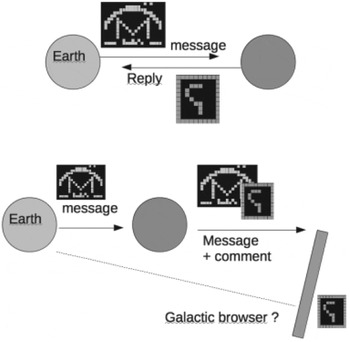
The SETI community presents a hierarchical organization (Billingham Reference Billingham2002): In order to send a message from Earth such as the one sent from Arecibo in 1974, people of the 0.7H civilization needed some hierarchical organization to have access to the transmitter, to compose and agree about the content of the message and finally to get the right to send it. For instance in the case of the Arecibo message, there was no real worldwide debate about the data and information sent. The way of sharing data was then hierarchical. It is no longer the case now (Denning Reference Denning2010). Technology to send messages today is indeed available for a lot of skilled people and several initiatives have already been done in that direction (Zaitsev Reference Zaitsev2006). This way of sharing data is called heterarchy, a term used in biological taxonomy as well as in information sciences (Crumley Reference Crumley, Ehrenreich, Crumley and Levy1995). There would be only very few people sending messages in a galactic civilization using a strong hierarchy, whereas a lot of people would be communicating with the same rights in a civilization where heterarchy would be dominant. This point has important implications for SETI: it means that the probability to detect a civilization would be greater if it is heterarchical than if it is hierarchical (Fig. 1)
Hierarchy versus Heterarchy.

In 1997, Allen Tough designed the Welcome ETI website (Tough Reference Tough1998). The project based on web 1.0 was to invite E.T. to communicate and share data by connecting to our Internet network. E.T. had to write HTML code to contact the team managing the website (about 100 people). It was a hierarchical organization because nobody could write a word without sending it to people having access to the server, but this technology was the only one available at the time. This experiment was unsuccessful.
Earth Speaks is a more recent project (Vakoch Reference Vakoch2010; http://earthspeaks.seti.org/), based on Web-2.0 technology. The principle is the following: anyone on Earth can create an account on this website and write messages answering the question ‘what should we respond?’ (to a possible extraterrestrial message). All the messages are freely available via a map, a cloud of words or by navigating from the latest one to the earliest, without any kind of hierarchy. Once logged, everybody can evaluate each message rating it with 1 to 5 stars, thus answering the question ‘How appropriate would it be to communicate this message in an actual transmission to an extraterrestrial civilization?’. Participants to the Earth Speaks messages do not need particular knowledge. They do not have to contact SETI organizations like the SETI League, the Planetary Society, the SETI Institute or the International Academy of Astronautics. This last point emphasizes the heterarchical aspect of this project with respect to the older Welcome ETI initiative.
A 0.7H civilization will find the Welcome ETI website more convenient because it can identify the authors, surf in an organized hierarchical way or print some papers. A 0.4 G civilization will appreciate the Earth Speak website because people will be able to easily contribute to an evaluation of its content.
Discussion
It is well appreciated that the Drake equation is a splendid tool to quantify our ignorance, even if some of the first factors are nowadays easier to estimate. The factors dealing with civilizations, i.e. technological level, evolution of techniques and civilization lifetime, are obviously the most difficult to quantify. In this paper, we called attention to a parameter related to these factors – the ability for an E.T. civilization to share information. We believe that this parameter strongly influences factor f c (and possibly L also) and that its separate discussion does not lead to an increase uncertainty on f c but may help to analyse it with greater precision.
In line with other authors who recently proposed to add new factors in the Drake equation (Zaitsev Reference Zaitsev2005; Maccone Reference Maccone2010), it would be possible to consider a new parameter representing the fraction of planets with intelligent creatures that are capable of widely producing and sharing data. Nevertheless it would certainly be difficult to have this new factor ‘orthogonal’ (i.e. not correlated/coupled/linked) to f c.
An important distinction in information sharing is between hierarchical and heterarchical organizations. Heterarchy is a way of sharing large quantity of information and this could be of significant interest for SETI in several ways:
(i) Heterarchy could play a significant role in our technological development related to SETI. In passive SETI, it could provide an additional tool for detecting an E.T. civilization with Earth's instruments in the future and for deciphering its message with a better efficiency. Specialists of informatics and human–computer interface are expected to provide a greater contribution to the analysis of parameters influencing the interstellar communication.
(ii) A hierarchical civilization with only one entity (organization, leader) having the capability of producing interstellar messages will be less detectable than a civilization with many communicating entities, as suggested in this paper with the example of the new heterarchy civilization.
(iii) Heterarchy can increase the probability of receiving a non-intentional broadcast but requires technological improvements, for example a kind of galactic web browser, made of probes and telescopes exploring and scanning the sky for messages (Fig. 1).
(iv) How a civilization might react to the content of an Arecibo-type of message is not known. It is conceivable that a heterarchical 0.4G civilization receiving such a message will not send us a reply but instead will enrich it with some data or comments and then will broadcast the messages and comments in several relays using heterarchy.
Acknowledgements
We are very grateful to Dr Jean-Pierre Rospars, Dr Claudio Maccone and two anonymous referees for their constructive comments, which led to many improvements in the manuscript.