




No CrossRef data available.
Article contents
Quality of life, emotional, and cognitive function following acute respiratory distress syndrome
Published online by Cambridge University Press: 01 November 2004
Abstract
Acute Respiratory Distress Syndrome (ARDS) is characterized by lung injury and hypoxemia, has a high mortality rate, and is associated with significant morbidity including cognitive and emotional sequelae and decreased quality of life. There is limited information regarding which of these factors are associated with decreased quality of life. This study assessed the relationships between quality of life, cognitive and emotional function in ARDS survivors at 1-year post-hospital discharge. Sixty-six ARDS survivors were administered a battery of neuropsychological tests, measures of emotional function and quality of life 1 year post-hospital discharge. At 1 year 45% of the ARDS patients had cognitive sequelae and 29% had mild to moderate symptoms of depression and anxiety. Depression, anxiety, and intensive care unit length of stay were significantly correlated with decreased quality of life. Cognitive impairments did not correlate with decreased quality of life. Illness severity and emotional function, but not cognitive sequelae, are associated with decreased quality of life 1 year following ARDS. ARDS is common and may result in significant cognitive and emotional morbidity and decreased quality of life. (JINS, 2004, 10, 1005–1017.)
Information
- Type
- SYMPOSIA ARTICLE
- Information
- Journal of the International Neuropsychological Society , Volume 10 , Issue 7 , November 2004 , pp. 1005 - 1017
- Copyright
- © 2004 The International Neuropsychological Society
INTRODUCTION
The acute respiratory distress syndrome (ARDS) is a common cause of mortality and morbidity, affecting an estimated 150,000 people per year in the United States (Rubenfeld et al., 1995). However, recent evidence suggests the incidence may be even higher (Rubenfeld, 2003). Acute respiratory distress syndrome is characterized by acute lung injury, arterial hypoxemia, reduced total thoracic compliance, and diffuse bilateral infiltrates on chest radiograph due to increased-permeability pulmonary edema (Bernard et al., 1994; Petty & Ashbaugh, 1971). Treatment of ARDS requires aggressive supportive care including positive pressure ventilation and increased oxygen concentrations with risks of barotrauma, oxygen toxicity, and nosocomial infection. Advances in medical care have improved hospital survival from 50 to 70% of patients (Abel et al., 1998; Milberg et al., 1995). Survivors of ARDS are often left with chronic pulmonary fibrosis, pulmonary function abnormalities, and diminished health-related quality of life (Cooper et al., 1999; Davidson et al., 1999; Hopkins et al., 1999; McHugh et al., 1994; Suchyta et al., 1993; Weinert et al., 1997). Acute Respiratory Distress Syndrome survivors are also at risk for physical, emotional, and neurocognitive deficits likely due to inflammation, multiorgan dysfunction, hypoxia, and intensive care unit (ICU) treatment. Even though survival has improved in recent years, questions remain regarding the effect of ARDS on cognitive and emotional function and their relationship to quality of life.
Critical illness, including ARDS, is associated with significant cognitive impairments (Ely et al., 2004; Hopkins et al., 1999; Marquis et al., 2000). Approximately 33% of general medical ICU survivors develop cognitive impairments (Jackson et al., 2003). In 1999, we reported that a significant percentage of ARDS survivors had cognitive impairments including memory, attention, concentration, mental processing speed, and global cognitive decline (Hopkins et al., 1999). Since our report of cognitive impairments in ARDS survivors, others have confirmed our findings (Al-Saidi et al., 2003; Jackson et al., 2003; Marquis et al., 2000; Rothenhausler et al., 2001). The prevalence of cognitive impairments varies from 78% 1 year post-hospital discharge (Hopkins et al., 1999) to 25% in patients with less severe acute lung injury at 6-year (median) follow-up (Rothenhausler et al., 2001). The cognitive impairments following ARDS are related to decreased quality of life (Rothenhausler et al., 2001). Cognitive impairments are a major determinant in the ability to return to work, work productivity, and life satisfaction following traumatic brain injury (Streadman-Pare et al., 2000), and ARDS (Rothenhausler et al., 2001). Even mild cognitive impairments in elderly individuals with mild cognitive impairment or dementia result in clinically significant impairments in driving, money management, and the ability to perform activities of daily living (Albert et al., 1997; Griffith et al., 2003; Nygard, 2003; Tabert et al., 2002).
Individuals with a critical illness are faced with disease or injury that is life threatening, requires ICU hospitalization, and invasive medical treatment. The combination of medications, traumatic stress, pain, inflammation, hypoxemia, and brain injury may contribute to mood disorders following critical illness and ICU treatment (McCartney & Boland, 1994; Skodol, 1999; Szokol & Vender, 2001). The prevalence and severity of mood disorders including depression, anxiety and posttraumatic stress disorder (PTSD) in survivors of critical illness is heterogenous (Michaels et al., 2000; Milisen et al., 2001; Rincon et al., 2001; Skodol, 1999; Szokol & Vender, 2001). Similarly there is marked variability regarding the prevalence of depression and anxiety in ARDS survivors, with some studies reporting minimal mood changes (Hopkins et al., 1999) whereas others report depression in over 50% of survivors (Angus et al., 2001; Nelson et al., 2000).
Health related quality of life is defined as a set of causally linked dimensions of health, with biological/physiologic, mental, physical, social function, cognitive, and health perception of quality of life (Weinert et al., 1997). Health related quality of life has emerged as an important measure of outcome in a variety of disease states, and may be particularly important following ICU treatment where interventions can maintain life but may lead to significant morbidity. Critically ill patients with severe sepsis (Heyland et al., 2000) and prolonged mechanical ventilation (Combes et al., 2003) have significantly lower health-related quality of life. A number of recent studies have reported decreased quality of life in ARDS survivors. For example, ARDS survivors' quality of life scores were very low at extubation, increased substantially at 3 months with only slight improvement at one year (Weinert et al., 1997).
Survivors of ARDS have significantly lower health-related quality of life primarily in physical domains (e.g., physical functioning, bodily pain, and role physical; Davidson et al., 1999; Hopkins et al., 1999; Weinert et al., 1997); which are associated with pulmonary symptoms (McHugh et al., 1994; Weinert et al., 1997), abnormal pulmonary function (Orme et al., 2003; Schelling et al., 1998), and persistent muscle wasting and weakness (Herridge et al., 2003). Not only is the observation of decreased physical functioning common across studies but it persists at least 2 years post-hospital discharge (Angus et al., 2001; Davidson et al., 1999; Schelling et al., 1998; Weinert et al., 1997). In contrast, depression and PTSD following ARDS are associated with lower quality of life on the emotional domains and with disability and unemployment (Rothenhausler et al., 2001).
Cognitive impairment is a major threat to both functional recovery and quality of life following an acute illness (National Research Council, 2000). Health care professionals, patients, and families, are increasingly concerned with the patients the quality of life following a critical illness. Quality of life is in part determined by the ability to return to the pre-illness level of cognitive performance (Davidson et al., 1999; Scragg et al., 2001). The costs of long-term cognitive impairment are high as they result in increased medical and disability costs, and prevent return to work. For example, the “per-patient societal cost burden” for even mild cognitive impairments is over $15,000 per year, and considerably higher ($34,515) for individuals with moderate to severe cognitive impairments (Rockwood et al., 2002).
There is limited research regarding the relationships between cognitive and emotional sequelae and quality of life in ARDS survivors. The only study that compared quality of life in ARDS survivors with cognitive impairments (N = 11) and those with no impairments (N = 35), found lower quality of life in individuals with cognitive impairments for the role physical and social functioning domains on the SF-36 (Rothenhausler et al., 2001). The purpose of this study was to assess the relationship between cognitive outcome, emotional outcome, and quality of life in ARDS survivors, 1 year after hospital discharge, using a prospective cohort design.
METHODS
Research Participants
The ARDS survivors were approached to participate in a prospective longitudinal outcome study to assess health-related quality of life, cognitive, and emotional outcome at hospital discharge and 1 year post-hospital discharge. Patients were excluded from the study if they had a traumatic brain injury, history of neurologic disease (i.e., multiple sclerosis, stroke, dementia, etc.), psychotic disorder, or prior comorbid disease with known cognitive effects (i.e., HIV, coronary artery bypass surgery, chronic obstructive pulmonary disease, etc.). Patients with premorbid cognitive disability were identified by chart review, interview of the patient's significant other, and patient interview prior to signing informed consent. This outcome study was approved by LDS Hospital Institutional Review Board and conformed to institutional and federal guidelines for the protection of human subjects. Written informed consent was obtained from the patient prior to hospital discharge, after treatment of ARDS.
Seventy-eight consecutive ARDS survivors were evaluated for this study. Three survivors were excluded at the initial evaluation: two with premorbid cognitive disability, one with Alzheimer's disease, and one patient declined the study. Seventy-four patients completed the hospital discharge evaluation and 66 completed the 1-year evaluation. Three ARDS survivors died in the first year following hospital discharge from: pulmonary fibrosis/cor pulmonale, liver failure, or diabetic complications. Five survivors declined to return when contacted (e.g., inconvenience or not interested). Patient demographic, medical (e.g., length of stay, Acute Physiologic and Chronic Health Evaluation II (APACHE II) score (Knaus et al., 1985), LDS Hospital multiple organ failure score (MOF; Suchyta et al., 1991), laboratory values, ventilator, and outcome data were collected prospectively for all enrolled patients. APACHE II is a severity of disease classification system (Knaus et al., 1985) which scores patients on a number of variables including age, previous health status, initial routine physiologic measurements, admission type (medical or surgical) and the patient diagnosis. The scores range from zero to 71, with higher scores indicating increased illness severity (Knaus et al., 1985).
Eligible ARDS patients were enrolled in the neuropsychological outcome study from a mechanical ventilation study. The inclusion criteria for the ventilation study were tracheal intubation, PaO2/FiO2 ≤150 mm Hg, pulmonary wedge pressure ≤18 mm Hg (when available), no clinical evidence of congestive heart failure, diffuse infiltrates in three out of four quadrants on chest radiographs, age >16 years, and presence of an ARDS risk factor (e.g., aspiration, multiple trauma, pancreatitis, pneumonia, or sepsis). Patients were excluded if they had disease states that were not reversible (e.g., liver failure, malignancy, patients with acquired immune deficiency syndrome), traumatic brain injury, prior neurologic disease, prior cognitive disability, or if they were enrolled in another ARDS study.
Continuous oxygen saturation data to assess hypoxemia was automatically collected using the Ohmeda Biox 3700 and 3740 devices connected to a computer (routine in all ICU patients). Continuous pulse oximetry measurements were assessed during ventilatory support in the ARDS survivors. A detailed description of the methods can be found elsewhere (Hopkins et al., 1999). The saturation readings were sampled every two minutes and the median value for each 15-min period was recorded (Oniki & Gardner, 1994), and categorized if below 90% saturation. We calculated the length of desaturation events by adding consecutive measurements that were below saturation threshold.
Quality of Life Questionnaire
The Medical Outcome Study 36-Item Short Form Health Survey (SF-36; Stewart et al., 1988; Ware et al., 1994) was used to assess health-related quality of life. The eight domains of the SF-36 (physical functioning, role-physical, bodily pain, general health, vitality, social functioning, role-emotional, and mental health), are clustered to form two higher-orders domains, the physical and mental health summary scores. Each domain is scored from zero to 100, with higher score indicating better health-related quality of life. The SF-36 has been used in a variety of patient populations and norms for age and gender are available (Ware, 1993; Ware et al., 1994).
Neuropsychological Tests
Cognitive outcome assessed the following cognitive domains including intellectual function, attention/concentration, memory, mental processing speed, executive function, verbal abilities, and visual–spatial abilities. For a description of the tests and references refer to Naugle et al., (1998). The neuropsychological tests included the Weschler Adult Intelligence Scale–Revised (WAIS–R), Weschler Memory Scale–Revised (WMS–R), Rey Auditory–Verbal Learning Test (RAVLT), Rey-Osterrieth Complex Figure Test (copy, immediate and 30-min delayed recall), Trail Making Test Parts A and B, and Verbal Fluency (letters F, A, S). We choose this test battery because of its sensitivity in detecting impairments in patients with pulmonary disorders and concomitant hypoxemia (Gale & Hopkins, 2004; Gale et al., 2000; Hopkins et al., 1998; Weaver et al., 2002). Scores were transformed to demographically corrected T scores (Heaton, 1994; Heaton et al., 1991) for the WAIS–R and Trail Making Test Parts A and B. T scores were calculated using normative data for the ROCF, RAVLT, and WMS–R scores.
A priori the presence of cognitive sequelae was defined as scores on two or more neuropsychological tests that were >1.5 SD or 1 test score that was >2 SD below the normative population mean. The following scores were used to determine cognitive sequelae: either VIQ or PIQ (the lowest of the two scores were used if both were >1.5 SD below the mean) from the WAIS–R, digit symbol from the WAIS–R, Trial 1 (learning) and delay recall trial (memory) from the RAVLT, Attention/Concentration and Delay Recall Indices from the WMS–R, Trails A, Trails B, Verbal Fluency total score, and the delay recall score of the ROCF. Our definition of cognitive sequelae is similar to those used in previous studies following carbon monoxide poisoning (Weaver et al., 2002), and post-cardiac bypass graft surgery (Newman et al., 2001a, 2001b).
In order to assess the magnitude of neurocognitive impairment, an overall impairment score was derived using the T scores (M = 50, SD = 10), and assigning a numeric value of 1 for each SD the T scores were >1 SD below the mean, and summing the total number of SDs below the mean across all tests.
Emotional state was assessed using the Beck Depression Inventory (Beck, 1996) and Beck Anxiety Inventory (Beck & Steer, 1993). For the BDI, scores of zero to 9 indicate minimal, 10 to 16 mild, 17 to 29 moderate, and 30 to 63 severe depression. For the BAI, scores of zero to 7 indicate minimal, 8 to 15 mild, 16 to 25 moderate, and 26 to 63 severe anxiety.
Statistics
Descriptive statistics were carried out for demographic, medical, cognitive, and health-related quality of life scores. Cognitive sequelae are reported as percentage of patients with sequelae at hospital discharge and 1 year post discharge. The McNemar test was used to determine if ARDS survivors at 1 year experience change in cognitive sequelae status (sequelae, no sequelae) from hospital discharge to 1 year following ARDS. Paired t tests were performed to determine if neuropsychological test scores changed from hospital discharge to 1 year following ARDS.
Primary Analysis
Pearson's correlation coefficients were calculated for each variable pair across any two domains in order to test if statistically significant associations exist between domains. Correlation coefficients were statistically significant at a .01 two-sided significance level in order to reduce the number of spuriously significant findings resulting from multiple comparisons.
Secondary Analysis
Independent t tests were performed to determine if the quality of life, emotional state, medical, and demographic factors were different between patients who have cognitive sequelae 1 year following ARDS and those with no cognitive sequelae 1 year following ARDS. Data are expressed as M ± SD. All t tests were tested at a .01 two-sided significance level. Pearson's correlation coefficients were calculated for duration of hypoxemia during ICU treatment with neurocognitive test scores at hospital discharge and at 1 year outcome were considered statistically significant at the .01 two-sided significance level.
RESULTS
Descriptive statistics and medical data for the ARDS patients are presented in Table 1. There were 41 females and 33 males, with a mean age of 45.8 ± 16.4 years (range 16–81 years) and a mean education level of 13.1 ± 2.3 years (range 9–22 years). The ARDS patient were 95% White and 5% Hispanic. The 1-year follow-up rate was 89% and excluding patients that died was 93%. The ARDS patients' mean oxygen saturation <90% during ICU treatment was 105.9 ± 127.6 hr (range 0–656.3 hr).
Medical data for ARDS survivors

Neuropsychological Outcome
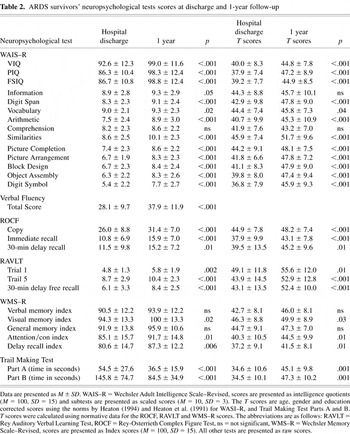
Seventy-three percent of patients (54 of 74) had cognitive sequelae at hospital discharge. For ARDS survivors who completed the 1-year outcome, 69.7% (46 of 66) had cognitive sequelae at hospital discharge, while 45.5% (30 of 66) had cognitive sequelae at 1 year post discharge. Fourteen of 66 ARDS survivors (21.2%) experienced no cognitive sequelae at either time, while 24 of 66 (36.4%) had cognitive sequelae at hospital discharge and at 1 year post discharge. In addition, 22 of 66 ARDS survivors (33.3%) improved over time, having cognitive sequelae at hospital discharge but not at one-year. Six of 66 (9.1%) had cognitive sequelae 1 year following ARDS, but not at hospital discharge. The McNemar test indicated that cognitive sequelae in the ARDS survivors were more likely to improve than get worse over time (exact p value = .004). The ARDS patients have cognitive impairments in the domains of memory, attention/concentration, executive function, mental processing speed and general intellectual decline but not verbal production. Paired t tests for the ARDS survivors' neuropsychological test scores at hospital discharge to 1-year follow-up are shown in Table 2.
ARDS survivors' neuropsychological tests scores at discharge and 1-year follow-up

The magnitude of neurocognitive impairment was assessed using the overall impairment mean scores. The mean overall impairment score (number of SDs below the mean) at hospital discharge was 13.3 ± 8.7 (range 0–42), at 1 year 5.7 ± 5.8 (range 0–26).
The mean scores for the BDI and BAI were 9.3 ± 9.5 (range 0–41) and 9.6 ± 9.8 (range 0–43) respectively, which are not different from the normal population. However, 13 ARDS patients (20%) had mild, 7 patients (11%) moderate, and 4 patients (6%) severe symptoms of depression on the BDI. Ten ARDS patients (15%) had mild, 10 patients (15%) moderate, and 6 patients (9%) severe symptoms of anxiety on the BAI.
Quality of Life
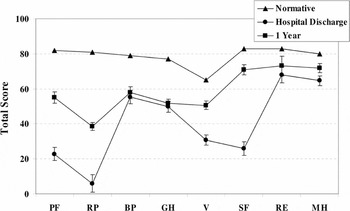
Figure 1 shows the SF-36 scores for hospital discharge and one year follow up compared to normative population data. The ARDS patients had significantly lower quality of life on all scales compared to normative data (t = 19.9–4.1, p < .01–.001). At 1-year follow-up the ARDS survivors SF-36 scores improved for physical functioning (t = 5.4, p < .01), role physical (i.e., problems at work or physical activity due to physical health; t = 5.6, p < .01), vitality (t = 3.5, p < .01), and social functioning (interference with normal social activities due to physical or emotional problems; t = 6.4, p < .01). Alternatively, ARDS survivors' quality of life did not improve for the domains of bodily pain, general health, role emotional, and mental health.

The figure shows the SF-36 scores for the ARDS survivors at hospital discharge and one year compared to normative data (Ware, 1993). Data are presented as mean ± standard error. Both the hospital discharge and 1-year follow-up scores are significantly lower compared to normative data. The abbreviations are PF = physical functioning, RP = role physical, BP = bodily pain, GH = general health, V = vitality, SF = social functioning, RE = role emotional, and MH = mental health.
Primary Analysis
Cognitive sequelae, individual neuropsychological test scores, nor the overall impairment score (number of standard deviations below the mean) correlated with quality of life, depression (BDI), or anxiety (BAI) at 1-year follow-up. However, ICU length of stay was associated with worse physical functioning (r = −.340, p = .005) and role physical (r = −.430, p < .001) on the SF-36. Other hospital stay variables related to ICU length of stay were hospital length of stay (LOS) and total intubation duration, which were also negatively correlated with physical functioning (hospital LOS: r = −.347, p = .004; intubation duration: r = −.361, p = .003) and role physical (hospital LOS: r = −.451, p < .001; intubation duration: r = −.405, p = .001). APACHE II score, a measure of illness severity, at study enrollment was negatively correlated with delayed visual memory 1 year post discharge (r = −.352, p = .004). The ARDS survivors' emotional state, depression (BDI scores) and anxiety (BAI scores) correlated with all domains on the SF-36, except for physical functioning (Table 3). Figure 2 shows the correlations between the BDI and BAI scores and general health and mental domains of the SF-36.
Correlations between SF-36 domains and BDI and BAI scores for ARDS survivors


The figure shows correlations between two SF-36 domains with depression and anxiety. Panel A shows the scatter plot and fit line between BDI and general health scores and Panel B shows BDI and mental health scores. Panel C shows the scatter plot and fit line between BAI and general health scores and Panel C shows BAI and mental scores.
Secondary Analysis
Independent t tests comparing quality of life domains (SF-36), emotional state (BDI and BAI scores), hospital-stay variables and demographic factors between ARDS survivors were not different between the cognitive sequelae and no cognitive sequelae groups (Table 4 and Figure 3).
Comparisons of quality of life domains (SF-36), emotional state (depression and anxiety), medical variables, and demographic variables for ARDS patients with and without cognitive sequelae


The figure shows the SF-36 scores at 1 year for ARDS survivors with cognitive sequelae and with no cognitive sequelae compared to normative data (Ware, 1993). There was no difference on any domain when comparing ARDS survivors with cognitive sequelae compared to those with no cognitive sequelae. The abbreviations are PF = physical functioning, RP = role physical, BP = bodily pain, GH = general health, V = vitality, SF = social functioning, RE = role emotional, and MH = mental health.
Correlations
Since there were no differences in the mean oxygen desaturation duration <90% for ARDS patients with cognitive sequelae 110.6 ± 113.8 hr (n = 30) compared to those with no cognitive sequelae 115.0 ± 152.0 hr (n = 36; p = .89), the two subgroups were combined for analyses. There were no significant correlations at the .01 level with hypoxia <90% SaO2 and neuropsychological test scores.
DISCUSSION
Our ARDS patients exhibit significant affective problems following ARDS, 20% had mild, 11% moderate and 6% severe symptoms of depression, and 15% had mild, 15% moderate and 9% severe symptoms of anxiety. The relationship between critical illness and emotional (mood) disorders is increasingly recognized. The prevalence and severity of depression and anxiety in ICU survivors range from <10% to 58% (Al-Saidi et al., 2003; Angus et al., 2001; Herridge et al., 2003; Hopkins et al., 1999; Kapfhammer et al., 2004; McCartney & Boland, 1994; Milisen et al., 2001; Orme et al., 2003; Skodol, 1999; Szokol & Vender, 2001; Weinert et al., 1997). Prevalence rates for depression and anxiety in our ARDS patients are similar to those reported in other critically ill patients (Rincon et al., 2001; Scragg et al., 2001). Similarly, depression is reported in 22 to 33% of medical inpatients (Katon & Sullivan, 1990) and 25 to 28% in patients with cardiac and pulmonary disorders (Silverstone, 1996; Silverstone et al., 1996). Anxiety is reported in 5 to 20% in medical inpatients (Strain et al., 1981) and 10 to 40% in patients with pulmonary disorders (Karajgi et al., 1990; Pollack et al., 1996). The rate of depression in our ARDS patients is similar to other ARDS populations, medical inpatients, and patients with pulmonary disorders. Alternatively, the anxiety in our ARDS patients is higher than that reported in medical inpatients, but is similar to patients with pulmonary disorders.
Depression and anxiety in our study were identified using self-report measures (BDI and BAI) which may over diagnose these disorders compared with structured clinical interviews. Self-report measures of depression and anxiety are commonly used in studies in medical populations (Craven et al., 1988; Kabacoff et al., 1997). Most previous ARDS studies use self-report measures to assess depression and anxiety (Hopkins et al., 1999; Nelson et al., 2000; Orme et al., 2003; Schelling et al., 2003; Weinert et al., 2001) but the measures varied across studies making comparisons across studies difficult. Had we used clinician ratings to assess depression and anxiety, the prevalence may be lower than what we found using the BDI and BAI. However, previous studies have shown moderate correlations between clinician ratings of depression and BDI scores (.62–.66) in normal individuals (Foa et al., 1993) and .55 to .96 in psychiatric patients (Groth-Marnat, 1990). The prevalence of depression was 22 to 33% medical inpatients using depression self-rating scales (Katon & Sullivan, 1990) and 25 to 28% when using structured psychiatric interviews (Silverstone, 1996).
One limitation of the BDI is that seven of the items measure physical symptoms (somatic items) of depression therefore the depression reported by our ARDS subjects may reflect physical problems associated with ARDS, which may increase the severity and prevalence of depression. A study in individuals with traumatic brain injury compared the cognitive–affective with the somatic items on the BDI, and found higher endorsement of the cognitive–affective items compared to the somatic items suggesting that the BDI may be an effective tool for evaluating depression even in disorders associated with somatic symptoms (Green et al., 2001). Research is needed to determine the extent to which somatic symptoms influence reporting of depression in ARDS patients.
The high rate of affective disorders in the ARDS patients raise questions regarding the etiology of depression and anxiety following critical illness. While the etiology of mood disorders following critical illness is unclear, they are thought to be associated with biological changes (Morrison & Kastenberg, 1997). For example depression has been associated with elevated cytokines (Katz, 1996), activation of the hypothalamic pituitary axis (Gold et al., 1995), cerebral atrophy (Pearlson et al., 1989) hypoxemia (Katz, 1982), and neurotransmitter aberrations due to brain injury (Frasure-Smith et al., 1995). Sedative medications (Nelson et al., 2000), pain, altered sensory inputs, and traumatic stress (McCartney & Boland, 1994; Skodol, 1999; Szokol & Vender, 2001) may also contribute to affective morbidity following critical illness. Given the significant correlations between depression and low quality of life in our ARDS patients, the depression may be due in part to a psychological reaction to ARDS related physical and cognitive morbidity.
Relationships Between Quality of Life and Depression, Anxiety and Illness Severity
Depression, anxiety, duration of intubation, ICU length of stay, and hospital length of stay were associated with decreased quality of life for all domains, except physical functioning (SF-36; Table 3). As expected, the decreased quality of life in our ARDS survivors is similar to previous studies (Al-Saidi et al., 2003; Angus et al., 2001; Davidson et al., 1999; Herridge et al., 2003; Hopkins et al., 1999; McHugh et al., 1994; Rothenhausler et al., 2001; Schelling et al., 1998; Weinert et al., 1997). A study in patients with acute lung injury (milder form of ARDS) found depression and psychosocial symptoms were associated with lower life satisfaction but not with physical problems or limitations (Weinert et al., 1997). Our findings differ from those of Weinert and coworkers in that decreased quality of life was associated with all domains, except physical functioning, including physical role and general health. Similarly depression correlates with poor functional status and decreased ability to perform activities of daily living in patients with chronic obstructive pulmonary disease (COPD; Toshima et al., 1992). Decreased health-related quality of life on the psychosocial domains of the SF-36 (e.g., role emotional, mental health and vitality) are associated with PTSD in ARDS patients (Kapfhammer et al., 2004; Schelling et al., 1998). Affective morbidity and its relationship with decreased quality of life are likely multifactorial and additional research is needed to understand patient predisposition, illness and treatment-specific contributions to affective morbidity.
Cognitive Sequelae
We found significant cognitive sequelae in our ARDS survivors at hospital discharge (75%) and at 1 year (45%). The ARDS survivors' cognitive function modestly improved from hospital discharge to 1 year, however almost one-half of the patients still had significant cognitive sequelae at 1 year. At 1 year approximately 50% of ARDS survivors neuropsychological test scores fell below the 6th percentile of the normal distribution of cognitive function. These ARDS survivors' impairments included executive function, memory, attention, and slow mental processing speed.
The cognitive impairments are similar to our previous report (Hopkins et al., 1999), other ARDS investigations (Al-Saidi et al., 2003; Marquis et al., 2000; Rothenhausler et al., 2001), and medical ICU survivors (Jackson et al., 2003). However the prevalence of cognitive impairment varies across studies. While 46% of our ARDS survivors had cognitive sequelae at 1 year, other investigations report prevalence rates of 20 to 35% (Al-Saidi et al., 2003; Jackson et al., 2003; Rothenhausler et al., 2001). It is difficult to compare our results to previous findings (Al-Saidi et al., 2003; Jackson et al., 2003; Marquis et al., 2000; Rothenhausler et al., 2001) as our study was different with respect to definition of sequelae, neurocognitive tests administered, time to follow up, patient population, and ARDS disease severity. For example Al-Saidi and colleagues used a self-report questionnaire of memory (Al-Saidi et al., 2003), and Rothenhausler and colleagues administered a brief cognitive test that assessed only memory and attention and they had a low follow-up rate (Rothenhausler et al., 2001). Conversely, our ARDS patients had more severe ARDS (PaO2/FiO2 ratio ≤ 150) and we used a comprehensive neuropsychological test battery that may be more sensitive to cognitive impairments and identify impairments in more cognitive domains.
Relationship Between Quality of Life and Cognitive Sequelae
Cognitive sequelae were not associated with decreased quality of life in our ARDS survivors. There were no significant differences between the ARDS survivors with cognitive sequelae compared to those with no cognitive sequelae on any SF-36 domain (see Table 4 and Figure 3). In contrast, cognitive impairments have been associated with decreased quality of life in ARDS patients, however there was significant overlap between the ARDS survivors with and without cognitive sequelae on all domains and both subgroups reported lower quality of life than age and gender related normal individuals (Rothenhausler et al., 2001). Similar findings of decreased quality of life associated with cognitive impairments are found in stroke patients (Kwa et al., 1996a, 1996b), in ICU survivors following multiple trauma (Thiagarajan & Miranda, 1995), following traumatic brain injury (Warren et al., 1996), HIV (Osowiecki et al., 2000), carbon monoxide poisoning (Churchill et al., 2002), and COPD (McSweeny & Labuhn, 1996). For example impaired executive function significantly correlated with poor life functioning in COPD patients (McSweeny et al., 1985).
The reason for the lack of relationship between cognitive sequelae and decreased quality of life in our ARDS survivors is unclear. One possible reason that cognitive sequelae were not related to decreased quality of life is that many of the ARDS subjects report very low quality of life and almost half have significant cognitive impairments, resulting in a restricted range. Thus the low SF-36 scores may have resulted in the non-significant effects. However, SF-36 scores correlated with measures of depression and anxiety, suggesting that there must be sufficient variability in the SF-36 scores allowing significant correlations to be detected, if they are present. A second possibility may be that the physical and emotional sequelae override the contribution of cognitive sequelae on quality of life at least in the 1st year after ARDS. For example decreased quality of life on the physical domains have been associated with pulmonary function abnormalities (Orme et al., 2003) and persistent physical dysfunction (Herridge et al., 2003). Similarly emotional sequelae including depression and PTSD have been associated with decreased quality of life (Schelling et al., 1998; Weinert et al., 1997). Thus, factors besides cognitive function may account for decreased quality of life in the ARDS patients.
Study Strengths and Limitations
The strengths of this study include the prospective cohort study design, consistent follow up time, and high follow-up rate. The relationship between ICU length of stay, depression, and anxiety and quality of life does not appear to be due to subject selection bias.
There are several limitations of this study including the small sample size. A sample of 66 patients will have 90% power to detect a correlation of .453 or higher when tested at the .01 two-sided significance level (i.e., null hypothesis of no association between two factors). Similarly, a sample with 30 and 36 patients with and without cognitive sequelae, respectively, will have 90% power to detect 0.82 standard deviation units when using an independent samples t test testing at the .05 two-sided significance level. Thus a larger study might find a relationship between cognitive sequelae and decreased quality of life.
A second limitation of our study is the lack of an appropriate ARDS control group. Since we did not follow a control group of ICU survivors who did not have ARDS, the cognitive sequelae we observed may not be specific to ARDS but rather may represent morbidity due to critical illness. We also did not follow a normal control group; however, it should be noted that we used demographically (i.e., age, gender, and education) corrected neuropsychological test scores for statistical analyses, which provides normative data for comparison, resulting in improved neurodiagnostic accuracy by correcting for variables known to affect test performance.
The improvement from hospital discharge to 1-year follow-up may be due to practice effects. The improvement in cognitive function was approximately .3 to .5 standard deviations, however the improvement in cognitive function are larger than those observed in most studies of repeated test administration in stable individuals (Heaton et al., 2001; Temkin et al., 1999). A final limitation of our study and most prior studies of quality of life is the inability to measure premorbid quality of life and neurocognitive function.
CONCLUSION
Acute Respiratory Distress Syndrome is a life-threatening illness with a high mortality and is associated with significant sequelae including physical disabilities, pulmonary function abnormalities, cognitive impairments, depression, and anxiety. Decreased quality of life correlated with increased depression, anxiety, and length of intensive care unit stay, duration intubation, and hospital length of stay. Mood disorders and illness severity represent important contributors to decreased quality of life impairments in survivors of critical illness. Clinicians need to be aware of the brain related morbidity manifest by cognitive impairments, affective sequelae, and decreased quality of life following ARDS.
ACKNOWLEDGMENTS
This research was sponsored by Deseret Foundation Grants #300 and #318, and NIH ARDS SCOR Grant #HL50513.
References
REFERENCES
Abel, S.J.,
Finney, S.J.,
Brett, S.J.,
Keogh, B.F.,
Morgan, C.J., &
Evans, T.W.
(1998).
Reduced mortality in association with the acute respiratory
distress syndrome (ARDS).
Thorax,
53,
292–294.Google Scholar
Albert, S.M.,
Michaels, K.,
Padilla, M.,
Pelton, G.,
Bell, K.,
Marder, K.,
Stern, Y., &
Devanand, D.P.
(1997).
Functional significance of mild cognitive impairment in elderly
patients without a dementia diagnosis.
American Journal of Geriatric Psychiatry,
7,
213–220.Google Scholar
Al-Saidi, F.,
McAndrews, M.P.,
Cheunt, A.M.,
Tansey, C.M.,
Matte-Martyn, A.,
Diaz-Granados, N., &
Herridge, M.S.
(2003).
Neuropsychological sequelae in ARDS survivors.
American Journal of Respiratory and Critical Care Medicine,
167,
A737.Google Scholar
Angus, D.C.,
Musthafa, A.A.,
Clermont, G.,
Griffin, M.F.,
Linde-Zwirble, W.T.,
Dremsizov, T., &
Pinsky, M.R.
(2001).
Quality-adjusted survival in the first year after the acute
respiratory distress syndrome.
American Journal of Respiratory and Critical Care Medicine,
163,
1389–1394.Google Scholar
Beck, A.
(1996).
BDI–II Depression Inventory manual
(2nd ed.).
New York:
Harcourt-Brace.
Beck, A. &
Steer, R.A.
(1993).
Beck Anxiety Inventory.
San Antonio, TX:
The Psychological Corporation.
Bernard, G.R.,
Artigas, A.,
Brigham, K.L.,
Carlet, J.,
Falle, K.,
Hudson, L.,
Lamy, M.,
LeGall, J.R.,
Morris, A., &
Spragg, R.
(1994).
Report of the American-European Consensus Conference on acute
respiratory distress syndrome: Definitions, mechanics, relevant
outcomes, and clinical trial coordination.
American Journal of Respiratory Critical Care Medicine,
149,
818–824.Google Scholar
Churchill, S.,
Hopkins, R.O.,
Weaver, L.K.,
Chan, K.J., &
Haberstock, D.
(2002).
Health related quality of life (HRQL) following carbon monoxide
poisoning.
Undersea and Hyperbaric Medicine,
29,
139–140.Google Scholar
Combes, A.,
Costa, M.A.,
Trouillet, J.L.,
Baudot, J.,
Mokhtari, M.,
Gibert, C., &
Chastre, J.
(2003).
Morbidity, mortality, and quality-of-life outcomes of patients
requiring > or = 14 days of mechanical ventilation.
Critical Care Medicine,
31,
1373–1381.Google Scholar
Cooper, A.B.,
Ferguson, N.D.,
Hanly, P.,
Meade, M.O.,
Kachura, J.R.,
Granton, J.T.,
Slutsky, A.S., &
Stewart, T.E.
(1999).
Long-term follow-up of survivors of acute lung injury: Lack of
effect of a ventilation strategy to prevent barotrauma.
Critical Care Medicine,
27,
2616–2621.Google Scholar
Craven, J.L.,
Rodin, G.M., &
Littlefield, C.
(1988).
The Beck Depression Inventory as a screening device for major
depression in renal dialysis patients.
International Journal of Psychiatry Medicine,
18,
365–374.Google Scholar
Davidson, T.A.,
Caldwell, E.S.,
Curtis, J.R.,
Hudson, L.D., &
Steinberg, K.P.
(1999).
Reduced quality of life in survivors of acute respiratory distress
syndrome compared with critically ill control patients.
Journal of the American Medical Association,
281,
354–360.Google Scholar
Ely, E.W.,
Shintani, A.,
Truman, B.,
Speroff, T.,
Gordon, S.M.,
Harrell, F., Jr.,
Inouye, S.K.,
Bernard, G.R., &
Dittus, R.S.
(2004).
Delirium as a predictor of mortality in mechanically ventilated
patients in the intensive care unit.
Journal of the American Medical Association,
291,
1753–1762.Google Scholar
Foa, E.B.,
Riggs, D.S.,
Dancu, C.V.S., &
Rothbaum, B.O.
(1993).
Reliability and validity of a brief instrument for assessing Post
Traumatic Stress Disorder.
Journal of Traumatic Stress,
6,
459–473.Google Scholar
Frasure-Smith, N.,
Lesperance, F., &
Talajic, M.
(1995).
The impact of negative emotions on prognosis following myocardial
infarction: Is it more than depression?
Health Psychology,
14,
388–398.Google Scholar
Gale, S.D. &
Hopkins, R.O.
(2004).
Effects of hypoxia on the brain: Neuroimaging and
neuropsychological findings following carbon monoxide poisoning and
obstructive sleep apnea.
Journal of the International Neuropsychological Society,
10,
60–71.Google Scholar
Gale, S.D.,
Hopkins, R.O.,
Weaver, L.K.,
Walker, J.M.,
Bigler, E.D., &
Cloward, T.V.
(2000).
Hippocampal atrophy following sleep apnea and carbon monoxide
poisoning: similarities and differences.
Journal of International Neuropsychological Society,
6,
154.Google Scholar
Gold, P.W.,
Licinio, J.,
Wong, M.L., &
Chrousos, G.P.
(1995).
Corticotropin releasing hormone in the pathophysiology of
melancholic and atypical depression and in the mechanism of action of
antidepressant drugs.
Annals of the New York Academy of Sciences,
771,
716–729.Google Scholar
Green, A.,
Felmingham, K.,
Baguley, I.J.,
Slewa-Younan, S., &
Simpson, S.
(2001).
The clinical utility of the Beck Depression Inventory after
traumatic brain injury.
Brain Injury,
15,
1021–1028.Google Scholar
Griffith, H.R.,
Belue, K.,
Sicola, A.,
Krzywanski, S.,
Zamrini, E.,
Harrell, L., &
Marson, D.C.
(2003).
Impaired financial abilities in mild cognitive impairment: A direct
assessment approach.
Neurology,
60,
449–457.Google Scholar
Groth-Marnat, G.
(1990).
Handbook of psychological assessment
(2nd ed.).
New York:
John Wiley and Sons.
Heaton, R.K.
(1994).
Comprehensive norms for an Expanded Halstead–Reitan Battery:
A supplement for the WAIS–R.
Odessa, FL:
Psychological Assessment Resources, Inc.
Heaton, R.K.,
Grant, I., &
Matthews, C.G.
(1991).
Comprehensive norms for an Expanded Halstead-Reitan Battery:
Demographic corrections, research findings, and clinical
applications.
Odessa, FL:
Psychological Assessment Resources, Inc.
Heaton, R.K.,
Temkin, N.,
Dikmen, S.,
Avitable, N.,
Taylor, M.J.,
Marcotte, T.D., &
Grant, I.
(2001).
Detecting change: A comparison of three neuropsychological methods,
using normal and clinical samples.
Archives of Clinical Neuropsychology,
16,
75–91.Google Scholar
Herridge, M.S.,
Cheung, A.M.,
Tansey, C.M.,
Matte-Martyn, A.,
Diaz-Granados, N.,
Al-Saidi, F.,
Cooper, A.B.,
Guest, C.B.,
Mazer, C.D.,
Mehta, S.,
Stewart, T.E.,
Barr, A.,
Cook, D.,
Slutsky, A.S., &
the Canadian Critical Care Trials Group.
(2003).
One-year outcomes in survivors of the acute respiratory distress
syndrome.
New England Journal of Medicine,
348,
683–693.Google Scholar
Heyland, D.K.,
Hopman, W.,
Coo, H.,
Tranmer, J., &
McColl, M.A.
(2000).
Long-term health-related quality of life in survivors of sepsis.
Short form 36: A valid and reliable measure of health-related quality
of life.
Critical Care Medicine,
28,
3599–3605.Google Scholar
Hopkins, R.O.,
Larson-Lohr, V.,
Weaver, L.K., &
Bigler, E.D.
(1998).
Neuropsychological impairments following hantavirus pulmonary
syndrome.
Journal of the International Neuropsychological Society,
4,
190–196.Google Scholar
Hopkins, R.O.,
Weaver, L.K.,
Pope, D.,
Orme, J.F.,
Bigler, E.D., &
Larson, L.V.
(1999).
Neuropsychological sequelae and impaired health status in survivors
of severe acute respiratory distress syndrome.
American Journal of Respiratory and Critical Care Medicine,
160,
50–56.Google Scholar
Jackson, J.C.,
Hart, R.P.,
Gordon, S.M.,
Shintani, A.,
Truman, B.,
May, L., &
Ely, E.W.
(2003).
Six-month neuropsychological outcome of medical intensive care unit
patients.
Critical Care Medicine,
31,
1226–1234.Google Scholar
Kabacoff, R.I.,
Segal, D.L.,
Hersen, M., &
Van Hasselt, V.B.
(1997).
Psychometric properties and diagnostic utility of the Beck Anxiety
Inventory and the State–Trait Anxiety Inventory with old adult
psychiatric outpatients.
Journal of Anxiety Disorders,
1,
33–47.Google Scholar
Kapfhammer, H.P.,
Rothenhausler, H.B.,
Krauseneck, T.,
Stoll, C., &
Schelling, G.
(2004).
Posttraumatic stress disorder and health-related quality of life in
long-term survivors of acute respiratory distress syndrome.
American Journal of Psychiatry,
161,
45–52.Google Scholar
Karajgi, B.,
Rifkin, A.,
Doddi, S., &
Kolli, R.
(1990).
The prevalence of anxiety disorders in patients with chronic
obstructive pulmonary disease.
American Journal of Psychiatry,
147,
200–201.Google Scholar
Katon, W. &
Sullivan, M.D.
(1990).
Depression and chronic medical illness.
Journal of Clinical Psychiatry,
51 (Suppl.),
3–14.Google Scholar
Katz, I.R.
(1982).
Is there a hypoxic affective syndrome?
Psychosomatics,
23,
846–853.Google Scholar
Katz, I.R.
(1996).
On the inseparability of mental and physical health in aged
persons: Lessons from depression and medical comorbidity.
American Journal of Geriatric Psychiatry,
4,
1–16.Google Scholar
Knaus, W.A.,
Draper, E.A.,
Wagner, D.P., &
Zimmerman, J.E.
(1985).
APACHE II: A severity of disease classification system.
Critical Care Medicine,
13,
818–829.Google Scholar
Kwa, V.I.,
Limburg, M., &
de Haan, R.J.
(1996a).
The role of cognitive impairment in the quality of life after
ischaemic stroke.
Journal of Neurology,
243,
599–604.Google Scholar
Kwa, V.I.,
Limburg, M.,
Voogel, A.J.,
Teunisse, S.,
Derix, M.M., &
Hijdra, A.
(1996b).
Feasibility of cognitive screening of patients with ischaemic
stroke using the CAMCOG. A hospital-based study.
Journal of Neurology,
243,
405–409.Google Scholar
Marquis, K.,
Curtis, J.,
Caldwell, E.,
Davidson, T.,
Davis, J.,
Sanchez, P.,
Rosenbaum, G.,
Hudson, L.D., &
Steinberg, K.P.
(2000).
Neuropsychological sequelae in survivors of ARDS compared with
critically ill control patients.
American Journal of Respiratory and Critical Care Medicine,
161,
A383.Google Scholar
McCartney, J.R. &
Boland, R.J.
(1994).
Anxiety and delirium in the intensive care unit.
Critical Care Clinics,
10,
673–680.Google Scholar
McHugh, L.G.,
Milberg, J.A.,
Whitcomb, M.E.,
Schoene, R.B.,
Maunder, R.J., &
Hudson, L.D.
(1994).
Recovery of function in survivors of the acute respiratory distress
syndrome.
American Journal of Respiratory and Critical Care Medicine,
150,
90–94.Google Scholar
McSweeny, A.J.,
Grant, I.,
Heaton, R.K.,
Prigatano, G.P., &
Adams, K.
(1985).
Relationship of neuropsychological status to everyday functioning
in healthy and chronically ill persons.
Journal of Clinical and Experimental Neuropsychology,
7,
281–291.Google Scholar
McSweeny, A.J. &
Labuhn, K.T.
(1996).
The relationship of neuropsychological functioning to life quality
in systemic medical disease: The example of chronic obstructive
pulmonary disease. In
I. Grant &
K.M. Adams (Eds.),
Neuropsychological assessment in neuropsychiatry (pp.
577–602).
New York:
Oxford, University Press.
Michaels, A.J.,
Michales, C.E.,
Smith, J.S.,
Moon, C.H.,
Peterson, C., &
Long, W.B.
(2000).
PTSD in critical care.
Journal of Trauma,
48,
841–850.Google Scholar
Milberg, J.A.,
Davis, D.R.,
Steinberg, K.P., &
Hudson, L.D.
(1995).
Improved survival of patients with acute respiratory distress
syndrome (ARDS): 1983–1993.
Journal of the American Medical Association,
273,
306–309.Google Scholar
Milisen, K.,
Foreman, M.D.,
Abraham, I.L.,
Geest, S.D.,
Bodderis, J.,
Vandermeulen, E.,
Fischler, B.,
Delooz, H.H.,
Spiessens, B., &
Broos, P.L.
(2001).
A nurse-led interdisciplinary intervention program for delirium in
elderly hip-fracture patients.
Journal of the American Geriatrics Society,
49,
523–532.Google Scholar
Morrison, M.F. &
Kastenberg, J.S.
(1997).
Differentiation of secondary for primary mood disorders:
Controversies and consensus.
Seminars in Clinical Neuropsychiatry,
2,
232–243.Google Scholar
National Research Council.
(2000).
The aging mind: Opportunities in cognitive research.
Washington, DC:
National Academy of Press.
Naugle, R.I.,
Cullum, C.M., &
Bigler, E.
(1998).
Introduction to clinical neuropsychology: A Case book.
Austin, TX:
Pro-Ed.
Nelson, B.J.,
Weinert, C.R.,
Bury, C.L.,
Marinelli, W.A., &
Gross, C.R.
(2000).
Intensive care unit drug use and subsequent quality of life in
acute lung injury patients.
Critical Care Medicine,
28,
3626–3630.Google Scholar
Newman, M.,
Grocott, H.,
Mathew, J.,
White, W.,
Landolfo, K.,
Reves, J.,
(2001a).
Report of the substudy assessing the impact of neurocognitive
function on quality of life 5 years after cardiac surgery.
Stroke,
32,
2874–2881.Google Scholar
Newman, M.,
Kirchner, J.,
Phillips-Bute, B.,
Gaver, V.,
Grocott, H.,
Jones, R.H.,
Mark, D.B.,
Reves, J.G.,
Blumenthal, J.A., &
The Neurological Outcome Research Group and the Cardiothoracic
Anesthesiology Research Endeavors Investigators.
(2001b).
Longitudinal assessment of neurocognitive function after
coronary-artery bypass surgery.
New England Journal of Medicine,
344,
395–402.Google Scholar
Nygard, L.
(2003).
Instrumental activities of daily living: A stepping stone towards
Alzheimer's disease diagnosis in subjects with mild cognitive
impairment?
Acta Neurologica Scandinavia,
179,
S42–S46.Google Scholar
Oniki, T.A. &
Gardner, R.M.
(1994).
Computerized detection of arterial oxygen desaturations in an intensive
care unit.
Proceedings of the Annual Symposium of Computer Applications in
Medical Care,
307–311.
Orme, J., Jr.,
Romney, J.S.,
Hopkins, R.O.,
Pope, D.,
Chan, K.J.,
Thomsen, G.,
Crapo, R.O., &
Weaver, L.K.
(2003).
Pulmonary function and health-related quality of life in survivors
of acute respiratory distress syndrome.
American Journal of Respiratory and Critical Care Medicine,
167,
690–694.Google Scholar
Osowiecki, D.M.,
Cohen, R.A.,
Morrow, K.M.,
Paul, R.H.,
Carpenter, C.C.,
Flanigan, T., &
Boland, R.J.
(2000).
Neurocognitive and psychological contributions to quality of life
in HIV-1-infected women.
Aids,
14,
1327–1332.Google Scholar
Pearlson, G.D.,
Rabins, P.V.,
Kim, W.S.,
Speedie, L.J.,
Moberg, P.J.,
Burns, A., &
Bascom, M.J.
(1989).
Structural brain CT changes and cognitive deficits in elderly
depressives with and without reversible dementia
(‘pseudodementia’).
Psychological Medicine,
19,
573–584.Google Scholar
Petty, T.L. &
Ashbaugh, D.G.
(1971).
The adult respiratory distress syndrome: Clinical features and
factors influencing prognosis and principles of management.
Chest,
60,
233–239.Google Scholar
Pollack, M.H.,
Kradin, R.,
Otto, M.W.,
Worthington, J.,
Gould, R.,
Sabatino, S.A., &
Rosenbaum, J.F.
(1996).
Prevalence of panic in patients referred for pulmonary function
testing at a major medical center.
American Journal of Psychiatry,
153,
110–113.Google Scholar
Rincon, H.G.,
Granados, M.,
Unutzer, J.,
Gomez, M.,
Duran, R.,
Badiel, M.,
Salas, C.,
Martinez, J.,
Mejia, J.,
Ordonez, C.,
Florez, N.,
Rosso, F., &
Echeverri, P.
(2001).
Prevalence, detection and treatment of anxiety, depression, and
delirium in the adult critical care unit.
Psychosomatics,
42,
391–396.Google Scholar
Rockwood, K.,
Brown, M.,
Merry, H.,
Sketris, I., &
Fisk, J.
(2002).
Societal costs of vascular cognitive impairment in older adults.
Stroke,
33,
1605–1609.Google Scholar
Rothenhausler, H.B.,
Ehrentraut, S.,
Stoll, C.,
Schelling, G., &
Kapfhammer, H.P.
(2001).
The relationship between cognitive performance and employment and
health status in long-term survivors of the acute respiratory distress
syndrome: Results of an exploratory study.
General Hospital Psychiatry,
23,
90–96.Google Scholar
Rubenfeld, G.D.
(2003).
Epidemiology of acute lung injury.
Critical Care Medicine,
31 (Suppl.),
S276–S284.Google Scholar
Rubenfeld, G.D.,
Doyle, R.L., &
Matthay, M.A.
(1995).
Evaluation of definitions of ARDS.
American Journal of Respiratory and Critical Care Medicine,
151,
1270–1271.Google Scholar
Schelling, G.,
Richter, M.,
Roozendaal, B.,
Rothenhausler, H.B.,
Krauseneck, T.,
Stoll, C.,
Nollert, G.,
Schmidt, M., &
Kapfhammer, H.P.
(2003).
Exposure to high stress in the intensive care unit may have
negative effects on health-related quality-of-life outcomes after
cardiac surgery.
Critical Care Medicine,
31,
1971–1980.Google Scholar
Schelling, G.,
Stoll, C.,
Haller, M.,
Briegel, J.,
Manert, W.,
Hummel, T.,
Lenhart, A.,
Heyduck, M.,
Polaset, J.,
Meier, M.,
Preuss, U.,
Bullinger, M.,
Schuffel, W., &
Peter, K.
(1998).
Health-related quality of life and posttraumatic stress disorder in
survivors of the acute respiratory distress syndrome.
Critical Care Medicine,
26,
651–659.Google Scholar
Scragg, P.,
Jones, A., &
Fauvel, N.
(2001).
Psychological problems following ICU treatment.
Anaesthesia,
56,
9–14.Google Scholar
Silverstone, P.H.
(1996).
Prevalence of psychiatric disorders in medical inpatients.
Journal of Nervous and Mental Disease,
184,
43–51.Google Scholar
Silverstone, P.H.,
Lemay, T.,
Elliott, J.,
Hsu, V., &
Starko, R.
(1996).
The prevalence of major depressive disorder and low self-esteem in
medical inpatients.
Canadian Journal of Psychiatry,
41,
67–74.Google Scholar
Skodol, A.E.
(1999).
Anxiety in the medically ill: Nosology and principles of
differential diagnosis.
Seminars in Clinical Neuropsychiatry,
4,
64–71.Google Scholar
Stewart, A.,
Hays, R., &
Ware, J.
(1988).
The MOS short form general health survey: Reliability and validity
in a patient population.
Medical Care,
26,
724–732.Google Scholar
Strain, J.J.,
Liebowitz, M.R., &
Klein, D.F.
(1981).
Anxiety and panic attacks in the medically ill.
Psychiatric Clinics of North America,
4,
333–350.Google Scholar
Streadman-Pare, D.,
Colantonio, A.,
Ratcliff, G.,
Chase, S., &
Vernich, L.
(2000).
Factors associated with perceived quality of life many years after
traumatic brain injury.
Journal of Head Trauma Rehabilitation,
16,
330–342.Google Scholar
Suchyta, M.R.,
Clemmer, T.,
Orme, J.F., Jr.,
Morris, A.H., &
Elliott, C.G.
(1991).
Increased survival of ARDS patients with severe hypoxemia (ECMO
criteria).
Chest,
99,
951–955.Google Scholar
Suchyta, M.R.,
Elliott, C.G.,
Jensen, R.L., &
Crapo, R.O.
(1993).
Predicting the presence of pulmonary function impairment in adult
respiratory distress syndrome survivors.
Respiration,
60,
103–108.Google Scholar
Szokol, J.W. &
Vender, J.S.
(2001).
Anxiety, delirium, and pain in the intensive care unit.
Critical Care Clinics,
17,
821–842.Google Scholar
Tabert, M.H.,
Albert, S.M.,
Borukhova-Milov, B.A.,
Camacho, Y.,
Pelton, G.,
Liu, X.,
Stern, Y., &
Devanand, D.P.
(2002).
Functional deficits in patients with mild cognitive impairments:
Prediction of AD.
Neurology,
58,
758–764.Google Scholar
Temkin, N.R.,
Heaton, R.K.,
Grant, I., &
Dikmen, S.S.
(1999).
Detecting significant change in neuropsychological test
performance: A comparison of four models.
Journal of the International Neuropsychological Society,
5,
357–369.Google Scholar
Thiagarajan, J. &
Miranda, D.R.
(1995).
Quality of life after multiple trauma requiring intensive care.
Anaesthesia,
49,
211–218.Google Scholar
Toshima, M.T.,
Blumberg, E.,
Ries, A.L., &
Kaplan, R.M.
(1992).
Does rehabilitation reduce depression in patients with chronic
obstructive pulmonary disease?
Journal of Cardiopulmonary Rehabilitation,
12,
261–269.Google Scholar
Ware, J.E.
(1993).
SF-36 Health Survey manual and interpretation guide.
Boston:
The Health Institute, New England Medical Center.
Ware, J.E.,
Kosinski, M., &
Keller, S.D.
(1994).
SF-36 Physical and Mental Health Summary Scales: A user's
manual.
Boston:
The Health Institute, New England Medical Center.
Warren, L.,
Wrigley, J.M.,
Yoels, W.C., &
Fine, P.R.
(1996).
Factors associated with life satisfaction among a sample of persons
with neurotrauma.
Journal of Rehabilitation Research and Development,
33,
404–408.Google Scholar
Weaver, L.K.,
Hopkins, R.O.,
Chan, K.J.,
Churchill, S.,
Elliott, C.G.,
Clemmer, T.P.,
Orme, J.F., Jr.,
Thomas, F.O., &
Morris, A.H.
(2002).
Hyperbaric oxygen for acute carbon monoxide poisoning.
New England Journal of Medicine,
347,
1057–1067.Google Scholar
Weinert, C.R.,
Chlan, L., &
Gross, C.
(2001).
Sedating critically ill patients: Factors affecting nurses'
delivery of sedative therapy.
American Journal of Critical Care,
10,
156–167.Google Scholar
Weinert, C.R.,
Gross, C.R.,
Kangas, J.R.,
Cury, C.L., &
Marinelli, W.A.
(1997).
Health-related quality of life after acute lung injury.
American Journal of Respiratory and Critical Care Medicine,
156,
1120–1128.Google Scholar

Medical data for ARDS survivors
ARDS survivors' neuropsychological tests scores at discharge and 1-year follow-up
The figure shows the SF-36 scores for the ARDS survivors at hospital discharge and one year compared to normative data (Ware, 1993). Data are presented as mean ± standard error. Both the hospital discharge and 1-year follow-up scores are significantly lower compared to normative data. The abbreviations are PF = physical functioning, RP = role physical, BP = bodily pain, GH = general health, V = vitality, SF = social functioning, RE = role emotional, and MH = mental health.

Correlations between SF-36 domains and BDI and BAI scores for ARDS survivors

The figure shows correlations between two SF-36 domains with depression and anxiety. Panel A shows the scatter plot and fit line between BDI and general health scores and Panel B shows BDI and mental health scores. Panel C shows the scatter plot and fit line between BAI and general health scores and Panel C shows BAI and mental scores.

Comparisons of quality of life domains (SF-36), emotional state (depression and anxiety), medical variables, and demographic variables for ARDS patients with and without cognitive sequelae

The figure shows the SF-36 scores at 1 year for ARDS survivors with cognitive sequelae and with no cognitive sequelae compared to normative data (Ware, 1993). There was no difference on any domain when comparing ARDS survivors with cognitive sequelae compared to those with no cognitive sequelae. The abbreviations are PF = physical functioning, RP = role physical, BP = bodily pain, GH = general health, V = vitality, SF = social functioning, RE = role emotional, and MH = mental health.
 You have
Access
- 142
- Cited by