INTRODUCTION
Spiritual well-being is an essential dimension of human life and is recognized as a critical factor in terms of health and well-being (Puchalski, Reference Puchalski2012). It is also an important component of quality of life for patients with cancer (Lucette, Reference Lucette, Bredart and Vivat2014) and patients at the end of life (Balboni et al., Reference Balboni, Paulk and Balboni2010). Previous studies have shown that spiritual well-being impacts physical (Campbell et al., Reference Campbell, Yoon and Johnstone2010: Park et al., Reference Park, Lee and Sun2011) and psychological well-being (Nelson et al., Reference Nelson2009; Dein et al., Reference Dein, Cook and Powell2010; Breitbart et al., Reference Breitbart, Rosenfeld and Gibson2010), as well as quality of life (Vallurupalli et al., Reference Vallurupalli, Lauderdale and Balboni2011). It has also been reported to be a significant predictor of the effectiveness of palliative care in patients with advanced cancer (Chaiviboontham, Reference Chaiviboontham2014).
Although the concept of spiritual well-being still lacks a consensus definition and conceptualization (Vivat et al., Reference Vivat, Young and Efficace2013), Edwards and colleagues (Reference Edwards, Pang and Shiu2010) proposed that it offers a sense of purpose, peace, meaning, and relationship. From the Thai perspective, spiritual well-being can be defined as a multidimensional concept of wisdom, or a mental state, in relation to a religious view that leads to peace, happiness, and enlightenment. It also can be defined within a humanistic context as the compassionate relationship of an individual with other people and with their environment, and it includes religious faith and compliance with religious principles in their interests of self and society (Kunsongkeit, Reference Kunsongkeit, Suchaxaya and Panuthai2004). Similarly, Paloutzian and Ellison (Reference Paloutzian and Ellison1982) suggested that it is comprised of two dimensions, with both vertical and horizontal dimensions. The vertical dimension refers to a sense of well-being in relation to God, while the horizontal dimension refers to a sense of life purpose and life satisfaction, with no reference to anything specifically religious. These two dimensions have been conceptualized as “religious well-being” and “existential well-being,” respectively.
The Spiritual Well-Being Scale (SWBS) has been extensively employed in studies within a spiritual context (Paloutzian & Ellison, Reference Paloutzian and Ellison1982; Ellison, Reference Ellison1983). It is a self-assessment scale consisting of two subscales, with 10 items measuring existential well-being (EWB, the horizontal dimension) and 10 measuring religious well-being (RWB; the vertical dimension). The EWB subscale yields a self-assessment of an individual's sense of life purpose and overall life satisfaction. The RWB subscale provides a self-assessment of an individual's relationship with God.
The scale is widely employed in translation and modification for other cultures and language groups. Imam and colleagues (Reference Imam, Karim and Jusoh2009) investigated the psychometric properties of the Malay version of the SWBS among undergraduate students. The scale was adapted and translated into Malay using the forward-translation method. The internal consistency coefficients for the SWB, EWB, and RWB were 0.88, 0.81, and 0.86, respectively. The four-factor structures were found to account for 57.36% of total variance, a result that did not support the two-factor structures of the original version. An Arabic version of the SWBS was validated by Musa & Pevalin (Reference Musa and Pevalin2012) in Jordanian patients following coronary artery bypass graft surgery. The SWBS was translated and modified to Arabic using the back-translation method. The internal consistency coefficients for the SWB, EWB, and RWB were 0.83, 0.75, and 0.90, respectively. Factor extraction showed that the two-factor structures accounted for 54% of total variance, which supported the original version.
This spiritual well-being assessment tool is not well validated in Thailand, particularly for patients in the advanced stages of a disease. The purpose of our study was to investigate the psychometrics properties of the Thai SWBS (including validity and reliability) in patients with advanced cancer. In terms of validity, the scale was examined for known-group validity, concurrent validity, and construct validity. Internal consistency was also tested with respect to reliability.
METHODS
Design
This study is a secondary data analysis of a cross-sectional study that investigated symptom experience, palliative care use, and spiritual well-being in Thais with advanced cancer, and was conducted during 2008 and 2009 (Get-Kong et al., Reference Get-Kong, Hanucharurnkul and McCorkle2010).
Sample and Setting
Some 196 participants from three tertiary hospitals in Bangkok and suburban Thailand were recruited. The inclusion criteria were patients who were: (1) diagnosed at an advanced stage of cancer, (2) at least 18 years of age, (3) not receiving aggressive or curative treatment, (4) willing to participate, and (5) able to speak, read, and write in Thai. The sample size of 196 was judged adequate for using factor analysis, which represented five subjects for each item (Waltz et al., Reference Waltz, Stickland and Lenz2010).
Ethical Considerations
The design was reviewed and approved by the Institutional Review Board of the Faculty of Medicine at Ramathibodi Hospital of Mahidol University. All participants received trial information and provided written informed consent. Participants were assured of confidentiality and freedom to discontinue at any time throughout the process of data collection.
Data Collection
Patients who consented to participate were given full explanations and completed the study questionnaires in a private room. For participants who needed assistance as a result of health or visual problems, the principal investigator read the questionnaires directly to them and gathered responses to each question. Clinical data—including type of cancer, length of time after diagnosis, comorbid diseases, and use of medical devices—were retrieved from medical records.
Measurements
Three instruments were used for data collection: a Personal Information Questionnaire (PIQ), the Memorial Symptom Assessment Scale (MSAS), and the Spiritual Well-Being Scale (SWBS), Thai version.
The Personal Information Questionnaire (PIQ) was developed by the principal investigator to collect such demographic characteristics as age, gender, marital status, religion, religious practice, educational level, years of education, family income, method of payment for medical expenses and presence of a family caregiver.
The Memorial Symptom Assessment Scale (MSAS), developed by Portenoy and colleagues (Reference Portenoy, Thaler and Kornblith1994), was utilized to assess the prevalence and distress level of 32 symptoms. Symptom prevalence was rated and scored “yes = 1” or “no = 0” by participants, with regard to whether they experienced that symptom during the past week. The MSAS is comprised of frequency, severity, and distress dimensions. According to prior studies, the three dimensions demonstrate a highly positive correlation with each other. Thus, only symptom distress was selected for use in our study because it influences a patient's capability to function in their role, especially in terms of self-management. Symptom distress was measured on a 5-point Likert-type scale (“0 = not at all” to “4 = very much”). The internal consistency of the total symptom distress scale was found to be 0.88.
The Spiritual Well-Being Scale (SWBS) (English version) was developed by Paloutzian and Ellison (Reference Paloutzian and Ellison1982) and is a general measure of spiritual well-being. It is a 20-item instrument with two subscales: 10 items measuring religious well-being (RWB) and 10 measuring existential well-being (EWB). The scale was purchased from Life Advance Inc. for use in our study. The SWB scale is a 6-point Likert-type scale (“strongly agree” to “strongly disagree”). Negative wordings in items are reverse scored. The scale yields three scores: a total scale score (total SWB), a score for RWB, and a score for EWB. The highest possible score, representing the highest degree of SWB, is 120. In addition, the highest possible scores on the EWB and RBW subscales is 60 (Bufford et al., Reference Bufford, Paloutzian and Ellison1991). The SWBS has good face validity, as is evident from the content of the items. Subsequent research has shown a good general index of well-being for the scale. The SWBS and its subscales have also been found to correlate positively with several standard indicators of well-being, including a positive self-concept, finding meaning and purpose in life, high assertiveness, low aggressiveness, good physical health, and good emotional adjustment. In contrast, the SWBS is negatively correlated with such indicators as illness, emotional maladjustment, and dissatisfaction with life (Bufford et al., Reference Bufford, Paloutzian and Ellison1991).
The test–retest reliability coefficients were reported across four studies, with 1 to 10 weeks between testing with the SWBS. The coefficients for total SWB score were 0.93, 0.99, 0.99, and 0.82. For RWB, the coefficients were 0.96, 0.99, 0.96, and 0.88. For EWB, the coefficients were 0.86, 0.98, 0.98, and 0.73. The internal consistency coefficient α across seven samples ranged from 0.89 to 0.94 for total SWB, 0.82 to 0.94 for RWB, and 0.78 to 0.86 for EWB (Bufford et al., Reference Bufford, Paloutzian and Ellison1991).
Noipiang (Reference Noipiang2002) translated and modified the English version of the SWBS into Thai, with permission from the developer, by using the forward-translation method. According to cultural, belief, and religious differences, three items were modified: (1) item 11 (“I believe that a Higher Being/God is concerned about my problems”) was changed to “I believe that religious practice is the way to a peaceful life”; (2) item 17 (“I feel most fulfilled when I am in close communion with a Higher Being/God”) was modified to “Practicing and meditation make me feel peaceful”); and (3) item 19 (“My relationship with a Higher Being/God contributes to my sense of well-being”) became “Even though I have a physical illness, my religious beliefs make me feel peaceful or not anxious.” The content was validated by five experts, including two monks, two nursing instructors, and an oncology nurse. The content validity of the modified version was found to be 0.86. Noipang's study included only women with breast cancer and yielded an internal consistency coefficient α of 0.84 on total scale score (SWB). We also tested the Spiritual Well-Being Scale (SWBS), Thai version, for validity and reliability.
Validity Testing
Known-group validity examines a measure's ability to reliably distinguish between groups who should score high on a trait and those who score low on that trait (Waltz et al., Reference Waltz, Stickland and Lenz2010). For our study, we hypothesized that patients who followed Thai culture and religious beliefs would report a better SWB score than those who did not. We thus employed the SWB score between these groups to evaluate discrepancies.
Concurrent validity is provided by sizable correlations between a construct measure and indicator and are used to estimate an individual's present status based on the same criterion at the same time (Waltz et al., Reference Waltz, Stickland and Lenz2010; Polit & Beck, Reference Polit and Beck2010). Total SWB, EWB, and RWB were used in our study as indicators to test correlations with symptom distress.
Construct validity is directly concerned with the theoretical meanings of a measure. It refers to the measure capturing the major dimension of the concept under study (Polit & Beck, Reference Polit and Beck2010; Waltz et al., Reference Waltz, Stickland and Lenz2010). Exploratory factor analysis (EFA) was employed to assess the construct of the instrument in the light of modifications that might create variations.
Reliability Testing
Internal consistency is a measure of reliability that assesses the degree to which items are related to each other and are measured as a unified construct. The scale was found to be internally consistent to the extent that its items are highly intercorrelated, so that the items are all measuring the same thing (Netemeyer et al., Reference Netemeyer, Bearden and Shama2003; DeVellis, Reference DeVellis2012).
Data Analysis
The data were cleaned and coded before being entered into the computer program. Statistical significance was set with an α value of 0.05. The demographic data were described by using descriptive statistics.
Validity
Known-Group Validity
The t test was used to distinguish spiritual well-being between the groups who did and did not follow spiritual practices.
Concurrent Validity
Pearson's product moment was utilized to test the correlation between total SWB, EWB, and RWB and symptom distress.
Construct Validity
Exploratory factor analysis (EFA), using principal component analysis (PCA) with varimax rotation, was used to determine the number and content of the factors. The Kaiser–Meyer–Olkin test of sampling adequacy and Bartlett's test of sphericity were also performed. The number of factors to be retained was determined by a convergence of criteria including eigenvalues greater than 1, a scree plot, and the theoretical interpretability of the resulting factor structure. Items were selected according to factor loadings above 0.5 and the minimum factor association of the three items.
Reliability
Internal Consistency Reliability
Internal consistency reliability was evaluated using Cronbach's α for each subscale.
RESULTS
Sample Characteristics
The sample ages ranged from 19 to 86 years (mean (M) = 56.4 years), almost equally divided by gender (females: n = 106, 54.1%; males: n = 90, 49.5%). The majority of the sample were married (n = 152, 77.6%); Buddhist (n = 189, 96.4%); followed spiritual practice (n = 142, 72.45%); were primary school graduates (n = 113, 59.2%), and had a mean of 8.29 years of education. All participants (n = 196, 100%) reported having a family caregiver, had an average family income of 29,655.31 baht per month (range = 4,000–300,000 baht per month), and had their healthcare costs primarily paid for by way of the universal coverage system (n = 79, 40.3%) and government welfare (n = 84, 42.9).
Validity
Known-Group Validity
The Thai SWBS was able to distinguish between groups with respect to spiritual practice. Our results showed that patients who followed spiritual practice reported significantly higher scores on total SWB, EWB, and RWB than those who did not (Table 1).
Comparison of SWB subscale scores between participants who did and did not follow spiritual practice

Concurrent Validity
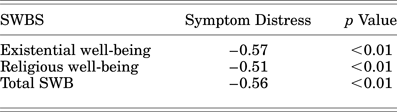
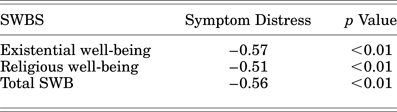
A significant negative relationship was found between total SWB, EWB, and RWB and symptom distress. Patients who reported high spiritual well-being had less symptom distress (Table 2).
Concurrent validity of SWBS and symptom distress (correlation coefficients)
Construct Validity
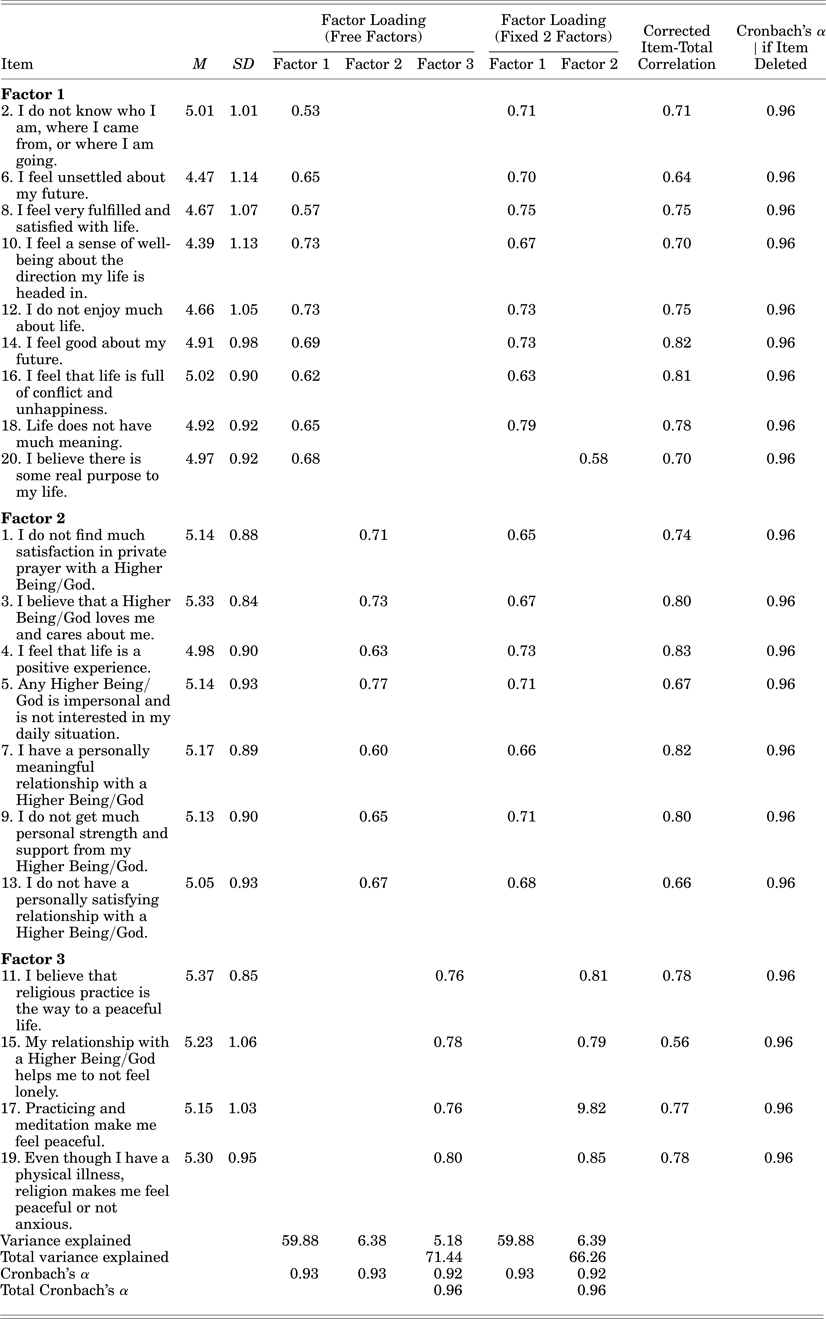
The internal structure of the 20-item SWBS was analyzed using EFA with varimax rotation. The Kaiser–Meyer–Olkin value was 0.94, indicating excellent sampling adequacy. Bartlett's test of sphericity was significant (χ2 = 3,582.3, df = 190, p = 0.000), indicating relationships between the variables. Factor loading scores less than 0.50 were removed for clarity. The results of the factor analysis revealed three factors that accounted for 71.44 % of total variance (Table 3).
Mean, SD, factor loading, corrected item–total correlation, Cronbach's α, and Cronbach's α if an item was deleted, for 20 items of SWBS

The first factor included nine items: “I do not know who I am, where I came from, or where I am going,” “I feel unsettled about my future,” “I feel very fulfilled and satisfied with life,” “I feel a sense of well-being about the direction my life is heading in,” “I do not enjoy much about life,” “I feel good about my future,” “I feel that life is full of conflict and unhappiness,” “Life does not have much meaning,” and “I believe there is some real purpose to my life.” This factor accounted for 59.88% of total variance and was described as “existential well-being”—similar to the original version.
The second factor included seven items: “I do not find much satisfaction in private prayer with a Higher Being/God,” “I believe that a Higher Being/God loves me and cares about me,” “I feel that life is a positive experience,” “Any Higher Being/God is impersonal and not interested in my daily situations,” “I have a personally meaningful relationship with a Higher Being/God,” “I do not get much personal strength and support from my Higher Being/God,” and “I do not have a personally satisfying relationship with a Higher Being/God.” Most of the items loaded on this factor were on the religious well-being subscale of the original version except for “I feel that life is a positive experience.” This factor continued to be termed “religious well-being” and accounted for 6.38% of total variance.
The third factor covered four items: “I believe that religious practice is the way to a peaceful life,” “My relationship with a Higher Being/God helps me to not feel lonely,” “Practicing and meditation make me feel peaceful,” and “Even though I have a physical illness, religion makes me feel peaceful or not anxious.” This new factor, described as “peacefulness,” accounted for 5.18% of total variance.
Reliability
Internal consistency testing yielded a Cronbach's α for the three-factor structure as follows: total SWB = 0.96, existential well-being = 0.93, religious well-being = 0.93, and peacefulness = 0.92 (Table 3). For the two-factor structure, α on total SWB = 0.96, existential well-being = 0.94, and religious well-being = 0.93. The corrected item–total correlation ranged from 0.56 to –0.83, whereas values for Cronbach's α, if an item was deleted, were 0.96 for each.
DISCUSSION
The purpose of our study was to determine the psychometric properties of the modified Spiritual Well-Being Scale (Thai version). Overall, we found the Thai SWBS to be a valid and reliable instrument for measuring spiritual well-being.
For validity testing, the known-group technique revealed that patients who followed spiritual practice reported a significantly higher score on total SWB, EWB, and RWB than those who did not practice. These results indicate that the Thai SWBS was able to distinguish between these groups. Additionally, a significant negative relationship was found between SWB score and symptom distress, indicating the validity of the instrument to measure an individual's present status on the criterion at the same time. Construct validity was tested using PCA with varimax rotation and reflected the three factors with a total variance of 71.44%. This three-factor structure was a bit different from the original structure. All items in factor 1, “existential well-being,” were the same as for the items in the original version. Factor 2, “religious well-being,” included six items from the “religious well-being” and one item from the “existential well-being” subscales of the original scale. The new factor 3, “peacefulness,” included four items from the “religious well-being” subscale of the original.
Considering items in the new factors, three of the four were modified as follows: (1) item 11 (“I believe that a Higher Being/God is concerned about my problems”) was changed to “I believe that religious practice is the way to peaceful life”; (2) item 17 (“I feel most fulfilled when I am in close communion with a Higher Being/God”) became “Practicing and meditation make me feel peaceful”; and (3) item 19 (“My relationship with a Higher Being/God contributes to my sense of well-being”) was modified to “Even though I have a physical illness, religion makes me feel peaceful or not anxious.” The new factor that emerged might be a result of the modification technique to reduce cultural and spiritual belief differences. We tried to test the factor structure by fixing two factors as per the original. Surprisingly, the result showed two factors loading with the four items in the new factor, three loading on one factor, and the remaining items loading on the other factor.
This evidence strongly supports the uniqueness of the new factor 3 (peacefulness) in our study. The concept of spirituality is heavily influenced by religion, because religion has remained a part of human life since prehistoric times. The Eastern spiritual worldview is based on each religion's individual traditions (Hinduism, Buddhism, Jainism, Shintoism, Confucianism, and Taoism). However, each religion views spirituality in the same way—faith, belief, and practice following the particular doctrines, leading to enlightenment, peace, happiness, honor, and valuable relationships in life (Richards & Bergin, Reference Richards and Bergin1997). This might be a characteristic of Thai people, who are a people of faith with strong religious beliefs and a strong sense of the holy, and who constantly strive to encompass a peaceful life.
Some researchers have identified spiritual well-being as having more than a two- factor structure (Scott et al., Reference Scott, Agresti and Fitchett1998; Imam et al., Reference Imam, Karim and Jusoh2009; Unterrainner et al., Reference Unterrainner, Lewis and Fink2014). This might have resulted from different sample characteristics, cultures, and statistical techniques. Our results present the new emerging factor of “peacefulness,” a finding that represents a uniqueness of Thai people that is not found in the original version (Paloutzian & Ellison, Reference Paloutzian and Ellison1982), the Malay version (Imam et al, Reference Imam, Karim and Jusoh2009), nor the Arabic version (Musa & Pevalin, Reference Musa and Pevalin2012) of the SWBS. Only two studies have been reported recently employing the Malay and Arabic versions. The other spiritual well-being measure, which is translated into many languages, includes a “peace” subscale (Bredle et al., Reference Bredle, Salsman and Debb2011; Lazenby et al., Reference Lazenby, Khatib and Al-Khair2013; Jafari et al., Reference Jafari, Zamani and Lazenby2013), which confirms the strength of our new factor, “peacefulness.”
Internal consistency reliability testing revealed values of Cronbach's α for the three-factor structure as follows: total SWB = 0.96, existential well-being = 0.93, religious well-being = 0.93, and peacefulness = 0.92 (see Table 3). For the two-factor structure, the value of α for total SWB was 0.96, existential well-being 0.94, and religious well-being 0.93. These results demonstrated high internal consistency, both in total score and on each subscale, reflecting the strong reliability of the instrument. The high internal consistency found in our study must be viewed with caution in terms of item redundancy, though. Thus, “item–total statistics” was analyzed, and we found that corrected item–total correlation ranged from 0.56 to 0.83, while Cronbach's α, if the item was deleted, settled at 0.96, even when deleted item by item. Likewise, the study with the Malay SWBS also showed high internal consistency, with a value of α for total score at 0.89, and, if the item was deleted, α ranged from 0.88 to 0.89 (Imam et al., Reference Imam, Karim and Jusoh2009).
These results reflect the homogeneity of the items, and the construct measured, as being too specific. Some researchers suggested that the high correlation between subscales indicated that the SWBS may be a reconceptualization and that the factorial complexity of the SWBS might be related to the diversity of items, which include different behaviors, beliefs, and feelings (Ledbetter et al., Reference Ledbetter, Smith and Fisher1991). This is congruent with the results of our factor analysis: if fixed on two factors (Table 3), the factor loading score for 16 items including both the EWB and RWB subscales loaded on only one factor, and the remaining four items were loaded on the other factor. This is possibly due to the value that Thai people place on religion, faith, and spiritual well-being, particularly in the advanced stages of disease. They thus perceived the meaning of existential well-being as not differing from religious well-being.
CONCLUSION, LIMITATIONS, AND RECOMMENDATIONS
In conclusion, our study found that the modified version of the SWBS for Thailand is a reliable and valid instrument for use with Thai patients who have advanced cancer.
There were some limitations to our study. The nature of the population, being weak and fatigued, limits the data to only one datapoint, so that test–retest reliability was not performed. A replicative study should be undertaken to confirm or revise our findings in culturally different populations.
IMPLICATION FOR NURSING AND CLINICAL PRACTICE
This Thai Spiritual Well-Being Scale is helpful in demonstrating the important factors that contribute to spiritual well-being in patients with advanced cancer. The scale is a valid and reliable instrument for both nurses and healthcare providers to assess spiritual well-being, and to evaluate practice outcomes of spiritual interventions and treatment effects.
ACKNOWLEDGMENTS
This study was a part of a major project supported by the Commission on Higher Education of the Ministry of Education, and the Thailand Nursing and Midwifery Council. Our gratitude is also extended to the patients who participated.