

Introduction
Human lactoferrin (hLF), found in mammalian exocrine secretions, is a glycoprotein in the iron-binding family of proteins (Chasteen, Reference Chasteen1983). The structure of hLF is similar to transferrin, but its iron-binding capacity is 300 times greater than that of transferrin. It is a mono-strain peptide consisting of 689 amino acids, and its molecular weight lies between ~78 and 90 kDa. It has many biologic activities, including antibacterial activities (Farnaud and Evans, Reference Farnaud and Evans2003), antiviral activities (Waarts et al., Reference Waarts, Aneke and Smit2005), a host defence and immune regulation function (Lee et al., Reference Lee, Farmer, Hilty and Kim1998), resistance to tumour growth (Fujita et al., Reference Fujita, Ohnishi, Sekine, Ligo and Tsuda2002) and metastases (Tsuda et al., Reference Tsuda, Sekine, Fujita and Ligo2002), and so on. Thus, hLF has a wide range of potential applications in the food and drug industry. For this reason, many groups have tried extracting natural hLF from milk, using various techniques including ion exchange chromatography, gel filtration chromatography, affinity chromatography, chromatography and ultrafiltration. Although much research has focused on hLF expressed by lacteal glands, reports concerning the bio-activities of hLF expressed by the lacteal glands of mice are relatively rare. Van Berkel and colleagues (Reference Van Berkel, Welling and Geerts2002) have demonstrated that the natural hLFs from human and transgenic cow milk have identical antibacterial, iron-binding and iron-releasing properties. In this study, using transgenic mice (PCL25 and AP) able to generate recombinant human lactoferrin (rhLF; Huang et al., Reference Huang, Cheng, Bai and Feng2007), gel filtration chromatography was applied to extract rhLF from the milk of the mice, followed by analysis of its antibacterial activities.
Materials and methods
Materials
The CXG-1 computer used to maintain a controlled constant temperature, the HD-3 ultraviolet detector, a BSZ-100 automatic collector, an HD-A spectrum analyser for computed tomography acquisition and the HL-2 constant pump were supplied from Shanghai Qingpu Huxi analytical instrument factory (Shanghai, China). Other materials were supplied by Bio-Rad (Power-PAC300), Vertical Electrophoresis Systems (Foster City, California, USA), Bio-TEK (Elx-800 micro plate reader; Winooski, Vermont, USA) and Pharmacia (chromatography column, 60 cm×1.6 cm; filler SephadexG-100, Pharmacia-17006002; dialysis bags, molecular weight dialysis 14–100 kDa; New York, New York, USA).
PCL25 and AP transgenic mice were supplied from the laboratory of Engin Research Center for Transgenic Animal Pharm of Jiangsu Province, Yangzhou University. AvianEscherichia coli and Salmonella enteritidis were provided by the State Key Laboratory of Infectious Diseases of Yangzhou University. hLF protein standard was purchased from Sigma (Alexander City, Alabama, USA), and protein molecular weight standards were acquired from Shanghai Biological Engineering Technology and Health Engineering Services Limited (Shanghai, China). Rabbit anti-hLF antibody and horseradish peroxidase goat anti-rabbit HRP secondary antibody were supplied by Huamei Company (Luoyang, China). Other chemical reagents were analytically pure (Shanghai ShengGong Biotechnology Company, Shanghai, China).
Methods
Collection of mouse milk
The PCL25 and AP hLF transgenic female mice were mated with ICR normal mice. Milk (~4.0 ml) was collected from the transgenic PCL25 and AP hLF female mice when their offspring were two weeks old.
Preparation of albumin
The milk of the transgenic PCL25 and AP hLF mice was placed in sample buffer (pH 7.4 in phosphate buffer saline, PBS) at a ratio of 1:1, centrifuged at 4°C, 10 000g for 30 min, the upper layer of fat removed, and the pH adjusted to 4.6 with 1.0 mol/l HCl, then stored at room temperature for 10 min. It was then centrifuged at 4°C, 10 000g for 20 min, the casein removed, and the pH adjusted to 7.4 with 1.0 mol/l NaOH, followed by storage at room temperature for 10 min. The albumin was transferred to a dialysis bag, placed in a beaker containing 500 ml eluent (pH 7.4 in PBS) and dialysed for 24 h on a magnetic stirrer (100 rpm). The buffer was exchanged every 8 h. The albumin was concentrated and collected to a volume of 1.0 ml by PEG20000.
Gel filtration chromatography
The dialysed albumin from the PCL25 and AP transgenic mice was added to a gel chromatography column, maintained at 4°C, eluted at 0.2 ml/min and detected at 280 nm UV. A 1 ml volume of sample was collected per column when the peak value was reached in the chromatography computer.
Determination of rhLF content with ELISA
The rhLF content enzyme-linked immunosorbent assay (ELISA) was carried out according to the method of Zhang et al. (Reference Zhang, Chi and Dong1999b). The standard curve of hLF was constructed by plotting the OD490 values of the native hLF protein compared to blank control against the concentration of the native hLF protein.
SDS-PAGE and Western blot analysis
The sample was subjected to sodium dodecyl sulphate polyacrylamide gel electrophoresis (SDS-PAGE) and Western blot, performed according to the method of Huang and Wang (Reference Huang and Wang2005).
Antimicrobial activity assay (agar diffusion method)
The bacterial suspensions were first prepared by inoculating Luria-Bertani (LB) culture medium with the E. coli and Salmonella strains and cultured overnight. The culture concentration was measured and diluted to 106 CFU/ml for use in the experiments. The albumin from the PCL25 and AP transgenic mice was then diluted to 2.00, 1.00, 0.50 and 0.25 mg/ml. A 20 μl volume of albumin was pipetted onto 6-mm-diameter dry-sterilized filter papers with two specimens in each set, and then UV sterilized for 10 min. The sterilized filter papers were placed in dishes, the bacterial suspension placed in the appropriate position and the dishes incubated at 37°C for 24 h. The diameter of the inhibition zone was then measured using slide calipers and the results recorded.
Results
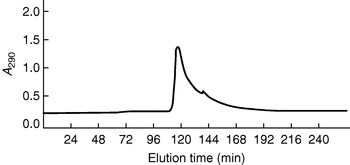
The gel chromatography curve for PCL25 transgenic mice has only one peak, at 120 min (Fig. 1). This is because of the differences in the molecular weight of the proteins in milk, which are very small in size. The gel chromatography curve for AP transgenic mice was similar to that in Fig. 1.
Gel chromatography curve for PCL25 transgenic mice.

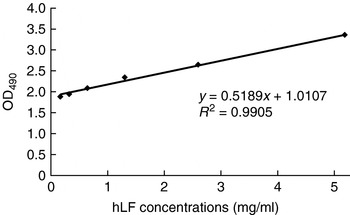
The standard curve of hLF was constructed by plotting the OD490 values of the native hLF protein compared to blank control against the concentration of the native hLF protein (Fig. 2). The concentrations of rhLF extracted from the whey extract from PCL25 and AP transgenic mice were thus calculated to be 8.04 and 7.52 mg/ml, respectively.
Standard curve of human lactoferrin.

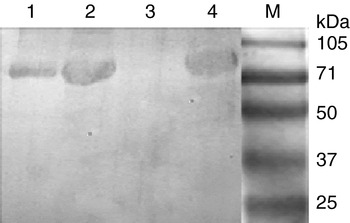
The results of SDS-PAGE and Western blot show that the whey extracts from PCL25 and AP transgenic mice have the same band as the native hLF protein, but this is not the case for normal mice (Fig. 3). This also indicates that the rhLF in the milk of PCL25 and AP transgenic mice has the same molecular weight as the native protein (~78 kDa).
Western blot results Lanes: 1, whey extractive of transgenic AP mice; 2, whey extract of transgenic PCL25 mice; 3, whey extractive of normal mice; 4, standard human lactoferrin; M, protein marker.

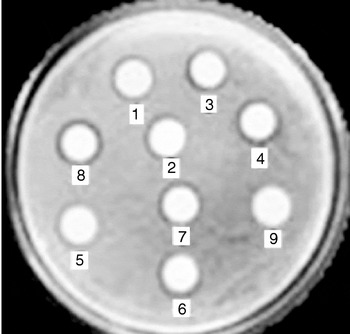
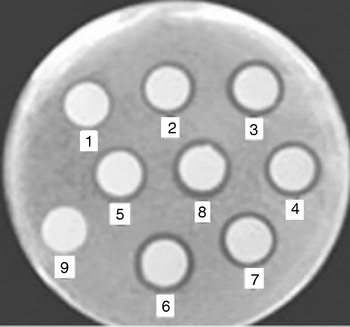
Figures 4 and 5 show the results of the antibacterial activity against E. coli and Salmonella of rhLF from the whey extract of PCL25 and AP transgenic mice and normal mice. Table 1 lists the results of the bacteriostatic effect of rhLF in milk of PCL25 and AP transgenic mice. The inhibition zone of the whey extract of PCL25 and AP transgenic mice was more than 6 (7–10 mm), but in normal mice it was 6 mm, which is the width of the filter paper. The results of the present studies provide clear evidence that rhLF in the whey extract of PCL25 and AP transgenic mice manifest antibacterial activity against E. coli and Salmonella. The greater the concentration of rhLF in the whey extract of the transgenic mice, the bigger the inhibition zone and the stronger the antibacterial activity. However, the whey extract of normal mice does not have any antibacterial activity.
Bacteriostatic map of rhLF activity against E. coli. 1–4, Bacteriostatic activity of rhLF of AP transgenic mice against E. coli; 5–8, bacteriostatic activity of rhLF of PCL25 transgenic mice to E. coli; 9, bacteriostatic activity of whey extract of normal mice to E. coli.

Bacteriostatic map of rhLF activity against Salmonella. 1–4, Bacteriostatic activity of rhLF of AP transgenic mice to Salmonella; 5–8, bacteriostatic activity of rhLF of PCL25 transgenic mice against Salmonella; 9, bacteriostatic activity of whey extract of normal mice against Salmonella.

Results of the bacteriostatic effect of rhLF from the milk of PCL25 and AP transgenic mice

Discussions
Mitra and Zhang (Reference Mitra and Zhang1994) transformed a suspension tobacco (Nicotiana tabacum L.) cell line with the recombinant hLF gene. Western blot analysis indicated the transgenic calli produced a 48 kDa protein and a weak band slightly larger than 48 kDa. Protein extracts from transgenic tobacco callus exhibited the antibacterial activity of lactoferrin. Zhang et al. (Reference Zhang, Zhang, Wang and Hong1999a) also introduced the recombinant hLF gene into tobacco. The RNA band was 2.2 kDa, and the expressed protein 50 kDa, with antibacterial and anti-TMV (Tobacco mosaic virus) activities. Cao et al. (2000) transfected the MA782 cell line with liposome-coated recombinant plasmid with the hLF gene. The expressed protein was 34 kDa in size. The antibacterial assay indicated that the expressed protein has higher bacteriostatic efficacy than purified standard hLF. Zhao and colleagues (Reference Zhao, Liu, Zheng, Lu and Zheng2006) introduced the hLF gene into the tomato. Protein extracts from the transgenic plant have a significant bacteriostatic effect on DH5α. The hLF protein is an 80 kDa glycoprotein. It is 76 kDa in size without the carbonyl. We collected milk from two transgenic mice strains that can produce rhLF efficiently. The rhLF was purified by gel filtration chromatography. The amount of expressed rhLF was 7–8 mg/ml. The expressed protein was of the same size as natural human lactoferrin. It also has antibacterial activities against E. coli and Salmonella. Although a previous report showed that rhLFs have antibacterial effects, their molecular weights are smaller than their natural counterparts. The reduced sizes of the rhLFs could be explained by either degradation or lack of glycosylation. Our product was expressed within the milk gland of transgenic mice, a totally different environment to tobacco, tomato and cancer cell lines. It is postulated that the 78 kDa product was not affected by protease and the glycosylation was comparatively complete. We extracted milk serum from transgenic mice strains AP and PCL25 and demonstrated that the extracted products have marked antibacterial activities, which paves the way for the further development of a high-efficacy rhLF producer and future industrial production of rhLF.
Acknowledgements
This work was supported by universities and colleges in Jiangsu Province High-Tech Industry Development Project (no. JHB04-032).