Introduction
Destructive earthquakes may challenge the belief systems of survivors and trigger many negative psychological outcomes (e.g., Neria, Nandi, & Galea, Reference Neria, Nandi and Galea2008). Posttraumatic stress disorder (PTSD) is one of the most common psychopathologies in earthquake victims (e.g., Wang, Reference Wang2012) and is particularly prevalent in adolescents owing to their immature cognitive and emotional capabilities (e.g., Ying, Wu, & Lin, Reference Ying, Wu and Lin2012). The prevalence of PTSD was between 8.6% and 28.4% in adolescents 1 year after the Wenchuan earthquake (e.g., Liang, Cheng, Ruzek, & Liu, Reference Liang, Cheng, Ruzek and Liu2019), while 29.6% of adolescents reported PTSD 3 years after the same earthquake (e.g., Pan et al., Reference Pan, Liu, Deng, Liu, Yan, Tang and Xu2015). This raises the question of why these adolescents showed persistent PTSD over time. From attachment theorists’ perspective (e.g., Ainsworth, Blehar, & Waters, Reference Ainsworth, Blehar and Waters1973; Bowlby, Reference Bowlby1969), it might be attributable to insecure attachment (e.g., Mikulincer, Shaver, & Horesh, Reference Mikulincer, Shaver, Horesh, Snyder, Simpson and Hughes2006), particularly adolescents’ insecure attachment to parents following trauma (e.g., Stubenbort, Greeno, Mannarino, & Cohen, Reference Stubenbort, Greeno, Mannarino and Cohen2002). A growing number of studies have examined the underlying mechanisms of the association between insecure attachment and PTSD (e.g., Ferrajão, Badoud, & Oliveira, Reference Ferrajão, Badoud and Oliveira2017; Ogle, Rubin, & Siegler, Reference Ogle, Rubin and Siegler2016; Woodhouse, Ayers, & Field, Reference Woodhouse, Ayers and Field2015), but relatively few have focused on this association in adolescents following major natural disasters. To extend previous studies, the aim of this study was to examine the potential mechanisms underlying the association between adolescents' insecure attachment to parents and PTSD following an earthquake.
Insecure attachment, which encompasses anxious and avoidant styles, reflects global beliefs that the self is unworthy of care and that others are unreliable caregivers (e.g., Bowlby, Reference Bowlby1969). These beliefs can negatively impact the development of social cognition, which in turn may impair the ability to effectively process social information (e.g., Sharp, Fonagy, & Allen, Reference Sharp, Fonagy and Allen2012) and positively regulate emotion (e.g., Ogle et al., Reference Ogle, Rubin and Siegler2016). This chain of events can ultimately augment PTSD (e.g., Clark & Owens, Reference Clark and Owens2012; Escolas et al., Reference Escolas, Arata-Maiers, Hildebrandt, Maiers, Mason and Baker2012; Ogle, Rubin, & Siegler, Reference Ogle, Rubin and Siegler2015). That is, insecure attachment may be associated with higher levels of PTSD following a traumatic event (e.g., Huang, Chen, Su, & Kung, Reference Huang, Chen, Su and Kung2017).
Insecure attachment seems related to PTSD via several mediators (e.g., Woodhouse et al., Reference Woodhouse, Ayers and Field2015). The central tenet of attachment theory is that attachment is reflected in communication patterns. For instance, individuals with insecure attachment are generally anxious or avoidant during interpersonal communication (e.g., Bowlby, Reference Bowlby1988), and this elicits more problematic and less open communication. Such individuals may have specific emotional issues related to the attachment figure and distorted emotional communication (e.g., Bretherton, Reference Bretherton and Thompson1990). This can lead to conflicts with the attachment figure (e.g., Domingue & Mollen, Reference Domingue and Mollen2009), which may exaggerate the symptoms of PTSD (Creech & Gabriela, Reference Creech and Gabriela2017). As the attachment figures of adolescents are mainly parents, the type of communication that occurs between adolescents and parents may mediate the relation between insecure attachment to parents and PTSD.
Sharp et al. (Reference Sharp, Fonagy and Allen2012) integrated PTSD-related theories (e.g., DePrince, Reference DePrince2005; Nietlisbach & Maercker, Reference Nietlisbach and Maercker2009) into the framework of attachment theory and proposed a social-cognitive model of PTSD. They suggested that insecure attachment elicits adolescents’ bias in obtaining, organizing, and operating attachment-relevant social information. As with adolescents, parents may exhibit negative psychological outcomes following natural disasters (e.g., Cobham, McDermott, Haslam, & Sanders, Reference Cobham, McDermott, Haslam and Sanders2016; Juth, Silver, Seyle, Widyatmoko, & Tan, Reference Juth, Silver, Seyle, Widyatmoko and Tan2015). Depression is one of the most common and representative distress reactions in Chinese adults following an earthquake (e.g., Chan et al., Reference Chan, Wang, Ho, Qu, Wang, Ran and Zhang2012). However, insecure attachment to parents may affect the interpretation of parental depression. For instance, adolescents with avoidant attachment seek to maintain psychological and emotional distance from parents, particularly during times of stress or threat (e.g., Wardecker, Chopik, Moors, & Edelstein, Reference Wardecker, Chopik, Moors, Edelstein, Zeigler-Hill and Shackelford2016), which may lead them to perceive lower levels of parental depression (Mikulincer et al., Reference Mikulincer, Shaver, Horesh, Snyder, Simpson and Hughes2006) after a shared trauma experience.
In contrast, adolescents with anxious attachment emotionally engage more in parent–child relationships and are afraid of being abandoned in their relationships (e.g., Mikulincer, Shaver, & Pereg, Reference Mikulincer, Shaver and Pereg2003). These individuals are very susceptible to parental feelings or behaviors (e.g., Cassidy & Kobak, Reference Cassidy, Kobak, Belsky and Nezworski1988), and tend to perceive higher levels of parental depression. Affective state is somewhat “contagious” (Hatfield, Cacioppo, & Rapson, Reference Hatfield, Cacioppo and Rapson1993); therefore, adolescents who perceive high levels of parental depression are likely to internalize negative emotions and show depression themselves. This may negatively affect the way they feel and behave after traumatic experiences (e.g., Zhou, Levin, Stein, Zerach, & Solomon, Reference Zhou, Levin, Stein, Zerach and Solomon2016) and lead them to exhibit more PTSD symptoms. That is, perceived parental depression may mediate the association between insecure attachment to parents and PTSD in adolescents.
The social-cognitive model of PTSD suggests that insecure attachment leads to global negative beliefs and expectations towards the self, others, and the world, resulting in maladaptive cognitive processing of social information at the procedural level of automatic thoughts (Sharp et al., Reference Sharp, Fonagy and Allen2012). Hence, individuals with insecure attachment are likely to pay increased attention to stress-related information (e.g., Mikulincer, Gillath, & Shaver, Reference Mikulincer, Gillath and Shaver2002) and conduct a more negative appraisal of such information (e.g., Mikulincer & Orbach, Reference Mikulincer and Orbach1995). This may ultimately elicit intrusive rumination about stressful/traumatic events (e.g., Mikulincer & Florian, Reference Mikulincer, Florian, Simpson and Rholes1998; Ruijten, Roelofs, & Rood, Reference Ruijten, Roelofs and Rood2011). Moreover, attachment insecurities (e.g., attachment anxiety or avoidance) increase the likelihood of using inefficient strategies (e.g., hyperactivating or deactivating strategies) to tackle distress, making it hard for individuals to perceive and manage negative emotions adequately (e.g., Lanciano, Curci, Kafetsios, Elia, & Zammuner, Reference Lanciano, Curci, Kafetsios, Elia and Zammuner2012) and to “shake off” the effects of negative emotions (e.g., Lanciano et al., Reference Lanciano, Curci, Kafetsios, Elia and Zammuner2012). They may then pay more attention to negative emotions or experiences in a repetitive and passive way, leading to intrusive/negative rumination (e.g., Lanciano et al., Reference Lanciano, Curci, Kafetsios, Elia and Zammuner2012; Lanciano, Curci, & Zatton, Reference Lanciano, Curci and Zatton2010). Some studies also suggest a positive association between insecure attachment (e.g., attachment anxiety or avoidance) and intrusive/negative rumination (e.g., Burnette, Davis, Green, Worthington, & Bradfield, Reference Burnette, Davis, Green, Worthington and Bradfield2010; Caldwell & Shaver, Reference Caldwell and Shaver2012; Lanciano et al., Reference Lanciano, Curci, Kafetsios, Elia and Zammuner2012). Repeatedly engaging in thoughts about traumatic events in a negative way, and failing to solve issues of concern related to such events, increases the possibility of developing PTSD (e.g., Egan, Hattaway, & Kane, Reference Egan, Hattaway and Kane2014). In such cases, intrusive rumination is a potential mediator between insecure attachment to parents and PTSD in adolescents.
Although a unique role for these potential mediators has been proposed, their combined mediating role has been overlooked. In a positive and open parent–child communication style, parents acknowledge their child's trauma-related information and needs (e.g., Murphy, Murray, & Compas, Reference Murphy, Murray and Compas2017) and provide help or support (e.g., Keim et al., Reference Keim, Lehmann, Shultz, Winning, Rausch, Barrera and Compas2017; Kunkel, Hummert, & Dennis, Reference Kunkel, Hummert, Dennis, Braithwaite and Baxter2006). This helps the child to re-examine trauma-related cues, reframe their understanding of traumatic events (e.g., Riesch, Anderson, & Krueger, Reference Riesch, Anderson and Krueger2010; Schroevers, Helgeson, & Ranchor, Reference Schroevers, Helgeson and Ranchor2010), and, in turn, hinder intrusive rumination on trauma. In contrast, problematic parent–child communication may lead to more conflicts (e.g., Boniel-Nissim & Sasson, Reference Boniel-Nissim and Sasson2018), which causes children to form negative self-concepts (e.g., Burleson, Metts, & Kirch, Reference Burleson, Metts, Kirch, Hendric and Hendrick2000), thus increasing their engagement in negative rumination behaviors (e.g., Spasojevic & Alloy, Reference Spasojevic and Alloy2001). In such cases, parent–child communication may be directly associated with intrusive rumination in adolescents.
Moreover, positive and open parent–child communication promotes the positive disclosure of information between parent and child (e.g., Metcalfe, Coad, Plumridge, Gill, & Farndon, Reference Metcalfe, Coad, Plumridge, Gill and Farndon2008; Yang, Reference Yang2014). In such a communication style, parents are responsive to and affectively involved with adolescents, and adolescents perceive more positive parental initiative attitudes and behaviors (Fang & Fang, Reference Fang and Fang2003). Thus, open communication in parent–child relationships helps adolescents perceive less parental depression. In contrast, problematic communication may lead adolescents to perceive more parental depression. Problematic communication hinders an open exchange of trauma experiences between parents and children, which may cause children to make exaggerated guesses about their parents’ depression (e.g., Stein, Lahav, & Solomon, Reference Stein, Lahav and Solomon2017). In addition, such communication elicits more parent–child conflicts (Overbeek, Stattin, Vermulst, Ha, & Engels, Reference Overbeek, Stattin, Vermulst, Ha and Engels2007), in which parents show more negative behaviors or emotions in front of children (e.g., Chiariello & Orvaschel, Reference Chiariello and Orvaschel1995). Children may assume that this is a consequence of parental depression following trauma, and perceive a greater level of parental depression. When children perceive parents to be experiencing greater levels of depression, they tend to worry more about their parents’ mental status. This increases the probability of cognitive retrieval of trauma-related cues, which causes children to dwell on negative thoughts about trauma-related cues, thus increasing intrusive rumination (e.g., Quan, Zhen, Yao, & Zhou, Reference Quan, Zhen, Yao and Zhou2017). Hence, parent–child communication may be related to intrusive rumination via perceived parental depression.
The literature reviewed here suggests that insecure attachment to parents in adolescents after trauma may be related to PTSD via parent–child communication, perceived parental depression, and intrusive rumination. It is noteworthy that although previous studies have examined and compared the associations between anxious attachment and PTSD symptoms, and between avoidant attachment and PTSD symptoms (e.g., Fraley, Fazzari, Bonanno, & Dekel, Reference Fraley, Fazzari, Bonanno and Dekel2006; Frey, Blackburn, Werner–Wilson, Parker, & Wood, Reference Frey, Blackburn, Werner-Wilson, Parker and Wood2011; Ogle et al., Reference Ogle, Rubin and Siegler2016; Woodhouse et al., Reference Woodhouse, Ayers and Field2015), there have been no comparisons of the potential mechanisms by which the two attachment styles contribute to PTSD. In addition, most previous studies have focused on adults rather than adolescents. Owing to their undeveloped cognition and emotional capabilities, adolescents are more susceptible to trauma (e.g., Ying et al., Reference Ying, Wu and Lin2012). Additionally, insecure attachment to parents is likely to increase adolescents’ susceptibility to posttraumatic reactions (MacDonald et al., Reference MacDonald, Beeghly, Grant-Knight, Augustyn, Woods, Cabral and Frank2008). Therefore, this study sought to examine the mediating roles of parent–child communication, perceived parental depression, and intrusive rumination, and to compare the mechanisms underlying the association between anxious and avoidant attachment and PTSD in adolescents after a natural disaster.
Methods
Participants and procedures
This study was conducted 1 year after the Jiuzhaigou earthquake, which occurred on August 8, 2017. The earthquake was magnitude 7.0 on the Richter scale and resulted in 25 deaths, up to 525 injured people, five missing people, and 73,671 damaged buildings (including 76 collapsed buildings). In this study, we focused on individuals living in Jiuzhaigou county in Sichuan province. Two middle schools (one junior middle school and one senior middle school) agreed to participate, involving 16 classrooms with approximately 40 students in each. All students who attended school on the assessment date agreed to participate in the study. A total of 620 adolescent earthquake survivors completed self-report questionnaires. The mean age of participants was 15.56 (standard deviation (SD) = 1.59) years; the range was 12.0–19.0 years; 13 participants did not report their age. Of the 620 participants, 373 (60.2%) were female, 233 (37.6%) were male, and 14 (2.2%) did not report their gender.
This project was approved by the Research Ethics Committee of Faculty of Psychology, Beijing Normal University, the local education authorities (in this case, the county Department of Education), and the participating schools. Informed consent was obtained from the school principals, classroom teachers, parents, and all participants. The participants were free to withdraw from the survey at any time. The assessments were conducted during regular school hours under the supervision of trained postgraduate psychology students. No compensation was provided for participation other than counseling services, if needed.
Measures
Trauma exposure
A seven-item trauma exposure questionnaire (Zhou, Zhen, & Wu, Reference Zhou, Zhen and Wu2019) was used to assess the adolescents’ exposure to the Jiuzhaigou earthquake. Example items were “Someone I know got trapped, injured, or killed by this earthquake” and “My family possessions were seriously damaged by this earthquake.” Items were scored as 1 (yes) or 0 (no). Higher aggregate scores thus indicated more severe traumatic experience.
Attachment to parents
We adapted a Chinese version of the Experiences in Close Relationships Inventory (ECRI) (Li & Kazuo, Reference Li and Kazuo2006) to assess the degree of adolescents’ insecure attachment to their parents. The original 36-item ECRI was developed by Brennan, Clark, and Shaver (Reference Brennan, Clark, Shaver, Cassidy and Shaver1998) and consisted of anxious and avoidant attachment subscales. Both the original and Chinese ECRI have demonstrated good validity (e.g., Aonso-Arbiol, Ballluerka, & Shaver, Reference Aonso-Arbiol, Ballluerka and Shaver2007; Li & Kazuo, Reference Li and Kazuo2006). Each item was rated on a seven-point Likert scale from 1 to 7 (1 = completely disagree, 7 = completely agree). We revised the Chinese ECRI for this study using the following two steps. First, the context was changed from “partner” to “parents” for each item (e.g., from “I am nervous when partners get too close to me” to “I am nervous when parents get too close to me”). Second, we conducted a preliminary interview with 15 adolescents (seven boys and eight girls; 10 from junior middle school and five from senior middle school) following the Jiuzhaigou earthquake using the scale in the first step, and reworded the language of some items according to Chinese expressions and adolescents’ feedback (e.g., from Chinese characters “受挫” to “难过” for “frustrated”) to ensure that adolescents fully understood each item. This produced the final version of the scale assessing attachment to parents. In this study, anxious and avoidant attachment to parents showed good internal reliability (Cronbach's alpha = .85 and .72, respectively) and validity: χ 2/df = 2.24, comparative fit index (CFI) = .92, Tucker–Lewis index (TLI) = .90, root mean square error of approximation (RMSEA) (90% confidence interval (CI)) = .045 (.041–.048), and standardized root mean square residual (SRMR) = .062.
Parent–child communication
An (Reference An2004) adapted the parent–child communication scale from Barnes and Olson (Reference Barnes and Olson1985) to produce a Chinese version of the scale. We used this Chinese version to assess parent–child communication. This 20-item scale has two dimensions: openness and problems in parent–child communication. Items are rated using a five-point Likert scale (1 = completely disagree, 5 = completely agree). This scale has previously shown good validity (e.g., Sales et al., Reference Sales, Milhausen, Wingood, Diclemente, Salazar and Crosby2008; White, Reference White2014) and also showed good validity in the present study (χ 2/df = 2.83, CFI = .92, TLI = .90, RMSEA (90% CI) = .054 (.049–.060), SRMR = .054). The subscales of openness and problems in parent–child communication showed good internal reliability (Cronbach's alpha = .88 and .78, respectively).
Perceived parental depression
We developed a perceived parental depression questionnaire based on the Chinese edition of the Center for Epidemiologic Studies Depression Scale (CES-D; Wang, Reference Wang1999) to assess adolescents’ perceived parental depression. The CES-D has shown good validity in Chinese adults following an earthquake (e.g., Qu et al., Reference Qu, Wang, Tian, Zhao, Zhang, He and Guo2012). Following feedback from the above-mentioned preliminary interview with 15 adolescents, we selected seven items to measure adolescents’ perceived parental depression (e.g., “I notice that my parents have been in a negative mood since the earthquake”). Items were rated on a five-point Likert scale (0 = none, 4 = always). In the present study, this seven-item questionnaire showed good internal consistency (Cronbach's alpha = .90) and validity (χ 2/df = 3.16, CFI = .99, TLI = .98, RMSEA (90% CI) = .059 (.040–.079), SRMR = .021).
Intrusive rumination
We used the Event-Related Rumination Inventory (ERRI) (Cann et al., Reference Cann, Calhoun, Tedeschi, Triplett, Vishnevsky and Lindstrom2011), as revised by Zhou, Wu, An, Wang, and Tian (Reference Zhou, Wu, An, Wang and Tian2017), to measure intrusive and deliberate rumination. This measure assesses intrusive (10 items) and deliberate (10 items) ruminations over the preceding 2 weeks. The ERRI has shown good reliability and validity in previous studies (e.g., Xu, Jiang, Zhou, Zhou, & Fu, Reference Xu, Jiang, Zhou, Zhou and Fu2019). Items are rated on a six-point scale (0 = not at all, 5 = always). In the present study, this inventory showed good validity (χ 2/df = 4.11, CFI = .91, TLI = .90, RMSEA (90% CI) = .071 (.065–.076), SRMR = .044). The alpha coefficients for intrusive and deliberate rumination were .92 and .88, respectively. In view of the study objectives, we selected the intrusive rumination data for analysis.
PTSD
We assessed PTSD using the PTSD checklist of the Diagnostic and Statistical Manual of Mental Disorders Fifth Edition (DSM-5) (Weathers, Reference Weathers2013). This measure is a 20-item self-report scale designed to assess the occurrence and frequency of PTSD symptoms in relation to the most distressing event experienced by an individual. In the present study, all respondents rated the frequency of symptoms during the last 2 weeks on a five-point scale that ranged from 0 (not at all/only once) to 4 (almost every day). The scale has four subscales: intrusions, negative cognition and emotion alteration, avoidance, and hyperarousal. This checklist has shown good validity in adolescents following trauma (e.g., Cao, Wang, Cao, Zhang, & Elhai, Reference Cao, Wang, Cao, Zhang and Elhai2017; Liu et al., Reference Liu, Wang, Cao, Wang, Zhang, Zhang and Elhai2014). The overall severity score is generated by adding up the four symptom scores. In this sample, the scale demonstrated good internal consistency (Cronbach's alpha = .92) and validity (χ 2/df = 3.10, CFI = .92, TLI = .90, RMSEA (90% CI) = .058 (.052–.064), SRMR = .049).
Data analysis
Descriptive analyses were conducted for all the administered measures. We calculated Pearson's correlation coefficients to examine the associations between the major variables. Statistical analyses were performed using Mplus 7.0 software (Muthén & Muthén, Reference Muthén and Muthén2012). To assess whether the missing data had a random pattern, we used Little's missing completely at random test. The analysis revealed that the data were missing at random, χ 2 (163) = 128.178, p = .980. Hence, missing data were handled with maximum likelihood estimates in the structural models.
To evaluate the model fit, we used χ 2 values, the CFI, the TLI, the RMSEA, and the SRMR. The general cutoffs for model acceptance were ≥.90 for the CFI and TLI, and <.08 for the SRMR and RMSEA.
To examine the potential mechanisms by which insecure attachment to parents contributes to PTSD via parent–child communication, perceived parental depression, and intrusive rumination, we built a series of structural equation models. First, we built a multiple mediation model in which trauma exposure was controlled for. We built the predictive path from insecure attachment to PTSD, and then added the predictive paths from insecure attachment to parent–child communication, from parent–child communication to perceived parental depression, from perceived parental depression to intrusive rumination, and from intrusive rumination to PTSD. Second, based on the significance of the above paths, we built a parsimonious model that constrained the non-significant paths to zero or removed them, which facilitated further examination of the indirect effects among the main variables. Third, we performed bias-corrected bootstrap tests with a 95% CI to evaluate the significance levels of the indirect effects observed in the parsimonious model. In all the above models, there were correlation paths between anxious and avoidant attachment, and between problems and openness in parent–child communication, to reduce the chance of type I errors.
Results
Descriptive statistics and correlations among the main measures
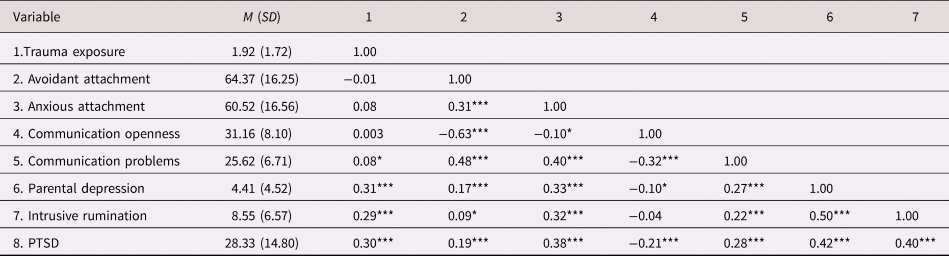
Table 1 shows the results of the descriptive statistics and correlations among the main measures. Following Foa, Asnaani, Zang, Capaldi, and Yeh (Reference Foa, Asnaani, Zang, Capaldi and Yeh2018), we used a cutoff score of 31 on the DSM-5 checklist for PTSD to identify probable cases of PTSD. The results showed that 255 (41.1%) participants had probable PTSD. Furthermore, trauma exposure was significantly associated with parent–child communication problems, perceived parental depression, intrusive rumination, and PTSD. With the exception of a non-significant association between communication openness and intrusive rumination, correlations among all the variables were significant.
Correlations between main measures

Notes: Anxious attachment = anxious attachment to parents, Avoidant attachment = avoidant attachment to parents, Parental depression = perceived parental depression; ***p < .001, *p < .05.
Mediating roles of parent–child communication, perceived parental depression, and intrusive rumination
We used the three procedures described in the Data analysis section to examine the mediating roles of parent–child communication, perceived parental depression, and intrusive rumination in the association between insecure attachment and PTSD, controlling for trauma exposure.
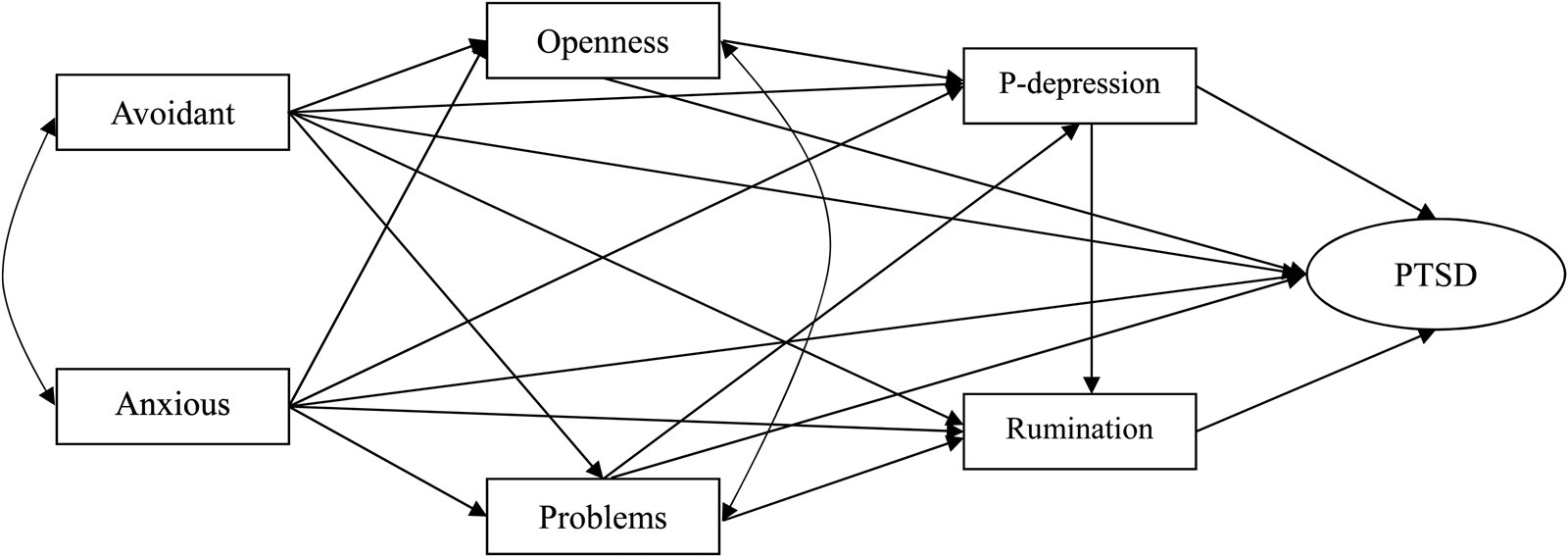
In the first multiple mediation model, the predictive path from parent–child communication openness to intrusive rumination was excluded because there was no significant correlation between these variables (see Figure 1). This model had good fit indexes (χ 2 (23) = 87.602, CFI = .97, TLI = .93, RMSEA (90% CI) = .068 (.053–.083), SRMR = .042). The results indicated that both anxious and avoidant attachment were significantly associated with two types of parent–child communication. In addition, anxious attachment had significant associations with perceived parental depression, intrusive rumination, and PTSD. Parent–child communication openness was significantly associated with PTSD, and problematic communication was associated with perceived parental depression. Perceived parental depression had significant associations with intrusive rumination and PTSD, and intrusive rumination was associated with PTSD. All other paths were statistically non-significant.
The hypothesized multiple mediation model. Avoidant = avoidant attachment to parents, Anxious = anxious attachment to parents, Openness = parent–child communication openness, Problems = parent–child communication problems, P-depression = perceived parental depression, Rumination = intrusive rumination.

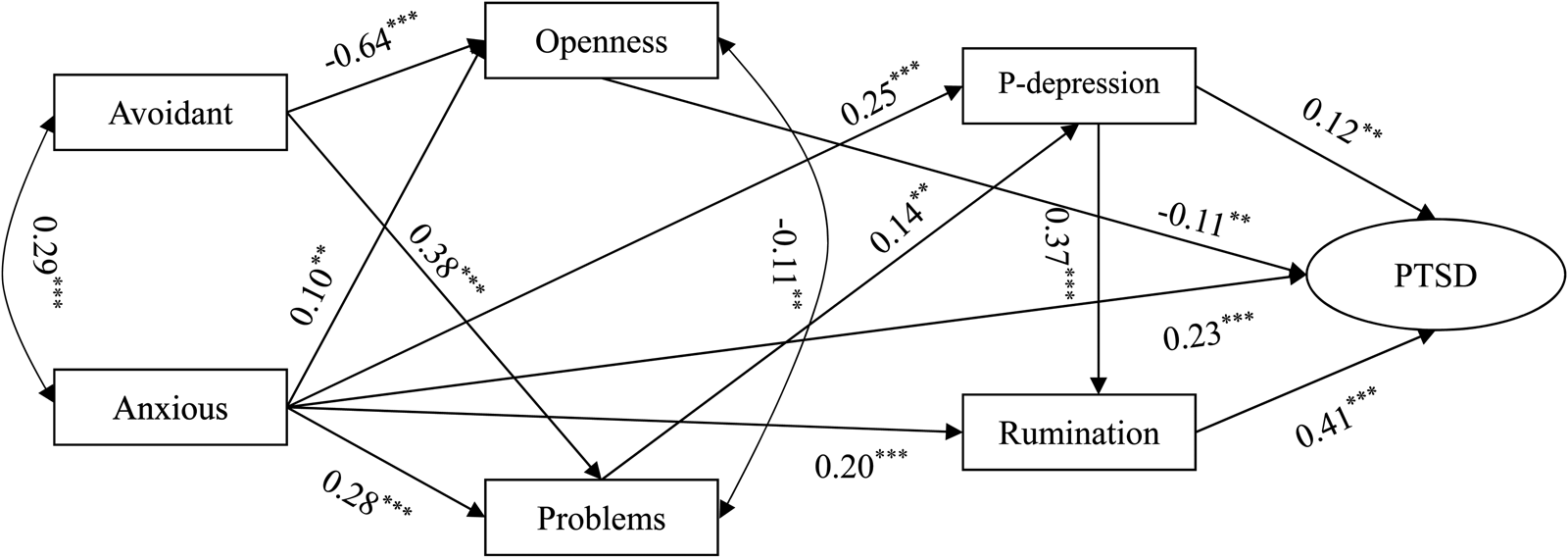
After removing the non-significant paths listed above, we obtained a parsimonious model. This model fit the data well, with χ 2 (29) = 96.661, CFI = .97, TLI = .94, RMSEA (90% CI) = .062 (.049–.076), and SRMR = .042. The results indicated that all the paths were significant (see Figure 2).
The final parsimonious mediation model. ***p < .001, **p < .01. Avoidant = avoidant attachment to parents, Anxious = anxious attachment to parents, Openness = parent–child communication openness, Problems = parent–child communication problems, P-depression = perceived parental depression, Rumination = intrusive rumination. Trauma exposure was controlled for in the model.

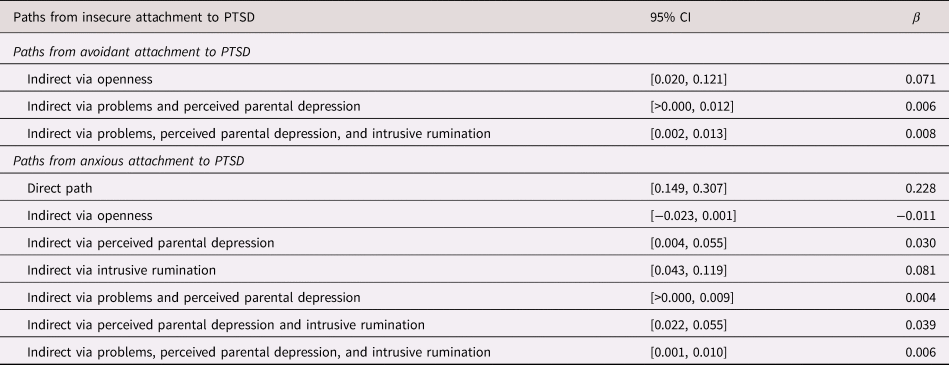
Third, we conducted bias-corrected bootstrap tests with a 95% CI (see Table 2). If the CI of an indirect path coefficient does not include zero, this indicates that the indirect path is significant. The results showed that all but one of the indirect paths from attachment to PTSD were significant: the 95% CI indicated that the mediating effect from anxious attachment to PTSD via parent–child communication openness was non-significant. The results suggested that avoidant attachment was indirectly associated with PTSD via parent–child communication openness, via the path “communication problems–perceived parental depression” and via the path “communication problems–perceived parental depression–intrusive rumination.” Anxious attachment was directly related to PTSD, and was also indirectly related to PTSD via perceived parental depression, intrusive rumination, via the path “communication problems–perceived parental depression,” via the path “perceived parental depression–intrusive rumination,” and via the path “communication problems–perceived parental depression–intrusive rumination.”
Bias-corrected bootstrap tests of mediating effects

Notes: A 95% CI of an indirect path coefficient that does not include 0 suggests that the indirect path is significant. Openness = parent–child communication openness, Problems = parent–child communication problems.
Discussion
To our knowledge, this is the first study to examine the potential mechanisms by which anxious and avoidant attachment to parents contributes to PTSD in adolescents following an earthquake. Our findings indicate that insecure attachment to parents is associated with greater levels of PTSD, which is consistent with previous studies in adolescents following trauma events (Greco, Reference Greco2011; Macdonald et al., Reference Macdonald, Livingstone, Hanratty, McCartan, Cotmore, Cary and Churchill2016). We found that the association between anxious attachment and PTSD was stronger than that between avoidant attachment and PTSD. In addition, parent–child communication, perceived parental depression, and intrusive rumination mediated the associations between anxious and avoidant attachment to parents and PTSD, which also supports our hypothesis. Furthermore, we observed that anxious and avoidant attachment to parents was associated with PTSD via paths that were shared and paths that were not shared by the three above-mentioned factors.
The results indicated that, after adding mediators to the mediating effects model, anxious attachment was still directly and significantly related to PTSD, supporting our hypothesis. However, the direct association between avoidant attachment and PTSD became non-significant, which is inconsistent with our hypothesis. This may be because the two attachment styles have different functions. Specifically, individuals with anxious attachment to parents tend to have heightened attention towards negative emotions and threatening information (e.g., Mikulincer et al., Reference Mikulincer, Gillath and Shaver2002). This can elicit hyperactivating coping strategies that amplify negative emotional reactions to stressful events (e.g., Maunder, Lancee, Nolan, Hunter, & Tannenbaum, Reference Maunder, Lancee, Nolan, Hunter and Tannenbaum2006), resulting in increased levels of PTSD (e.g., Ogle et al., Reference Ogle, Rubin and Siegler2015, Reference Ogle, Rubin and Siegler2016). In contrast, individuals with avoidant attachment are more likely to use deactivating coping strategies, such as being oblivious to threatening information (e.g., Edelstein & Gillath, Reference Edelstein and Gillath2008), and to avoid or minimize threat-related cues and thoughts (e.g., Fraley & Shaver, Reference Fraley and Shaver1997; Mikulincer et al., Reference Mikulincer, Shaver and Pereg2003), which temporarily buffers the effect of trauma cues on negative reactions (e.g., Zhou, Wu, Yuan, Chen, & Chen, Reference Zhou, Wu, Yuan, Chen and Chen2015). Therefore, avoidant attachment to parents does not appear to be directly related to PTSD.
Nevertheless, we found that avoidant attachment to parents was related to increased PTSD severity via three indirect paths: (a) a one-step indirect path comprising parent–child communication openness, (b) a two-step indirect path comprising parent–child communication problems and perceived parental depression, and (c) a three-step indirect path comprising parent–child communication problems, perceived parental depression, and intrusive rumination. Avoidant attachment to parents indicates that the child is less willing to interact with their parents (e.g., Zhou, Reference Zhou1999), which reduces the openness of parent–child communication and leads to problems in parent–child communication. Furthermore, non-open parent–child communication prevents a child from disclosing trauma-related information to parents. As a result, parents experience difficulty ascertaining their child's experience, depression, and needs, which hinders their provision of useful and timely help and support to the child. Thus, parents are less likely to be effective in buffering the effects of PTSD in their child, and their actions may even increase the severity of their child's PTSD. Problematic parent–child communication is characterized by greater conflict and discord (e.g., Hammen, Brennan, & Shih, Reference Hammen, Brennan and Shih2004), and limited affective expression (e.g., Jacob & Johnson, Reference Jacob and Johnson1997). This may hinder children from accurately understanding their parents’ emotional reactions following a traumatic event. For instance, children might mistakenly perceive higher levels of parental depression in response to an earthquake, and are likely to internalize parental negative emotions and show depression themselves. This may increase their negative emotions and behaviors after a traumatic experience (e.g., Zhou et al., Reference Zhou, Levin, Stein, Zerach and Solomon2016), leading them to exhibit more PTSD symptoms. Further, researchers have proposed that this may reduce a child's willingness to disclose traumatic experiences or distress as they try to avoid increasing others’ depression (e.g., Cummings, Reference Cummings2011). As a result, the child's patterns of thinking became more negative, thus increasing the possibility of intrusive rumination. This may lead to a failure to deal with issues of concern regarding traumatic events and ultimately increase the possibility of PTSD (e.g., Egan et al., Reference Egan, Hattaway and Kane2014; Zhou et al., Reference Zhou, Wu, Yuan, Chen and Chen2015).
Similar to the multiple mediating effects between avoidant attachment and PTSD, anxious attachment was also found to be indirectly related to PTSD via (a) a two-step indirect path comprising communication problems and perceived parental depression, (b) and a three-step indirect path comprising communication problems, perceived parental depression, and intrusive rumination. It is possible that individuals with anxious attachment to parents are more inclined to hold ambiguous opinions of others (e.g., Armour, Elklit, & Shevlin, Reference Armour, Elklit and Shevlin2011), show hostility to others (e.g., Lopez, Mitchell, & Gormley, Reference Lopez, Mitchell and Gormley2002), and obstruct interpersonal trust and relationships (e.g., Huang et al., Reference Huang, Chen, Su and Kung2017), which may result in more problems in parent–child communication. Parents are likely to show more negative behaviors or emotions in such parent–child communication (e.g., Chiariello & Orvaschel, Reference Chiariello and Orvaschel1995), and children may attribute this to parental depression. Perception of a greater level of parental depression would increase intrusive rumination in the child and intensify their PTSD symptoms.
In contrast to the one-step mediating effect from avoidant attachment to PTSD via communication openness, anxious attachment was found to be indirectly associated with PTSD via (a) a one-step indirect path comprising perceived parental depression, (b) a one-step indirect path comprising intrusive rumination, and (c) a two-step indirect path comprising perceived parental depression and intrusive rumination. Anxious attachment to parents may impair interpersonal trust and relationships (e.g., Huang et al., Reference Huang, Chen, Su and Kung2017) and trigger dysfunctional parent–child relationships that in turn reduce care and sympathy among family members (e.g., Ebrahimi & Kimiaei, Reference Ebrahimi and Kimiaei2014). This induces a more stressful family atmosphere following a traumatic event, as both children and parents may perceive one another as experiencing a high level of depression. That is, adolescents with anxious attachment to parents may perceive a high level of parental depression following an earthquake, which is directly associated with greater PTSD (e.g., Zhou et al., Reference Zhou, Levin, Stein, Zerach and Solomon2016), or indirectly via intrusive rumination as described above. Mikulincer and Shaver (Reference Mikulincer, Shaver and Zanna2003) have suggested that individuals with an anxious attachment style prefer to use hyperactivating strategies to regulate their emotional distress following stressful experiences. These individuals are more likely to exaggerate threats and focus on distress-eliciting thoughts as a means of upregulating the attachment system and eliciting attention, care, and support from others (e.g., Shaver & Mikulincer, Reference Shaver and Mikulincer2002). This approach may reactivate memories of trauma (e.g., Mikulincer et al., Reference Mikulincer, Shaver, Horesh, Snyder, Simpson and Hughes2006; Mikulincer, Shaver, & Solomon, Reference Mikulincer, Shaver, Solomon, Safir, Wallach and Rizzo2015) and induce intrusive trauma-related cues that influence cognition (e.g., Huang et al., Reference Huang, Chen, Su and Kung2017), thus increasing the possibility of intrusive rumination and resulting in enhanced levels of PTSD.
The bootstrap tests indicated a non-significant mediating effect of communication openness on the association between anxious attachment and PTSD. This is attributable to the weak positive relation from anxious attachment to communication openness. Indeed, anxious attachment to parents is also characterized by persistent concerns about and desire for proximity to parents, combined with a lack of confidence that proximity will be attained (e.g., Ogle et al., Reference Ogle, Rubin and Siegler2016). It is likely that adolescents in such cases communicate openly with and disclose their stressful experiences to parents, but also worry that intimacy will not be attained owing to the disclosure (e.g., Cummings, Reference Cummings2011). Thus, although adolescents with anxious attachment may communicate openly with their parents, this openness is insufficient to resolve their concerns.
Several limitations of this study should be noted. First, attachment styles include both insecure attachment and secure attachment, but in this study we only examined the potential mechanisms by which insecure attachment (e.g., anxious and avoidant attachment) was related to PTSD. Second, previous studies have suggested that anxious and avoidant attachment are associated with different PTSD symptom clusters (e.g., Huang et al., Reference Huang, Chen, Su and Kung2017; Mikulincer et al., Reference Mikulincer, Shaver, Horesh, Snyder, Simpson and Hughes2006, Reference Mikulincer, Shaver, Solomon, Safir, Wallach and Rizzo2015); however, we only assessed the association between attachment and overall PTSD. Further research is needed to examine and compare the linkages between insecure attachment, secure attachment, and specific PTSD symptom clusters. Third, this was a cross-sectional study, so our findings do not indicate causality or a temporal sequence. Moreover, participants were Jiuzhaigou earthquake victims, so generalization of the findings to other individuals must be made with caution.
Despite these limitations, this is the first study to examine differences in the underlying mechanisms of the association between anxious and avoidant attachment and PTSD among adolescents following an earthquake. Our findings suggest that avoidant attachment and anxious attachment share some mediating paths in their associations with PTSD. However, avoidant and anxious attachment also show different mediating paths, indicating that adolescents with avoidant attachment showed more problems with parent–child communication, whereas those with anxious attachment were more likely to focus on negative cognitions. Our findings extend previous results (Huang et al., Reference Huang, Chen, Su and Kung2017; Ogle et al., Reference Ogle, Rubin and Siegler2016) and support both attachment theory (Ainsworth et al., Reference Ainsworth, Blehar and Waters1973; Bowlby, Reference Bowlby1969) and the social-cognitive model of PTSD (Sharp et al., Reference Sharp, Fonagy and Allen2012). The findings of this study have corresponding clinical implications. After a traumatic event, psychologists, educators, and parents should pay close attention to adolescents with avoidant attachment and anxious attachment styles, and attempt to ameliorate their PTSD by enhancing the openness of parent–child communication and reducing intrusive rumination. Disclosure of trauma experiences and emotional distress allows parents and children to understand each other's trauma experiences more fully. This helps children better comprehend their parents’ posttraumatic depression, which in turn reduces the severity of child PTSD. Moreover, rumination-focused cognitive behavioral therapy (e.g., Watkins et al., Reference Watkins, Scott, Wingrove, Rimes, Bathurst, Steiner and Malliaris2007, Reference Watkins, Mullan, Wingrove, Rimes, Steiner, Bathurst and Scott2011) can be used to assist adolescents in transitioning from intrusive rumination to more helpful styles of rumination through the use of concrete, process-focused, and specific cognitive processing, and by changing their approach behaviors. This can help adolescents reframe their positive understanding of traumatic events, which ultimately benefits their PTSD and facilitates their adjustment to the post-earthquake surroundings. More attention should also be paid to improving the quality of parent–child communication for adolescents with avoidant attachment to parents. Additionally, adolescents with anxious attachment need greater care to reduce their negative cognitions and alleviate their PTSD.
Financial support
This study was funded by the General Project for Humanities and Social Sciences Research of the Ministry of Education of China (Grant No. 19YJA190012), the Young Elite Scientists Sponsorship Program by CAST, and the General Research Program of Education Department of Zhejiang, China (Grant No. Y201840094).
Conflict of interest
The authors declare that they have no competing interests.
Ethical standards
All procedures performed in studies involving human participants were in accordance with the Research Ethics Committee of Faculty of Psychology, Beijing Normal University .
Informed consent
Informed consent was obtained from all individual participants included in the study.