

The decades from the outbreak of the First World War to the aftermath of the Second was an Age of Catastrophe. For forty years, [Western Civilization] stumbled from one calamity to another. There were times when even intelligent conservatives would not take bets on its survival.
Eric Hobsbawm Reference Hobsbawm1994: 7
Eric Hobsbawm's comment about the Age of Catastrophe seems a singularly appropriate introduction to an essay celebrating the 40th anniversary of the Social Science History Association (SSHA). We are currently in the midst of the centennial of commemoration of the war that French Premier Georges Clemenceau described as “a series of catastrophes that ended in victory” (Eigen and Siegel Reference Eigen and Siegel1993: 689). The fruits of that victory—if, indeed, anyone won that war—proved to be short-lived. The “Great War” was followed by three decades of additional calamities in the form of the worst economic collapse in modern times in the 1930s and another world war in the 1940s. The legacy of this Age of Catastrophe touched every facet of life and fundamentally altered the course of the history throughout the rest of the twentieth and into the twenty-first century.
What troubled people at the time and has puzzled scholars ever since was that there does not seem to be any systematic explanation why the policies and institutional arrangements that had maintained a century of relative calmness and stability were suddenly unable to prevent these wars, panics, and depressions. Library shelves today are filled with a plethora of hypotheses and insights into various episodes of the period, but there is still no overarching framework of analysis with which to examine the entire period. That is perhaps understandable. Given the magnitude and complexity of the events under scrutiny no single theory or story is likely to explain everything. One of the great accomplishments of the SSHA has been that it provides scholars who work more than one discipline an arena in which they can present their ideas. As a cliometrician who has divided his time evenly between departments of economics and history, this anniversary issue of Social Science History offers me an opportunity to present some thoughts about the interaction of war and economics at the beginning of the twentieth century from the perspective of several disciplines in the social sciences and history.
A Century of European Warfare
In 1900 most of the world was ruled or controlled by European nations and their descendants who were scattered all over the globe. “This civilization,” wrote Hobsbawm,
. . . was capitalist in its economy; liberal in its legal and constitutional structure; bourgeois in the image of its characteristic hegemonic class; glorying in the advance of science, knowledge and education, material and moral progress; and profoundly convinced of the centrality of Europe, birthplace of the revolutions of the sciences, arts, politics and industry, whose economy had penetrated, and whose soldiers had conquered and subjugated most of the world; whose populations had grown until (including the vast and growing outflow of European emigrants and their descendants) they had risen to form a third of the human race; and whose major states constituted the system of world politics. (Hobsbawm Reference Hobsbawm1994: 6)
It is difficult to overstate the confidence with which these populations addressed the challenges of a new millennium. The possibility that this world might collapse in a cataclysm of social, political, and economic confusion never entered their minds. The nineteenth century had provided ample evidence for those inclined to believe they were sitting atop of a world that belonged to them and promised a bright future. To be sure, there had been financial crises and wars, however these disturbances did not initiate global depressions or wars. People in Hobsbawm's European world had developed a confidence that made them blind to the reality that beneath the veneer of world peace and economic progress they envisioned there might be a world that could be wracked by intermittent economic, political, and military turmoil. The assassination of an Austrian archduke in 1914 touched off a crisis among Austria, Serbia, and Russia that revealed just how fragile that global peace actually was. In the words of historian Martin Gilbert, “[B]y midnight of August 4th, 1914 five European empires were at war: Austria-Hungary against Serbia and Russia; Russia against Austria-Hungary and Germany; Germany against Russia, France, Belgium, and Britain; France against Germany, and Britain against Germany” (Gilbert Reference Gilbert1997: 332). In the space of four days the diplomatic crisis between Austria and Serbia had touched off a series of seemingly separate wars that soon morphed into a world war.
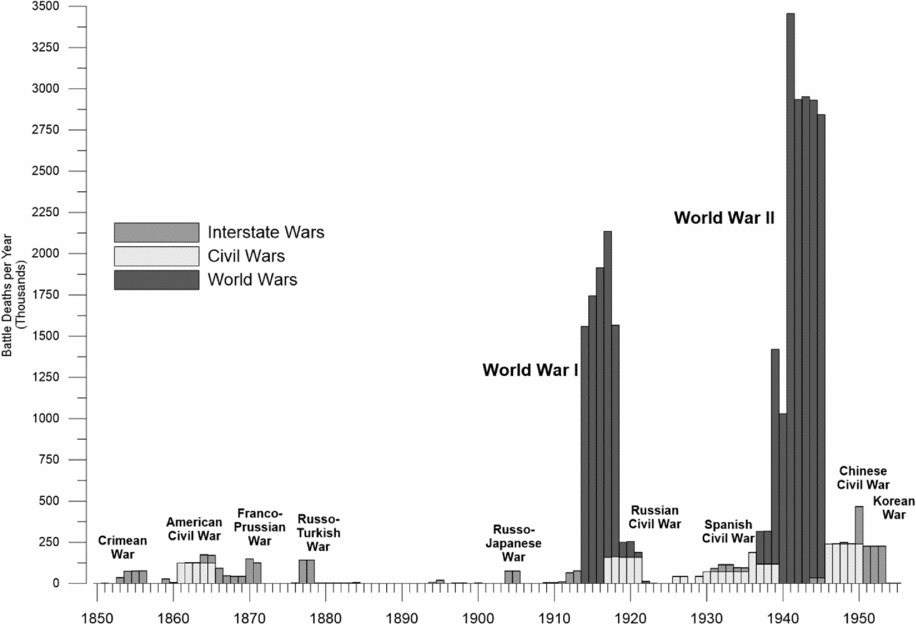
One of the most common measures of the scale of a war is the number of men who died in battle. Figure 1 traces the battle deaths incurred in military conflicts throughout the world from 1845 to 1945.Footnote 1 From the middle of the nineteenth century to the outbreak of World War I in the summer of 1914, there were only two significant wars that involved European armies facing each other on the battlefield. The Crimean War began in 1853 as a quarrel between Turkey and Russia over the treatment of Christian minorities in the Ottoman Empire. Britain and France got involved a year later because of their concerns that Russia might gain control of the Dardanelles. The war dragged on until February 1856, when Russia proposed an armistice. All of the major European powers subsequently gathered in Paris and agreed to a treaty that ended the war. Just more than 600,000 men died in the conflict, more than three-quarters of them from disease. The Treaty of Paris, which ended the Crimean War, created a new status quo that avoided any direct military action by European powers against each other in the Middle East until 1914.Footnote 2 The other war that pitted large European armies against each other was the Franco-Prussian War, which ended with a crushing defeat of the French at the Battle of Sedan in September 1870 and led to the collapse of the French government under Emperor Louis Napoleon. The Germans insisted on annexing territory comprising two French departments—all of Alsace and most of Lorraine—into the newly created Imperial German Empire and celebrated their victory by crowning Wilhelm I of Prussia as the first emperor of Germany in Versailles. The only other significant war after 1871 involving a major power was a conflict between Japan and Russia that began with a Japanese attack on the Russian fleet in Port Arthur in February 1904. That dispute, which cost the two sides more than 200,000 battle deaths, ended with a negotiated settlement that elevated Japan to the status of a major power in the Orient.
A Century of European Warfare, 1850–1950

Each of these wars played an important role in shaping the political relationships among the great powers of Europe in the years leading up to World War I. The battles involved clashes between large masses of infantry that produced huge casualty lists; however, the conflicts were all relatively short and were settled by treaties that sometimes involved powers that had remained neutral during the conflict. Governments remained confident that, for those willing to pay the costs, waging a war could be a useful, albeit expensive, policy option. “The object of war,” wrote the German Chancellor Otto von Bismarck in his memoirs, “is to conquer peace under conditions which are comfortable to the policy pursued by the state” (Bismarck Reference Bismarck1968: 192). Bismarck did not preclude the possibility that quarrels between governments might escalate into a larger war, but he was confident that diplomacy would find some sort of settlement without getting into a war that involved all of the major powers.
All that changed in the summer of 1914. “Battle losses of World War I” writes Michael Clodfelter, “were totally unprecedented in human history. Even the greatest battles of the continental wars of the seventeenth and eighteenth centuries in Europe paled beside those of World War I” (Clodfelter Reference Clodfelter2002: 479). If one adds the deaths resulting from the Russian Civil War and territorial conflicts immediately following the end of the Great War, at least 12 million men lost their lives. World War II was even more deadly. “The toll of World War II, according to the most conservative estimate,” claims Clodfelter, “surpasses 30 million—with 40 million a more likely figure and some estimates going as high 55 million” (Clodfelter Reference Clodfelter2002: 581). These estimates suggest that something on the order of 100 million people—a number equal to the entire population of the United States in 1914—died as a direct consequence of the two world wars.
Two “world wars” in 40 years would seem to be more than enough to warrant Eric Hobsbawm's term “Age of Catastrophe” to describe the period from 1914 to 1945. But the wars were only part of the story. Military historians tend to view the two decades following the end of the Great War as a lull before the resumption of fighting. To economic historians, the interwar years were anything but a “lull”; they were a period of intense economic and social turmoil as people struggled to get back into some sort of “normalcy” amid the destruction and confusion surrounding the end of World War I, and were then confronted with a global depression. Among the most visible signs of the economic uncertainty caused by the war were the instability of international financial markets; the collapse of antebellum trading patterns; widespread unemployment throughout the industrial economies; and episodes of hyperinflation that paralyzed several countries immediately after the war.
On the face of it, one might think that economic depressions and the outbreak of wars are not easily tied to each other. Yet it is not difficult to find explanations suggesting that the two situations share some common features. Two observations by scholars who have studied wars and crises will serve to make our point. The first quote is from the introduction to John Stoessinger's widely read book Why Nations Go to War:
Mortals made these decisions. They made them in fear and in trembling, but they made them nonetheless. In most cases, the decision makers were not evil people bent on destruction but were frightened and entrapped by self-delusion. They based their policies on fears, not facts, and were singularly devoid of empathy. Misperception, rather than conscious evil design, appears to have been the leading villain in the drama. (Stoessinger Reference Stoessinger2001: 1–2)
The second quote is from John Kenneth Galbraith's best-selling account of the Great Crash:
No one was responsible for the great Wall Street Crash. No one engineered the speculation that preceded it. Both were the product of the free choice and decision of hundreds of thousands of individuals. The latter were not led to the slaughter. They were impelled to do it by the seminal lunacy which has always seized people who are seized in turn with the notion they can become very rich. (Galbraith Reference Galbraith1954: 4)
Like Stoessinger, Galbraith believes that the economic crisis of the 1930s was the result of decisions made by people—lots of people—following their often-conflicting self-interests. Unfortunately, their decisions were governed by a “seminal lunacy” that turned their rational decision to buy a stock into a collective mania that caused a speculative bubble.
Though they deal with very different phenomena, either of these two descriptions could refer to decisions involving a declaration of war or to the actions that brought about a financial panic. Stoessinger and Galbraith both claim that at the moment of crisis the decision makers are under considerable pressure to act quickly on the basis of imperfect perceptions and instincts to make what proved to be erroneous decisions in terms of the eventual outcome. Military historians have highlighted the “irrational” (and therefore unexplained) mistakes, miscalculations, and misperceptions that have led generals and politicians to choose war over diplomacy. Economic historians have relied on the economists’ notions of rational markets, which insist that market systems will operate in a fashion that will ensure rational outcomes even if individuals behave in an irrational way. Unfortunately, rationality is an a priori assumption about the way the world should work, and our data on wars and panics strongly suggest that there are times when the world does not work “rationally.”
Animal Spirits
Writing in the middle of the Great Depression, John Maynard Keynes claimed that “if orthodox economics is at fault, error is to be found not in the superstructure, which has been erected with great care for logical consistency, but in a lack of clearness and of generality in the premises” (Keynes Reference Keynes1936: ii). He suggested that economic theorists needed to recognize that much more than mere “rationality” lay behind the decisions that households and businesses made every day. “[A] large proportion of our positive activities,” Keynes wrote, “depend on spontaneous optimism rather than on mathematical expectation, whether moral or hedonistic or economic. Decisions to do something positive. . . can only be taken as the result of animal spirits—of a spontaneous urge to action rather than inaction, and not as the outcome of a weighted average of quantitative benefits multiplied by quantitative probabilities” (ibid., 129). Keynes did not elaborate on the details of his animal spirits, he merely implied that people's actions are sometimes motivated by spontaneous urge.Footnote 3
Economists George Akerloff and Robert Schiller have recently adapted Keynes's notion of animal spirits for their “account for how [the economy] works when people act as humans, that is, possessed of all-too-human animal spirits” (Akerlof and Shiller Reference Akerlof and Shiller2009: 5). They identify five animal spirits that they use to analyze economic behavior in more recent times: confidence; fairness; corruption and bad faith; the influence of “stories”; and the presence of a “money illusion.” In fact, one can easily imagine a dozen additional situations in which animal spirits can influence human decisions. For the analysis of this paper I have retained Akerlof and Shiller's taxonomy of five animal spirits and added some animal spirits that might affect decisions leading to the recurrence of economic crises of the 1930s and the outbreak of the two world wars. I have grouped my discussion around three broad types of animal spirits: confidence, fear, and what I call the propensity to gamble.
Confidence
“The very term confidence,” explain Akerlof and Shiller, “implies behavior that goes beyond a rational approach to decision making. . . . When people are confident they go out to buy; when they are unconfident they withdraw, and they sell. Economic history is full of such cycles of confidence and withdrawal” (ibid.: 13). Every account of an economic boom talks about some set of confidence multipliers: actions or events that reinforced expectations about the profitability of a particular group of assets in the financial markets. So long as asset prices continued to rise, and investors could obtain funds, the confidence multipliers sustained continued speculation. At some point, however, the “irrational exuberance” of investors pushed prices to a point where those speculators who were trying to lever their position in the market by borrowing funds, were forced to sell assets in order to raise cash to meet the demands of their creditors. A single investor could sell stocks to repay loans without affecting market prices. But when many investors tried to liquidate their holdings, the sudden urge to sell created a financial panic as speculators rushed to limit their losses.Footnote 4
When leaders start down the “road to war” what follows is a sequence of events that is remarkably similar to the reaction of investors to a speculative investment bubble. Carl von Clausewitz, the Prussian general whose 1835 treatise On War remains one of the primary sources in the study of how states use military power, insists that war is simply one of many options in state diplomatic policy (Clausewitz Reference Clausewitz2008). Policies demand choices. Most of the time there are options available that allow the parties to resolve the crisis without resorting to war. But if diplomatic measures do not ease tensions and the situation continues to escalate, the number of options to lessen the pressure on the confidence bubble dwindles. The one option that is invariably not “taken off the table” is going to war. Like the investor who has borrowed too much money to sustain his position in the market, the political leaders are eventually faced with a situation in which force is the only policy that can seemingly resolve the dispute.
This brings us to the problem of overconfidence. Modern wars, like modern investment schemes, involve a great deal of planning. Planning involves constructing a set of assumptions to estimate the probability that the use of force will resolve the problem. Military planners, like their counterpart in the investment markets, tend to let their eagerness to win cloud the reality of their assumptions. Dominic Johnson notes that positive illusions may not be the “all-encompassing explanation for war, but they. . . offer a compelling extra piece of the war puzzle” (Johnson Reference Johnson2004: 34). He makes an interesting point, that the larger the scope of the problem, the more room there is for positive illusions to foment overconfidence. A rather simple extension of his argument would imply that the overconfidence of leaders will often be shared by the masses. Just as promises of quick profits reinforce the euphoria of a stock market boom, stories reinforcing the view that victory is within sight fuels the incessant beat of the “drums for war.” Both military/diplomatic and economic situations can turn into a crisis situation in which overconfidence has produced a “bubble” that has been stretched to a point where the slightest dislocation may cause the bubble to burst.
Fear
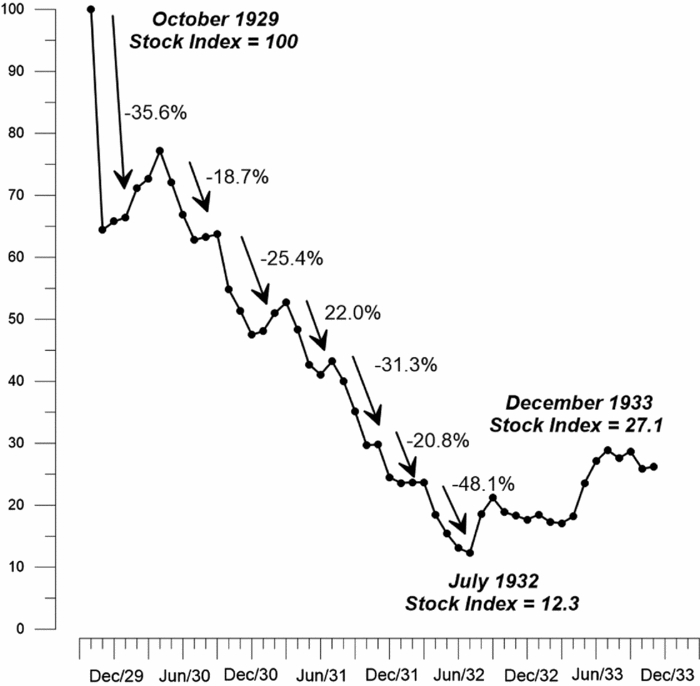
The flip side of confidence is fear, which kicks in if confidence is shaken by the course of events. As confidence wanes and fears grow, decisions become much more geared to the need for immediate solutions to defuse the “bubble” of economic speculation or the imminent dangers that a major war might break out at any moment. In the economic sphere even the most optimistic investors know that the financial bubble will not go on forever. As credit tightens investors become increasingly edgy. A gradually increasing level of fear and uncertainty grips decision makers in a situation in which no matter what they do, the risks of loss will continue to grow until the bubble finally bursts. Fear can also play a role in determining what will happen after the confidence bubble bursts. As Franklin Roosevelt so aptly remarked when he took office in 1933, “[T]he only thing we have to fear, is fear itself!” One of the aftereffects of an economic crash is a pervasive pessimism based on fear of what just happened. Rallies are met with a skepticism that produces quick sell-offs, investors are reluctant to invest, and consumers hoard cash and postpone savings. One of the most dramatic examples of the interaction of confidence and fear was the New York stock market crash of October 1929. Figure 2 presents monthly data on stock prices on the New York Stock Exchange from October 1929 to January 1934. The initial panic selling drove stock prices down more than 30 percent. However, there were six bursts of optimism between the beginning of 1930 and the middle of 1932. Each was quickly washed away by a new rush to sell. By the time prices finally hit rock bottom, the New York Times Index of Stock Prices stood at 12.3—a decline of almost 90 percent!
The New York Times Index of Stock Prices, 1929–34

Fear and falling confidence play a major role in deciding the next move at tipping points in war. Victories set the confidence multiplier spinning upward while defeats puncture the confidence bubble, but offer little in the way of suggestions of where to go next. This interplay of fear and confidence brings us to the final element that influences decisions on war and economics: the propensity for humans to make risky gambles.
A Propensity to Gamble
Decisions about both military and economic crises involve the need to predict events that are subject to varying degrees of risk and uncertainty. The probabilities associated with market behavior in a world of uncertainty can be estimated using complex models that forecast future outcomes, but no amount of probability analysis or simulation models can eliminate the uncertainty that pervades financial markets. Empirical models designed to predict the behavior of financial markets assume some degree of “rational” decision making by investors. But people confronted with a “confidence bubble” do not always act “rationally”—particularly if they are afraid that the consequences of their actions could result in substantial losses. One of the effects of fear is to encourage investors to take risks they might otherwise not consider. At some point, they must either borrow more to maintain their fragile position in the market, or cash in their chips and hope that they are at the front of the line of sellers, rather than at the end of the line when the market collapses.
It is common knowledge that investing in the stock market involves some degree of gambling. So it is with war. “No other human activity,” claimed Clausewitz, “is so continuously or universally bound up with chance. And through the element of chance, guesswork and luck come to play a great part in war” (Clausewitz Reference Clausewitz2008: 85). Simple choice theory suggests that military or political leaders would carefully look at the odds of winning or losing and select the option with the highest odds of success. Economic theory would suggest the same scenario for investors. Investors should select those investments with the greatest chance of increasing their net wealth. However, making choices that involve risk is not that simple. In 1979 behavioral economists Daniel Kahneman and Amos Tverskey (Reference Kahneman and Tversky1979) developed a model they called “prospect theory” to analyze how people make decisions when facing risks. Prospect theory argues that people will place less weight in assessing outcomes that are “merely probable” than they will on choosing outcomes that appear to be certain. This tendency, they claim, “contributes to risk aversion in choices involving sure gains and to risk seeking in choices involving sure losses” (ibid.: 263). Prospect theory also postulates that people are much more concerned about avoiding large losses than they are about acquiring gains. Jack Levy and William Thompson (Reference Levy and Thompson2010) show how these aspects of prospect theory explain the propensity to gamble when it comes to international war and diplomacy:
Given the overweighting of losses relative to gains and the tendencies toward risk aversion in decisions involving possible gains and risk acceptance in decisions involving possible losses, political leaders have a tendency to take more risks to maintain their international and national positions, reputations, and domestic political support against potential losses than they do to enhance their positions. They are more likely to fight in order to avoid losses than to make gains. This helps to reinforce the argument that wars are driven more by fear than by ambition. Similarly, domestic publics punish their leaders more for incurring losses than for the failure to make gains. (ibid.: loc. 2354–56)
Prospect theory is particularly useful for an economic historian using a narrative analysis to explain wars because the calculations of risk for a specific situation are placed in the context of a reference point that “frames” the specific assumptions for each decision. Once the outcome of that decision is known, a new reference point can be established for subsequent decisions. The emphasis in prospect theory is on the value of changes brought about by the decision, not the total level of activity. This allows us to look at the outcome of battle as marginal increments in the context of the larger war.
The tendency for people to reframe their actions on how to deal with changing situations produces another way in which animal spirits can influence decisions dealing with wars and economic crises. Battles involve enormous costs both in terms of human casualties and the resources to carry on the fight, just as plunging asset prices in the midst of a financial panic produce dramatic changes in the economic situations for both people and institutions. The costs associated with these phenomena are what economists call “sunk costs.” The logic of marginal economics tells us to ignore such costs and concentrate on the added or marginal costs or benefits associated with what we want to do next. Prospect theory suggests that sunk costs in the form of casualties from wars persist in a way that creates a tendency for leaders to find ways to recover those costs, even if this choice involves higher risks rather than pulling back efforts to “cut one's losses.” As Levy and Thompson put it, “[P]olitical leaders often continue to pursue costly interventions and wars, even in strategically unimportant areas, rather than risk the state's loss of power and prestige or their own loss of domestic support” (ibid: loc. 2363). The reluctance to ignore sunk costs has similar implications for the risk behavior of investors struggling with the challenge of rapidly changing asset prices. Investors eager to protect their gains or regain their losses are willing to gamble on risky investments in an effort to offset recent changes in the value of their portfolio. All of this is tied to what Robert Shiller calls “a basic human interest in gambling, seen in one form or another in all cultures, an interest that also expresses itself in speculative markets” (Shiller Reference Shiller2000: 150).
Information, Perceptions, and “Stories”
History does not move smoothly along a predetermined path. The major wars, panics, and depressions of the first half of the twentieth century were all touched off by some sort of displacement—an event that somehow changed the economic, political, or economic environment in an unexpected way. Displacements lead to a situation in which animal spirits of confidence, fear, and a propensity to gamble come forcefully into play. Both the military/diplomatic and the economic situations described in the preceding text involve a situation in which overconfidence produced a “bubble” stretched to a point where the slightest dislocation may cause the bubble to burst.
This brings us back to the question of how individuals—and groups of individuals—formulate what they believe to be a “rational” calculus of decision making. People base their decisions on perceptions that are shaped by the information available to them. Most people have a tendency see things as they want them to be, not as they actually are. Even when they have reliable information about the situation, they can fall victim to systematic biases that exaggerate the gains or minimize the risks of some action. “A root cause of war,” notes Stephen Van Evera, “lies in the opacity of the future and in the optimistic illusions that this opacity allows. These illusions lead states to a false confidence in victory, or for Pyrrhic victories” (Van Evera Reference Van Evera1999: 14). John Vasquez adds that “as one examines the actual consequences of each action that is taken, one finds that it is anything but rational. Misperception, miscalculation, self-fulfilling prophesies, and errors often produce disasters that might have been avoided if actors had behaved differently” (Vasquez Reference Vasquez1993: 154).
Every explanation of war and economic speculation must take into consideration this issue of inaccurate or insufficient information. Akerlof and Schiller (Reference Akerlof and Shiller2009) add a further dimension to the problems surrounding information gathering by noting that a substantial amount of information comes in the form of “stories” that convey information formally or informally among groups of people. Stories, they argue, give us “our sense of reality, of who we are and what we are doing, is intertwined with the story of our lives and of the lives of others. The aggregate of such stories is a national or international, story, which itself plays an important role in the economy” (ibid.: 41). Quantitative historians shy away from a reliance on stories. In part, this reflects the difficulty of assessing the accuracy of what a lawyer might call hearsay evidence; in part, it reflects the difficulties of quantifying statements involving magnitudes that are stated as “large” or “small” without any numerical context. Word of mouth is a pervasive and powerful source of information that is disseminated throughout society because people are prone to accept a story as “trustworthy” if the source is someone they trust or respect. Information obtained from stories of past successes or failures in investment decisions can play an important role shaping investment bubbles. Politicians use the information from stories to influence voters in elections. Descriptions of past military successes or failures form an important source of information for defending subsequent decisions. Alfred von Schlieffen's plan failed in its ultimate objective of defeating France in 1914. However, the campaign was enough of a success to provide confidence that subsequent German offensive operations might succeed.Footnote 5 The Japanese attack on Pearl Harbor in 1941 was a brilliant tactical success, but it did not permanently cripple the American fleet because the American carriers were not there. Nevertheless, there were endless “stories” on both sides of the Pacific that shaped the decisions for the Battle of Midway six months later. In all of these facets of decision making, stories can play a crucial role in accentuating the influence of animal spirits on the people who are reacting to the changing events of the military or economic crisis.
Following the Leader
Our discussion of wars and financial bubbles up to this point has implicitly assumed that whether or not the decisions of individuals were “rational,” they were made independent of each other. If this were the case, then investors who pick winners and those picking losers would tend to average out regardless of the basis of their calculations. However, if a significant number of investors are mechanically following the same recommendations or information provided by “experts” or “leaders,” then a situation emerges that economists call “herd-like movements.” As Shiller explains it, “[E]ven completely rational people can participate in herd behavior when they take into account the judgments of others, and even if they know that everyone else is behaving in a herd-like manner. The behavior, though individually rational, produces group behavior that is, in a well-defined sense, irrational” (Shiller Reference Shiller2000: 159). Ironically, one of the challenges facing decision makers is not that there is too little data at hand on which to base a decision; it is that there is too much information for the average investor to digest and evaluate. If the leader has a track record of success, the herding instinct produces a situation in which price increases beget more price increases, a process that will eventually lead to that moment when confidence turns into fear and prices are driven back down. Robert Shiller explains this process of amplification:
Initial price increases attract investor interest and demand, and the new demand begets more price increases. We find ourselves in a vicious circle whereby prices accelerate upward. The price increase cannot go on forever, and eventually the halting of price increases disrupts the investor motivation for holding the highly priced stocks. At that point, the price increase may be sharply reversed, the bubble burst, and there can be downward feedback, leading to lower and lower prices. . . . [T]his simple amplification mechanism is well known and has been talked about for centuries, but curiously, it is rarely mentioned by economists in their scholarly papers. From this lack of discussion, one might easily assume that such amplification is discredited by some scholarly work, while in fact, no such scholarly work exists. (ibid.: 38)
Herd-like behavior is not confined to the marketplace; it has been equally significant in political affairs. The rise of fascism in Germany and Italy in the 1920s and 1930s is evidence of the ability of political demagogues, such as Benito Mussolini and Adolf Hitler, to rally their devotees into herd-like support that enabled them to control entire countries and take them to war. A subtler example can be seen in the support for rising military expenditures among the populations of European powers in the half century leading up to World War I. Legislative assemblies complained about the exorbitant costs of armies and navies, but in the face of real or imagined crises they reluctantly voted for the funds requested to at least maintain the status quo. If war did come, they tended to enthusiastically support the decision to send their troops into battle.
Paradigms, Anomalies, and Tipping Points
So why was it so difficult for people to return to the prewar world of 1914? It should be apparent by now that we are not going to come up with a simple answer to this question. The world of 1914 had numerous checks and balances that had evolved over the past century, and things had worked well enough so long as there were no “displacements” large enough to require significant adjustments to the global status quo. The Great War changed all that. People were forced to construct a whole new set of reference points with which to reset their priorities. The new situation called for a new way of looking at things.
In his book dealing with the origins of scientific revolutions, Thomas Kuhn used the concept of “paradigms” to explore the roots of intellectual change. Kuhn identified scientific paradigms as accepted bodies of knowledge that the scientific community took for granted in their research agenda. He contended that, precisely because they “worked” most of the time, paradigms were not only accepted, they were resistant to any major changes. Only if someone discovered some “anomaly”—an empirical event or occurrence that could not be reconciled with the implications of the paradigm—would there be an incentive for researchers to look for a new paradigm. Because no paradigm can explain everything.Footnote 6 There would always be a few anomalies that could not be reconciled with the paradigm. Only if someone discovered an anomaly significant enough pose a serious “crisis” for the usefulness of the paradigm would researchers abandon the existing paradigm.Footnote 7
We can extend Kuhn's logic of scientific revolutions to reflect what John Kenneth Galbraith called the “conventional wisdom” of the world of economics—the way people think about economics, politics, and war.Footnote 8 In the years following the Great War, people experienced hyperinflation, persistent unemployment, the collapse of security markets, the unexplained decline of incomes, and the demise of governments that had existed for decades. All of this constituted a massive group of anomalies that suggested that the generally accepted view of the world no longer reflected how the world really worked. A new set of paradigms was needed to understand what was happening. Unfortunately, it is not easy to change people's views of the world. Keynes commented on the power that existing paradigms tend to exert on people when he wrote in the closing paragraph of The General Theory that
the ideas of economists and political philosophers, both when they are right and when they are wrong, are more powerful than is commonly understood. Indeed the world is ruled by little else. Practical men, who believe themselves to be quite exempt from any intellectual influences, are usually the slaves of some defunct economist. Madmen in authority, who hear voices in the air, are distilling their frenzy from some academic scribbler of a few years back. I am sure that the power of vested interests is vastly exaggerated compared with the gradual encroachment of ideas. (Keynes Reference Keynes1936: 327)
The problem for those seeking new approaches in 1919 was that the Great War had shifted things so far away from “normalcy” that policy makers did not know where to start rebuilding the shattered antebellum confidence. “Practical men” in Western Europe and the United States still had an unrelenting belief that markets were stable, efficient institutions that promoted exchange and specialization throughout the world, and they were reluctant to give up those beliefs even in the face of anomalies that appeared in the form of inflation, unemployment, and falling income. Eventually, stubbornness might give way to a grudging recognition that things had changed and that ideas had to change with them. But the process by which that occurred was not simple.
Why were the “paradigms” and institutional arrangements unable to contain the forces of change unleashed by the crisis of 1914? One explanation is that animal spirits trumped rational thinking during the deliberations of each country whether or not to go to war. Most of the time animal spirits simply add an element of enthusiasm—or lack of enthusiasm—to decisions that are routinely made. However, the threat of a major war that could dramatically change the balance of power among the major countries of Europe was a possibility that made everyone “recalculate” their options. Historians refer to such situations as tipping points: moments in time when events have reached a threshold where decisions can decisively alter the course of subsequent events. Because people do not know when these tipping points might come along, leaders are seldom prepared to act quickly; they must react by using whatever tools are at hand. This is when animal spirits are most likely to take over the decision-making process. We have seen that one of the most important ways that animal spirits exert an influence is by influencing how decision makers view risk. Historical descriptions of the decision processes in various countries considering their options during the 1914 crisis invariably emphasize that while the “road to war” had many exits, they were universally ignored by generals, monarchs, and politicians who were driven by a combination of overconfidence in their military plans and fear that failure to take military action would lead to eventual disaster.Footnote 9 These rich narrative accounts allow us to examine how decisions at the tipping points could change the course of events.
One of the things that emerges from all of the narrative accounts and quantitative analysis that has emerged over the years is the extent to which war and economics had become entwined with each other by the beginning of the twentieth century. Fighting wars involved more the development of military strategies and tactics; generals and politicians had to deal with the voracious demands of modern armies that required massive shifts of supply and demand within the economy. Generals were slow to understand this point. Historian Barbara Tuchman relates an incident early in the war when an official presented the German commander Helmuth von Moltke with a memorandum indicating the need for an “economic general staff” to deal with problems of supply. “Don't bother me with economics,” snapped Moltke, “I am busy conducting a war” (Tuchman Reference Tuchman1962: 335). Moltke and his colleagues would eventually learn that conducting a war would get them very involved in the economics of planning wartime demand and supply.
The Metrics of War and Economics
A major challenge for quantitative studies of war and economics is finding measures that quantify the variables needed for their quantitative analysis. Although economic historians and cliometricians have at their disposal a huge cache of data on economic variables with which to examine the Great Depression, there is a far smaller body of data to deal with animal spirits and war. Not surprisingly, economic historians have not tended to extend their analysis to issues of war and economics beyond the questions dealing with economic disruption and mobilization of the economy for war. Thus, for example, in their book Power and Plenty, Ronald Findlay and Kevin O'Rourke (Reference Findlay and O'Rourke2007: xxv)—two cliometricians who actually incorporate war into their analysis—reluctantly admit that World War I “appears as somewhat of a diabolus ex machina in our account.”Footnote 10 A veritable army of military and political historians have examined the causes and impact of these military and economic crises, however, as John Vasquez observes, “much has been written on the causes of war; little has been learned about the subject” (Vasquez Reference Vasquez2009: 3). Research focusing on individual wars has tended to produce a situation in which wars are “overexplained” because more than one explanation is consistent with the same data. The difficulty of untangling what econometricians call the “identification problem” is that there is seldom enough additional data to sort things out and select the “best” explanations.Footnote 11
Any study of warfare in the twentieth century involves some attempt to assess and compare the ability of rival states or groups to wage war. One of the most ambitious efforts to meet this challenge has been the research effort by the Correlates of War Project (COW) founded by J. David Singer at the University of Michigan. What makes the data collected by the COW project particularly useful is it applies the same definitions for variables collected from many areas of the world over a period of more than 200 years. One of the more intriguing results of their efforts is the construction of a Composite Index of National Capability (CINC). The CINC index is comprised of six variables intended to measure the demographic, industrial, and military indicators, which the COW project views as the most effective measures of a nation's ability to wage war (see Correlates of War Project 2014).
The six variables included in the data set are:
Military Personnel (thousands): Defined as troops under the command of the national government, intended for use against foreign adversaries, and held ready for combat as of January 1 of the referent year.
Military Expenditures (thousands of current dollars): Defined as the total military budget for a given state for a given year.
Total Population (thousands): Defined as the number of people living in a given state.
Urban Population (thousands): Defined as the number of people living in a city of 100,000 or more.
Primary Energy Consumption (thousands of coal-ton equivalents): Computed using data about four broad categories of sources—coal, petroleum, electricity, and natural gas. The raw data for each commodity is converted into a common unit and then summed to produce the total energy consumption for a given state in a particular year.
Iron and Steel Production (thousands of tons): Defined as all domestically produced pig iron until 1920 and total iron and steel production after 1920.
The CINC index data sets includes data for every state that reported data for a given year. For each state COW computes the ratio of the total value reported for a variable, divided by the global total for that variable. The CINC “score” is the sum of all six ratios divided by six. Multiplying the CINC ratios by 100 gives us a %CINC index that represents that state's percentage of the global total. The %CINC index provides us with a rough measure of the relative share of military and economic power of countries across territory and time. However, it is important to emphasize that the aggregate %CINC score measures the overall capability of a state's military and economic power, not the actual ability to wage war at a point in time. Whether or not the country actually realizes that capability depends on the degree to which resources have been mobilized into an effective system of economic and military organization prepared to fight a war.Footnote 12
Can an index constructed from estimates for six aggregate variables spread across dozens of states over a period of nearly 200 years capture the subtleties and capricious outcomes that decided a world war? Probably not. The data can, however, provide some support and interesting insights to our analysis of how animal spirits related to confidence, fear, and the propensity to gamble affected the decisions that led to shifts in strategy. We can examine this data to consider several questions that are frequently raised in the literature dealing with World War I.
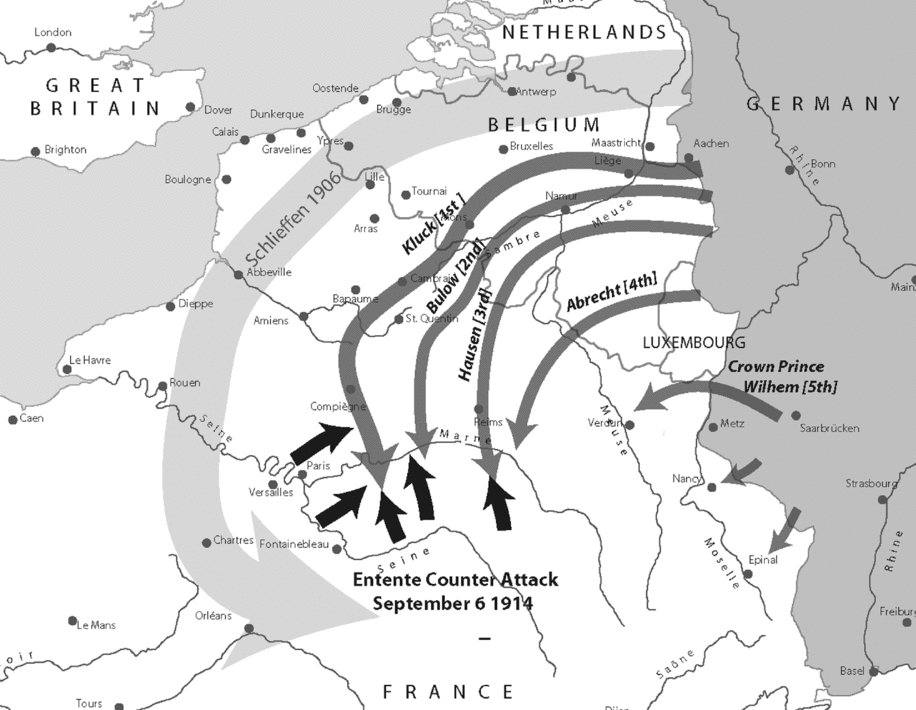
Following their victory over the French in 1871, the great fear on the part of German military and civilian leaders was the strong likelihood that a future war against Germany would involve both Russia and France. By 1914 a plan first introduced by General Alfred von Schlieffen in 1906 was in place to deal with just such a contingency.Footnote 13 Schlieffen had proposed that Germany concentrate her forces against one opponent at a time. He felt that France offered the best opportunity for a quick German victory, and he therefore recommended that between two-thirds and three-quarters of the German army be prepared to sweep through Belgium and Holland and on into France in a broad arc that would carry them west of Paris. They would then be in a position to annihilate the French Army in a single battle as it had in 1871 (see figure 3). The proposal depended on the speed of movement and successful coordination of a huge mass of troops, most of whom had no experience under combat. It constituted a violation of both Belgium's and Holland's sovereignty, which would almost surely bring the British into the fray.
The Schlieffen Plan

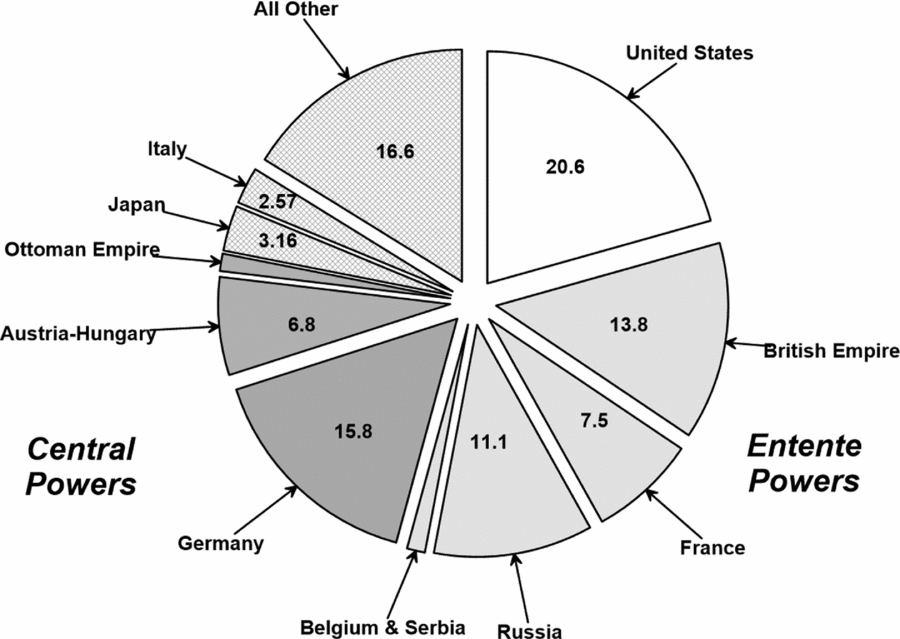
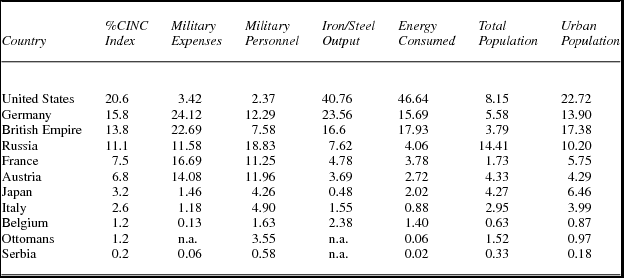
On the face of it, the Schlieffen memorandum was a very risky proposal. The %CINC scores in figure 4 underscore the importance for a quick and overwhelming victory against the French if it was to succeed. The combined %CINC of the three Entente Powers in 1914 was 32.5 while that of Germany and her Austrian ally totaled only 22.6. The longer the war, the lower the odds of a German victory. Schlieffen recognized the urgency of a quick victory, and that is why he was willing to violate the neutrality of both Holland and Belgium in order to create an invasion route that would take his armies deep into Northern France.Footnote 14
%CINC Scores in 1914

By 1914 the German war plan was still based on Schlieffen's premise that the Germans could quickly defeat the French and use their interior lines to hold off the Russians in the east, and that any intervention by the British would come too little and too late.Footnote 15 Though Schlieffen and the German High Command in 1914 did not have all of the data embedded in figure 4 and table 1, their assessments are not contradicted with the %CINC scores. Taken separately, the total %CINC scores in figure 4 for Germany exceeded the scores for each of their potential adversaries in 1914, and table 1 shows that the Germans had particularly favorable %CINC scores for every component dealing with military factors compared to France—which was the one that mattered most if the Germans were going to gain a quick victory in the west.
The crisis of 1914: Component scores of military capability (%CINC) for major powers

Things started out well enough for the Germans. The invading forces swept through Belgium and reached the French border two weeks later. However, at this point they began to encounter difficulties both from resistance of Entente troops and logistical problems in keeping the timeline demanded by the overall plan. By the end of August, the two German armies on the right wing of the invasion force—commanded by Kluck and Bulow—were no longer on a route that would keep them west of Paris. On September 4, Molke ordered the German armies to halt while they sought to regroup. The next day the Entente forces counterattacked, and the Battle of the Marne ended Germany's bid for a quick victory (see figure 3). The two sides then engaged in a series of battles that produced a line of hastily dug trenches that eventually stretched from the English Channel to the Swiss border.
Unfortunately for the Germans the war on the Western Front at this point turned into a bloody stalemate that neither side could break. It is worth noting, however, that the invasion was hardly a complete failure. By the end of 1914, Germany occupied almost all of Belgium and a significant portion of Northern France, and it was able to hold on to this territory throughout the rest of the war. In the east things also started well for the Germans. Generals Hindenburg and Ludendorff routed an invading force of Russian troops at the Battle of Tannenburg on August 26–30; a victory that served to keep the Russians out of East Prussia and buy the time that Schlieffen had hoped for to deal with the situation in the east. Planners in the German High Command could therefore contend that although the Germans had not destroyed the Entente armies, by the end of 1914 Germany had gained enough territory in the west to maintain its war effort for another three years.
Various explanations have been put forward to explain why Schlieffen's gamble fell short of its goal. An obvious factor was the scale of an operation involving millions of men who had never been in combat and a complex schedule that could not be maintained with the technology at hand. But an equally important factor may have been the shortcomings of the man who replaced Schlieffen in 1906 and was still in command of German armies in 1914. Helmut von Molke accepted the basic foundations of Schlieffen's plan, however he was not a gambler, and his lack of confidence in Schleiffen's scheme crippled his ability to carry out the details of the plan. As the battle in France progressed, Molke's confidence—already sorely tested during the invasion—evaporated. In a letter written to his wife on September 8, Moltke reveals the depths of the fear that had been plaguing him since the onset of the campaign:
It is going badly. The battles to the east of Paris will go against us. One of our armies must withdraw [Billow's?], the others will have to follow. The opening of the war, so hopefully begun, will turn into the opposite. . . . The campaign is not lost, no more than it was until now for the French, but French spirit, which was on the point of being extinguished, will now flare up tremendously and I am afraid that our nation in its headlong careening towards victory will scarcely be able to bear this misfortune. (Barnett Reference Barnett1963: 95)
In the end Schlieffen's gamble to win the war in one bold stroke failed because confidence had turned into fear. The Battle of the Marne was the first major tipping point in the Great War.
At least one man on the German General Staff realized the implications of the %CINC scores that favored the Entente. Just before Christmas in 1914, Erich von Falkenhayen, who had replaced Moltke as chief of the German General Staff, advised the kaiser that Germany should seek a negotiated end to the war as soon as possible. Falkenhayen's assessment of the situation facing the Germans reveals one of the greatest shortcomings of the Schlieffen Plan: The Germans did not have a “Plan B.” Realizing this, Falkenhayen pointed out that the odds would surely continue to shift steadily in the Entente's favor as the war wore on, and now was the best time for Germany to cut a favorable deal with the Entente Powers. Unwilling to concede that the Germans were not likely to win the war, the kaiser elected to ignore Falkenhayen's advice and continue the fight.Footnote 16
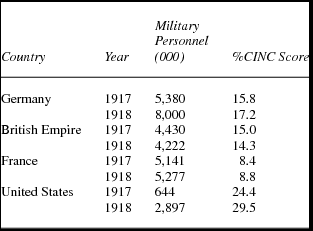
So the struggle on the Western Front turned into a stalemate that dragged on for another three years. In the east, however, things gradually turned in Germany's favor, and by the end of 1917 there was reason for optimism about the ultimate outcome of the war. A revolution in Russia overthrew the tsar and brought a new government to power that agreed to a cease-fire in December 1917. The departure of Russia from the war presented the Germans with another tipping point. Table 2 summarizes the relative military capabilities of the Germans, British, and French in 1917–18. By early 1918 the Germans had managed to increase the size of their army to eight million men and their %CINC score had risen to 17.2—its highest level since the outbreak of the war. The British and the French, by contrast, had barely managed to hold their exhausted military resources together. The result was that the Germans managed to increase the number of divisions serving on the Western Front from 150 in October 1917 to 192 in March 1918, while the strength of Entente forces declined from 176 to 169 (Clodfelter Reference Clodfelter2002: 449). Eric Ludendorff, now the head of the German Army, was confident that, with the Germans now controlling the Eastern Front, they could win the war if they launched one last offensive in the west. But they had to act quickly, because they must force the French and British to quit the war before the United States, which had entered the war in April 1917, could bring its considerable resources to help the Allied cause. On March 21, 1918 the Germans launched their last gamble of the war. They managed to get within 60 miles of Paris by the end of June; however, at that point the Allied line was bolstered by the steady arrival of more American troops, and at the Second Battle of the Marne the German advance was finally stopped.
The military situation, 1917–18
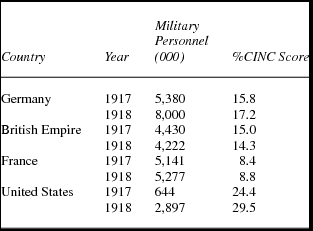
The Ludendorff offensives in the spring of 1918 are another example of how confidence, fear, and a propensity to gamble on the part of leaders affected decisions when the inevitability of defeat seemed certain if no action was taken. Though they held a temporary military advantage in the spring of 1918, a reality check would have revealed that the German economy was already “running on empty.” A growing level of civil unrest in opposition to the war suggested that civilians did not share the generals’ confidence that they could carry out their grand scheme for victory. As the Allied forces began their counteroffensives at the end of July, the confidence of the foot soldiers in the German Army also began to disappear. One measure of this loss of confidence is the sudden increase in German soldiers surrendering. “According to one estimate,” writes Niall Ferguson, “340,000 Germans surrendered between 18 July and the Armistice. Between 30 July and 21 October—less than three months—the British alone took 157,047 German prisoners. In the whole rest of the war they had captured only slightly more than that (190,797) (Ferguson Reference Ferguson1999: 168). The effect of these mass defections was to force Ludendorff to lose his own confidence in the effectiveness of his troops. As the success of the Allied offensives became increasingly apparent, Ludendorff reluctantly decided that the Germans must seek an armistice before a social revolution erupted in Germany.
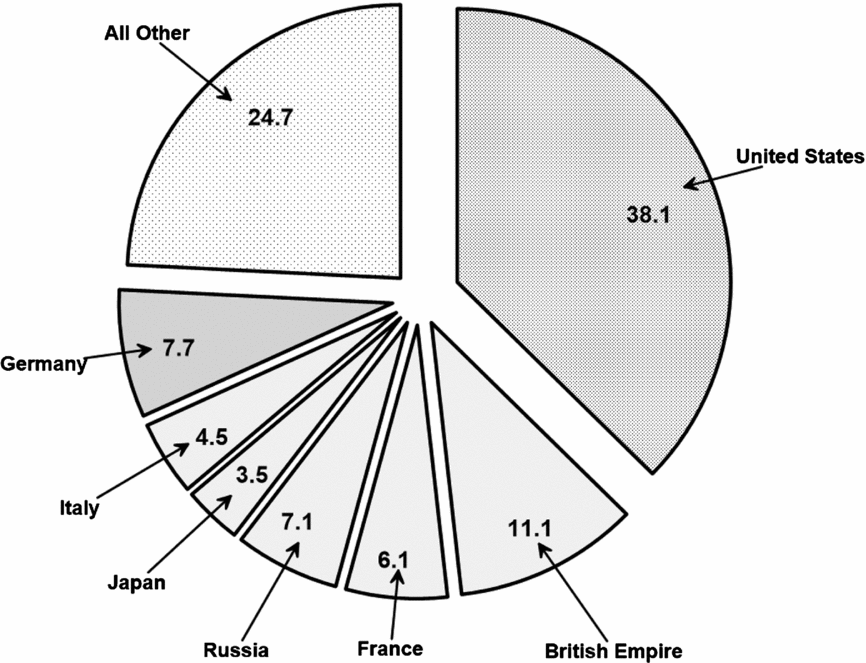
In addition to examining the gambles taken by generals to win wars, several general observations emerge from a comparison of the global %CINC rankings in 1914 and 1919. First is the extent to which one country—the United States—had by far the greatest share of global military capability of any great power even before the war started (figure 5). The Americans had abstained from the arms races of the first decade and a half of the twentieth century; and as a result they maintained a relatively small army and had a very modest defense spending compared to the European powers. However, the American economy accounted for more than a third of the world's iron and steel production and energy consumption (table 3). American military capability peaked at the end of 1919, when there were more than two million doughboys in France and American military spending accounted for more than 70 percent of the global total (table 3).
%CINC Scores in 1919

The situation in 1919: Component scores of military capability (%CINC) for major powers
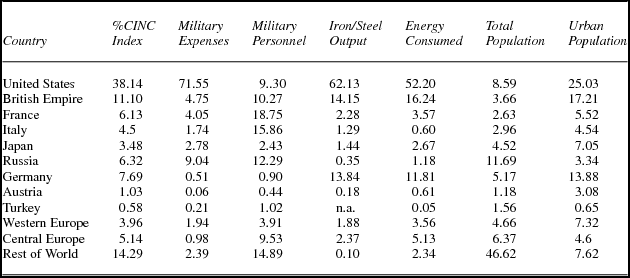
Notes: Western Europe includes Belgium, Denmark, the Netherlands, Norway, Spain, Sweden, and Switzerland; Central Europe includes Albania, Bulgaria, Czechoslovakia, Estonia, Finland, Greece, Latvia, Lithuania, Poland, Romania, and Yugoslavia.
A second observation is the extent to which global military capability was concentrated in the hands of a very small group of nations and empires throughout this period. The outcome of World War I did not significantly change that situation; however, the relative positions of various countries within the nexus of military and economic power changed dramatically over the course of the fighting. A final note regarding the influence of economic variables into the equation of military capability is the relatively high %CINC score of Germany in 1919—despite the reduction in the size of their military capability. The Allies had defeated the German armies; however, the %CINC scores suggest that as early as 1919 there was evidence that war had not permanently removed the economic capability for the Germans to rearm.
The %CINC measures of military capability reaffirm our conclusion that economics had become an essential part of military power in the post–World War I world. In addition to Schlieffen's 1914 gamble and Ludendorff's 1918 gamble, there were two other significant examples of military gambles in the Age of Catastrophe where the overconfidence of attackers led them to rely on what they confidently viewed as a superior military situation that would let them overwhelm their opponents and win a major victory. Adolf Hitler's invasion of the Soviet Union in July 1941 and the Japanese attack on Pearl Harbor in December 1941 were both instances in which the military components of the %CINC favored the attackers, and all of them were instances where the military offensives met with early success. But in the long run, the preponderance of power reflected in the economic %CINC components of their opponents proved decisive in determining the outcome of the war. All of these military actions were justified by the attackers because they felt that the odds of success were favorable enough to warrant a try for victory rather than face the certainty of what they saw as a worse outcome if they did nothing at all. Overconfidence surely accounted for some of this hubris, but it was ultimately fear of the alternative to offensive action that carried the day in 1914 and subsequent years.
Historian Ruth Henning summed all this up very nicely at the conclusion of her essay on the origins of World War I. “Countries went to war,” she wrote,
because they believed that they could achieve more through war than by diplomatic negotiation and that if they stood aside their status as great powers would be gravely affected. That was their greatest miscalculation. The balance sheet in 1918 proved how wrong they had been; by that time the status of all Europe's major powers had been greatly diminished and virtually none of the objectives of the European ruling elites had been realized. (Henning Reference Henning1989: 54)
Whether or not they were the consequence of “rational” decisions, Henning's judgment reminds us that the price the world paid for the gambles on wars during the Age of Catastrophes was extraordinarily high for what they gained. As the British cabinet completed their deliberations on the declaration of war against Germany on the evening of August 3, 1914, Sir Edward Grey, the British Foreign Secretary turned to a colleague and said, “The lamps are going out all over Europe, and we shall not see them lit again in our lifetime.” Grey's comment has become one of the iconic quotes associated with the outbreak of a war that nobody wanted, nobody understood, and nobody can forget. He was right that the lights were going out; but his estimate of when they would go back on was unduly optimistic.Footnote 17 A century later we are still struggling to adjust to the dark legacy of the Great War.
If there is a lesson from this brief look at war and economics in the Age of Catastrophe, it may be that although we have managed to avoid another world war, and our economic downturns can be labeled “recessions,” the puzzle of how to tame the animal spirits that cause “rational” people to make “irrational choices” remains for the next generation of social science historians to resolve.
Acknowledgments
Research for this paper was supported by the Edward A. Dickson Emeritus Professorship awarded by the Academic Senate of the University of California, Riverside for the 2015–16 academic year. I would like to thank Anne McCants, Richard Sutch, Claude Diebolt, Michael Bonner, Charles Calomiris, Louis Cain, Peter Lindert, Peter McCord, Kevin O'Rourke, and Hugh Rockoff for their helpful comments on earlier drafts of this paper. Thanks also to Lindsay Johnson for her valuable editorial assistance. This paper is part of a book project dealing with the puzzle of war and economics from 1914 to 1945.