Introduction
Bombs are falling outside of Kyiv. It is February 2022 and Russia has just invaded Ukraine. The Biden administration rushes to offer evacuation to Zelensky, the former comedian and now president of Ukraine. ‘I need ammo, not a ride’, Zelensky dryly responds according to the Ukrainian embassy in London.Footnote 1 The answer is poignant, thick with dark humour, and soon turned into endless social memes and retweets by Western leaders and publics. The image of Zelensky as a witty war hero, providing everyone with a bit of comic relief. But perhaps this humorous framing of the war also offered a facile way to engage with its complexity? Did it afford us a smile, without needing to give war the solemn weight it required? Did the original tweet and all its infinite retweets create an entertaining distance to the horrors unfolding and a state leader's (serious) request for help? These are some of the broader questions this article will begin to unpack.
Humour has been a long-standing subject in disciplines such as philosophy, communication studies, psychology, and anthropology, while International Politics until recently ‘overlooked the vast array of humorous practices that make up the stuff of global politics’.Footnote 2 Lately an exciting conversation has, however, begun on how to theorise humour for international politics and its constitutive implications for identity constructions, international recognition, knowledge, and global dissent.Footnote 3 Less attention has been directed to the limitations that humorous articulations of politics, such as Zelensky's tweet, may also have. The underside of framing international politics humorously is often passed over.
This article therefore aims to direct the emergent field's attention to the challenging implications that humorous enactments of international politics also have for global politics both theoretically and empirically. In an era of entertainment politics,Footnote 4 where government leaders and global publics engage one another through funny memes and staged jokes,Footnote 5 even in times of war, it appears increasingly relevant to probe further into the potential limitations of humorous performances in global politics, yet without losing sight of humour's productive side.
To do so, the article will begin by looking beyond International Politics, bringing in critical reflections on humour by the philosopher Søren Kierkegaard and the writer David Foster Wallace. The two thinkers are particularly relevant in this context as they, similarly to this article, were attracted to humour's productive power, yet at the same time concerned about its pervasiveness and perils: The ambiguity humour plays with, the unbearable lightness it can create, the detached engagement it may offer. As Kierkegaard and Foster Wallace did not write explicitly about politics, this will also be an attempt to reinterpret their ideas for International Politics and relate some of their concerns to concrete empirical examples from global politics. Three different examples will be analysed in depth: a ‘meme war’ between the Iranian and the US government at the height of their escalating proxy conflict in Iraq and the dismantling of the nuclear deal (JCPOA), the ‘Yes Men’, an international activist group, protesting climate change through parody at COP15 in Copenhagen, and thirdly nuclear talks in Pyongyang between Donald Trump and Kim Jong Un in 2019.
How can these examples of humorous practices then be analysed? If we are to study humorous performances in their multiplicity, without resorting to what Allister Wedderburn rightly calls a ‘normative commitment’ or telos, humour's critical or productive side should reversely not be discarded.Footnote 6 Drawing on poststructuralist theory in particular, the article proposes a three-pronged analytical strategy of: (1) strategic appropriation; (2) parodic subversion; and (3) continuous simulation. Each relates differently to power/knowledge by articulating a distinct relationship between an original referent and its giddy imitation. The analytical strategy is thus primarily underpinned by a Foucauldian understanding of power and knowledge as intimately connected, where humorous practices are embedded in formation of power and knowledge, never exterior to these. As analytical strategies, the three forms are, however, not to be seen as an ontology, or catalogue, of humour, but as a means to explicate and sharpen our analytical gaze to the different productive ways humorous practices work in relation to power/knowledge.Footnote 7
The remainder of the article is structured into four parts. The first part provides an overview of how the emerging field in International Politics has theorised the constitutive power of humour. The second part seeks to reinterpret Kierkegaard and Foster Wallace's thoughts on humour's potential limitations for present global politics. The third part develops the three-pronged analytical strategy of appropriation, parody, and simulation. This is followed by the empirical analysis of the three cases. The fourth concluding part suggests that there may be indications that humour's critical potential to question established truths and authority is hallowed out, as governments, state leaders, and international organisations increasingly adopt humourous practices in new public diplomacy, hybrid warfare, and nation branding efforts.
The productive power of humour: Three major themes in International Politics
What is humour? In his seminal book on humour, the philosopher Simon Critchley effectively defines it as a disjunction between expectation and actuality.Footnote 8 It is often the surprise or incongruity that makes us laugh, as when a serious world leader suddenly slips or acts out of character. Think, for instance, of the EU President Juncker slapping several European heads of states at the Riga summit and calling the Hungarian Prime Minister Viktor Orban a dictator. The unexpected clash between taboo and non-taboo, the real and unreal can make us laugh, as the comedic mode brings out contradictions and trouble familiar claims.Footnote 9 There is often a certain oddity or out of placeness to the comical that arises out of a shared social understanding: to appreciate a comical disjunction therefore requires some form of shared norms or community – ‘no social congruity no comic incongruity’.Footnote 10 Humour, moreover, is often characterised by a semantic ambiguity playing with multiple meanings and possibilities.Footnote 11 This ambiguity is especially prominent in the ironic form that uses contradictions and oppositions to install a sense of uncertainty of what we know about the world.Footnote 12 Most famously, perhaps, humour is taken to provide a sense of ‘psychological relief’.Footnote 13 Laughing can release repression and fears and create a necessary emotional distance to, for instance, trauma and crisis. Traces of Freud's ‘relief theory’ can also be found in present approaches to humour in international politics, where humour is seen as a means for states to manage anxieties and insecurities in the international realm.Footnote 14
In International Politics the focus has indeed mainly centred on what humour does to the political field, on humour's productive and enabling power. These ‘productive effects’ can be grouped into three major themes: Humour's ability to: (1) subvert and trouble power; (2) provide alternative truths and narratives; and (3) manage international anxieties and identities.
Subversion and troubling
Humourous practices can defamiliarise the familiar, making us aware of the contingency of social order and the assumptions of International Politics theory itself. Identities or beliefs that the discipline tends to take for granted – be they nation-states, certain gendered or racial norms, or the supposed tragic continuity of international politics – can be humorously questioned and the historical and discursive conditions of our being drawn out in novel ways. Wedderburn, for instance, argues that humour operates at, and across, the frontier of ‘orderly and righteous’ politics, that it has ‘a potential transversal role and the ability to contest social relations.’Footnote 15 Humorous practices can trouble power and social order by witty exaggeration, doubling, and playing with the unexpected. This is often particularly visible at mass demonstrations and uprisings, where activists playfully satirise political authority figures or engage in different forms of humorous happenings that disrupt dominant narratives and formations of power. But humorous contestations equally unfold in more subtle everyday practices. For instance, Mark B. SalterFootnote 16 has explored how joking in the security spaces at the airports constitute a form of subversion of that order, as joking undermine officials’ attempts to assess and know the dangers ‘joking subjects’ potentially pose. Amanda Källstig has similarly identified how female stand-up comedy acts as a practice of resistance to prevalent party and patriarchal gender norms in Zimbabwe.Footnote 17 In dark times of war, or in extreme authoritarian settings, joking and gallows humour may also constitute one of the few ways citizens can engage in clever political critique and create a sense of common bond, as Lisa Wedeen has explored under the rule of the Assad family and Bhungalia in the case of Palestine.Footnote 18 Indeed autocratic governments have persistently sought to regulate and censor political humour. In the Soviet Union there was even capital punishment for telling a counter-revolutionary joke.Footnote 19 Reversely laughing with rather than at political leaders’ mediocre joke telling can be a political necessity signalling political loyalty and submission.Footnote 20 Just as refusing to laugh may work as a form of protest or resistance to power, as Claus Dodds and Philip Kirby, for instance, have shown.Footnote 21
Alternative truth telling
Comedy and irony may also work as alternative forms of ‘truth-telling’, as Louiza Odysseos’ pioneering article from 2001 pointed out.Footnote 22 Odysseos reflects on how the comic poet in Greek tragedies has a particular power to interpret the political through riddles and oblique references, and how comic poetry can offer interpretations that ‘enlarges our political visions beyond the rational’.Footnote 23 It can, as Wedderburn argues convey the less visible and orderly facets of politics.Footnote 24 Historically the jester in the royal court also played this role. During the reign of absolutist kings, the fool was standing at the gates of the court neither being fully inside nor completely outside. In this liminal position he was the only one able to ridicule and challenge the sovereign king. With humour and wit, the court jester was expected, and the monarch dependent on, the fool being able to relate a different kind of truth to the king.Footnote 25 In Nasser's Egypt, intelligence officers were allegedly roaming the streets, collecting jokes from ordinary Egyptians, for the president to find out what his citizens really thought of him and his policies. Present-day stand-up comedians and television comedy hosts are occasionally analysed along similar lines as popular figures who can voice inconvenient truths to power.Footnote 26
Riika KuusistoFootnote 27 and Brent J. Steele in a similar vein suggest that the comedic mode can be an effectful way to counter foundational and rationalist epistemologies within the discipline of International Politics itself. Kuusisto even argues that the ironic underpinnings of constructivist and poststructuralist theories make them ‘best equipped to come up with novel solutions to grave world political problems’.Footnote 28 Steele, reflecting on the concept of irony, suggests that irony can force us to acknowledge ‘our frailties and limits’ without inferring evil intent or conscious choice. Irony, to Steele, shares the poststructuralist emphasis on contingency and can provide a form of necessary emotional distance – to, for example, idealism's certainty and blindness – by showing how representations could be constructed differently, thereby enabling a redescription of ‘the façade of power’.Footnote 29
Anxiety and recognition management
Drawing mainly on ontological security understandings and Freudian relief theory, authors such as Rebecca Adler-Nissen and Alexei Tsnivoi, James Brassett, Christopher Browning, and Muireen O'Dwyer primarily approach humour as a way international actors can manage anxieties and international (mis)recognition. Humorous practices, they argue, can performatively build up biographical narratives and ‘cooler’ identities: as when EU parliamentarians participate in a rap battleFootnote 30 or Israel seeks to link itself to a softer or funnier image online.Footnote 31 Humorous practices perform a certain identity, in part by differentiating an idealised superior Self from a presumably ‘ridiculous’ or delegitimised Other. The Other, as the butt of the joke, can be mocked, belittled, and laughed at, precisely because this is supposedly ‘just for fun’ – allowing for types of (diplomatic) transgressions, which normally would not be possible. Brassett, Browning, and O'Dwyer, for instance, point to the EU's president Donald Tusk's infamous social media post during Brexit negotiations, with a picture of him offering a piece of cake to the former UK Prime Minister Theresa May, with the caption ‘A piece of cake, Sorry, no cherries.’ The gag was reportedly planned long in advance, the EU officials waiting for just the right angle and setting.Footnote 32 Humorous articulations of Self and Other can thus also involve a certain shaming of those who, for instance, do not live up to EU's expectations of normal politics.
These three strands of literature have importantly introduced humour as a field of study to the International Politics and examined how these can work productively to question theoretical certainties, build identities, contest order and power, and manage international anxieties. Yet the potential risks to articulating and framing world politics humorously tend to be neglected or only briefly discussed. For instance, Lene Hansen or Adler-Nissen and Tsinovi show how humorous practices rely on superiority notions and stereotypical framings of Others in the case of the Muhammed Cartoon Crisis and Israel's public diplomacy, respectively, and Brasettt, Browning, and O'Dwyer importantly point to the correcting and disciplinary power involved in EU's humorous practices.Footnote 33 Enacting politics in a comedic way may, however, have challenging implications beyond its stereotypical othering and shaming effects. In his 2010 article on irony and emotional distance, Steele largely embraces and praises irony because it allows for critical thinking and emotional detachment. But towards the end Steele also briefly points to several important limitations: Irony can unfold into irresponsibility, lack of sympathy, and a loss of that solemn weight a given issue may require.Footnote 34
So how may this unfolding happen? How can we get closer to unpacking not only the productive power of humorous practices, but also the risks they may entail? The philosopher Kierkegaard and the postmodernist writer Foster Wallace may here provide some first insights. They were both fascinated with and apt users of ironic and humorous modes of writing, but equally concerned with humour's perils and pervasiveness. The two writers were, however, not very interested in or explicitly writing about politics. To be relevant to our understanding of present humorous practices in global politics, their points of critique will need to be reinterpreted and related to contemporary examples.
Approaching Humour's limitations: An engagement with Kierkegaard and Foster Wallace
To Kierkegaard, irony is not a mere rhetorical strategy of negation, but a livsanskuelse, a certain mode of being in the world that allows one to become a self. Through ironic engagement one can free oneself from immediacy and what is given. Kierkegaard stressed: ‘Just as philosophy itself begins with doubt so also a life that may be called human begins with irony.’Footnote 35 Ironic contradictions of well-established practices and customs can allow the subject, at least for a while, to free herself from facticity.Footnote 36 The kind of questioning the ironist undertakes, however, only temporarily gives freedom from facticity, in the longer run the endless doubting leads to a form of entrapment, distance, and indifference, Søren Kierkegaard warns.Footnote 37 In Either/Or: A Fragment of Life, Kierkegaard describes this in his usual (perhaps ironic) literary style: ‘These words Either/Or are a double-edged dagger I carry with me and with which I can assassinate the whole of actuality. I just say Either/Or. Either it is this or it is that; since nothing in life is either this or that, it does of course not exist.’Footnote 38 Kierkegaard's constant questioning kills actuality.
Drawing on Kierkegaard, the postmodernist thinker Foster Wallace similarly argued that irony easily becomes permanent and only has short-term emergency use.Footnote 39 Writing in the 1990s, the decade of irony par excellence, Foster Wallace argued that the ironic mode had lost its subversive potential. It had been co-opted by the commercial industry and pop culture, thereby exhausting its critical edge. As its detached self-referential style had come to dominate, despair, and entrapment had followed. Wrapped up in irony and infinite jest – the title of Foster Wallace's famous novel – the only final decider remaining was seemingly a kind of blasé pleasure hunting – creating a lonely subject divorced from sociality and actuality. The characters of Infinite Jest in fact become docile subjects from continuous amusement. Passive and unable to engage in any other activity than watching pleasurable films they end up dying of too much entertainment.
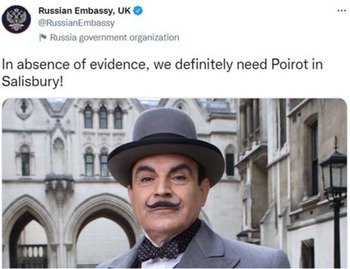
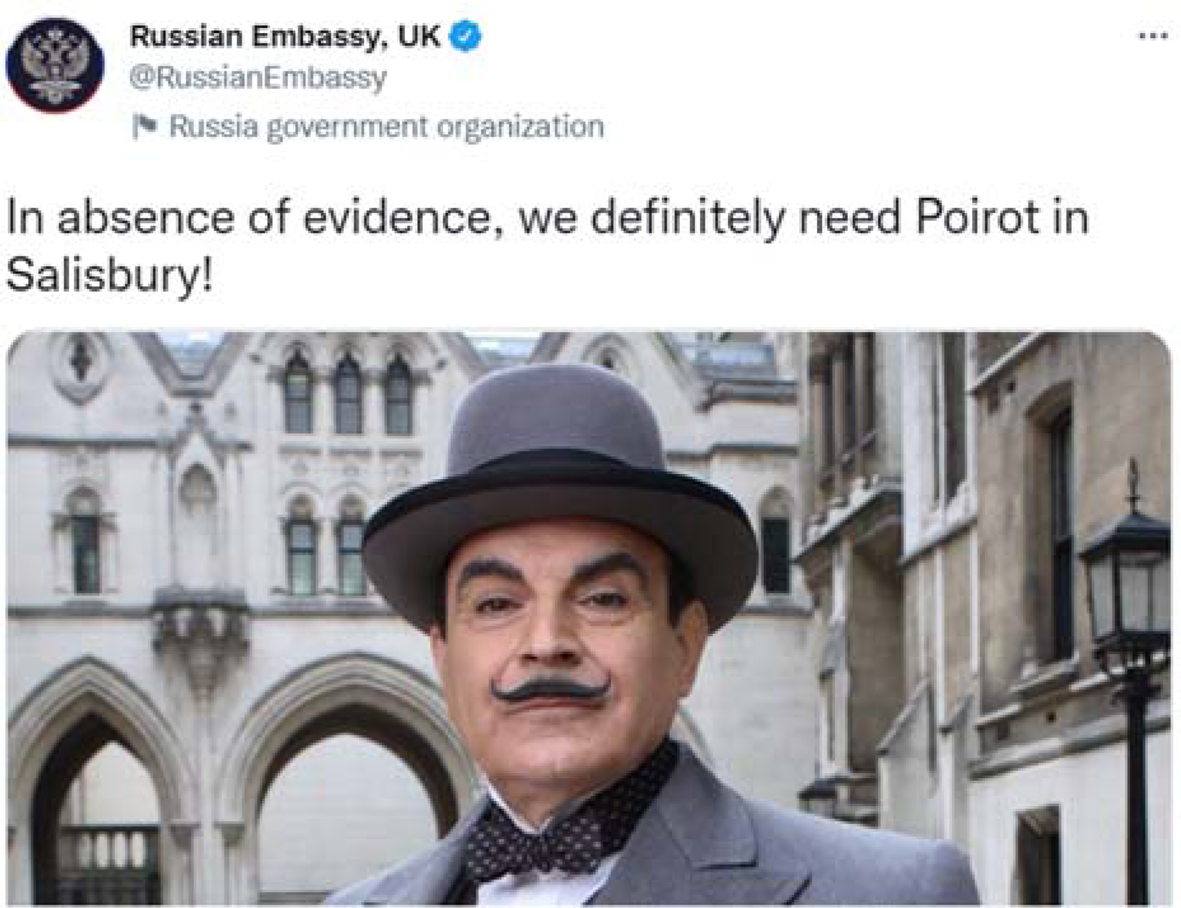
Relating these insights to present uses, humour in, for instance, diplomacy and misinformation online, it could certainly be argued that humour frequently is used precisely to induce a form of relativisation and infinite either/or thinking, while at the same time allowing the subject the so-desired entertainment. Consider, for instance, Russia's disinformation campaigns after the Salisbury poisoning.Footnote 40 One of the Russian government tweets that was widely reported in the global media, was by its embassy in London with an image of Hercule Poirot and the text: ‘In absence of evidence, we definitely need Poirot in Salisbury!’, a ‘joke’ that was also repeated several times by a smirking Russian ambassador at a press meeting in London (Figure 1).Footnote 41 Russia's ironic play with doubt and uncertainty about the validity of the British investigation into the poisoning was likely intended to produce a Kierkegaardian apathy or resignation with international audiences, where it might be this, or it might be that. Maybe it's all not that serious, we will never really know the truth, leaving us with a smirk and a shrug.
Russian Embassy tweet after the Salisbury Poisoning (18 March 2018).
Source: {https://twitter.com/RussianEmbassy/status/975309334191230977?s=20&t=TMfkIamtpww0tVXfdlf9zQ}.
In the absence of a way to determine, it thus risks becoming the ones who leave us with a smile who imperceptibly are entitled to decide. Or at the very least, the humorous play fortifies a sense of ambiguity and unknowability of what happened, and who is right and wrong. To the extent that comedic diplomatic exchange and international discourses are judged or valued by their ability to induce momentary pleasure and amusement, is it not the international actor who tickles its audience the most that gathers support and likability? The position as the butt of the joke, in contrast, is necessarily defensive, marginalised, and of course ridiculed. Serious, complex, or intractable international issues and counterarguments may be discarded. Or, as I will point out below, the intractable can appear amusedly resolved and dissolved.
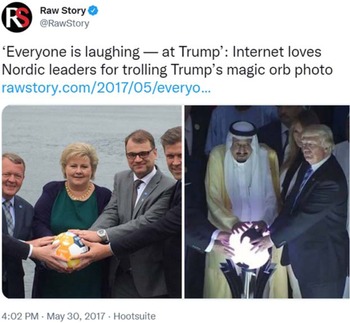
David Foster Wallace forcefully maintained that irony is self-perpetuating.Footnote 42 We – for instance, state leaders, diplomats, or engaged citizens – tend to respond to irony with irony in order to protect ourselves and not appear weak or naïve. But irony cannot be overcome by meta-irony, he argued; it becomes instead a ‘cage of irony’. Ironic statements foreclose sincere conversation, as it is impossible to engage with the ironist, other than with irony. As I will explain further in the empirical analysis below, such ironic entrapments may also apply to an international context. Consider, for instance, a widely circulated meme by Nordic government leaders during a summit in Norway in 2017. Here the heads of states mocked an absurd post-summit photo from Riyad between key Middle East autocrats and the US president with their hands on a glowing orb – the Nordic leaders similarly placing their hands on a football with a globe printed on it. The Norwegian prime minister posted the photo alongside the original photo of Trump, Sissi, and bin Salman with the caption: ‘Who rules the world? Riyadh vs. Bergen.’Footnote 43 The photo went viral and was widely reported in global news media (Figure 2).Footnote 44 While it surely was a funny rebuff to Trump and Middle Eastern autocrats, it unwillingly reproduced the same structures that it supposedly wanted to oppose. The meme did not seem to invite the US president into any conversation on political content or policy goals – a perhaps too cumbersome task – but neither did the ironic snub point to alternative ways of thinking and being in global politics. Instead, it merely reproduced politics as an ironic spectacle, thereby risking inducing similar forms of momentary amusement, indifference, or even despair with global publics as Trumpian politics have. Foster Wallace would probably not be surprised, as he contended – alongside Kierkegaard – ‘irony is critical and destructive, a ground-clearing … but singularly un-useful when it comes to constructing anything to replace … what it debunks.’Footnote 45
Meme by Nordic government leaders mocking Trump's glowing orb photo from Riyad (left); the original glowing orb photo (right) (30 May 2017).
Source: {https://twitter.com/rawstory/status/869569799931793409}.

Humourous forms of international exchanges may similarly affect our sense of a situation's gravitas or complexity. Steele notes how writing ironically about abhorrent practices such as the Holocaust – as Hannah Arendt, for instance, was accused of by some critics – one may not give the repulsive acts the solemn weight they deserve. Without a sense of proper weight, it could be asked, how can political leaders or engaged citizens prioritise and commit to grave international topics, when does a humorous engagement become too unbearably light? One example could be the present memes on Western social media accounts satirising Putin and Russia's invasion of Ukraine. Ukrainians and others have voiced concerns and question the political engagement of Westerners from afar, asking if they were ethically allowed to cope humorously with Russian bombings without experiencing the weight of violence and war themselves?Footnote 46
Within the fields of cultural studies and political science, Jonathan Coe and Stephen Wagg precisely point out that humour often provides a facile feeling of engagement.Footnote 47 Laughing at late night news shows or political memes on Twitter may provide citizens with a sense of political engagement without the necessary comprehension of the complexity of an issue. Difficult international problems, be they the US withdrawal from the nuclear deal (JCPOA) or EU UK Brexit negotiations, do not need to be seriously understood or reflected upon, but can legitimately – and much easier – be responded to with a giggle and an ironic smile. The humorous framing ‘lets the audience off the hook’Footnote 48 and produces a lightness that makes the issue at hand appear amusedly resolved and dissolved. As we will see in the analysis of the meme war between the US and Iran in 2019, it was partly publicly responded to through funny war memes mocking fears of a Third World War breaking out, thereby echoing the two leaders’ own meme war without serious engagement.
In short, humorous enactments of politics may risk creating: (1) entrapments; (2) facile engagement; and (3) blur distinctions between reality and fiction, amusement, and serious politics. Further below these limitations will be related to the three empirical analyses of the Meme War between Iran and the US, the Yes Men COP15 happening, and the US North Korean nuclear summit. First, however, the three-pronged analytical strategy will be unpacked.
Humour as a performative practice: Towards a three-pronged analytical strategy
Humour can be theorised as a performative practice that is constitutive and productive of the social world.Footnote 49 Humorous practices may trouble social relations by teasingly imitating, exaggerating, and playing with incongruity and the unexpected, thus operating at, and questioning, the very boundaries of order and discipline.Footnote 50 Yet we cannot assume that such practices are inherently critical or emancipatory. They do not escape or stand outside social relationsFootnote 51 but are always embedded in formations of power and knowledge.Footnote 52 As Wedderburn succinctly stresses, humour has no theology and may reproduce oppressive violent dynamics as well as contesting these: ‘humour even when mobilised as part of an emancipatory political programmes can pull in multiple directions simultaneously.’Footnote 53 How can we then analyse the multiple ways humour may relate to formations of power? How may we examine humorous practices in their specificity without presuming a telos?
To disentangle how humorous practices specifically may relate to forms of power/knowledge,Footnote 54 I propose a three-pronged analytical strategy of humorous performances: (1) appropriation; (2) subversion; and (3) simulation. As analytical strategies,Footnote 55 they are not to be seen as an ontology or exhaustive catalogue of humorous practices, but instead as a means to make the analytical gaze explicit; allowing humorous performances appear in their specificity without inferring a priori that they either subvert or reproduce power/knowledge.
Underpinning the analytical strategy is a Foucauldian understanding of power and knowledge as intimately connected. Power relies on fields of knowledge, and knowledge depends on how power is organised and exercised, without power being a tool possessed by certain actors or operating hierarchically from the top down.Footnote 56 For instance, Foucault examined in the History of Sexuality how the confession came to work as a technology of power probing people to tell the truth about their inner desires and dispositions. These confessions were treated as types of knowledge that were able to reveal the very core of the self; a self that in turn were to be motivated and controlled through various governing technologies of power.Footnote 57 Transferred to the context of this article, humorous practices can be analysed as particular forms of representations (knowledge) that articulates a relationship between a signified – that which we laugh at – and its giddy imitation (signifier); representations that in turn may work to reproduce, subvert, or simulate formations of power. Each of these three being differentiated by their relation to power/knowledge.Footnote 58 As will be developed in more detail below, the first type of strategic appropriation relates to power through reproduction and reiteration, and it involves little novelty or surprising thinking. The second relates to power through parodic subversion and troubling; it seeks to reframe discourses and articulate alternative imaginaries. The third works through a continuous simulation of power, where power mutates into mere signs of itself, an endless affirmation without limit.
In terms of knowledge, the three types each invokes a different representational relationship between an original referent and its giddy imitation. The first type of representation refers to a presumed original that it imitates and mocks, while doing so rather reproductively or stereotypically. In the second type, parody, the humorous representation, instead of pointing back to an assumed original, troubles it, in a Butlerian sense, by showing how it is also only an imitation, a copy of a copy, thereby defamiliarising power and knowledge.Footnote 59 In the third type of simulation, humorous performances work in a Baudrillardian way as purely self-referential: signifier and signified are unhinged, and the reality principle in shreds. This blurs or dissolves the very distinction between original and imitation, reality and fiction, the serious and comical, and leaves us in a simulacrum of undecidable intention and simulated power.Footnote 60
Strategic appropriation
The first analytical strategy is strategic appropriation. Here, in particular, I draw on Brassett, Browning, and O'Dwyer's conceptualisation of the term. Thus, it is a way to analyse humorous acts that appear overtly staged and doctored for calculated purposes. Examples could be drawn from governments’ nation branding, crisis management, or strategic (dis)information campaigns, which may often merely reproduce social and political hierarchies and reiterate common tropes with little novelty or surprising thinking. Strategic appropriation is a way to analyse enactments that do not appear wholly genuine; where there is a certain oddity or slightly peculiar translation at play.Footnote 61 For instance, the EU participating in a rap battle or, as we will see below, the Iranian theocracy making memes out of Hollywood movies.
Analysing humorous practices as strategic appropriation also involves asking to the notions of Self and Other they rely on. What notions of idealised Self are invoked and what narratives about the Other as, for instance, ridiculous and laughable are inferred? How do humorous forms of appropriation perform a superior or idealised identity, and how is the Other as the butt of the joke mocked and belittled? This may also imply asking to the transgressions of diplomacy and international exchange that humour appropriation may allow for and make more readily permissible. For instance, heads of state demeaning other heads of state publicly, or as we will see below, Iran and the US exchanging ‘funny’ memes with outrageous threats against each other.
Finally humour appropriation is a way to analyse how conformity and discipline can be enforced through shaming and belittling. Humorous acts can regulate and govern subjects in specific directions, as when ‘corporate comedians’ or ‘fun Friday’ at workplaces implicitly require employees not just to work, but also having fun while working.Footnote 62 Or even as a type of forced laughing, as when party delegates in the former Soviet Union were expected to laugh at Stalin's boring jokes in the Duma to signal their loyalty and support.Footnote 63 Critchley also uses the term ‘structured fun’ to denote such forms of compulsory laughing that serve to discipline subjects in specific directions or signal their political allegiance.
In sum, analysing humorous practices as strategic appropriation one may ask: (1) in what ways do humorous articulations appear staged or calculated? (2) what kind of Self-Other relations do they rely on and how are these used to shame, condone or correct certain behaviours; and (3) what kind of transgressions do they make permissible and possible?
Parodic subversions
The second analytical strategy, I wish to suggest, drawing in particular on Judith Butler, is parodic subversion. Parody involves a certain exaggeration or amplification of reality, drawing out traits or identities that we take for granted or that have become normalised to the extent of naturalisation.Footnote 64 Parodic subversions depend on an (assumed) original that it troubles and makes fun of, by showing that it is really only a copy of a copy, and thus it could be different. Parody makes fun of, or critically comments upon and ridicules the ‘original’ in a hyperbolic fashion, thereby exposing or unsettling formations of power.Footnote 65 The parodic excess and hyperbole can make what may appears as omnipotent or given less so and make us see otherwise.Footnote 66
Parodic enactments may, as Judith Butler asserts in relation to gender identities, deprive identities of their claims to be natural and fixed and allow a form of re-reading of hierarchies, scrambling and troubling these binaries, rather than merely reversing them.Footnote 67 In Gender Trouble, Butler gives the example of drag, as a subversive parodic practice. By dressing up in exaggerated clothing and stylised movements, drag imitates the imitative structure of gender, revealing gender itself to be an imitation, ‘reveals that the original identity after which gender fashions itself is an imitation without an origin’.Footnote 68 Similarly, watching drag performances we, as an audience, may initially doubt what we really see – for example, a man dressing up as a woman, or a woman dressing up as a woman – and come to question how we make such determinations in the first place, probing us to examine the knowledges we draw on, and the categories through which we see. How perhaps all identity is drag. The pleasure involved in this ‘realisation’ is, however, important.Footnote 69 The surprising laugh, the instant we realise that perhaps the original is also derived.Footnote 70 The pleasure, or giddiness that drag installs, is a different form of realisation or knowledge than one derived from say a theoretical argument and, Butler seems to hint, perhaps a more effective way of subversion and defamiliarisation.Footnote 71
As parodic enactments now can travel and circulate online and with social media, they can also easier reach a global audience. During the COVID-19 lockdown and in a US election year, Sarah Cooper's Trump impersonations, for instance, became immensely popular worldwide with millions of views.Footnote 72 Cooper used Trump's own speech and exact statements, but her exaggerated facial expressions, gave a surprising novelty to the speech that drew out the horrendousness of what was actually said, as if we heard it for the first time. Trump's speech became uncannily strange. Or as we will see in the example of the Yes Men below, parody can make us ponder the limits of present discourses and imagine alternatives by questioning the unbelievable and incredible.
Analysing how parodic enactments may trouble formations of power and knowledge, one may thus ask: what hierarchies and identities are destabilised, what boundaries are questioned, and which alternative imaginaries and rereadings emerge therefrom?
Simulation
The third analytical strategy, I wish to propose is simulation. Here the difference between the comical and the serious threatens to collapse. There is a lingering ambivalence to the performance, an air of mockery and hyperbole, where we are never certain as to its seriousness or pretence. The difference between the real and the simulated seems indeterminable. Think, for instance, of the topless Putin riding on a horse in the wilderness, Trump's short bromance with Kim Jong-Un, or Boris Johnson's endless – perhaps jokingly – use of military metaphors in relation to Brexit negotiations. Are these earnest statements? Or a mere mocking simulation of international politics? And if we cannot distinguish between the two, what kind of difference does it make? Drawing on Jean Baudrillard's work on simulation, I wish to suggest that we can analyse such humorous practices as signs that have ceased to refer back to as signified, as endless self-referential signs of simulation without final determination or depth.
In an age of the hyperreal, Baudrillard argues, there is no longer an origin to signs, but only repeated replication. Symbols, icons, and spectacles replace actual objects, signifier and signified become unhinged, dissolving the representational model. In simulation, ‘[i]t is no longer a question of imitation, nor of reduplication, nor even of parody. It is rather a question of substituting signs of the real for the real itself, … of the simulated generation of difference.’ Baudrillard, for instance, points to Disneyland as hyperreal, a place becoming more real, than the real US, or the CNN-mediated Gulf War overtaking and preceding the actual war.Footnote 73 To Baudrillard, the Iraq War was not so much like a film, but was a film, as cinema becomes ‘the paradigm of war, and we imagine the “real” war as if it was only a mirror of its filmic being’.Footnote 74
One could perhaps argue that similar hyperreal dynamics are at play, when the comedian Volodymyr Zelensky plays the role of the ideal Ukrainian president on television, but then in reality becomes the president of Ukraine – the sign preceding the signified, comedy becoming reality? And then it folds back on to itself, so that the distinction between the very two is cancelled, as when Donald Trump the master and star of reality television, simulates and emulates his presidency according to the very codes of television verité. The real reinvented as fiction. As we will see below, the Trump-Kim Jong-Un nuclear summit can similarly be analysed as a hyperreal, with an actual film trailer functioning as part of the framing of the negotiation process, and the summit itself dressed up as a movie, featuring two stars, an audience and a White House production company.
In simulation, the signs refer to themselves. The endless circuit between real/fiction and serious/comedy creates a peculiar ironic atmosphere, where we never know, on which side of the boundary we reside, or rather where such sovereign boundaries and distinctions blur, we are left uncertain if we are meant to laugh, or even care. In this hyperreality, Baudrillard argues, there is nothing underneath appearances – it is all dull surface with no hidden meaning or ‘real reality’. What remains is a mere desert of the real.Footnote 75 ‘Real life’ acquires the features of a staged fake, and we are left with a sense that political leaders act as movie stars, who frame and prime our reality and that we all perhaps take part in a gigantic television show, without ever being really sure.Footnote 76 In this (perhaps) staged hyperreality, there is an air of the ‘unheimlich’ and uncanny, of wordplays and meanings with no stakes, saturated with ambivalence that cannot be resolved.
Simulation thus becomes a form of mockery because, as Baudrillard argues ‘It is reversible and exchanged for itself … it makes one laugh as only the lack of distinction between life and death makes one laugh, deeply laugh.’Footnote 77
Analysing humorous practices as simulation one may thus ask: how are distinctions between reality and fiction produced and blurred, what (truth) status do the humorous enunciations claim to have and what types of (unsettling) ambiguities may they produce?
The sections below will turn to the empirical analyses of the three examples of humorous practices in international politics: the meme war between the US and Iran, the Yes Men parody at COP15, and the nuclear summit in Pyongyang.Footnote 78 These three examples have been chosen in order to cover a wide range of humorous practices in international politics, including examples that involve both government leaders and activists, a variety of political themes (conflict escalation in the Middle East, climate change and nuclear negotiations) and different types of humour; irony, parody and the ‘unheimlich’.
The aim of the analysis is twofold: to show how the three analytical strategies can be used empirically, and how the limitations to humorous practices concretely unfold.
Meme war, the Yes Men, and a nuclear summit: Three examples of humorous practices
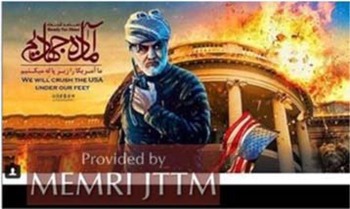
It is the summer of 2018. The US is about to withdraw from the nuclear deal with Iran and impose new draconic sanctions. The infamous Iranian General Soleimani posts a surprising meme on his Instagram account – an unexpected joke not only because Instagram is officially banned in Iran, but also because it effortlessly plays with American pop culture. The meme is an image doctored from the US blockbuster Olympus has Fallen (Figure 3). In the meme, the General appears in the foreground looking fierce, and behind him the White House is in flames, as in the movie itself. The central motif of the film is the near nuclear destruction of the US, planned by North Korea, who manages to capture the American president and his government inside the White House, while bombing most of Washington DC's iconic buildings. Olympus has Fallen, though hardly a movie that engages in subversive political critique, does, however, show a crumbling and fragile superpower, on the verge of extinction by its sworn enemies, North Korea and Iran. The latter has apparently provided the Koreans with novel nuclear technology. ‘Now the U.S. will also feel suffering and hunger’, says the North Korean supervillain towards the end, possibly alluding to the severe sanctions that the US for decades have imposed on North Korea and of course Iran.
The Iranian General Soleimani's meme doctored from the movie Olympus has Fallen (28 July 2018).
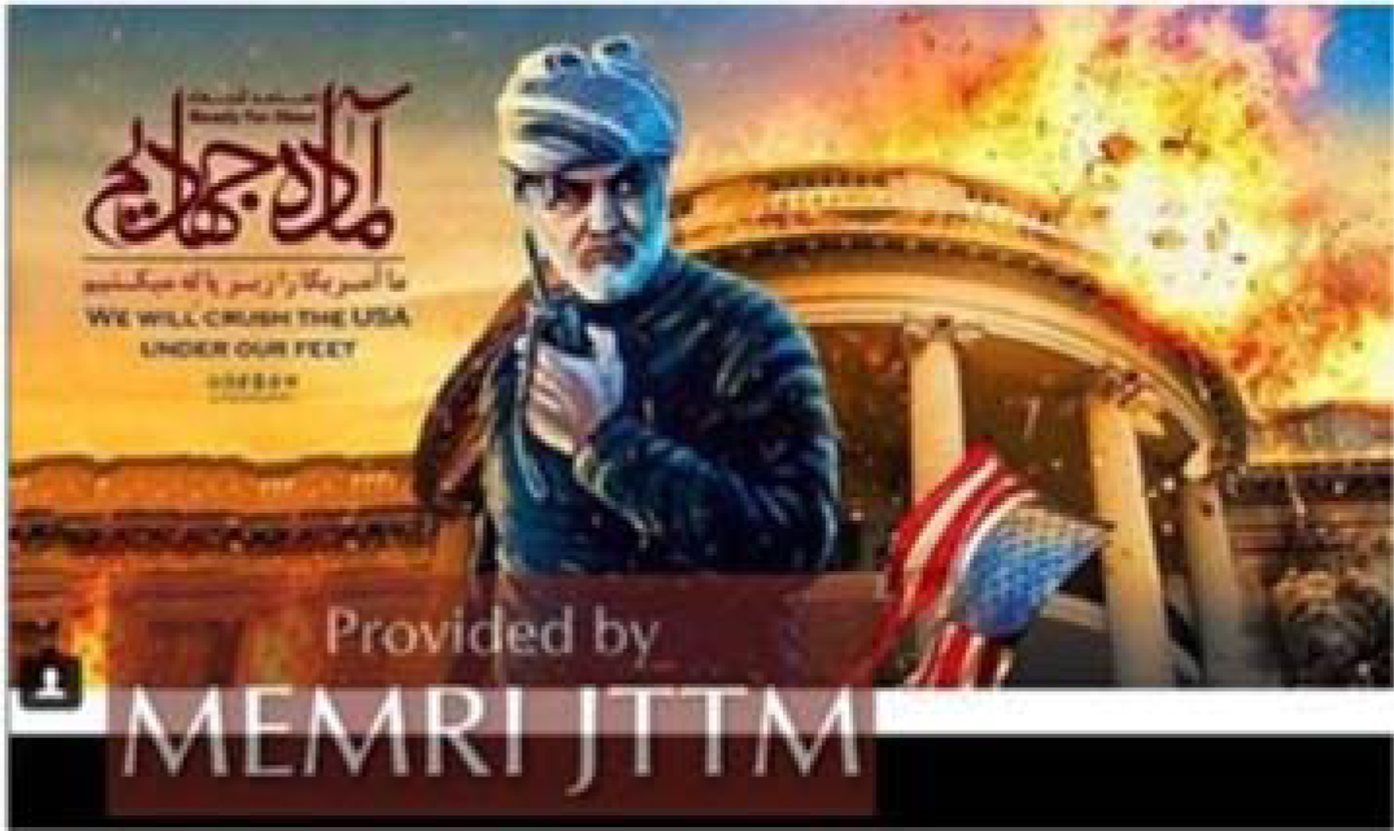
Superimposing the image of General Soleimani into precisely this movie therefore appears as a deliberate and well thought out strategic appropriation. Too calculated perhaps to spur a real spontaneous laugh. Yet the meme has a strong air of irony, a ‘tongue-in-cheekness’ that softens its threatening references. The aesthetics of the meme (its bright colours and stylised oil paint character) can be read as an exaggeration or mocking of common clichés found in all-American movie posters, just as the contrast and juxtaposition of the Iranian general into a Hollywood aesthetics produces a form of comic-ironic incongruity or punchline. Even the fact that Iran responds to Donald Trump and Mike Pompeo's war drums, with the use of an archetypical American culture meme, may induce, if not a giggle, then perhaps a smile or raised brow in acknowledgement of the sarcasm. However, the ambiguity and negation that irony plays with, also enables Iran to point to the menacing themes of the movie (destroying the US and kidnapping its government) without ever explicitly making such threats, and to appropriate the movie's belittling of the US, exposing its fragility in the face of enemies, without really uttering this belittling.
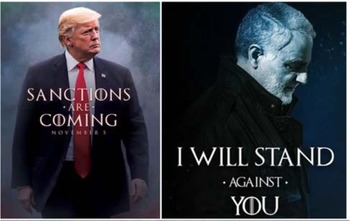
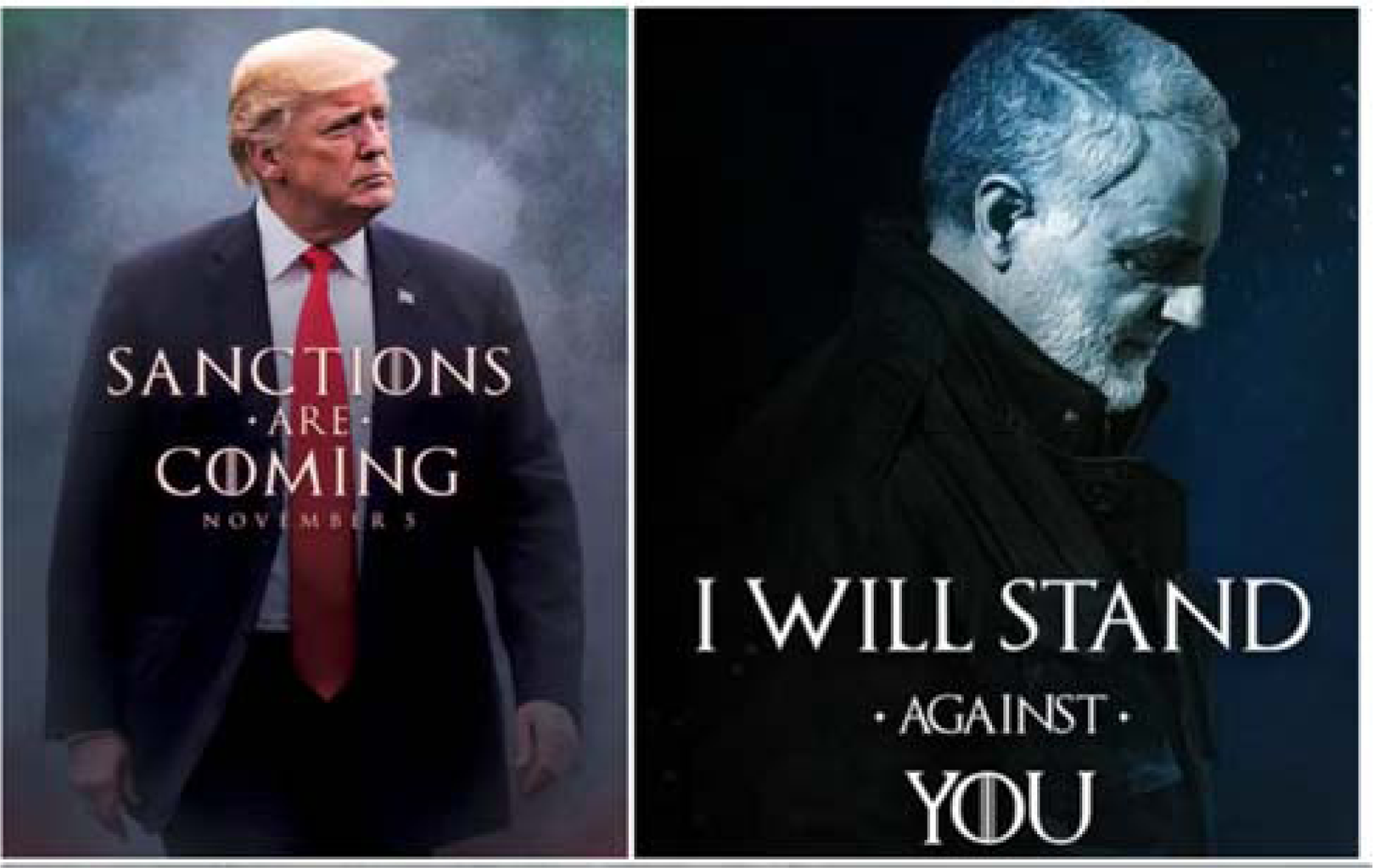
As suggested above, asking to the strategic appropriation of humour also involves specific Self-Other identity constructions and some form of shaming or correction. Here Iran's appropriation of Hollywood culture may be said to invoke a – perhaps – surprising articulation of US-Iranian identities, which goes beyond the meme's obvious visual representation of the White House/Presidency as vulnerable targets succumbing to an all-powerful Iran/General Soleimani. Beyond the image itself, Iran shows that it can juggle Hollywood referents, memes, and Instagram with ease and humour, thereby parading a coolness and savoir-faire that punctuate the stereotypical portrayal of the Iranian government in the West as religious backward fanatics. In its place it shows a hip young Iranian government that knows its enemy far better than the other way around, potentially exposing or shaming the ignorance of the Other. Indeed, a few weeks later, Trump responds to Soleimani's meme, with a superimposed picture of himself from the popular, but again US produced, HBO series Game of Thrones. In a canny wordplay with the series’ metaphor for looming hardship and war (‘Winter is coming’) the title is altered to ‘Sanctions are coming’. The Iranian government, however, immediately creates a counter meme. Using the very same signature font and dark aesthetics from Game of Thrones, Soleimani is depicted with a king-like aura and the words ‘I will stand against you’ (Figure 4). Although the memes unsettle the stereotypical depiction of Iranian identity in the West, the very relationship between the US and Iran is rather stereotypically framed as one of antagonistic enemies that seemingly require the destruction of the Other. In this sense, the Trump administration's own framing of the relationship as one of enemies in an existential battle is left unquestioned by the Iranian memes. The dominant policy narrative is reproduced.
Trump's response to Soleimani's meme inspired by Game of Thrones (left); Soleimani's response similarly from Game of Thrones (right) (3 November 2018).
Source: {https://www.businessinsider.com/soleimani-fought-trump-with-game-of-thrones-memes-before-airstrike-2020-1?r=US&IR=T https://twitter.com/Tasnimnews_EN/status/1058701751430365184}.
What did this permit? The play with irony and Hollywood entertainment seemed to allow Iran and the US to engage in a form of Bakhtinian transgression of international norms and an almost carnivalesque international exchange, far removed from normal diplomatic conduit.Footnote 79 Threats and aggressive intentions were sent per meme in lieu of normal diplomatic signalling. The humorous threats were, perhaps, or perhaps not, seriously meant. This ambivalence may have exacerbated uncertainty in a situation of already tense conflict, just as the memes’ ironic posturing seemed to have relieved the two sides of any real accountability for the conflict escalation and man-ego play.
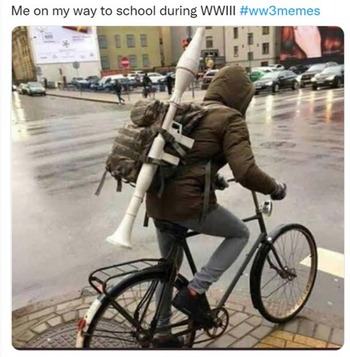
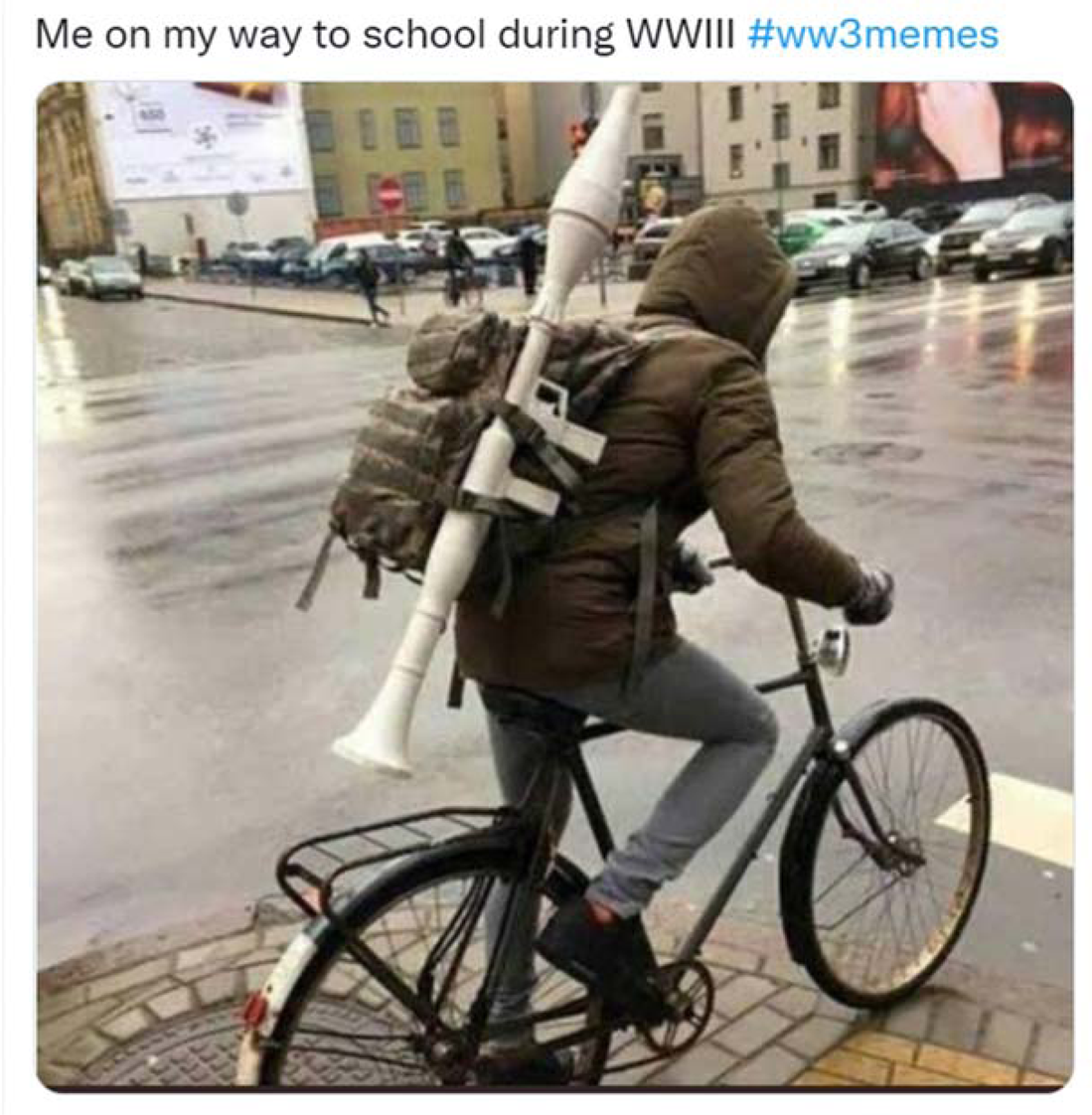
Curiously, the escalating tensions between the US and Iran were also responded to online by a multitude of funny memes under the popular hashtag #WWIII. One widely shared meme, for instance, shows a person bicycling in a gloomy urban environment carrying a bazooka on his back with his rucksack, the caption reading, ‘Me on my way to school during the WWIII’ (Figure 5).Footnote 80 Another portrays a couple eating calmly at the dining table, while an apparent blitzkrieg is happening right outside their windows, the caption reading ‘Me minding my business with headphones in during WWII.’Footnote 81 These memes riddled with black humour may certainly have worked as coping mechanisms and anxiety relief in a situation of fierce international tension, but did they also work as substitutes for complex reflection and political action? Did they allow their millions of viewers to pretend that they were actually engaging with difficult problems and complex facts of international politics, while being effectively let off the hook? Just as the two leaders seemed to defer political responsibility for the escalation of the conflict through funny memes, so to did online publics, it could be argued: They ‘were all in on the joke’. Also, in leading news media, the memes were widely reported, as if they were seriously part of the conflict on the ground between the US and Iran. The meme war – as one news outlet later called itFootnote 82 made a difficult proxy war in Iraq and complex nuclear negotiations entertaining and easier understood. Perhaps the memes even enabled their own self-fulfilling prophecy. A little over a year later, the Iranian General was killed by a drone strike ordered by the American president. In the end, winter had come.
One of the many memes circulating under the hashtag #WWIII.
Source: Anonymised Twitter account.
Parodic subversion: The Yes Men are revolting?
Since the 1990s the Yes Men – a satirical activist group – has been parodying big corporations and government officials to an often unknowing, but complicit, media audience. Dressed up in suits and ties they announce what (may) appear to be incredible policy changes, such as the end of the Iraq War or new climate change legislation. The Yes Men themselves define these parodic interventions as ‘identity corrections’ that point to the possibilities of governments and corporations being and acting very differently in the world.Footnote 83 The group's performances have often attracted global media attention and political debate, just as the three ‘Yes Men documentaries’ chronicling their various parodic enactments have won acclaimed film prizes. In its most recent documentary, The Yes Men Are Revolting, the activists carry out their hitherto most elaborate performance at the COP15 Summit in Copenhagen.
Ahead of the international summit, the Yes Men spends months of planning for the event. They aim to impersonate a spokesperson from the Canadian government, and we follow the meticulous, but also quite comical, preparations ahead of the meeting. The group turns pipe cleaners and kitchen sponges into imitations of the expensive microphones used at COP15, the impersonator is propped up with nose glasses, fetch hair, and the obligatory suit in order to play his part as a serious bureaucrat. The solemn official voice and intonation is methodically rehearsed, as he reads aloud from a teleprompter with a prepared announcement.
Now ready to broadcast from an uncanny replica of the UN conference the impersonator declares that Canada from next year on will enact strict new emissions reduction guidelines and begin paying its ‘climate debt’ to all countries in the global south, starting with 15 billion dollars to Africa. The announcement is immediately reported in all the major news outlets and the Canadian government is asked to comment on its surprising U-turn. It takes a day before the performance is revealed as political parody, but this only seems to create further media spectacle, as the hoax is retold and debated by the global media gathered at the summit. The Canadian government is forced to deny/confirm its position on climate legislation, and its abysmal record is publicly unveiled.Footnote 84
In ways that resemble the logic of Judith Butler's example of drag performances, the Yes Men's imitation of a Canadian government official, and the elaborate scenography used to parody the COP15 press room expose the props of official power in a very visceral way. Our engrained notions of international summits as peaks of political importance are troubled and perhaps a little ridiculed by being so easily imitated. The enactment of the Canadian government official's serious and slightly nerdy demeanour is of course laughable, as the dethroning of official power often is. However, the giddiness only arises after we realise that the government announcement is a parody that we too readily believed; only then are our notions of the imitation and the original and our own embeddedness in official discourse put into motion. Thus, the suit and tie, lectern, microphones, and COP15 logo – all the props that the Yes Men use to persuade the assembled press corps of their identity – serve to draw out the performativity of the ‘original’ itself. How also (real) governments are dependent on performing their identities as states and reproducing the rituals of international summits. The parodistic ‘wearing of the mask of the target reveals, as in the literary hoax, the target's own theater’.Footnote 85
In a second move, we are, however, also asked to imagine otherwise and ponder the limits of present policy discourses on climate change. As an ‘identity corrective’ the performance appears to ask: Why would the Canadian, or indeed any other governments in global North, not pay their climate debt? How does it emerge as so incredible or humorously transgressive to suggest significant emission reduction and climate debt payments? The Yes Men in this way plays with the limits and taken for granted assumptions of official policy discourse and tests the bounds of credulity. The realisation that the apparent unthinkable was immediately believed and reported in media worldwide, takes the parody beyond a funny mimicking of power and pushes us to reflect on the possibilities for alternative policies. As the (real) Copenhagen summit widely is interpreted as a fiasco, the performance points to the different paths that the assembled governments could have taken. It becomes, as Ian Reilly puts it, an ethical spectacle dramatising how international actors should have acted.Footnote 86
Yet, at the Copenhagen airport, we see the Yes Men disappointed and dejected. The performance did in the end not succeed they conclude. Not only did the Canadian government not change its policy on emission reduction, but neither did the media give the Yes Men a chance to debate the parody's political project. The journalists were only interested in the funny hoax, not in any serious discussion of the inequalities between the Global South and the Global North that the Yes Men had hoped to engage in. ‘I really believed it would work, I thought, let's go and make our bit of noise in this bunch of noise and these leaders will then listen and do something right’, one Yes Man laments to the other.
Was it the funniness and spectacle of the political performance that undermined its own purpose? The initial framing of the issue as parody certainly gave the Yes Men the media attention they aimed for, but then seemed to make it impossible to change the humorous framing into a serious one. As in Foster Wallace's ‘irony trap’ the Yes Men could not escape the framing they themselves had set up. In front of rolling cameras at the real COP15 summit a bewildered Yes Man is asked by a journalist, ‘is this just a joke to you?’. ‘No’, he responds, but we are not entirely sure how to read his facial expression, the humorous ambiguity easily mistaken for insincerity. Once revealed as a scam the media questions the seriousness of all the following statements from the Yes Men, and an earnest conversation on climate change seem to foreclose.
In Kierkegaard's work Either/Or, he gives a now famous example of a clown: ‘A fire broke out backstage in a theatre. The clown came out to warn the public; they thought it was a joke and applauded. He repeated it; the acclaim was even greater.’ I think – Kierkegaard then notes – this is how the world will come to an end: to general applause from wits who believe it's a joke. The Yes Men wanted to point to the dangers and urgency of climate change, but as the clown in the theater, they were caught by their own theatrics: The stage, performance, props, and witty spectators’ need for constant entertainment. Through the noise of it all the Yes Men attracted an audience, but what they said seemed to be translated into a joke.
A spectacular nuclear summit
In the summer of 2018, the US president and the North Korean Chairman Kim Jong-Un are to meet for the first time in Singapore to sign a nuclear agreement. It is from the outset a global media event; 2,500 journalists are summoned to the Capella luxury hotel at a tiny island resort chosen by the White House. Their presence, it seems, is to actualise the meeting as an historic summit, in advance of its making. The buzz and media reality of it all priming the global spectatorship to expect something monumental will happen. Yet, a sense of unreality, of being slightly mocked, seep through the event, as if the main actors are simulating a film set, merely imitating an international summit in a very Baudrillardian play of mirrors.
As the two leaders meet in the Singaporean hotel room ahead of negotiations, or perhaps rather already as part of the negotiations, Trump shows a (faux) movie trailer to the North Korean leader that the White House has produced.Footnote 87 The Presidency has seamlessly metamorphosed into a film production company (in)appropriately named Destiny, complete with a logo and credits. The four-minute-long film made in the hybrid style of movie trailer/documentary is supposedly to persuade Kim Jong-Un, who apparently is a film buff like Trump, to sign the agreement.Footnote 88 To fanfares and exciting drum beats the trailer displays footage of the two state leaders going in and out of airplanes, looking ‘presidential’, waving to cheering crowds, with crosscuts to grainy black-and-white Second World War footage and nuclear war imagery. An authoritative male voiceover proclaims:
Only the very few will be able to change the course of history, the question is what difference will the few make? Out of darkness can come the light, and the light of hope will burn bright … the Koreans’ story is well known, but what will be their sequel? Destiny Pictures present, a story of opportunities, two men, two leaders, one destiny.
The trailer ends with the common trope of all movie previews – yet voiced in the context of a ‘real’ international denuclearisation summit between two heads of states, it sounds manifestly bizarre: ‘Featuring Donald Trump and chairman Kim Jong-Un in a meeting to remake history.’ The two leaders, the trailer seems to claim, are also movie stars, who participate in a historic meeting on denuclearisation – or is it a film? – soon to be released. Thus, not only is fiction (the movie trailer) purposefully used to mould and shape reality (persuading Kim Jong-Un to sign the agreement), so that reality can come to resemble a movie, but reality is already from the outset framed as fictional. ‘Real’ state leaders emulating state leaders in a movie, who emulate real state leaders, erasing any vestiges of representational order. The (simulated) event refers to the simulated event in an endless circle of self-referentiality.
The blurring of distinctions between fiction/reality, actors/state leaders is enhanced by the bombastic orchestration of the handshake ceremony that begins the meeting. From two long colonnades, Trump and Kim Jong-Un slowly move towards each other. In panorama view, hundreds of cameras amassed in the courtyard follow their slow-paced steps on the red carpet, capturing their solemn demeanours, as they carefully progress alongside the Roman columns towards each other. Right in the centre, where the two colonnades meet, they shake hands in a light of blitz, the two national flags wave in the background. ‘A historic handshake’ global outlets testify in unison of breaking news.Footnote 89 As the two leaders walk away from the media crowd, side by side, padding each other's shoulders, Kim Jong-Un is caught on one of the cameras’ microphones whispering to Trump ‘It is like being in a science fiction movie!’.
But it was not only Kim Jong-Un who had a sense of uncertainty about the summit's quivering reality. The agreement, which the two leaders signed at the end, turned out to be little more than a generic one-pager, with no roadmap, follow up or monitoring mechanisms, just as there apparently only had been very rudimentary talks between the two delegations in advance of the summit. In yet another reversal of representational order, the signing of the deal came before its content. The US administration called it a ‘historic deal’ that would lead to a ‘complete denuclearization of the Korean Peninsula’. In one interview with the ABC, Trump noted with a certain smirk that ‘he had developed a special bond with Kim Jong-Un’, who was a ‘very talented leader’ who ‘loved his people’ and would ‘de-nuke the whole place’. The interviewer paused for a moment, looking bewildered, perhaps unsure if he were to laugh in disbelief. The continuous comments about the historical weight of the agreement and the admiration the US President suddenly had for the North Korean leader appeared so hyperbolic that it bordered mockery. The self-assured exaggerations, it could be argued, resembling the archetypical stand-up comedian who brags and mocks his audience to a laugh. Media commentators and policy experts, in the following days, tried to ascertain the reality of what had ‘really happened’. There was an apparent urge to find the truth behind the hyperreal façade; was this indeed a historical summit or merely a hallow imitation?Footnote 90 One policy analyst testifying to its unreality, told the BBC that it could best be described as a ‘Trump faith over reality’.Footnote 91
Yet, was the summit not from the beginning a hyperreal sheltered from distinctions between the real and the imaginary, the serious and the comical, with nothing beneath the surface? The imagery and spectacle of it all did not, to paraphrase Baudrillard, conceal anything, ‘they were perfect simulacra, forever radiant with their own fascination.’Footnote 92 Indeed as Kim Jong-Un returned to Pyongyang, he made his own forty-minute documentary about the meeting, as if affirming the hyperreality of what had taken place by turning it into another film.Footnote 93 As in a replay of Foster Wallace's Infinite Jest, the continuous moviemaking reduced citizens to desirous consumers of entertainment, docile subjects forever glued to the screen, indifferent to its reality or politics, as long as it keeps on amusing.
Two years later, negotiations break down. North Korea ends its moratorium on intercontinental ballistic testing, and calls the US ‘a hypocrite seeking regime change.’ In the end, all that was left of the hyperreal nuclear deal, was Trump's Destiny movie trailer and Kim Jong-Un's own documentary, circulating on YouTube with millions of views. Even a Baudrillardian deep laugh, could not wash the two movies away.
Infinite Jest? Concluding thoughts on the possible implications for international politics
This article aimed to take some first steps towards interrogating the risks of framing international politics humourously, both theoretically and empirically. Engaging with the thoughts of Kierkegaard and Foster Wallace in particular, it has suggested that humorous practices may: (1) risk producing facile forms of political engagement; (2) lead to entrapments; and (3) blurr distinctions between fiction and reality, entertainment and politics. It showed how these unfolded empirically in Iran's meme war with the US, the Yes Men's parodic entrapment during COP15, and the Pyongyang Nuclear Summit's uncanny play with entertainment and fiction, by developing a three-pronged analytical strategy. Each ‘prong’ or analytical gaze related differently to power/knowledge by articulating a distinct relationship between an original referent and its giddy imitation, and to power through reproduction, subversion, and simulation. The conversation on humour and international politics is, however, just beginning, and several interesting questions and studies remain. One of the most warranted is perhaps the extent to which humour has become more pervasive in international politics compared to the past, or if it is only more visible, as state leaders engage each other in full spotlight online rather than in the dark corridors of diplomacy. And if humorous forms of government interaction are becoming more prominent, or just more visible, what does that do to the possibilities for humorous forms of dissent?
In the 1990s, Foster Wallace argued that while irony once had been very effective in postmodern literature and thinking, it had come to lose its countercultural and critical edge, having become widely adopted by the commercial industry, pop culture, and politics, its pervasiveness and habituality had turned into stasis and mainstream.Footnote 94 Do we see the contours of such developments in international politics? As governments, state leaders, and international organisations are required to be funny and entertaining in new public diplomacy, hybrid warfare, and nation branding efforts, do they edge off humour's critical potential and ability to question established truths and authority? Is humour's disrupting ability hallowed out, as in domestic politics, where the so-called comedy boom since the 1960s has been sweeping the Anglo-Saxon world in particular?Footnote 95 We may not be there yet, but there may be indications pointing in this direction. In Humour, Subjectivity and World Politics, Wedderburn also appears to argue this towards the end of the book. He suggests that humour's critical ability to problematise and denaturalise may prove less appealing to protesters and dissenting voices, as political leaders and authority figures themselves engage in clownishness. The Black Lives Matter and school strike climate movements ‘demonstrate little interest in humour as a rhetorical technique or tactical methodology but makes claims for immediate actions using more serious registers’.Footnote 96 Arguably, leading figures in these movements such as Greta Thunberg have a mode of address that oozes solemnity and sincerity, and perhaps therefore is often misunderstood by parents of the ironic Generation X.
In Foster Wallace's critique of irony's ubiquity, he precisely argues for the need for sincerity without abandoning the komisch in life.Footnote 97 In contrast to Kierkegaard, this call for sincerity does not involve assumptions of higher ethical principles or notions of truth externally to ourselves, but rather an acknowledgement of humans’ embeddedness in an always particular world, where our struggles are at the same time both tragic and laughable.Footnote 98 This is a very different sensibility than Baudrillard's ironic laugh. One that dares to choose sincerity even, or perhaps especially, when faced with the tragedy and complexities of international politics.
Acknowledgements
I am particularly grateful to Lene Hansen, Johannes Lang, the Peace and Violence group at DIIS, the three reviewers, and Maja Zehfuss, Martin Coward, editors at RIS for comments and insight to earlier drafts. Special thanks to the 2019 BISA panel ‘Humour and Global Politics’ organised by James Brassett, Chris Browning, and Alistair Wedderburn, which took me down the humorous path.