


1 Introduction
In this paper, we investigate transcendental number theory in the following ring:

This is called the ring of integers modulo infinitely large primes (see, for example, [Reference Jarossay11]). In other literature (for example, [Reference Kaneko and Zagier13]), it is also referred to as the poor man’s adèle ring. To the best of the authors’ knowledge, the earliest appearance in the literature is in a paper by Ax [Reference Ax2].
Let
$\mathcal {P}_{\mathcal {A}}^0$
 denote the set of all finite algebraic numbers defined by Rosen in [Reference Rosen20]. Let
$\mathcal {C}_{\mathcal {A}}$
 be the integral closure of
$\mathbb {Q}$
 in
$\mathcal {A}$
 . Note that
$\mathcal {P}_{\mathcal {A}}^0$
 and
$\mathcal {C}_{\mathcal {A}}$
 are both
$\mathbb {Q}$
 -algebras and the following inclusions hold:
$\mathbb {Q}\subsetneq \mathcal {P}_{\mathcal {A}}^0\subsetneq \mathcal {C}_{\mathcal {A}}\subsetneq \mathcal {A}$
 . The set
$\mathcal {P}_{\mathcal {A}}^0$
 is countable, while the set
$\mathcal {C}_{\mathcal {A}}$
 is uncountable. In
$\mathcal {A}$
 , there are two possible definitions of transcendence: one given by not belonging to
$\mathcal {P}_{\mathcal {A}}^0$
 , and the other by not belonging to
$\mathcal {C}_{\mathcal {A}}$
 . Although Rosen’s definition, in which algebraic elements are defined as those contained in
$\mathcal {P}_{\mathcal {A}}^0$
 , gives the correct notion of algebraicity corresponding to
$\overline {\mathbb {Q}}\subsetneq \mathbb {C}$
 , proving that an element does not belong to
$\mathcal {C}_{\mathcal {A}}$
 is, whenever this is actually the case, stronger than merely showing that it does not belong to
$\mathcal {P}^0_{\mathcal {A}}$
 . When it is necessary to emphasize transcendence in the sense of not belonging to
$\mathcal {C}_{\mathcal {A}}$
 , we refer to it as naive transcendence.
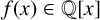
Since there are still relatively few papers in this area, we begin by mentioning a point that can easily be misunderstood. For any polynomial
$f(x)\in \mathbb {Q}[x]$
 that is irreducible over
$\mathbb {Q}$
 and has degree at least
$2$
 , there exist infinitely many primes
$p$
 for which the reduction of
$f(x)$
 modulo
$p$
 has no linear factor. In other words, for any
$\alpha \in \mathcal {A}$
 , we have
$f(\alpha )\neq 0$
 . This may give the mistaken impression that
$\mathbb {Q}=\mathcal {C}_{\mathcal {A}}$
 . In fact, however, since
$\mathcal {A}$
 has many zero divisors, there are in general many roots of reducible polynomials lying in
$\mathcal {A}\setminus \mathbb {Q}$
 . See also [Reference Kaneko and Zagier13, Non-Example 10].
As for transcendence in
$\mathcal {A}$
 , there are the following three previous works. The first work is due to Anzawa and Funakura. The sequence
$(F_n(q))_n$
 is the q-Fibonacci sequence defined by
$F_0(q)=0$
 ,
$F_1(q)=1$
 , and the recurrence relation
$F_{n+2}(q)=F_{n+1}(q)+q^nF_n(q)$
 , and was introduced by Schur in [Reference Schur21].
Theorem 1.1 (Anzawa–Funakura [Reference Anzawa and Funakura1, Theorem 1.2]).
Let
$\mathscr {F}(q):= (F_p(q)\bmod {p})_p$
 . For a square-free integer
$q>1$
 ,
$\mathscr {F}(q)\in \mathcal {A}\setminus \mathcal {C}_{\mathcal {A}}$
 under the generalized Riemann hypothesis.
Note that, in the case where
$q=1$
 ,
$\mathscr {F}(1)\in \mathcal {P}^0_{\mathcal {A}}\setminus \mathbb {Q}$
 is a finite algebraic number.
In contrast, Luca and Zudilin succeeded in removing the assumptions that
$q$
 is square-free and that the generalized Riemann hypothesis holds. However, unlike Anzawa and Funakura, they did not consider transcendence in the naive sense.
Theorem 1.2 (Luca–Zudilin [Reference Luca and Zudilin14, Theorem 1.3]).
For every integer
$q>1$
 ,
$\mathscr {F}(q)\in \mathcal {A}\setminus \mathcal {P}^0_{\mathcal {A}}$
 .
They then proved the transcendence of elements naturally defined from the traces of Frobenius of elliptic curves.
Theorem 1.3 (Luca–Zudilin [Reference Luca and Zudilin15, Theorem 1]).
Let
$E$
 be an elliptic curve defined over
$\mathbb {Q}$
 . For a prime
$p$
 of good reduction for
$E$
 , define
$a_p(E):= p+1-\#E(\mathbb {F}_p)$
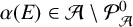
 to be the trace of Frobenius. Let
$\alpha (E):= (a_p(E)\bmod {p})_p\in \mathcal {A}$
 . If
$E$
 does not have complex multiplication (CM), then
$\alpha (E) \in \mathcal {A} \setminus \mathcal {P}^0_{\mathcal {A}}$
 .
As noted in [Reference Luca and Zudilin15, Remark 1], an anonymous referee of [Reference Luca and Zudilin15] pointed out that one can in fact prove that
$\alpha (E)\in \mathcal {A}\setminus \mathcal {C}_{\mathcal {A}}$
 for
$E/\mathbb {Q}$
 without CM.
The first aim of this paper is to remove the assumption that the elliptic curve does not have CM, and to establish naive transcendence in the results of Luca and Zudilin.
Theorem 1.4 (Theorems 3.3 and 4.1).
-
(i) For every integer $q>1$
 ,
$\mathscr {F}(q)\in \mathcal {A}\setminus \mathcal {C}_{\mathcal {A}}$
.
-
(ii) Let $E$
be an elliptic curve defined over
$\mathbb {Q}$
. Then
$\alpha (E)\in \mathcal {A}\setminus \mathcal {C}_{\mathcal {A}}$
.





Although the results are strengthened, we emphasize that the ideas of the proofs are essentially due to Luca and Zudilin. Their proofs were written as proofs that the elements in question do not belong to
$\mathcal {P}^0_{\mathcal {A}}$
 . In fact, although at first sight their arguments seem to depend on Rosen’s formulation of finite algebraic numbers using Frobenius elements, they have the potential to be extended to proofs that the elements in question do not belong to
$\mathcal {C}_{\mathcal {A}}$
 . By axiomatizing those arguments as criteria, we obtain several transcendental numbers that were not explicitly given in the previous literature, fulfilling the second aim of this paper.
Let
$D_n(q)$
 ,
$B_n$
 , and
$E_n$
 denote the
$n\,\mathrm{th}$
 Bressoud polynomial, Bernoulli number, and Euler number, respectively (see Sections 3 and 5 for their definitions).
Theorem 1.5 (Theorems 3.5, 5.1, and 5.2).
-
(i) For every integer $q>1$
,
$\mathscr {D}(q):= (D_{p-1}(q) \bmod {p})_p \in \mathcal {A}\setminus \mathcal {C}_{\mathcal {A}}$
. -
(ii) $\mathscr {B}:= (B_{{(p+1)}/{2}}\bmod {p})_p\in \mathcal {A}\setminus \mathcal {C}_{\mathcal {A}}$
. -
(iii) $\mathscr {E}:= (E_{({p-1})/{2}}\bmod {p})_p\in \mathcal {A}\setminus \mathcal {C}_{\mathcal {A}}$
.




The number
$\mathscr {D}(q)$
 is an analogue of
$\mathscr {F}(q)$
 , while
$\mathscr {B}$
 and
$\mathscr {E}$
 are, at least apparently, of a different kind from the numbers treated in the previous works.
In addition, we give examples of naive transcendental elements such as
$(\lfloor \log p\rfloor \bmod {p})_p$
 and
$(\lfloor\! \sqrt {p}\rfloor \bmod {p})_p$
 in Section 2, and also discuss the transcendence of
$\pi (\boldsymbol {p}):= (\pi (p)\bmod {p})_p$
 in Section 6 (the question of naive transcendence remains open). Here,
$\lfloor X\rfloor $
 denotes the greatest integer less than or equal to
$X$
 , and
$\pi (X)$
 denotes the prime counting function.
It is easy to prove that the example given by Anzawa and Funakura in [Reference Anzawa and Funakura1] and
$(\lfloor \log p\rfloor \bmod {p})_p$
 are algebraically independent. However, it is a difficult problem to determine whether numbers defined more naturally from arithmetic objects are algebraically independent. These topics are discussed in Section 7.
Finally, we discuss logarithmic values in
$\mathcal {A}$
 in Section 8. Let
$p$
 be a prime and
$\mathbb {Z}_{(p)}$
 be the localization of
$\mathbb {Z}$
 with respect to the prime ideal
$(p)$
 . For
$\alpha \in \mathbb {Z}_{(p)}^{\times }$
 , we define the Fermat quotient of
$\alpha $
 by

Then the logarithm function
$\log _{\mathcal {A}}\colon \mathbb {Q}^{\times }\to \mathcal {A}$
 is defined by
$\log _{\mathcal {A}}(\alpha ):= (q_p(\alpha )\bmod {p})_p$
 . This is a group homomorphism:
$\log _{\mathcal {A}}(\alpha \beta )=\log _{\mathcal {A}}(\alpha )+\log _{\mathcal {A}}(\beta )$
 . The values of
$\log _{\mathcal {A}}$
 appear in number-theoretic contexts (see [Reference Kaneko, Matsusaka and Seki12, Reference Seki22]) and the following conditional result is known concerning their nonvanishing.
Theorem 1.6 (Silverman [Reference Silverman25]).
Let
$\alpha \not \in \{+1,-1\}$
 be a nonzero rational number. Then
$\log _{\mathcal {A}}(\alpha )\neq 0$
 under the ABC conjecture.
As stated in [Reference Luca and Zudilin14, Section 3], proving the irrationality of logarithmic values is ‘perhaps the first step to do before looking into the irrationality of
$Z_{\mathcal {A}}(k)$
 for
$k> 1$
 odd’ (see Section 5 for
$Z_{\mathcal {A}}(k)$
 ). In this paper, we complete this first step, again under the ABC conjecture.
Theorem 1.7 (Corollary 8.2).
Let
$\alpha \not \in \{+1,-1\}$
 be a nonzero rational number. Then
$\log _{\mathcal {A}}(\alpha ) \in \mathcal {A}\setminus \mathbb {Q}$
 under the ABC conjecture.
We emphasize that the assertion
$\log _{\mathcal {A}}(\alpha )\in \mathcal {A}\setminus \mathbb {Q}^{\times }$
 is unconditional (see Theorem 8.1). We were not able to extend the present proof to a proof of transcendence.
2 Criteria and examples
In this section, we collect four criteria for naive transcendence and present several artificial transcendental numbers.
Although this notation may not be standard, in this paper we distinguish the following two meanings according to whether parentheses are attached to
$\mathrm {mod}\, p$
 . An element of
$\mathbb {Z}/p\mathbb {Z}$
 is written as
$a\bmod {p}\in \mathbb {Z}/p\mathbb {Z}$
 , where
$a$
 is an integer representative of the residue class. On the other hand, for integers
$a$
 and
$b$
 , the congruence relation is written in the form
$a\equiv b\,\,\pmod {\,\,p}$
 .
Anzawa and Funakura gave the following simple criterion for naive transcendence and used it to prove Theorem 1.1.
Lemma 2.1 (Anzawa–Funakura criterion [Reference Anzawa and Funakura1, Proposition 3.7]).
Let
$\alpha =(a_p)_p\in \mathcal {A}$
 . Let
$(b_n)_n$
 be a strictly increasing sequence of positive integers. If, for every
$n$
 , there exist infinitely many primes
$p$
 such that
$a_p=b_n\bmod {p}$
 , then
$\alpha \in \mathcal {A}\setminus \mathcal {C}_{\mathcal {A}}$
 .
Example 2.2 [Reference Anzawa and Funakura1, Example 3.8].
$(t_{\pi (p)}\bmod {p})_p\in \mathcal {A}\setminus \mathcal {C}_{\mathcal {A}}$
 . Here,
$\pi (X)$
 denotes the prime counting function, and
$(t_n)_n=(1,1,2,1,2,3,1,2,3,4,\ldots )$
 . This appears to be the first explicit example of a naive transcendental number in the literature, just as Liouville’s example was the first explicit example in the classical setting of transcendental numbers.
There is also the following simple criterion, which is different from that of Anzawa and Funakura.
Lemma 2.3. If a sequence of integers
$(a_p)_p$
 satisfies
$a_p\to \infty $
 and
$a_p^d=o(p)$
 as
$p\to \infty $
 for every positive integer
$d$
 , then
$(a_p\bmod {p})_p\in \mathcal {A}\setminus \mathcal {C}_{\mathcal {A}}$
 .
Proof. Let
$f(x)$
 be a polynomial of degree
$d\geq 1$
 with integer coefficients. Suppose that
$f(a_p)\equiv 0\,\,\pmod {\,\,p}$
 holds for all sufficiently large primes
$p$
 . Since
$f(n)=O(n^d)$
 for positive integers
$n$
 , it follows that
$|f(a_p)|<p$
 for all sufficiently large
$p$
 . The condition
$f(a_p)\equiv 0\,\,\pmod {\,\,p}$
 then implies that
$f(a_p) = 0$
 . This contradicts the fact that
$a_p\to \infty $
 .
Example 2.4.
$(\lfloor \log p\rfloor \bmod {p})_p\in \mathcal {A}\setminus \mathcal {C}_{\mathcal {A}}$
 . Here,
$\lfloor X\rfloor $
 denotes the greatest integer less than or equal to
$X$
 .
A criterion that applies even when the growth is not as slow as required in Lemma 2.3 can be extracted from the proof of the main theorem in the second paper of Luca and Zudilin [Reference Luca and Zudilin15] (see also [Reference Luca and Zudilin15, Remark 1]).
Lemma 2.5 (Luca and Zudilin’s second criterion).
Let
$\alpha = (a_p)_p \in \mathcal {A}$
 . Let
$S$
 be an infinite set of primes, and let
$(b_p)_{p \in S}$
 be a sequence of integers satisfying
$b_p\to \infty $
 , and
$b_p = O(p^{\epsilon })$
 as
$p \to \infty $
 for some
$0 < \epsilon < 1$
 . Suppose that
$a_p=b_p \bmod {p}$
 for all
$p \in S$
 . Assume further that there exists
$\epsilon '$
 with
$\epsilon < \epsilon ' < 1$
 such that
$\#\{ p \le X : p \in S \} \gg X^{\epsilon '}$
 for all sufficiently large
$X$
 . Then
$\alpha \in \mathcal {A} \setminus \mathcal {C}_{\mathcal {A}}$
 .
Proof. Let
$f(x)$
 be a nonzero polynomial with integer coefficients, and suppose that
$f(\alpha )=0$
 . Then
$f(b_p)\equiv 0 \,\pmod {\,p}$
 holds for all but finitely many
$p\in S$
 . Let
$R$
 denote the set of all integer roots of
$f(x)$
 . It is clear that
$R$
 is a finite set. For sufficiently large real numbers
$X$
 , define

Then, by the assumption,
$\#S(X)\gg X^{\epsilon '}$
 holds.
For each
$p \in S(X)$
 , by the assumption, we have
$b_p = O(X^{\epsilon })$
 . Hence, the number of integers of the form
$f(b_p)$
 , as
$p$
 ranges over
$S(X)$
 , is at most
$O(X^{\epsilon })$
 . For each such integer (note that
$f(b_p)\neq 0$
 since
$b_p \not \in R$
 ), the number of its prime divisors is at most
$O(\log X)$
 . This follows from the fact that, for a positive integer
$n$
 , the number of its prime divisors satisfies
$\omega (n)=O(\log n)$
 , together with the estimate
$f(b_p)=O(X^{O(1)})$
 . Since every element of
$S(X)$
 coincides with one of these prime divisors, it follows that
$\#S(X)=O(X^{\epsilon }\log X)$
 . Therefore, we have
$X^{\epsilon '} \ll X^{\epsilon }\log X$
 . Since
$\epsilon <\epsilon '$
 , this yields a contradiction for sufficiently large
$X$
 .
By this criterion, we obtain an example of transcendental numbers as follows, which cannot be derived from Lemmas 2.1 and 2.3.
Example 2.6.
$(\lfloor \sqrt {p}\rfloor \bmod {p})_p\in \mathcal {A}\setminus \mathcal {C}_{\mathcal {A}}$
 .
The following criterion can be extracted from the proof of the main theorem in the first paper of Luca and Zudilin [Reference Luca and Zudilin14]. For a prime
$p$
 and
$q\bmod {p} \in (\mathbb {Z}/p\mathbb {Z})^\times $
 , we denote by
$\operatorname {\mathrm {ord}}_p(q)$
 the order of
$q\bmod {p}$
 , and set
$I_p(q) := [(\mathbb {Z}/p\mathbb {Z})^\times : \langle q\bmod {p} \rangle ] = (p-1)/\operatorname {\mathrm {ord}}_p(q)$
 .
Lemma 2.7 (Luca and Zudilin’s first criterion).
Let
$\alpha = (a_p)_p \in \mathcal {A}$
 . Let
$q>1$
 and
$d\geq 1$
 be integers. For
$1 \le j \le d$
 , let
$(b_{j,n})_n$
 be sequences of integers satisfying
$|b_{j,n}| \to \infty $
 and
$\log |b_{j,n}| = O(n)$
 as
$n \to \infty $
 . Let
$(N,c)$
 be a pair of coprime positive integers. Suppose that, for all sufficiently large primes
$p \equiv c \,\pmod {\,N}$
 , there exists an index
$1 \le j \le d$
 for which
$a_p = b_{j, I_p(q)} \bmod {p}$
 . Then
$\alpha \in \mathcal {A} \setminus \mathcal {C}_{\mathcal {A}}$
 .
Proof. Let
$f(x)$
 be a nonzero polynomial with integer coefficients, and suppose that
$f(\alpha ) = 0$
 . Let
$R$
 denote the set of all integer roots of
$f(x)$
 . Choose a sufficiently large odd integer
$r$
 , coprime to
$N$
 , such that
$b_{j,n} \not \in R$
 for all
$1 \le j \le d$
 and all
$n \ge r$
 . For sufficiently large real numbers
$X$
 , define

By our assumptions, for every
$p\in P(X)$
 , there exists an index
$1\le j\le d$
 such that
$a_p=~b_{j,I_p(q)}\bmod {p}$
 and

Here the nonvanishing follows from the inequality
$I_p(q)=(p-1)/\operatorname {\mathrm {ord}}_p(q)\ge r$
 and the choice of
$r$
 .
We first prove that

Write
$q=q_0^k$
 , where
$k$
 is a positive integer and
$q_0$
 is not a perfect power. Set
$m:= r/\gcd (r,k)$
 and
$K:= \mathbb {Q}(\zeta _{rN},\!\!\sqrt [m]{q_0})$
 . Here,
$\zeta _{rN}$
 is a primitive
$rN\,\mathrm{th}$
 root of unity. By the Chinese remainder theorem, we may choose an integer
$a$
 satisfying
$a\equiv 1 \,\pmod {\,r}$
 and
$a\equiv c \,\pmod {\,N}$
 . Let
$\sigma _a\in \operatorname {\mathrm {Gal}}(\mathbb {Q}(\zeta _{rN})/\mathbb {Q})$
 be the element determined by
$\sigma _a(\zeta _{rN})=~\zeta _{rN}^a$
 . Let
$p$
 be a prime unramified in
$K$
 , and let
$\mathfrak {P}$
 be any prime ideal of
$\mathcal {O}_K$
 lying above
$p$
 . Write
$\varphi _{\mathfrak {P}}\in \operatorname {\mathrm {Gal}}(K/\mathbb {Q})$
 for the Frobenius element at
$\mathfrak {P}$
 . Under the assumption
$p\equiv 1 \,\pmod {\,r}$
 , the condition
$\operatorname {\mathrm {ord}}_p(q)\mid ({p-1})/{r}$
 is equivalent to
$q^{({p-1})/{r}}\equiv 1\,\pmod {\,p}$
 , which is equivalent to
$q_0^{({p-1})/{m}}\equiv 1\,\pmod {\,p}$
 , and this is further equivalent to
$\varphi _{\mathfrak {P}}(\!\!\sqrt [m]{q_0})=\sqrt [m]{q_0}$
 . Therefore, for sufficiently large
$X$
 , we have

Since
$r$
 is odd,
$m$
 is also odd, and
$\mathbb {Q}(\zeta _{rN})\cap \mathbb {Q}(\!\!\sqrt [m]{q_0})=\mathbb {Q}$
 . It follows that
$x^m-q_0$
 is irreducible over
$\mathbb {Q}(\zeta _{rN})$
 . Therefore,

is nonempty, and in fact consists of a single element. Hence, the Chebotarev density theorem is applicable.
On the other hand, we decompose
$P(X)$
 into three subsets as follows, and estimate each of them separately:

First, for
$p \in P_1(X)$
 , we have
$p \mid (q^{\operatorname {\mathrm {ord}}_p(q)} - 1)$
 , and hence

Note that this inequality argument does not hold when
$q=1$
 . Since
$p\ge X$
 , it follows that

Second, the number of integers of the form
$f(b_{j, I_p(q)})$
 , as
$p$
 ranges over
$P_2(X)$
 , is at most
$O(\!\sqrt {X}/\log X)$
 . By the same argument as in the proof of Lemma 2.5, the number of prime divisors of each
$f(b_{j, I_p(q)})$
 is at most
$O(\log |b_{j, I_p(q)}|) = O(\!\sqrt {X}/\log X)$
 . Hence, by (2-1), we obtain

We estimate
$\#P_3(X)$
 by using Ford’s result. We use the notation
$H(x,y,z)$
 and
$H(x,y,z;P_{\lambda })$
 from [Reference Ford9]. If
$p\in P_3(X)$
 , then
$\operatorname {\mathrm {ord}}_p(q)\mid p-1$
 and

Therefore,

By [Reference Ford9, Theorem 6] we have

and by [Reference Ford9, Theorem 1(v)] we have

where

and
$\delta = 1-(1+\log \log 2)/\log 2=0.08607\ldots $
 . Therefore, we have

Combining the above estimates, we obtain

which yields a contradiction.
The estimates for
$\#P_1(X)$
 and
$\#P_3(X)$
 are obtained by the same method as in [Reference Luca and Zudilin14]. On the other hand, for
$\#P_2(X)$
 , the key point is to incorporate into the proof from the first paper of Luca and Zudilin [Reference Luca and Zudilin14] the counting method introduced in their second paper [Reference Luca and Zudilin15].
Example 2.8.
$(I_p(2)\bmod {p})_p\in \mathcal {A}\setminus \mathcal {C}_{\mathcal {A}}$
 . Note that
$(I_p(2)\bmod {p})_p-1$
 is a zero divisor if and only if the set of primes
$p$
 for which
$2$
 is a primitive root modulo
$p$
 is infinite, in other words, Artin’s primitive root conjecture holds for
$2$
 .
3 Polynomials related to Rogers and Ramanujan’s identity
The
$q$
 -Fibonacci sequence was originally introduced in connection with a finite form of the first Rogers–Ramanujan identity,

whose limit, together with Jacobi’s triple product, yields the identity

Here,
$\binom {n}{k}_q := {(q)_n}/({(q)_k (q)_{n-k}})$
 denotes the q-binomial coefficient, and
$(q)_n := (1-~q)(1-q^2) \cdots (1-q^n)$
 is the q-Pochhammer symbol. In this section, we prove, via Luca and Zudilin’s first criterion, that the naive transcendence of
$\mathscr {F}(q)$
 holds without assuming the generalized Riemann hypothesis. We also consider another such finite form of the same identity, given by the polynomial sequence
$(D_n(q))_n$
 introduced by Bressoud [Reference Bressoud5]. For background on finite forms, see Sills [Reference Sills24, Ch. 4].
Let
$(F_n)_n$
 be the Fibonacci sequence. Note that
$F_n(1)=F_n$
 .
Theorem 3.1 (Anzawa–Funakura [Reference Anzawa and Funakura1, Theorem 1.1]).
For a nonzero rational number
$q$
 and a prime
$p$
 satisfying
$q\in \mathbb {Z}_{(p)}^{\times }$
 and
$\operatorname {\mathrm {ord}}_p(q)\not \equiv 0\,\pmod {\,5}$
 , we have

where
$(\frac {\cdot }{\cdot })$
 is the Legendre symbol.
Remark 3.2. Anzawa and Funakura state the theorem excluding the case where
$q-~1\in p\mathbb {Z}_{(p)}\setminus \{0\}$
 , but it is easy to check that the theorem remains valid even in that case.
Theorem 3.3. For every integer
$q> 1$
 ,
$\mathscr {F}(q) \in \mathcal {A} \setminus \mathcal {C}_{\mathcal {A}}$
 .
Proof. By Theorem 3.1, we see that Lemma 2.7 applies to the sequences
$b_{1,n}=F_{n-1}$
 and
$b_{2,n}=F_{n+1}$
 . To ensure the condition
$\operatorname {\mathrm {ord}}_p(q) \not \equiv 0 \,\pmod {\,5}$
 , it suffices, for instance, to restrict to primes
$p \equiv 4 \,\pmod {\,5}$
 . Indeed, if
$5 \mid \operatorname {\mathrm {ord}}_p(q)$
 , then
$5 \mid (p-1)$
 , which is a contradiction. The condition
$\log |b_{j,n}|=O(n)$
 follows from Binet’s formula.
We define the Bressoud polynomials
$D_n(q)$
 using the initial conditions
$D_0(q) =~1, D_1(q) = 1+q$
 , together with the recurrence

Bressoud showed that these polynomials satisfy the following finite form of the first Rogers–Ramanujan identity:

This provides a
$q$
 -analogue of
$2^n$
 . In this setting, the following proposition holds.
Proposition 3.4. For
$q\in \mathbb {Q}^\times $
 and a prime
$p$
 satisfying
$q\in \mathbb {Z}_{(p)}^{\times }$
 , we have

Proof. In [Reference Anzawa and Funakura1, Lemma 2.6], Anzawa and Funakura proved that

under the additional assumption that
$q-1 \in \mathbb {Z}_{(p)}^{\times }$
 . However, it is easy to see that this also holds when this assumption is not satisfied. Therefore, by (3-1), it follows that

We consider
$\mathscr {D}(q):= (D_{p-1}(q)\bmod {p})_p$
 .
Theorem 3.5. For every integer
$q> 1$
 ,
$\mathscr {D}(q)\in \mathcal {A}\setminus \mathcal {C}_{\mathcal {A}}$
 .
Proof. Using the congruences established in Proposition 3.4, it suffices to apply Lemma 2.7 with the sequence
$b_n = 2^n$
 and any arithmetic progression you like.
Note that
$\mathscr {D}(1)=1$
 by Fermat’s little theorem.
4 Frobenius traces of elliptic curves
In this section, we prove the following theorem. (Yuto Tsuruta [Reference Tsuruta28] has also independently obtained a result that overlaps with this theorem, using a different method.)
Theorem 4.1. Let
$E$
 be an elliptic curve over
$\mathbb {Q}$
 . Then
$\alpha (E):= (a_p(E)\bmod {p})_p\in \mathcal {A}\setminus \mathcal {C}_{\mathcal {A}}$
 .
As noted in [Reference Luca and Zudilin15, Remark 1], the result is already known when
$E$
 does not have CM. The proof given there uses the Kaneko–Elkies theorem and Serre’s open image theorem, technically. From the point of view of Luca and Zudilin’s second criterion, however, it suffices to establish a statement such as the following lemma, which holds regardless of whether
$E$
 has CM, although the argument ultimately relies on the Sato–Tate distribution and still involves a case-by-case analysis.
Lemma 4.2. There exist constants
$0<c_1<c_2\leq 1$
 such that the set of primes
$p$
 satisfying
$2c_1\sqrt {p}\leq a_p(E)\leq 2c_2\sqrt {p}$
 has positive relative density.
Proof. In fact, this holds for any constants
$0<c_1<c_2\leq 1$
 . For an elliptic curve
$E/\mathbb {Q}$
 and an interval
$I = [\alpha , \beta ] \subset [0,\pi ]$
 , it is known that

where
$a_p = 2\sqrt {p} \cos \theta _p$
 and
$\delta _I = 1$
 if
$\pi /2 \in I$
 and
$\delta _I = 0$
 otherwise. The CM case is classical and goes back to Hecke and Deuring; see, for example, Sutherland’s survey [Reference Sutherland26, Section 2.4]. The non-CM case was finally proved by Barnet-Lamb, Geraghty, Harris, and Taylor [Reference Barnet-Lamb, Geraghty, Harris and Taylor3]. Therefore, the set of primes
$p$
 satisfying
$2c_1 \sqrt {p} \le a_p(E) \le 2c_2 \sqrt {p}$
 , that is,
$c_1 \le \cos \theta _p \le c_2$
 , has positive relative density.
Proof of Theorem 4.1.
Let
$S$
 be the set of primes of positive relative density obtained in Lemma 4.2. For each
$p \in S$
 , define
$b_p := a_p(E)$
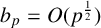
 . Then
$b_p \to \infty $
 and
$b_p = O(p^{\frac 12})$
 . Moreover, since
$\# \{p \le X : p \in S\} \gg X/\log X$
 , it follows from Lemma 2.5 that
$\alpha (E) \in \mathcal {A} \setminus \mathcal {C}_{\mathcal {A}}$
 .
5 Bernoulli and Euler numbers
Let
$(B_n)_{n\geq 0}$
 be the sequence of Bernoulli numbers defined by

Using the Bernoulli numbers, we define
$Z_{\mathcal {A}}(k)$
 for integers
$k\geq 2$
 as follows:

Recalling that
$B_n = 0$
 for odd integers
$n\geq 3$
 , we see that
$Z_{\mathcal {A}}(k)=0$
 whenever
$k$
 is even. On the other hand, it is conjectured that
$Z_{\mathcal {A}}(3), Z_{\mathcal {A}}(5), Z_{\mathcal {A}}(7), Z_{\mathcal {A}}(9), \ldots $
 are algebraically independent over
$\mathbb {Q}$
 (compare [Reference Rosen19, Theorem 5.3]). From the point of view of the Kaneko–Zagier conjecture ([Reference Kaneko and Zagier13, Main Conjecture]), recalling that
$Z_{\mathcal {A}}(k)$
 corresponds to
$\zeta (k)\bmod {\pi ^2}$
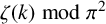 , this conjecture may be regarded as corresponding to the conjecture that
$\pi ^2, \zeta (3), \zeta (5), \zeta (7), \zeta (9), \ldots $
 are algebraically independent over
$\mathbb {Q}$
 . It is natural to regard the counterpart of
$\pi ^2$
 (or
$2\pi i$
 ) in
$\mathcal {A}$
 as being
$0$
 .
However, nothing is known about this conjecture. In fact, there is not even a single value of
$k$
 for which
$Z_{\mathcal {A}}(k)\neq 0$
 has been proved. Moreover, it has not even been shown that the set
$\{k: Z_{\mathcal {A}}(k)\neq 0\}$
 is nonempty. This stands in contrast to the case of the Riemann zeta values, where Apéry’s theorem and Rivoal’s theorem are known. The numbers
$Z_{\mathcal {A}}(k)$
 appear as values of finite multiple zeta values defined by Kaneko and Zagier, for example,
$\zeta _{\mathcal {A}}^{}(1,2)=3Z_{\mathcal {A}}(3)$
 . Nevertheless, the existence of a nonzero finite multiple zeta value
$\zeta _{\mathcal {A}}^{}(k_1,\ldots ,k_r)$
 has not been established at all, except for
$\zeta _{\mathcal {A}}^{}(\varnothing )=1$
 . Assuming the infinitude of regular primes, one can barely show that, for each
$k\neq 1,2,4$
 , there exists a nonzero finite multiple zeta value of weight
$k$
 [Reference Seki22, Proposition 2(i)].
Thus, the nonvanishing of
$Z_{\mathcal {A}}(k)$
 for odd
$k>1$
 remains difficult and also outside the scope of this paper. On the other hand, for

which is likewise defined from Bernoulli numbers, one can prove its naive transcendence. Note that
$\mathscr {B}$
 is a zero divisor, since
$B_{({p+1})/{2}}=0$
 whenever
$p\equiv 1\!\!\mod {\,4}$
 .
Let
$h(D)$
 denote the class number of the quadratic number field of discriminant
$D$
 . In the case of imaginary quadratic fields, that is, when
$D<0$
 , the famous theorem of Siegel [Reference Siegel23] asserts that

However, for our purposes, it is enough to use only the upper bound
$h(D)\ll |D|^{\tfrac 12+\varepsilon }$
 together with Heilbronn’s result that
$ \lim _{D\to -\infty }h(D)=\infty $
 .
For a prime
$p>3$
 with
$p\equiv 3 \,\pmod {\,4}$
 , the well-known congruence

holds. This congruence goes back at least to Cauchy, and is proved in [Reference Carlitz6, Equation (5.2)].
Theorem 5.1.
$\mathscr {B}\in \mathcal {A}\setminus \mathcal {C}_{\mathcal {A}}$
 .
Proof. Let
$S$
 be the set of all primes
$p>3$
 satisfying
$p\equiv 3\,\pmod {\,4}$
 , and for each
$p\in S$
 define
$b_p:= h(-p)$
 . Then the facts that
$b_p\to \infty $
 and that
$b_p=O(p^{\tfrac 12+\varepsilon })$
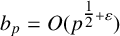 for every
$\varepsilon>0$
 follow from the classical results mentioned above. Since
$\#\{p\leq X : p\in S\}\sim \tfrac 12({X}/{\log X})$
 , it follows from (5-1) and Lemma 2.5 that
$-2\mathscr {B}\in \mathcal {A}\setminus \mathcal {C}_{\mathcal {A}}$
 .
Let
$(E_n)_{n\geq 0}$
 be the sequence of Euler numbers defined by

which is one of the analogues of Bernoulli numbers.
The Euler numbers give rise to questions analogous to those studied for the Bernoulli numbers. For example, a prime
$p$
 that does not divide any of
$E_2,E_4,\ldots ,E_{p-3}$
 is called E-regular (this is related to Fermat’s last theorem [Reference Vandiver29]), and it is an open problem whether there exist infinitely many such primes. Corresponding to Theorem 5.1, one can prove the naive transcendence of

Note that
$\mathscr {E}$
 is also a zero divisor, since
$E_{({p-1})/{2}}=0$
 whenever
$p\equiv 3 \,\pmod {\,4}$
 .
Theorem 5.2.
$\mathscr {E}\in \mathcal {A}\setminus \mathcal {C}_{\mathcal {A}}$
 .
Proof. Let
$S$
 be the set of all primes
$p$
 satisfying
$p\equiv 1\,\pmod {\,4}$
 , and for each
$p\in S$
 define
$b_p:= h(-4p)$
 . Then the facts that
$b_p\to \infty $
 and that
$b_p=O(p^{\tfrac 12+\varepsilon })$
 for every
$\varepsilon>0$
 follow from the classical results mentioned above. Since
$\#\{p\leq X : p\in S\}\sim \tfrac 12({X}/{\log X})$
 and the congruence

holds [Reference Carlitz6, Equation (1.2)], it follows from Lemma 2.5 that
$\tfrac 12\mathscr {E}\in \mathcal {A}\setminus \mathcal {C}_{\mathcal {A}}$
 .
Since
$\mathscr {B}\mathscr {E}=0$
 , the numbers
$\mathscr {B}$
 and
$\mathscr {E}$
 are algebraically dependent (see Section 7 for the definition of algebraic independence and examples). Nevertheless, it is easy to see that the following proposition holds.
Proposition 5.3. The numbers
$\mathscr {B}$
 and
$\mathscr {E}$
 are linearly independent over
$\mathbb {Q}$
 .
Proof. Assume that there exist integers
$b$
 and
$e$
 such that
$b\mathscr {B}+e\mathscr {E}=0$
 . Then, for all sufficiently large primes
$p$
 , one has

If
$p\equiv 1\,\pmod {\,4}$
 , then
$B_{({p+1})/{2}}=0$
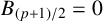 and
$E_{({p-1})/{2}}\not \equiv 0\,\pmod {\,p}$
 , the latter following from
$0<h(-4p)<p$
 . Hence,
$e\equiv 0\,\pmod {\,p}$
 . Since there are infinitely many such primes
$p$
 , it follows that
$e=0$
 . Next, consider the case where
$p\equiv 3\,\pmod {\,4}$
 . Since
$0<h(-p)<~p$
 , one has
$B_{({p+1})/{2}}\not \equiv 0\,\pmod {\,p}$
 , and therefore
$b\equiv 0\,\pmod {\,p}$
 . Again, since there are infinitely many such primes
$p$
 , we obtain
$b=0$
 .
6 An intriguing example
Define
$\pi (\boldsymbol {p}):= (\pi (p)\bmod {p})_p=(n\bmod {p_n})_{p_n}$
 , where
$p_n$
 denotes the
$n\,\mathrm{th}$
 prime. Although this is somewhat artificial, it is reminiscent of the Champernowne constant

in the sense that it is formed by listing the natural numbers. Champernowne proved in [Reference Champernowne7] that the Champernowne constant is normal in base
$10$
 , and Mahler proved its transcendence in [Reference Mahler16].
Since
$\pi (p)=O(p^{\epsilon })$
 does not hold, Luca and Zudilin’s second criterion cannot be applied. Nevertheless, the irrationality of
$\pi (\boldsymbol {p})$
 , and even the following stronger statement, can be proved easily. Although the full strength of the assertion is not needed, we use the prime number theorem.
Proposition 6.1.
$\pi (\boldsymbol {p})\in \mathcal {A}\setminus \mathcal {P}^0_{\mathcal {A}}$
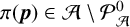 .
Proof. Suppose that
$\pi (\boldsymbol {p})\in \mathcal {P}^0_{\mathcal {A}}$
 . Then, since
$\mathcal {P}^0_{\mathcal {A}}\subset \mathcal {C}_{\mathcal {A}}$
 , there exists a nonzero polynomial
$f(x)$
 with rational coefficients such that
$f(\pi (\boldsymbol {p}))=0$
 . However, by [Reference Rosen20, Theorem 1.4], any such polynomial
$f(x)$
 must have a rational root. It follows that there exist an integer
$a$
 and a positive integer
$b$
 such that
$b\pi (p)-a\equiv 0 \,\pmod {\,p}$
 holds for infinitely many primes
$p$
 . Since
$\pi (p)\sim {p}/{\log p}$
 , we have
$0<b\pi (p)-a<p$
 for all sufficiently large
$p$
 , which is a contradiction.
Although we are not yet able to prove it, we make the following conjecture.
Conjecture 6.2.
$\pi (\boldsymbol {p})\in \mathcal {A}\setminus \mathcal {C}_{\mathcal {A}}$
 .
As evidence for this conjecture, we would like to point out that it can be derived conditionally. An integer is said to be y-smooth if all of its prime factors are at most
$y$
 . The following theorem is known concerning the smoothness of polynomial values.
Theorem 6.3 (Bober–Fretwell–Martin–Wooley [Reference Bober, Fretwell, Martin and Wooley4, Corollary 1.2]).
Let
$f(x)$
 be any quadratic polynomial with integer coefficients. Then, for every
$\varepsilon>0$
 , there exist infinitely many positive integers
$n$
 such that
$f(n)$
 is
$n^{\varepsilon }$
 -smooth.
In fact, they derive this theorem by proving a somewhat stronger theorem concerning polysmoothness (see [Reference Bober, Fretwell, Martin and Wooley4, Theorem 1.1]). A generalization of this theorem has not yet been obtained.
Question 6.4 (cf. [Reference Bober, Fretwell, Martin and Wooley4, Reference Martin17]).
Does Theorem 6.3 remain true if
$f(x)$
 is replaced by an arbitrary nonconstant polynomial in one variable with integer coefficients?
Proof. Let
$f(x)$
 be a nonconstant polynomial with integer coefficients. Suppose that
$f(n)\equiv 0\,\pmod {\,p_n}$
 holds for all sufficiently large integer
$n$
 . Since
$p_n\sim n\log n$
 , it would follow that there exist at most finitely many positive integers
$n$
 such that
$f(n)$
 is
$n$
 -smooth.
Moreover, by using the following result on the equidistribution of roots of quadratic polynomials, one can obtain an unconditional result concerning Conjecture 6.2.
Theorem 6.6 (Duke–Friedlander–Iwaniec [Reference Duke, Friedlander and Iwaniec8] and Tóth [Reference Tóth27]).
Let
$f(x)$
 be a polynomial with integer coefficients, and let
$\alpha $
 and
$\beta $
 satisfy
$0\leq \alpha < \beta \le 1$
 . Define

where
$p$
 is a prime and
$\nu $
 is an integer satisfying
$0\leq \nu \le p-1$
 . If
$f(x)$
 is an irreducible quadratic polynomial, then we have

as
$X\to \infty $
 .
Theorem 6.7. Let
$f(x)$
 be a nonzero polynomial with integer coefficients such that every irreducible factor of
$f(x)$
 has degree at most
$2$
 . Then
$f(\pi (\boldsymbol {p}))\neq 0$
 .
Proof. Assume that
$f(\pi (\boldsymbol {p}))=0$
 . Let
$X$
 be a sufficiently large real number. Let
$l_1(x),\ldots ,l_a(x)$
 be the distinct linear factors of
$f(x)$
 , and let
$q_1(x),\ldots ,q_b(x)$
 be the distinct irreducible quadratic factors of
$f(x)$
 . Define
$S_g(X):= ~\{n\leq \pi (X) : p_n\mid g(n)\}$
 for a polynomial
$g(x)$
 . Then

By the assumption,
$S_f(X)$
 is in one-to-one correspondence, up to finitely many exceptions independent of
$X$
 , with the set of primes not exceeding
$X$
 . Therefore,

By the same argument as in the proof of Proposition 6.1, we have
$\#S_{l_i}(X)=O(1)$
 . Let
$\varepsilon>0$
 be small. Since
$ \lim _{n\to \infty }n/p_n=0$
 , if
$n\in S_{q_j}(X)$
 is sufficiently large, then
$(p_n,n)\in R_{q_j}(X;0,\varepsilon )$
 . Hence,

By Theorem 6.6, we have
$\#R_{q_j}(X;0,\varepsilon )\sim \varepsilon \pi (X)$
 , and therefore, by the arbitrariness of
$\varepsilon $
 , it follows that
$\#S_{q_j}(X)=o(\pi (X))$
 . It then follows from (6-1) that

which contradicts (6-2).
If an equidistribution result analogous to Theorem 6.6 could also be established for all irreducible polynomials of degree at least
$3$
 , then Conjecture 6.2 would be resolved. Both this plan and the argument of Proposition 6.5 rely only on the asymptotic behaviour of
$p_n$
 . It would be interesting if Conjecture 6.2 could be proved by making use of more specific properties of
$p_n$
 .
7 Algebraic independence
In this section, we discuss algebraic independence over
$\mathbb {Q}$
 of two elements of
$\mathcal {A}$
 . Here, for
$\alpha ,\beta \in \mathcal {A}$
 , we say that
$\alpha $
 and
$\beta $
 are algebraically independent over
$\mathbb {Q}$
 if, for every nonzero polynomial
$F(x,y)$
 in two variables with integer coefficients, one has
$F(\alpha ,\beta )\neq 0$
 in
$\mathcal {A}$
 .
Lemma 7.1. If integer sequences
$(a_p)_p$
 and
$(b_p)_p$
 satisfy
$a_p\to \infty $
 ,
$b_p\to \infty $
 ,
$a_p^d=o(p)$
 , and
$b_p^d=o(a_p)$
 as
$p\to \infty $
 for every positive integer
$d$
 , then
$(a_p\bmod {p})_p$
 and
$(b_p\bmod {p})_p$
 are algebraically independent.
Proof. Let
$F(x,y)\in \mathbb {Z}[x,y]$
 be a nonzero polynomial, and suppose that
$F(a_p,b_p)\equiv 0\,\pmod {\,p}$
 for sufficiently large primes
$p$
 . Write

where
$g_i(y)\in \mathbb {Z}[y]$
 for
$0\leq i\leq d$
 and
$g_d(y)$
 is a nonzero polynomial. Since
$b_p\to ~\infty $
 ,
$g_d(b_p)\neq 0$
 for sufficiently large primes
$p$
 . In particular,
$|g_d(b_p)a_p^d|\geq a_p^d$
 . Let
$ k:= ~\max _{0\leq i\leq d}\deg g_i(y)$
 . Since
$g_i(n)=O(n^k)$
 for every
$0\leq i\leq d$
 and every positive integer
$n$
 , we have

by
$b_p^k=o(a_p)$
 . Therefore,
$F(a_p,b_p)\neq 0$
 for sufficiently large primes
$p$
 . On the other hand, since
$F(a_p,b_p)=O(b_p^ka_p^d)=o(p)$
 , we have
$|F(a_p,b_p)|<p$
 for sufficiently large primes
$p$
 . Thus, we have a contradiction.
Example 7.2.
$(\lfloor \log p\rfloor \bmod {p})_p$
 and
$(\lfloor \log \log p\rfloor \bmod {p})_p$
 are algebraically independent.
Lemma 7.3. Let
$\alpha =(a_p)_p\in \mathcal {A}$
 be an element satisfying the conditions of Lemma 2.1. That is, there exists a strictly increasing sequence of positive integers
$(a^{\prime }_n)_n$
 such that, for every
$n$
 , there exist infinitely many primes
$p$
 such that
$a_p = a^{\prime }_n \bmod {p}$
 . Let
$\beta = (b_p)_p\in \mathcal {A}$
 be an element satisfying the conditions of Lemma 2.3. That is, there exists a sequence of integers
$(b^{\prime }_p)_p$
 such that
$b^{\prime }_p \to \infty $
 and
$(b^{\prime }_p)^d = o(p)$
 as
$p \to \infty $
 for every positive integer
$d$
 , and
$b_p = b^{\prime }_p \bmod {p}$
 . Then
$\alpha $
 and
$\beta $
 are algebraically independent.
Proof. Let
$F(x,y)\in \mathbb {Z}[x,y]$
 be a nonzero polynomial, and suppose that
$F(\alpha ,\, \beta )=0$
 . Write

where
$f_i(x)\in \mathbb {Z}[x]$
 for
$0\leq i\leq d$
 and
$f_d(x)$
 is a nonzero polynomial. For an integer
$m$
 , if
$F(m,y)$
 is the zero polynomial in
$y$
 , then it must be the case that
$f_d(m)=0$
 . It follows that there are only finitely many integers
$m$
 for which
$F(m,y)$
 is the zero polynomial in
$y$
 . Therefore, for some
$n$
 , the polynomial
$g(y) := F(a^{\prime }_n,y)$
 is not the zero polynomial in
$y$
 . In this case, by the assumption,
$g(b^{\prime }_p)\equiv 0\,\pmod {\,p}$
 holds for infinitely many primes
$p$
 . From the assumption on
$\beta $
 , it follows that for such primes
$p$
 , if
$p$
 is sufficiently large, then
$0<|g(b^{\prime }_p)|<p$
 , which leads to a contradiction.
Example 7.4. Anzawa and Funakura’s example
$(t_{\pi (p)}\bmod {p})_p$
 with
$(t_n)_n=(1,1,2,1,2,3,\, 1,2,3,4,\ldots )$
 and
$(\lfloor \log p\rfloor \bmod p)_p$
 are algebraically independent.
It is also of interest to study algebraic independence for two numbers defined arithmetically. For example, given two elliptic curves
$E_1$
 and
$E_2$
 over
$\mathbb {Q}$
 , we may ask whether
$\alpha (E_1)$
 and
$\alpha (E_2)$
 are algebraically independent.
By Faltings’s theorem, the condition that
$E_1$
 and
$E_2$
 are
$\mathbb {Q}$
 -isogenous is equivalent to the equality
$\alpha (E_1)=\alpha (E_2)$
 . Moreover, if
$E_2$
 is a quadratic twist of
$E_1$
 , then
$\alpha (E_1)^2=\alpha (E_2)^2$
 holds. However, apart from such cases of obvious algebraic dependence, it is natural to ask whether
$\alpha (E_1)$
 and
$\alpha (E_2)$
 are algebraically independent. To this end, let us recall the proof that
$\alpha (E)$
 is transcendental in the naive sense. The key ingredients in that proof were the counting argument in the proof of Luca and Zudilin’s second criterion and the Sato–Tate distribution.
As for the latter ingredient, in order to discuss algebraic independence, it would likely be enough to have the so-called joint Sato–Tate distribution, that is, the equidistribution of
$(a_p(E_1),a_p(E_2))$
 with respect to the product Sato–Tate measure. Results in this direction have been obtained by Harris [Reference Harris10] and Wong [Reference Wong30].
On the other hand, difficulties arise when we try to extend the first ingredient to an argument for algebraic independence. Indeed, in counting the number of integers that arise in the proof of Lemma 2.5, the argument relied on the fact that
$a_p(E)$
 is of size
$O(p^{\frac 12})$
 by Hasse’s theorem, and it worked precisely because
$\frac 12<1$
 . However, if we try to extend this argument naively to pairs, this leads to about
$O(p^{\frac 12})\times O(p^{\frac 12})=O(p)$
 possible values, which is too large for the argument to work.
If we restrict to linear polynomials
$F(x,y)$
 , then
$F(a_p(E_1), a_p(E_2))$
 remains of size
$O(p^{\frac 12})$
 , and equidistribution implies its nonvanishing for infinitely many
$p$
 . In particular, this yields the linear independence of
$\alpha (E_1)$
 and
$\alpha (E_2)$
 over
$\mathbb {Q}$
 .
8 Irrationality of values of the logarithmic function
Assuming a certain kind of uniform distribution for
$q_p(2)\bmod {p}$
 , one is led to conjecture that there exist infinitely many Wieferich primes, that is, primes
$p$
 satisfying
$q_p(2)\equiv 0\,\pmod {\,p}$
 . However, only two Wieferich primes, namely
$1093$
 and
$3511$
 , are currently known, and at present there seems to be no prospect of proving this conjecture. In the language of
$\mathcal {A}$
 , this means that
$\log _{\mathcal {A}}(2)$
 is conjectured to be a zero divisor. Combined with Theorem 1.6, this in turn suggests that
$\log _{\mathcal {A}}(2)$
 is conjectured to be a nonzero zero divisor, and hence, of course, to be irrational. Although we are not able to prove that
$\log _{\mathcal {A}}(2)$
 is a zero divisor in this paper, we do prove, under the ABC conjecture of Masser and Oesterlé, that
$\log _{\mathcal {A}}(2)$
 is irrational. In fact, we prove the same kind of result for
$\alpha $
 -Wieferich primes to bases other than
$2$
 as well. It seems unlikely that the criteria in Section 2 can be applied to
$\log _{\mathcal {A}}(\alpha )$
 .
Theorem 8.1. Let
$\alpha \not \in \{+1,-1\}$
 be a nonzero rational number. Then we have
$\log _{\mathcal {A}}(\alpha )\in \mathcal {A}\setminus \mathbb {Q}^{\times }$
 .
Proof. Since
$-\log _{\mathcal {A}}(\alpha ^{-1}) = \log _{\mathcal {A}}(-\alpha ) = \log _{\mathcal {A}} \alpha $
 , there is no loss of generality in assuming that
$\alpha> 1$
 . Suppose for a contradiction that
$\log _{\mathcal {A}}(\alpha ) = a/b \in \mathbb {Q}^\times $
 with
$a \neq 0$
 ,
$b>0$
 , and
$\gcd (a,b) = 1$
 . Then for all sufficiently large primes
$p \ge N$
 , we have

Write
$\alpha = u/v$
 with
$\mathrm {gcd}(u, v) = 1$
 . Note that
$u>v>0$
 . Let
$\ell $
 be a sufficiently large prime (such that
$\ell> u, |a|, b, N$
 ) and consider the value of the homogenization of the
$\ell $
 th cyclotomic polynomial

First, by the lifting-the-exponent lemma, any prime divisor
$p$
 of
$u-v$
 does not divide
$\Phi _\ell (u,v)$
 , since
$p \nmid \ell $
 . Let
$p$
 be any prime divisor of
$\Phi _\ell (u,v)$
 . Since
$u$
 and
$v$
 are coprime, we have
$p\nmid v$
 . Hence,
$\alpha ^\ell \equiv 1 \,\pmod {\,p}$
 and
$\alpha \not \equiv 1 \,\pmod {\,p}$
 , so that
$\operatorname {\mathrm {ord}}_p(\alpha )=\ell $
 . In particular, such a prime
$p$
 satisfies
$p\equiv 1 \,\pmod {\,\ell }$
 , and therefore
$p>\ell >N$
 .
We next show that
$\Phi _\ell (u,v)$
 is square-free. For each prime
$p\mid \Phi _\ell (u,v)$
 , write

From
$\alpha ^\ell = 1 + v^{1-\ell } (\alpha -1) pt_p$
 , we obtain

By our assumption, we get

If
$p \mid t_p$
 , then
$a\ell v^\ell \equiv 0 \,\pmod {\,p}$
 , which is impossible since
$p> \ell $
 and
$\ell $
 is sufficiently large (note that
$a\neq 0$
 ). Thus
$p \nmid t_p$
 , and hence
$\Phi _\ell (u,v)$
 is square-free.
Now we define

Then (8-1) implies that for each prime
$p\mid \Phi _\ell (u,v)$
 ,
$T_\ell \equiv 0\,\pmod {\,p}$
 . Since
$\Phi _\ell (u,v)$
 is square-free, it follows that

Since
$\Phi _\ell (u,v)$
 is square-free, we can write
$\Phi _\ell (u,v) = p_1 \cdots p_r$
 with distinct primes
$p_1 < \cdots < p_r$
 . As observed above, each
$p_j \equiv 1 \,\pmod {\,\ell }$
 , so we may write
$p_j = \ell m_j+~1$
 with
$m_1 < \cdots < m_r$
 . In particular,
$m_j \ge j$
 . Since
$p_j> \ell $
 , we have
$\ell ^r<\Phi _\ell (u,v)<\ell u^{\ell -1}<~\ell ^\ell $
 , which implies
$1 \le r < \ell $
 . Moreover,

where
$H_n = \sum _{j=1}^n 1/j$
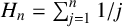 is the
$n\,\mathrm{th}$
 harmonic number. Hence, for sufficiently large
$\ell $
 , since
$\alpha> 1$
 , we obtain

which implies

Combining (8-3) and (8-4), we conclude that
$T_\ell = 0$
 .
By the definition of
$T_\ell $
 in (8-2), this yields

For each
$p_i$
 , since
$p_i\equiv 1 \,\pmod {\,\ell }$
 , we have

Therefore, by reducing modulo
$\ell $
 , we have

However, by construction, the prime
$\ell $
 is chosen to be larger than both
$u-v>0$
 and
$b>0$
 , and moreover
$1\leq r < \ell $
 , which yields a contradiction.
When
$\alpha =2$
 , only five primes are currently known to satisfy
$q_p(2) \equiv 1 \,\pmod {\,p}$
 , that is,

namely
$3$
 ,
$29$
 ,
$37$
 ,
$3373$
 , and
$2001907169$
 (see OEIS A125854). By analogy with non-Wieferich primes, this naturally suggests that there are infinitely many primes with
$q_p(2) \not \equiv 1 \,\pmod {\,p}$
 . The special case
$\log _{\mathcal {A}}(2)\neq 1$
 of this theorem means that this infinitude holds unconditionally.
Furthermore, together with Theorem 1.6, we immediately obtain the following result.
Corollary 8.2. Let
$\alpha \not \in \{+1,-1\}$
 be a nonzero rational number. Then
$\log _{\mathcal {A}}(\alpha ) \in \mathcal {A}\setminus \mathbb {Q}$
 under the ABC conjecture.
Let
$(G_n(x))_n$
 be the sequence of Gregory polynomials defined by

In particular, when
$x=0$
 , the coefficients
$G_n:= G_n(0)$
 are called the Gregory coefficients. The Gregory coefficients are another analogue of the Bernoulli numbers, distinct from the Euler numbers; indeed, they are also sometimes called the Bernoulli numbers of the second kind. For a rational number
$x$
 and an integer
$k \ge 2$
 , set
$G_{\mathcal {A}}(k; x) := (G_{p-k}(x) \bmod {p})_p\in \mathcal {A}$
 . Then the above corollary immediately strengthens [Reference Kaneko, Matsusaka and Seki12, Theorem 3.3].
Corollary 8.3. Let
$k \ge 2$
 be an integer and
$x\in \mathbb {Z}\setminus [-k-1,-1]$
 . Then
$G_{\mathcal {A}}(k;x)\in \mathcal {A}\setminus \mathbb {Q}$
 under the ABC conjecture.
Proof. As a generalization of [Reference Kaneko, Matsusaka and Seki12, Theorem 3.2], we have

by [Reference Matsusaka, Miyazaki and Yara18, Theorem 3.8]. Here, we set

We can check that
$h_k(-k-2-x)=h_k(x)^{(-1)^{k+1}}$
 and if
$x\geq 0$
 then
$h_k(x)$
 is rational and

Therefore, the claim follows from Corollary 8.2.
In particular,
$G_{\mathcal {A}}(k):= G_{\mathcal {A}}(k;0)=(G_{p-k} \bmod {p})_p$
 is an analogue of
$Z_{\mathcal {A}}(k)=(B_{p-k}/k \bmod {p})_p$
 , and it is interesting that, in the case of
$G_{\mathcal {A}}(k)$
 , one can obtain results on irrationality in this way.
Acknowledgements
The authors are grateful to Dr. Takumi Anzawa and Prof. Jun Ueki for helpful discussions on notation at the draft stage. The second author has been interested in the topic of this paper since his student days, before receiving his degree in 2017, and has continued to think about it ever since. He would like to thank Prof. Kenji Sakugawa and Prof. Shuji Yamamoto for the many discussions since that time. The authors were supported by JSPS KAKENHI (JP24K16901 and JP26K06734, respectively).



