Introduction
The assessment and interpretation of neuropsychological (NP) performance is influenced by several factors, including age, education, gender, ethnicity, and cultural variables such as socio-economic status, and acculturation (for review, see Heaton, Ryan, & Grant, Reference Heaton, Ryan and Grant2009). More recently, bilingualism has been identified as a factor that needs to be considered when administering and evaluating NP measures (Bialystok, Craik, Green, & Gollan, 2009; Rivera Mindt et al., Reference Rivera Mindt, Arentoft, Kubo Germano, DíAquila, Scheiner, Pizzirusso and Gollan2008).
Two patterns of cognitive performance have been associated with bilingualism. Bilinguals have been reported to do better than monolinguals (the “bilingualism advantage”) on tasks requiring conflict resolution and attention control (e.g., Bialystok et al., Reference Bialystok, Craik, Grady, Chau, Ishii, Gunji and Pantev2005; Costa, Hernandez, & Sebastian-Galles, Reference Costa, Hernandez and Sebastian-Galles2008). There are several hypotheses as to why this might be so, but in general cognitive mechanisms involved in the executive control system are thought to be used by bilinguals when suppressing words from languages not currently in use (Bialystok, Craik, Klein, & Viswanathan, Reference Bialystok, Craik, Klein and Viswanathan2004; Green, Reference Green1998; Hernandez, Costa, Fuentes, Vivas, & Sebastian-Galles, Reference Hernandez, Costa, Fuentes, Vivas and Sebastian-Galles2010; Kroll, Bobb, Misra, & Guo, Reference Kroll, Bobb, Misra and Guo2008).
Conversely, disadvantages of bilingualism have been demonstrated on measures of verbal performance, where bilinguals perform less efficiently on tasks such as speech production and picture naming relative to monolinguals (e.g., Gollan, Montoya, Fennema-Notestine, & Morris, Reference Gollan, Montoya, Fennema-Notestine and Morris2005). A smaller vocabulary in each of the two languages for bilinguals compared to monolinguals (Bialystok & Feng, Reference Bialystok and Feng2009), and slower semantic (Gollan, Montoya, & Werner, Reference Gollan, Montoya and Werner2002) and lexical retrieval for bilinguals (Gollan, Montoya, Cera, & Sandoval, Reference Gollan, Montoya, Cera and Sandoval2008; Ivanova & Costa, Reference Ivanova and Costa2008) have been proposed to explain this verbal fluency disadvantage.
When languages share many cognates, the bilingual disadvantage observed for verbal fluency measures may be attenuated or eliminated (e.g., Gollan & Acenas, Reference Gollan and Acenas2004; Sandoval, Gollan, Ferreira, & Salmon, Reference Sandoval, Gollan, Ferreira and Salmon2010). Cognates are words that share phonological form across languages (e.g., the Spanish word for activity is actividad). Studies examining Spanish and Catalan (known to have a high rate of cognates) suggest that shared phonological characteristics in cognates (e.g., gat in Catalan and gato in Spanish [cat in English]) result in faster retrieval of the target word, and thus a facilitation effect on picture naming tasks (Costa, Caramazza, & Sebastian-Galles, Reference Costa, Caramazza and Sebastian-Galles2000). However, a bilingualism disadvantage was still noted when comparing the naming latencies of bilinguals with those of monolinguals (Costa et al., Reference Costa, Caramazza and Sebastian-Galles2000; Ivanova & Costa, Reference Ivanova and Costa2008). Similarly, a bilingualism disadvantage (e.g., Bialystok, Craik, & Luk, Reference Bialystok, Craik and Luk2008; Portocarrero, Burright, & Donovick, Reference Portocarrero, Burright and Donovick2007; Rosselli et al., Reference Rosselli, Ardila, Araujo, Weekes, Caracciolo, Padilla and Ostrosky-Solis2000) and cognate facilitation effect (e.g., Sandoval et al., Reference Sandoval, Gollan, Ferreira and Salmon2010) have been demonstrated for verbal fluency tests requiring spontaneous word generation. Relatively little information is available about possible cognate effects in the verbal fluency tasks in bilinguals of different language combinations.
The characteristics of our study sample provided a good opportunity to examine the relationship between bilingualism and cognitive performance in adult speakers of two phonologically and semantically similar languages (Marathi and Hindi). This enabled us to build upon the Spanish-Catalan naming latency literature and examine the bilingualism effect on verbal fluency measures in the context of high cognate overlap.
Little is known about the effects of bilingualism on executive and verbal performance in India. The unique sociolinguistic characteristics of this setting include the high prevalence of bilingualism (220 million speakers, or approximately 19% of the Indian population, are fluent in at least two of 22 official Indian languages; 34 million speak both Marathi and Hindi; Benedikter, Reference Benedikter2011) and the considerable overlap in geographic and demographic characteristics of monolingual and bilingual speakers of Marathi and Hindi (Annamalai, Reference Annamalai1990). Additionally, of the approximately 6 million Marathi and Hindi words in the multilingual corpus of the Central Institute of Indian Languages, 44.5% are reported to be cognates (phonologically and lexically similar; Singh & Surana, Reference Singh and Surana2007a; Reference Singh and Surana2007b).
Consistent with extant literature, we hypothesized that the considerable practice in attention control and inhibition afforded by being bilingual in Marathi and Hindi would impart an advantage on measures of executive function. Given the high rate of cognates shared by these languages, an attenuation of the verbal fluency disadvantage was expected. Of note, although Marathi and Hindi share many cognates, Marathi verbs often differ from their translation equivalents in Hindi on lexical and structural levels due to the differences in Marathi and Hindi grammatical rules governing verb construction, use and placement (Deoskar, Reference Deoskar2006; Pandharipande, Reference Pandharipande1986). This raises the possibility of a differential attenuation of the bilingualism disadvantage for tests eliciting predominantly nouns (Phonemic fluency test and Animal fluency test) Versus verbs (Action fluency test).
Methods
Participants
All human subjects data were collected in accordance and compliance with standards outlined by the University of California at San Diego (UCSD) Institutional Review Board (IRB), and the Ethics Committee of the National AIDS Research Institute and the IRB. The parent study addressing the neurobehavioral effects of HIV infection in India was approved by the UCSD IRB as well as the Indian Council of Medical Research.
One hundred seventy-four native Marathi speakers, recruited as healthy control participants for a neuroAIDS study in Pune, India (a large industrial city in the state of Maharashtra, India), participated in this study.
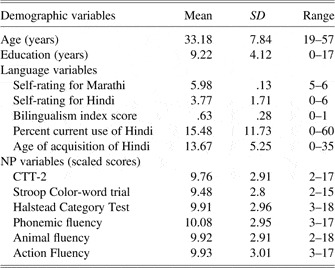
Participants were required to be between 18 to 60 years old. Exclusion criteria included head injury, loss of consciousness greater than 30 minutes, other neurologic disorders, infections that can affect the CNS, current or past psychotic disorder, significant substance abuse, current active infection of any sort (e.g., fevers >38.5°C), and conditions that could confound the NP testing (color blindness, significant hearing deficit). The group consisted of young-to-middle age adults (Table 1). Men and women were equally represented (85 males, 89 females). Education (number of years of schooling completed) covered a broad range, with 14% of participants having fewer than 6 years of education, and 13% having a college degree (15 years of education or higher).
Participant characteristics and NP performance

Procedure
Neuropsychological testing and a review of language use history were conducted exclusively in Marathi, the native and preferred language for all participants.
Language-history
All participants completed a detailed language-history questionnaire regarding characteristics of their use of all languages with which they were familiar (Gollan et al., Reference Gollan, Montoya and Werner2002). This included age of acquisition of the language, age of first exposure to the language in school, percentage of time using the language at present and in the past, and self-rated level of proficiency. Participants ranked their proficiency in reading, writing, speaking, and understanding for each language on a scale of 0 to 6, where 0 = no proficiency, 1 = very poor, 2 = fair, 3 = functional, 4 = good, 5 = very good, and 6 = like a native speaker. While Marathi and Hindi were the most commonly reported languages, 47 of 174 participants reported minimal knowledge of another language (English). Self-reported proficiency English was minimal (mean = 1.2, i.e., “very poor”). In a sub-analysis, no effect of English proficiency on NP performance was noted (data not shown), so it was not included in the subsequent bilingualism analyses. Sixteen monolingual Marathi speakers denied any significant exposure to Hindi. Thus, age of Hindi acquisition was not used as an indicator of bilingualism in the primary analyses, but was examined separately. Self-rated speaking proficiency in the first and second language have been shown to be strongly correlated with objective measures of proficiency (Marian, Blumenfeld, & Kaushanskaya, Reference Marian, Blumenfeld and Kaushanskaya2007). Accordingly, self-ratings of proficiency in speaking Marathi and Hindi were selected as measures of bilingualism in this study. Furthermore, it was expected that by using the speaking proficiency variable, as opposed to proficiency in reading or writing, any confounds of education or literacy level may be reduced.
Based on self-reported level of proficiency in Hindi and Marathi, a Bilingualism Index Score (BIS) was generated. This score was calculated as the ratio of the self-reported proficiency in speaking Hindi to that in Marathi. BIS ranged from 0 (low level of Hindi proficiency relative to Marathi proficiency) to 1 (equal and high levels of proficiency with both languages). For example, native speakers of Marathi who rate their Marathi proficiency at 6 (“like a native speaker”) and Hindi proficiency at 2 (“fair”), would have a bilingualism index score of .33 (2/6). There were no individuals in the sample who were Hindi dominant (i.e., proficiency in Hindi greater than that in Marathi).
Neuropsychological tests
Participants were administered six measures assessing executive functioning and verbal skills within the context of a more comprehensive fixed-order test battery, which took approximately three hours. All tests and questionnaires were translated from English, back-translated, and administered in Marathi. To have a common metric for performance on these fluency and executive function tests, demographically uncorrected scaled scores were calculated based upon a large Indian normative sample which included the current cohort (n = 248); the scaled scores have a mean of 10 and a standard deviation of 3. The distributions of these scaled scores are presented in Table 1. (Note that the findings were similar using raw scores (not shown), but raw scores preclude some of the grouping analyses discussed later).
Executive Functioning
Some studies have suggested that exposure to more than one language gives bilinguals the opportunity to engage in inhibitory control and selective attention as they suppress the non-target language when communicating (Green, Reference Green1998; Meuter & Allport, Reference Meuter and Allport1999; Bialystok & Majumder, Reference Bialystok and Majumder1998; Colzato et al., Reference Colzato, Bajo, van den Wildenberg, Paolieri, Nieuwenhuis, La Heij and Hommel2008). Participants were administered three standardized tests of executive function that covered the ability areas of cognitive set switching, inhibition, and abstraction/problem solving.
Color Trails Part 2
This test was developed by D'Elia, Satz, Uchiyama, and White (1996) as a culture-fair test of executive functioning, similar to Trail Making Test-B (TMT-B; Army Individual Test Battery, 1944). This is a paper and pencil test in which circles colored in yellow or pink are used instead of letters to overcome the limitation of using TMT-B with individuals who are illiterate, or poorly educated, or do not use the Latin/English alphabet (Maj et al., Reference Maj, Delia, Satz, Janssen, Zaudig, Uchiyama and Chervinsky1993). On Part 2, participants were to quickly connect sequences of numbers (1 to 25) contained in pink circles and yellow circles that are randomly distributed on a page, while alternating between the sequences in pink versus yellow circles (e.g., 1-pink to 2 yellow (avoiding the pink 2) and then to 3-pink (avoiding the yellow 3), etc.). Time to completion was used in the analysis.
Stroop Color-Word Test (Golden, Reference Golden1978)
Participants were instructed to name colors in Marathi (laal [red], neela [blue], and hirva [green]) as fast as possible under three conditions. Individuals with negligible reading skill, defined as an inability to read more than eight words or simple sentences correctly on a reading literacy measure or the stimuli presented in this test, were excluded from the analysis of Stroop data (n = 16). In the “Color Trial,” participants named the color of the ink in which a series of blocks are printed. Participants then read out loud a series of color words (printed in black) in the “Word Trial.” Finally, in the “Color-Word” condition participants named the color of the ink in which an incongruent color word was printed (i.e., the word “red” printed in blue ink). This condition requires participants to inhibit the automatic response of reading the word. The number of correct responses in 45 s was used to generate the total score for the color-word trial.
Halstead Category Test (Heaton, Grant, & Matthews, Reference Heaton, Grant and Matthews1991; Reitan & Wolfson, Reference Reitan and Wolfson1993)
Administered on a personal computer, this test measures abstraction and sequential problem solving (for review, see Choca, Laatsch, Wetzel, & Agresti, Reference Choca, Laatsch, Wetzel and Agresti1997). Participants were presented with seven subtests in which they were required to deduce the rule being used for the selection of one out of four objects presented on the screen for each subtest. The total number of errors across the seven subtests was used in the analysis.
Verbal Skills
Participants were administered three standardized tests of phonemic and semantic fluency.
Phonemic fluency (Benton, Hamsher, & Sivan, Reference Benton, Hamsher and Sivan1994)
Participants are to retrieve words using phonemic processing. Based on previous studies of phonemic fluency (e.g., Ratcliff et al., 1998) three Marathi phonemes (denoted in English as /p/[“paa”], /a/[“a”], and /s/[“saa”]) were used in this task and participants were asked to generate words that started with the sounds associated with these letters in the 60-s time limit.
Animal fluency (Benton, Hamsher, & Sivan, Reference Benton, Hamsher and Sivan1994)
In this task, retrieval processing at a semantic level is required. Participants were asked to name as many animals as they could in 60 s. The number of correct responses was then calculated.
Action fluency (Piatt, Fields, Paolo, & Troster, Reference Piatt, Fields, Paolo and Troster1999)
This is another measure in which retrieval processing must occur on a semantic level. Participants must rapidly generate as many verbs (i.e., “things that people do”) as possible in 60 s. They were to generate only single verbs (e.g., eat) and avoid repeating verbs that were generated earlier with a different ending (e.g., eating, eaten). The number of correct responses was calculated.
Statistical Analyses
Using the entire sample, we performed multivariable regression analyses exploring the association between the dependent variables of interest (i.e., the scaled scores from the NP tests) and the bilingualism index score, with adjustment for demographic variables (age, education, and gender). For each regression model we report, the proportion of variability explained by the model, R 2, and the standardized regression coefficient (β) for each predictor variable. The relationship between BIS, education, age, and gender was examined, as well as the Pearson's correlations between the demographic variables, BIS, and test scores.
Results
Language History
By design, all participants were native speakers of Marathi, which they reported speaking with high levels of proficiency. Two individuals reported speaking Marathi with “very good” (score = 5) level of proficiency, while the rest of the cohort endorsed speaking Marathi with the proficiency of a “native speaker” (score = 6). Mean self-reported proficiency in Hindi was 3.77 [range = 0 (do not speak Hindi; n = 11) to 6 (speak Hindi like a native speaker; n = 36)] (see Table 1). BIS was associated with education (r(172) = .43, p < .0001), age (r(172) = −.16; p = .044), and also with gender (t(169) = −7.17, p < .0001; with men reporting higher levels of bilingualism than women). Taking self-reported proficiency in a third language (English) into account did not alter the relationships between BIS and the demographic variables, or test performance. Age of acquisition of Hindi (the second language) ranged from 0 (from birth) to 35 years (M = 13.68; SD = 5.25). Participants reported speaking Hindi between 0 and 60% of the time (M = 15.45%; SD = 11.76). Correlation analyses indicated significant association between BIS and age of acquisition for Hindi (r(158) = −.25; p < .01) and percent current use (r(174) = .58; p < .0001), such that higher levels of proficiency in speaking Hindi were reported by individuals who started speaking Hindi at an early age as well as those who spoke the language often. Current use of Hindi and age of first frequent use were not significantly associated (p > .60).
NP Performance
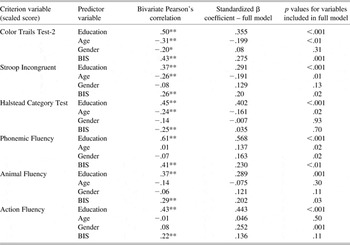
As seen in Table 2, education, age, and BIS were significantly correlated with tests of executive functioning. In addition, a significant correlation was noted for gender and Color-Trails 2 performance. Modest correlations were observed between BIS and scaled scores on the executive functioning tests. On tests of verbal fluency, performance was significantly associated with education and BIS. Modest correlations were noted for BIS and performance on Phonemic and Animal fluency, whereas a weak correlation was observed between BIS and Action fluency performance.
Results for multivariate analyses

*Correlation is significant at the .05 level.
**Correlation is significant at the .01 level.
β = Standardized regression coefficient.
A priori models of education, gender, age and BIS as predictors of test performance were examined. Also seen in Table 2, for tests of executive functioning, after adjusting for demographic variables, BIS was associated with Color-Trails performance (β = .275; t(156) = 3.47; p = .001). The full model accounted for 34% of the variance (F(4,157) = 20.62; p < .0001). BIS was a unique predictor of performance on the Stroop Color-Word trial β = .20, t(152) = 2.313, p = .02 (Total model R 2 = .20; F(4,153) = 9.97; p < .0001). On both tests, a higher degree of bilingualism was associated with better performance. However, BIS was not a significant predictor of performance on the Halstead Category Test (β = .04; t(166) = .41; p = .7). The full model with demographic variables and BIS accounted for 23% of the variance, F(4,167) = 12.5; p < .0001.
An examination of the bilingualism effect on tests of verbal fluency revealed a significant effect of bilingualism on two of the three tests administered (Table 2). After adjusting for education, age, and gender (all p's < .05), BIS was significantly associated with phonemic fluency performance β = .23, t(167) = 3.07, p = .002. The model containing the demographic variables and BIS together accounted for 43% of the variance, F(4,167) = 31.8, p < .0001. Similarly, BIS was an independent and significant predictor of performance on the Animal fluency test, β = .20, t(168) = 2.26, p = .03. The full model was significant, R 2 = .17, F(4,169) = 8.63, p < .0001. On both tests, individuals reporting higher levels of bilingualism had higher scaled scores relative to those who reported lower proficiency levels. In contrast, BIS was not a significant predictor of performance on the Action fluency test (β = .14; t(168) = 1.60; p = .11) but the overall model, with education as the only significant predictor, was significant, R 2 = .24; F(4,168) = 13.62; p < .0001.
Additional Analyses
Post hoc analyses using individuals who endorsed at least some experience with speaking Hindi (n = 158) revealed that this pattern of bilingualism effects was similar when age of first frequent use of Hindi was used as a predictor in the multivariate models in addition to BIS (data not shown). Additionally, entering percent current use of Hindi and BIS as language-use related predictors of NP performance revealed that of the two, only BIS was significantly associated with performance on Color Trails Part 2, Stroop Color-Word test, Phonemic, and Animal fluency (all p's < .01).
To examine whether there was a general, nonspecific bilingualism effect across all cognitive abilities, we computed an index of general NP competence. The mean of the scaled scores of tests not hypothesized to be associated with bilingualism, and having a minimal verbal component was calculated. Measures included were Brief Visuospatial Memory Test (learning and recall), Grooved Pegboard (dominant and non-dominant trials), WAIS-III Digit Symbol test, WAIS-III Symbol Search test, Trail Making Test-A, WMS-III Spatial Span test, Paced Auditory Serial Addition Test, and Stroop Color trial. BIS, education, age, and gender were entered in a model predicting general NP competence. Of note, BIS was not associated with general NP competence (β = .09; t(169) = 1.29; p = .20). The overall model was significant, R 2 = .50, F(4,170) = 42.2, p < .0001. When the index of general NP competence was entered in the models predicting performance on the six executive function and verbal fluency tests, the pattern of results pertaining to the BIS was unchanged (data not shown).
Discussion
Given the high prevalence of bilingualism and cognate frequency associated with the languages of the Indian subcontinent, and the dearth of empirical studies examining the effect of bilingualism on cognitive performance in this population, we sought to expand the literature by studying the effects of bilingualism in a sample of native Marathi speakers with varying levels of self-rated proficiency in, and ages of acquisition of Hindi, their second language. We tested the hypotheses that bilingualism advantages would be observed on tests of executive functions, while an attenuation of the often reported bilingual disadvantage would be seen on specific verbal fluency tasks based upon a possible facilitation effect resulting from the high rate of cognates shared by Marathi and Hindi.
In this Indian cohort, as might be expected with most studies of cognitive functioning, education was the first and strongest predictor of performance on these NP tests. However, BIS contributed an independent effect on many of the tests.
The effect of bilingualism on executive functions varied depending on the aspect of executive functioning assessed and was detected on the Color-Trails Test-2, a measure of cognitive set switching and executive processing abilities (D'Elia et al., Reference D'Elia, Satz, Uchiyama and White1996; Dugbartey, Townes, & Mahurin, Reference Dugbartey, Townes and Mahurin2000), and the Stroop Color-Word trial, which taps the abilities of inhibitory control and interference suppression. Higher levels of Marathi-Hindi bilingualism were associated with better performance on these tasks. Our findings are consistent with current theories of bilingualism, which propose that the frequent demand to control activation of two languages placed on bilinguals (but not monolinguals) may confer a bilingualism advantage in non-linguistic tasks that require executive control (e.g., Bialystok & Feng, Reference Bialystok and Feng2009). More specifically, bilingual language switching (Meuter & Allport, Reference Meuter and Allport1999; Prior & Gollan, Reference Prior and Gollan2011; Prior & MacWhinney, Reference Prior and MacWhinney2010), and attention control, encompassing inhibition of attention to irrelevant information and selective attention to relevant information, may be required to focus attention to the relevant representational systems of the language presently in use while ignoring those associated with the second language (e.g., Bialystok et al., Reference Bialystok, Craik, Klein and Viswanathan2004, Reference Bialystok, Craik and Luk2008; Bunge, Dudukovic, Thomason, Vaidya, & Gabrieli, Reference Bunge, Dudukovic, Thomason, Vaidya and Gabrieli2002; Costa, Santesteban, & Ivanova, Reference Costa, Santesteban and Ivanova2006; Green, Reference Green1998; Kroll et al., Reference Kroll, Bobb, Misra and Guo2008).
The Halstead Category Test was included in our analyses with the goal of adding to the knowledgebase of bilingualism effects on different aspects of executive function, including abstract concept formation (Pendleton & Heaton, Reference Pendleton and Heaton1982) attention, and visuospatial ability (Lansdell & Donnelly, Reference Lansdell and Donnelly1977). Studies of bilingualism have historically not included this test in their battery of executive function measures. While BIS and number of errors on the Category Test were negatively correlated, BIS was not a significant predictor of performance on this test after controlling for education.
Based on these findings it appears that, in our sample, there is a bilingual advantage associated with certain components of executive functioning. The results for the Halstead Category Test suggest some specificity of the bilingual advantage on executive control in this sample, such that a bilingualism effect is not associated with abstract concept formation tested with visuospatial stimuli. However, the presence of a bilingual advantage was evident on measures of effortful switching, attention control, and interference suppression.
A reduction/elimination of the bilingualism disadvantage associated with verbal fluency performance has been reported when bilinguals have the opportunity to use their lexical knowledge in both languages (e.g., Gollan et al., Reference Gollan, Montoya and Werner2002; Sandoval et al., Reference Sandoval, Gollan, Ferreira and Salmon2010). Accordingly, an attenuation of the bilingualism disadvantage was hypothesized for verbal performance on the Phonemic, Animal, and Action fluency tests, with the possibility of a differential attenuation of the disadvantage due to lexical and structural disparities reported for Marathi and Hindi verbs compared to nouns.
The current body of literature on the linguistic similarities of Marathi and Hindi only sheds light on the high frequency of cognates shared by these languages and the lexical and structural discrepancies for translational equivalents of verbs in these two languages (Deoskar, Reference Deoskar2006; Pandharipande, Reference Pandharipande1986; Singh & Surana, Reference Singh and Surana2007a). Exact numbers for the cognate frequencies for nouns relative to verbs in this language pair are not available. Given this limitation, we may only speculate about the effect of Marathi and Hindi cognates on the relationship between bilingualism and verbal performance.
It has been proposed that bilingual speakers of very similar languages (e.g., Spanish and Catalan) may be less prone to disadvantages associated with their bilingualism (Costa et al., Reference Costa, Caramazza and Sebastian-Galles2000; Gollan, Bonanni, & Montoya, Reference Gollan, Bonanni and Montoya2005). Consistent with this, on the tests of verbal fluency administered to this Indian sample, an elimination, and actually a reversal, of the bilingual disadvantage was noted on the Phonemic and Animal Fluency Tests. An analysis of Phonemic fluency responses suggested that mostly nouns were generated on this test. Higher bilingualism index scores predicted better performance on these two tests, which predominantly elicited nouns, even after controlling for education. On the Action Fluency Test, which required generation of verbs, a weak positive correlation was noted between degree of bilingualism and the number of correct responses. However, BIS was not a significant predictor of performance after controlling for education, age, and gender. The distinct pattern of associations on tasks eliciting nouns versus verbs lends some support to the possibility that the rate of cognates shared by this language pair influences the effect of bilingualism on verbal performance. The considerable degree of phonologic and semantic overlap for Marathi and Hindi is speculated to allow bilinguals to overcome the lexical access burden often reported for bilinguals on a verbal performance task such as Phonemic and Animal Fluency. Perhaps when this degree of overlap is lower, as with Marathi and Hindi verbs, the relationship between bilingualism and verbal fluency is weaker and the bilingual effect is eliminated.
Our finding of a bilingualism advantage on verbal fluency tasks might also have been affected by the fact that our bilingual participants were dominant in their first-learned language in contrast to, for example, the second-language dominant cohort of Gollan and colleagues. This concern is mitigated by the comparable bilingualism effect shown on naming fluency in samples of bilinguals tested in both their dominant and non-dominant languages (Ivanova & Costa, Reference Ivanova and Costa2008). Mechanisms underlying the role of cognate facilitation in generating the positive bilingualism effect on verbal fluency need further exploration.
This pattern of findings for tests of executive functions as well as verbal performance was replicated when age of Hindi acquisition was added as a predictor. Early speakers of Hindi demonstrated better NP performance, consistent with the pattern of results noted for BIS alone. The unexpected pattern of better performance by bilinguals on the verbal fluency tests raised the possibility that the bilingualism effect may simply reflect higher overall neurocognitive competence in bilingual individuals. However, additional analyses using an estimate of general cognitive competence did not support this interpretation, and rather supported the notion of specificity for the bilingual effect.
Our study has limitations. While there have been some sociolinguistic studies addressing multilingualism in India, extensive psycholinguistic research dealing with Indian bilingualism and its impact on cognitive performance is lacking. We aimed to address this void by examining a battery of tests measuring cognitive domains associated with bilingualism. However, given the dearth of validated instruments assessing vocabulary and other aspects of linguistic proficiency that are suitable for Marathi and Hindi, we were unable to administer a measure of vocabulary level. As reported by Bialystok and colleagues (Bialystok et al., Reference Bialystok, Craik and Luk2008; Luo, Luk, & Bialystok, Reference Luo, Luk and Bialystok2010), a bilingualism advantage, such as the one noted in this study, may be associated with letter fluency after vocabulary level is controlled. Such data would have helped to clarify our results in this Indian sample. Development of linguistic instruments appropriate for Indian languages and their usage in future studies of bilingualism would also be beneficial.
The use of English is increasingly common in India. Although the individuals in our sample reported minimal experience of this language, and knowledge of English was not associated with NP performance, future research should explore the patterns of cognition in multilingual individuals. For this study, we used NP tests that are expected to be culture-fair. However, no published data regarding the psychometric properties of these measures currently exist for an Indian sample. This limitation precludes direct comparisons of Marathi-Hindi bilinguals in our sample with bilingual speakers of other languages.
To our knowledge, few studies have examined the lexical, phonemic, and structural overlap of this language pair, and those studies were in the field of computational linguistics (e.g., Makin, Pandey, Pingali, & Varma, Reference Makin, Pandey, Pingali and Varma2007; Ramanand, Ukey, Singh, & Bhattacharyya, Reference Ramanand, Ukey, Singh and Bhattacharyya2007; Singh & Surana, Reference Singh and Surana2007a, Reference Singh and Surana2007b). The findings from these studies were helpful in informing our hypotheses and interpretation of results, but the limited knowledgebase in this area tempers the conclusions that may be drawn based on our findings.
Our sample included individuals with education levels that are considerably lower than those typically encountered in the United States. Gender-bias in educational attainment as well as acquisition of a second language is another factor that may not be generalizable to Western populations, but is common throughout the world. While gender was seldom a significant predictor of test performance in our statistical models, education did explain unique variance in performance on the six tests. The Indian educational system is structured such that students acquire a greater exposure to their second language (typically Hindi) as they advance in grades (Bhatia & Ritchie, Reference Bhatia and Ritchie2004). Given the wide range of educational attainment in our sample, the strong relationship between education and cognitive performance as well as degree of bilingualism is to be expected. This is a limitation and introduces some degree of uncontrolled variability, but is representative of the characteristics of the population at large. That an association between bilingualism and NP function was still observed independent of education is compelling. Other factors such as socioeconomic status may also impact acquisition of a second language. However, Hindi, the second language reported by our participants, is ubiquitous in the region sampled. This may potentially reduce the effects of socioeconomic status on bilingualism. Future studies would benefit from an examination of these variables to be able to better understand these associations. The exploration of the nature of bilingualism effects in Spanish-English bilinguals with low levels of education might further complement this avenue of study.
The sociolinguistic characteristics of the Indian population lend themselves to studies of various aspects of bilingualism, such as the effect on cognition of speaking two less closely related Indian languages. Given the evidence from imaging studies regarding the separability of neural activation for semantic and phonological tasks (e.g., Shaywitz et al., Reference Shaywitz, Pugh, Todd Constable, Shaywitz, Bronen, Fulbright and Skudlarski1994), and the impact of language acquisition patterns on cortical organization in bilinguals (e.g., Perani et al., Reference Perani, Paulesu, Galles, Dupoux, Dehaene, Bettinardi and Mehler1998), an examination of the potential effect of neurodegenerative diseases (e.g., HIV, Alzheimer's disease) on neural networks associated with bilingualism is warranted.
Despite the unique challenges and limitations of the present study, it is important to examine the construct of bilingualism in diverse settings so as to understand the cognitive underpinnings of the same. We found support for a bilingualism advantage on tests of attention, switching, and inhibitory control. The expected bilingualism disadvantage was absent for tests eliciting nouns as well as verbs, with a bilingual advantage noted for the former. The findings of this study may help clarify the nature of bilingualism in closely related languages and the impact thereof on executive and verbal function in a sample of healthy Indian adults.
Acknowledgments
This research was supported by NIMH R01 MH78748 NeuroAIDS India (Dr. Marcotte, P.I.) and P30 MH62512 HIV Neurobehavioral Research Center (Dr. Grant, P.I.). These data were presented in preliminary form at the Annual Meeting of the International Neuropsychological Society at Boston, Massachusetts in February, 2011. Dr. Heaton receives royalties from the publisher of the Wisconsin Card Sorting Test. The authors have nothing to disclose regarding relationships that could be interpreted as a conflict of interest. The San Diego HIV Neurobehavioral Research Center [HNRC] group is affiliated with the University of California, San Diego, the Naval Hospital, San Diego, and the Veterans Affairs San Diego Healthcare System, and includes: Director: Igor Grant, M.D.; Co-Directors: J. Hampton Atkinson, M.D., Ronald J. Ellis, M.D., Ph.D., and J. Allen McCutchan, M.D.; Center Manager: Thomas D. Marcotte, Ph.D.; Jennifer Marquie-Beck, M.P.H.; Melanie Sherman; Neuromedical Component: Ronald J. Ellis, M.D., Ph.D. (P.I.), J. Allen McCutchan, M.D., Scott Letendre, M.D., Edmund Capparelli, Pharm.D., Rachel Schrier, Ph.D., Terry Alexander, R.N., Debra Rosario, M.P.H., Shannon LeBlanc; Neurobehavioral Component: Robert K. Heaton, Ph.D. (P.I.), Steven Paul Woods, Psy.D., Mariana Cherner, Ph.D., David J. Moore, Ph.D., Matthew Dawson; Neuroimaging Component: Terry Jernigan, Ph.D. (P.I.), Christine Fennema-Notestine, Ph.D., Sarah L. Archibald, M.A., John Hesselink, M.D., Jacopo Annese, Ph.D., Michael J. Taylor, Ph.D.; Neurobiology Component: Eliezer Masliah, M.D. (P.I.), Cristian Achim, M.D., Ph.D., Ian Everall, FRCPsych., FRCPath., Ph.D. (Consultant); Neurovirology Component: Douglas Richman, M.D., (P.I.), David M. Smith, M.D.; International Component: J. Allen McCutchan, M.D., (P.I.); Developmental Component: Cristian Achim, M.D., Ph.D.; (P.I.), Stuart Lipton, M.D., Ph.D.; Participant Accrual and Retention Unit: J. Hampton Atkinson, M.D. (P.I.), Rodney von Jaeger, M.P.H.; Data Management Unit: Anthony C. Gamst, Ph.D. (P.I.), Clint Cushman (Data Systems Manager); Statistics Unit: Ian Abramson, Ph.D. (P.I.), Florin Vaida, Ph.D., Reena Deutsch, Ph.D., Anya Umlauf, M.S., Tanya Wolfson, M.A. The views expressed in this article are those of the authors and do not reflect the official policy or position of the Department of the Navy, Department of Defense, nor the United States Government.