Introduction
Lacewings belonging to the Chrysoperla genus are recognised as crucial natural predators and are frequently employed in the biological management of agricultural pests (Figueiredo et al., Reference Figueiredo, Dami, Souza, Paula, Cabral, Rodriguez-Saona and Vacari2021; Liu and Chen et al., Reference Liu and Chen2024). Chrysoperla externa (Hagen, 1861) (Neuroptera: Chrysopidae) holds significance as one of the prominent lacewing species within the genus across the Americas, spanning from the southern USA to Argentina (Albuquerque et al., Reference Albuquerque, Tauber, Tauber, McEwen, New and Whittington2001; Toledo-Hernández et al., Reference Toledo-Hernández, Peña-Chora, Mancilla-Dorantes, Torres-Rojas, Romero-Ramírez, Palemón-Alberto, Ortega-Acosta, Delgado-Núñez, Salinas-Sánchez, Tagle-Emigdio and Sotelo-Leyva2024). This species possesses a remarkable adaptability to diverse climates, facilitating its widespread distribution (Silva et al., Reference Silva, Malaquias, Faria Filho, Santos and Fernandes2024).
Research on the biology of C. externa and its utilisation as a augmentative biological control has been documented since the 1970s (Albuquerque et al., Reference Albuquerque, Tauber and Tauber1994). Despite extensive investigations into the biology of C. externa over the years (Braghini et al., Reference Braghini, Lima, Dami, Souza, Barbosa, Figueiredo, Paula, Rodriguez-Saona and Vacari2024), its predatory capability against two-spotted mites remains inadequately explored. In various South American countries such as Argentina, Peru, Mexico, and Colombia, C. externa is reared in laboratories and subsequently released into agricultural environments (Acevedo et al., Reference Acevedo, Gil S, Seoane, G and Schneider2024; Cruces et al., Reference Cruces, Peña and De Clercq2024; Toledo-Hernández et al., Reference Toledo-Hernández, Peña-Chora, Mancilla-Dorantes, Torres-Rojas, Romero-Ramírez, Palemón-Alberto, Ortega-Acosta, Delgado-Núñez, Salinas-Sánchez, Tagle-Emigdio and Sotelo-Leyva2024). In Brazil, five companies are officially registered with the Ministry of Agriculture, Livestock, and Supply for the production of C. externa, primarily targeting the management of whiteflies and certain aphid species. However, approval for the control of two-spotted mites is still pending. Presently, lacewing releases in Brazil encompass an area of 750 thousand hectares annually, with expectations of additional companies receiving approval by the end of 2024. This approval process will facilitate the broader commercial availability of these predators.
Moreover, its broad spectrum of prey, encompassing delicate insects like aphids, whiteflies, thrips, moths, and mites, renders it suitable for various biological control initiatives (Braghini et al., Reference Braghini, Lima, Dami, Souza, Barbosa, Figueiredo, Paula, Rodriguez-Saona and Vacari2024; Carvalho et al., Reference Carvalho, Vieira, Pec and Souza2022; Luna-Espino et al., Reference Luna-Espino, Jiménez-Pérez and Castrejón-Gómez2020; Saraiva et al., Reference Saraiva, Silva, Maciel, Duarte, Alves Filho, Rodrigues, Ramos, Lira and Dias-Pini2024). The predatory effectiveness of Chrysopidae members escalates during the larval stage’s molting processes (Palomares-Perez et al., Reference Palomares-Perez, Bravo-Nunez and Arredondo-Bernal2019; Santos et al., Reference Santos, Souza and Hernandez2024). Additionally, adults sustain themselves on nectar, pollen, or insect-produced honey (Martins et al., Reference Martins, Andrade, Botti, Perez, Schmidt and Venzon2025). Furthermore, they are easily cultivated in laboratory settings (Braghini et al., Reference Braghini, Lima, Dami, Souza, Barbosa, Figueiredo, Paula, Rodriguez-Saona and Vacari2024).
Incorporating a natural antagonist, be it a predator or a parasitoid, into a biological control scheme necessitates a comprehensive grasp of its predation patterns. Insight into prey consumption holds pivotal significance for the effective integration of these organisms into biological control and integrated pest management strategies. Such understanding serves as a cornerstone for deploying efficient biological control measures (Bueno et al., Reference Bueno, Sutil, Jahnke, Carvalho, Cingolani, Colmenarez and Corniani2023).
The hypothesis of this research is that C. externa is a predator of the two-spotted mite Tetranychus urticae (Koch, 1836) (Acari: Tetranychidae) and consumes a high number of individuals at elevated prey densities. To test this hypothesis, the results were compared with the alternative prey Ephestia kuehniella (Zeller, 1879) (Lepidoptera: Pyralidae), commonly used in the mass breeding of natural enemies. Therefore, considering the potential of C. externa for biological pest control programs, this research was conducted to study the behaviour of the predator C. externa consuming the two-spotted mite, with the aim of producing results that can be applied in future biological control programs for this pest in strawberry cultivation.
Materials and methods
Chrysoperla externa rearing
Individuals from field collections conducted in organic coffee-growing areas in the region of Franca, São Paulo, Brazil, were transferred to the laboratory and housed in a climate-controlled room (temperature of 25 ± 1°C, photoperiod of 12L:12D, and relative humidity of 70 ± 10%). Adults from the rearing were sent to a taxonomist, Prof. Dr. Francisco José Sosa Duque, UFRA, Capitão Poço, PA, Brazil, to confirm the species and were later deposited at the Goeldi Museum, Belém, PA, Brazil. The rearing of the predator was conducted following a methodology adapted from Freitas (Reference Freitas2001), as described by Dami et al. (Reference Dami, Santos, Barbosa, Rodriguez-Saona and Vacari2023). The predator larvae were provided with E. kuehniella eggs as prey. The eggs were supplied by the Insect Rearing Laboratory of the Minas Gerais Association of Cotton Growers (AMIPA) in Uberlândia, MG, Brazil.
Tetranychus urticae rearing
A spider mite colony was obtained from organic strawberry plantations in Claraval, MG, Brazil. The colony was maintained on strawberry plants (var. Festival) placed in transparent plastic cages (60 cm wide × 60 cm long × 30 cm high). The cages were covered with voile fabric, secured with elastic gum, allowing for air circulation. The plants were kept under laboratory conditions with two 60-watt incandescent lamps providing a photoperiod of 14 h light to 10 h dark, a temperature of 25 ± 1ºC, and a relative humidity of 70 ± 10%. The plants received approximately 250 mL of water three times a week. New plants were introduced into the cages weekly.
Experimental trial
The bioassays were conducted in a room with controlled abiotic conditions (temperature of 25 ± 1°C, photoperiod of 12L:12D, and relative humidity of 70 ± 10%). The experimental arena consisted of an acrylic container (15 cm in diameter × 3 cm in height) closed with a plastic lid to prevent mites from escaping. In each arena, strawberry leaves were added with prey. The strawberry cultivar (Fragaria × ananassa Duch. ‘Albion’) used was a cultivar widely employed by organic strawberry producers and susceptible to the target pest.
To conduct the experiments, third-instar larvae of C. externa, aged 12–24 h, were utilised. These larvae were obtained from the laboratory rearing, which was maintained according to the previous description. Lacewing larvae were kept without prey for a period of 12 h before the commencement of the tests. Adults of T. urticae were used as prey at densities of 1, 2, 4, 8, 16, 32, and 64 individuals. For comparison purposes, eggs of E. kuehniella, a pest of stored products like flour, were also employed as prey. These eggs are utilised for lacewing rearing in the laboratory, and the same densities mentioned for the spider mite were used to E. kuehniella eggs. Each arena contained strawberry leaves with the specified mite densities. Arenas with E. kuehniella eggs did not contain leaves. A single third-instar lacewing larva was introduced into each arena. Mite adults obtained from rearing were used to infest strawberry leaves. Subsequently, leaves containing mite adults were used in the experiments based on the mentioned densities. The experiment was conducted using a completely randomised design.
Assessments of predation behaviour were conducted 24 h after the start of the experiment, counting the number of prey consumed per replicate at each density for the predator C. externa. Ten replications were observed for each prey density (mites and eggs). Both the T. urticae adults and the E. kuehniella eggs used in the experiments were not replaced until the end of the evaluations. To verify prey survival in the absence of the predator, the same number of replicates without a predator was established for each prey density.
Data analysis
The natural mortality of the prey without the presence of a predator was less than 5% across all experiments. Therefore, we ran our analyses without correcting for natural mortality. For each prey density combination, we calculated the number of prey attacked (N a) as a function of the initial number of prey available (N 0). N a and N 0 were then used to determine the functional response of the predator C. externa for each prey species, which was estimated to the description by Dami et al. (Reference Dami, Santos, Barbosa, Rodriguez-Saona and Vacari2023). The type of functional response was then determined by the significance and slope of the linear term (Juliano, Reference Juliano, Scheiner and Gurevitch2001). The parameters of the attack rate (a′, expressed per hour (h−1)) and handling time (T h, expressed in h (h)) of the functional response were estimated as described by Juliano et al. (Reference Juliano, Hechtel and Waters1993).
Results
Logistic regression models using the predation data were estimated to determine the type of functional response of the predator C. externa to both prey species (T. urticae and E. kuehniella). For the prey T. urticae adult, the linear parameter presented a value of −0.5125 ± 0.1011, and P < 0.0001 (Table 1). Since the linear parameter was negative and significant, this indicates that the predator C. externa, when consuming mites, exhibited a type II functional response. For E. kuehniella eggs as prey, the linear parameter had a value of −0.1550 ± 0.0357, and P < 0.0001 (Table 1). Thus, the type of functional response of C. externa preying on E. kuehniella eggs was also determined to be type II (Table 2).
Estimated mean of the logistic regression parameters of Tetranychus urticae adults and Ephestia kuehniella eggs predated by third-instar Chrysoperla externa larva with prey densities between 1 and 64 individuals

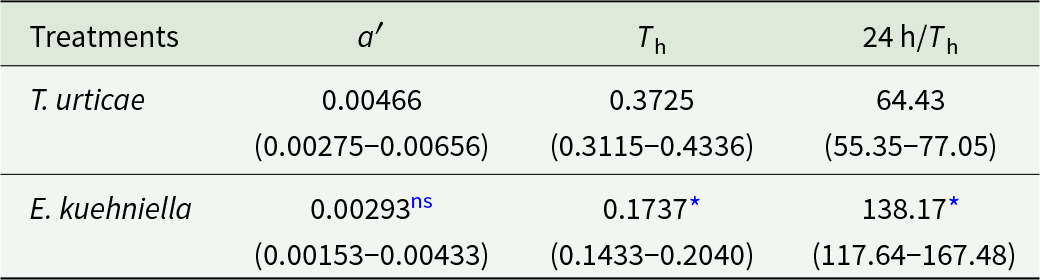
Mean values (95% confidence limits (CL)) of attack rate (a′, expressed in h−1), handling time (t h, expressed in h) and estimated number of prey attacked during the observation period (24 h/t h) of third-instar Chrysoperla externa larva when consuming Tetrannychus urticae adults or Ephestia kuehniella eggs

ns indicates that there is no significant difference between treatments based on overlapping 95% confidence intervals.
* indicates significant difference between treatments based on non-overlapping 95% confidence intervals.
The average number of prey attacked was proportional to the density provided to the predator C. externa. As the number of T. urticae adults and E. kuehniella eggs offered increased, the number of prey attacked also increased (Fig. 1). However, the proportion of the average number of prey attacked was inversely related to the initial density of prey offered, tending to decrease as the prey density increased (Fig. 1).
Functional response of third-instar Chrysoperla externa larva (A and C) and the proportion of prey attacked (B and D) towards Tetranychus urticae adults and Ephestia kuehniella eggs. Mean (±SE) number (n a) of mites and eggs consumed in relation to initial prey density (n a/n 0) by third instar of predator after 24 h of exposure.

The attack rate of C. externa preying on T. urticae adults and E. kuehniella eggs over a 24-h period was not influenced by the type of prey (Table 2). The attack rate for T. urticae adults was 0.00466 (0.00275–0.00656) h⁻1, and for E. kuehniella eggs, it was 0.00293 (0.00153–0.00433) h⁻1. The handling time was influenced by the types of prey tested (Table 2). The handling time for T. urticae adults was 0.3725 (0.3115–0.4336) h, and for E. kuehniella eggs, it was 0.1737 (0.1433–0.2040) h for pupae. Consequently, a higher number of eggs were consumed within 24 h (138.17).
Discussion
This study presents the initial evidence supporting the capability of the lacewing species C. externa to readily consume adult two-spotted spider mites under laboratory conditions. Concerning the feeding behaviour of C. externa on both T. urticae adults and E. kuehniella eggs, it was observed that the functional response followed a type II pattern. This means that as the prey population increases, consumption tends to stabilise at higher densities over a 24-h period for both types of prey. At lower prey densities, fewer prey were subdued, and consumption increased with higher prey densities but did not reach a stable level. Thus, future investigations should focus on higher prey densities. This pattern is attributed to the voracious appetite of the predator C. externa (Dami et al., Reference Dami, Santos, Barbosa, Rodriguez-Saona and Vacari2023) and the small size of the mites, necessitating substantial daily consumption to satisfy the predator. Additionally, the abundance or scarcity of prey influences the behaviour of predatory arthropods (Udayakumar at el., Reference Udayakumar, Venu, Kandan, Arvind and Shivalingaswamy2024). The predator’s attack, successful prey ingestion, and subsequent conversion are crucial processes indicating the predator’s biological performance and its potential to regulate pest populations (Pocius and Kersch-Becker, Reference Pocius and Kersch-Becker2024; Wang et al., Reference Wang, Li, Song, Xie, Liu, Zhao and Peng2024).
In this initial experiment involving the predator species C. externa, observations were made regarding its ability to prey on T. urticae, revealing that the predators could consume mite adults even in the presence of a web (as noted during laboratory assessments). Regardless of the density of the prey population under investigation, C. externa exhibited substantial consumption of T. urticae within a 24-h period (averaging 64.43 prey). Predators actively foraged until they located their prey on the leaf, even when confronted with webs, a characteristic defence mechanism of this mite species. Previous findings suggested that while lacewings could potentially consume mites, the presence of webs might pose a challenge to consumption (Mena et al., Reference Mena, Mesa, Escobar and Pérez2020), and it was previously believed that adult T. urticae might not be suitable prey for lacewings (Pappas et al., Reference Pappas, Broufas and Koveos2007).
The feeding behaviour of C. externa showed no significant difference between T. urticae and E. kuehniella, indicating that even when reared on E. kuehniella eggs, the predator readily preys on mites when released into the field. C. externa demonstrated the ability to consume over 50 prey within a 24-h period. There are limited published studies on the biology and predatory habits of Chrysoperla species feeding on T. urticae, with only one study focusing on C. externa. Morando et al. (Reference Morando, Toscano, Martins, Eduardo, Maruyama and Santos2014) investigated the biology of C. externa feeding on two-spotted spider mites, highlighting its potential for controlling this pest species. Hassanpour et al. (Reference Hassanpour, Nouri-Ganbalani, Mohaghegh and Enkegaard2009) reported the functional response of a closely related species, Chrysoperla carnea (Stephens, 1836), against T. urticae. They observed an estimated consumption of up to 187.5 mites, with a type II functional response for the first and second instars and a type III response for the third instar of the predator.
Experiments investigating functional responses in laboratory settings with elevated prey densities have been subject to criticism due to concerns that predation rates derived from such studies may not accurately represent natural field conditions (Choo et al., Reference Choo, Low, Ngiam and Yeo2021). Wiedenmann and O’Neil (Reference Wiedenmann and RJ1991) explored the theory that, in controlled laboratory environments, the attack rate is mainly constrained by consumption behaviour (such as handling time), whereas in natural settings, the attack rate is more influenced by search behaviour. However, various factors including host plants, climate, competition from other predators or parasitoids, the presence of alternative prey, among others, can impact the efficiency of predators (Cicero et al., Reference Cicero, Chavarin-Gómez, Pérez-Ascencio, Barreto-Barriga, Guevara, Desneux and Ramirez-Romero2024; Rostami et al., Reference Rostami, Huang, Shi, Zheng, Li, Madadi and Fu2024; Su et al., Reference Su, Chen and Zhang2024). Thus, experiments conducted under laboratory conditions offer insights into potential predator predation, contributing to the understanding of fundamental mechanisms underlying predator–prey interactions in field settings.
Conclusion
The predator C. externa exhibits a type II functional response when consuming T. urticae adults. This underscores the potential of this natural enemy as an effective biological control agent for the two-spotted spider mite, a key pest in strawberry plants.
Acknowledgements
We express our gratitude to Bela Época farm in the region of Franca, SP, Brazil, for permitting the collection of lacewings on their organic coffee plantation. Additionally, we extend our thanks to the Cooperativa dos Agricultores Familiares de Claraval e Região, MG, Brazil, for granting permission to collect mites in an organic strawberry site. Our sincere appreciation goes to F. Sosa at the Federal Rural University of Amazon in Brazil for the valuable contribution to the identification of the species Chrysoperla externa. We also express our gratitude to AMIPA (Uberlância, MG, Brazil) for providing Ephestia kuehniella eggs to initiate rearing in the laboratory. To the Vittia Group for the master’s degree scholarship and financial support for this research. To CNPq, Fapesp (2019/18376-3) and Capes (financial code 001) for their support.