Introduction
Since the landmark study by Faris and Dunham in 1939, many studies have examined connections between socio-economic variables and physical living environment on the onset and course of mental disorders (Faris & Dunham, Reference Faris and Dunham1965; Cockerham, Reference Cockerham2002, pp. 139–140; Silver et al. Reference Silver, Mulvey and Swanson2002). Their conclusion was that persons with a mental illness cluster in disadvantaged city areas, and this finding has been replicated in a number of subsequent studies (Cockerham, Reference Cockerham2002; Hudson, Reference Hudson2005, pp. 141–145; Drukker et al. Reference Drukker, Gunther and van Os2007; Lorant et al. Reference Lorant, Croux, Weich, Deliege, Mackenbach and Ansseau2007). A set of these studies was conducted in Mannheim and Heidelberg (Germany). Starting in 1965, the different connected studies showed that over 25 years the concentration of residents with schizophrenia in poor inner city areas with unfavourable living conditions remained stable (Löffler & Häfner, Reference Löffler and Häfner1999).
The focus of most studies is on urban areas where mental illness prevalence was found to be higher than in rural areas (Paykel et al. Reference Paykel, Abbott, Jenkins, Brugha and Meltzer2000; Sundquist et al. Reference Sundquist, Frank and Sundquist2004; Allardyce & Boydell, Reference Allardyce and Boydell2006; Kringlen et al. Reference Kringlen, Torgersen and Cramer2006; Weich et al. Reference Weich, Twigg and Lewis2006). A meta-analysis including 20 population survey studies since 1985 from high-income countries showed that the pooled total prevalence rates for psychiatric disorders for urban areas were higher than in rural areas (Peen et al. Reference Peen, Schoevers, Beekman and Dekker2010).
For Germany, similar patterns were found: Spauwen et al. Reference Spauwen, Krabbendam, Lieb, Wittchen and van Os(2004, Reference Spauwen, Krabbendam, Lieb, Wittchen and van Os2006) showed that adolescents and young adults in the urban part of Munich had an increased risk of reporting an expression of psychosis compared to persons from the rural part, and Dekker et al. (Reference Dekker, Peen, Koelen, Smit and Schoevers2008) found that prevalence rates of most major psychiatric disorders increased with rising urbanization levels. But not all German studies provide clear findings. The ESEMeD study shows that findings can change if you redefine what is urban and what is rural. The first findings indicate that 12-month prevalence rates of psychiatric disorders in Germany are higher in rural areas than in urban ones, but after changing the definition of urban/rural (from two to three categories), looking at different diagnostic groups and/or including marital status, once again higher rates were found in the newly defined urban categories (Kovess-Masféty et al. Reference Kovess-Masféty, Alonso, de Graaf and Demyttenaere2005).
Focusing on studies not older than 10 years, not comparing urban–rural differences, not researching mental health service provision but really solely researching possible risk factors in solely rural areas, the found articles tends to be nil. The reason for this lack of such studies may be that there is a hidden assumption that underlying risk factors are the same in urban and rural settings. Thornicroft et al. (Reference Thornicroft, Bisoffi, De Salvia and Tansella1993) found that healthcare service use may depend on the social isolation of patients irrespective of urban or rural residence. In the study, families were found to buffer against social deprivation, suggesting there may be similar underlying risk factors but different amplifying or attenuating elements (Thornicroft et al. Reference Thornicroft, Bisoffi, De Salvia and Tansella1993). Allardyce et al. (Reference Allardyce, Gilmour, Atkinson, Rapson, Bishop and McCreadie2005) showed that initial admission rates were strongly associated with measures of social and material fragmentation in both urban and rural study sites. In summary, there are risk factors influencing mental health in both urban and rural areas, but underlying mechanisms may differ.
This study aims to test if socio-demographic factors such as population density, income inequality and structural area characteristics that have been found to affect service use in urban areas influence admission rates in a South German rural catchment area to give first hints if there really is a lack of research.
Method
Study region
Municipalities were chosen as the unit of analysis as this is the smallest administrative unit where area-wide statistical data on socio-economic and infrastructural characteristics are available (Bavarian State Office for Statistics and Data Processing, 2006–2009). In the German psychiatric care system, the regional provision of psychiatric inpatient care is organized at the level of catchment areas where all inpatient services are provided by a particular hospital. To define the study region, we selected those 174 municipalities from the catchment area of a psychiatric hospital in the south of Germany which were classified as rural by the regional planning authority (Regionalverband Donau-Iller, 1987; Regionaler Planungsverband Augsburg, 2007). The classification into the categories: ‘urban’, ‘urban agglomeration’ and ‘rural areas’ is based on the Regional Planning Act, used across Germany and takes into consideration population density, availability of jobs, schools and higher education, and cultural institutions.
In the selected municipalities, the population size varies between 595 and 20 853 with a mean of 3397.6 (SD 3861.9). Agriculture is the dominant land use in the region of Swabia (around 56%); woods and forestry rank second at about 28%. Settlement areas and traffic areas only cover 12% of the region (Bavarian State Office for Statistics and Data Processing, 2010).
Hospital admission data
Hospital admission records were used to count all relevant psychiatric admissions from the study region for the years 2006–2009. Of the total 33 813 admissions registered during the four study years, 13 775 cases had been admitted with a primary diagnosis of schizophrenia-type disorder (F20–F29 ICD-10-WHO) or affective disorder (F30–F39 ICD-10-WHO). To prevent double counting of patients who had more than one admission, only the first admission of each patient was counted. Admissions of patients who did not live in the study region or admissions of patients whose place of residence was unclear or unknown were excluded. The final sample included 4198 admissions, 1586 due to schizophrenia-type disorders and 2612 due to affective disorders.
Admission data and data on municipality characteristics from official statistics were merged using the municipality code as a unique identifier.
The selection of relevant community characteristics
The selection of relevant community characteristics was based on our literature review, but limited by the availability of data from the Bavarian State Office for Statistics and Data Processing or the Federal Employment Agency Statistics (Bavarian State Office for Statistics and Data Processing, 2006–2009; Federal Employment Agency, 2010). After comparing the relevant characteristics mentioned in the literature with the available data we chose the following independent variables for our analyses:
• Inhabitants per square kilometre were taken as an indicator of population density, which has been found to be related to the occurrence of mental disorders in several studies (Laird, Reference Laird1973; Paykel et al. Reference Paykel, Abbott, Jenkins, Brugha and Meltzer2000; van Os et al. Reference van Os, Hanssen, Bak, Bijl and Vollebergh2003; Sundquist et al. Reference Sundquist, Frank and Sundquist2004; Weich et al. Reference Weich, Twigg and Lewis2006; Dekker et al. Reference Dekker, Peen, Koelen, Smit and Schoevers2008).
• Change of population size since the year 1987 was included because the growth or the decline of the population size could have similar effects as the population density.
• The absolute value of the balance of all persons migrating from or immigration to the municipality during one year independent of nationality was regarded as an indicator of population mobility, which was found to be positively related to the occurrence of schizophrenia and depression by Silver et al. (Reference Silver, Mulvey and Swanson2002).
• Commuter in/out quota computed as the number of employees of one municipality minus all inhabitants of the municipality was included because an increasing in-commuter overspill could be related to a decrease of perceived social cohesion and homogeneity in the inhabitant population. This could have similar effects as those expected from population mobility (Silver et al. Reference Silver, Mulvey and Swanson2002).
• Annual total income per taxpayer was included as an indicator of wealth and economic prosperity, which has been found to be negatively related to the occurrence of mental disorders in several studies (Gresenz et al. Reference Gresenz, Sturm and Tang2001; Eibner et al. Reference Eibner, Sturn and Gresenz2004; Sundquist & Ahlen, Reference Sundquist and Ahlen2006; Sareen et al. Reference Sareen, Afifi, McMillan and Asmundson2011; Pulkki-Råback et al. Reference Pulkki-Råback, Ahola, Elovainio, Kivimäki, Hintsanen, Isometsä, Lönnqvist and Virtanen2011).
• Income inequality was included as an indicator of socio-economic inequality, which has been found to be positively related to the occurrence of mental disorders in several studies (Cifuentes et al. Reference Cifuentes, Sembajwe, Tak, Gore, Kriebel and Punnett2008; Pickett & Wilkinson, Reference Pickett and Wilkinson2010; Wilkinson & Pickett, Reference Wilkinson, Pickett, Wilkinson and Pickett2010).
• Unemployment was included because it has been found to be positively related to the occurrence of mental disorders in several studies (Dooley et al. Reference Dooley, Fielding and Levi1996; World Health Organization, 2004, p. 21; Zimmerman & Katon, Reference Zimmerman and Katon2005; Fortney et al. Reference Fortney, Rushton, Wood, Zhang, Xu, Dong and Rost2007, Reference Fortney, Xu and Dong2009; Marwaha et al. Reference Marwaha, Johnson, Bebbington, Angermeyer, Brugha, Azorin, Kilian, Hansen and Toumi2009).
• Proportion of forest, agricultural and traffic areas were included because different types of land use have been found to be related to the occurrence of mental disorder in some recent studies (Pedersen et al. Reference Pedersen, Raaschou-Nielsen, Hertel and Mortensen2004; Maas et al. Reference Maas, Verheij, Groenewegen, de Vries and Spreeuwenberg2006; Pedersen & Mortensen, Reference Pedersen and Mortensen2006; van den Berg et al. Reference van den Berg, Maas, Verheij and Groenewegen2010).
As no direct measure of income inequality was available, an index for income inequality was calculated by subtracting annual gross income per employee from the annual total revenue per taxpayer for 2006–2009. While a low income mostly results from employment as the only basis for making a living, higher incomes more often result from entrepreneurship or different income sources such as employment plus income upon investments or rent (Brenke, Reference Brenke2011; Fritsch et al. Reference Fritsch, Kritikos and Rusakova2012). Therefore, the difference between income from employment and total income may reflect not the total amount of income difference but the differences between low- and high-income groups.
For unemployment only, the unemployment figures for every municipality were available. To calculate the unemployment rate, we divided these figures by the number of the working population living in the municipality (Federal Employment Agency, 2010).
To control for a potential effect of the proximity to the psychiatric hospital on admission rates (Curtis, Reference Curtis2007; Fortney et al. Reference Fortney, Rushton, Wood, Zhang, Xu, Dong and Rost2007), the distance between municipality and psychiatric hospital was included in each regression model. Distance was calculated with Google maps, we used the shortest distance via car from the middle of the municipality to the psychiatric hospital.
Statistical analysis
Psychiatric hospital admissions at the municipal level are rare events, and their distribution is characterized by discrete non-negative values defined as count data. While an application of the linear regression model would disregard the discreteness and the non-negativity of the data, the Poisson regression model provides an adequate framework for analysing how the occurrence of the event under study depends on other observable variables (Cameron & Trivedi, Reference Cameron and Trivedi1998, pp. 3–5; Greene, Reference Greene2003, pp. 740–745). The Poisson model specifies that the occurrence of a discrete event y under the condition of a set of independent variables x follows the Poisson distribution. However, the Poisson model requires the equality of the mean and the variance of the distribution, and this property of equidispersion is often violated in real world data. The distribution of psychiatric hospital admissions is characterized by a large number of zeros which results in a variance much greater than the mean Var (y|x) ≥ E(y|x). In this case of overdispersion, the negative binomial model is recommended as the adequate regression approach (Cameron & Trivedi, Reference Cameron and Trivedi1998, pp. 3–5; Greene, Reference Greene2003, pp. 740–745). The negative binomial model handles the overdispersion by adding an overdispersion parameter α which is the variance divided by the mean and assumed to have a Gamma distribution. Since we used admission data for 4 years, we applied a random-effects negative binomial model to take into account the panel structure of the data. In the random-effects negative binomial model, the overdispersion parameter is allowed to vary between groups, which means in our model between municipalities (StataCorp LP, Reference StataCorp2007, p. 318). To examine potential differences in the influence structure for different diagnostic groups, we computed three models. In model 1, the combined admissions for schizophrenic and affective disorders were used as the dependent variable, in model 2 only admission for schizophrenic disorders and in model 3 only admissions for affective disorders were used. The natural logarithm of the adult population was included as exposure into each model.
In all models, the community characteristics described above were included as independent variables. In addition, the admission year was included as time variable to control unobserved heterogeneity between the municipalities (Greene, Reference Greene2003, pp. 740–745).
Results of the negative binomial regression models are presented as exponentiated coefficients eb, which represent the incidence rate ratios (IRR) indicating the proportional change of the dependent variable by a one-unit change of the independent variable (Cameron & Trivedi, Reference Cameron and Trivedi1998, pp. 3–5; Greene, Reference Greene2003, pp. 740–745).
Negative binomial regression models were computed with the xtnbreg module in STATA 12 (StataCorp LP, 2011).
Results
Admissions due to schizophrenia and affective disorders combined
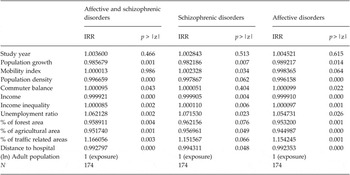
As shown in Table 1, the IRRs for the population growth (IRR 0.985679; p 0.001) indicate that a 1% increase in the population since 1987 is related to a 1.4% decrease in the hospital admission rate for schizophrenic and affective disorders. The IRR for population density (IRR 0.996659; p 0.000) indicates that an increase in the number of inhabitants per square kilometre (km2) is related to a decrease in the hospital admission rate by 0.3%. As indicated by the IRR for the commuter balance (IRR 1.000095; p 0.043) the increase in the in-commuter overspill by one person is related to a 0.009% increase in the hospital admission rate. While the increase in the annual total income by 1 Euro is related to a 0.008% decrease in the hospital admission rate (IRR 0.999921; p 0.000) an increase in the income inequality by 1 Euro is related to an increase in the hospital admission rate by 0.008% (IRR 1.000085; p 0.002). The IRR for the unemployment rate (IRR 1.062128; p 0.002) reveals that an increase in the unemployment ratio by 1% is related to an increase in the hospital admission rate by 6.2%. As indicated by the IRRs for the land use, an increase in the areas used for traffic by 1% is related to an increase in the hospital admission rate by 16.6% (IRR 1.166056; p 0.003), while an increase in the areas used for agriculture by 1% is related to a hospital admission rate decrease by 5.8% (IRR 0.951740; p 0.001), and an increase in the woodland by 1% is also related to a decrease in the hospital admission rate by 4.1% (IRR 0.958911; p 0.004). The IRR for the distance between the municipality and the psychiatric hospital reveals that with each additional kilometre the admission rate decreases by 0.7% (IRR 0.992797; p 0.000).
Results of the random-effects negative binomial regression models for the effects of municipal area characteristics on psychiatric admissions between 2006 and 2009 (IRR; p)

Study year = 2006–2009 included to control for unobserved heterogeneity at the level of municipality; Population growth = change of population between 1987 and 2005 in %; Mobility index = absolute value of the balance of all persons migrating from or immigration to the municipality during one year independent of nationality; Population density = inhabitants per square kilometre; Commuter balance = number of employees of one municipality minus all inhabitants of the municipality; Income = annual total revenues per taxpayer; Income inequality = the annual total revenue per taxpayer minus the annual gross income per employee; Unemployment ratio = number of unemployed persons divided by the number of employed persons; % of forest area = percentage of total space covered by forest; % of agricultural area = percentage of total space used for agriculture; % of traffic-related areas = percentage of total space used for traffic; Distance to hospital = the shortest driving distance between the middle of the municipality to the psychiatric hospital calculated with Google maps; (ln) Adult population = natural logarithm of the adult population is included as an exposure variable.
Admissions due to schizophrenia-type disorder
As revealed by the IRR in Table 1, the relationship between community characteristics and hospital admission rates is slightly different in the model for schizophrenic disorders than in the other models. An increase in the population by one person is related to a decrease in the admission rate due to schizophrenia by 1.8% (IRR 0.982186; p 0.007). The effect of the mobility index (IRR 1.002328; p 0.034) reveals that an increase in the absolute migration/immigration balance by one person is related to an increase in the admission rate by 0.23%. The effect of income (IRR 0.9999905; p 0.004) indicates that an increase in the annual per capita income by 1 Euro is related to a decrease in admission rate by 0.01% and the effect of income inequality (IRR 1.000110; p 0.006) reveals that an increase in the income inequality by 1 Euro is related to an increase in the admission by 0.01 as well. As indicated by the significant coefficient (IRR 1.071530; p 0.023), an increase in the unemployment ratio by 1% is related to an increase in admissions by 7.2%. The coefficient for agricultural land use (IRR 0.956961; p 0.049) shows that an increase in agricultural land use by 1% is related to a decrease in admissions by 4.3%. As shown by the significant coefficient for the distance to the hospital (IRR 0.994341; p 0.048) the admissions decrease with each additional km by 0.6%.
Admissions for affective disorders
Effects of community characteristics on hospital admissions rates due to affective disorders are quite similar to those for combined admission rates. The growth of the population by one person is related to the decrease in admissions due to affective disorders by 1.1% (IRR 0.989217; p 0.014) and an increase in the population density by one person per km2 is related to a decrease in admissions (IRR 0.996158; p 0.000) by 0.4%. While the effect of the mobility index is not significant, the coefficient for the commuter balance reveals that the increase in the in-commuter overspill by one person is related to an increase in admissions by 0.01% (IRR 1.000099; p 0.022). As indicated by the significant coefficients, an increase in the annual per capita income by 1 Euro is related to a decrease in admissions by 0.009% (IRR 0.999910; p 0.000), while an increase in the income inequality by 1 Euro is related to an increase by 0.01% (IRR 1.000097; 0.001). An increase in the unemployment ratio by 1% (IRR 1.054731; p 0.026) is related to an increase in the admissions by 5.5%. The effects of the land use indicators show that with an increase in forest areas by 1% (IRR 0.953200; p 0.001), the admissions decrease by 4.7%, with a 1% increase in agricultural areas (IRR 0.944987; p 0.000), admissions decrease by 5.5%, while with a 1% increase in traffic areas (IRR 1.154245; 0.005), admissions increase by 15.4%. The significant effect of the distance to the hospital shows that with each additional km the admissions decrease by 0.8% (IRR 0.992353; p 0.000).
Discussion
This study examined whether risk factors identified in urban areas influence admission rates in a rural catchment area. Using all admissions of 2006–2009 (of people with schizophrenia/related disorders and affective disorders) we found socio-demographic, economic and area structural parameters to influence admission rates. However, not all findings corresponded to findings reported in the literature. Results show that while effects of wealth such as income influence admission rates in rural areas as reported in urban areas, other factors, e.g. population density, have a reverse effect.
In this study, admission rates increased as population density declined. This is in contrast to findings from urban areas where both prevalence and admission rates have been found to rise with increasing population density. Urbanicity is often defined by high population density and is considered a risk factor (Sundquist et al. Reference Sundquist, Frank and Sundquist2004; Dekker et al. Reference Dekker, Peen, Koelen, Smit and Schoevers2008). It is assumed by most experts that high population densities in urban areas may affect mental health through high stress levels. However, it might be that the relationship between population density and mental disorders is non-linear. Generally speaking, rural areas are associated with a certain life style that includes good social networks, close family ties, high social capital and high levels of support, all possible protective factors against mental illness (World Health Organization, 2004, p. 21). The mechanism leading to our findings could be that not all persons living in sparsely populated areas can profit from the protective factors. Homogenous social structures in smaller communities could make it more difficult for people with deviant characteristics to establish adequate social networks. Therefore, it is possible that in small communities people with psychological problems may experience a stronger feeling of social exclusion and alienation than they would feel in larger and more heterogeneous communities (Parr et al. Reference Parr, Philo and Burns2004; Watkins & Jacoby, Reference Watkins and Jacoby2007; Thornicroft, Reference Thornicroft2008). For Germany, Angermeyer et al. (Reference Angermeyer, Holzinger and Matschinger2010) tried to identify emotional reactions from the public towards people with mental illness. Most frequently people report that they have the desire to help, expressed sympathy and empathy, etc. so-called ‘positive feelings’, but a remarkable number of persons also reported feelings of fear, uneasiness, mistrust, insecurity and anger, which could lead to a desire for social distance. Also, a low population density could be an indicator of poor economic development that might be related to socio-economic disadvantage and therefore to an increased risk of mental disorder.
Low income has proved to be a risk factor at different levels. At the individual level, low-income individuals have a higher risk of suffering from mental health problems (Simmons et al. Reference Simmons, Braun, Charnigo, Havens and Wright2008). Sunquist & Ahlen (2006) showed that at the neighbourhood level low income was associated with an increased risk of being hospitalized for a mental disorder. The current study shows that low income is a risk factor at the municipality level with high admission rates in municipalities with low annual per capita income. As we have not examined income at the individual level it is considered an indicator of economic development. Other indicators of economic development are population growth and unemployment rate, which also show negative effects on psychiatric admission. Thus, our study supports the hypothesis that poor economic development at the neighbourhood level is related to a higher risk of mental disorder (Muntaner et al. Reference Muntaner, Eaton, Miech and O'Campo2004; Hudson, Reference Hudson2005; Mauz & Jacobi, Reference Mauz and Jacobi2008).
The positive relationship between in-commuter overspill and admission rates could indicate that living conditions in the municipalities with a higher in-commuter overspill are less attractive than job opportunities. A high in-commuter rate can also be related to a lower level of social cohesion. Since we have no data on the housing conditions or social cohesion, we were not able to test these hypotheses.
In addition to income level, income inequality was also found to be related to psychiatric admissions. There are two theories of how income inequality can influence mental health: (1) it can lead to social stress because people tend to compare themselves with peers of their age group or with people living in the neighbourhood; (2) income inequality can be an indicator of inequity with part of the population being impoverished and suffering from the condition and from unequal distribution of health-promotion resources (Wen et al. Reference Wen, Browning and Cagney2003; Kondo et al. Reference Kondo, Sembajwe, Kawachi, van Dam, Subramanian and Yamagata2009).
In this study, as in previous research, there was an effect of the pattern of land use on inpatient care. Admission rates in the overall patient and affective disorder group increased with a higher proportion of ‘traffic-related areas’. Traffic areas are related to environmental stressors with negative effects on mental health such as noise, air pollution, traffic density and inadequate street conditions (Marcelis et al. Reference Marcelis, Takei and van Os1999; Pedersen et al. Reference Pedersen, Raaschou-Nielsen, Hertel and Mortensen2004; Pollack et al. Reference Pollack, von dem Knesebeck and Siegrist2004; Almedom, Reference Almedom2005). Green space is considered to act as a buffer against stressful life events, and as a protective factor for mental well-being (Frumkin, Reference Frumkin2003; Maas et al. Reference Maas, Verheij, Groenewegen, de Vries and Spreeuwenberg2006; Sugiyama et al. Reference Sugiyama, Leslie, Giles-Corti and Owen2008; van den Berg et al. Reference van den Berg, Maas, Verheij and Groenewegen2010). The present study confirmed this relationship; this is noteworthy in a rural setting generally characterized by more ‘green areas’. A study by van den Berg et al. (Reference van den Berg, Maas, Verheij and Groenewegen2010) may help clarify this finding. The authors found more ‘green areas’ (agricultural landscape, woods) in a 3 km radius from home to affect mental well-being more than small ‘green spaces’ (gardens and parks) close to home: extended green space may provide more effective regeneration.
Limitations
The present study has a number of limitations. Psychiatric hospital admissions do not necessarily reflect the prevalence of mental disorders. The average treatment rate of mental disorders, in Germany, is about 50% and a significant proportion of patients will not be treated in hospitals but by office-based physicians or psychologists (Alonso et al. Reference Alonso, Codony, Kovess, Angermeyer, Katz, Haro, De Girolamo, De Graaf, Demyttenaere, Vilagut, Almansa, Lépine and Brugha2007; Fernández et al. Reference Fernández, Haro, Martinez-Alonso, Demyttenaere, Brugha, Autonell, de Girolamo, Bernert, Lépine and Alonso2007). Thus, psychiatric hospital admissions that we analysed may represent the tip of the iceberg.
Only aggregated data was used. Therefore, it was not possible to conduct multilevel analyses to differentiate environmental and individual effects. The environmental effects identified in our analyses could reflect the effects of individual characteristics only. There is an ongoing discussion of ‘shift’ v. ‘drift’ regarding living conditions and psychiatric morbidity of a person (Dohrenwend et al. Reference Dohrenwend, Levav, Shrout, Schwartz, Naveh, Link, Skodol and Stueve1992; Cockerham, Reference Cockerham2002, pp. 148–155; Hudson, Reference Hudson2005). It was not possible in this study to examine causal pathways.
Conclusion
Results of our study indicate that some associations between the occurrence of mental disorders and environmental factors may differ between rural and urban areas. While economic factors such as income level, income inequality and unemployment are similarly related to psychiatric hospital admissions, population density and population growth appear to have opposite effects in rural vs. urban areas. The study also underlines the potential effects of land use characteristics on the occurrence of mental illness, a phenomenon hardly studied so far. Since our study was limited by the use of aggregate data, the results provide hypotheses that should be tested and further elaborated in future population-based multi-level studies. Therefore, it is not possible to draw any conclusions regarding interventions targeted at the prevention of mental illness or the improvement of mental health care services from our results.
Acknowledgments
We thank the Bavarian State Office for Statistics and Data Processing for providing us with data. We also thank Karola Eichler-Paul, Simone Cramer and Lilija Sommer for their assistance with data collection.
Declaration of Interest
No conflicts of interest.