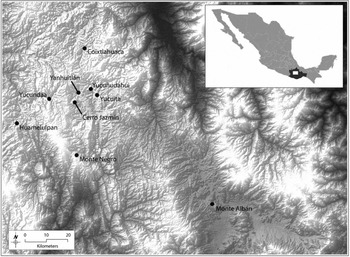
This report presents new chronological and descriptive data on a class of ceramics that we call Tiltepec yellow wares, which date to the Late and Terminal Formative periods at Cerro Jazmín, Mixteca Alta region, Oaxaca, Mexico (Figure 1; Supplemental Table 1). The definition and chronological placement of these ceramics contribute to the refinement of the Mixtec ceramic chronology, which has been used to identify broader patterns of sociopolitical development.
Map of the Mixteca Alta, Cerro Jazmín, and places mentioned in the text.

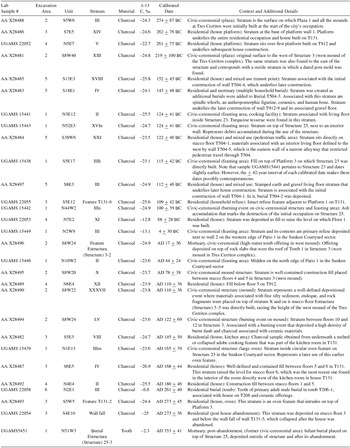
Surface evidence recorded by two previous surveys suggested that Cerro Jazmín was a Late Formative city abandoned in the Terminal Formative and reoccupied in the Early Classic and Postclassic periods (Kowalewski et al. Reference Kowalewski, Balkansky, Stiver Walsh, Pluckhahn, Chamblee, Rodríguez, Espinoza and Smith2009:32–39). Our initial mapping and survey, based on a then-current understanding of the ceramic chronology, seemed to confirm these findings (Pérez Rodríguez et al. Reference Pérez Rodríguez, Anderson and Neff2011). New chronological data (Table 1) nevertheless point to continuous occupation from the Late to the Terminal Formative and the abandonment of the site by the Classic period (AD 300). The site was reoccupied in the Postclassic period, but we will not focus on this later occupation.
Chronological and Provenience Data on the Analyzed Assemblages.

Based on earlier understandings of the ceramic chronology, scholars have suggested the abandonment of some settlements and subregions during the Late Ramos period (Kowalewski et al. Reference Kowalewski, Balkansky, Stiver Walsh, Pluckhahn, Chamblee, Rodríguez, Espinoza and Smith2009:303–304). The Tiltepec yellow wares discussed in this paper date to the Late and Terminal Formative periods (300 BC–AD 200) and not only to the Transition period (AD 200–300); this new information prompts a reassessment of the regional settlement sequence to test the Terminal Formative regional abandonment model.
The Mixteca Alta
The Mixteca Alta is a temperate and mountainous region extending across western Oaxaca, eastern Guerrero, and southwestern Puebla. Spores (Reference Spores1972:22,172) established the original Mixtec ceramic chronology based on stratigraphic excavations in the Nochixtlán Valley, and further chronological refinements followed (Supplemental Text 1).
According to Spores (Reference Spores1972), Ramos-period ceramics include Juanito fine gray wares and decorated grays (including G-12 and G-17), Yucuita tan wares, red-on-tan wares, thin tan wares, polished brown wares, and Stucco wares. For the Classic period, Spores notes the appearance of Chachoapan sandy cream wares, Miguelito hard grays, Tio Lico thin grays (G-12 and G-17 vessels disappear), Nochixtlán rust wares, and Chachoapan orange wares.
Chachoapan orange wares as Classic-period chronological markers are well established in the literature (Gaxiola Reference Gaxiola1984:35; Kowalewski et al. Reference Kowalewski, Balkansky, Stiver Walsh, Pluckhahn, Chamblee, Rodríguez, Espinoza and Smith2009:373; Plunket Nagoda Reference Plunket Nagoda1983:409; Spores Reference Spores1972:182; Winter Reference Winter, Carreón and Cook2006:103; Supplemental Text 1). Regional surveys have dated settlements to the Classic period based on the surface presence of orange wares, with the vessel form and other surface characteristics determining exact temporal placement. In particular, Transition-period orange-ware collections include conical bowls with channel or stepped rims and jars with restricted necks decorated by vertical surface smoothing.
The most common Ramos-period ceramics were the Yucuita tan wares, which come in a wide array of forms and colors (Spores Reference Spores1972:52–56). They are predominantly cooking vessels, jars, and comals, as well as some open serving vessels, which Spores assigned to the Mariana and Alicia varieties. Spores's definition of the Alicia-variety tan wares includes orange varieties that “become much more frequent in Las Flores than in Ramos times” (Spores Reference Spores1972:56), suggesting that orange-colored Yucuita tans can occur in Ramos-period contexts.
Investigators working at Late and Terminal Formative sites across the Mixteca Alta have also noted the presence of orange (or yellow-pinkish) ceramics. At Monte Negro, Acosta and Romero (Reference Acosta and Romero1992:75) found ochre and yellow-pinkish materials occurring with Zapotec-style gray wares (G12) of the Monte Albán Late I period. At Yucuita and Huamelulpan, scholars have also noted the presence of what they called yellow-orange paste materials in Late and Terminal Formative assemblages (Winter Reference Winter, Carreón and Cook2006:97, 99). Plunket Nagoda (Reference Plunket Nagoda1983:22, 412) described Late Cruz–period La Nopalera orange ceramics and T-1 variety tan wares, which encompass orange-color materials dating to AD 150–350. At Huamelulpan, Gaxiola (Reference Gaxiola1984:33–37) identified yellow and cream wares, dating to 100 BC–AD 200, and orange ceramics dating to AD 200–600. A broad pattern can be identified from these findings at Monte Negro, Yucuita, and Huamelulpan: each site features an orange-yellow ceramic ware, typically in the serving-vessel category. This ware has sometimes been placed in its own category and at other times within the Yucuita tan wares of the Mariana or T-1 varieties.
This article defines a new ceramic ware we call Tiltepec yellow wares. Based on 27 associated radiocarbon dates, we show that Tiltepec yellow wares appear with the initial occupation of Cerro Jazmín at cal. 261±75 BC (Early Ramos period) and continue until cal. AD 273±45 (Transition period). Although conventional practices would associate the yellow ware with the tan wares, we believe otherwise: yellow wares should not be included in the tan-ware category since they have a distinct, finer clay body and a different color range; furthermore, they served different primary uses (serving and water storage vessels).
Methodology
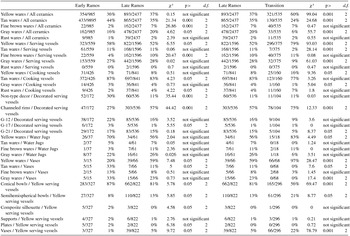
We selected 27 radiocarbon dates from artifact-associated contexts (Table 1) and extrapolated to contexts with the same stratigraphic placement and location, yielding 29 date-associated ceramic assemblages. All ceramics were sorted by ware, hardness, form, surface finish, and decoration. For the 29 assemblages, we calculated the total number of wares by vessel form and grouped them into three chronological categories (Table 2). We calculated the percentages of different vessel forms for all the wares in each time period and created two functional categories: serving (bowls, plates, and vases) and cooking and storage vessels (jars, comals, and water jugs). Within each category, we investigated chronological shifts in decoration and form.
Chi-square Results and Raw Numbers Per Ware and Vessel Type in Relation to the Entire Assemblage or Specific Functional or Vessel-Form Subsamples.

We performed these calculations for the 29 assemblages, bodies, and rims. To make our results comparable with previous studies, we ran our analysis again for rims, supports, and decorated bodies. Chi-square testing in both iterations of the analysis identified statistically significant chronological shifts. To identify which wares or forms were responsible for the statistical significance, we performed the chi-square tests on pairs, comparing each ware or form category with the entire remaining assemblage. We submitted 53 ceramic samples for Instrumental Neutron Activation Analysis (INAA) at the Oregon State University Archaeometry Laboratory.
Results
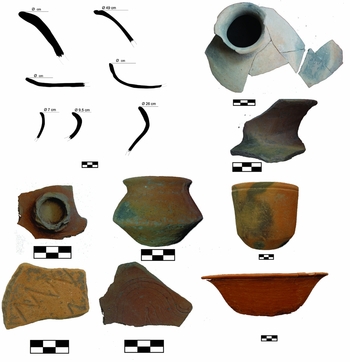
We documented Yucuita tan wares, Nochixtlán gray wares, Yucuita polished brown wares (or fine brown wares), rust wares, and our proposed Tiltepec yellow wares, which we define for the finer-paste pinkish-orange-yellow ceramics (Figure 2). The definition of Tiltepec yellow wares reduces the array of paste textures and colors currently encompassed by Yucuita tan wares. Yellow wares have a much finer clay body than tan wares, with few or no small inclusions. When visible, the most common inclusions are small (<1 mm) white flecks of calcite, 1–2 mm gray and white inclusions, or finely ground mica temper. Yellow-ware pastes are as fine as that of the gray wares.
Tiltepec yellow wares. Drawings by Barbara Elizalde. Photographs by CJAP.

INAA results also support the ware definition: yellow wares fall into two compositional groups that suggest a Mixteca regional manufacture (Supplemental Table 2). Two subgroups within the larger compositional groups also contain examples of gray wares; it appears that the primary difference between these Mixteca-made gray and yellow wares is the oxidizing environment in which the yellow wares were fired.
Yellow wares come in soft and hard paste varieties. Soft clay bodies, which correspond to 1a and 2a, are spongy, porous, and powdery in consistency. They erode easily and often show smoothed edges. The clay body is not compact and crumbles easily. The hard pastes correspond exclusively to subgroup 1c; they are compact, smooth, not as erodible, and often retain intact surface finishes. When broken, they snap, producing a high-pitched sound that suggests higher temperatures of firing.
The surface color of yellow wares can be orange-yellow, yellowish-tan, or peach-to-cream color, usually with a yellow or orange core (5YR 6/6, 6/8, 7/6, and 7/8 reddish-yellows, 5YR 7/4 pink, 5YR 6/4 light reddish-brown, and 7.5YR 7/6 reddish-yellow, 7/4 and 6/6 pink, and 6/4 light brown). Some yellow wares display gray cores, but not as frequently as tan wares. Often, the surface color is mottled, showing areas of yellow-orange to gray-black. The vessel surface was smoothed, but not polished.
In our sample, <10% of yellow wares show red-orange paint or slip decoration. The most common vessels are conical bowls with flat or convex bases (Figure 2 and Supplemental Figure 1). Bowls range from 8 cm to 50 cm in diameter (
 $\bar{x}$
= 24.18 cm). Among serving vessels, 12% of Early Ramos, 32% of Late Ramos, and 26% of Transition display an interior channel or stepped-rim decoration. An even smaller number of bowls have incised line or nail-print decorations along the bottom. This style is reminiscent of the G-21 bowls that Caso and colleagues (Reference Caso, Bernal and Acosta1967:61–62) found in Monte Albán II contexts.
Less common vessels are cylindrical vases (
$\bar{x}$
= 17.7 cm) with exterior channel rims and small-to-medium-sized water jugs with restricted, small, straight-to-flaring necks with vertical smoothing (
$\bar{x}$
= 10.97 cms). Water jugs are very thin, globular, 3–4 mm thick, and mostly of the hard paste variety. Closed vessel forms indicate that the orange surface color was the result of firing, because water jugs have orange exteriors and gray interiors.
Chronological Trends
Tiltepec yellow wares are the second most common ceramic type in all the Cerro Jazmín assemblages; they were present from the Early Ramos period (36%) through the Late Ramos (37%) and Transition (60%) periods (Table 2). Their number is double that of gray wares in the serving-vessel category and surpasses the gray wares throughout the Formative-period occupation of the city.
Across all phases, gray, fine brown, and yellow wares represent nearly 90% of serving vessels, while tan and rust wares comprise over 89% of cooking vessels (Table 2). Yellow and gray wares have more compact clay bodies, and many were fired at higher temperatures, improving their ability to retain liquids.
Trends in vessel form, surface decoration, and relative proportions among wares were found to be chronologically significant. We observed statistically significant changes in the relative frequencies of wares between the Early Ramos and Late Ramos assemblages (Table 2). The proportion of tan wares significantly decreased as the proportion and frequency of fine brown wares and gray wares increased. The frequency of yellow wares remained constant. Significant changes also occurred between the Late Ramos and Transition periods (Table 2): the proportion of yellow wares increased, while gray and tan wares decreased.
Since different wares were preferred according to different vessel functions, we investigated trends within functional categories. Among cooking vessels, the frequency of tan-ware jars decreased through time, while rust-ware jars increased and comals remained statistically unchanged throughout the entire sequence. There was a significant increase in the prevalence of yellow-ware water jugs and a notable, though not significant, decrease in gray-ware jugs between the Late Ramos and Transition periods (Table 2).
Decorated vases are associated across Mesoamerica with beverage consumption during feasts and other ritual settings. In the Early Ramos period, cylindrical vases were made using gray, tan, yellow, and fine brown wares, but this diversity decreased over time. By the Transition period, nearly all vases were produced in yellow ware (Table 2).
Bowls were also prominent vessels in private or public food-consumption events. The yellow-ware serving vessels were predominantly conical in the Early Ramos period (87%) but their frequency declined, while the proportion of semihemispherical bowls and vases increased to comprise 43% of yellow-ware serving vessels by the Transition period (Table 2).
We investigated surface- and rim-decoration changes in bowls (Table 2). In the Cerro Jazmín collections, G-12 and G-17 vessels were predominantly gray, while G-21–style bowls were more often yellow wares. The frequency of G-12 bowls decreased from the Early Ramos to the Late Ramos and Transition periods. G-17 bowls went from scarce in the Early Ramos period to a near-disappearance in the Transition period. The frequency of yellow ware G-21–style bowls also decreased, from 17% in Early Ramos, to 15% in Late Ramos, to 5% in the Transition period. As these types decreased significantly, the frequency of yellow-ware channel-rim bowls increased significantly. Channel-rim decoration was recorded in 27% of Early Ramos vessels, and of these 80% were yellow wares. Channel-rim frequencies increased to 54% in the Late Ramos period and 75% by the Transition period, when nearly all of them (97%) were yellow wares.
Discussion
We have argued for the definition of Tiltepec yellow wares as a distinct ceramic type. Some may ask, however, why Tiltepec yellow wares should not simply be grouped with the Chachoapan orange wares. In Spores's (Reference Spores1972:64–66) description of Chachoapan orange wares, he mentions only two varieties: (i) Susana thin oranges, likely imported and very similar to the ones at Teotihuacan; and (ii) Anita fine orange wares, fine in texture and powdery in paste body. Neither of these varieties reflects the diversity of materials at Cerro Jazmín—the hardness and high-fired qualities of the hard yellow wares or the coarser clay bodies with visible white inclusions. Spores (Reference Spores1972) defined Chachoapan orange wares as Classic-period materials, while radiocarbon data show that the Tiltepec yellow wares date to the Late or Terminal Formative periods.
In addition, previous scholars have mentioned yellow wares: Caso and colleagues (Reference Caso, Bernal and Acosta1967:55) mention yellow wares (amarillos) at Monte Albán, describing them as unmistakably different from tan wares (cafés) in their texture and finish. Furthermore, although called amarillos, some of them are actually orange, pink, or brick-colored. They appear rarely in the Monte Albán I collections, and more frequently in Monte Albán II (Late Ramos period).
Among the yellow wares that Caso and colleagues (Reference Caso, Bernal and Acosta1967:60) describe, they mention an A6 type—G-12-like vessels made in a pale pink paste—and an A5 type—very thin, high-fired, pale pink vessels similar to the hard-paste yellow wares. In Monte Albán II, A9 and A11 vessels are also reported (Caso et al. Reference Caso, Bernal and Acosta1967:70), with descriptions reminiscent of the yellow-ware conical bowls with G-21–like incised line decoration. Nevertheless, the decorations reported in the Monte Albán vessels are more complex than those we observed at Cerro Jazmín. Some yellow-ware bowls were produced or traded into Monte Albán, but they were still a minority.
Conclusion
By defining Tiltepec yellow wares and setting them apart from Classic-period orange ceramics, we may reassess the regional settlement sequence, which currently describes a pattern of Terminal Formative settlement abandonment. We are currently undertaking this reassessment, but a discussion of preliminary results is beyond the scope of this report. In the case of Cerro Jazmín, however, the correct chronological placement of Tiltepec yellow wares demonstrates that the settlement was continuously occupied between 300 BC and AD 300 and that the urban occupation was longer-lived than previously thought.
The new ceramic data also suggest that although Valley of Oaxaca gray wares were used at Cerro Jazmín, their frequency decreased from the Late to Terminal Formative and Transition periods, just as the frequency of yellow-ware serving vessels increased (Pérez Rodríguez et al. Reference Pérez Rodríguez, Tuñón, Minc, Stiver Walsh and Rosales2017). Joyce and colleagues (Reference Joyce, Neff, Thieme, Winter, Elam and Workinger2006) identified a similar pattern from the Late and Terminal Formative period Lower Río Verde region, attributing the decrease in Zapotec-style gray wares in favor of locally made ceramics to conflict and trade-route disruption.
When Cerro Jazmín was first being established, the use of ceramics similar to those used at Monte Albán may have served the political purposes of local elites. Then, as the new city grew in influence, its inhabitants shifted their political strategies, favoring the use of locally made wares to express the independence and transformative cultural power of their city.
Acknowledgments
NSF Grant #1116380 supported this research. Mexico's Consejo de Arqueología and Centro INAH Oaxaca granted permits and institutional support. We thank our families, the people of Santa María Tiltepec, and all those who were part of the project. We thank the reviewers for their helpful comments.
Data Availability Statement
Cerro Jazmín artifacts are at the INAH Oaxaca repositories at Cuilapam. Technical reports are at INAH's technical archives in Mexico City.
Supplemental Materials
Supplemental materials are linked to the online version of this article, which is accessible via the SAA member login at https://doi.org/10.1017/laq.2017.34.
Supplemental Table 1
Supplemental Text 1
Supplemental Table 2
Supplemental Figure 1