With this research, we investigated whether adult beginning learners of German pay attention to irregular, stem-changing verbs. We were interested in not only the learners’ attention to irregularities but also whether increased attention to these features is associated with improvements in learners’ subsequent production of stem-changing verbs.
BACKGROUND
Attention in Cognitive Science and SLA
Attention improves learning (e.g., Baars & Gage, Reference Baars and Gage2010; Cowan, Reference Cowan1995; Logan, Reference Logan2005); it has been hailed as “the sovereign remedy for learning anything” (Baars, Reference Baars1997, p. 304). Within SLA research and practice, the assumption that attention facilitates learning underlies a number of pedagogical techniques such as focus on form (e.g., Doughty & Williams, Reference Doughty and Williams1998; Norris & Ortega, Reference Norris and Ortega2000), input enhancement (e.g., Han, Park, & Combs, Reference Han, Park and Combs2008; Lee & Huang, Reference Lee and Huang2008), and corrective feedback (e.g., Li, Reference Li2010; Lyster & Saito, Reference Lyster and Saito2010; Russell & Spada, Reference Russell, Spada, Norris and Ortega2006). Indeed, the widespread belief is that any pedagogical technique that succeeds in inducing learners’ attention to targeted linguistic forms is likely to enhance learning.
But how does attention enhance learning? Cognitive scientist Bernard Baars (Reference Baars1988, Reference Baars1997) proposed that attention facilitates learning because it functions as a spotlight that lights up the most significant information from the large number of stimuli (e.g., sensory stimuli, thoughts, or feelings) that impinge on us at any given time. In Baars’s extended metaphor, which consists of a comparison of the human mind to a theater, the attentional spotlight creates a bright spot of focal consciousness, which makes the selected information available for deeper cognitive processing. Thus, in Baars’s model, selective attention and consciousness are intimately related: “Selective attention enables access to conscious contents, and vice versa” (Baars, Reference Baars2002, p. 50). Once a stimulus is attended to and conscious, however, it can be disseminated to and processed by the vast unconscious resources (i.e., specialized modules) of the human mind. Baars claims that most learning is implicit, or unconscious, but “all learning requires conscious access to what is to be learned” (Baars, Reference Baars1997, p. 305).
Within the field of SLA, attention is believed to enhance learning because it leads to noticing. Robinson (Reference Robinson, Doughty and Long2003) defined noticing as “selective focal attention and rehearsal in working memory” (p. 655). The premise is that by paying focal attention to a linguistic form, the form is selected from all the possible input for further processing in working memory. Processing takes the form of subvocal rehearsal mechanisms (see Craik & Lockhart, Reference Craik and Lockhart1972; Craik & Tulving, Reference Craik and Tulving1975): either instance-based maintenance rehearsal or conceptually driven elaborative rehearsal (Robinson, Reference Robinson1995, pp. 297–298; Robinson, Reference Robinson, Doughty and Long2003, p. 656). Because rehearsal in working memory is an attention-based process (Awh, Vogel, & Oh, Reference Awh, Vogel and Oh2006; Miyake et al., Reference Miyake, Friedman, Emerson, Witzki, Howerter and Wager2000), we propose that the amount of attention paid to a language form is a good index of the extent to which it is processed in working memory and, hence, of the strength of the resulting memory trace (e.g., Cowan, Reference Cowan2005; Craik, Reference Craik2002, Eysenck & Keane, Reference Eysenck and Keane2010).
The relationship between attention and learning becomes more complicated in the context of natural, uninstructed second language (L2) processing. Without prior instruction about a new target form (e.g., third-person-singular -s in the English simple present), L2 learners may not even realize that the form exists (see Ellis, Reference Ellis2006a, Reference Ellis2006b) and, therefore, may fail to attend to this dimension of the language input. Thus, before we can assess the influence of attention and processing on L2 learning, we need to ascertain that learners actually attend to and notice (Schmidt, Reference Schmidt1990, Reference Schmidt and Schmidt1995, Reference Schmidt and Robinson2001) those elements in the language input that will help them to acquire the target form.
Eye-Tracking as a Measurement of Attention
Throughout the past decade, SLA researchers have utilized eye-movement recordings to study language learners’ mental processes during reading (see Dussias, Reference Dussias2010; Frenck-Mestre, Reference Frenck-Mestre2005; and Roberts & Siyanova-Chanturia, this issue, for reviews) as “eye-movement data . . . give a good moment-to-moment indication of cognitive processes during reading” (Rayner, Reference Rayner2009, p. 1461). First language (L1) studies investigating lexical, morphological, and syntactic processing during reading collectively rely on the premise that there is a close link between overt attention (i.e., eye location) and covert attention (i.e., the mental focus on and processing of what is attended to overtly; for a discussion of overt and covert attention, see Wright & Ward, Reference Wright and Ward2008). This principle has been termed the “eye-mind link” (Reichle, Pollatsek, & Rayner, Reference Reichle, Pollatsek and Rayner2006, p. 4). It embodies the idea that cognitive processing is a major determinant of when and where the eyes move during complex task performance. In line with this view, Dussias (Reference Dussias2010) notes that “inconsistencies associated with the structural analysis of a particular word (or a collection of words) are noticed by readers” (p. 151) and are reflected in their eye-movement records. Thus, the appeal of eye-tracking is based on the relationship that has been found between eye movements and sentence processing (e.g., Frenck-Mestre, Reference Frenck-Mestre2005).
This study investigated the processing of and attention to German irregular verbs by beginning learners. Because one or two letters (i.e., the German verb stem vowel[s]) assume a particular importance in our study, we first consider some facts about eye-movement control uncovered by L1 reading research. Early L1 eye-tracking studies established that fixations are often located in the middle of a word or slightly left of center (e.g., Dunn-Rankin, Reference Dunn-Rankin1978; McConkie, Kerr, Reddix, & Zola, Reference McConkie, Kerr, Reddix and Zola1988). This position has been termed the optimal viewing position (OVP) (O’Regan, Reference O’Regan, Fisher, Monty and Senders1981) because it coincides with the most informative part of a word (e.g., Brysbaert & Nazir, Reference Brysbaert and Nazir2005) and, consequently, with the smallest refixation probability (e.g., Vitu, O’Regan, & Mittau, Reference Vitu, O’Regan and Mittau1990). Although all letters of a word seem to be processed in parallel (e.g., Liversedge & Findlay, Reference Liversedge and Findlay2000), the visibility of a letter decreases as it is further away from the fixation location (e.g., Brysbaert & Nazir, Reference Brysbaert and Nazir2005).
In the present study, the OVP concurred with the critical stem vowel in most of the verbs (e.g., er spricht “he talks”), which seems to guarantee that learners would perceive the vowel. However, that need not entail that learners would also perceive that the critical vowel is different from the base vowel, which they saw in the first-person singular (e.g., ich spreche “I talk”). The question, then, is whether learners would also attend to the stem-vowel change occurring between the first- and third-person-singular verb forms. We assume that if they do notice the change, it will likely be at a later stage of processing—namely, during so-called postlexical processing (Reichle, Warren, & McConnel, Reference Reichle, Warren and McConnel2009). Therefore, we expect that later eye-movement measures (e.g., total time) may be more informative than early measures (e.g., first fixation duration and gaze duration) for our purposes.
Godfroid, Boers, and Housen (in press) used eye-tracking to measure advanced L2 English learners’ attention to and noticing of new words (i.e., pseudowords) during leisure reading. Although they found an effect of word novelty on both early and late eye-movement measures, only a participant’s total fixation time (i.e., a late measure) predicted her learning of that word on an unannounced vocabulary posttest. Thus, Godfroid et al. demonstrated that amount of attention and amount of learning are positively related in the context of incidental vocabulary acquisition. This raised the question of whether eye-tracking methodology can also be employed to gauge attention to novel forms in other domains of language such as morphology. Most of the existing eye-tracking research on morphological processing has looked at compound processing (see Bertram, Reference Bertram2011, and Pollatsek & Hyönä, Reference Pollatsek, Hyönä and Andrews2006, for reviews). Nonetheless, the advantages of eye-tracking methodology, which include natural reading conditions and a rich data output (Bertram, Reference Bertram2011), are likely to extend to the areas of derivational and inflectional morphology as well.
Using a self-paced reading procedure, Pliatsikas and Marinis (Reference Pliatsikas and Marinis2012) found that highly advanced Greek learners of English looked longer at regular past tense forms than irregular past tense forms during sentence processing, just like a native English control group. They attributed the longer processing times for the regular verbs to natives’ and advanced nonnatives’ rule-based decomposition of the regular past tenses (into stem + -ed) prior to accessing the stem in declarative memory. Because the irregular past tense forms, in contrast, were arguably represented as separate lexical entries in memory (e.g., Ullman, Reference Ullman2001a, Reference Ullman2001b), no such additional processing was necessary.
English irregular past tenses (e.g., arose, drank, or left) do not contain a transparent inflectional suffix, unlike the German irregular present tenses in our study. For example, the irregular verb er fäng-t (he catch-[e]s) has the same morphological makeup as the regular verb er lach-t (he smile-s) plus an additional a → ä vowel change. Given that our strong verbs can be conceived of as regularly decomposable verbs with an extra element (the vowel change), and given that our participants, unlike the highly proficient L2 speakers in Pliatsikas and Marinis’s (Reference Pliatsikas and Marinis2012) study, are beginning L2 learners, we predict our results to be the opposite of Pliatsikas and Marinis’s—that is, they will show longer processing of the strong verbs than the regular verbs.
The Stem-Vowel Change in Present Tense Strong German Verbs
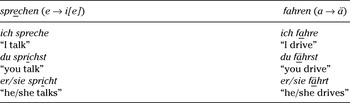
The form targeted for learning in this study is the changed stem vowel in selected forms of the present indicative of strong or irregular German verbs.Footnote 1 As shown in Table 1, the second- and third-person-singular forms of the verbs sprechen “to talk” and fahren “to drive” have undergone an e → i vowel change and an a → ä vowel change, respectively.
The stem-vowel change in the present indicative, second- and third-person-singular forms of strong verbs

Like most irregular grammatical forms, the stem-vowel change in the German present indicative is an artifact of older variants of German (see Bybee & Newman, Reference Bybee and Newman1995). It is a secondary characteristic of many strong verbs, which is a category of Germanic verbs that marks its past tense by means of ablaut (e.g., sehen–sah–gesehen “to see–saw–seen”) rather than dental suffixes (e.g., sehnen–sehnte–gesehnt “to long–longed–longed”). As the phonological trigger for the stem-vowel change (i.e., an i in the verb ending; Nübling, Dammel, Duke, & Szczepaniak, Reference Nübling, Dammel, Duke and Szczepaniak2006) disappeared from modern German, the reason for the stem-vowel change disappeared from the surface form of the verb, which contributed to the collapse of the strong-verb system as the default verb paradigm. The weak or non-vowel-changing verbs became the new regular and productive verb class.
Ullman (Reference Ullman2001a) argues that morphophonological transformations—such as a stem-vowel change—that are unproductive and do not result in the sequencing of two morphemes (e.g., compare sprech → sprich with sprech → sprech-e) are irregular. According to his (2001a, 2001b) declarative/procedural model, irregular forms are stored in declarative memory, or the mental lexicon. The mental lexicon is an “associative memory of distributed representations” (Ullman, Reference Ullman2001a, p. 41), similar to a connectionist network, that contains single morphemes and irregular, morphologically complex words. Representations in the mental lexicon may well be structured, showing a certain level of word-internal analysis. Thus, provided that a sufficient number of verbs with changed stem vowels are stored in memory, we may speculate that the critical vowel may acquire a special status (sprech “talk,” geb “give,” fahr “drive,” schlaf “sleep”) or may even be represented as a more abstract slot whereby sprech, geb, fahr, and schlaf are represented as sprV 1 ch, gV 1 b, fV 2 hr, and schlV 2 f, with V1 = e / i and V2 = a / ä. “To the extent that such structured representations are more abstract, containing (sub-)category specifications (rather than specifications for particular lexical items)” some low-scope productivity is possible (Ullman, Reference Ullman2001b, p. 109). However, unlike the fully productive rules for regular verbs, Ullman (Reference Ullman2001a) asserts that “stem-adjustment rules . . . are . . . not mental rules, but only descriptions of patterns in the language” (p. 43).
Bybee (Reference Bybee1995) questions the absoluteness of the regular-irregular dichotomy inherent in Ullman and colleagues’ work (e.g., Clahsen & Rothweiler, Reference Clahsen, Rothweiler, Booij and van Marle1992; Pinker, Reference Pinker1991). In her view, the productivity of a linguistic pattern depends not on the memory system involved (i.e., declarative memory or procedural memory) but on the pattern’s type frequency. The type frequency of a structure is the number of items stored in the mental lexicon that represent that structure. For example, the type frequency of German strong verbs is estimated at 160 (Clahsen & Rothweiler, Reference Clahsen, Rothweiler, Booij and van Marle1992). The beginning learners in our experiment will encounter 12 of these verbs. If these verb forms are effectively committed to memory, Bybee predicts that they should eventually be related to one another “via sets of lexical connections between identical and similar phonological and semantic features” (Bybee, Reference Bybee1995, p. 428). As a learner’s database of stored exemplars grows, their shared morphological structure is expected to emerge as a knowledge schema, which can then be applied to new, similar exemplars. This final step corresponds to the productive use or generalization of a pattern.
Different theoretical frameworks then converge on the notion that the processing of a new grammatical feature such as the stem-vowel change is likely to be lexically based. In the absence of explicit instruction, learners are prone to process and store the irregular verb forms as unanalyzed chunks, akin to lexical items, in their mental lexicons. The diachronic overview further indicated that modern German no longer has reliable clues as to whether a given verb will undergo a stem-vowel change, which makes rule-based learning of either descriptive rules or linguistic (i.e., procedural) rules hard. However, this lexically driven type of grammar learning carries a risk: When verb forms with changed stem vowels (e.g., sprich-, fähr-) are present in the input as potential memory items, they can be assimilated to the regular verb stems (e.g., sprech-, fahr-) that occur in the infinitive and the first-person singular, among other forms (see Table 1). This risk is even larger when the forms with regular verb stems are the only ones to which participants have been formally introduced at the time of the experiment. In such a case, which applies to our study, the participants may need to pay particular attention to the stem vowel—notice it—to discriminate between the changed stem vowel and the default stem vowel. The aim of this study, then, is to examine whether beginning L2 German learners will rise to this challenge, despite the low perceptual salience, redundancy, and seeming idiosyncrasy of the target form.
Why German Vowel-Changing Verbs Are Hard for Adults to Learn
Research investigating the acquisition of verb morphology indicates that adult learners, regardless of their proficiency level, have difficulty learning and producing the inflectional morphology of verbs, particularly those with stem-vowel changes (see Leow, Reference Leow1997, Reference Leow2000, for Spanish). The acquisition of verb morphology poses a challenge even to advanced learners of German (e.g., Clahsen, Reference Clahsen1999; Neubauer & Clahsen, Reference Neubauer and Clahsen2009; Silva & Clahsen, Reference Silva and Clahsen2008), Spanish (VanPatten, Keating, & Leeser, Reference VanPatten, Keating and Leeser2012), and English (Haznedar, Reference Haznedar2001; Lardiere, Reference Lardiere2007). As Hopp (Reference Hopp2010), citing Lardiere (Reference Lardiere1998a, Reference Lardiere1998b) and White (Reference White2003), observes, “inflection is a prime candidate for fossilization of interlanguage (IL) grammars well short of target accuracy” (p. 902). In this section, we explore Larsen-Freeman’s (Reference Larsen-Freeman2010) assertion that “it is processing difficulty that makes the acquisition of inflectional morphology so elusive” (p. 221; see also Hopp, Reference Hopp2010; Prévost & White, Reference Prévost and White2000).
In his 2005 review article on L2 grammar learning, DeKeyser argued, “it is the transparency of form-meaning relationships to a learner who is processing a language for meaning that determines the difficulty of acquisition” (p. 3), at least in the context of uninstructed L2 processing. The stem-vowel change in German represents an opaque and, hence, difficult form-meaning relationship to the learner. It can be explained diachronically but not synchronically (as discussed in the previous section) and occurs in two lexically arbitrary classes of verbs (see Bybee & Newman, Reference Bybee and Newman1995). It is also redundant in that it does not add any semantic content to the utterance beyond what is already expressed by the subject, the unchanged verb stem, and the verb ending. Thus, there is nothing that the form sie sieht “she sees” expresses that the ungrammatical form *sie seht could not. This redundancy and seeming idiosyncrasy, combined with the low saliency of one or two letters embedded in a word, may explain why adult German learners experience such difficulty acquiring this feature of the German verb system. Goldschneider and DeKeyser’s (Reference Goldschneider and DeKeyser2001) meta-analysis lends indirect support to this claim, as it showed that perceptual salience and morphophonological regularity (i.e., allomorphy) are two significant predictors of morpheme acquisition order in L2 English.
However, Bybee and Newman (Reference Bybee and Newman1995) present evidence from paired-associate learning with artificial nouns to suggest that stem-vowel changes are not intrinsically more difficult than suffixes. Rather, it is their lexical arbitrariness and low type frequency in real languages that makes them harder to master. These characteristics are not inherent to vowel-changing forms per se but are a consequence of how languages evolve over time and, in particular, of the fact that “stem changes tend to develop very late in the grammaticization process” (Bybee & Newman, Reference Bybee and Newman1995, p. 637).
RESEARCH QUESTIONS
Based on the theoretical background provided, this study seeks to answer two research questions:
-
1. Do adult beginning learners of German who are unfamiliar with stem-changing verbs pay more attention to those verbs as compared to similar, regular verbs during reading?
-
2. Are they more likely to learn the irregular verbs if they pay more attention to them?
For the first research question (RQ1), we hypothesize that learners will look significantly longer at stem-vowel-changing verbs during reading than at similar, regular verbs in which the stem does not change. We expect this effect to become apparent in later processing measures (as explained previously). For the second research question (RQ2), we predict that the longer a participant looks at an irregular verb form during reading, the more likely he or she will be to produce that verb correctly on the posttest.
METHODOLOGY
Participants
Forty-three adult learners of German enrolled in German 101 courses at Michigan State University volunteered to participate in the study. Three participants were excluded from the final data analyses because they were nonnative English speakers. The remaining 40 participants all reported having English as a L1. Two of them also listed another language, French or Malay, as a L1. The participants had comparable German proficiency: Students are enrolled in German 101 courses if they have no previous experience in German or receive a low score on the university’s German placement test. They had previously received 3.5 weeks of German instruction, which included lessons on the regular present indicative. However, none had explicitly learned about the existence of stem changes in German or how to use them. Twenty-three of the participants were females, and 17 were males. They were 17–36 years of age (M = 19 years). Twenty-nine participants indicated that they had studied other foreign languages in high school, including Spanish or a combination of Spanish and French. One of those students had also studied Thai, and one other student reported having studied Latin. Ten students had not studied any other foreign languages before they enrolled in their German classes.
Materials
The research materials included a background questionnaire, pretest, posttest, and four counterbalanced versions of the reading task (i.e., sentences and pictures) presented on a computer screen.
Pre- and Posttests
The pretest and posttest measured learners’ productive knowledge of selected stem-changing verbs. The two tests were identical except for the order in which the test items were presented to the students. The difference between a participant’s pretest and posttest scores served as our measure of learning—operationally defined here as a participant’s improvement in his or her written production of the stem-changing verbs after the reading task.
Both the pretest and the posttest required the participant to write down a sentence using the action verb that was depicted in a picture. Each testing session proceeded as follows: The researcher had a stack of 14 pictures illustrating 14 verbs, the 12 irregular verbs that were used in the experiment as well as 2 regular verbs (i.e., fillers). The researcher held up a picture and asked in English what the man or the woman in the picture was doing. The participant was required to answer in German. The student then typically said something like, *Sie sprecht an/in/auf Telefon “She is talking on the phone” (target form spricht [i.e., with a vowel change]). The researcher asked the student to write down the sentence; she did not give feedback. The procedure was repeated until all 14 pictures had been shown.
Unlike more controlled test formats such as fill-in-the-blank tests, this cued-production test had the advantage of not disclosing its purpose. Therefore, the pretest did not sensitize participants to the importance of verb morphology in our study. This issue was critically important to safeguard the validity of our measure of learner-driven attention to language during natural language processing.
Reading Task
The target forms (i.e., 12 regular and 12 irregular verbs) were embedded in short, simple sentences, which the participants were instructed to read for meaning. To ensure that the participants were familiar with the meanings of the target verbs, only verbs from the first two textbook chapters that the participants had covered in class thus far were selected. There were six e → i(e) changing verbs and six a → ä changing verbs, which jointly equaled the number of regular verbs (i.e., 12). The appendix lists the lengths and lemma frequencies of the verbs in each category. The verb infinitives had an overall mean length of 6.38 characters (SD = 1.25), which did not differ significantly between verb categories (Kruskal-Wallis test, χ2 (2) = 4.28, p = .118). However, the lemma frequencies of the verbs did differ according to the core corpus of the Digitales Wörterbuch der deutschen Sprache “Digital Dictionary of the German Language” (2003; Kruskal-Wallis test, χ2 (2) = 6.01, p = .050). In particular, e → i(e) changing verbs (mean frequency 635.11 per million; SD = 519.33) tended to be more frequent than regular verbs (174.39 per million; SD = 274.44; Mann-Whitney U test, z = −2.34, p = .018)2 and more frequent than a → ä changing verbs (154.86 per million; SD = 135.67; Mann-Whitney U test, z = −1.76, p = .093). The a → ä changing verbs and the regular verbs did not differ in frequency (Mann-Whitney U test, z = −0.562, p = .616). We controlled for any frequency-related effects on eye-fixation durations by working with subtracted fixation times (as explained in the section Analysis of the Eye-Tracking Data). We also wish to point out that word frequency, which is a major determinant of skilled readers’ fixation times (e.g., Rayner, Reference Rayner2009), may have a much smaller influence on the true beginners’ reading patterns examined in this study, as they had had very little exposure to any of the target forms prior to the experiment.
There were two sentences per screen, each of which appeared on a separate line (see Figure 1). The endings of the sentences were different, but they were matched for number of words and difficulty level. The sentences were intentionally kept short to be suitable for the participants’ very low German proficiency. All stimuli were also shared with another experienced German foreign language teacher, who confirmed that the learners would not experience difficulty comprehending the overall meaning of the sentences. Every sentence pair was preceded by a fixation cross in front of the first sentence.
An example of one critical trial.

We informed the students that the study’s purpose was to investigate how beginning learners read from a computer screen. As previously stated, each trial included two sentences presented on the same screen. The first sentence is the baseline sentence: It starts with ich “I” and never contains a vowel change, regardless of the verb type. The second sentence starts with du “you,” sie “she,” or er “he” and is termed the target sentence. It contains a vowel change if the verb is strong but not if it is weak. The same verb was used in the two sentences that made up a single trial, although the verb appeared with different inflections due to the difference between first, second, or third person. In the experimental condition, the difference was established not only by inflection but also by the stem-vowel change, hence the term critical condition. The grammatical subject of the target sentence (du, sie, or er) and the sentence endings were counterbalanced across participants, which yielded four different versions of the experimental materials. Each participant read only one version of the four possible sentence pairs for a particular verb.
The participants worked through 24 verb pairs, or trials, and saw three screens per trial. The first screen showed a picture of the action verb targeted in that trial. The purpose of this screen was to lower the processing burden of the two sentences presented on the next screen. The second screen contained the sentence pair described in the previous paragraph, which included two occurrences of the targeted action verb. Finally, on the third screen, participants saw three new pictures, one of which, again, depicted the action verb of interest. The participants were instructed to look at the picture (out of the three) that corresponded to the action expressed in the preceding sentences. This selection of the correct picture with their eyes served as a comprehension check to make sure that the learners were reading for meaning. Participants moved from one screen to the next by pressing a button. Eye-drift correction was performed in between all trials to ensure continued measurement accuracy. On the whole, the participants saw 12 critical trials (i.e., irregular verbs) and 12 control trials (i.e., regular verbs) in a fully randomized order.
Procedures
The beginning learners of German participated individually in a quiet room—the eye-tracking laboratory—for about 1 hr. After filling out the background questionnaire, each participant completed the 14 pretest items with the researcher. Then, the learners sat down in front of a desk and placed their chin on a chin rest with a computer screen approximately 80 cm in front of them. A desk-mounted eye-tracking camera, the Eyelink 1000, captured the learners’ eye-gaze movements as they read the sentences and looked at the pictures on the screen. The learners clicked through the screen displays at their own pace. As a final step, each participant took the posttest. The students were paid $10 for their participation in the study.
Analysis of the Eye-Tracking Data
To examine whether the beginning learners paid particular attention to the verb forms with changed stem vowels (i.e., Research Question 1), we analyzed their eye-movement behavior during reading. Because only strong verbs have changing stem vowels, this entailed comparing eye-fixation durations for strong verbs and weak verbs—akin to what Pliatsikas and Marinis (Reference Pliatsikas and Marinis2012) did for English. However, to minimize any effect of the verb-frequency differences described previously, we first subtracted a learner’s fixation time for the ich form of a verb from his or her fixation duration for the du, sie, or er form of the same verb, which appeared below on the same screen (see Figure 1). We argue that these subtracted fixation durations approximate the amount of attention, if any, that learners paid to the stem-vowel change after filtering out the effects of frequency on eye-fixation times.
There is, however, one scenario in which the subtracted fixation times may not be a suitable measure of attention to the stem change—that is, when participants look back and forth between the two verb forms on the screen (e.g., to compare their spelling). Such a processing pattern would engender longer reading times for both the ich form and the du, sie, or er form; these would, however, cancel each other out in a subtraction. To examine this possibility, we also analyzed the occurrence of direct visual comparisons between the two verb forms in our data. Of interest was whether irregular-verb pairs engender more comparisons than regular-verb pairs do.
We considered direct visual comparisons both as a binary and as a count variable. A comparison was defined as either a regression from the du, sie, or er form into the ich form or a progressive eye movement from the ich form straight into the du, sie, or er form. For the binary variable, all trials with at least one comparison were coded as 1. For the count variable, we counted the actual number of comparisons. Trials that did not have a verb-form comparison were coded as 0 in either case.
For the subtraction data, we analyzed three fixation time measures. First fixation duration is the duration of the first fixation readers make on a word. Gaze duration is the summed duration of all fixations that participants make on a word during first pass (i.e., initial, left-to-right) reading. It excludes any fixations made on reentry of the word from a downstream location. Total time is the sum of all fixation durations over all passes. Thus, subtracted first fixation duration is the difference between a participant’s first fixation duration for the du, sie, or er form and his or her first fixation duration for the matched ich form. Consequently, negative values mean longer gazes at the (non-stem-changing) ich form, and positive values index longer looks at the (possibly stem-changing) du, sie, or er form.
We fit generalized linear mixed models (GLMM) to the subtracted fixation durations—that is, linear regressions including random effects (Fitzmaurice, Laird, & Ware, Reference Fitzmaurice, Laird and Ware2011; Kutner, Nachtsheim, Neter, & Li, Reference Kutner, Nachtsheim, Neter and Li2005). Verb type was the main factor of interest. It was coded as two dummy variables for the e → i(e) changing verbs and the a → ä changing verbs, respectively. Hence, the regular verb category was the baseline. Models were fit in R using the glmer function from the lme4 library (Bates, Maechler, & Bolker, Reference Bates, Maechler and Bolker2011). A base model that included only the random effects was created while observing the change in -2log-likelihood. We retained the model with random intercepts for subjects only (Baayen, Davidson, & Bates, Reference Baayen, Davidson and Bates2008). Next, we entered the dummy variables representing the different verb categories. We assessed the goodness of fit of each model by comparing that model to the base model via the -2log-likelihood test. P values for individual predictors were calculated with the languageR package (Baayen, Reference Baayen2008).
Analysis of the Test Scores
To assess the effects of the reading task on stem-change learning (i.e., Research Question 2), we computed learners’ gains in productive knowledge of the strong verbs from pre- to posttest. To this end, we scored the verb forms that learners wrote down on the tests in response to the picture prompts. Full credit was given for verb forms with a correct stem-vowel change. We did not penalize spelling mistakes in the rest of the verb stem or incorrect verb endings, given that they were not the focus of this study. However, it is worth noting that, with two exceptions, learners who produced the correct stem-vowel change also inflected the verb correctly.
For the e → i(e) changing verbs, we accepted both an i stem change (e.g., er nimmt “he talks,” *er list “he reads”) and an ie stem change (e.g., *er niemt, er liest) because we reasoned that both answers reflected some learner knowledge of the target form. Additionally, we accepted the reverse digraph ei (e.g., *er neimt, *er leist), given that letter transpositions are fairly common in the early stages of writing development (Cook, Reference Cook1997; Treiman, Reference Treiman1993). This problem was likely compounded by the fact that English e and German ie are both pronounced as [i:] (R. Treiman, personal communication, July 5, 2012).
Similar to the fixation time data, we analyzed the relationship between attention during reading and stem-change learning by means of GLMM. All analyses used stem-change learning as the dependent variable. Stem-change learning was coded as 1 if a participant produced an item incorrectly on the pretest and correctly on the posttest. Otherwise, it was coded as 0. Because the dependent variable was binary, we used a logit link function to run logistic regressions (e.g., Hosmer & Lemeshow, Reference Hosmer and Lemeshow2000; Jaeger, Reference Jaeger2008). The other technical details of model fitting were the same as for the fixation time analyses and can be found in the previous section. For all of the analyses, the significance level α was set at .05.
RESULTS
RQ1: Irregular Verbs Generate Longer Subtracted Total Times
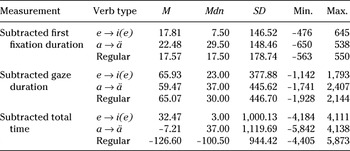
We gauged participants’ attention to the stem-changing verb forms, relative to the regular verbs, by computing their subtracted fixation times for the three verb types. Table 2 lists the descriptive statistics for the three eye-movement measures.
Descriptive statistics for the three subtracted fixation time measures per verb type

Note.
All the fixation durations are in milliseconds.
With two exceptions, all of the mean fixation time differences are positive: Participants tended to look longer at the du, sie, or er form than the ich form. The mean subtracted first fixation duration and gaze duration seem quite stable across verb types. However, for subtracted total time, the mean and median drop below 0 for the regular verbs, which signals a longer total processing time for the ich form than the du, sie, or er form in this category. For the a → ä changing verbs, the mean and median hover around 0. Finally, the large standard deviations and ranges point to the high degree of variability in the data. They are suggestive of participants’ low reading skills in L2 German as well as their differential responses to the verb stimuli. For the analyses reported in the next two paragraphs, we excluded any observations that fell outside of the mean ±3 standard deviations. For subtracted total time, this amounted to a data loss of eight observations (< 1%).
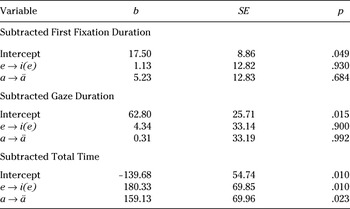
A linear regression with varying intercepts for subjects revealed that verb type was not significantly associated with subtracted first fixation duration or gaze duration (see Table 3). The intercept in these models represents the baseline scenario, which we chose to be the regular-verb processing. The p values for the two irregular-verb variables indicate whether the distribution of processing time over the two verb forms (i.e., first- and second- or third-person singular) changes significantly when learners process a vowel-changing verb. It appears that subtracted total time did differ as a function of verb type.
The effect of verb type on subtracted fixation time: (a) Subtracted first fixation duration, (b) subtracted gaze duration, and (c) subtracted total time

The significant, negative coefficient for the intercept in the total time analysis indicates that participants tended to look longer at the ich form than the du, sie, or er form of regular verbs (see the Discussion section for one explanation for why this might be so). On average, the processing time difference between the two verbs of an e → i(e) trial increased by 180 ms compared to the regular verbs, meaning that the vowel-changing du, sie, or er forms were looked at longer (M = 41 ms longer) than the non-vowel-changing ich forms in this condition (see also Table 2). A similar regression analysis with the a → ä changing verbs as the reference category confirmed that the subtracted total times for these verbs also differed from the regular verbs (b = −159.13, SE = 69.96, p = .023) but not from the e → i(e) changing verbs (b = 21.20, SE = 80.77, p = .793). The final model with the added verb-type variables fit the data significantly better than the baseline model containing only the random subject effects (-2log-likelihood test, χFootnote 2 (2) = 8.90, p = .011). There were 6% standardized residuals smaller than −2 or larger than +2, but removing the corresponding observations from the data set did not change the results.
RQ1: Learners Do Not Compare the Strong Verb Forms More Often
In about one out of three trials (i.e., 326 out of 960 trials), participants directly compared the two verb forms—their eyes went either from the ich form to the du, sie, or er form, from the du, sie, or er form to the ich form, or back and forth. Of these 326 trials, 170 (i.e., 52%) had a vowel-changing verb and 156 (i.e., 48%) had a regular verb. The likelihood of making a direct visual comparison did not differ as a function of verb type: Participants did not compare verb pairs more often when they contained a different stem vowel than when their stem vowel was the same (two-way ANOVAs with a random subjects factor and verb type as a fixed, within-subjects factor, p = .284 for regular vs. irregular verbs, and p = .514 for regular vs. a → ä vs. e → i[e]).
The number of comparisons on any given trial ranged from 0 to 14. Within the subset of trials that contained at least one comparison, the mean number of back-and-forth movements between the two verb forms was 2.07 (SD = 1.74). The number of comparisons between vowel-changing verb pairs was not significantly higher than that between regular verb pairs (Mann-Whitney U test, z = −1.04, p = .297 for regular vs. irregular, and Kruskal-Wallis test, χ2 (2) = 1.20, p = .549 for regular vs. a → ä vs. e → i[e]).
RQ2: Total Time Facilitates Stem-Change Learning; Only a → ä Changing Verbs Benefit from Comparisons
Research Question 1 concerned the effect, if any, of verb irregularity on two types of attention measures: eye-fixation durations and direct visual comparisons. We will now consider whether these attention measures are related to participants’ improved production of stem-vowel-changing verbs, as revealed by a pretest-to-posttest comparison.
Participants were tested on the 12 strong verbs that appeared in the reading task as well as 2 regular fillers, which yielded a maximum possible score of 12 points. The average pretest score of 1.05 (SD = 1.48, range = 0–5) confirmed that our participants had limited or no knowledge of the stem-vowel change in German prior to the experiment. After exposure to the critical verb forms in the reading task, the participants correctly produced an average of two verb forms more (mean posttest score = 3.13, SD = 3.21, range = 0–11). This improvement in the production of the strong-verb forms was statistically significant (two-sided Wilcoxon signed ranks test, z = −4.22, p < .001), and it did not seem to differ by the type of vowel change (two-sided Wilcoxon signed ranks test, z = −0.75, p = .456). Hence, the findings of the univariate analyses suggest that the beginning learners of German improved in their production of irregular e → i(e) and a → ä verbs alike after they encountered them during reading (but see the end of this section for a revisiting of this conclusion).
The question arises as to whether or not these significant knowledge gains regarding stem-changing verbs can be predicted by the total time that a participant spent reading each of these verbs. We used the raw (i.e., uncorrected) total times for the strong du, sie, or er forms for this analysis so that individual differences in reading speed were not wiped out.Footnote 3 Similar to the linear regression analysis, we removed any observations that fell outside of the mean ±3 standard deviations. This led to the elimination of 11 observations (i.e., 2.3% of all critical trials).
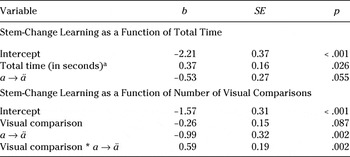
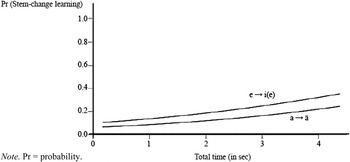
A logistic regression with varying intercepts for subjects revealed a positive association between total time on a vowel-changing verb form and the improved, accurate production of that verb form on the posttest (see Table 4, upper half). Figure 2 provides a visual representation of the strength of the association. For instance, an increase in total time with 2 standard deviations centered around the mean (i.e., from 315 ms [M − 1 SD] to 2,204 ms [M + 1 SD]) corresponded to an 8.6% higher probability of that participant correctly reproducing the targeted verb form on the posttest. Hence, these findings suggest that participants’ attention to stem-changing verbs had a modest, favorable effect on the accuracy of their subsequent verb reproductions.
The effects of two measures of attention on stem-change learning

a We ran the analysis on total time / 1,000 (i.e., total time in seconds) to obtain larger regression coefficients and facilitate interpretation.
The relationship between attention, measured as total time on a stem-changing verb form, and stem-change learning.

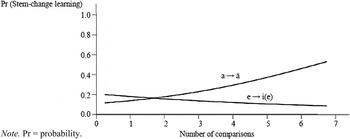
Next, we examined whether the direct visual comparison of a verb pair (e.g., sehe “[I] see” vs. siehst “[you] see”) predicted the acquisition of the stem-changing item in the pair (e.g., siehst). We report the analyses on the count variable, trimmed at the mean ±3 standard deviations. Trimming entailed a data loss of nine trials (i.e., 1.8% of the data) in which participants’ eyes moved between the two verb forms six or more times. The results did not change when we included these observations or when we analyzed visual comparisons as a binary rather than a count variable. The regression coefficients in the lower half of Table 4 indicate that verb comparison interacted with verb type. In particular, comparing the two verbs in an a → ä pair significantly increased the chances of accurately reproducing the ä form on the posttest; however, for e → i(e) changing verbs, visual comparisons tended to have the opposite effect (see Figure 3). Finally, the baseline probability of learning a verb with an irregular ä vowel was significantly lower than that of learning a verb with an irregular i(e) vowel. We found a trend in the same direction in the previous analysis (see the upper half of Table 4), which suggests that the original findings of the Wilcoxon signed ranks test ought to be reconsidered. E → i(e) changing verbs may have a slight acquisition advantage over a → ä changing verbs, which can, however, be turned around when learners start to compare the form with and without the umlaut.
The interaction effect of verb type and visual comparisons on stem-change learning.

DISCUSSION
Attention to Verb Irregularities during Reading
This study investigated whether or not adult beginning learners of German who are unfamiliar with stem-changing verbs pay increased attention to these verbs during reading. We conceived of increased attention as behavioral evidence for noticing (Godfroid, Housen, & Boers, Reference Godfroid, Housen, Boers, Pütz and Sicola2010; Robinson, Reference Robinson1995, Reference Robinson, Doughty and Long2003; Schmidt, Reference Schmidt and Robinson2001) and operationalized it as follows: (a) significantly longer subtracted fixation times for irregular verbs than regular verbs or (b) a direct visual comparison between a possibly vowel-changing du, sie, or er form and a non-vowel-changing ich form.
With regard to the subtracted fixation times, we found that du, sie, or er verb forms with a stem-vowel change attracted comparatively longer total times than regular du, sie, or er forms. This was the case for both e → i(e) transformations and a → ä umlaut insertions. Despite the many factors (i.e., low saliency, redundancy, and idiosyncrasy) that seem to conspire against the acquisition of the vowel-changing verb forms, these fixation time data suggest that the beginning learners of German did pay particular attention to them in this study. Without additional evidence from more ecologically valid language processing tasks, the findings of this laboratory experiment cannot be extended to a natural learning context. However, our data do suggest that it is possible, in principle, for beginning L2 learners to attend to small morphological features that are semantically empty during written sentence processing.
As noted in the Results section, the baseline scenario for subtracted total time was not one in which the ich form and the du, sie, or er form received equal amounts of attention. Rather, learners tended to process the du, sie, or er form of regular, non-vowel-changing verbs more quickly than the corresponding ich form, which resulted in a negative mean and median subtracted total time (see Table 2). This presumably reflects a task familiarity or habituation effect. Participants may have become accustomed to the fact that the second verb form on the screen always denoted the same activity as the first verb form, only with a different grammatical subject. When their initial processing of the du, sie, or er form confirmed it was the same action verb as the one in the sentence above, there was no need for them to return to it later—unless there was a vowel change, that is. The design of follow-up studies could be improved by counterbalancing the presentation order of the two sentences on the screen such that the du, sie, or er sentence appears as the top sentence in half of the trials. We predict that this will result in longer subtracted total times for all three verb conditions but that the absolute differences between the conditions will remain the same.
The fact that verb irregularity had an effect on subtracted total time but not on subtracted first fixation or gaze duration suggests that the increased focus on the stem-vowel change occurred late in the reading process (e.g., Clifton, Staub, & Rayner, Reference Clifton, Staub, Rayner, Van Gompel, Fischer, Murray and Hill2007). It likely reflects revisits to the irregular du, sie, or er form following a regressive eye movement—either from the critical verb to an earlier part of the text or back to the critical verb from a text location further ahead. The ensuing second pass reading could account for the increases in total time that we observed (see also Mitchell, Shen, Green, & Hodgson, Reference Mitchell, Shen, Green and Hodgson2008). Although we did not analyze regressions or second pass time in this study, future studies on attention to L2 grammatical features may want to include additional measures of reanalysis to confirm this interpretation.
In their eye-tracking study on the noticing of new vocabulary, Godfroid et al. (in press) found both late and early effects of word novelty on fixation durations. It is interesting to interpret the difference in findings between the two studies in light of an influential model of eye-movement control, E-Z Reader 10 (Reichle et al., Reference Reichle, Warren and McConnel2009). E-Z Reader 10 postulates that processing difficulty can occur at two stages: (a) lexical processing, which consists of a word familiarity check and lexical access, and (b) postlexical or higher order language processing. Postlexical language processing involves the integration of the currently fixated word n “into the higher-level representations that readers construct online” (Reichle et al., Reference Reichle, Warren and McConnel2009, p. 5). These can be at the syntactic, semantic, or discourse levels. Within this framework, then, it seems that the difficulties that Godfroid et al.’s participants had with the novel words arose in the early stages of lexical processing and endured thereafter, whereas our participants originally processed the vowel-changing verb forms as ordinary, familiar forms. Although they must have perceived the stem vowel (because it is close to the OVP), they did not initially notice that it was different from the default stem vowel for that verb. It could be said that their eyes saw du sprichst, but their minds read *du sprechst. To the extent that this error was corrected, it happened later in reading, during postlexical processing and reanalysis.
Is More Attention Associated with More Learning?
In view of the beneficial effect of attention on learning (see the Background section), we predicted that attention to stem-changing verb forms, as captured by our eye-movement measures, would be positively related to the acquisition of those forms. This hypothesis was confirmed by the data: Both total reading times and comparisons between verb forms predicted stem-change learning, although comparisons between verbs only predicted stem-change learning for a → ä changing verbs.
The finding that L2 learners’ total time on an irregular verb form aided their acquisition of that form is consistent with the eye-mind link that has been posited for reading. As Reichle et al. (Reference Reichle, Warren and McConnel2009), referring back to Just and Carpenter (Reference Just and Carpenter1980), put it, “where a reader is looking at any point in time reflects, at least to some degree, whatever is going on in his or her mind at that time” (p. 2). On this assumption, the longer fixations and refixations on the strong du, sie, or er forms are likely to reflect the enhanced processing of these forms. They signal, in our view, the prolonged representation and manipulation of the attended stimuli in working memory (Baars, Reference Baars1988, Reference Baars1997; Baars & Gage, Reference Baars and Gage2010; Baddeley, Reference Baddeley2003; Cowan, Reference Cowan1995, Reference Cowan2005; Godfroid et al., in press; Knudsen, Reference Knudsen2007; Robinson, Reference Robinson1995, Reference Robinson, Doughty and Long2003; Styles, Reference Styles2006, among others). Working memory, the active part of short-term memory, is “the home of explicit deduction, hypothesis formation, [and] analogical reasoning . . . where we develop, apply, and hone our metalinguistic insights into an L2” (Ellis, Reference Ellis2005, p. 337). Following Robinson (Reference Robinson, Doughty and Long2003), we propose that the joint action of selective, focal attention followed by working memory processing will result in the initial representation of new linguistic material in long-term memory (i.e., intake).
At the same time, the extent to which attention facilitated stem-change learning in this study was modest: an 8.6% increase in probability for every two standard deviations of extra processing time (i.e., roughly 2 s) for average fixation durations.Footnote 4 This might raise the question of how useful it is to expose beginning learners to written input with strong verbs—and perhaps, by extension, other irregular morphological features—when they have not yet been instructed about the underlying rule system. Ellis (Reference Ellis2006a, Reference Ellis2006b) argues that the acquisition difficulties posed by low-salient, redundant L2 forms may stem from L1 attentional biases (i.e., learned attention), which can be overcome by form-focused pedagogical interventions (as in Ellis & Sagarra, Reference Ellis and Sagarra2010). Our findings also suggest that explicit instruction or structured input may be of great practical importance. Our findings are, however, less conclusive with regard to the source of the acquisition difficulty: The subtracted total times indicate that participants did pay attention to the relevant features in the input, yet their learning was still limited. At the same time, we believe that the small learning benefits found for increased attention should be viewed in their right context—that is, that of a one-time intervention in a laboratory setting. Although 2 s is a large time unit in psycholinguistics, it is ephemeral in actual L2 learning practice, in which exposure is counted in hours, weeks, months, or years. In other words, an 8.6% probability increase per extra 2 s of attention may seem modest, but it could become quite meaningful when extrapolated to real life.
One finding we had not anticipated is that the type of vowel change (i.e., e → i[e] or a → ä) would modulate the effects of certain eye-movement behavior. We found that verb type interacted with visual comparisons: A visual comparison of an a → ä verb pair significantly increased the chances of learning the ä form, but comparisons between e → i(e) forms tended to lead more often to learning failure. As can be seen in Figure 3, the negative effect of comparisons on the acquisition of e → i(e) changing verbs was small. The main difference between the two types of irregularity is the foreign, non-English umlaut in the former verb category. German language instructors can attest to the difficulties that beginning learners experience with the umlaut, both in terms of its pronunciation (e.g., fahrt and fährt look very similar but are pronounced differently) and as regards the written production (e.g., which vowel takes the umlaut in a diphthong). It is, therefore, noteworthy that our eye-movement data indicate that these acquisition difficulties do not find their origin in a lack of attention to the umlaut. Indeed, we have informal evidence to suggest that, in particular, learners with high metalinguistic awareness focus very strongly on this type of vowel change. The three nonnative English participants, whose data were not included in the final analyses, followed courses at an American university and lived in an English-speaking environment. Therefore, they were experienced, successful L2 learners who, presumably, had a high degree of metalinguistic awareness (e.g., Cook, Reference Cook2003; Jessner, Reference Jessner2008; Koda & Zehler, Reference Koda and Zehler2008; Sanz, Reference Sanz and Chapelle2012). All three participants had a clear tendency to focus strongly on the a → ä changing verb pairs, and one of them also paid a lot of attention to the e → i(e) change. Indeed, all effects became stronger when we included the nonnative English speakers in the analyses. We may speculate that the foreignness of the umlaut makes it more salient for a subset of experienced language learners who have become skilled at attending to subtle differences between language forms. This would seem compatible with our finding that the memory benefits of English native speakers’ comparisons of a → ä verb pairs were larger than those associated with e → i(e) verb comparisons.
Attention, Learning, and the Developmental Level of the Learner
To control for prior knowledge, it is desirable to use target structures for noticing that have been either artificially created (e.g., pseudowords) or have not yet been formally introduced to the L2 learners. We chose ones not yet formally introduced (see also Leow, Reference Leow1997, Reference Leow2000). However, because the stem-vowel change is covered early on in the German curriculum, a consequence of this decision is that the participants in this study were true beginning learners of German. On average, they had had 3.5 weeks of instruction when they took part in the experiment. In what follows, we discuss two ways in which the participants’ very low proficiency level may have affected their performance.
First, although the participants had recently been taught the present indicative with regular verbs in class, the automatization of L2 declarative knowledge takes time and practice (e.g., DeKeyser, Reference DeKeyser2007; Segalowitz, Reference Segalowitz2010; Segalowitz & Hulstijn, Reference Segalowitz, Hulstijn, Kroll and de Groot2005). As a result, the participants arguably had not fully internalized the regular (i.e., non-vowel-changing) forms yet by the time they were presented with the irregular verbs. In fact, the learners’ prior formal instruction on German verb inflection may have induced them to focus their selective attention on the endings of the verbs, rather than on the stems, given that instruction can function as an attention-focusing device (e.g., Fotos, Reference Fotos1993; Portmann-Tselikas, Reference Portmann-Tselikas2003). Additional analyses could examine this possibility by comparing the accuracy of the verb inflections produced before and after the experiment and linking it with eye-fixation durations.
More generally, the processing of these seemingly simple sentences was a taxing task for our beginning learners. Although we conceived of the changed stem vowels as the only novel elements in the input, in practice, most of the information in the sentences seems to have required a processing effort, as judged by the many regressions and refixations in the participants’ eye-movement records. This is in line with McLaughlin’s (Reference McLaughlin1987) assertion that the early stages of L2 acquisition are characterized by controlled processing. As controlled attention is bounded by capacity limits (e.g., Izumi, Reference Izumi2003; McLaughlin & Heredia, Reference McLaughlin, Heredia, Ritchie and Bhatia1996; Uggen, Reference Uggen2012), the beginning learners’ attention might conceivably have been consumed by processing the propositional content of the sentences in some of the trials. This might have prevented them from processing the irregular verb morphology successfully. One clear finding of this study, then, is that the default L1 reading process, in which comprehension seldom breaks down and the eyes mainly move forward (e.g., Rayner, Reference Rayner2009; Reichle et al., Reference Reichle, Warren and McConnel2009), did not correspond to our participants’ default L2 reading process, owing to their incomplete knowledge of the target language.
Although these observations may be read as a cautionary note, they are not intended to deter scholars from doing eye-tracking research with beginning L2 learners. For one thing, we feel that the higher levels of noise in low-level L2 learners’ data can be dealt with by adopting more robust eye-movement measures such as the visual comparison data in our study. Additionally, regression analyses, which do not rely on the normal distribution of the dependent variable, proved to be a viable technique for analyzing the data in this study that were not normally distributed. Finally, excluding beginning L2 learners from eye-movement research would seem undesirable for theoretical reasons as well. For instance, the research on verb morphology reviewed in this article seems to have focused extensively on advanced or near-native L2 speakers to investigate issues of representational and processing differences between native and nonnative speakers. Although these are important questions, highly advanced L2 speakers are, in many ways, an idealized population that represents only a fraction of L2 learners. The processes and mechanisms that will lead language learners down the path of L2 proficiency are just as interesting in their own right. We hope to have demonstrated that the study of one of these mechanisms—namely, attention—can be informed by the use of eye-tracking technology.
CONCLUSIONS AND PERSPECTIVES
This study examined whether and to what extent beginning learners of L2 German attend to and notice vowel-changing verbs during sentence processing. The use of eye-tracking in this study complements and extends existing approaches to this and similar questions that have relied on concurrent or retrospective verbal reports (e.g., Hama & Leow, Reference Hama and Leow2010; Leow, Reference Leow1997, Reference Leow2000; Leung & Williams, Reference Leung and Williams2011, Reference Leung and Williams2012; Williams, Reference Williams, VanPatten, Williams, Rott and Overstreet2004, Reference Williams2005), recently also in conjunction with reaction time data (Leung & Williams, Reference Leung and Williams2011, Reference Leung and Williams2012). A potential advantage of eye-tracking methodology over verbal reports is that eye-tracking does not rely on learners’ abilities to put the objects of their attention into words. This seems particularly relevant in the context of L2 grammar processing in which verbalizations might conceivably be hindered by a participant’s lack of metalinguistic terminology. In contrast, although eye-tracking data may be used as an index of processing difficulty, they do not inform us about whether the processing issue was resolved successfully. Therefore, triangulation of eye-tracking data with pre- and posttests and perhaps a verbalization measure seems recommended to obtain a more complete picture of L2 learners’ cognitive processing.
Analysis of the eye-fixation durations indicated that the L2 learners of German paid more attention to the vowel-changing verb forms than the regular verb forms. These attention increases were shown to underlie modest gains in productive verb knowledge. The efficacy of attention allocation and the resulting learning gains are likely to be influenced by the learners’ L1, their prior knowledge and language-learning experience, their working memory capacity in both the L1 and the L2, their developmental level, and the grammar targeted. Nonetheless, Schmidt’s (Reference Schmidt and Schmidt1995) advice to “pay particular attention to whatever aspects of the input (phonology, morphology, . . . etc.) that you are concerned to learn” (p. 45) still seems sound, provided that one keeps in mind that there are “no magic bullets” (Ellis & Larsen-Freeman, Reference Ellis and Larsen-Freeman2006, p. 559).
This study supports general claims about the facilitative role of attention in SLA with fine-grained empirical evidence collected during online processing. Although there are many ways in which this research could be extended, a particularly promising avenue may be the use of mixed-methods studies that also include an awareness measure. The triangulation of attention data and awareness data will help us refine our understanding of the noticing construct. This will be an important stepping stone on the way toward integrating noticing with the more general theories of implicit and explicit learning.
APPENDIX LENGTH AND LEMMA FREQUENCY OF THE 24 TARGET VERBS IN THE STUDY