INTRODUCTION
East Coast fever (ECF) is a lympho-proliferative disease of cattle caused by the protozoan parasite Theileria parva. It is transmitted by Rhipicephalus appendiculatus tick (Waladde et al. Reference Waladde, Young, Ochieng, Mwaura and Mwakima1993). The disease kills a million cattle every year and devastates the livelihood of those who depend on cattle for survival (GALVmed newsletter, May 2010). The disease is endemic in Eastern, Central and Southern African countries, including Tanzania (Morrison et al. Reference Morrison, Goddeeris, Teale, Groocock, Kemp and Stagg1987).
Acaricide treatment of cattle is a major control method which limits infestation of tick vector R. appendiculatus. However, this method has major drawbacks, including the development of resistance by ticks, food-safety concerns and environmental contamination resulting from toxic residues (George et al. Reference George, Pound and Davey2004). Infection and treatment method (ITM) which uses the Muguga live sporozoite cocktail vaccine has been successfully used in pastoral systems in Northern, Eastern and Central zones of Tanzania (Di Giulio et al. Reference Di Giulio, Lynen, Morzaria, Oura and Bishop2009). Despite the successes observed, many studies have shown that the widespread deployment of the live sporozoite vaccine has been hindered by several concerns, including the possibility of introducing new strains to unvaccinated cattle (De Deken et al. Reference De Deken, Martin, Saido, Madder, Brandt and Geysen2007; Oura et al. Reference Oura, Bishop, Asiimwe, Spooner, Lubega and Tait2007). Continued use of this vaccine may modify transmission dynamics and parasite population genetics, initial reports indicate that parasite populations are changed, at least in the short-term after vaccination (Bishop et al. Reference Bishop, Geysen, Spooner, Skilton, Nene, Dolan and Morzaria2001; Oura et al. Reference Oura, Bishop, Wampande, Lubega and Tait2004, Reference Oura, Bishop, Asiimwe, Spooner, Lubega and Tait2007). It has been demonstrated that Muguga vaccine components can be transmitted to field ticks and cattle (Geysen et al. Reference Geysen, Bishop, Skilton, Dolan and Morzaria1999; De Deken et al. Reference De Deken, Martin, Saido, Madder, Brandt and Geysen2007; Oura et al. Reference Oura, Bishop, Asiimwe, Spooner, Lubega and Tait2007). In addition, extensive movements of cattle that are asymptomatic carriers of the T. parva will result in the continuous introduction of new parasite types to an area (Geysen et al. Reference Geysen, Bishop, Skilton, Dolan and Morzaria1999; De Deken et al. Reference De Deken, Martin, Saido, Madder, Brandt and Geysen2007). Previous studies in many parts of Africa, including Kenya (Nene et al. Reference Nene, Iams, Gobright and Musoke1992), Zimbabwe (Bishop et al. Reference Bishop, Spooner, Kanhai, Kiarie, Latif, Hove, Masaka and Dolan1994) and Uganda (Oura et al. Reference Oura, Tait, Asiimwe, Lubega and Weir2011) reported a diversity of T. parva parasites in cattle. Moreover, T. parva genotypes in East Africa are heterogenous because of the presence of more than two generations of the tick vector, R. appendiculatus in the field (Geysen et al. Reference Geysen, Bishop, Skilton, Dolan and Morzaria1999), and it has been reported that there is a significant level of recombination in the field (Katzer et al. Reference Katzer, Lizundia, Ngugi, Blake and McKeever2011; Hayashida et al. Reference Hayashida, Abe, Weir, Nakao, Ito, Kajino, Suzuki, Jongejan, Geysen and Sugimoto2013).
Studies of immune responses in cattle immunized by infection and treatment have provided evidence that MHC-I restricted CD8+ T-cells, which are able to kill parasitized lymphoblasts, are important mediators of immunity (Taracha et al. Reference Taracha, Goddeeris, Morzaria and Morrison1995). The recent identification of a number of T. parva antigens and epitopes recognized by CD8+ T-cells from T. parva-immune cattle (Graham et al. Reference Graham, Pellé, Honda, Mwangi, Tonukari, Yamage, Glew, de Villiers, Shah, Bishop, Abuya, Awino, Gachanja, Luyai, Mbwika, Muthiani, Ndegwa, Njahira, Nyanjui, Onono, Osaso, Saya, Wildmann, Fraser, Maudlin, Gardner, Morzaria, Loosmore, Gilbert and Audonnet2006, Reference Graham, Pellé, Yamage, Mwangi, Honda, Mwakubambanya, de Villiers, Abuya, Awino, Gachanja, Mbwika, Muthiani, Muriuki, Nyanjui, Onono, Osaso, Riitho, Saya, Ellis, McKeever, MacHugh, Gilbert, Audonnet, Morrison, van der Bruggen and Taracha2008) provides an opportunity to address the nature and selective pressures driving antigenic diversity relevant to immune protection. Detailed studies of immune responses to two of these antigens, Tp1 and Tp2, have demonstrated that they are highly dominant targets of the CD8+ T-cell response in cattle expressing the A18 and A10 class I MHC haplotypes, respectively (MacHugh et al. Reference MacHugh, Connelley, Graham, Pelle, Formisano, Taracha, Ellis, McKeever, Burrells and Morrison2009).
Simple sequence repeat (SSR) markers have provided insights into the genetic diversity of T. parva populations, the population dynamics and geographical origin of the field isolates (Oura et al. Reference Oura, Odongo, Lubega, Spooner, Tait and Bishop2003, Reference Oura, Asiimwe, Weir, Lubega and Tait2005; Katzer et al. Reference Katzer, Ngugi, Oura, Bishop, Taracha, Walker and McKeever2006; Odongo et al. Reference Odongo, Oura, Spooner, Kiara, Mburu, Hanotte and Bishop2006).
In this paper we report genotype diversity, shared genotypes and antigenic diversity of T. parva present in cattle in Eastern and Southern zones of Tanzania as a way forwards for sustainable control measures of T. parva in Eastern and Southern zones of Tanzania.
MATERIALS AND METHODS
Sample collection
Samples were collected from asymptomatic cattle from livestock keepers in villages in Southern and Eastern zones of Tanzania during 2012. Bovine blood was collected in ethylenediaminetetraacetic acid (EDTA) vacutainer tubes. The blood was spotted onto FTA cards (Flinders Technology Associates filter paper, Whatman FTA cards, UK), left to dry for 1 h and stored individually in a paper pack at room temperature until used.
DNA extraction
DNA was extracted from FTA card blood spots using PureLink™ Genomic DNA Mini extraction kits (Invitrogen®, Germany) according to the manufacturer's protocol. Purity of the extracted DNA was assessed using a Nano drop spectrophotometer (Wilmington, Delaware, USA) and the quality was analysed by running on 0·8% agarose gel.
Variable Number Tandem Repeats (VNTR) markers and genotyping
A nested p104 PCR assay (Odongo et al. Reference Odongo, Sunter, Kiara, Skilton and Bishop2010) was used to identify T. parva positive samples. Fourteen satellite markers were used throughout this study (Oura et al. Reference Oura, Odongo, Lubega, Spooner, Tait and Bishop2003). The selected markers are known to be highly polymorphic and at least one marker was selected on each of the four chromosomes of T. parva. To increase sensitivity of the PCR, a nested assay was carried out. Forward primer of each nested primer pair was labeled at the 5′ end with one of the following four standard dyes; 6-FAM (Blue), VIC (Green), NED (Yellow) and PET (Red) (Bioneer, Korea), for detection on an ABI genetic analyser.
PCR amplification of the mini and microsatellite loci
Amplifications were performed using genomic DNA (20 ng), 5 U Taq polymerase (Promega), 1 × PCR buffer (10 mm Tris–HCl [pH 8·4], 50 mm KCl, 2 mm MgCl2), 0·2 mm dNTPs, and 0·2 μ m of each reverse and forward primers, and made up to a final reaction volume of 10 μL with sterile water. The PCR was carried out in a Gene Amp® PCR System 9700 (ABI-USA). The cycling conditions were as follows: denaturation at 94 °C for 30 s, annealing at 60 °C for 1 min and extension at 72 °C for 1 min and final extension was at 72 °C for 20 min before cooling to 4 °C. The reaction was run for 35 cycles. For the second round, 1 μL of PCR product was used in a final volume and PCR conditions were the same. PCR products (2 μL) were separated on 2% agarose gels in 0·5 × Tris–acetate–EDTA (TAE) buffer, gels were stained with gel red (Biotium, USA) and the DNA bands were visualized on a UV light box and documented.
Capillary flow genotyping of T. parva DNA
The reaction mix containing (0·5–2 μL) of PCR product was added into each well of a 96-well plate containing 8 μL of a mixture of Hi-Di Formamide and GeneScan 500 LIZ size standard (ABI-USA). Rapid denaturation was performed in a thermocycler at 95 °C for 5 min followed by rapid chilling of the plate on ice. The amplicons were processed and analysed on the ABI 3730 genetic analyser (Applied Biosystems-USA). Scorring was carried out using GeneMapper programme (Applied Biosystems-USA). Amplicons with maximum peak height were scored, and a predominant peak was defined as that with the largest area under the curve. All data generated from GeneMapper were resized by the Allelobin software based on consensus sequence repeats of the marker. A predominant allele at each locus was used to generate allele frequency data and multilocus genotypes (MLGs) in Excel file.
SSR analyses
Summary statistics were calculated using the genetic analysis package Power Marker V. 3.25 (Liu and Muse, Reference Liu and Muse2005). Major allele frequency, gene diversity (GD) and polymorphism information content (PIC) were used to determine diversity at each microsatellite locus. The maximum number of alleles identified for each marker in each population was constructed using GenAlEx V. 6.5 (Peakall and Smouse, Reference Peakall and Smouse2006) plug in microsoft excel. Similarly, the software was used to investigate patterns of distribution of each genotype in a population. In addition, principal component analysis (PCA) was constructed using sets of MLGs data. The null hypothesis of linkage equilibrium was tested using LIAN which calculates the standardized index of association (I S A) and a quantification of linkage equilibrium or disequilibrium (Haubold and Hudson, Reference Haubold and Hudson2000). Linkage equilibrium is characterized by the statistical independence of alleles across all loci and is investigated by initially determining the number of loci at which each pair of MLGs differs. From the distribution of mismatch values, a variance V D is calculated which is compared to the variance expected for linkage equilibrium, termed Ve. The null hypothesis that V D = Ve is tested by both a Monte Carlo simulation and a parametric method in order to calculate a 95% confidence limit, which are denoted L MC and L para , respectively. When V D is found to be greater than L, the null hypothesis is rejected and linkage disequilibrium is accepted.
Antigenic variability
Specific forward and reverse primers were designed for nested PCR (nPCR) amplification of Tp1 and Tp2 gene sequences (Genbank XM_757880.1 and XM_760490.1), respectively. First round Tp1 primers were Tp1-F: ATGGCCACTTCAATTGCATTTGCC and Tp1-R TTAAATGAAATATTTATGAGCTTC with a product size of 432 bp (Pelle et al. Reference Pelle, Graham, Njahira, Osaso, Saya, Odongo, Toye, Spooner, Musoke, Mwangi, Taracha, Morrison, Weir, Silva and Bishop2011). Inner forward primer Tp1_Forword_inner: TGCATTTGCCGCTGATCCTGGATTCTG and Tp1_Reverse_inner: TGAGCTTCGTATACACCCTCGTATTCG with a product size of 405 bp (Salih et al. unpublished data). The primers used to amplify Tp2 gene were; Tp2-F: ATGAAATTGGCCGCCAGATTA and Tp2-R: CTATGAAGTGCCGGAGGCTTC which produce product size of 525 bp for primary PCR (Pelle et al. Reference Pelle, Graham, Njahira, Osaso, Saya, Odongo, Toye, Spooner, Musoke, Mwangi, Taracha, Morrison, Weir, Silva and Bishop2011). Secondary amplification primers were, Tp2_Forword_inner: ATTAGCCTTTACTTTATTATTTWCATTYTAC and reverse Tp2_Reverse_inner: CTATGAAGTGCCGGAGGCTTCTCCT which amplify a 504 bp PCR product (Salih et al. unpublished data).
The nPCR amplifications for Tp1 were performed in a total volume of 20 μL containing, nuclease-free water 17, 0·5 μL each forward and reverse primer (10 pmol) and 2 μL of genomic DNA (20 ng μL−1) template added into the lyophilized pellet (Bioneer PCR-PreMix-Korea), followed by vortexing and briefly spining down to dissolve the pellet. For a second round, amount of water was 18 and 1 μL of the primary PCR product was used as a template and the primer amount was the same as in the first PCR. A nPCR for Tp2 was carried out in a total volume of 20 μL. The first round PCR reaction contained 2 μL of 10 × PCR buffer, and 2 μL of 25 mm MgCl2, 0·5 μL of the 2·5 mm dNTPs, 0·25 μL of each forward and reverse primers, 13·8 μL of water, 0·2 μL of Taq polymerase enzyme and 1 μL of DNA template. In the second PCR, 1 μL of PCR product from the first run was used as a template. The cycling conditions for Tp1 were initial denaturation at 95 °C for 5 min followed by denaturation at 94 °C for 30 s, annealing at 50 °C for 1 min and extension at the 72 °C for 1 min, and final extension was 72 °C for 9 min and subsequent cooling at 4 °C. The reaction was run for 40 cycles. The cycling profile conditions for the secondary PCR was as described for the primary amplification except that annealing was at 55 °C and number of cycles were reduced to 30. The cycling conditions for Tp2 were: step 1, 95 °C for 11 min (hot start Taq was used); step 2, 94 °C for 30 s; step 3, 50 °C for 1 min; step 4, 72 °C for 1 min. Steps 2–4 were repeated 35 times. The second round used the same programme except for annealing done at 58 °C and number of cycles reduced to 30. PCR products were analysed by electrophoresis in gelred – stained 1·5% agarose gels. All the positive products (10 μL from each PCR product) were purified and sent to Segolip unit at BecA-ILRI Hub Nairobi-Kenya for sequencing using ABI 3730 capillary sequencer (Applied Biosystems – USA). Thereafter, sequences were edited and translated to protein using CLC DNA workbench version 6.7.1 (http://www.clcbio.com). Multiple alignment of Tp2 sequences together with Muguga vaccine isolate (XM_760490) and Theileria annulata (TA_19865) was performed by ClusterW (http://www.genome.jp/tools-bin/clustalw) (Thompson et al. Reference Thompson, Higgins and Gibson1994). Genetic differenation estimates as well as gene flow estimates were obtained with DnaSP v5 http://www.ub.edu/dnasp/ (Librado and Rozas, Reference Librado and Rozas2009).
RESULTS
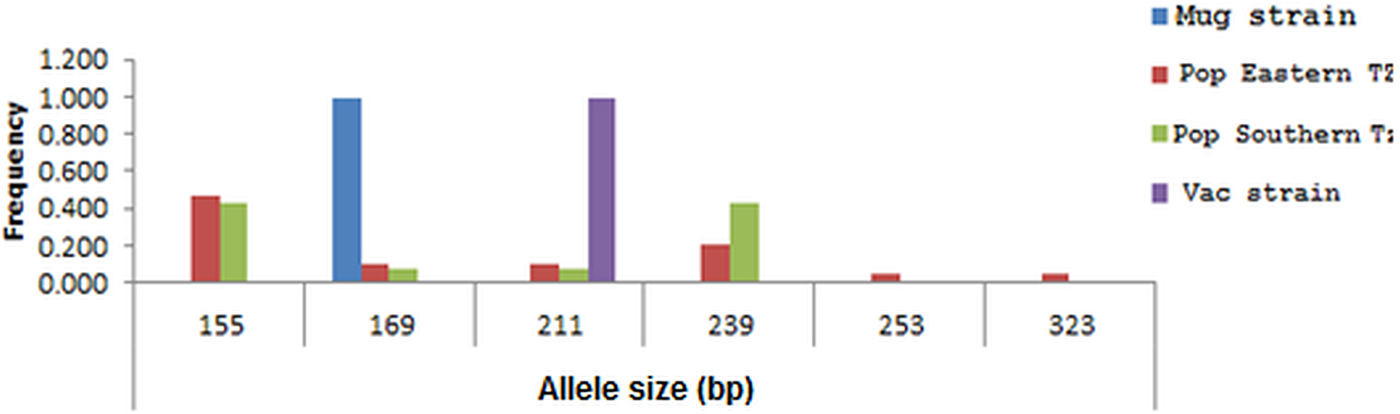
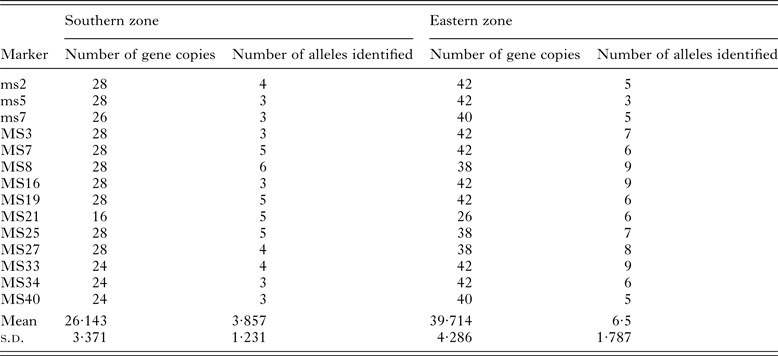
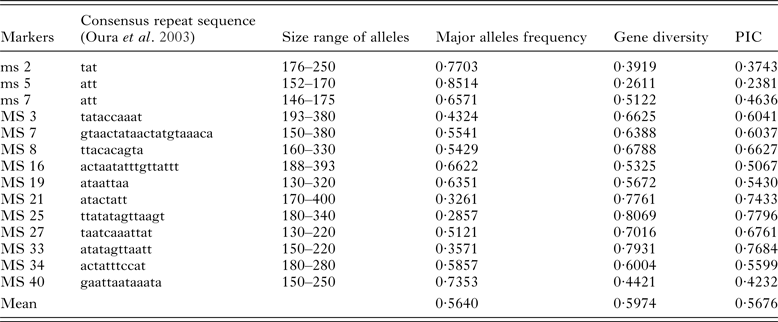
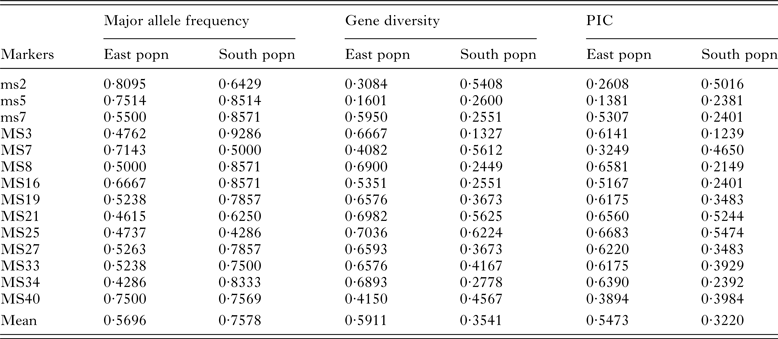
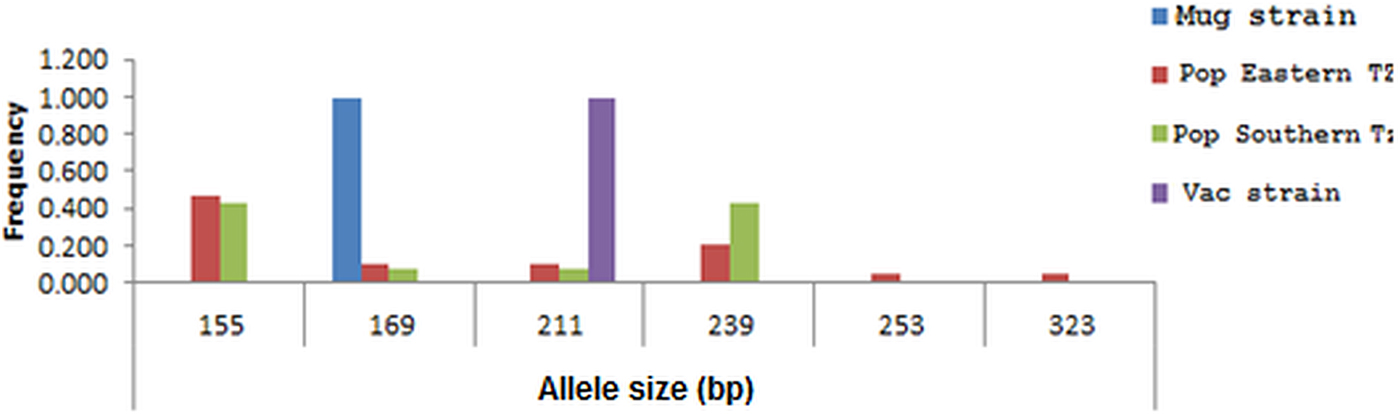
Fourteen polymorphic micro and minisatellite markers representing the 4 chromosomes of T. parva were used to genotype 39 T. parva positive samples, of which 14 were from populations sampled from the Southern zone and 21 were from the Eastern zone of Tanzania. Four samples were excluded from the final analysis because most of the markers failed to amplify. The number of alleles identified in each marker is shown in Table 1, whereas in Fig. 1, we show allele frequencies in representative loci. Major allele frequencies in all populations ranged from 0·2857 (MS 25) to 0·8514 (ms5) with a mean value of 0·564. The gene diversity and PIC values ranged from 0·2611 (ms5) to 0·8069 (MS25) and from 0·2381 (ms5) to 0·7796 (MS25), with average values of 0·5974 and 0·5676, respectively (Table 2). Analysis of samples from the Southern zone revealed major allele frequency range from 0·50 (MS7) to 0·9286 (MS3) with an average of 0·7578. The gene diversity and PIC values ranged from 0·260 (ms5) to 0·6224 (MS25) and from 0·1239 (MS3) to 0·5474 (MS25), with average values of 0·3541 and 0·3220, respectively (Table 3). Furthermore, analysis of samples from the Eastern zone revealed major allele frequency range from 0·4286 (MS34) to 0·8095 (ms2) with an average of 0·5696. The gene diversity and PIC values ranged from 0·1601 (ms5) to 0·7036 (MS25) and from 0·1381 (ms5) to 0·6683 (MS25), with averages of 0·5911 and 0·5473, respectively (Table 3).
Representative marker MS25 locus showing allele frequency identified in Eastern and Southern population, Muguga strain (Kenyan isolate), vaccine strain (FAO1). The size of each allele (in bp) is given on the x-axis.
Number of gene copies and alleles identified in each marker in Eastern and Southern zone population

ms, microsatellite, MS, minisatellite, s.d., standard deviation.
Major allele frequency, gene diversity and polymorphic information contents for 14 VNTR markers in three populations of T. parva (Eastern, Southern and vaccine strains).

ms, microsatellite, MS, minisatellite, popn, population.
Major allele frequency, gene diversity and polymorphic information contents for 14 VNTR markers in populations of T. Parva from Eastern and Southern Tanzania.

ms, microsatellite, MS, minisatellite, popn, population.
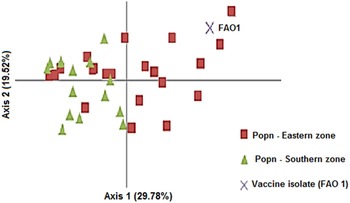
PCA was constructed using sets of MLGs. Results from PCA revealed eight genotypes of the parasite population from Southern zone, which clustered together in the bottom left quadrant. Genotypes obtained from Eastern zone parasite populations showed close genetic relatedness to Muguga vaccine strain, based on the pattern of clustering as shown in in the top right quadrant (Fig. 2).
PCA of T. parva population from Eastern and Southern zone and Muguga vaccine isolates (FAO 1). The proportion of the variation in the data set explained by each axis is indicated in parentheses.

Linkage equilibrium between pairs of loci was measured using the standard index of association (I S A) in order to test whether the parasite populations from Southern and Eastern zones comprised a single panmyctic population. The values of I S A were close to zero with L > V D supporting linkage equilibrium (LE) in both populations (Table 4).
Linkage equilibrium analyses in Eastern and Southern zones populations of T. parva

V D = mismatch variance, Ve = expected variance, I S A = standard index of association, L mc and L para = upper 95% confidence limits of Monte Carlo simulation and parametric tests, respectively (linkage analysis), LE = linkage equilibrium.
Sequence analysis of Theileria parva CD8+ T-cell antigen genes (Tp1 and Tp2) was conducted to identify antigenic variability of the epitopes within the selected antigen genes. A total of 30 and 29 sequences were obtained for Tp1 and Tp2, respectively from all samples. Results revealed a single CD8+ T-cell Tp1 epitope (VGYPKVKEEML) existing in all samples, which was also present in the Muguga strain. On the other hand, analysis of Tp2 antigen gene revealed that five out of the six distinct CD8+ T-cell epitopes were identical to Muguga strain. The exception was epitope one, which showed two protein variants, one of which was identical to Muguga strain, while the other was identical to var-2 described previously as Kiambu 5 strain by Pelle et al. (Reference Pelle, Graham, Njahira, Osaso, Saya, Odongo, Toye, Spooner, Musoke, Mwangi, Taracha, Morrison, Weir, Silva and Bishop2011). Variant-2 was obtained from Tp2 CTL epitope number two (SDEELNKLGML) in six samples M72, M78, M87, M94, M102 and M111, all of which were from the Eastern zone. Neighbour-joining tree was constructed to examine whether the sequence diversity observed in Tp2 was associated with geographical origin of the parasite samples. As depicted in Fig. 3, the tree separated the T. parva parasite populations into two major clusters. While majority of Tp2 genotypes from the Eastern zone grouped into cluster 1, cluster 2 comprised majority of Tp2 genotypes from the Southern zone. Separately, the mixed cluster comprised Muguga vaccine strain reference sequence, as well as some parasite sequences from the Eastern and Southern zones. One isolate, M119, did not cluster to any of the three groups. Genetic differentiation estimates using chi-square (χ2) suggested non significant differentiation between the two populations (χ = 15·1 P = 0·176, d.f. = 11). Gene flow estimates reported Gst = 0·045 and Fst = 0·094, indicating no gene flow between the populations.
Tp2-Neighbour joining tree showing the relationship between cattle T. parva population. M = population from Eastern zones, N = population from Southern zone, Muguga = XM760490 vaccine isolate FAO1 and TA 19865 is T. annulata (Outlier).

DISCUSSION
In this study SSR markers were used to study population structure of T. parva parasites in blood of asyptomatic cattle collected from villages in Eastern and Southern zones of Tanzania Furthermore, Theileria parva CD8+ T-cell antigen genes Tp1 and Tp2 were sequenced to identify antigenic variability of the epitopes within the parasite populations.
Several alleles were identified at one or more loci analysed. This implies that there is multiplicity of infection (MOI) in both, the Eastern and Southern zones, where cattle blood samples were collected. Occurrence of mixed infections is a common phenomenon, particularly with field samples like those used in this study. Several reasons may be used to explain mixed T. parva infections, such as diversity of parasites transmitted by field ticks, intensity of tick burden on cattle as well as the level of infection in the ticks. Previous studies conducted in Uganda (Oura et al. Reference Oura, Asiimwe, Weir, Lubega and Tait2005) similarly revealed existence of a significant MOI in field samples when analysing populations of T. parva using SSR markers. In this study, we eliminated possible allele scoring errors by adopting a quantitative method to generate MLGs each being representative of the dominant strain across the whole sample size. To avoid shortfalls due to mixed infections in field samples, as was the case in this study, cloning out samples or choosing samples with only a single allele would be preferable before generation of MLGs.
The mean number of alleles per locus as well as allele frequencies varied between Eastern and Southern zones suggesting existence of multiple genotypes in both zones in Tanzania. Parasite population from the Southern zone showed lower mean genetic diversity when compared with that from the eastern zone. The higher T. parva genetic diversity found in the eastern zone can be explained by ongoing cattle vaccination programmes using the Muguga cocktail vaccine. It was therefore not surprising to document lower diversity in parasite population from Southern Tanzania, since there has been no recent cattle vaccination against ECF in the Southern zone (Di Giulio et al. Reference Di Giulio, Lynen, Morzaria, Oura and Bishop2009). It is also likely that the high T. parva diversity documented in the Eastern zone of Tanzania may be explained by heavy tick infestations in these areas, where there are no regular tick control regimes (Wambura et al. Reference Wambura, Gwakisa, Silayo and Rugaimukamu1998). Our findings may be supported by previous work conducted in Turkey, where Weir et al. (Reference Oura, Tait, Asiimwe, Lubega and Weir2011) demonstrated significantly higher genetic diversity of T. annulata in vaccinated animals than in non-vaccinated animals.
Analysis of genotype similarity between T. parva populations and Muguga vaccine isolate revealed clustering patterns confirming sharing of MLGs. This finding may be explained by presence of unrestricted movements of cattle between zones in the country, thus introducing new parasite genotypes. Moreover, geographical sub-structuring of T. parva genotypes was observed as expected, what was further supported by neighbour joining tree constructed using Tp2 antigen gene sequences. Previous reports on T. parva genotyping revealed geographical sub-structuring of the field isolates in Zambia (Muleya et al. Reference Muleya, Namangala, Simuunza, Nakao, Inoue, Kimura, Ito, Sugimoto and Sawa2012) and Uganda (Oura et al. Reference Oura, Asiimwe, Weir, Lubega and Tait2005).
Our data on linkage equilibrium (LE) and disequilibrium (LD) between pairs of loci, as measured by value of standard index of association strongly suggested occurrence of recombination between as well as within populations. The reasons for LE in the Eastern zone would be a substantial level of genetic exchange between vaccine strains and field isolates while in the Southern zone, the most appealing reason would be the introduction of genotypes from the Eastern zone taking into consideration absence of trade barriers and policies limiting movement of cattle between zones. As demonstrated from earlier findings a high degree of genetic diversity within a population may be a result of high levels of recombination (Katzer et al. Reference Katzer, Lizundia, Ngugi, Blake and McKeever2011, Hayashida et al. Reference Hayashida, Abe, Weir, Nakao, Ito, Kajino, Suzuki, Jongejan, Geysen and Sugimoto2013). This information is very important in vaccine development as it is easier to develop a vaccine against a clonal pathogen than a highly diverse pathogen (Muleya et al. Reference Muleya, Namangala, Simuunza, Nakao, Inoue, Kimura, Ito, Sugimoto and Sawa2012), as is the case with T. parva.
Our results identified antigenic variability of T. parva epitopes occurring in Eastern and Southern zones of Tanzania, whereby Tp2 antigen gene displayed more diversity than Tp1. A significant level of homogeneity was observed within Tp1 sequences. Likewise sequence resemblance of the Tp1 epitope with the known Muguga variant, a major component of the Muguga cocktail vaccine was demonstrated. Our findings on Tp1 epitope homogeneity and sequence resemblance to the Muguga variant support a previous report (Pelle et al. Reference Pelle, Graham, Njahira, Osaso, Saya, Odongo, Toye, Spooner, Musoke, Mwangi, Taracha, Morrison, Weir, Silva and Bishop2011). Tp2 antigen gene was identical with majority of the Muguga cocktail epitopes (5 out of 6), and only variant was found to be similar to the var-2 gene, as previously reported (Pelle et al. Reference Pelle, Graham, Njahira, Osaso, Saya, Odongo, Toye, Spooner, Musoke, Mwangi, Taracha, Morrison, Weir, Silva and Bishop2011).
In conclusion, the results from the present study suggest that, there is a moderately lower genetic diversity of T. parva within populations analysed. Moreover, the results provide evidence of geographical sub-structure of the T. parva and some of field samples are genetically related to the Muguga vaccine isolate. Apparent homogeneity observed in Tp1 epitope is an indication for future production of recombinant vaccine. The findings obtained from this study pave way for future T. parva genotyping studies in Tanzania, which will involve a larger sample size from different agro ecological zones of the country. Our results on antigenic variability and genetic diversity of T. parva existing in Tanzania are essential to consolidate ongoing control measures against ECF.
ACKNOWLEDGEMENTS
Our sincere gratitude to Roger Pelle and Richard Bishop for their tireless technical support in the data analysis.
FINANCIAL SUPPORT
We gratefully acknowledge the financial support provided to the Biosciences Eastern and Central Africa Hub at the International Livestock Research Institute (BecA-ILRI Hub) by the Australian Agency for International Development (AusAID) through a partnership between Australia's Commonwealth Scientific and Industrial Research Organisation (CSIRO) and the BecA-ILRI Hub; and by the Syngenta Foundation for Sustainable Agriculture (SFSA); the Bill & Melinda Gates Foundation (BMGF); and the Swedish Ministry of Foreign Affairs through the Swedish International Development Agency (Sida), which made this work possible.