Deborah Welch Larson and Alexei Shevchenko. 2019. Quest for Status: Chinese and Russian Foreign Policy. New Haven, Conn.: Yale University Press, 352 pp.
Michelle Murray. Reference Murray2019. The Struggle for Recognition in International Relations: Status, Revisionism, and Rising Powers. New York, N.Y.: Oxford University Press, 280 pp.
Jonathan Renshon. Reference Renshon2017. Fighting for Status: Hierarchy and Conflict in World Politics. Princeton, N.J.: Princeton University Press, 328 pp.
Steven Ward. 2017. Status and the Challenge of Rising Powers. New York, N.Y.: Cambridge University Press, 282 pp.
IN a 2018 address to the United Nations, American President Donald J. Trump asserted, “My administration has accomplished more than almost any administration in the history of our country.” Humiliatingly, the audience laughed at him. “The United States is stronger, safer, and a richer country than it was when I assumed office,” he continued undaunted, “we are standing up for America and for the American people.”Footnote 1 It is tempting to dismiss these boasts as those of an unusual leader, but while Trump may be unusual,Footnote 2 he is not alone. From Brazil and Hungary to the Philippines, leaders the world over are bluntly asserting their international status and bristling at encroachments upon it. In a 2014 address justifying the annexation of Crimea, Russian President Vladimir Putin accused the West of “constantly trying to sweep us into a corner because we have an independent position, because we maintain it, and because we call things like they are and do not engage in hypocrisy. But there is a limit to everything.”Footnote 3 In a 2019 speech, Chinese President Xi Jinping boasted, “The Chinese nation has realized a tremendous transformation: it has stood up, grown rich and is becoming stronger; it has come to embrace the brilliant prospects of national renewal. This phenomenal transformation brings infinite pride to every son and daughter of the Chinese nation.”Footnote 4
Why do leaders invoke national status in their public statements? What consequences does this have on world politics? In recent years, a growing literature has developed to answer these questions. Status scholarship, William Wohlforth argues, “has become mainstream. It has gone global.”Footnote 5 By our count, there have been at least eighteen scholarly monographs in this past decade alone that focus on status, prestige, recognition, and related topics.Footnote 6 Scholars have pointed to status as the primary cause of arms races, territorial expansion, and diplomatic crises, as well as of the outbreak and intensity of interstate wars.Footnote 7 On this view, Trump, Putin, and Xi are not outliers. Their obsession with their countries’ standing reflects impulses that have driven states’ foreign policies throughout history.Footnote 8
The four books under consideration here represent some of the best recent attempts to place status at the center of the study of world politics. Their arrival could not be more timely. As China’s relative power increases, there are worries that this could shake up the membership of the great powers, exacerbate concerns over standing, and become a source of conflict.Footnote 9 So, too, the ascent of populist demagogues has generated anxiety about how questions of status could inflame domestic divisions and fuel international rivalries.Footnote 10 If world politics is entering a period in which boasts and brags are supplanting discretion and diplomacy, then instability will likely increase. It is essential that scholars help decipher these disquieting trends.
The aim of this review is to assess the progress of the status literature. We ask three questions: What is status? How does it work? And what effects does it tend to have? On the one hand, the literature has impressively convergent answers to these questions. There is near unanimity that status consists of collective beliefs about a state’s standing and membership, based on valued attributes, and is recognized by voluntary deference. It also agrees that status hierarchies are common in world politics, that states crave high perches within these hierarchies, and that a combination of psychological and domestic political factors push states to engage in status-seeking behavior. It concurs that although status does not predestine violence, the pursuit of status does tend to destabilize interstate relations. Therefore, states should recognize each other’s status claims and find ways to accommodate them.
On the other hand, this convergence is not only a sign of progress, but also an obstacle to it. By agreeing on what status is, why states want it, and how they tend to compete for it, the status literature has made great strides in addressing fundamental dynamics in international politics. But this apparent consensus conceals crosscutting logics that ought to be openly juxtaposed. For instance, by defining status as both standing and membership, the literature has unreconciled contradictions in its core concept, and makes it tougher to measure persuasively. By developing psychological and domestic pathways, the literature has fleshed out the causal processes through which status can influence foreign policy without fully recognizing tensions within and between these pathways. By focusing on status as a destabilizer, the literature misses the ways that status can help states avoid conflict and promote cooperation under certain conditions. For continued progress, we should acknowledge these tensions and refine our theories and evidence to help adjudicate them.
A single review article cannot cover the entirety of any body of literature, so in what follows, we focus on the most popular topic: studies connecting status to foreign policy and interstate conflict, which is the focus of all four books under review. This means that we must exclude studies that look at how status affects internal conflict, global governance, and other issues, although some of our points may also apply to them.Footnote 11 We begin in Section I with a brief overview of the four books. In Section II, we consider some of the challenges scholars have encountered when seeking to define and measure status. Section III explores the varied and contradictory ways scholars have thought about how status influences foreign policy. Section IV examines the nexus between status and competition, and sketches a wider range of possible ways status may shape the prospects for peace. In Section V, we conclude with suggestions about how the status literature can improve its theoretical foundations and expand the scope of its empirical applications.
I. Summary of the Books Reviewed
The four books under review have the same essential purpose: to highlight how status matters in world politics. In Status and the Challenge of Rising Powers, Steven Ward argues that status provides the most compelling explanation for why rising powers pursue revisionist foreign policies designed to overturn existing international orders (pp. 3–4). In The Struggle for Recognition in International Relations: Status, Revisionism, and Rising Powers, Michelle Murray contends that the failure to recognize rising powers’ status claims is the primary cause of spirals of competition and conflict during power transitions (pp. 14–17). In Fighting for Status: Hierarchy and Conflict in World Politics, Jonathan Renshon demonstrates that states frequently fight with one another to improve their standing within particular status communities (pp. 21–25). In Quest for Status: Chinese and Russian Foreign Policy, Deborah Welch Larson and Alexei Shevchenko maintain that it is the pursuit of status, more than wealth or power, which drives the foreign policy choices of great powers, such as Russia and China (pp. 14–16).
Previous reviews of the status literature focus on the challenge of defining status and distinguishing it from related concepts like “honor,” “prestige,” or “reputation.”Footnote 12 These reviews also push the status literature to more clearly delineate the effects of status from those driven by power or interests.Footnote 13 These four books make considerable progress in addressing these concerns. First, all rely upon the same definition of status.Footnote 14 In its most general form, status refers to “an actor’s position within a social hierarchy. It may mean either membership in a highly regarded group … or rank within a group” (Ward, p. 35). Collective assessments of status depend on “others’ perceptions of a state’s ranking on a set of valued characteristics” (Murray, p. 45). In international politics, these “prized attributes” can include “military power, economic development, cultural achievements, diplomatic skill, and technological innovation” (Larson and Shevchenko, p. 3). But status is more than the mere possession of valued attributes. Status is also social. It “clarifies what rights, obligations, and patterns of deference from others the actor should expect as well as how the actor is expected to behave with respect to others in dominant and subordinate positions” (Renshon, p. 33). High-status states enjoy certain rights and responsibilities, which low-status states accept.
Second, all four provide detailed accounts of why status is not a marginal concern in international politics, but a core and continuous one. Renshon observes that leaders are “plainly obsessed with investing in, seizing, and defending” status, making it “one of the most sought-after qualities in world politics” (pp. 1, 3). Similarly, Ward argues that status is “not the only resource that motivates states, but it is a prominent and underappreciated one” (p. 38). Leaders may covet status for a variety of reasons. Some desire status because it is a “valuable resource” that “confers benefits on its holders” in interactions with rival states (Renshon, pp. 52–53). Others seek status because “having higher status increases collective self-esteem and pride” (Larson and Shevchenko, p. 3). Still others value status because of “its significance for domestic political legitimacy” (Ward, p. 37). It is precisely because status is so valuable, whether for instrumental or intrinsic reasons, that the decision to deny another state’s status claims can be so consequential (Murray, pp. 12–13). Because status can appear zero-sum and particular status positions, such as that of a great power, are relatively scarce, this raises the stakes for whether a state is included or excluded.
Third, all four detail the ways that the pursuit of status can have destabilizing consequences for world politics, which neither a focus on power nor interests would predict. Ward argues that “anxiety about status” can advantage “hardliners over moderates in domestic contests over the direction of foreign policy” (p. 204). He attributes the poisonous revisionism of Wilhelmine Germany, Imperial Japan, and Interwar Germany to these “obstructed or thwarted status ambitions” (p. 208). Murray contends that rising powers that are denied “world power status” lash out by aggressively pursuing high-status markers, such as large navies (p. 80). She contrasts Britain’s successful recognition of American aspirations with its rejection of German ambitions, which resulted in an arms race, then war (p. 191). Broadening the analysis beyond rising powers, Renshon finds states that are dissatisfied with their status in general are more likely to go to war, favoring weak, high-status targets they can embarrass and defeat (p. 258). Using a combination of experimental, statistical, and historical evidence, he demonstrates that “once triggered, heightened status concerns set in motion a set of consequences at the individual and state level” that more often than not end in conflict (p. 256). Larson and Shevchenko acknowledge that states may “pursue varying strategies for attaining status, depending on the openness of elite clubs and the similarity of their values with those of the established powers” (p. 6). Yet after surveying more than five hundred years of diplomatic history, they conclude that “both China and Russia are hypersensitive to perceived slights and have used military power to assert superiority” (p. 244). Even attempts to bolster one’s status through peaceful means can “shade into social competition, insofar as a state is stressing new criteria for status” (p. 245). Conflicts over status are not inevitable, but other things equal, status makes cooperation harder.
II. What Is Status? The Concept and Its Complications
Unlike many social science concepts, status is not essentially contested. The building blocks of status are well understood: there exists a set of collectively valued attributes in world politics, states occupy different positions on these valued attributes, and high-status states have different rights and responsibilities than low-status ones. Despite surface agreement, however, the works considered here reveal significant differences. This is most striking in two related areas: whether status should refer primarily to standing or membership and whether status is best captured using quantitative or qualitative methods. We consider each in turn.
Defining Status: Standing versus Membership
A central ambiguity in consensus definitions of status is whether it is best thought of as a continuous measure of relative standing, a dichotomous attribute of group membership, or some combination of both. Most definitions of status are agnostic on this question. They acknowledge that status can refer to either “membership in a defined club” or “relative standing within such a club.”Footnote 15 If states with high-status attributes tend to enter high-status clubs, this ambiguity would be unproblematic. Yet theoretically, standing and membership are different concepts, and empirically, they are often mismatched. Postwar Japan ranked high on measures of economic influence, but “[lacked] the institutional privileges accorded ‘legitimate great powers’” in the UN system.Footnote 16 By contrast, “material factors would surely have predicted France’s relegation to the international system’s periphery” after the Second World War, yet it was nevertheless rewarded with a permanent seat on the UN Security Council.Footnote 17
In practice, different authors end up emphasizing different aspects of status. Some focus on standing, which equates with esteem, and see status as a kind of metric states can use to establish baselines, to draw comparisons, and to assess worth. Renshon comes closest to this position. He notes that “status as rank is not about ‘having’ versus ‘not having’; it concerns how much we have relative to others” (p. 35). The benefit of standing is that it allows one to make fine-grained assessments of where states are positioned. Austria-Hungary and Germany were both members of the great power club prior to the First World War, but the former was falling from the ranks while the latter was ascending them, a difference that mattered in their foreign policy orientations.Footnote 18 The drawback is that standing is underspecified. Do valued attributes refer primarily to the impressive means states possess or to the virtuous ends they pursue? Who decides which attributes are prized and how? Should we treat standing as a universal metric or disaggregate it into one’s standing in a particular issue area, institutional context, or geographic region?Footnote 19 Consider Brazil and India, two states with high status aspirations. Brasilia’s claim has rested on Brazil’s economic strength and the establishment of a kind of “consensual hegemony” over states in South America, while New Delhi has focused on projecting India’s military strength and cultivating bilateral ties with the hegemon, the United States.Footnote 20 One, the other, both, or neither could be considered high status, depending on what criteria and whose judgments we rely on.
Other authors choose to focus on membership, which treats status as closely related to recognition. The attributes that states possess are less important than whether high-status states choose to grant others membership in high-status clubs. Murray is a leading proponent of this approach. She emphasizes that status “refers to a recognized identity, not the acknowledgement or acceptance of a state’s characteristics or capabilities” (p. 46). A state cannot “simply assert its social status … only when recognized does it assume the authority it needs to secure the identity it seeks” (p. 46). The advantage of using membership is that which states are members of elite clubs and which are not is often uncontroversial. We can simply assume that states that sit on the UN Security Council, the IMF executive board, or the WTO core negotiation group have higher status than those that are excluded. Yet membership exhibits many of the same problems as standing. Why are some states admitted over others? Why are some clubs more prestigious than others, and how do we know? For example, outsiders attribute outsized influence to the World Economic Forum held annually in Davos, Switzerland, while insiders dismiss it as a “big cocktail party.”Footnote 21 These issues are compounded in the case of certain clubs, such as the “regional powers,” for which membership is more implicit, informal, and sometimes contested.Footnote 22 The reasons for, and consequences of, club membership may also have little to do with status. States grant or withhold recognition to one another for a variety of reasons, including to exercise strategic leverage, to avoid third-party punishments, and to achieve geopolitical goals.Footnote 23 States join clubs for a variety of reasons, too, only some of which may be tied to status aspirations. And if membership tends to be influenced by nonstatus considerations, then membership loses much of its meaning.
Many authors adopt a flexible approach, lumping standing and membership together and shifting between them. An example of this is Ward’s discussion of Wilhelmine Germany. There are passages in which Ward suggests that Kaiser Wilhelm II and his advisors simply desired more respect among the great powers (pp. 73, 78). Yet there are others in which he argues that what they really wanted was recognition as a “world power” (p. 81), which included a right to “naval equality” and the “splitting [of] the entente” (pp. 83, 86). The difference matters a great deal. If we focus on standing, Germany was a rising great power, an economic and military model for much of Europe, whose revisionism appeared premature and self-defeating. Yet if we emphasize membership, Germany rated below Britain, and its revisionism seemed to be the only way it could force its way into the world-power club. Germany embraced revisionism not because it cared about status in general, but because it became obsessed with one kind of status and not the other.
In short, what is missing is a clear set of theoretical expectations about why states may care more about membership than rank or vice versa, and how one goes about aggregating valued attributes in each case. Hybrid solutions sidestep these essential questions and allow scholars to conceptualize status however is convenient for their claims. Hybrid solutions also downplay essential differences between these two kinds of status. For example, when states focus on standing, their assessments tend to be zero-sum, yet when they emphasize membership, they need not be.Footnote 24 Just as light may be a particle and a wave, status may be standing and membership, but one should not equate the two, and which kind of status states are preoccupied with matters a great deal.
Measuring Status: Quantitative versus Qualitative Approaches
Assuming a clear conception of status, there remains the matter of measuring it. Some scholars use quantitative data to generate cross-national measures of rank. Renshon represents the cutting-edge of this method. He uses diplomatic exchange data to identify states that reside in central positions within diplomatic networks (pp. 124–32), and to identify the boundaries of distinct status communities (pp. 140–48). An alternative approach uses qualitative methods to identify status motives in the language of policymakers. Ward typifies this approach. “When actors speak in terms of the rights that the state is owed on the basis of its position,” he observes, “they are articulating a claim to status” (p. 63). When leaders invoke their national honor or bristle at perceived humiliations, this is taken as evidence that they are driven by status, especially when uttered in private (Murray, p. 85).
The choice of method is tied in part to how one conceives of status. One of the main advantages of quantitative measures is that they allow scholars to capture where states rank in the international hierarchy. This can help to illuminate the extent to which status departs from material capabilities (see Renshon, pp. 135–40) and to provide insights as to why some states “over-” or “under-perform” on status given their material endowments.Footnote 25 An obvious challenge of quantitative approaches, of course, is deciding how best to operationalize rank. Some scholars, including Renshon, use measures of diplomatic exchange, based on the assumption that establishing an embassy is an act of social recognition; others look at membership in international organizations, based on the idea that belonging to multiple clubs conveys social prominence.Footnote 26 Some rank states based on their aggregate attributes, such as the number of diplomats they host; others, including Renshon, rank states based on their centrality within broader networks of diplomatic exchange.Footnote 27 Some rank states relative to the entire international community; others, including Renshon, rank states within their home regions or among relevant “status communities.”Footnote 28 Each of these empirical choices is defensible in the abstract, and Renshon does an admirable job validating his particular method, which uses Google’s PageRank algorithm with other more-direct measures of status, such as official state visits (pp.132–35). But the more baroque the technique for generating status rankings, the less plausible it is that politicians will practice similar methods of accounting when making their own status assessments.
More important, none of these quantitative measures capture voluntary deference, and as a result, they are at best rough proxies for status. Centrality within diplomatic networks, for example, is partly a product of money: wealthy states can afford to send more diplomats abroad, while their large economies entice diplomats in return.Footnote 29 Diplomatic recognition can also be an outgrowth of coercion. The fact that North Korea and Taiwan “receive fewer embassies than their capabilities would warrant”Footnote 30 could be evidence of their pariah status or a reflection of the arm-twisting that the United States and China apply to others. And even if diplomatic actions are independent of bribery or threats, they could reflect shared interests or ideological affinities and be a product of choice, not deference. Unless wealth, power, and interests can be disentangled from diplomatic recognition, it is unclear that status is driving recognition.
Qualitative measures approach status differently. Instead of trying to measure status ex ante, they look for evidence of status ex post, in the statements and actions of policymakers. The advantage of this approach is that it has the potential to capture the subjective and perceptual aspects of status: if leaders perceive that their states occupy particular status positions, and if they describe their actions as efforts to increase their status, then this supports status accounts. The primary problem is that leaders rarely talk about status as scholars define it. Instead, they use words or phrases that seem to evoke status: national honor, national dignity, national greatness, and so on. Yet these phrases may have little or nothing to do with status defined as high rank or membership in elite clubs. After all, there is honor among thieves, too. Leaders may also favor this language for psychological reasons, as a way to convey emotions, such as pride, that may be unrelated to where their states stand in social hierarchies.Footnote 31 Alternatively, leaders may use emotional language strategically to signal their interests to foreign audiences or to mobilize domestic support.Footnote 32 In these cases, it is the rhetorical necessities rather than the status hierarchies that are doing the causal work.
A related problem is the existence of mixed motives and the challenge of disentangling security or economic interests from status concerns. Consider Germany’s naval buildup prior to the First World War, a case mentioned by all four authors (Larson and Shevchenko, pp. 8–9; Murray, pp. 94–95; Renshon, pp. 187–88; Ward, pp. 79–80). While status may have been a motive for some German policymakers, others saw a large navy as a military instrument to deter British intervention in a continental war, a diplomatic tool to buttress claims to territorial concessions in China, and a domestic political maneuver to discredit Social Democrats.Footnote 33 The fact that naval officers, in particular Admiral Alfred von Tirpitz, were the strongest proponents of becoming a world power suggests that organizational culture and parochial interests can drive status language. Even if we could be clear about what kind of rhetoric reflects status concerns, it can be difficult to determine whose words matter most.
One final issue with qualitative assessments is their tendency to focus almost exclusively on examples of the pursuit of status, not deference to it. Larson and Shevchenko, Murray, and Ward provide ample evidence that states like Germany, Japan, Russia, and China desired respect, but little evidence that status translates into deference. Of course, states might still seek esteem by asserting high status regardless of whether others offer deference. If that’s the case, then the pursuit of status would verge on solipsism. If status hierarchies are genuinely social and shape world politics in more systematic ways, we need to see evidence that other states at least recognize and likely defer to those at the top of the totem pole. The problem here is that states align their policies with the preferences of the powerful for a variety of reasons that have nothing to do with status. In his study of the 1899–1902 South African War, Jonathan Mercer finds that Britain’s adversaries did not acknowledge its status and refused to defer, while its allies deferred to it out of “a desire for security” rather than “mutual admiration.”Footnote 34 The weak submit to the strong all the time in world politics, but deference alone is not proof that status hierarchies exist, or that status motives are driving behavior.
In sum, both quantitative and qualitative approaches have their advantages. The former allows us to construct useful cross-national metrics of relative rank. The latter provides compelling evidence that status is driving the assessments and actions of policymakers. Yet neither approach fully captures the primary collective manifestation of status as voluntary deference. And if other states do not defer to high status, then the pursuit of status itself may be a chimera.
III. How Status Works: Conditions and Mechanisms
Let us assume that we can settle on a clear conception of status and measure it in practice. How does status work? Status scholars agree that international politics is full of status hierarchies and that states are driven to improve their positions within them. Yet they differ on what conditions activate status concerns and, once activated, by what mechanisms status concerns influence foreign policy. We delve into conditions and mechanisms, respectively.
Conditions: Prompted by Position or a Response to Events?
While scholars maintain that states desire esteem, they acknowledge that status-driven behavior can vary in frequency and intensity. A number of scholars argue that there are certain positions that compel states to be concerned with status. Larson and Shevchenko place particular emphasis on powerful states and their desire to attain great power status. “Great power status carries with it the expectation that the state will be consulted on important issues,” they observe, and as a result, “governments have spent enormous sums on efforts to achieve or maintain great power standing, at the expense of their state’s power and wealth” (pp. 233–34). Ward also argues that powerful states have a particular interest in status, especially if their material capabilities are rising. “Increasing wealth and military power make a rising state more like established high-status powers,” he observes, “which prompts people who identify with the riser to expect—and demand—convergence in terms of standing, influence, and rights” (p. 39). Renshon provides perhaps the broadest positional argument. He argues that states will be most interested in status when there is a “divergence between the status accorded an actor and what they believe themselves to deserve” (p. 53). When there is an inconsistency between a state’s objective capabilities and its subjective rank within a particular community, “status dissatisfaction” can prompt greater interest in achieving elevated status (pp. 63–64).
It is worth noting that this list of positions is not exhaustive. While Larson and Shevchenko emphasize powerful states’ interests in status, others contend that middle powers should be particularly status-obsessed because they have the most to gain if they are admitted to exclusive clubs.Footnote 35 Still others observe that small states should be the most invested in status because their material weakness means that elevated status is one of the few remaining ways they can gain influence.Footnote 36 While Ward contends that rising powers should be preoccupied with status, others maintain that declining powers should be most sensitive to their relative rank because status can help offset drops in relative capabilities.Footnote 37 Ward admits that the literature has “not developed a comprehensive account of variation in the salience of status concerns” (p. 39).
The downside of rooting status in particular structural positions is that it becomes difficult to disentangle the influence of status from relative power. Great powers may be more assertive in defending their rank and rights, as Larson and Shevchenko suggest, but they may also be more assertive in general, regardless of the issue. Rising powers may have reasons to be more status conscious, as Ward claims, yet they also tend to have expanding interests and growing capabilities, both of which can correlate with aggressive behavior. “If power determines prestige,” Mercer observes, “then distinguishing the concepts is pointless.”Footnote 38 Status is then the language with which states discuss power positions. Renshon provides a way around this issue by underscoring the disjuncture between status and power. But Renshon’s approach introduces a second issue: How do we identify inconsistencies or deficits in status? We have already noted the challenges in measuring status. Identifying status deficits requires an additional step: we must generate baseline expectations of rank based on material capabilities, which we then compare to those derived from status. Yet there are a range of contested ways to measure national power, doubling the difficulty of demonstrating where a state stands and making it hard to know whether a state is receiving too little, too much, or the proper amount of respect.
An alternative approach is to see status as triggered less by position than by humiliating events. Murray provides the best example of this approach in her discussion of what she calls “misrecognition” (p. 47).Footnote 39 When established powers “treat a rising power as an inferior actor” (p. 71), denying it the status that it believes it deserves, this is “experienced by the rising power as disrespect” (p. 73). Rising powers respond to humiliation by engaging in “forceful contestation with the established powers” designed to “compel these states to recognize its aspirant status” (p. 74). Ward offers a similar, though slightly different, account in his discussion of “status immobility” (pp. 3–4). When established powers engage in repeated “acts of status denial,” it creates the perception that rising powers face a “glass ceiling” (p. 47). But rather than responding by trying to compete with the established powers on their own terms, Ward argues that humiliated states will embrace rejectionist policies that aim to “protest, delegitimize, or overthrow” the established international order (p. 51).
While Murray and Ward focus on cases of disrespect by established powers, other authors highlight how humiliating events can spark an obsession with status. Ayşe Zarakol argues that defeat in major wars can saddle states with shameful stigmas that they strive to correct.Footnote 40 Joslyn Barnhart finds that states that experience an involuntary territorial loss seek to restore their status through their own acts of territorial aggression.Footnote 41 Both Paul Saurette and Ahsan Butt contend the shock and humiliation of the 9/11 terrorist attacks prompted the United States to respond in an aggressive manner.Footnote 42 Although not a central part of their account, Larson and Shevchenko list “humiliating military defeats, exclusion from elite clubs, disregard for their interests, or economic difficulties” as the kinds of events that can prompt a state to seek to restore its tarnished status (p. 240). As with the structural positions described earlier, the list of events that could spark status seeking is long to the point of indeterminacy. If everything from defeat in major wars to economic fluctuations to unkind diplomatic exchanges is sufficient to activate status concerns, then humiliations are wildly over-predictive. There will always be some injury that scholars can point to after the fact to explain a state’s behavior.
There are additional challenges in connecting status to cycles of action and reaction. One is that it can be difficult to separate insults and humiliations from regular hard bargaining. Ward cites Britain’s refusal to accept “naval equality” with Germany prior to the First World War as evidence that London rejected Berlin’s status aspirations (p. 83). Yet Britain had sensible strategic reasons to maintain naval supremacy. As Foreign Secretary Sir Edward Grey observed, “If the German Navy ever became superior to ours, the German Army can conquer this country. There is no corresponding risk of this kind to Germany.”Footnote 43 Britain was hardly dismissive of German concerns. London engaged Berlin in arms control negotiations on multiple occasions—it simply refused to accept the demand that it remain neutral in a continental war in exchange for reductions in German shipbuilding. All of this is consistent with a traditional defense of British interests rather than with an attempt to denigrate Germany’s status.
A second is that diplomats have strategic incentives to use the language of humiliation. They may be seeking a more favorable settlement or be signaling a willingness to use force. As Renshon acknowledges, German Foreign Minister Alfred von Kiderlen-Waechter confessed to “fanning the flames of nationalist fervor” during the Second Moroccan crisis in 1911 “in order to signal resolve” (p. 204). Appeals to status in these cases are a consequence of incompatible interests, not a cause of them. A final challenge is that states often respond to dramatic events not only because they are humiliating, but also because it is in their interest to do so. Larson and Shevchenko argue that Russia and China embraced military reforms after “humiliating military defeats” because these events were “damaging to morale” and “[made their] inferiority visible to others” (p. 24). Yet an equally compelling reason to embrace reforms is pragmatism. They can help to remedy institutional defects and to prevent future defeats.Footnote 44 Just because events are humbling does not mean that the actions that follow them are necessarily rooted in status.
Of course, it may well be that status concerns are catalyzed both by a state’s position and by events. But there are tensions within and between positional and events-based explanations. There is no consensus logic for which structural positions accentuate status concerns, nor a convincing technique for separating status from power. Event-based explanations often boil down to humiliations, but what constitutes a humiliation is capacious and hard to extricate from international and domestic bargaining. And if states are doomed to seek status by position, then events are largely epiphenomenal. Yet if humiliating events drive status, then it becomes harder to predict in advance which kinds of states will be most obsessed with status.
Mechanisms: Leader Psychology and Domestic Pathologies
Once status concerns are activated, they must influence foreign policy decisions in some clear and consistent way. In general, scholars have focused on two distinct, although potentially connected, mechanisms. The first centers on the psychology, perceptions, and emotions of leaders. Drawing on Social Identity Theory (sit), Larson and Shevchenko argue that “people derive part of their identity from membership in social groups” and that there exists “an innate human desire for one’s group to be superior” (p. 3). Leaders respond to perceived inferiority by pursuing “identity management strategies” designed to “improve [their state’s] standing” (p. 5). Renshon likewise argues that “leaders are typically assumed to identify with the status concerns of the states they represent” (p. 10). Once status concerns are triggered, leaders will attach an “increased value for status” (p. 60) and be willing to run greater risks to acquire it. He argues that this is particularly true for leaders with high Social Dominance Orientation (sdo), defined as “one’s preference for (or comfort with) dominance and hierarchy” (p. 64).
There is no shortage of examples of prideful leaders around the world, so it makes sense that scholars would place them at the center of how status shapes foreign policy. But as Ward and others have pointed out, we must be careful about how we translate social psychology to world politics.Footnote 45 Many of these theories, such as sit, were originally designed to understand individual attitudes toward group membership, not to provide a complete account of intergroup relations.Footnote 46 Thus, although studies have established that individuals exhibit in-group favoritism, there is little evidence that assignment to a group increases out-group antipathy or that the intensity of in-group bias is correlated with aggression.Footnote 47 Moreover, studies suggest that individuals in lower-status groups tend to display less in-group favoritism and to perceive more in-group variability “so as to mitigate the consequences of being tarred with the same brush.”Footnote 48 How one translates these findings to world politics is unclear, but one possibility is that individuals in lower-status states would actually be less nationalistic and less invested in their state’s status, a prediction that is at odds with Larson and Shevchenko and others. Although the alternatives might be circumscribed, individuals in lower-status states may identify more with subnational, regional, or ethnic identities or alternatively, with pan-national, religious, or even cosmopolitan identities, than with their nations.
A related issue concerns the levels-of-analysis problem. Theories that emphasize leadership psychology assume, as Renshon does, that leaders attach as much value to their state’s reputation as they do to their own. But many leaders are more concerned with their personal prestige; they want to remain in office and reap the rewards of power. So if the pursuit of status abroad comes at the expense of prestige at home, most will likely choose the latter. There may even be some cases, as Rebecca Adler-Nissen emphasizes, in which international stigmas can be a source of individual pride, a sign that a leader is willing to defy the international community to defend the unique moral virtues of their state.Footnote 49
More significantly, scholars have not provided clear guidance about what kinds of leaders will be most emotionally invested in status. Some allude to a leader’s personal history. Murray references the Kaiser’s penchant for delivering “excited” and “emphatic” speeches (pp. 106, 118), which some have attributed to his sense of insecurity after being born with a withered arm.Footnote 50 Others emphasize a leader’s ideological commitments. Ward speculates that leaders who are “strong nationalists” will be particular invested in their state’s rank (p. 55). Renshon emphasizes dispositional features of leaders’ personalities, singling out “high-SDO subjects” as “particularly susceptible to the deleterious effects of status concerns” (p. 64). Whichever factor one focuses on, the challenge is how to separate a leader’s dispositions and attitudes from his or her context and behavior. Recent studies, for example, have shown that SDO is “not a relatively stable, fixed individual difference variable” but a product of the “specific forms of group-based inequality” relevant to the respondent.Footnote 51 It is exceedingly difficult, in other words, to divorce individual dispositions from their social context. Leaders who are strong nationalists may be particularly sensitive to humiliations and thus more likely to clash with rivals, or they may be more likely to lash out at rivals simply because they are strong nationalists.
An alternative mechanism through which status can shape foreign policy is domestic politics. Ward provides the best example of this argument. He contends that hardliners can exploit perceived foreign insults to “undermine moderate leaders” and force a state to adopt “an aggressive, rejectionist foreign policy couched in the language of status” (p. 57). These dynamics are most likely to occur when leaders are “less secure from replacement by rivals” (p. 60) and when nationalists “represent a significant part of a leader’s governing coalition” (p. 58). Although not the main focus of their theory, Larson and Shevchenko also hint at the importance of domestic motives for status seeking. They document how “the drive for political equality with the United States” was a “key ingredient … of domestic legitimacy for both Soviet and post-Soviet rulers” (p. 183). States pursue status not only because of co-alitional pressures, but also to cultivate broad public support.
The focus on domestic politics is compelling because it provides a plausible political account of how status concerns can shape the policy process. At the same time, elements of the domestic political story are underspecified. First, it has not been demonstrated that domestic constituencies place much stock in status. Most publics in most places tend to hold favorable views of their countries and suspicious views of other countries, while assessments of “national pride” tend to be driven more by domestic factors, such as levels of economic inequality, than international ones.Footnote 52 There are good reasons to believe that most people either do not know or do not care what other countries think about them.Footnote 53 Nor do public sentiments appear to be strongly tied to international triumphs or defeats. In an extensive statistical analysis, Andreas Wimmer finds that “countries that fought many wars with other states since 1816 are neither more nor less proud than more peaceful countries … nor are countries that lost those wars less proud.”Footnote 54 Of course, there may be concentrated interest groups that worry about international rankings. Yet nationalist lobbies do not necessarily agree on which policies will improve their state’s status, nor do they always possess sufficient influence to impose their preferences on policymakers. The literature posits large, status-sensitive constituencies, but this is more assumed than demonstrated.
Second, nationalist groups articulate collective grievances almost constantly, so it is not clear that status can explain why publics shift their support from moderates to hardliners. Interwar Germany provides a useful example. Ward argues that the Nazi party was able to exploit public anger about reparations, especially the 1929 Young Plan (pp. 150–51). However, the evidence for domestic outrage at this international insult is thin. While extremists rejected the plan, the Reichstag voted to accept it by a 318 to 82 margin, and a subsequent popular vote on the issue had low turnout (15 percent) but high approval (95 percent). Adolf Hitler did not take power until four years later, and foreign policy played a limited role. Indeed, as Jack Snyder points out, Hitler “soft-pedaled his Lebensraum theme in the crucial years when the Nazis were winning huge electoral successes.”Footnote 55 Hardliners may try to exploit foreign policy setbacks, but their political success often depends more on their capacity to seize resources, attract recruits, build parties, and offer compelling domestic programs. Status claims may follow nationalist groups’ electoral or political successes without necessarily causing them.
Third, scholars have not specified which regimes produce the strongest pressures to pursue status. One might assume that democracies, in which leaders are responsive to domestic publics, may be most inclined to status seeking. Yet democratic institutions are also governed by norms of equality, which would seem to diminish the salience of arguments based on hierarchy and rank. Conversely, autocratic leaders tend to have the kinds of personalities, such as a high sdo, which would make them receptive to status arguments. At the same time, they are less beholden to their publics and are more invested in maintaining domestic control, which may be only loosely connected to their state’s global standing. Ward’s claim that insecure leaders who are beholden to nationalist parties are particularly prone to status seeking is reasonable, but borders on tautology.
In sum, each of the mechanisms linking status to foreign policy is plausible, but the literature lacks a developed theory of the interaction between leader psychology and domestic politics. Do leaders manipulate status to bolster their domestic authority? Do domestic hardliners force reluctant leaders to pursue status? Or do elites and masses sing from the same nationalist hymnal? Whether leaders are hypocrites, hostages, or true believers has profound implications, and the literature has muddied matters by portraying them as all three.
IV. The Effects of Status Seeking: Competition and Its Competitors
If states are compelled to seek status for wide-ranging reasons, it raises the question of what impact so doing has on world politics. For the most part, scholars worry that the pursuit of status will be destabilizing. While careful to note that the pursuit of status does not always generate competition or conflict, the consensus is that status impedes cooperation. The association of status seeking with conflict and instability, however, raises a number of issues. We elaborate two: the extent to which the pursuit of status demands competition and the extent to which status competition results in conflict.
How Pervasive Is Status Competition?
One issue the literature is divided on concerns the extent to which threats and the use of force are required to adjudicate status rankings. Some authors see a relatively tight connection between status and competition. Robert Gilpin famously argued that prestige is “ultimately imponderable and incalculable,” and is only known when “tested … on the field of battle.”Footnote 56 Renshon provides compelling evidence to support this claim. His statistical results indicate that “even just the initiation of conflict— independent of outcome—boosts a state’s status ranking by three ranks over the course of ten years” (p. 263). While less deterministic, Murray finds that rising powers that have been denied great power status often respond by investing in “exemplary military power” to “compel the recognition” they desire (p. 80). Such “struggles for recognition” can quickly devolve into arms races, territorial scrambles, containment, and war (p. 84).
But it is unclear how far one can push this logic. Most scholars acknowledge that states are unlikely to compete over status unless there is already some underlying conflict of interest.Footnote 57 Most accept that power political concerns will moderate status competition. States are unlikely to engage in competition if the prospects of victory are dim (Renshon, p. 168).Footnote 58 As a consequence, there is a tendency to focus on great power rivalries over status. But this creates a problem: great powers are more likely to compete in general, so it can be difficult to know whether competitive behaviors are a response to status or a byproduct of power. It is also unclear why being an aggressor should raise a state’s esteem and why a reputation for achieving one’s interests through skilled diplomacy would not be equally, if not more, valuable. As Renshon acknowledges (pp. 159–61), the meaning of victory and defeat varies depending on circumstances and who the relevant audiences are—and even when outcomes are clear, they can be paradoxical: overpowering a social inferior can diminish a state’s status, while a valiant defeat at the hands of a social superior can augment it.Footnote 59 The meaning of conflict can similarly change with the broader normative context. If war comes to be seen as less legitimate, this diminishes, if not reverses, the status gains states can reap from engaging in it. As noted above, Wimmer finds no relationship between war and national pride, while Jennifer Miller and her coauthors find that contemporary states ascribe positive status to peers that respect human rights and engage in peaceful dispute resolution.Footnote 60 These are perfectly plausible findings, but ones that undermine the core logic of status competition.
Acknowledging these concerns, other authors allow for a wider range of responses to status anxieties. Larson and Shevchenko draw on SIT to argue that lower-status states can embrace multiple strategies to remedy their situation, including social mobility, where “aspiring states adopt the political, economic, and social norms of the dominant powers to be admitted to more prestigious institutions or clubs” (p. 6), and social creativity, where they “seek prestige in a different area … such as promoting international norms or a particular model for economic development” (p. 11). They argue that states will be drawn to more competitive strategies when elite clubs are impermeable and the status hierarchy is insecure, meaning it is perceived “to be illegitimate (unfair or unjust) and/or unstable (susceptible to change)” (p. 7). Ward concurs that there are multiple “logics of identity management” that lower-status states can adopt, some of which work within the normative constraints of the status hierarchy and others that reject it altogether (p. 49).
Although these approaches move us beyond status competition, they still do not provide a compelling account for why states choose some strategies over others. Part of the challenge here is translating findings from SIT, which studies individuals, to the realm of world politics, which concerns groups. Recent psychological studies suggest that the potential for social mobility “need not be very extensive” for actors to prefer individual adaptation to collective action in response to status deficits.Footnote 61 The most common psychological response to low status, in other words, is to distance oneself from a group rather than to fight for it, an option that may not be available to every individual, and a possibility at odds with the thrust of the status literature. More broadly, how do we know when elite clubs are permeable? How can we determine whether a status hierarchy is stable or unstable? For Larson and Shevchenko, the answer often comes down to “prevailing power relations” (p. 13). They point to the 2008 global financial crisis, for example, as a critical juncture that “undermined the stability and legitimacy of the status hierarchy” (p. 204). Yet this event also shook up the distribution of economic and military power, providing revisionist opportunities that were independent of status considerations. As Zarakol points out, how states respond to international stigmas can be shaped by many factors outside of the stability and legitimacy of status hierarchies, including the historical context, prevailing domestic conditions, and the rhetorical strategies adopted by political entrepreneurs.Footnote 62
How Destabilizing Is Status Competition?
Once states have chosen to compete over status, the literature assumes that the risks of conflict outbreak increase significantly. This pessimistic view is driven by two interrelated assumptions. The first is that status anxieties, once triggered, are difficult to alleviate. Leaders will cling to anger and resentment, hardliners will dominate domestic debates, and publics will rally around the flag, even as costs mount (Ward, pp. 59–61). The second is that international audiences will be unwilling or unable to address the status concerns of aggrieved states. Although most scholars agree that policies of “status accommodation” would ameliorate conflict, those at the top of status hierarchies are often reluctant to sacrifice their privileged positions (Larson and Shevchenko, p. 250; Murray, p. 202).Footnote 63 The perceived zero-sum character of status traps states in “status dilemmas,” in which each side issues inflexible demands for recognition that results in a spiral of escalating tensions (Murray, p. 208).Footnote 64
Though tenable, there are reasons to doubt whether these arguments hold as often as the literature asserts. First, states are often willing to abandon their status claims, especially when competition turns out to be costly. One of the curious features of the Anglo-German naval rivalry, which only Renshon stresses (pp. 214–15), is that it ended on relatively amicable terms. As Jan Rüger argues, the “naval race [was] effectively decided between 1909 and 1912, resulting in a more positive image of Germany in Britain.” Indeed, in the two years prior to the war, Britain and Germany worked together to defuse a series of crises related to Portuguese colonies, the Baghdad railway, military advisors in Constantinople, and a host of other issues based on “a mutual feeling of responsibility.”Footnote 65 Although Renshon may be overstating matters when he claims this proves that status competition paid dividends for Germany, it does suggest that while status anxieties may be acutely felt, they can be quickly forgotten.
Second, high-status states are often willing to accommodate status demands, especially if they can exchange recognition for political, economic, or institutional support. Although their focus is primarily on status competition, Larson and Shevchenko acknowledge that other states have accommodated Russian and Chinese status concerns on numerous occasions. Indeed, by our count Larson and Shevchenko cite atleast nine examples in the post–Cold War period in which the international community recognized Russian and Chinese status concerns (pp. 185, 191, 196–97, 206, 208–209, 216–17). As Phillip Lipscy and others have argued, there may be certain issues areas in which states have to sacrifice their privileged positions if they want to maintain institutionalized cooperation.Footnote 66 Clubs can be exclusive status markers, but they can also be useful mechanisms for peacefully distributing scarce resources. At the same time, recent Russian and Chinese revisionism raises questions about just how effective these acts of recognition have been, and Larson and Shevchenko concede that accommodation may fail if it does not meet stringent conditions, including that it is “made from a position of relative strength” (pp. 206, 219, 250).
All of this suggests a third point: although the notion of status dilemmas depends on the spiral model of conflict, it is equally plausible that status may operate based on the deterrence model. Refusing to accommodate status demands may dissuade states from seeking to overturn the status quo while accommodating status demands might prompt calls for more extreme forms of recognition. Consider British appeasement. As Stacie Goddard argues, Hitler legitimated his expansionist policies through status appeals, in particular to notions of “equality” and “self-determination,” and British policymakers accommodated him because they perceived themselves to be “honest brokers” who were upholding the norms of the Versailles system.Footnote 67 Ward claims that it was the allies’ refusal to acknowledge Germany’s status that paved the way for Hitler’s rise (pp. 156–57). But Goddard’s evidence suggests the opposite: it was Britain’s willingness to indulge German status demands that blinded them to the danger of Hitler’s revisionism. It is worth noting that aggressors often use the language of status grievances. The Kaiser Wilhelms, Hideki Tojos, and Adolf Hitlers of the world have justified aggression by claiming that they had been disrespected, that they were the true victims, that they had no choice to but to lash out at their tormentors. We are under no obligation to take them at their word, nor to assume that accommodation would have satiated them.
Possible Functions of Status in World Politics
Status scholars have provided one possible pathway connecting status to conflict, but as the discussion above suggests, much of the basic theoretical and empirical work remains incomplete. We still do not know how often states issue status demands, how often other states accommodate or deny these demands, and how often these varied responses produce either competition or quiescence. All this raises the possibility that status hierarchies may promote stability and cooperation under certain conditions. There are some grounds for this claim. Hegemonic stability theorists have long argued that the global economy functions best when there is a recognized leader who accepts the responsibility of providing public goods.Footnote 68 Recent studies suggest that states that sit in subordinate positions in global security and economic hierarchies tend to spend less on defense and are less likely to participate in militarized disputes.Footnote 69
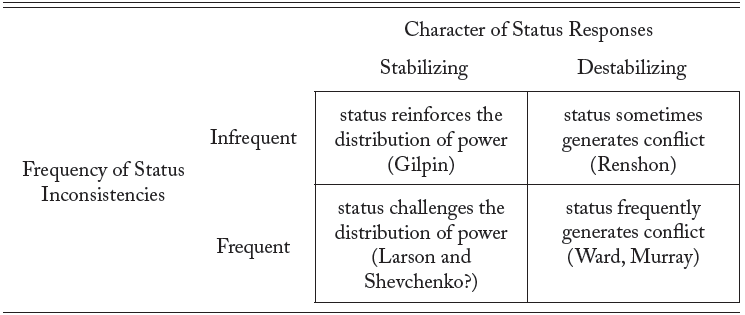
To explore the varied functions status can perform in world politics, consider two potential dimensions. The first is the frequency of status inconsistencies. In some cases, states will tend to be granted roughly the amount of status that their wealth or power would suggest, while in other cases they will be routinely deprived of the rank and recognition they believe they are entitled to. We anticipate states will make more frequent and intense status demands in the latter case. The second is the character of responses to status. Sometimes, status tends to produce peaceful responses: states either defer to high status or attempt to acquire or creatively redefine the attributes that deliver status. Other times, status tends to produce destabilizing reactions: states either embrace strategies of status competition or engage in violent rejection of status hierarchies.
Pulling these dimensions together, we can imagine four different ways status may shape world politics, which we present together in Table 1. When status inconsistencies are commonplace and status induces destabilizing responses (lower right-hand quadrant), status tends to have a particularly harmful impact on world politics. States will find themselves locked in deep and enduring rivalries over irreconcilable differences in status, along the lines described by Ward or Murray. When status is destabilizing yet status inconsistencies are relatively rare (upper right-hand quadrant), status can still be dangerous, but not necessarily debilitating. States may sometimes pick fights to bolster their status, as Renshon suggests. They may sometimes seize unimportant territories or participate in arms races to prove their place in the great power ranks. But most of the time, states will be afforded the status they believe they deserve, and competition among them will be shaped by factors unrelated to status.
Functions of Status in World Politics

Status hierarchies play a much different role if we move to the other side of the table. When status inconsistencies are rare and status prompts nonviolent responses (upper left-hand quadrant), status will tend to reflect and reinforce the distribution of power. States that possess wealth and power will tend to receive status, will assume the rights and responsibilities associated with being great powers, and subordinate states will tend to defer to them, as Gilpin suggests. Status in this world becomes a way in which systems of hegemony or great power cliques get normalized and legitimated. When status elicits peaceful responses yet status inconsistencies are common (lower left-hand quadrant), status operates as a kind of autonomous, normative standard that states use to evaluate and to challenge one another. Higher-status states claim special rights based on perceived moral, economic, or social superiority, while lower-status states seek to emulate or appropriate characteristics of their higher-status peers. Contestation in such a world will be driven less by geopolitical competition than by debates about how to construct status hierarchies—about what attributes should be valued and who should be included or excluded. Passages in Larson and Shevchenko suggest this kind of contestation, such as their discussion of the “new development models” offered by Deng Xiaoping and Mikhail Gorbachev (p. 135). Yet they describe these policies as reactions to prior failures of competitive policies (p. 138) rather than as choices shaped by the character of status itself. The bottom line is that status need not destabilize world politics, though more work needs to be done to clarify when and why this may be the case.
V. Conclusions
Over the last generation, there has been an explosion of scholarship on status. As demonstrated by the four books reviewed in this article, this work is theoretically ambitious, methodologically diverse, and rich with insights. Nonetheless, there remain significant gaps in our understanding of what status is, how it works, and what its effects are. While scholars have coalesced around a single definition of status, they have not resolved how membership and standing combine to create status, nor provided direct and compelling measures of status itself. They are also unclear about which states will be most interested in status and the pathways through which status shapes foreign policy. And scholars agree that status exerts a pernicious pull on world politics, although they disagree about the extent to which the pursuit of status requires competitive behavior and they neglect the ways in which status can defuse conflict and promote cooperation.
Paradoxically, then, the status of status is established, but not settled. It is established in the sense that it has arrived: the status literature is massive, is produced by scholars from around the world, and is widely recognized by the field. Yet it is unsettled in the sense that its countervailing concepts and claims jostle for preeminence, and its standing relative to other literatures, which wrestle with similar problems, remains undetermined. To its critics, status is an illusion, just another way of speaking about power. To its defenders, status supplements or supplants traditional theories, providing a unique perspective on what drives leaders and states. We have suggested that the empirical possibilities are more varied, depending on the assumptions one makes about how frequently states make status claims and the extent to which competition is required to adjudicate them. The convergence of claims among the four books considered here highlights just how far the status literature has come, yet we have made the case that the tensions and inconsistencies in the literature deserve equal attention. The next steps are for status scholars to more clearly articulate their divergent theoretical positions and to devise new empirical strategies to resolve their differences.
More specifically, we venture a few recommendations. First, scholars should tighten their definitions and explore other measures of status. Neither the qualitative nor quantitative measures developed in these books directly capture what status is or how it is expressed. We have little data about which attributes policymakers or publics tend to value, where they think their own state and other states rank on these attributes, and whether these assessments are consistent or vary from one country to another. Anecdotal evidence suggests that these kinds of assessments vary widely. In 2019, the Pew Research Center asked people in thirty-four countries who they considered the globe’s top economic power; majorities in twenty-one countries named the United States, while those in thirteen countries named China.Footnote 70 Along the same lines, we do not have systematic data about how often policymakers invoke status in their public or private statements. The data we do have suggests that status concerns are one among many. In his data set of the almost three thousand inferences British policymakers drew about the future behavior of European great powers in private diplomatic documents between 1855 and 1914, Robert Trager finds that only about 2 percent related to “prestige or to reputations for resolve.”Footnote 71 Most important, we still do not have a clear sense of how often states defer voluntarily to those with higher status. Much turns on how we define voluntary deference and how we distinguish between decisions driven by coercion from those rooted in consent. Going forward, scholars should focus on identifying cross-national measures that more directly capture how policymakers and publics talk about status, and whether this actually translates into voluntary deference.
Second, scholars should do more to develop the specific causal mechanisms that connect status to foreign policy outcomes, paying particular attention to the conditions under which different mechanisms operate and how different mechanisms may interact with one another. One approach would be to focus on narrower events. When do wartime humiliations generate feelings of shame versus romanticization of a lost cause? When do diplomatic insults prompt resentment rather than indifference? Jennifer Lind, for example, examines the varied reactions to apologies, describing the conditions that can help them facilitate reconciliation.Footnote 72 An alternative approach would be to explore mechanisms related to particular kinds of status hierarchies. When is membership in the ranks of the great powers contested and when is it stable? When do states make explicit appeals to racial hierarchies and when do they gesture toward racial equality? Adom Getachew provides a compelling account of how principles of self-determination were reinvented to challenge racial hierarchies and spur anticolonial movements.Footnote 73 A third approach would be to use different methods to explore specific links in the causal chain. In a creative experiment, Renshon finds that the fear of losing status increases the tendency of actors to take risks in international crises, but only for “low-power” individuals (pp. 112–13). This suggests that psychological mechanisms work for some leaders in certain situations, but not others. Scholars could employ similar survey experiments of public opinion to identify scope conditions for domestic pressure and coalitional outbidding mechanisms.
Last, scholars need to better engage counterarguments. All the books under review take care to disentangle the effects of status from power and interests, but they could do more to explore the occasions when status does not work as we expect. When do states minimize or ignore status? When does the pursuit of status not exacerbate tensions, but instead facilitate cooperation? Because much of the literature focuses on the ways status precedes conflict, we know less about how status operates in other domains. Preliminary evidence suggests that it works much differently. In his study of socialization in international institutions, for example, Iain Johnston finds that China’s desire to “maximize the normatively accepted markers of a high-status actor” prompted it to accept various multilateral arms control agreements.Footnote 74 Beth Simmons and Zachary Elkins present evidence that states are more likely to adopt liberal economic policies when high-income states and their cultural peers do so.Footnote 75 Wohlforth and his coauthors find that small states, such as Norway, often engage in “do-gooder status seeking,” providing foreign aid or humanitarian assistance to bolster their moral authority.Footnote 76 Writing in a more speculative mode, Robert Keohane wonders whether creating an “economy of esteem” around greenhouse-gas mitigation could lead to more concerted action on climate change.Footnote 77 Taken together, these studies suggest that the initial emphasis on great powers and geopolitics may lose sight of the big picture. Status may appear zero-sum and competition for it may seem destabilizing. But this may be because power politics is a domain in which relative gains, fears of cheating, and tragic outcomes already predominate. Ultimately, status may buttress world order.
Acknowledgements
The authors thank Benjamin Denison, Michael Desch, Eugene Gholz, Stacie Goddard, Moritz Graefrath, Alec Hahus, Daniel Jacobs, Robert Jervis, Danielle Mueller, Maria Parent-Quintana, Joshua Shifrinson, Jack Snyder, Sebastian Ro-sato, Jazmin Sierra, Mavis Staples, and especially the three anonymous reviewers for World Politics for their feedback. Jacintha Dillemuth and Dion Thompson-Davoli provided helpful research assistance.
Authors
Paul K. MacDonald is an associate professor of political science at Wellesley College. His books include Networks of Domination: The Social Foundations of Peripheral Conquest in International Politics (2014) and Twilight of the Titans: Great Power Decline and Retrenchment (2018), coauthored with Joseph M. Parent. He can be reached at pmacdona@wellesley.edu.
Joseph M. Parent is a professor of political science at the University of Notre Dame. His books include Uniting States: Voluntary Union in World Politics (2011) and Twilight of the Titans: Great Power Decline and Retrenchment (2018), coauthored with Paul K. MacDonald. He can be reached at jparent@nd.edu.