





Introduction
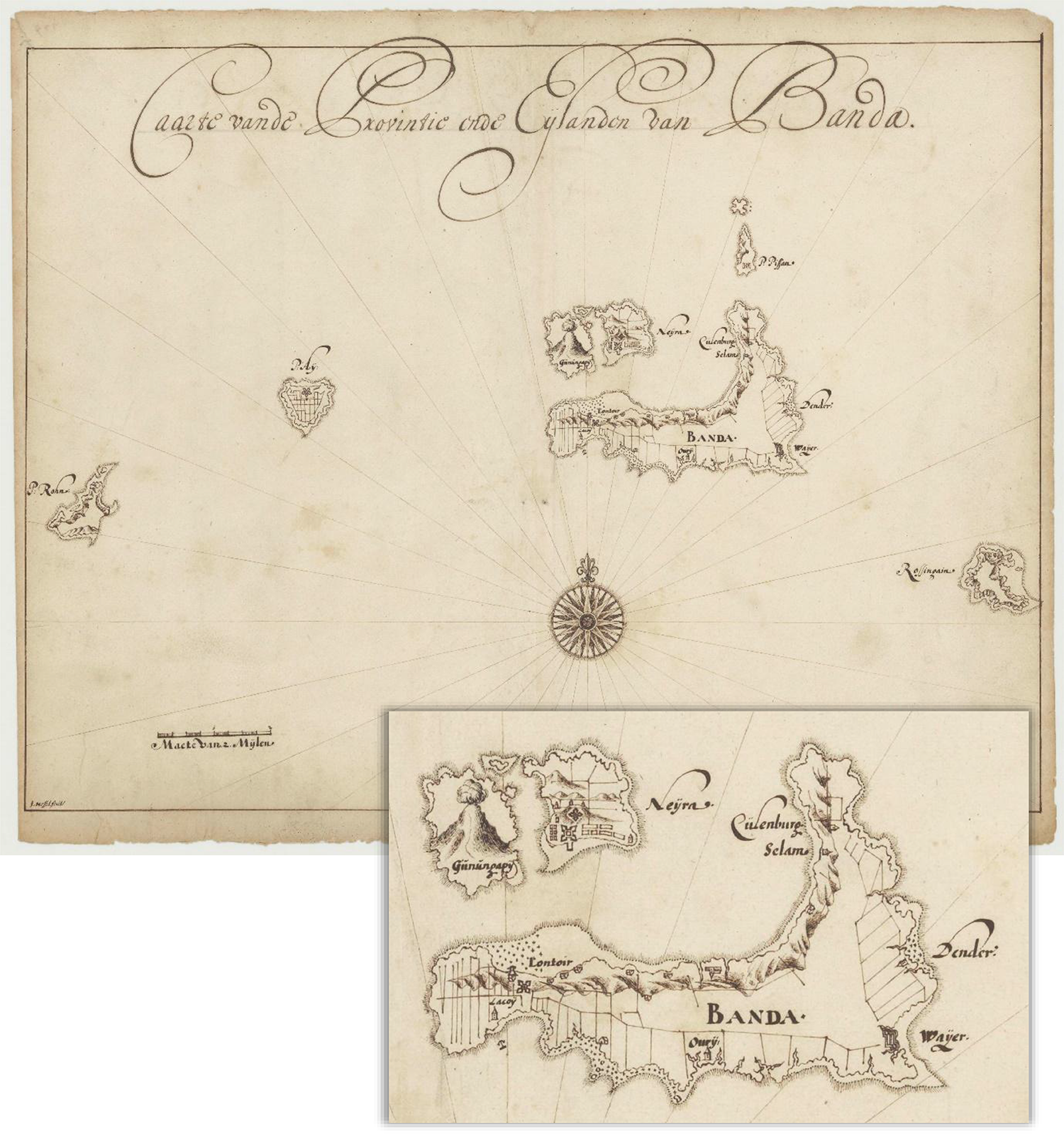
The Banda Islands are a small group of islands in Maluku, Indonesia (see Figure 1). Until the early seventeenth century, their indigenous inhabitants were the world’s only producers and sellers of nutmeg and mace. The Dutch East India Company (VOC) conquered the islands in 1621 with the aim of monopolising the trade in these valuable spices. Under the leadership of Governor-General Jan Pieterszoon Coen, the indigenous Bandanese were killed, enslaved and expelled. Following this genocide, a new system of production was established, later named the perkeniersstelsel. Footnote 1 Under this system, the nutmeg forests were divided into small perken (parks or plots) to be cultivated and maintained by private planters or perkeniers who sold their produce to the Company at fixed prices. The perkeniers exploited an enslaved workforce, supplied by the VOC, which initially included a significant number of indigenous Bandanese. Even though the genocide of 1621 is increasingly recognised as a pivotal moment in the early history of the Company, dominant understandings of the early perkeniersstelsel remain both limited and problematic. The aims of this article are therefore to critically address the existing historiography and to contribute to the development of a new analysis of the socio-economic and ecological transformations which accompanied the colonisation of the Banda Islands.
Map of the Province and Islands of Banda. From left to right: Pulau Run, Pulau Ai, the core islands — Gunung Api, Banda Neira, Banda Besar and the uninhabited islet of Pisang — and Pulau Hatta or Rosengain. Clearly visible in the detail below are the perken of Neira and Besar (J. Nessel, ca. 1650; source: VEL 1356)

Figure 1 Long description
The map depicts the Banda Islands, a group in Maluku, Indonesia. It includes Pulau Run, Pulau Ai, Gunung Api, Banda Neira, Banda Besar, the uninhabited islet of Pisang and Pulau Hatta. The map features a compass rose at the center, indicating cardinal directions. The inset provides a detailed view of the core islands, highlighting the perken (plots) of Neira and Besar. The map is titled 'Caerte vande Provincie ende Eylanden van Banda' and is attributed to J. Nessel, circa 1650. The islands are shown with detailed coastlines and some interior features, emphasizing their geographical layout and historical significance.
The only substantive analysis of the early perkeniersstelsel based on primary sources has been written by Vincent Loth in the 1990s.Footnote 2 Loth argues that, ‘[i]n the [sixteen-]twenties, the Company formulated and executed a conscious and deliberate policy of land use intensification, by means of extreme rationalisation of productional means.’Footnote 3 This was supposedly accomplished by the removal of all vegetation unnecessary for nutmeg cultivation so that ‘[t]he perken came to look not unlike apple or cherry orchards in Holland, neatly kept, and the vegetation restricted to the bare minimum.’Footnote 4 Loth argues that the system of slavery on the Banda Islands was more comparable to the chattel slavery of the plantations of the Atlantic world than to that of other VOC colonies, where slavery tended to be centred around the household.Footnote 5 In short, according to Loth, the VOC was largely successful in its efforts to completely reorganise spice production, so that ‘[w]e may therefore conclude that in 1621 not only Bandanese society was conquered and colonised, but nature as well.’Footnote 6 Similarly, in his book on the history of regional trade networks in what he terms the Banda zone, Roy Ellen describes the perkeniersstelsel as a ‘classic plantation mode of production’ characterised by ‘intensified land use and rationalised agricultural production.’Footnote 7 Even though Ellen convincingly demonstrates that the Company, following colonisation, was forced to rely ‘on a preexisting framework of inter-island trade and division of labor’ to acquire means of subsistence, therefore, he denies that the early colonial system of nutmeg production was marked by a similar degree of continuity with the precolonial period.Footnote 8 Hans Hägerdal largely agrees with Loth and Ellen that the colonial system of production in Banda ‘draws some parallels with the plantation system of the West Indian islands’ and furthermore claims that ‘[t]he system eventually produced nutmeg harvests that exceeded the old pre-European system.’Footnote 9 This characterisation of the perkeniersstelsel — as a complete break with the precolonial past and comparable to the plantations of the Atlantic world — is found, with some variation, across more general Dutch and international scholarship as well.Footnote 10
However, this characterisation of the colonial system on Banda is problematic for various reasons. The most fundamental of these is that the effectiveness and extent of the VOC’s supposedly totalitarian control of the Banda Islands, as described by Loth, are largely assumed rather than supported by evidence. This has been demonstrated by Phillip Winn, who convincingly argues that the system of slavery on the Banda Islands had much in common with the household-centred systems found elsewhere in Southeast Asia.Footnote 11 Winn further claims that ‘[t]he essential method [of cultivation] remained much the same, though intensified’ — largely because the Dutch were likely forced to rely on the Bandanese for their horticultural knowledge and expertise.Footnote 12 Pepijn Brandon has added to Winn’s suggestion that ‘the ecological conditions and the nature of the production process of nutmeg and mace did not allow for easy rationalisation through gang labour and partial mechanisation introduced on West Indian sugar plantations.’Footnote 13
A rather different picture than the one sketched by Loth has been presented here: one in which the early perkeniersstelsel had a great deal of continuities with precolonial production methods and in which the VOC would have faced various obstacles in its effort to transform the environment. This new picture is far from complete, however, and in certain places more so resembles a tantalising hypothesis than a rigorously supported theory. For one, Winn’s article — which touches little on production methods — is based exclusively on eighteenth-century sources, introducing much ambiguity about the first decades of colonisation. And while Loth does make use of an extensive selection of seventeenth-century archival material, his view of the perkeniersstelsel seems to have been determined mainly by the functioning of this system in the nineteenth century onwards, by which time cultivation methods and labour processes had indeed changed much compared to the precolonial period.Footnote 14 The existing historiography could therefore benefit much from a careful reconstruction of the establishment and development of the perkeniersstelsel based on sources from the early seventeenth century.Footnote 15 In this article, I aim to reconstruct the violent transition from the precolonial to the early colonial period, tracing transformations and continuities in social organisation, nutmeg production, ecology and labour. I will be focusing on developments in the 1620s and early 1630s, when the most significant development of cultivation methods and productivity levels, since claims about these — central to the debate between Loth, Winn and, others — remain insufficiently empirically substantiated.
The colonisation of the Banda Islands has featured — both more and less prominently — within recent analyses of the ecologically destructive expansion of the capitalist world-economy in the early modern period. In his book The Nutmeg’s Curse, Amitav Ghosh uses the example of Banda as a jumping-off point to analyse the rise of a Western, colonial view of nature (as something passive, to be exploited) violently displacing indigenous views of nature.Footnote 16 The conquest of the islands also plays a small role in an essay by Jason Moore, where the latter argues that the VOC ‘imposed a new ecological regime’ in Banda as the islands ‘were subordinated to a plantation system’ with complete control over ecology and the human population.Footnote 17 As both Ghosh and Moore rely almost entirely on Loth’s work on the perkeniersstelsel, they unfortunately overestimate the extent to which the Company transformed the system of production and environment on the Banda Islands. In this paper, I hope to contribute to larger discussions about the ecology of capitalist expansion by complicating and nuancing our understanding of the socio-ecological dynamics of colonisation on Banda. In order to do so, a useful framework is provided in one of Moore’s earlier essays: the concept of the commodity frontier.Footnote 18 A commodity frontier is a zone in which new labour and resources are incorporated into the capitalist world-system through the production of certain commodities. Proceeding from the frontier reverses one’s approach to a commodity chain, analysing ‘a network of labour and production processes’ from the moment of extraction rather than of consumption.Footnote 19
In Moore’s work, key examples of commodity chains include the sugar plantations on Madeira and in the Americas, where the demands of capital accumulation completely reconfigure and dominate labour and ecology.Footnote 20 The core thesis of this article, however, is that such transformations did not take place on the seventeenth-century Banda Islands — or at least not to the extent that is claimed by Moore, Loth and others. By analysing the colonisation of Banda as the capture of a commodity frontier, I hope to show the limitations and contradictions of this colonial project on the ground. Of course, a key difference between the Atlantic sugar plantation and the perkeniersstelsel is that the latter’s crops were not introduced by the VOC. Since the colonisation of Banda constituted the reconfiguration of existing commodity chains, it is important to understand how these chains were configured before colonisation. Therefore, following a brief discussion of the sources used for this article, I attempt to reconstruct the organisation of nutmeg production in the late precolonial period. This reconstruction is followed by an analysis of the establishment of the perkeniersstelsel and its contradictory internal organisation. I then proceed to step inside the perken to examine production methods, the labour process, and ecological conditions and the agency of and resistance by the enslaved. Subsequently, I will attempt to analyse the changes in nutmeg production brought by colonisation from a quantitative perspective by reconstructing and comparing productivity levels from the sixteenth century to the seventeenth century and beyond. Finally, I conclude by analysing the changes in the production and commodity chains of nutmeg and mace and by reflecting on their limitations and internal contradictions.
Precolonial Bandanese society
Indigenous Bandanese society is described in highly contradictory terms in the existing historiography: it seems to have been either highly centralised and hierarchical or decentralised and democratic.Footnote 21 This confusion partly stems from a small and fragmentary historical record, mostly consisting of a handful of Portuguese and Dutch accounts — contemporary Bandanese sources did not exist or have not survived. In order to understand the precolonial system of production which was allegedly rationalised by the Dutch, it is therefore necessary to carefully examine the limitations and contradictions of the available sources. The earliest surviving sources on Bandanese society were written by Portuguese chroniclers: the Suma Oriental (1515) by Tomé Pires, an administrator and apothecary who visited various parts of Southeast Asia; the Livro de Duarte Barbosa (1518), written by an officer stationed in India; and the Décadas da Ásia (1552–1615) by João de Barros, an administrator.Footnote 22 It is unlikely that any of these authors ever visited the Banda Islands. However, due to their respective positions, they would have had access to relevant first-hand accounts of various Portuguese merchants.Footnote 23 A somewhat more substantive and reliable description of Bandanese society is contained in the journal of the second Dutch voyage to the East Indies, the relevant portions of which were written by vice-admiral Jacob van Heemskerck who reached Banda in 1599.Footnote 24
The most extensive description of precolonial Bandanese society is found in an anonymous source entitled ‘De Eylanden van Banda.’Footnote 25 François Valentijn, a Protestant minister stationed in Banda in the late seventeenth century, paraphrases the text at length and attributes it to Hendrick van Bergel, Governor of the Banda Islands between 1609–1610.Footnote 26 A second, expanded version of the source, ‘Beschijuinge van de Eijlanden Banda,’ contains Van Bergel’s text in its entirety, alongside other parts of text written before the conquest, possibly by Van Bergel, as well as parts written after the conquest.Footnote 27 The most likely person to have written the post-1621 contributions to the ‘Beschrijuinge’ is Artus Gijsels, amongst whose writings and personal documents both versions of the text remain today, and who probably never visited the Banda Islands before 1635.Footnote 28 Though it might be tempting to disregard Gijsel’s later ‘Beschrijuinge’ in favour of Van Bergel’s earlier ‘Eylanden,’ as will be shown below, the latter may not contain the complete observations of Van Bergel on the precolonial period. My analysis will therefore be based on a careful cross-referencing of the two versions of the source with one another, Valentijn’s extensive paraphrases, as well as other primary sources when possible.
The Banda Islands consist of three central islands — Banda Neira, Banda Besar (previously Banda Lonthor), and the volcanic island Gunung Api — and three outer islands — Pulau Ai, Pulau Run, and Pulau Hatta (previously Rosengain). Archaeological evidence suggests that the indigenous inhabitants of the Banda Islands started increasingly participating in long-distance trade from the early second millennium CE onwards.Footnote 29 As the islands are largely unsuited for agriculture (save for the small-scale cultivation of fruits and sago), it is no surprise that the Portuguese encountered a society largely dependent on the spice trade and the import of foodstuffs.Footnote 30 This participation in trade was likely accompanied by Islamification. Pires writes in 1515:
Those along the coast are Moorish merchants. It is thirty years ago since they began to be Moors in the Banda Islands. There are a few heathen inside the country.Footnote 31
In 1599, Van Heemskerck writes that all Bandanese are Muslims save for a small, inland community of apparent non-Muslims — as suggested by their social isolation and consumption of pork — on Banda Besar.Footnote 32 It is therefore clear that the Islamisation of the Banda Islands was never complete and seems to have started — logically — in those towns engaged in long-distance trade with Islamic trade partners. This conclusion is largely supported by the archaeological research of Peter Lape. The town of Neira, the main trade partner of Javanese and later Dutch merchants, seems to have been established around the twelfth or thirteenth century CE as a Muslim settlement.Footnote 33 By contrast, the much older town of Labataka, established around the sixth century CE, appears never to have embraced Islam until its apparent collapse in the sixteenth century.Footnote 34 Lape argues that this collapse, along with the ongoing process of Islamisation, indicates that Bandanese society had been experiencing significant changes and conflicts during the two centuries before the arrival of the Dutch.Footnote 35 He further claims that ‘[t]hese internal divisions limited an organised response to European intrusions.’Footnote 36
Van Heemskerck was the first European to observe an ongoing, violent conflict between various Bandanese towns. The Tweede Schipvaart describes a conflict which had been going on for many years between two parties: one consisting of Neira, Lonthor, Sammar, Ortatan, Pulau Ai, and Pulau Run; and the other consisting of Labataka, Selamon, Ouwendenner and Rosengain.Footnote 37 According to ‘Eylanden’, the two alliances or federations were called the ulilima and ulisiva respectively.Footnote 38 This historical evidence supports Lape’s observation of an internal conflict, though the degree to which this division prevented a unified Bandanese response to Dutch colonisation is debatable. Van Bergel describes how, to decide on matters which affect all towns, Bandanese from all towns would convene at a big tree in Ortatan.Footnote 39 This included matters of state and warfare, but also negotiations over prices of nutmeg and mace. The town leaders, seated on an elevated platform at the base of the tree, would lead the meetings while the commoners (also called the bujang) would be seated below according to their allegiance to either the ulilima or the ulisiwa. In a section of Gijsels’ ‘Beschrijuinge’ attributed by Valentijn to Van Bergel, it is described how decisions made by the leaders would have to be approved by the commoners — if the latter withheld approval, the leaders would be forced to reconvene.Footnote 40 The same was reported by one of the Dutchmen left behind on Banda in 1599.Footnote 41 Despite internal conflict, therefore, it seems like the towns usually presented a united front against foreign merchants and external threats.Footnote 42 This should not be surprising, as dualisms such as the ulilima/ulisiva were important organising principles in Maluku in this period. In his study of Ternate and Tidore, the two major sultanates in North Maluku, Leonard Andaya remarks on the confusion of Europeans towards the two sultanates who maintained shared traditions despite their ongoing conflict.Footnote 43 Dualisms, alongside other pluralities, were embedded in mythologies and origin stories shared across Maluku, facilitating statecraft and exchange between the dispersed settlements of the highly diverse region.Footnote 44 The ulilima and ulisiva of the Banda Islands, firmly placed within the world of Maluku, should therefore not simply be conceptualised as warring factions but as necessary components of a single whole.
The town leaders are typically referred to in Dutch sources as orang kaya (“lit. ‘rich men’”), a rather broad term which seems to have included a range of social positions. Sometimes the even more opaque term orang baik (“lit. ‘good men’”) was used to describe Bandanese in high social positions who apparently were not orang kaya. Footnote 45 More revealing is the list of the names and titles of the orang kaya executed by the Dutch following the conquest of 1621, which includes imams (‘paepen’) and shabandars (harbour masters).Footnote 46 Furthermore, various sources mention the existence of three or four kings with aristocratic lineages linked to particular Bandanese towns.Footnote 47 Though, by the start of the seventeenth century, they wielded no more power than the orang kaya, their existence may imply a distinction between an older aristocracy and a newer Islamic and mercantile elite. The social status and make-up of the commoners or bujang is even less clear than that of their leaders. The commoners were probably distinct from the slaves kept by the orang kaya (in the broad sense) which are mentioned in various sources and appear to have been non-Muslims from various regions.Footnote 48
There is some evidence of a gendered division of labour amongst the commoners which fits Anthony Reid’s characterisation of gender relations in fifteenth–seventeenth century Southeast Asia more broadly.Footnote 49 De Barros and Van Heemskerck claim that women were responsible for the cultivation and processing of nutmeg and mace, while men concerned themselves with trade and warfare.Footnote 50 Both men and women seemed to have sold various kinds of produce at marketplaces and Van Bergel relates how, before the Bandanese-Dutch war of 1609, there was a bi-weekly market held in Ortatan where only women were allowed on the base of the large tree.Footnote 51 However, commercial relations with Europeans seemed to have been controlled by elite men.Footnote 52 This control might have formed the basis of a patriarchal class society, allowing the elite to exploit commoners and slaves who would, amongst other things, have provided the labour necessary to organise trade expeditions as well as the necessary commodities for those expeditions: nutmeg and mace.Footnote 53
Unfortunately, the sources remain silent on the conditions and organisation under which women cultivated and processed nutmeg and mace. De Barros claims that the nutmeg trees grew wild on the islands and did not belong to particular individuals. Each year a collective harvest took place during which each village was assigned a part of the forest.Footnote 54 Pires and Van Heemskerck contradict the existence of a single annual harvest—the former describes how the spices are harvested on a monthly basis throughout the year while the latter speaks of three annual harvests.Footnote 55 Furthermore, Gijsels’ ‘Beschrijuinge’ implies that specific nutmeg trees were not (exclusively) owned collectively but belonged to specific families, though this is neither mentioned in ‘Eylanden’ nor repeated by Valentijn.Footnote 56 Finally, it should be noted that, given the prevalence of the nutmeg tree on the Banda Islands and the evident maintenance of their optimal growing conditions, the Bandanese were almost certainly actively involved in its cultivation, even if this form of cultivation might not have appeared as such to a Portuguese observer. The effectiveness of Bandanese cultivation methods will become evident below when looking at estimates of their output.
It is unclear how many people lived on these islands before the conquest of 1621. The oft-cited population figure of 15,000 finds it origin in Gijsels’ ‘Beschrijuinge’, and while the figure is repeated by Valentijn it is not explicitly attributed to Van Bergel.Footnote 57 Lucas Kiers has rejected the figure, pointing out its absence in Van Bergel’s ‘Eylanden’ and arguing that Gijsels would have been motivated to exaggerate the amount of victims of Coen’s conquest for political reasons.Footnote 58 Two other estimates exist of the Banda Islands’s precolonial population size: Pires cites a figure of 2,500–3,000 while Johann Verken, a Company soldier and contemporary of Van Bergel, estimates the population at 10,000–12,000.Footnote 59 It is difficult, if not impossible, to compare these different figures: not only does Pires’ estimate predate the others by about a century, it is unknown what any of these figures are based on. However, given the number of people killed on and displaced from Banda Besar in 1621, as described below, it seems Verken’s and Gijsels’ estimates are the most realistic.
Conquest and immediate aftermath
The Dutch made first contact with the Bandanese in 1599 and established their first treaty in 1602.Footnote 60 In this treaty, the Bandanese granted the VOC monopsony rights on nutmeg and mace in exchange for military aid against potential enemies. The agreement, conducted in the presence of an intimidating Dutch fleet, was not respected by the Bandanese for long. In the two decades that followed this treaty, the Dutch continually used (perceived) contract breaches to justify further encroachment on Bandanese autonomy. Resistance against these encroachments could be used to justify further actions: the construction of a fort on Banda Neira in 1609, the conquest of Pulau Ai in 1616, and finally the conquest and depopulation of Banda Besar in 1621. The genocide had been long in the making: already in 1612, VOC director Jacques l’Hermite recommended the Heeren XVII that the Bandanese ‘should be brought to see reason, with proper assurances, or be exterminated entirely.’Footnote 61 Two years later, opperkoopman Jan Pietersz. Coen would likewise argue that only two options remained for his superiors: either ‘do what is necessary and populate the place [with settlers and slaves], or leave the country, since otherwise Banda would be lost anyways.’Footnote 62 By 1615, the Heeren XVII had been convinced of the radical solutions proposed by l’Hermite and Coen and recommended the latter, now promoted to Director-General, to prepare to ‘subjugate the Bandanese, to exterminate and expel the principal [Bandanese] and to repopulate the land with heathens.’Footnote 63 The execution of these plans, however, had to wait until after Coen’s promotion to the office of Governor-General in 1619.
On 27 February 1621, Coen arrived at the Banda Islands with a sizeable fleet carrying almost 1,200 Company soldiers and sailors as well as over 100 Japanese and Southeast Asian mercenaries.Footnote 64 Lonthor was taken two weeks after Coen’s arrival, leading to the surrender of the other towns on the island.Footnote 65 During the following month of rising tensions and increasing paranoia amongst the Dutch, the orang kaya were forced to hand over their sons to the VOC as hostages.Footnote 66 Coen had the children interrogated in late April, one of whom confessed that the orang kaya had been planning a revolt against Dutch occupation.Footnote 67 47 orang kaya were captured and tortured until forced to confirm the paranoid-fuelled suspicions of the Dutch.Footnote 68 Two of these men died during the interrogation, one committed suicide, and the remaining 44 were publicly beheaded and quartered.Footnote 69 Most of the towns on Banda Besar were burned down, many of their inhabitants captured; 789 Bandanese were shipped to Batavia, of which 176 died during the journey.Footnote 70 Thousands fled into the fortifications in the mountains of the island where many would die of starvation; when the Dutch finally managed to take the fortifications in July, they encountered over 2,000 graves.Footnote 71
According to Coen, of those who had fled into the mountains, ca. 2,500 were starved and killed while no more than ca. 300 had managed to escape the island.Footnote 72 The latter number seems to be a (possibly deliberate) underestimation; the total number of escapees remains unknown but, judging by the incidental observations recorded by the Dutch, it might have approached or exceeded 1,000.Footnote 73 Though most appear to have fled to Seram, others might have escaped to the Kei islands, joining the Bandanese communities which — according to oral history — were founded there by earlier refugees following the Dutch occupation of Neira in 1609.Footnote 74 The ca. 650 Bandanese who had arrived in Batavia were granted land for their subsistence. In January 1622, they were once again accused of planning a revolt.Footnote 75 The Bandanese women and children, 307 in total, were shipped back to the Banda Islands to be sold as slaves whereas the men were kept in Batavia to serve the VOC.Footnote 76 Whether the accusations against the Bandanese were true or not, they directly served the interests of the Company — just as the accusations against the orang kaya in 1621 had. In its effort to restart spice production on the Banda Islands after the conquest, the VOC faced a shortage of enslaved labour. To address this issue, Governor Martinus Sonck had asked Coen in July 1621 to return all Bandanese women and children from Batavia — just as the latter would do a few months later.Footnote 77
Perken and perkeniers
The division of land into perken was started as quickly as possible — to recommence nutmeg production and minimise losses — but was not finalised until almost a decade later. The first perken were established on Pulau Ai. In an act signed by Coen and others on 5 May 1621, i.e. following the conquest of Banda Besar and during the negotiations over the conditions of surrender, it is recorded that ‘Pulau Ai shall be divided amongst and leased to the burgerij in order to better maintain the forest and to gain more fruits.’Footnote 78 About one month after the act was signed, Sonck wrote to Coen informing him that half of Ai’s forest had been divided amongst the ‘duytsche Burgerye’ — mainly consisting of former VOC employees — while the other half now belonged to the ‘swarten’ or Mardijkers — formerly enslaved people converted to Christianity.Footnote 79 One month after this letter, in July 1621, Sonck sent Coen a map of Ai detailing the division of land and to whom each parcel belonged — though sadly, it seems that this map has not survived.Footnote 80 In 1625, it is mentioned that Ai had been divided into 30 perken. Footnote 81 The division of the forests on Besar, the largest island of the archipelago, proceeded more slowly due to a lack of potential leaseholders and labourers.Footnote 82 The forest near Wayer and Denner was not divided into parcels until 1628,Footnote 83 a letter from Governor Jan Jansz. Visscher refers to a (since lost) map displaying the complete division of Besar, Ai and Rosengain into perken. Footnote 84 The sizes of the perken were measured not primarily in terms of square Rijnlandse roeden (a unit of area corresponding to 14.19 m2) but in terms of the amount of zielen (lit. ‘souls’), i.e. enslaved people, assigned to it — the assumption being that one enslaved worker would be able to maintain ca. 50 square roeden. Footnote 85 The initial sizes of perken in the 1620s ranged from 25 to 40 zielen, i.e. from 1.250 to 2.000 square roeden or from ca. 1.8 to 2.8 ha.Footnote 86
The rental conditions of the perken were first, though only partially, specified in a resolution dated 5 April 1621, concerning the division of land on Pulau Ai:
As Pouleway will be rented out amongst the burgerij so as to keep the forest clean and obtain more fruits, it has been approved those who will sell their parts [perken] … will give from that [the selling price] the landlord one fourth penninck, and of the fruits of nutmeg and mace which will be harvested one … [dotted line in original] penninck. Footnote 87
In November of that same year, Coen ordered that land on Banda Besar ought to be distributed at the same rental conditions as on Ai.Footnote 88 Furthermore, this same letter clarifies that the tax levied on the delivered nutmeg and mace would be a thiende or one tenth part.Footnote 89 Each perkenier would also have to pay a head tax of half a Reaal van achten for each ziel registered to their perk.Footnote 90 On top of these taxes, the leaseholders were forced to sell their produce to the Company at the price of one Reaal van achten per 55 lb. of nutmeg or 5.5 lb. of mace.Footnote 91 According to a 1629 letter from Visscher, these low prices contributed to the financial difficulties of the perkeniers and frequently led the latter to discard much of the low-value nutmeg in favour of the much higher-value mace, leading to much waste.Footnote 92
In the first few decades after colonisation, the perkeniers had not yet reached the levels of wealth and comfort later described by Valentijn.Footnote 93 A 1633 letter to the Heeren XVII by Governor-General Brouwer describes how the burgerij was riddled with debt and lived in poverty.Footnote 94 Some seventeenth-century VOC officials have blamed the planters for their own financial difficulties. In 1628, Governor Pieter Vlack lamented the lack of work ethic amongst the Dutch settlers.Footnote 95 A few months later, Visscher would complain to Coen about the irresponsible spending and alcohol consumption of the perkeniers, who allegedly spent their small earnings on arak imported from Java and let their slaves suffer from poverty and starvation.Footnote 96 However, these harsh judgements (or at least their explanatory power) should be taken with a grain of salt, as the higher officials of the VOC, often derived from the Dutch social elite, tended to look down on the lower-class planters.Footnote 97 This class-based resentment likely worked both ways, as the low fixed prices at which the VOC purchased the produce, the unforgiving rental rates and the ever-increasing debts must have bred discontent amongst the perkeniers. Indeed, these economic factors were more than likely responsible for the financial state of the planters alongside other factors discussed below, such as lack of horticultural expertise amongst the Europeans and resistance by the enslaved.
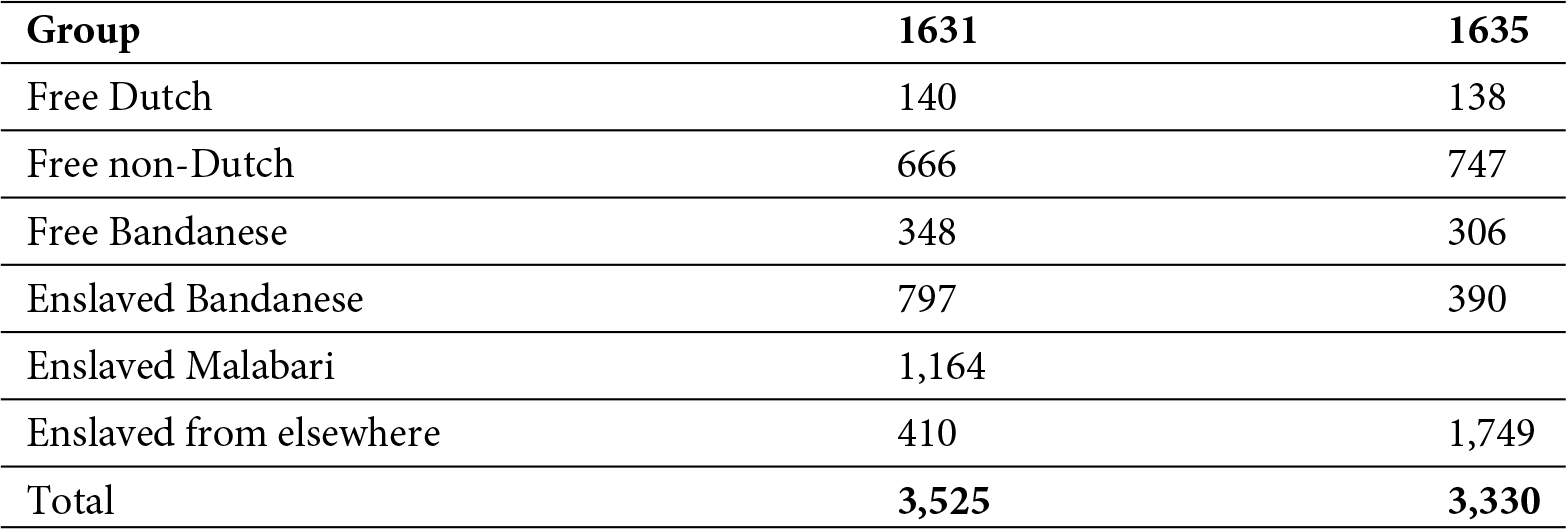
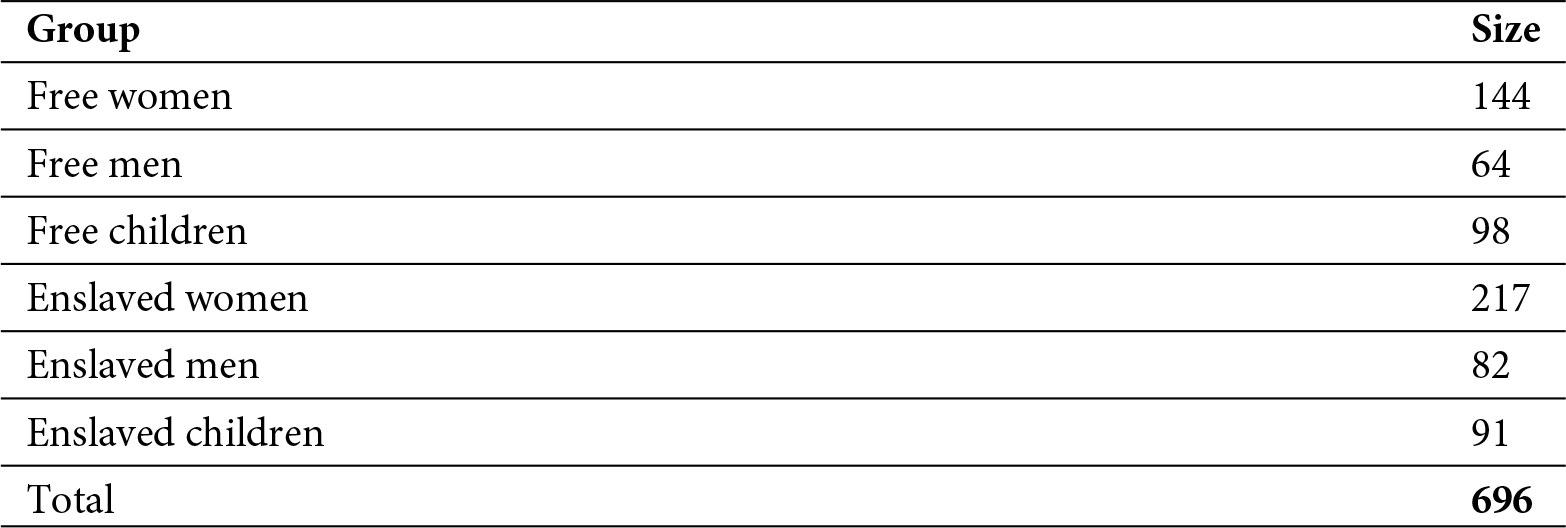
The majority of the enslaved people sold to the planters by the VOC in the early years of the perkeniersstelsel came from the Indian subcontinent and from Banda. A census from 1631 lists 797 enslaved Bandanese, 1,164 enslaved people from Malabar, and 410 enslaved people from various nations (see Table 1).Footnote 98 According to this same census, the total remaining Bandanese population was 1,145 out of a total population of 3,525 (excl. the VOC garrison). The data from the census largely corresponds to a report from 1635.Footnote 99 Comparing the numbers in Table 1, however, it seems as though the 1635 report underestimated the amount of remaining Bandanese. This discrepancy can either be accounted for by the fact that the total population count is also lower in 1635, implying some regions may have been neglected in the count, or by the fact that the amount of enslaved people from ‘any nation’ is larger in the 1635 report (even when including the Malabari from the 1631 census), suggesting that some Bandanese could have been included in that category. As Table 2 shows, most of the remaining Bandanese were women — likely due to the separation of men and women in Batavia and the higher likelihood for men to have died in direct combat with the Dutch.
Population of the Banda Islands in 1631 and 1635 (sources: VOC 1102:418 [920-21]; Karlsruhe 477:90)

Table 1 Long description
The table lists population counts for the Banda Islands by group in 1631 and 1635, separating free residents by origin and enslaved people by origin. The total declines from 3,525 in 1631 to 3,330 in 1635. Free Dutch remain nearly unchanged, from 140 to 138. Free non-Dutch increase from 666 to 747, while free Bandanese decrease from 348 to 306. Enslaved Bandanese fall steeply from 797 to 390. Enslaved people from elsewhere rise from 410 to 1,749, becoming the largest listed enslaved category in 1635. The 1635 value for enslaved Malabari is blank, so comparisons for that group and the composition of the 1635 total should be interpreted with caution.
Indigenous Bandanese population of the Banda Islands in 1635 (source: Karlsruhe 477:90)

Table 2 Long description
The table reports counts of Indigenous Bandanese people on the Banda Islands in 1635, grouped by legal status (free or enslaved) and by women, men, and children. The total population counted is 696. Enslaved people make up the larger share overall, with 390 enslaved compared with 306 free. Enslaved women are the largest single category at 217, exceeding free women at 144 and enslaved men at 82. Among free people, women are the largest group at 144, followed by children at 98 and men at 64. Children total 189 across both statuses, with slightly more free children at 98 than enslaved children at 91. These figures are simple headcounts by category and do not explain how status was defined or how complete the count was.
Labour and ecology
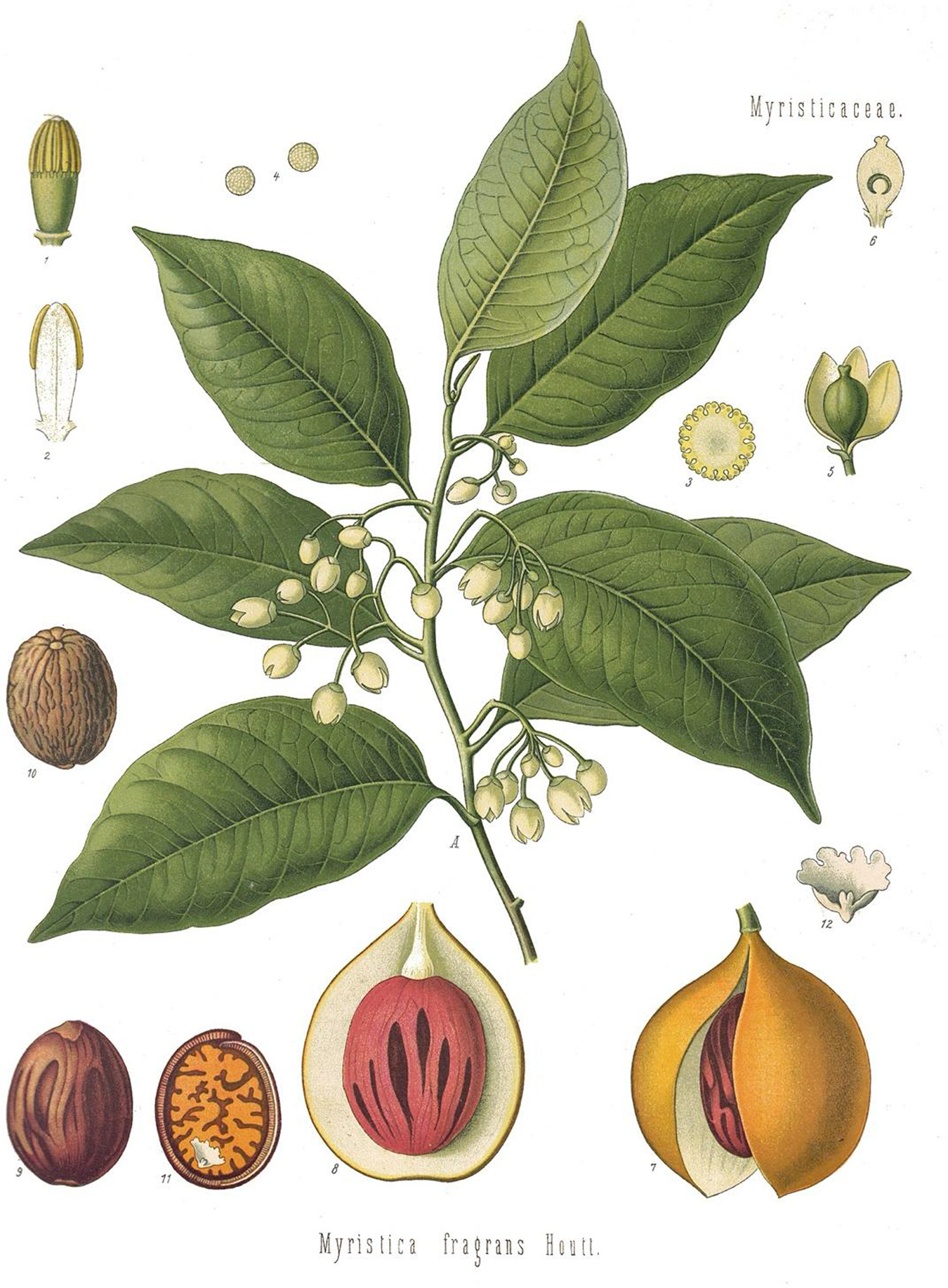
The nutmeg tree (Myristica fragrans) grows to between 5–13 m high, though some grow up to 20 m.Footnote 100 Its branches are longest near the bottom and shortest near the top. The tree’s fruits ripen continually throughout the year, meaning that any given moment one tree may bear fruits at various degrees of ripeness. It requires specific ecological conditions for its growth which have necessarily affected cultivation methods. Young nutmeg trees require shade and both young and mature trees need protection from the strong winds which are typical of the Banda Islands’ tropical monsoon climate. Historically, this has been accomplished by planting nutmeg trees besides other, larger trees (most commonly the nut-bearing kenari tree). The fruit of the M. fragrans is slightly oval-shaped, light green of colour and ca. 6–9 cm long. When ripe, the husk of the fruit splits open and reveals the bright-red mace which covers the striated nutshell containing the nutmeg (see Figure 2).
Botanical drawing depicting the nutmeg fruit in its various stages of growth as well as the various layers of the ripened fruit (Hermann Adolph Köhler, 1890; source: https://commons.wikimedia.org/wiki/file:K%C3%B6hler_Myristica.jpg, last accessed on 16 Apr. 2026)

Figure 2 Long description
The illustration depicts the nutmeg plant, Myristica fragrans, with various parts and stages of the fruit. The central image shows the plant with leaves and clusters of small flowers. Surrounding the plant are detailed drawings of the nutmeg fruit in different stages. These include the whole fruit, the split fruit revealing the seed and the seed itself. The layers of the fruit are shown, including the outer husk, the mace covering and the seed inside. Each part is labeled with botanical terms such as 'Myristicaceae' and 'Myristica fragrans Houtt.' The illustration provides a comprehensive view of the nutmeg plant's anatomy and fruit development.
There is little information on the techniques and labour processes involved in the cultivation of nutmeg and the maintenance of the forests in the 1620s. It seems likely, however, that nutmeg trees were generally not actively planted but grew from nutmeg fruits which had fallen on the ground. At least, this was the opinion of Vlack, who wrote in 1628 that the burgerij had not been planting enough nutmeg trees to compensate for the losses caused by harsh weather conditions. As a result, each perkenier had been ordered to plant as many trees yearly as they had souls under their command.Footnote 101 Perhaps to help things along, before leaving Banda in September 1629, Visscher had ordered the enslaved workers owned by the VOC to plant ‘a few thousands of nutmeg trees.’Footnote 102 A year later, however, Visscher’s successor, Governor Crijn van Raemburch, reports how almost all of the trees planted under his predecessor had died as a consequence of their weakness and vulnerability. The letter also mentions how other attempts to plant nutmeg trees, by perkeniers, had been equally unsuccessful — perhaps, Van Raemburch suggests, the trees would grow better in the shade of other vegetation.Footnote 103
These difficulties faced by the VOC and perkeniers might lead one to question Loth’s description of perken as ‘neatly kept’ orchards.Footnote 104 This description is further problematised by the simple fact that it takes the nutmeg tree 7–9 years to start producing fruits and that it can continue to do so for some 80 years. It would therefore have been economically and practically unfeasible to reshape and order the nutmeg forests as quickly and dramatically as Loth seems to be implying; the perken would likely have had a stronger resemblance to the nutmeg forests of the precolonial era than to any ‘apple or cherry orchards in Holland.’Footnote 105
As nutmeg fruits ripen continually, there were three harvest seasons each year. The most plentiful harvest took place in July and August, though the seventeenth-century botanist Georgius Rumphius claims it produced slightly thinner mace than the other harvests. In November and December another harvest took place — the smallest of the three, described as the tail end of the previous one. Finally, the harvest of March and April reportedly produced the best nutmeg and thickest mace.Footnote 106 In the early colonial period, nutmeg was harvested by climbing into the trees and manually picking the fruits.Footnote 107 Vlack mentions the ‘climbing, picking, cultivating and gathering of the spices.’Footnote 108 In accordance with earlier sources cited above, Rumphius provides a detailed description of the labour activities involved in the harvest:
… when the nuts are ripe … the inhabitants climb into the trees and remove the nuts from the branches with long hooks and short pulls, which happens in a less dangerous manner than with the clove trees in Ambon. This is because the nutmeg tree has branches which are thicker and flatter so that one can stand on them more easily, and also has long, thin branches which one can easily pull towards oneself[.] [T]he harvested and ripened nuts are simply dropped from the tree onto the low bushes, which are therefore not cleaned away completely as under the clove trees[.] Sometimes one has to leave half-circles of bushes around one side of the trees which grow near steep slopes, so that the nuts do not drop too far. The harvested nuts [nutmeg fruits] are then opened up with knives by the slaves and the outer husks are removed, which are then left to rot on heaps in the forest …Footnote 109
Harvesting the nutmeg fruits required quite some skill as slaves had to quickly distinguish between unripe and ripe nutmegs and harvest only the latter. According to VOC administrator Pieter van Dam, unripe and ripe fruits ‘could not be distinguished without proper knowledge and experience. The perkeniers had to keep certain specialists for this purpose which were therefore also their most valued slaves.’Footnote 110 In the years following the conquest, the latter were most likely the enslaved Bandanese, the majority of which would have been the women who had cultivated the spices before the conquest. In 1622, Coen wrote to Sonck:
If the other male and female slaves are not as skilled as the Bandanese in the cultivation of nutmeg and mace, they will improve over time with experience, and [you should] do as much for that purpose as is doable.Footnote 111
Indeed, two letters from 1623 and 1628 each claim it took newly arrived enslaved labourers one or two years to become adept at the cultivation and harvest of nutmeg.Footnote 112 In a letter to Coen, Visscher explicitly refers to the Bandanese knowledge of nutmeg cultivation; specifically to how, during the minor harvest season of December, the Bandanese would sometimes refrain from climbing into the trees so as to not risk damaging premature nutmeg fruits.Footnote 113
While not wishing to understate the control, coercion and violence to which the enslaved nutmeg harvesters were subjected, the conditions outlined above likely allowed for a not-insignificant degree of autonomy within the labour process. The reliance on the expert knowledge of the enslaved, the fact that the latter had to climb into the trees where their motions would have been less visible, and the forest surroundings would have all have limited the effectiveness of supervision and discipline.Footnote 114 This suggestion is furthermore supported by archaeological evidence. In excavations of multiple perken sites, Amy Jordan encountered much local cultural artefacts but little markers of European presence (e.g. clay pipes) so common in contemporary contexts within the town of Neira, leading her to argue that the perkeniers were often not supervising the labour process themselves.Footnote 115 While this does not imply a complete absence of supervision — non-European supervisors, perhaps even enslaved themselves, could have been employed — Jordan’s conclusions do support the suggestions above based on clues from historical evidence. Some results of this relative autonomy in the perken could have been increased opportunities for building of solidarity amongst the enslaved, subtle and everyday forms of resistance (James C. Scott’s ‘weapons of the weak’), and marronage.Footnote 116 Since there is insufficient space here for an extensive analysis of the (unfortunately fragmentary) data on marronage in Banda, a few illustrative figures will have to suffice. Between September 1625 and August 1626, at least 70 enslaved people escaped (or attempted escape) from slavery and similar numbers can be found for the spring of 1630 and the year 1636.Footnote 117 Given these numbers, it is no surprise that marronage was significant and persistent enough to cause serious financial problems for the slaveholders.Footnote 118
Productivity levels
If, as argued by Loth, the Company really accomplished ‘an intensification of land use and a rationalisation of agricultural production in its most extreme form,’ then one would expect productivity — measured in the amounts of nutmeg and mace produced — to have increased significantly compared to the late precolonial period.Footnote 119 The reality, however, appears to have been more complicated — even if productivity levels of the precolonial period remain difficult to reconstruct. According to Pires, the Banda Islands produced 3,300,000–3,850,000 Amsterdam pounds (lb.) of nutmeg and 275,000–330,000 lb. of mace annually. He adds that the annual yield is ‘sometimes more, sometimes less’ and that ‘they say that these islands used to produce a thousand bahar of mace,’ i.e. 550,000 lb.Footnote 120 Pires’ estimates are generally accepted within scholarship on the Banda Islands. Meilink-Roelofsz acknowledges that Pires had an incentive to exaggerate the size of Southeast Asian commerce — as he was trying to convince his superiors of its importance — but suggests that Pires’ estimates might have reflected a larger-than-average harvest.Footnote 121 She furthermore compares Pires’ estimates for commodities other than nutmeg and mace — such as cloves, pepper and gold — with those of his contemporaries, concluding that Pires’ estimates of those tended to be on the conservative side.Footnote 122 Villiers similarly defends Pires’ estimates, claiming that the ‘estimate is confirmed by most other contemporary Spanish and Portuguese sources’ but notes that the yield was likely usually lower than this.Footnote 123 Curiously, however, the only contemporary estimates cited by Villiers are significantly lower than Pires’: the 1529 ‘Descricão Sumaria das Molucas e de Banda’ — which even specifies the crop of each town on Banda Besar individually — cites a combined output of 858,000 lb. and a 1537 report by Andres de Urdaneta estimates the annual yields of nutmeg and mace at 1,031,250 and 137,500 lb. respectively.Footnote 124 Furthermore, in 1525, Antonio de Brito estimates the total crop size of nutmeg, mace, and cloves in Banda and Maluku at 2,200,000 lb.Footnote 125 Though the Portuguese phrasings of the ‘Descricão’ and of De Brito leave some ambiguity as to whether the estimates provided reflect the amount of spices harvested in total or just the portion of the harvest obtained by the Portuguese, the former seems to be the more likely interpretation.Footnote 126
Pires’ estimates of nutmeg yields are therefore not only uncorroborated but even contradicted by contemporary estimates. While there is one other estimate which far exceeds those of Pires’ contemporaries, it postdates the latter by almost a century. In his 1621 ‘Verhaal van eenige oorlogen in Indie’, Gijsels reports on the conquest of the Banda Islands and writes that, before the conquest, Banda Besar, Pulau Ai, and Run produced around 17,500 sockels of nutmeg and 3,500 sockels of mace.Footnote 127 Gijsels appears to have mixed up his units of measurement: sockels were woven bundles or baskets used for weighing mace, not nutmeg. Gijsels’ confusion might be explained by the fact that, as reported by Valentijn, nutmeg had previously been weighed in bunches of 161 lb., ‘which exactly corresponds to the weight of a sockel.’Footnote 128 However, the sockels mace of the late seventeenth century seem to have been heavier than those of earlier in the century — according to figures from between May 1630 and April 1633, sockels weighed anywhere between 90–120 lb.Footnote 129 Assuming an average weight of 105 lb., and furthermore assuming that the sockels of nutmeg weighed the same as those of mace, Gijsels’ estimates can be converted to 1,837,500 and 367,500 lb. of nutmeg and mace respectively. There are good reasons to doubt the reliability of these figures — Gijsels’ use of the incorrect unit of measurement for nutmeg as well as the fact that he likely had not visited the Banda Islands by 1621 — but there is one piece of evidence which seems to support the higher estimates of productivity of Gijsels and Pires.
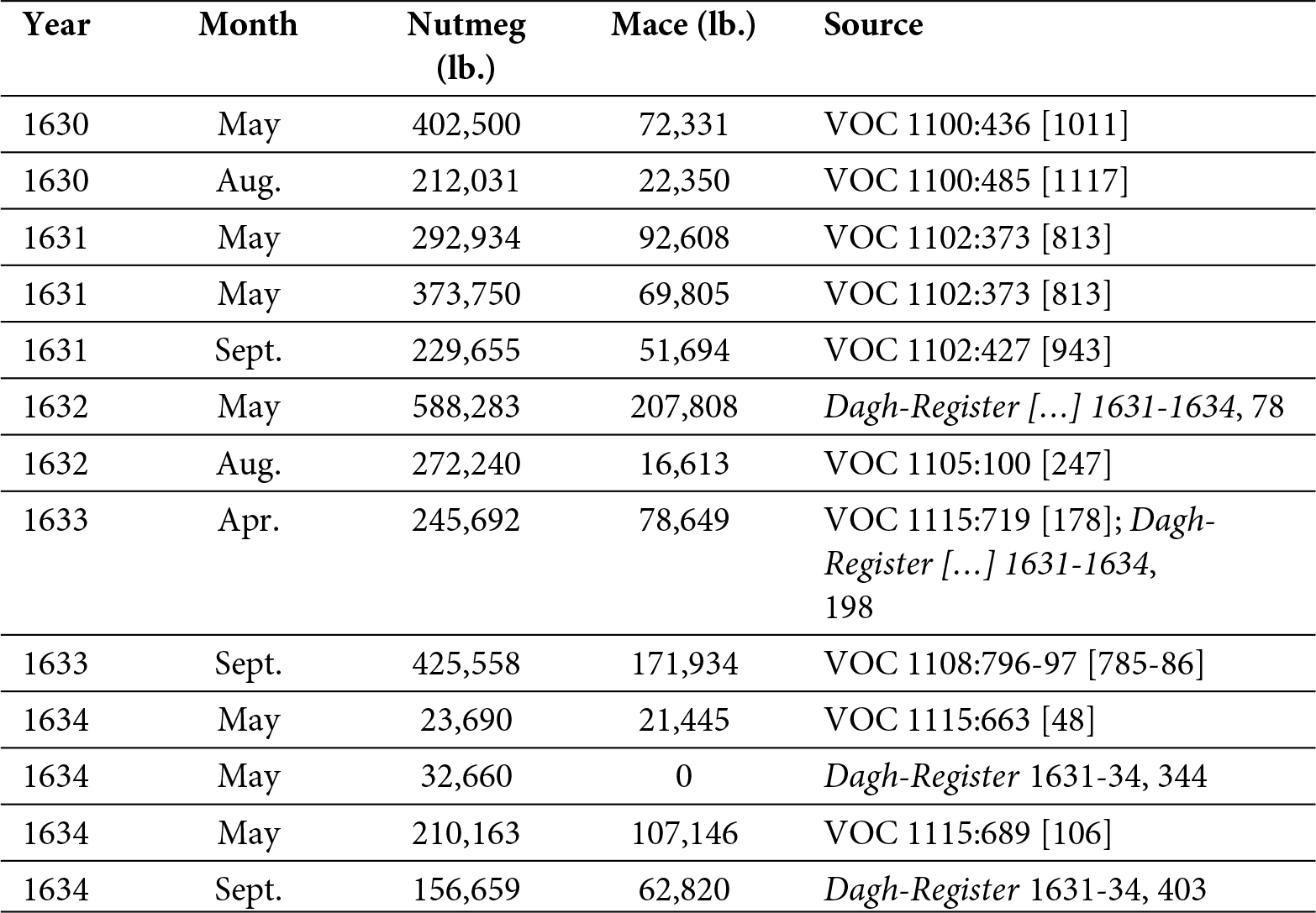
Export figures for nutmeg and mace per shipment in Amsterdam pounds, 1630–1634

Table 3 Long description
Monthly shipment records list nutmeg and mace export quantities in Amsterdam pounds for selected months from 1630 to 1634, with archival sources cited per entry. Nutmeg volumes range from 23,690 lb in May 1634 to 588,283 lb in May 1632, the peak shipment. Mace ranges from zero in one May 1634 entry to 207,808 lb in May 1632, also the peak. In 1630, May is much larger than August for both spices, with nutmeg dropping from 402,500 to 212,031 and mace from 72,331 to 22,350. In 1631 there are two separate May entries, showing variability within the same month, and September is lower than both May shipments for nutmeg and mace. After the 1632 peak, 1633 remains substantial, especially September with 425,558 lb nutmeg and 171,934 lb mace. May 1634 includes three separate shipments with widely differing amounts, indicating multiple departures or records rather than a single monthly total.
During the first Dutch voyage to reach the Banda Islands, Van Heemskerck was able to procure 780,165 lb. of nutmeg and 82,560 lb. of mace.Footnote 130 Assuming for the moment that the lower productivity estimates of either De Urdaneta or the ‘Descricão’ were correct, it would mean that Van Heemskerck had managed to purchase either 74 or 99 per cent of the annual produce on the Banda Islands despite being in fierce competition with Javanese, Malay, Gujarati, Portuguese and other merchants to whom the Bandanese had already promised much of their spices.Footnote 131 In other words, the estimates of productivity provided by Pires and Gijsels may not be as exaggerated as they appear. Still, the divergence between the different productivity estimates remains puzzling and while it is possible that productivity levels may have varied drastically, it would be difficult to explain this variance or to account for the fact that such drastic changes would occur over the span of 14 years (which is the difference in time between the writing of the Suma Oriental and the ‘Descricão’). Given these remaining questions, I will be taking into account both the upper and lower estimates for the precolonial period in the comparison with the colonial period below.
Data on productivity in the early colonial period is almost as scarce as on the precolonial period. Since no reliable figures exist for the 1620s or 1630s, I have attempted to reconstruct productivity for this period using data on the nutmeg and mace that was exported from the Banda Islands. Though export data for a given year cannot be assumed to equal annual productivity for another year — since in some years export was heavily restricted by ship availability — it is more likely that the average annual export figures over a stretch of several years approximate the average annual productivity of that same period. Wishing, therefore, to calculate the average annual export figures for a period of 5 years, I selected the years 1630–1634. This period was selected as it succeeds the complete division of the nutmeg forests into perken and precedes the year 1635, for which neither missives from Banda nor the Dagh-Register of Batavia are available.Footnote 132 Seeing as nutmeg and mace were typically exported 4–5 months after being harvested — following drying, sorting and further processing — the export data from 1630–1634 actually concerns the harvests of 1629–1634, excluding (possibly) the first harvest of the former and (definitely) the final harvest of the latter year.Footnote 133 Based on the data listed in Table 3, the annual export figures for the years 1630–1634 were 693,163 and 195,040 lb. of nutmeg and mace respectively. These figures are highly similar to those reported for the year 1634 by Valentijn, citing only ‘a certain traveller’ as his source, which add up to 666,744 and 182,170 lb. of nutmeg and mace respectively.Footnote 134
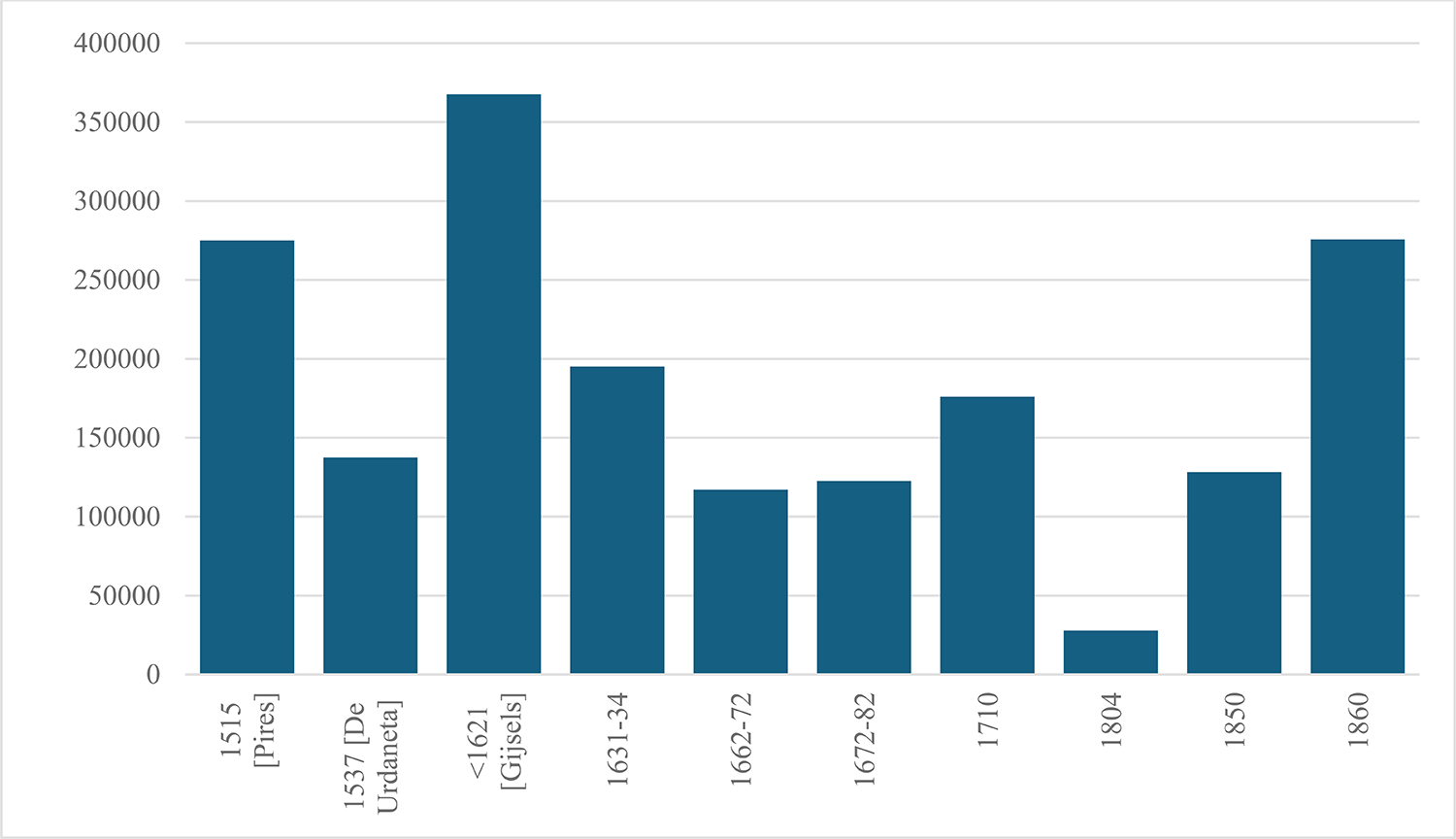
The data on productivity levels in the precolonial and early colonial periods is displayed in Figure 3, along with data on the late seventeenth century and beyond. I have elected to display only the amount of mace produced each year, as opposed to the amount of nutmeg or the size of the total crop, for two main reasons. Firstly, as was mentioned above, perverse incentives led some perkeniers to discard much of the low-value nutmeg in favour of the more valuable mace, thereby lowering the output of nutmeg to below its actual capacity.Footnote 135 Secondly, likely for the same reasons — i.e. the larger volume and lower price of nutmeg compared to mace — the VOC would have been incentivised to export more mace than nutmeg in periods of limited ship availability. For instance, in May 1634, the Company storage facilities on Banda contained some 310,500 lb. of nutmeg — equal to a sizeable shipment — and only 200 sockels (ca. 28,000 lb.) of mace — equal to a small shipment — which had been delivered too late to be loaded into the latest ship.Footnote 136 In short, a comparison of output data on mace is less likely to exaggerate the difference between the productivity levels of the precolonial and colonial eras.
Graph displaying annual mace yield in the Banda Islands (sources: Pires, Suma Oriental, 1:206; Mexia, “Descrição,” 15-6; De Urdaneta, “Narrative,” 85; Gijsels, “Verhaal,” 512, 514, 516; Valentijn, Oud en Nieuw, 3:23; Warburg, Muskatnuss, 258-61; for years 1631-34, consult Table 3)

Figure 3 Long description
The bar graph displays annual mace yield in the Banda Islands over several years. The horizontal axis lists the years: 1515, 1577 dash 79, 1621, 1624, 1631 dash 34, 1662 question mark, 1672 question mark, 1710, 1804, 1830 and 1860. The vertical axis represents yield in pounds, ranging from 0 to 400,000. Key values include: 1515 with approximately 250,000 pounds, 1577 dash 79 with around 150,000 pounds, 1621 with about 200,000 pounds, 1624 peaking at approximately 350,000 pounds, 1631 dash 34 with roughly 250,000 pounds, 1662 question mark and 1672 question mark both around 200,000 pounds, 1710 with about 100,000 pounds, 1804 with approximately 150,000 pounds, 1830 with around 200,000 pounds and 1860 with roughly 300,000 pounds. The graph highlights significant yield variations, with 1624 being the peak year and 1710 the lowest. The bars are vertical, representing a single series of data. The graph illustrates the fluctuations in mace production over time, emphasizing historical productivity trends in the Banda Islands.
Depending on whether one believes the upper or lower estimates for the precolonial period, Figure 2 can be used to tell two different stories. The first is one of decline: the production of mace was reduced by almost a third (Pires) or half (Gijsels) after colonisation. The second story is one of stagnation: productivity levels fluctuate over time but remain relatively similar from the sixteenth century until the mid-nineteenth century. There are two reasons for why the first is most likely to be closest to the truth. Firstly, as argued above, the amount of nutmeg and mace acquired by the Dutch in 1599 lends credibility to the upper estimates of productivity levels. Secondly, the decline in productivity seems to be reflected in a downwards trend in European consumption of nutmeg and mace after 1620, as observed by Jan Luiten van Zanden.Footnote 137 And while Van Zanden’s data only shows consumption levels within Europe, the Dutch monopoly on nutmeg and mace would naturally have drastically reduced consumption within Asia as well, a region which had previously competed with Europe over the acquisition of these spices. However, while I would argue that a decline in productivity following colonisation is likely to have occurred, the evidence in favour of this scenario is insufficiently conclusive to completely discount the possibility of a mere stagnation in productivity. In either case, however, it is clear that no significant rationalisation and intensification of production took place following colonisation, or at least that they did not result in any noticeable increase in productivity.
Given the costly conquest of the Banda Islands, it might seem puzzling that the Company seemingly never greatly invested in increasing the output of nutmeg production. This apparent paradox, however, can be resolved by examining the interests of the VOC. As a monopolist, it was not in the latter’s favour to produce great amounts of nutmeg and mace as this might drive down prices in Europe. As Els Jacob’s account of seventeenth– eighteenth century clove production on Ambon shows, the Company continually strived to artificially limit productivity by various means when prices fell and to increase it when prices rose.Footnote 138 Nutmeg and mace’s relative scarcity under the VOC allowed for highly inflated profit margins: from 1628 onwards into the 1630s, one lb. nutmeg was sold at the Amsterdam commodity exchange for ƒ2.50 or 50 stuivers whereas the perkeniers received less than a single stuiver per lb. (0.87 stuivers to be exact).Footnote 139 By contrast, this same pound of nutmeg had only cost ƒ1.28 in 1609 and ƒ1.20 in 1619 — the conquest of 1621 had clearly allowed the VOC to drive up the prices.Footnote 140 This markup of over 5,000 per cent would persist, if not grow, over time: in the mid-eighteenth century, a lb. of nutmeg was purchased from the perkeniers at 1.125 stuivers and sold in the Dutch Republic at 75 stuivers. Footnote 141 It should therefore not be surprising that these spices formed a major source of profits for the Company even though they constituted but a small part of the goods that were imported from Asia. According to Femme Gaastra, the monopolised spices of nutmeg, mace, cloves and cinnamon accounted for 28.5 per cent of VOC sales in Amsterdam between 1668–1670, whereas they only formed 12 per cent of total imports (measured in purchase price). For the years 1738–1740, these figures decreased to 23.5 per cent and 6.1 per cent respectively.Footnote 142 Given these profits, which were derived more from monopolisation than from any expansion or improvement of spice production, it may be more useful to conceptualise the colonial system of production on the Banda Islands in terms of control rather than in terms of rationalisation or intensification.
Concluding remarks
Loth’s characterisation of the early perkeniersstelsel is not just empirically ill-supported but also doubly anachronistic. Firstly, Loth seems to project the later perkeniersstelsel of the nineteenth century — characterised by more advanced cultivation methods and greater control over the labour process — back into the seventeenth century. Secondly, the modern conception of the plantation system — to which Loth compares the perken — would not yet have existed in the minds of the Dutch in 1621. Instead of a plantation, it seems more likely that the conceptual analogue of the perk would have been that of the garden. According to Richard Grove, the concept of the garden was central to European perceptions of nature in this period and signified human control or creation, the knowledge and ordering of plant species, and the (usually medical) usefulness of these species.Footnote 143 Brandon has made a similar link between the image of the garden and Dutch colonial expansion, using the colonisation of Banda as an example.Footnote 144 Through their division into perken, then, the wild and unknown nutmeg forests became symbolically subjected to Dutch control: bounded, categorised, and made useful — i.e. exploitable. However, not only did this symbolic subjection take a different shape than envisioned by Loth and others, it never fully translated into a subjection of the material world where human resistance and the environment limited rationalisation, exploitation, and control.
The analysis above presents difficulties for common understandings of the early perkeniersstelsel and of commodity frontiers in general. Rather than establishing a new commodity chain, as e.g. with sugar plantations in the Atlantic world, the VOC reorganised and redirected (parts of) an existing commodity chain. The early perkeniersstelsel differs strongly from the ideal-typical commodity frontier as conceptualised by Moore and shows that the exploitation of labour and resources by capital can be constrained by various limitations and contradictions. Production methods and labour processes were not rationalised or made more efficient but were mostly continuous with those of the precolonial period. The fact that land use was not intensified significantly is further shown by the decline — or, at best, stagnation — of productivity levels following colonisation. This was partly due to the contradictory relationship between the Company and perkeniers’ lack of horticultural knowledge amongst the latter, environmental conditions and resistance by the enslaved. Regardless, inefficient production was a minor inconvenience at worst as it created a scarcity which, under a Dutch monopoly, was used to inflate prices. The profits which were secured in 1621 remained an important pillar for the VOC throughout its existence, facilitating its expansion across Southeast Asia.

 Open access


