Mesoamerican scholars have focused their efforts on developing simulations of population and growth in primary Mesoamerican cities (Cowgill Reference Cowgill, Rivera and Ruiz2006:25–26; Gómez Chávez and Gazzola Reference Gómez Chávez and Gazzola2004:17, 33; Rojas Reference Rojas1987:9). Studies of the Maya lowlands have centered their attention on regional carrying capacities in the Classic period kingdoms of Guatemala, Belize, and Mexico (Cowgill Reference Cowgill, Rivera and Ruiz2006; Culbert and Rice Reference Culbert and Rice1990). Highland Mesoamerican scholarship has taken into consideration either population or, in fewer cases, the relationships between population and resources (Armillas Reference Armillas1971:661; Gómez Chávez and Gazzola Reference Gómez Chávez and Gazzola2004; Parsons Reference Parsons1968:876; Sanders Reference Sanders and Wolf1976:150). These are founded directly or indirectly on dynamics of preindustrial populations, which have been explained by Malthusian and Boserupian models (Reher Reference Reher, Nadalin, Marcilio and Balhana1990; Steinmann and Komlos Reference Steinmann and Komlos1988; Steinmann et al. Reference Steinmann, Prskawetz and Feichtinger1998; Wood Reference Wood1998).
Until now, analyses of demographic dynamics of the prehispanic coastal populations of the peninsula of Yucatan have rested on paleodemographic simulations that typically employ stable population scenarios, using hypothetical growth rates modeled after Malthusian populations (Cucina et al. Reference Cucina, Sierra, Tiesler, Charlotte Arnauld, Pereira and Beekman2016; Hernández Espinoza and Márquez Morfín Reference Hernández Espinoza and Morfín2015; Tiesler et al. Reference Tiesler, Cucina, Sierra-Sosa, Falla and Meindl2005). These hypothetical rates have not been tested by archaeodemographic studies of population growth and number of inhabitants (Hassan Reference Hassan1979; Rojas Reference Rojas1987:8; Turner Reference Turner II1983). Unfortunately, the data needed to do this have rarely been obtained from Maya sites due to the lack of extensive and thorough archaeological exploration of dwellings and residential compounds.
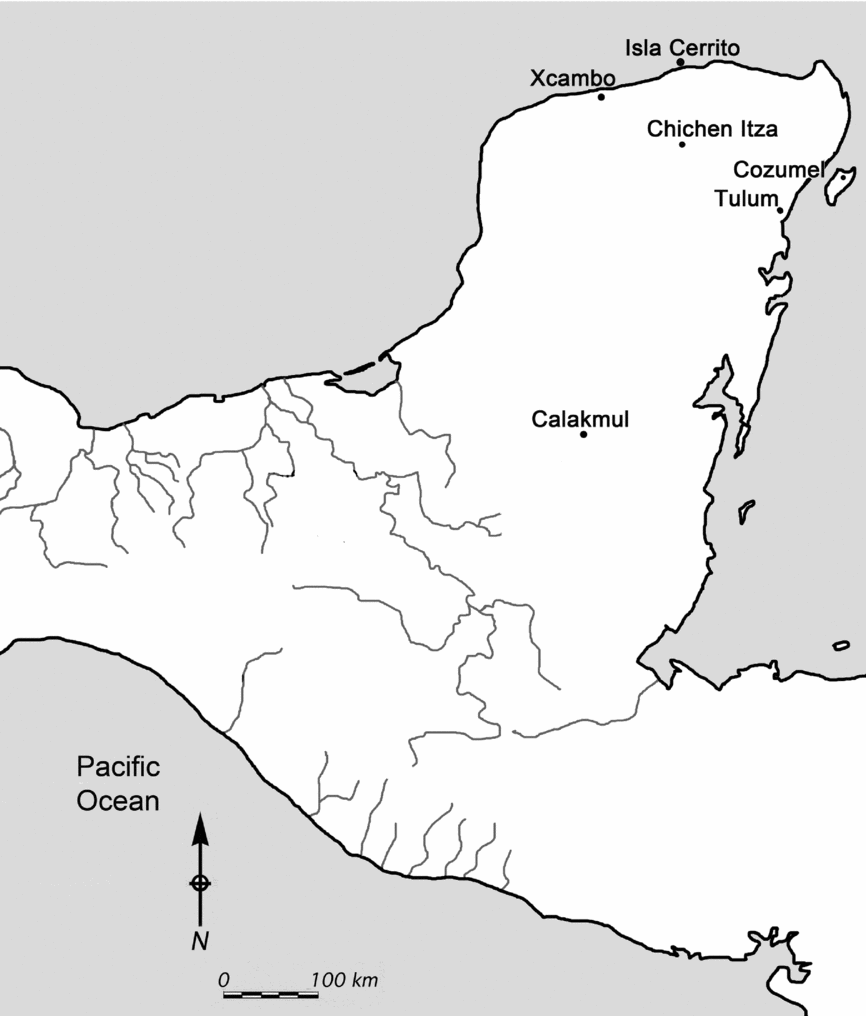
One exception is the Classic period (AD 250–750) port site of Xcambo, located along the northern shores of the Yucatan peninsula (Figure 1). Here, intensive and extensive archaeological exploration, and the large number of well-preserved burials recovered between 1996 and 2000 (Sierra-Sosa Reference Sierra-Sosa2004), have enabled a fertile combination of archaeodemographic approaches (analyses of population and growth of ancient populations based on the presence of archaeological elements) with paleodemographic analyses (analyses to assess fertility and mortality patterns of ancient populations, based on human remains), and other general bioarchaeological approaches (Sierra-Sosa Reference Sierra-Sosa2004; Sierra-Sosa et al. Reference Sierra-Sosa, Andrea Cucina, Burton and Tiesler2014). The well-defined settlement area, fringed by the inhospitable coastal marshlands, further solidifies demographic estimates by providing clear and precise boundaries. These factors make it a good test case for using multifactorial mathematical models of archaeodemographic growth.
Peninsula of Yucatan with localities such as Xcambo, Isla Cerritos, and Chichen Itza.

It is in this context that we reconstruct and discuss the broader implications of the shifting population of the site, applying (archaeodemographic) house-count methods, coupled with published demographic parameters from skeletal data (Tiesler et al. Reference Tiesler, Cucina, Sierra-Sosa, Falla and Meindl2005). Our assessment of population and growth fits well with the archaeologically documented evolution of Xcambo from a small salt production center in the Early Classic (AD 250–550) to an autonomous port in the Late Classic (AD 550–750) and helps to contextualize broader research questions related to Maya coastal networks at the end of the Classic.
Putting Demographic Growth Theory into Regional Frames
Hassan (Reference Hassan1979:138) states that preindustrial agriculturalist societies, centered on non-monetized subsistence, provide their own dietetic sustenance depending on population size, density, growth rate, and demographic distribution. Wood (Reference Wood1998) modeled these relationships on Malthus's (Reference Malthus and Simon1998 [Reference Malthus and Simon1798]) and Boserup's (Reference Boserup1967 [Reference Boserup1965]) frameworks. According to them, the growth of preindustrial populations is based on two contrasting assumptions. First, it is a slow and gradual process, despite potential phases of relatively fast growth. Second, population growth is cyclical and regulated by specific mechanisms, described below (Komlos and Nefedov Reference Komlos and Nefedov2002; Schacht Reference Schacht1981; Wood Reference Wood1998). The processes tend to balance, and unless exogenous variables intervene, population levels will eventually reach equilibrium.
In addition to demographic assumptions, population density points toward economic intensification (Netting Reference Netting1993; Wood Reference Wood1998) and creates a loop of population growth (Boserup Reference Boserup1967; Spooner Reference Spooner1972). Wood (Reference Wood1998:107) prefers to use the term “demographic saturation point” rather than “carrying capacity.” Saturation is related to the marginal productivity of any system and occurs “when the increment in marginal productivity is just enough to allow one more individual to survive and reproduce at levels just sufficient to replace himself or herself exactly” (Wood Reference Wood1998:107).
The demographic saturation point can change if the production system changes, depending on the environment and its resources. Boserup (Reference Boserup1967) pointed out that innovation always has a cost. Innovation is endogenous to a particular site or culture (Komlos and Nefedov Reference Komlos and Nefedov2002) and is subject to the interdependence between economic and demographic factors. For example, fertility could decrease with new contraceptive methods (innovation), decrease in income per capita, and decrease of mortality (Steinmann et al. Reference Steinmann, Prskawetz and Feichtinger1998). There is a positive correlation between the stock of human capital and technological innovation (Kuznets Reference Kuznets1973; Steinmann et al. Reference Steinmann, Prskawetz and Feichtinger1998). People who embrace some beneficial innovation (such as irrigation of crops, a new system of crop rotation, or elevation of fields) typically increase their fertility and at the same time decrease their mortality.
Modifications in density-dependent vital rates (birth and deaths) are an immediate consequence of innovation, but saturation does not necessarily imply a demographic crisis in the Malthusian sense. At the same time, the concept of saturation incorporates Malthusian “checks” that can help reduce population size: namely, preventive checks that limit fertility (e.g., late marriage, birth spacing, and celibacy) and positive checks that correspond to increased mortality.
In our own simulation, we consider Wood's (Reference Wood1998) model, which takes into account production modes, environment, and technological innovations. Wood (Reference Wood1998:110) states that positive checks are more common, but McKeown (Reference McKeown, Rotberg and Rabb1990) and Schofield (Reference Schofield, Rotberg and Rabb1990) show that mortality increase is modest, especially for young individuals. Consequently, preindustrial populations are balanced routinely well below the tolerable level of saturation. Nevertheless, there can be drastic overshoots in population growth that lead population size to temporarily exceed the saturation level. These sporadic but unavoidable overshoots occur when fertility increases without greater mortality. This happened in Europe (Schofield Reference Schofield, Rotberg and Rabb1990) and Mexico (Reher Reference Reher, Nadalin, Marcilio and Balhana1990) during the seventeenth and eighteenth centuries, respectively, with fluctuations in nuptiality and, therefore, marital fertility. Scholars have pointed out that this was related to economic fluctuations, improvement of agriculture, and rising income.
In its application to the Yucatecan setting of coastal populations, Wood's theorem is constrained by both weather and environmental conditions for marine and terrestrial resources. The north coast of Yucatan is the driest area in the region, with semiarid weather (Bautista et al. Reference Bautista, Palacio-Aponte, Quintana and Zinck2011; Leyden et al. Reference Leyden, Brenner, Whitemore, Curtis, Piperno, Dahlin and Fedick1996:48). Savannah, petenes (tropical forests on residual hills), mangroves, coastal dune scrub, sedge, and cattail marshes (Bautista et al. Reference Bautista, Palacio-Aponte, Quintana and Zinck2011:309) are the dominant environments, with a precipitation gradient of 500 to 600 mm per year (Carrillo Bastos et al. Reference Carrillo Bastos, Islebe and Valle2012:430–431).
Traditional peasant societies characterized by simple technologies and high dependency on the weather are more vulnerable to climatic variations that affect agricultural production (Galloway Reference Galloway1986; Lobell and Field Reference Lobell and Field2007; Zhang et al. Reference Zhang, Lee, Cong, Li, Zhang, Pei and Chen2011). Both anthropogenic and natural factors cause climatic variation in the Yucatan (Carrillo Bastos et al. Reference Carrillo Bastos, Islebe and Valle2012; Curtis et al. Reference Curtis, Hodell and Brenner1996:42; Hodell et al. Reference Hodell, Brenner, Curtis and Guilderson2001; Leyden et al. Reference Leyden, Brenner, Whitemore, Curtis, Piperno, Dahlin and Fedick1996). Around the transition from the Early to Late Classic period (ca. AD 550), an episode of extreme dryness affected the northeastern territories of the peninsula. Between AD 600 and 800, there was an interval of increased humidity, and by AD 800 to 900 dry conditions returned (Carrillo Bastos et al. Reference Carrillo Bastos, Islebe and Valle2012).
The coastal dwellers coped with geological, vegetation, and climatic conditions with diverse sets of adaptive strategies, geared towards counteracting either scarcity or the seasonality of resources, such as selective fishing or trade (Eder Reference Eder2005; Rosique and Rebato Reference Rosique and Rebato1997). Evidence of these strategies has been reported at Xcambo as well as at other prehispanic coastal settlements (Götz Reference Götz2008; Masson and Peraza Lope Reference Masson and Lope2008; Williams et al. Reference Williams, White and Longstaffe2009).
House Counts and Population Estimates
Archaeologists have used different approaches to estimate population in ancient societies, such as house counts, assessments of agricultural and water reservoir potential, and labor investment in buildings (Culbert and Rice Reference Culbert and Rice1990). These methods follow three steps: dividing time into distinct site occupations, selecting archaeological features that respond to demographic parameters, and multiplying these elements by modal population estimates such as average family size.
House counts are commonly used in the Maya area (Culbert and Rice Reference Culbert and Rice1990) and have been standardized by the equation:
 $$\begin{equation*}
{\rm{Po}}{{\rm{p}}_{(t)}} = {\rm{OcStruc}}{{\rm{t}}_{(t)}}*{\rm{HH}}{{\rm{S}}_{(t)}}
\end{equation*}$$
in which OcStruct(t ) is the number of occupied structures at a specific time t, and HHS(t ) is the average number of occupants per structure (Turner Reference Turner II, Culbert and Rice1990). It is a simple equation, and most archaeologists have used it when assessing population in ancient Mesoamerica (Hassan Reference Hassan1979; Turner Reference Turner II, Culbert and Rice1990), making results comparable among localities.
Proper application of this method hinges on overcoming the caveats of settlement patterns: hidden structures and unexplored areas, the continuity of occupation phases, contemporaneity, types of residential dwellings, and the number of inhabitants per residential dwelling. Settlement patterns of Maya agriculturalists ranged from “concentrated” (Culbert Reference Culbert, Yoffee and Cowgill1988; Turner Reference Turner II, Culbert and Rice1990) to “dispersed” (Ashmore Reference Ashmore1981; Fry Reference Fry, Patrick Culbert and Rice1990) around productive agricultural lands, although agriculture was not the unique variable to determine the pattern (Vogt Reference Vogt1961; Webster and Freter Reference Webster, Freter, Culbert and Rice1990). Wars and institutional pressure imposed by regional elites could lead to population concentrations around prehispanic cities (Fry Reference Fry, Patrick Culbert and Rice1990; Turchin Reference Turchin2005). Often, archaeologists cannot easily and clearly determine boundaries between rural and urban areas in and around archaeological sites, limiting the ability to calculate population density (Turner Reference Turner II, Culbert and Rice1990; Zetina and Faust Reference Zetina Gutiérrez and Faust2011).
Not all houses at a site are explored or even noted, because of difficulty in determining the exact boundaries of the settlement, the presence of buried or hidden structures, and the lack of resources (Pyburn Reference Pyburn, Culbert and Rice1990). In fact, scholars have pointed out that the number of structures and population size are not always related (Santley Reference Santley, Culbert and Rice1990; Schreiber and Kintigh Reference Schreiber and Kintigh1996). Both small and rural sites could have a significant number of hidden structures (Tourtellot Reference Tourtellot, Culbert and Rice1990; Webster and Freter Reference Webster, Freter, Culbert and Rice1990:46), caused due to mobility among the agriculturalists (Haviland Reference Haviland1989; Zetina and Faust Reference Zetina Gutiérrez and Faust2011). Reoccupation and reuse of a site could correspond with such mobility (Brooks and Yellen Reference Brooks, Yellen and Kent1987). There are several proposals for how to estimate the occupation/abandonment cycle of a residential structure, which depends on the lifetime of each structure (Culbert and Rice Reference Culbert and Rice1990).
The continuity of occupation depends on size as well as economic and political factors at each site (Fry Reference Fry, Patrick Culbert and Rice1990:289; Santley Reference Santley, Culbert and Rice1990). Therefore, there is no specific pattern in the continuity of occupation across the Maya area. Culbert (Reference Culbert, Yoffee and Cowgill1988) points out that for comparative purposes, it is necessary to normalize data to a standard unit of time (e.g., a century). Other authors use different factors depending on the characteristics of each site (Fry Reference Fry, Patrick Culbert and Rice1990:289; Webster and Freter Reference Webster, Freter, Culbert and Rice1990:47, 59).
Contemporaneity is bound to the phases of occupation and refers to the coexistence of archaeological elements. If an occupation phase was short, an adjustment must be applied to calculate both the absolute and relative populations (sensu Culbert et al. Reference Culbert, Kosakowsky, Fry, Haviland, Patrick Culbert and Rice1990:108–109). Webster and Freter (Reference Webster, Freter, Culbert and Rice1990:47, 59) have applied correction factors to such structures, decreasing population size by a factor of 5% to 20%.
In the Maya area, dwellings were heterogeneous, both within and between localities (Garza Tarazona de González and Kurjack Reference Garza Tarazona de González and Kurjack1984:21; Pyburn Reference Pyburn, Culbert and Rice1990). Based on ethnographic studies in Mesoamerica (Redfield and Villa Rojas Reference Redfield and Rojas1962; Robichaux Reference Robichaux and Robichaux2005), scholars have hypothesized that one of the characteristics of such houses was that they were inhabited by nuclear families. Corporate groups bounded by patrilinearity keep a corporate property and venerate their ancestors (Hageman Reference Hageman2004; Hendon Reference Hendon1991; Robichaux Reference Robichaux and Robichaux2005). Such groups alternated cycles of fusion and fission across generations (Robichaux Reference Robichaux and Robichaux2005), and dwellings are the remains of these cycles (Webster and Freter Reference Webster, Freter, Culbert and Rice1990). Across Mesoamerica, evidence of apartment compounds characterized by kinship ties has been found (Cowgill Reference Cowgill, Rivera and Ruiz2006:26; Garza Tarazona de González and Kurjack Reference Garza Tarazona de González and Kurjack1984:22; Tourtellot Reference Tourtellot, Culbert and Rice1990; Vogt Reference Vogt1961:137, 142). Although there is an active debate about such compounds (Duncan and Hageman Reference Duncan, Hageman and Cucina2015; Manahan et al. Reference Manahan, Ardren and Olvera2012), we consider that this model fits best with the characteristics of Xcambo.
The existence of lineages has direct implications for the number of inhabitants of each domestic unit, and if they were nuclear or compound families. Redfield and Villa Rojas's (Reference Redfield and Rojas1962) ethnographic study of the Maya population of Chan Kom, Yucatan, assessed an average number of 5.4 and 5.6 persons per dwelling. Webster and Freter (Reference Webster, Freter, Culbert and Rice1990:49) calculated between 3.5 and 5 individuals per room, depending on the kind of structure. Tourtellot and others (Reference Tourtellot, Sabloff, Smyth, Culbert and Rice1990) used an average of 4 persons per room, and Borah and Cook (Reference Borah and Cook1963) used 4.5 and 6. Turner (Reference Turner II, Culbert and Rice1990) stated that a larger average is consistent with ancient agrarian economies. According to these assessments, we assume that the families of Xcambo were characterized by apartment compounds containing two or three nuclear families, each with four to six members, depending on the cycle stage of each nuclear family.
The Archaeodemography of Xcambo, Yucatan
The ancient coastal settlement of Xcambo saw extensive and intensive explorations between 1996 and 2000 by the Proyecto Arqueológico Xcambo, led by Sierra-Sosa (Reference Sierra-Sosa2004). The chronology of the structures was established through analysis of ceramic materials collected from 2x2 m and 3x3 m stratigraphic pits excavated down to bedrock (Sierra-Sosa et al. Reference Sierra-Sosa, Hernández, Carrillo, Quintal, Euán, Osorio and Martínez1996:34, 86–89).
A total of 167 pits and trenches were dug across the site. Of these, 111 pits evinced both Early and Late Classic occupations, and the other 56 provided evidence only of the Late Classic. The ceramic analysis and related chronology rested on the type-variety classification system (Sierra-Sosa et al. Reference Sierra-Sosa, Andrea Cucina, Burton and Tiesler2014). Although the site was in use for about a millennium, the main occupation phases correspond to the Early Classic (AD 250–550) and the initial part of the Late Classic (AD 550–700). The Xtampu ceramic complex characterized the Early Classic period, showing ties with the northern Maya lowlands and the central lowlands of Mexico and the Guatemala Petén. The Grijalva, Canbalam, Cehpech, and Tepeu I ceramic complexes characterize the later phase of occupation, and indicate trade connections with the northern Maya lowlands, the central Petén, and the Gulf of Mexico all the way to the Usumacinta and Veracruz (Jiménez Álvarez Reference Jiménez Álvarez and Cucina2015; Sierra-Sosa et al. Reference Sierra-Sosa, Andrea Cucina, Burton and Tiesler2014).
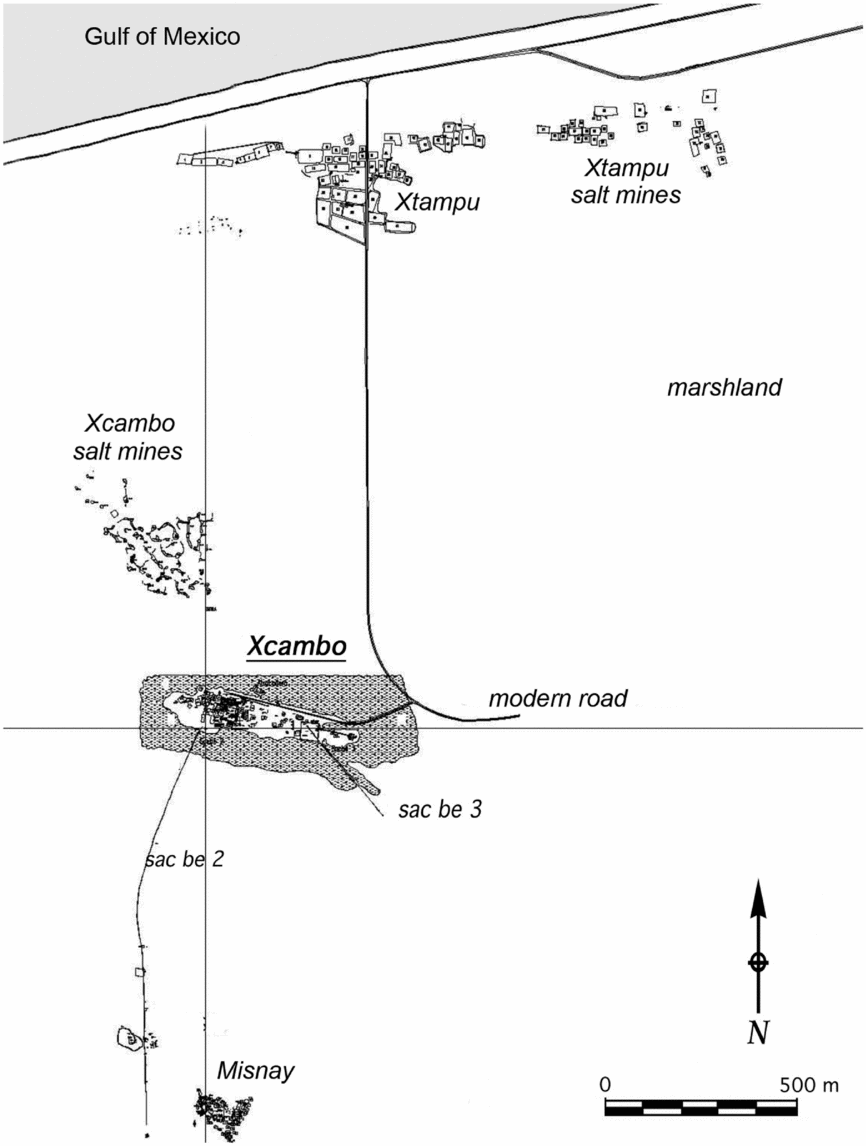
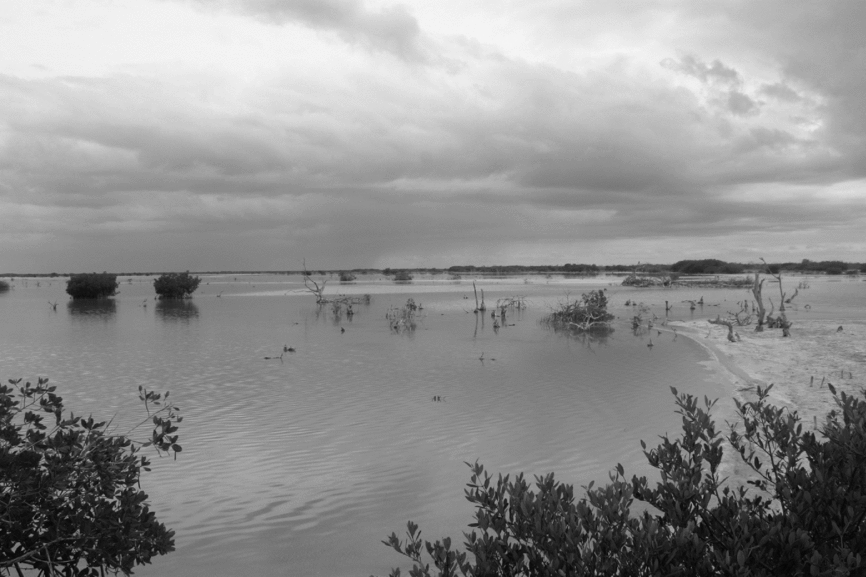
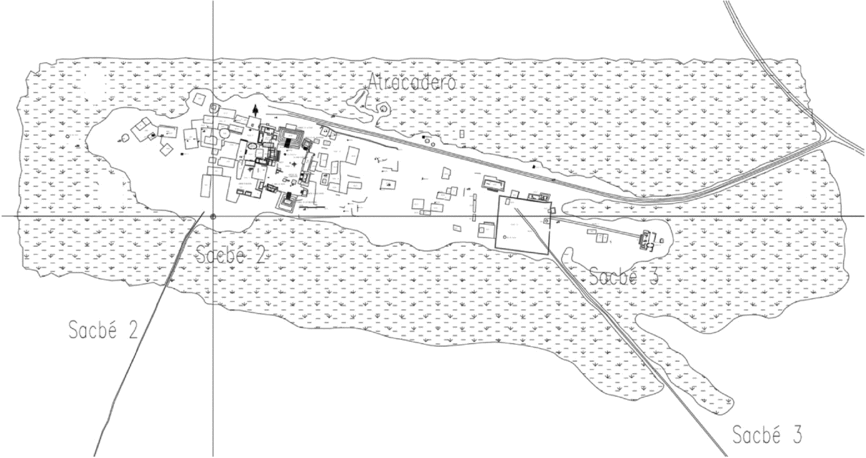
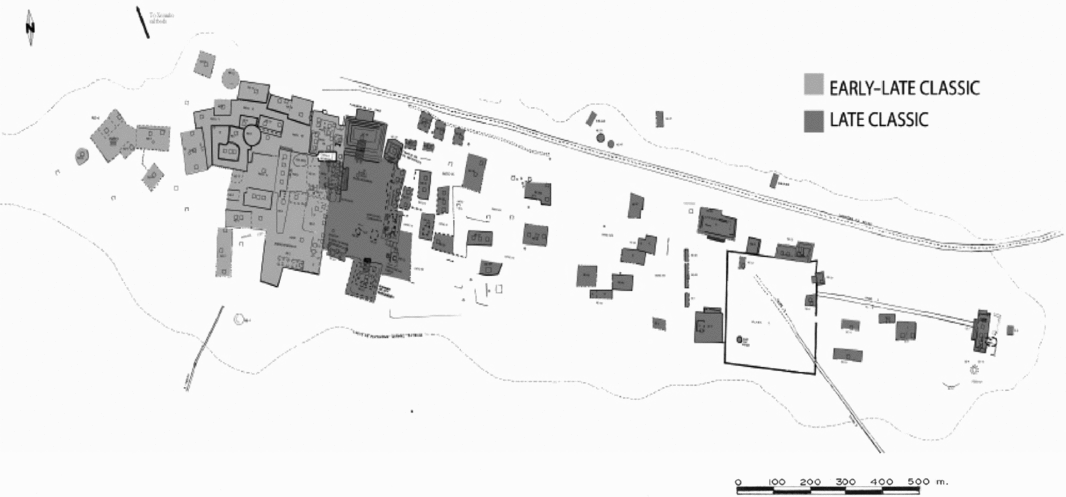
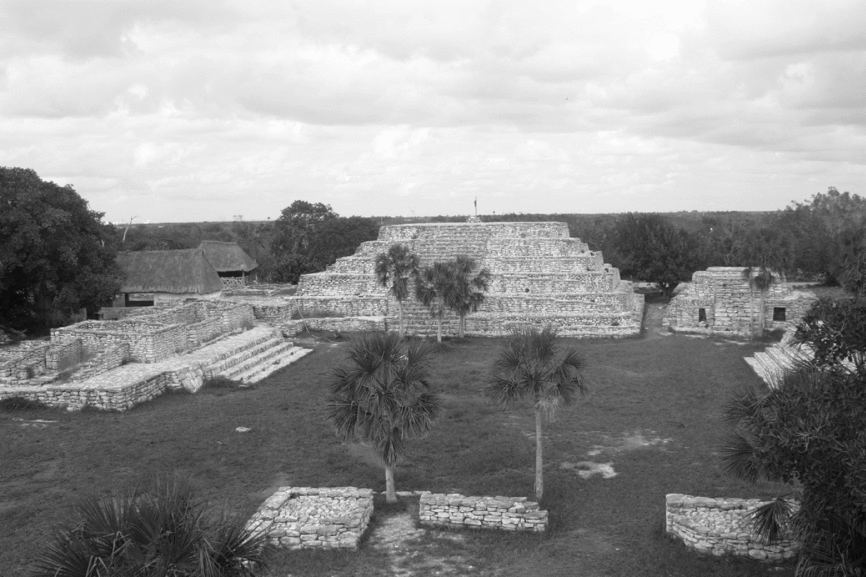
We classify the structures at Xcambo as either public or habitation in nature (Sierra-Sosa et al. Reference Sierra-Sosa, Hernández, Carrillo, Quintal, Euán, Osorio and Martínez1996). The site was built over a small natural mound on the edge of a swamp, which in ancient times was located about one km inland from the northeastern shores of the peninsula (Figures 1–3). This up-rise was a favorable location for settlement because of good soils, construction materials, and the availability of drinking water, which was provided by five water springs and a chultun (Sierra-Sosa Reference Sierra-Sosa2004:94 96). The whole peten measures 500 x 1,800 m, and the settlement occupies measures 700 m (east-west) by 150 m (north-south; Sierra-Sosa Reference Sierra-Sosa2004:97). Constructions at Xcambo are arranged along the east-west axis of the up-rise. The main plaza is at the center of the peten, and residences are positioned along its edges. The plaza is surrounded by 11 platforms, most of which were used to perform civic, religious, and administrative activities (Figure 4). Some 250 m east of the main plaza, three Late Classic public structures composed a second, smaller plaza. At one of its extremes, a sacbe (unpaved causeway) leads to the eastern residential periphery of the settlement (Figures 2, 4, and 5; Sierra-Sosa Reference Sierra-Sosa2004:96, 97).
Regional map, showing Xcambo and Misnay (adapted from Sierra-Sosa et al. Reference Sierra-Sosa, Hernández, Carrillo, Quintal, Euán, Osorio and Martínez1996).

Marshlands around the raised site of Xcambo.

Main plaza of Xcambo surrounded by civic and ceremonial buildings.

Settlement of Xcambo (adapted from Sierra-Sosa et al. Reference Sierra-Sosa, Hernández, Carrillo, Quintal, Euán, Osorio and Martínez1996).

Sierra-Sosa and colleagues (Reference Sierra-Sosa, Hernández, Carrillo, Quintal, Euán, Osorio and Martínez1996:49) reported 11 patio groups of different sizes. Dwellings on the western side of the site were more elaborate (bigger and with more finished carved blocks) than those in the modest platforms of the eastern sector. One or two houses used by nuclear families were erected on top of each platform, inferred from the presence of domestic waste (Sierra-Sosa Reference Sierra-Sosa2004:97–98) and from skeletons (likely members of the nuclear families) interred within the platforms, a feature characteristic of ancient Maya culture (Rathje Reference Rathje1970; Villa Rojas Reference Villa Rojas1985).
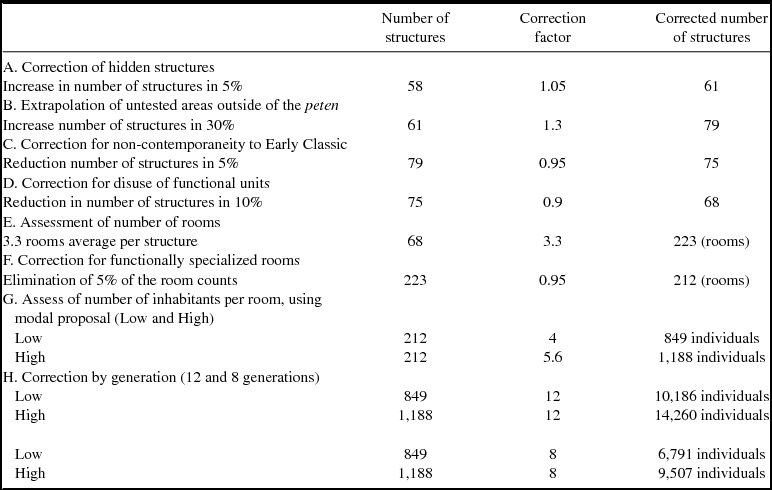
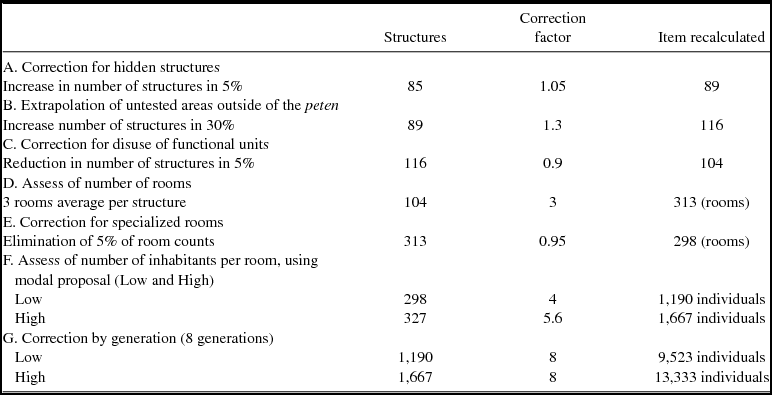
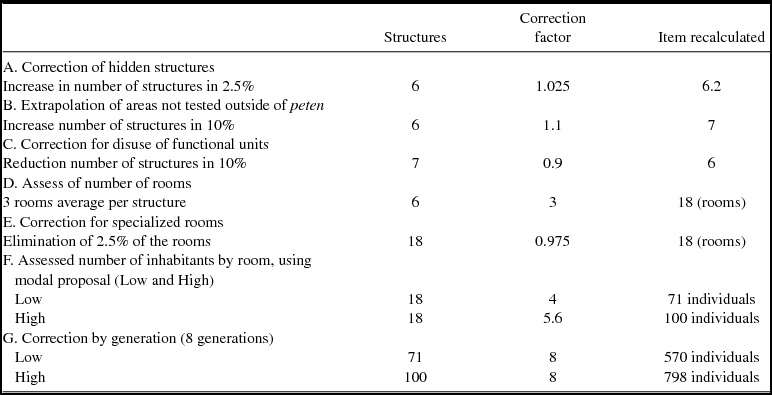
The settlement area displays vestiges of 104 structures, and the number of dwelling structures is 91. Of these, 58 structures show continuous occupation from the Early Classic to the Late Classic periods, and only 33 were built during the later phase of occupation. All 91 house platforms were used during the Late Classic. Of these, 85 are simple, and 6 are palace-type platforms (Figure 6). Simple houses were made of semiperishable material, erected on a low platform and inhabited by lower-status members of the society. Palace-type dwellings were of higher quality, more elaborate, and inhabited by people of higher status. The total population was estimated by counting common platforms dating to both the Early and Late Classic (Tables 1 and 2), and palace-type structures dating to the Late Classic period (Table 3). We do not know how many hidden structures are present, especially on the margins of the peten. For this reason, we apply conservative correction factors to the population estimates.
Architectonic distribution within the site of Xcambo—Main Plaza (from Sierra-Sosa et al. Reference Sierra-Sosa, Hernández, Carrillo, Quintal, Euán, Osorio and Martínez1996).

Estimates of Domestic Non-palace-type Structures and Their Inhabitants, Early Classic.

Estimates of Domestic Non-palace-type Structures and Their Inhabitants, Late Classic.

Estimates of Domestic Palace-type structures and Their Inhabitants, Late Classic.

The community of Xcambo might have extended beyond the limits of the peten, including people from Misnay and the near the salt pans. We explored Misnay and other groups outside the main survey zone (5,739 m2) and recorded 53 simple dwelling structures, erected either individually or in small clusters (Figure 2). Misnay comprises a small civic plaza with 10 administrative structures. The dwellings included small patios connected by narrow aisles that split the platforms (Sierra-Sosa Reference Sierra-Sosa2004). We decided to add a correction factor of 5% to the simple residential platforms in order to include hidden structures in the area explored by the archaeological investigation, and an additional 30% for the areas that were not surveyed and test-pitted (Tables 1 and 2). The low number of palace-type platforms at the site led us to correct our counts, respectively, by 2.5% and 10%, to include hidden examples and areas not surveyed or test-pitted (Table 3).
Contemporaneity at Xcambo was not a problem, because most of the structures showed continuous Early to Late Classic occupation (Sierra-Sosa Reference Sierra-Sosa2004:7, 98). Nevertheless, we applied a conservative correction factor of −5% in case we over-counted structures that were not contemporaneous in the Early Classic period (Table 1, step C). For the Late Classic, this was not necessary, because the site was not occupied in the Terminal Classic. For both periods and for all structures, we corrected for disuse (in the case that some structure fell down or ceased to be used) by subtracting 10% from the total structure count. This follows Webster and Freter (Reference Webster, Freter, Culbert and Rice1990) for Copan (Table 1, step D; and Tables 2 and 3, step C).
It would be erroneous to consider the domestic platforms as housing a single nuclear family. Instead, we estimate counts for extensive families from the reported family structures in ethnographies (Redfield and Villa Rojas Reference Redfield and Rojas1962; Vogt Reference Vogt1961). The average number of inhabitants per dwelling (physical space where its inhabitants perform production and reproduction activities) was obtained by counting the number of rooms of each structure. The average number of rooms for the Early Classic was 3.3 (Table 1, step E) and 3.0 for the Late Classic (Tables 2 and 3, step D). We reduced by 5% the number of rooms, to correct for specialized spaces in both Early and Late Classic for simple structures and by 2.5% for domestic palace-type structures (Table 1, step F; and Tables 2 and 3, step E).
The estimated total population of Xcambo depends on the number of inhabitants of each room of domestic structures. We consider that the likely number of inhabitants per room was 4 to 5.6 individuals, based on ethnographic studies in the region (Redfield and Villa Rojas Reference Redfield and Rojas1962; Tourtellot et al. Reference Tourtellot, Sabloff, Smyth, Culbert and Rice1990). We multiplied this modal number by the number of rooms to estimate the number of inhabitants by dwelling unit of an extensive family (Table 1, step G; and Tables 2 and 3, step F). Finally, we applied a correction factor to the structures that were continuously inhabited during the Early and Late Classic (500 years), in comparison with those inhabited only during a time span of 200 years (the Late Classic), taking into consideration the number of generations that could have inhabited them, according to Culbert and colleagues (Reference Culbert, Kosakowsky, Fry, Haviland, Patrick Culbert and Rice1990; Table 1, step H; and Tables 2 and 3, step G).
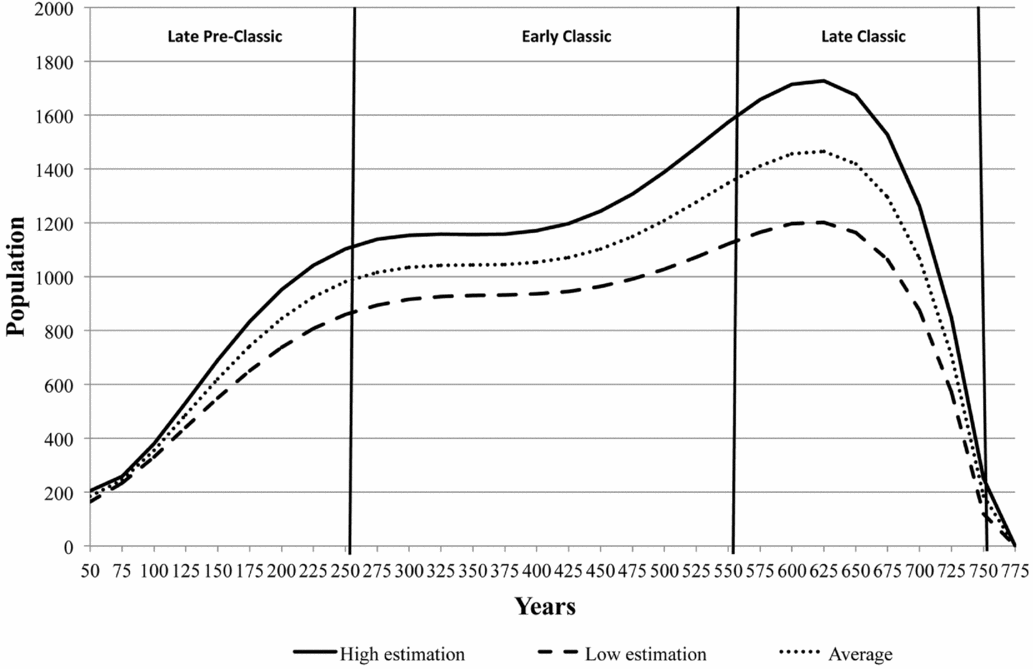
Our figures range from 6,791 to 14,131 total inhabitants during the entire period between AD 250 and AD 750. Using these numbers of total population, we develop 6th-degree polynomial equations with R² = 0.96075 and 0.93467 (Equations 1 and 2) to display the pattern of population growth.
Equation 1. To predict the yearly population with at low estimate:
 $$\begin{eqnarray}
y &=& 4.96434{\rm{E}} - 14{{\rm{x}}^6} - 4.23348{\rm{E}} - 10{{\rm{x}}^5}\nonumber\\
&& +\; 6.31402{\rm{E}} - 07{{\rm{x}}^4} - 3.61678{\rm{E}} - 04{{\rm{x}}^3}\nonumber\\
&& +\; 8.42995{\rm{E}} - 02{{\rm{x}}^2} - 4.08969{\rm{E}} + 00{\rm{x}}\nonumber\\
&& +\; 1.99701{\rm{E}} + 02\nonumber\\
{{\rm{R}}^2} &=& 0.96075
\end{eqnarray}$$
Equation 2. To predict the yearly population with at high estimate:
 $$\begin{eqnarray}
y &=& 5.07655{\rm{E}} - 13{{\rm{x}}^6} - 1.63614{\rm{E}} - 09{{\rm{x}}^5}\nonumber\\
&& +\, 1.82788{\rm{E}} - 06{{\rm{x}}^4} - 9.11570{\rm{E}} - 04{{\rm{x}}^3}\nonumber\\
&& +\, 2.03448{\rm{E}} - 01{{\rm{x}}^2} - 1.41701{\rm{E}} + 01{\rm{x}}\nonumber\\
&& +\, 5.07386{\rm{E}} + 02\nonumber\\
{{\rm{R}}^2} &=& 0.93467
\end{eqnarray}$$
Because there was an uninterrupted human presence from the Middle Preclassic to AD 750, when the site was completely abandoned (Sierra-Sosa Reference Sierra-Sosa2004), our simulations start at AD 50 with a hypothetical initial range of 165 to 204 persons, based on the estimates of 4 to 5.6 people per family. For the high estimates, we observe two population peaks: one of 1,158 inhabitants in the hypothetical year AD 320, and the second of 1,728 inhabitants for the year AD 625. For low estimates, on the other hand, only one peak occurs in AD 625 with 1,202 inhabitants, despite steady growth along the entire timeline (Equations 1 and 2, and Figure 7).
Evolution of population of Xcambo, Yucatan from AD 50 to 750. Please note that the period before AD 250 is merely hypothetical due to lack of archaeological evidence indicating settlement activities in that time span.

We calculate the hypothetical growth rate at Xcambo using a geometrical equation:
 $$\begin{equation*}
(r = \left( {\left( {Po/Pt} \right)exp1/t} \right) - 1
\end{equation*}$$
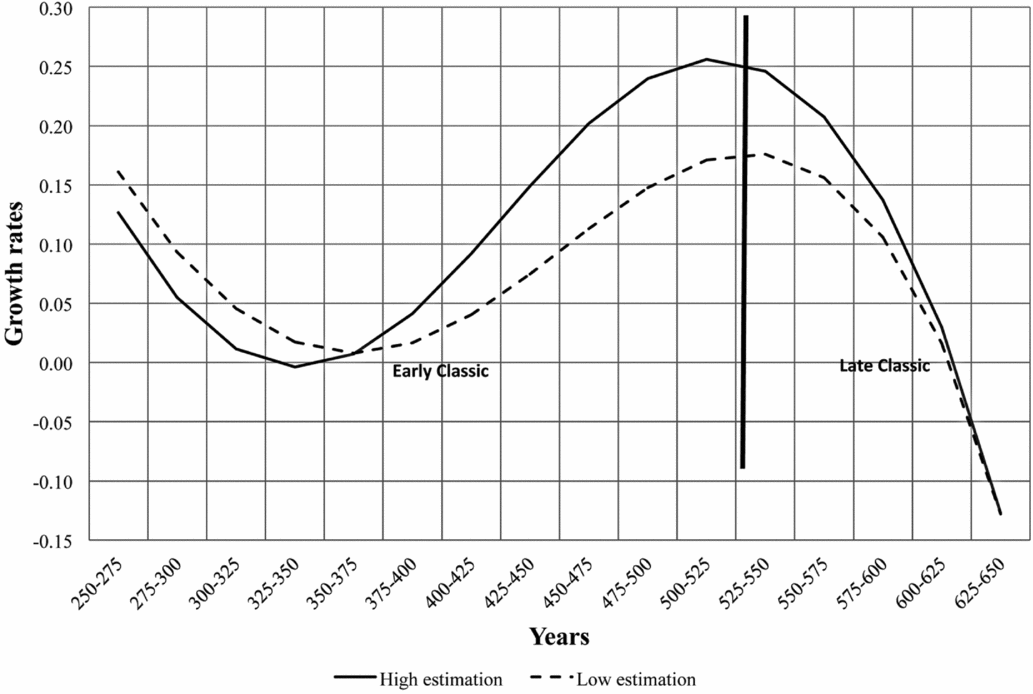
We consider that this equation provides reasonable estimates of population growth following the suggestions of Livi-Bacci (Reference Livi-Bacci1993). The corresponding low estimates suggest that the population of Xcambo grew at a yearly rate of 0.01 and 0.17% per year during the Early Classic, and between 0.02% and 0.18% during the Late Classic, with population loss (negative growth) during the last 150 years of the latter period (Figure 8). Conversely, when high estimates are used, growth appears to have occurred at a rate of 0.0% to 0.26% per year in the Early Classic, and from 0.03 to 0.25% in the Late Classic. Again, population decline occurred during the last 150 years of the Late Classic (Figure 8). Therefore, if low estimates are used, we expect that between 860 and 1,073 people lived at the site at any given time during the Early Classic, and up to 1,202 in the Late Classic (Figure 8). If high estimates are used, these are 1,103 inhabitants for the Early Classic and up to 1,728 in the Late Classic.
Estimated growth rates of the population of Xcambo, Yucatan, between AD 250 and 650 (Early to Late Classic Period).

Discussion
Estimation of population and population density is crucial to our efforts to comprehend diverse cultural, social, and biological situations (e.g., fertility, life expectancy, and epidemic disease spread), and the reasons behind demographic collapses (Gaines and Gaines Reference Gaines and Gaines1997; Hill et al. Reference Hill, Clark, Doelle and Lyons2004; Lynnerup Reference Lynnerup1996; Milner and Chaplin Reference Milner and Chaplin2010). From a wider regional perspective, multivariate demographic simulations of Maya populations during the latter part of the Classic period constitute a step towards understanding the population dynamics before and during the so-called Maya collapse (Culbert Reference Culbert, Yoffee and Cowgill1988; Lucero Reference Lucero2002). This holds particularly true for the archaeology of the Yucatan and its coastal settlements, which are still relatively poorly understood (Andrews et al. Reference Andrews, Andrews and Castellanos2003).
Xcambo, like any other preindustrial settlement, was subject to the two principal assumptions of demographic development: long and slow demographic growth and mechanisms of self-regulation related to the demographic saturation concept. Following Wood's model and the assumptions we present, we consider two different socioeconomic scenarios that could have occurred during development of Xcambo across its 500 years of occupation. According to this model and archaeological reconstructions, the site was a small settlement during the Early Classic period. We already know that the site functioned as a small coastal port specializing in salt production and distribution with trade contacts mainly in the northern Maya lowlands (Sierra-Sosa Reference Sierra-Sosa2004).
The Early Classic environment was characterized by significant drought and a reduction of forest cover, which affected Xcambo (Curtis et al. Reference Curtis, Hodell and Brenner1996; Hodell et al. Reference Hodell, Brenner, Curtis and Guilderson2001). Although the site counted on plenty of water sources from its karst springs, it is quite possible that demographic growth was constrained by limited commercial activities. In this scenario, the demographic growth of Xcambo was almost null (Figure 8). The low and fluctuating growth rate during this period is explicable because the population was small and endogamous. Culbert and Rice (Reference Culbert and Rice1990) and Fry (Reference Fry, Patrick Culbert and Rice1990) have reported similarly low growth rates for the Early Classic at several localities in both the northern and central Maya lowlands of the Yucatan Peninsula.
Small populations have a greater demographic dependence on stochastic variation than larger settlements, which are demographically more stable and less affected by random fluctuations (Weiss and Smouse Reference Weiss and Smouse1976). We stress that only 81 excavated skeletons date to the Early Classic period, of the 529 unearthed at the site. Cucina and colleagues (Reference Cucina, Sierra, Tiesler, Charlotte Arnauld, Pereira and Beekman2016) and Tiesler and colleagues (Reference Tiesler, Cucina, Sierra-Sosa, Falla and Meindl2005) point out that it is speculative to perform any paleodemographic analysis on such a small sample, although their data show that the proportion of infants and juveniles of the Early Classic mortuary population is limited in comparison to that of the corresponding age groups of the later series. This could suggest a reduced fertility rate. Is this scenario plausible? How would the population of Xcambo maintain control of female fertility and thereby limit its growth rate?
The cultural control of family size before the onset of our recent fertility transitions has been the object of an old but ongoing debate between demographers and cultural anthropologists (Harris and Ross Reference Harris and Ross1987). Caldwell and Caldwell (Reference Caldwell and Caldwell2003) have stated recently that the ethnographic evidence supporting voluntary regulation of birth rates, and therefore population growth (by abortion, contraception, infanticide, child abandonment, child neglect, warfare, high mortality of hunters, and in some groups, suicide among the elderly) is not conclusive in spite of vast coverage. Conversely, demographic scrutiny has not demonstrated that the control of marital fertility is a recent development of family planning. Nonetheless, as we have stated for Xcambo, preindustrial populations usually sustain themselves well below the tolerable level of saturation. Mechanisms for this are often, but not only, preventive checks such as late female marriage or celibacy when culturally prescribed marriage arrangements are less than optimal (Boserup Reference Boserup1967; McKeown Reference McKeown, Rotberg and Rabb1990; Reher Reference Reher, Nadalin, Marcilio and Balhana1990; Schofield Reference Schofield, Rotberg and Rabb1990). The figure of the unmarried caretaker daughter always has occupied a prominent role in family organization in Mesoamerica. Given the lack of direct evidence in the form of convincing paleodemographic trends and direct information on fertility behaviors for the early settlers of Xcambo, we consider that fertility control among the early settlers of the site is likely, but conclusions remain speculative.
Another element of importance in the total growth rate is immigration. An 87Sr/86Sr isotope analysis can detect individuals of local versus nonlocal geographic origin (Price et al. Reference Price, Burton, Fullager, Wright, Buikstra and Tiesler2008). At Xcambo, 131 individuals were analyzed for their isotopic ratio of their tooth enamel (Sierra-Sosa et al. Reference Sierra-Sosa, Andrea Cucina, Burton and Tiesler2014). Twenty individuals (15.3%) presented a strontium ratio below the threshold of 0.7089, which characterizes the site. We consider them to be nonlocals. A similar pattern was also noted by Cucina, Tiesler, Sierra-Sosa, and Neff (Reference Cucina, Tiesler, Sierra-Sosa and Neff2011) based on trace element analysis. Only one Early Classic individual was likely born inland of Xcambo. We assign all the remaining 19 foreigners, comprising both men and women, to the Late Classic period (Sierra-Sosa et al. Reference Sierra-Sosa, Andrea Cucina, Burton and Tiesler2014). Demographic movement, therefore, was seemingly restricted during the Early Classic period. Despite the exchange of goods and raw materials, settlers at Xcambo maintained limited biological relationships with inland sites in the northern Maya lowlands and Chenes region, as indicated by isotopic evidence and the diversity of head shaping traditions among settlers (Sierra-Sosa et al. Reference Sierra-Sosa, Andrea Cucina, Burton and Tiesler2014). Apparently, the socio-political structure of Xcambo maintained its population and allowed it to persist for three centuries, surrounding modest civic, religious, and administrative structures built in the Megalithic style.
This demographic scenario changed significantly during the Late Classic. There was an increase in the number of coastal sites occupation and in the number of people inhabiting each one (Andrews Reference Andrews1983; Garza Tarazona de González and Kurjak Reference Garza Tarazona de González and Kurjack1984). This was probably due to an increase in fertility, as reported by Hernández Espinoza and Márquez Morfín (Reference Hernández Espinoza and Morfín2015) for the coastal site of Jaina.
Xcambo lies some 20 km north of the mid-range urban site of Uci, and still farther from the large, roughly equidistant centers of Dzibilchaltun and Izamal. The site, therefore, seems to have been relatively independent from the larger inland polities. The diverse proveniences of artifacts, and specifically ceramics, support this conclusion (Sierra-Sosa Reference Sierra-Sosa2004). The Early Classic Xtampu complex belongs to the same ceramic sphere as other settlements in northern Yucatan, but the early Late Classic ceramic collection contains much material assigned to the Canbalam sphere of western Yucatan, Campeche, and even Tabasco. This points to a reorientation of larger family ties and exchange networks towards the Chontalpa plains of the Gulf Coast.
During the Late Classic period, new buildings were erected over previously existing structures, and completely new ones were raised, expanding the settlement to occupy the whole extension of the up-rise (Sierra-Sosa Reference Sierra-Sosa2004). Fry (Reference Fry, Patrick Culbert and Rice1990) states that investment in building programs and the reuse of space may indicate economic and social stability, which allow for population growth. Sierra-Sosa (Reference Sierra-Sosa2004), based on architectural and archaeological evidence, adds that groups in power acquired an improved capability to organize and control resources by means of commercial activities and the direct production of sea salt. These were favored by improved climatic conditions during this period (Carrillo Bastos et al. Reference Carrillo Bastos, Islebe and Valle2012). Thus, the population of the site grew in a short time, possibly following an exponential pattern. This kind of growth has been reported for Calakmul, Becan, and Tikal in the same period (Fry Reference Fry, Patrick Culbert and Rice1990; Turner Reference Turner II, Culbert and Rice1990).
We assume that growth of Xcambo began during the middle of the Early Classic and populations peaked around AD 625, with a total number of individuals of 1,202 to 1,728. These numbers were reached thanks to the demographic inertia of the elevated past growth rates (AD 450 to 575 with r around 0.20 to 0.26% according to the higher estimates, Figure 8).
The structural paleodemographic study (based on sex and age distribution) of the Late Classic remains adds information and insights to our conclusions (Cucina et al. Reference Cucina, Sierra, Tiesler, Charlotte Arnauld, Pereira and Beekman2016; Tiesler et al. Reference Tiesler, Cucina, Sierra-Sosa, Falla and Meindl2005). Paleodemography suggests a gross reproductive rate (daughters per woman) of 2.25, a mean number of offspring of 3.35, translating into a total fertility rate (TFR) of 4.5 children per woman, a birth and death rate of 0.0387, and a life expectancy of 25.85 years, given r = 0 (See Supplemental Table 1; Cucina et al. Reference Cucina, Sierra, Tiesler, Charlotte Arnauld, Pereira and Beekman2016). Apart from intrinsic reproduction, immigration to Xcambo was significant, as stated by Sierra-Sosa and colleagues (Reference Sierra-Sosa, Andrea Cucina, Burton and Tiesler2014). Almost one out of five Late Classic individuals had a nonlocal origin. At that time, there was more biological (Cucina et al. Reference Cucina, Sierra, Tiesler, Charlotte Arnauld, Pereira and Beekman2016) and cultural variability (Tiesler Reference Tiesler2005, Reference Tiesler2014).
Considering all of the above, the likeliest scenario is that the growth of the population of Xcambo during the Late Classic period was made possible by a rise in fertility and immigration (see Hernández Espinoza and Márquez Morfín Reference Hernández Espinoza and Morfín2015 for fertility in Jaina at the same time). This, in turn, invites questions regarding the reasons for the settlers’ change in reproductive behavior and their integration of outsiders. Gurri and Ortega-Muñoz (Reference Gurri and Ortega-Muñoz2015) demonstrate that in a similar environment and with the same mode of production, two groups of agriculturalists can perform different adaptive strategies and the outcome is a different fertility profile (Bentley et al. Reference Bentley, Goldberg and Jasienska1993; Sutherland et al. Reference Sutherland, Carr and Curtis2004). Resting on the theoretical overshoots stated in Wood's model (Reference Wood1998), the new life style should be directly related with commercial activities and control of new resources, which turned Xcambo into an affluent society. Its wealth should have granted its settlers better nourishment and improved fecundity (Cucina Reference Cucina2011; Cucina et al. Reference Cucina, Tiesler and Sierra2003; Watkins and Van de Walle Reference Watkins, Van de Walle, Rotberg and Rabb1990). A rising fertility in comparison to the previous period and a lower overall mortality profile would have occurred with improved living conditions. Perhaps there were additional cultural shifts behind the fertility changes, but we have no way to track those from the above parameters.
Past its growth peak, at some point after AD 700, the population of Xcambo began to decrease. It follows from the combined quantitative and qualitative datasets that this must have been an accelerated process that occurred in less than a century, and over two or three generations at the most (Figures 7 and 8). This abandonment process is seen in a disproportionally high rate of elderly females dated to the later stages of occupation, most laid to rest around the Eastern Plaza of Xcambo (Cucina et al. Reference Cucina, Sierra, Tiesler, Charlotte Arnauld, Pereira and Beekman2016; Tiesler et al. Reference Tiesler, Cucina, Sierra-Sosa, Falla and Meindl2005).
Demographically speaking, scholars agree that there has been little attention paid to understanding the process of demographic collapses in ancient societies (Gaines and Gaines Reference Gaines and Gaines1997; Hill et al. Reference Hill, Clark, Doelle and Lyons2004; Lynnerup Reference Lynnerup1996; Milner and Chaplin Reference Milner and Chaplin2010; Weiss and Smouse Reference Weiss and Smouse1976). It is known that small populations are subject to extinction due to stochastic fluctuations in birth and death. This is more evident when some populations are not buffered by cultural behaviors (Weiss and Smouse Reference Weiss and Smouse1976). Hill and others (Reference Hill, Clark, Doelle and Lyons2004) have pointed out that in early peasant societies, population decrease caused by stochastic fluctuations is relatively common. Population decrease is empirically related to out-migration to more favorable residential places (Lynnerup Reference Lynnerup1996), or to changes in the balance of fertility–mortality (Hill et al. Reference Hill, Clark, Doelle and Lyons2004) due to changes in living conditions (Gaines and Gaines Reference Gaines and Gaines1997).
Bioarchaeological studies show that inhabitants of Xcambo suffered from infectious diseases (Cucina Reference Cucina2011; Cucina et al. Reference Cucina, Tiesler and Sierra2003), but—compared to other rural settlements—were relatively well-fed and freed from harsh, physically stressful procurement and service activities. This is particularly noticeable for Late Classic males (Maggiano et al. Reference Maggiano, Schultz, Kierdof, Sierra-Sosa, Maggiano and Blos2008). Changes in subsistence strategies might have occurred through time. During the Early Classic, people likely based their subsistence on marine resources and crops. In the Late Classic, the significant increase in caries for males and females suggests access to previously inaccessible exotic foods as a consequence of improved economic and social conditions (Cucina, Perera Carrillo, Sierra-Sosa, and Tiesler Reference Cucina, Carrillo, Sierra-Sosa and Tiesler2011). Therefore, a decline in living conditions at Xcambo that would affect the fertility–mortality balance cannot be considered the reason behind the abandonment of the locality. Rather, an explanation must be found in political spheres of influence that led to the exclusion of the port of Xcambo from the commercial networks.
We conclude that the demographic collapse of the site after 500 years of continued occupation must have to do with out-migration. Lynnerup (Reference Lynnerup1996) demonstrated how the Viking settlement of Greenlandic Norse could have been abandoned over a period of 200 years (within a total settlement history of around five centuries) with an emigration of 10 persons per year and assuming a population peak of 2,000. This was due to climatic changes and resource depletion. Xcambo likely experienced a similar scenario (although perhaps for different reasons), which involved a high rate of emigration of 10 to 15 persons per year, which is equivalent to a Maya extended family (Redfield and Villa Rojas Reference Redfield and Rojas1962). This eventually resulted in a rather small population that was more susceptible to stochastic vital processes without cultural factors that could compensate against those fluctuations.
Conclusion
To conclude, an archaeodemographic approach to population is an essential element in assessing population growth and biocultural dynamics. It requires a clear theoretical frame in order to delineate the reasons behind growth or the extinction of preindustrial societies, as is the case for the Classic period Maya. In our case, Wood's (Reference Wood1998) frame has granted us the interpretive base to propose the pattern of demographic developmental process at Xcambo, by taking into consideration social organization, environmental conditions, and intrinsic (fertility and mortality) and extrinsic (in- and out-migration and economic ties with other localities) variables.
It is doubtless that for any simulation there are variables and factors that we cannot control, as Wood himself (Reference Wood1998) acknowledged. Methodological limitations such as hidden structures and unexplored areas, the differing lengths of occupation phases, the problem of contemporaneity, and the number of residential dwellings and their inhabitants, must be taken into consideration. These need to be accounted for in any simulation that uses the house count method. Yet, as in other bioarchaeological studies, a multidimensional approach that combines archaeo- and paleodemography, biological affinity, chemical studies, paleopathology and more, has permitted us to get clearer figures of the demographic and social history and fill in some of the gaps that affect every simulation.
Xcambo was extensively and thoroughly excavated. Each visible structure was registered and characterized, despite the inherent limitations of such enterprises in archaeological contexts. The archaeodemographic analysis based on demographic models indicates substantial growth from the initial development of the site until its rapid decline and abrupt abandonment. The latter was not related to any biological collapse, but rather to changes in the political spheres of influence in northern Yucatan at the end of the Late Classic, which saw the dramatic rise to regional and supraregional power of Chichen Itza and its new allies.
Acknowledgments
We wish to credit and at the same time thank the opinions and advice of Professor Alejandro Mina on the mathematical model. This research was financed by CONACyT Project No. 152105. Our thanks go to Elizabeth Iliana Ojeda Rodríguez, Socorro Jiménez, Patricia Hernández and Jorge Mendoza, Travis Stanton, and the anonymous reviewers. Naturally, all errors are solely ours.
Data Availability Statement
Data presented in this paper are available at the Osteology Lab, Instituto Nacional de Antropologia e Historia, Chetumal, Quintana Roo, Mexico and Taller de Biorarqueología of the Facultad de Ciencias Antropológicas, Universidad Autónoma de Yucatán, Mérida, Yucatán, México.
Supplementary Materials
To view supplementary material for this article, please visit https://doi.org/10.1017/laq.2018.11
Supplemental Table 1. Life table of the Late Classic period calculated for growth rate r = 0 (from Cucina et al. Reference Cucina, Sierra, Tiesler, Charlotte Arnauld, Pereira and Beekman2016).