What we have to consider here today while time remains, is the permanent prevention of war and the establishment of conditions of freedom and democracy as rapidly as possible in all countries. Our difficulties and dangers will not be removed by closing our eyes to them. They will not be removed by mere waiting to see what happens; nor will they be removed by a policy of appeasement.
Winston Churchill, speech delivered at Westminster College, Fulton, Missouri, 5 March 1946ASSESSING THE AMERICAN PUBLIC'S VIEWS ON DEMOCRACY PROMOTION
The idea of exporting freedom is nothing new to the American political arena. Policymakers, pundits, and professors have long debated the merits and demerits of such a proposal. Presidents, once obsessed with preferences for stability and national security, have begun to champion the cause of freedom. A series of books and scholarly articles has promoted the idea of expanding America's democratic institutions to other countries. How these policies of democracy promotion appeal to the American public, however, has received scant attention. Others have quizzed the American people on their preferences for involvement in world affairs,Footnote 1 but few have published anything about American attitudes concerning support democracy in other countries.
This paper examines results from several polls taken from the late 1980s through 2004. Analysis shows that while Americans generally support the concept of democracy promotion, there are a series of concerns for this proposition. Americans rarely express passionate views on the subject; only a minority express strong preferences for democracy promotion, or list it as a top priority. Support for exporting freedom may be recently waning, given the problems associated with democracy-building adventures around the world. People in the United States also value other factors more strongly when compared to the policy of democracy promotion. They give greater preference to elements such as peace, national security, job security, and a reliable source of energy. They appear unwilling to use money or force to achieve such a policy. It appears that Americans like it when their Presidents verbalize support for democracy abroad, yet they are unwilling to both make it their most important goal and spend resources to achieve it. I conclude by speculating on the reasons for America's growing queasiness with democracy promotion and on its implications for foreign policy, and question whether such dissipating faith in democracy promotion is attributable to poor policy salesmanship or to flaws with exporting freedom itself.
THE LEGACY OF THE SAN FRANCISCO DEBATE: DEMOCRACY PROMOTION and IDEOLOGICAL DIFFERENCES
A key feature of American foreign-policymaking has been the verbal promotion of democracy abroad by America's leaders. One could say this practice has its recent origins in the second debate of the 1976 election, located in San Francisco. Here, Governor Jimmy Carter sought to contrast himself with Republican President Gerald Ford and his secretary of state, Henry Kissinger.Footnote 2 Whereas Kissinger promoted policies that sought security, stability, and order, often the expense of ideals such as democracy, Carter called for America's foreign policy to adopt a pro-democracy and pro-human rights attitude.Footnote 3 In fact, in his inaugural address, Carter stated,
I would hope that the nations of the world might say that we had built a lasting peace, based not on weapons of war but on international policies which reflect our own most precious values. These are not just my goals, and they will not be my accomplishments, but the affirmation of our nation's continuing moral strength and our belief in an undiminished, ever-expanding American dream.Footnote 4
Subsequent Republican administrations of Ronald Reagan and George Herbert Walker Bush championed freedom in their critiques of communist governments or unfriendly tyrants.Footnote 5 Democrat Bill Clinton, having accused his predecessor of “coddling dictators from Baghdad to Beijing,” made democracy promotion a key plank of his foreign policy, in statements made by his national security adviser Anthony Lake.Footnote 6
Foreign-policymakers have also sought to back up their words with action. In several recent cases, America's military has been called upon to oust a foreign regime.Footnote 7 To justify their actions, leaders have argued that they are using force in the name of freedom. A new government is formed within the defeated state with institutions that at least are intended to look like a democracy.Footnote 8
Rather than confine the debate to a discussion of American presidential attitudes, I seek to examine its application to the attitudes of the American public on the issue of democracy promotion. Do the American people support the policy of democracy promotion? How important do they feel such a policy is, compared with other foreign-policy goals? Should Americans expend economic or military effort to promote such a policy?
DEMOCRACY PROMOTION AND THE PUBLIC: THEORIES
Since America's inception, it has had a democratic government. Democracy has been quite popular with United States citizens; few protests have occurred against having democracy. In fact, many protests have centered on any undemocratic vestiges in America's regime (lack of rights or suffrage, secrecy in war plans, and so on). American students are drilled in the virtues of democracy in civics classes. Antidemocratic attitudes are likened to enemy ideologies such as fascism or communism.Footnote 9 Therefore, when quizzed by a pollster, we should expect Americans to vocalize support for freedom abroad.
Yet there are limits to America's support for democracy promotion. Even though Americans are likely in polls to voice support for freedom abroad, there are limits to that enthusiasm. When Americans feel that “threats to our way of life” occur, these concerns trump idealistic views. The question is what represents such a threat, and when have such threats occurred. I contend that threats to America's way of life have a political, as well as an economic, component. If Americans feel that events beyond their borders have the capacity to destroy them, such cases represent political security threats. Likewise, if Americans feel their jobs are at stake, or factors that fuel their market are in jeopardy, they will generally pay more concern to their political or economic well-being, at the expense of democracy promotion.
The timing of the question may also affect the answer. At certain points in United States history, Americans are more likely to have felt that their political and economic security was at stake. When the United States and the Soviet Union were locked in an ideological struggle, each pointed incredibly destructive nuclear weapons at the other, each capable of destroying the other in minutes. One can argue that during such tense periods Americans were probably more likely to endorse regimes abroad that were strongly anticommunist and authoritarian than to tolerate a Marxist government anywhere in the world.
Similarly, after a “honeymoon” period in the 1990s, when America's hegemony was unchallenged, threats returned in the form of terrorism. Now the United States is concerned about the growing spread of Islam. Americans fear that triumphs by fundamentalists via the ballot box will likely strengthen the position of US enemies. Demands that Pakistan, Saudi Arabia, and Egypt democratize are apt to be replaced with calls for an antiterrorist coalition, regardless of the regime type of participants.
In the wake of the terrorist attacks on the World Trade Center and the Pentagon, a popular phrase emerged among the American public: “Freedom isn't free.” This ironic statement may explain an additional caveat to the theory of American support for democracy promotion. Americans may cheer exporting freedom abroad, so long as it does not cost much, if anything. Often, politicians criticize spending on foreign aid, regardless of its actual size in the budget. People in the United States are likely to express support for toppling a dictator so long as few people die in promoting the cause of freedom. President George Herbert Walker Bush's Persian Gulf War became more popular when it appeared that few lives would be lost. America's appetite for the second confrontation with Iraq was great when few soldiers died before Saddam Hussein was ousted from power. But President George W. Bush's poll numbers dropped as the confrontation against an insurgency dragged on and body bags increased.
It is apparent from these arguments that Americans have a “democracy-promotion” gap. On one hand, support for values such as democracy and freedom appeals to the average United States citizen. On the other hand, American fears about security and safety (in the form of dealing with threats from abroad) may lead many to compromise their views and undermine support for exporting democracy abroad.
DEMOCRACY-PROMOTION CHEERS
In this section I examine a series of polls to determine whether there is any support for the arguments outlined in the prior section. Preliminary evidence shows that Americans do verbally offer their support for the promotion of democracy. These findings hold for a variety of settings: during the Cold War, after the Cold War, before 11 September 2001, and after 11 September 2001.
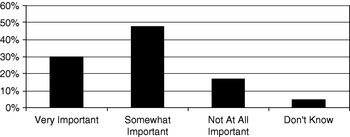
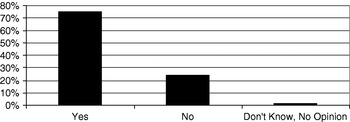
During the years of the Cold War, Americans appeared to back democracy evangelism. When asked by the Chicago Council on Foreign Relations (CCFR) whether bringing a democratic form of government to other nations was an important goal, more than three-quarters said it was either very important or somewhat important (see Figure 1). Only 17 percent contended that such a concept was “not at all important.”Footnote 10 Such conclusions held three years later (see Figure 2); in a poll taken months before the surprising fall of the Berlin Wall, 75 percent contended that the United States should promote democracy.Footnote 11
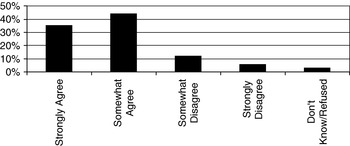
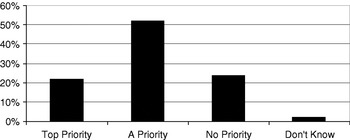
This support for democracy abroad seemed to persist during the following years, as the Soviet Union crumbled and America triumphed in the Persian Gulf War. Numbers from an Americans Talk Security survey showed that when asked about whether the US should use its position to promote democracy in Eastern Europe and the Middle East, 79 percent either agreed or strongly agreed (see Figure 3). Only 18 percent admitted that they somewhat disagreed or strongly disagreed with the policy.Footnote 12 Two years after winning the Gulf War, exporting freedom appeared to remain in vogue (see Figure 4). Nearly three-fourths of Americans saw democracy promotion as either a priority or a top priority.Footnote 13
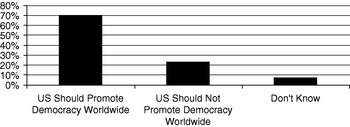
Americans' appetite for democracy promotion did not appear to wane after 11 September 2001 (see Figure 5). Even as critics worried that the USA Patriot Act would curtail civil liberties at home (and that the people would accept this), 70 percent of Americans said that the US should promote democracy worldwide. Only 23 percent thought this would be a bad idea.Footnote 14
Perhaps policymakers have accepted these results and sought to incorporate them into their pronouncements and procedures. In his 2004 “State of the Union” speech, Republican President George W. Bush declared that America's actions will generate democracy in the Middle East, serving as a viable alternative to terror and violence. He also called for doubling support for the National Endowment for Democracy in order to accomplish such tasks.Footnote 15 Bush also went out of his way to criticize democracy-promotion skeptics in a recent speech at the Air Force Academy:
Some who call themselves “realists” question whether the spread of democracy in the Middle East should be any concern of ours. But the realists in this case have lost contact with a fundamental reality. America has always been less secure when freedom is in retreat. America is always more secure when freedom is on the march.Footnote 16
Bush's national security adviser Condoleezza Rice called for a “balance of power that favors freedom.”Footnote 17 Even Vice President Dick Cheney declared on 26 August 2002 that the “U.S. is determined to establish a unified Iraq under a pluralist democracy in which the human rights of all ethnic groups will be respected. We are not about to overthrow one dictator just to replace him with another.”Footnote 18
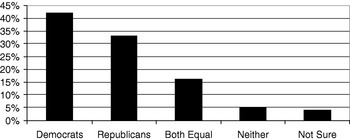
The Democratic Party also has deep ties to the policy of democracy promotion. In a poll conducted by Americans Talk Security,Footnote 19 42 percent of the sample identified the Democrat Party as more likely to do a better job of promoting democracy throughout the world. Only 33 percent of the public said that Republicans would do a better job. An additional 16 percent felt that both parties would do an equally good job, while five percent thought neither party would implement such a policy well (see Figure 16).
Some have noted the irony that Massachusetts Senator John Kerry, the Democratic Party nominee in 2004, did not follow in the footsteps of his predecessors. He was reticent on the subject of “nation-building” and exporting freedom abroad.Footnote 20 His foreign-policy speeches focused more on close ties with allies and security, even leading some to label Kerry a “realist.”Footnote 21 But Kerry's selection of North Carolina Senator John Edwards as his running mate may have balanced the ticket in more than just geographic differences, vigor or political experience. Senator Edwards had championed the cause of freedom in the world in numerous foreign-policy speeches on the campaign trail, blurring any interesting distinctions which may have emerged between the two party platforms.Footnote 22
DEMOCRACY-PROMOTION CONCERNS
While Americans routinely express their support for democracy at home, some polls may show less support for democracy abroad. Democracy promotion is not a top priority for most Americans. Additionally, Americans are becoming more skeptical of pushing freedom upon other countries, especially in recent years. Other priorities (national security, job security, energy supplies) may rank ahead of a freedom crusade for most Americans. Finally, Americans appear to be unwilling to pay for such democracy promotion in terms of monetary aid or military missions.
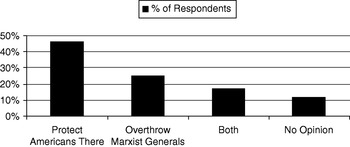
Earlier, I offered that Americans may have had a different conception of democracy promotion during the Cold War, when fears of nuclear war, communist revolutions in Third World countries, and electoral instability among allies may have given the enemy the advantage. There is some support for this contention. In an ABC News/Washington Post poll, questioners noted that President Reagan provided several reasons for the 1983 Grenada invasion, including the restoration of order and democracy on the tiny Caribbean island (see Figure 6). But when asked for the rationale, a large percentage contended that protection of Americans staying in Grenada was the most important reason. The second most important reason was “overthrow the Marxist generals.” Support for democracy barely registered at all in the poll.Footnote 23 Furthermore, in the 1986 CCFR poll (see Figure 1),Footnote 24 only 30 percent claimed democracy promotion was a very important foreign-policy goal, compared to the 48 percent who identified it as “somewhat important.”
Yet even during the heady days of the 1990s, when optimism about foreign policy abounded (from the toppling of the Soviet empire to the defeat of Saddam Hussein's forces in Kuwait, to the peace in the Middle East, South Africa, and Northern Ireland), Americans still did not see democracy promotion as something they passionately supported (see Figures 3 and 4). Of the 79 percent who agreed that the US should use its superpower status to promote democracy abroad, less than half said they “strongly agree” with this statement.Footnote 25 Similarly, only 22 percent of Americans saw democracy promotion as a “top priority.”Footnote 26
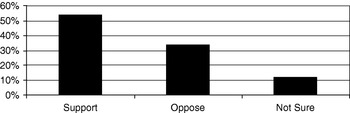
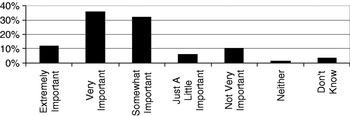
Americans may also be slowly losing their taste for pushing democracy abroad. In the days before President George W. Bush's invasion of Iraq to oust the undemocratic Saddam Hussein, only 54 percent supported the idea of the United States using its superpower status to promote democracy around the world, while 34 percent opposed the idea.Footnote 27 Both numbers reflect at least a ten-point drop in support for democracy promotion from the previous decade, as well as a near ten-point increase in opposition to exporting freedom (see Figure 7). A year after Operation Iraqi Freedom began, another poll also reflected lukewarm support for “democratic evangelism” (see Figure 8). When the Religion & Ethics News Weekly branch of the U.S. News and World Report asked whether America should be “promoting democracy and freedom abroad, such as for religious minorities,” only 12 percent said this was “extremely important,” and 36 percent claimed the policy was “very important.”Footnote 28 This is significant, given that the pollsters not only incorporated the religious minority element in their question, but used an oversample of white evangelicals, African Americans and Hispanics. The majority of the survey provided a far more tepid assessment of encouraging democracy abroad, even for religious minorities.
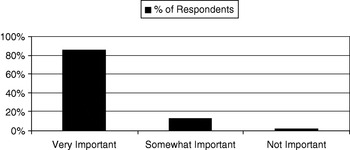
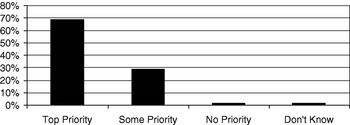
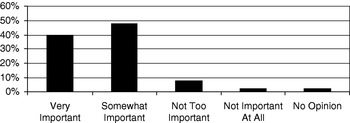
Other factors seem in recent years to have generated more excitement in the American people. When asked by the CCFR whether protecting the jobs of American workers was an important foreign-policy goal, 85 percent said it was “very important” (see Figure 9), only 13 percent said it was somewhat important, while 2 percent claimed it was not important.Footnote 29 The Pew Research Center found that ensuring adequate energy supplies for the United States was a “top priority” for 69 percent of the Americans surveyed (see Figure 10).Footnote 30 Another 29 percent said that energy supplies had “some priority.” Even an idea such as “protecting weaker nations against foreign aggression” was found to be at least as compelling as democracy promotion, if not more compelling (see Figure 11). The Gallup Organization found that 40 percent thought this “very important,” and another 48 percent considered it “somewhat important.”Footnote 31 Only 10 percent thought such protection was either “not too important” or “not important at all.”
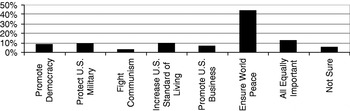
How does democracy promotion compare to other foreign-policy goals when multiple responses are available? The answers are also “less than encouraging” for democracy promotion. A 1990 poll found that when asked about America's foreign-policy priorities, the easy winner was “to ensure world peace” (see Figure 12).Footnote 32 The plan “to promote democracy throughout the world” finished fifth, receiving only 8 percent of the sample votes. Democracy promotion ranked behind “to increase the standard of living in the United States” and “to protect the United States (from) military threats,” and barely ahead of “to promote the worldwide interests of U.S. businesses.”
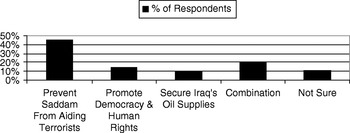
America's democratic evangelicals are undoubtedly concerned about a Fox News Poll from 2003, where a sample was asked, “What do you think is the most important reason for the United States to take military action against Iraq?” Respondents gave “preventing Saddam from aiding terrorists” as the top answer by a wide margin, even though such links were ambiguous at best at the time, and fully discredited today (see Figure 13). Only 14 percent thought “promoting democracy and human rights in Iraq” was the most important reason. Despite its third-place finish, democracy promotion barely ranked ahead of “securing Iraq's oil supplies for the world economy” and “unsure.”Footnote 33 These findings are significant, given that the military mission was labeled “Operation Iraqi Freedom,” not “Operation Prevent Saddam from Aiding Terrorists” or “Operation Grab Iraq's Oil.”
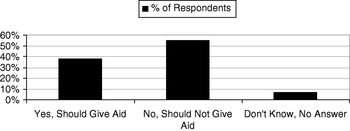
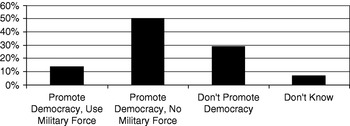
Americans also seem unwilling to pay the human and financial costs associated with democracy promotion abroad. When asked if the United States should give aid to help promote democracy in Russia, only 38 percent agreed.Footnote 34 A majority responded that America should not give aid to Russia to promote democracy, despite fears of Communists or anti-American nationalists coming to power (see Figure 14). The bloody postwar occupation of Iraq seemed to drag down American enthusiasm for democratic regime change via armed force. A Los Angeles Times Poll in November of 2003 found that half of all Americans preferred to promote democracy in the Middle East, but without military force (see Figure 15). Only 14 percent called for promoting democracy in the Middle East by means of military force, while 29 percent answered “The United States should not be engaged in promoting democracy in the Middle East.”Footnote 35 Perhaps this is why Senator Kerry appeared to have abandoned his party's prior rhetoric on exporting freedom abroad.
OBSERVATIONS AND IMPLICATIONS
Why might Americans be lacking the passion for helping others achieve the values so important to our country, despite the glowing pronouncements of policymakers? Perhaps a creeping cynicism may color their perceptions of what democracy promotion might involve, given the problems with putting such plans into effect.Footnote 36 Republicans blame Democrats for failed attempts at “nation-building” in Somalia and Haiti, as well as incomplete successes in places such as Bosnia.Footnote 37 Democrats undoubtedly point to the high cost (in human and financial terms) of Operation Enduring Freedom in Afghanistan and Operation Iraqi Freedom. As Eland points out, the liberation of Kuwait in 1991 did not provide freedom for the Kuwaitis.Footnote 38 If both sides are right, this may certainly account for the dispassionate responses to questions of democracy promotion.
If the American public is less enthusiastic about democracy promotion than are policymakers, why do politicians still make appeals to democracy promotion? Why label missions “Operation <Insert Country>Freedom” instead of “Operation Preserve Jobs” or something like it? Even if Americans show a greater preference for job security, energy supplies, or world peace, they may like to think that they stand for the promotion of our cherished values, despite ranking it third or fourth on the list. As Bueno de Mesquita and Downs put it, “In fact, presidents rarely fail to trot out ‘democracy’ as a justification for their actions abroad. That's because it is popular with Americans, who like to feel they are on the side of the angels.”Footnote 39
If a large majority of the American people express at least some modest support for democracy promotion, why should we care if only one-third or less feel passionately about it? Perhaps the answer lies in the type of democratic output our foreign-policymakers seem to be providing. Scholars are increasingly coming to the conclusion that America has not done a good job of creating democracy. Bueno de Mesquita and Downs find that since the beginning of the Cold War, the United States has intervened thirty-five times in developing countries.Footnote 40 According to the authors,
Our research shows that in only one case – Colombia after the American decision in 1989 to engage in the war on drugs – did a full-fledged, stable democracy with limits on executive power, clear rules for the transition of power, universal adult suffrage, and competitive elections emerge within 10 years. That's a success rate of less than three percent.Footnote 41
Pei, Amin, and Garz contend,
Most of the countries where the United States intervened militarily either failed to democratize or became more authoritarian within the decade of the end of the American intervention. Of the 14 such cases, the level of democracy remained high in only three (Japan and West Germany after World War II and Panama after 1989).Footnote 42
Others are equally pessimistic about America's cases of democracy promotion.Footnote 43 Even among countries which become more democratic, regime instability often embroils them in a conflict with another country.Footnote 44
Research on 273 United States military operations (USMOs) commenced since 1973 shows that eighty-six cases resulted in an improvement in democracy within the target state. Of the remainder, 109 cases saw no change in the status quo, while in seventy-eight events the country became less democratic after America's military mission concluded.Footnote 45 While these findings are less pessimistic than other studies, they do show room for improvement in America's ability to promote democracy abroad. Perhaps this is why only a tiny minority of Americans think democracy should be promoted by force.Footnote 46
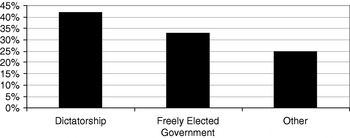
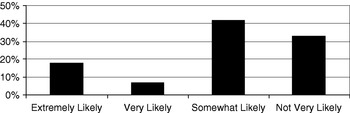
This may also explain why 42 percent of Americans think that Iraq will revert to dictatorship within the next five years (see Figure 17), as opposed to the 34 percent who believe a freely elected government will be in charge five years from now in Iraq.Footnote 47 It may also account for why 33 percent of Americans feel as though democracy is unlikely to come to the Middle East (see Figure 18), while 42 percent of Americans feel such prospects are only “somewhat likely.”Footnote 48
Americans' lack of overwhelming support for democracy promotion, and their willingness to support other priorities related to security and economic benefits, may encourage leaders to settle for something less than democracy abroad. As Bueno de Mesquita and Downs write, “Happy to be free of the burdens of war, voters back home are generally willing to embrace their administration's assurances that however imperfect the new government might appear to nitpickers, it is now well on the road to democracy.”Footnote 49 If the polls that show nearly three-quarters of the American people care somewhat about exporting freedom, leaders should be concerned about such trends.
THE FUTURE OF DEMOCRACY PROMOTION IN AMERICA
The argument that Americans verbally support the promotion of democracy abroad, yet are becoming increasingly skeptical about using force to achieve it, must be evaluated in the context of its most salient test case: Iraq. President Bush has sought to rally public support for his mission via democratic promotion, even to the point of naming it “Operation Iraqi Freedom.” In the absence of support for other reasons for going to war (the relative dearth of evidence supporting arguments that President Saddam Hussein had weapons of mass destruction or supported al Qaeda), democracy in Iraq remains the primary excuse for maintaining a strong presence in the Middle Eastern country. Bush has gone so far as to spend significant resources hosting initial elections and devising a constitution for the locals. He and his supporters continue to insist that America's efforts will help the Iraqis to become free, serving as a democratic model for the region.
Despite these rosy scenarios, events have emerged in Iraq that increased American cynicism not only with the war, but also with the policy of democracy promotion by force in general. The war has dragged on for months, leading to an increase in casualties and costs. Though an election was held, it took months for an interim government to be formed. Critics speculate that orders from Shiite clerics to vote had more to do with turnout than civic-minded Iraqis expressing support for freedom. The Abu Ghraib prison scandal led many to question whether United States values were truly being exported to Iraq. And events which once held promise for a reduction in domestic turmoil (the capture of Saddam Hussein, the election, the formation of an interim government, the signing of a constitution) have come and gone with no lessening of violence in Iraq.
As a result, an increasing number of Americans have come to doubt that democracy will ever come to Iraq. With waning support for the last public rationale for maintaining a large force in Iraq, calls for a withdrawal have escalated.
There are a few reasons for the continuing collapse of confidence in democracy promotion by military force in Iraq, which will undoubtedly undermine support for such a policy in any context. The first speculates that democracy promotion is a good idea, but has been poorly sold by America's leaders. The second rationale is that the policy itself is flawed, and should require revision or replacement as an instrument of United States strategy.
The first explanation of why the American people are becoming disenchanted with democracy promotion is that our leaders have done a poor job of public relations.Footnote 50 Those who agree with such an argument contend that US rulers have frequently failed to mention democratic evangelism as a war rationale (preferring nationalist rhetoric or pandering to patriotism). Even when a rally for republican government has been attempted, the idea is couched in overly optimistic terms so that rhetoric never seems to match reality. In other cases, the elected leaders of the United States have overstated the case for conflict in the first place. This line of reasoning assumes that with a smarter set of policies one can rekindle support for democracy promotion among the American people.
In the Iraqi case, American leaders have been known to focus on patriotic populism more than on this Middle Eastern country as a laboratory for democracy, because the latter is more complex and harder to explain. When democracy is mentioned, there is a great emphasis on holding elections, as if casting ballots is the only measure of political freedom. Thus Americans become confused when it takes months after an election to form a new government, or when the new regime does not initially dsiplay a stellar human rights record.Footnote 51 Furthermore, the American foreign-policy team has not adequately prepared US citizens, with their short attention spans, for how long it takes to build a stable democracy. As for justifying the reasons for invading Iraq in the first place, it is obvious by the writing of this article that the Bush administration did not have proof that Iraq was tied to the 9/11 terrorism attack or that the Saddam Hussein regime had possessed weapons of mass destruction.Footnote 52 Had the United States government merely pointed out that Iraq was likely to amass biological, chemical, and nuclear weapons or was tied to other acts of terrorism, it would not have the credibility problem over its democracy-promotion policy that it does today.Footnote 53 Supporters of this belief contend that if the Bush Administration had not made such blunders, Americans would solidly back our “nation-building” exercise in democracy.
But this argument ignores the fact that American appetite for democracy promotion began to wane long before the Iraqi conflict. Evidence presented in this article demonstrates that Americans have ranked democracy promotion behind other foreign-policy goals, and have shown a general reluctance to commit US troops or dollars to achieve such a democratic outcome abroad. Furthermore, American leaders have either subverted democratic or quasi-democratic regimes abroad through covert action.Footnote 54 In other cases, the United States has maintained close ties with autocratic nations.Footnote 55 Such skepticism about United States actions concerning the exporting of freedom have only seemed to accelerate in the wake of the recent Iraqi conflict.Footnote 56 American cynicism is not from poor salesmanship from Presidents and their personnel, but from the numerous failures of freedom promotion abroad, according to this rationale.
If Americans have come to the conclusion that democracy promotion does not work and is not worth dying for or expending valuable resources in its defense, what can US leaders do in their foreign-policy actions concerning freedom? The first step is borrowed from the first argument, and is to be more honest about the reason for dispatching troops abroad, to avoid a credibility problem with the American public and the people in the targeted country. The second step is not to dictate the terms and conditions of a country's post-conflict regime. Rather than impose a republican government on a conquered people because we want it to be so, the locals should clearly be in charge concerning their own political destiny.Footnote 57 America's leaders must realize that a country may consider democratic principles to run counter to their own history and traditions, and may consider such a system too chaotic and incompatible with their own values.
Surprisingly, it seems that American people have come to the realization that letting other countries determine their own political destiny is a smart policy. Perhaps the average American is more likely to be concerned about foreign elements such as the United Nations, foreign treaties, or international law dictating policy towards the United States than are its elites.Footnote 58 The US public may be sympathizing with the occupied peoples' desire “to be free,” even from an externally imposed American-style democracy.
Such democracy-promotion reforms, which even include the possibility of dispensing with such institutions if the locals do not actually desire democracy, are needed. Evidence has already shown that American people are wary of democracy promotion relative to other foreign-policy goals, and of the human and financial sacrifice. Unless American policymakers resist the urge to attempt imposing democracy abroad, support for such a policy is also likely to erode in future polls examining the issue in absolute terms.
FIGURESFootnote 59
Foreign Policy Goal: Helping Promote Democracy (Source: CCFR, 1986).

Should the U.S. Promote Democracy Around the World? (Source: ABC/Washington Post, 1989)

Do You Agree that the U.S. Should Promote Democracy Abroad? (Source: Americans Talk Security, 1991)

How Important is Promoting Democracy Abroad? (Source: Times Mirror, 1993)

US Attitude Toward Democracy Promotion (Source: Pew Research Center, 2002).

Why Invade Grenada? (Source: ABC/Washington Post, 1983)

Do You Support the U.S. Policy of Democracy Promotion? (Source: Fox News, 2003)

Should the U.S. Promote Democracy, for Religious Minorities? (Source: U.S. News & World Report, 2004)

Importance of Protecting American Jobs? (Source: CCFR, 2002)

How Important is Insuring Adequate Energy Supplies for the U.S.? (Source: Pew Research Center, 2001)

Importance of Protecting Weaker Nations vs. Foreign Aggression? (Source: Gallup, 2003)

America's Foreign Policy Interests (Source: NBC/Wall Street Journal, 1990).

What is the Most Important Goal for Iraq? (Source: Fox News, 2003)

Foreign Aid for Democracy in Russia? (Source: CBS, 1993)

Should the U.S. Promote Democracy with Force? (Source: L.A. Times, 2003)

Who Promotes Democracy Better? (Source: Americans Talk Security, 1988)

What Will Happen to Iraq in Five Years? (Source: Fox News, 2004)

How Likely is the U.S. Goal of a Democratic Middle East? (Source: Americans Talk Security, 1990)