I. Introduction
Within the nascent debate on regulatory corporate social responsibility (CSR), this paper proposes ‘inventive interventionism’ to incorporate substantive outcomes, stakeholder empowerment, effective disclosure and a global multi-stakeholder and multidimensional view of CSR and social disclosure. Inventive interventionism also applies new paradigms of regulation that recognise CSR as one of the proximate engineers of efficient public governance and ultimate sources of socio-economic development. It is specifically designed for regulatory CSR, unlike the more general regulation theories which, although they can be adapted for CSR, may not suit the peculiar features of regulatory CSR as a dynamic tool that can be exploited by state and non-state actors for both national and transnational governance. As a result, stakeholder empowerment through enforcement, verification and other rights is a distinguishing factor between inventive interventionism and alternative approaches to regulatory CSR.
The imperativeness of stakeholder empowerment to the success of regulatory CSR is illustrated by the conflict minerals provisions in Section 1502 of the US Dodd–Frank Act 2010, which are acclaimed as an advanced mandatory and global-focused CSR-related disclosure scheme. Amnesty and Global Witness (2015) very recently reported that more than 80 per cent of filings by companies contained little useful information and did not meet the minimum due diligence requirements. The statute, however, does not provide for sanctions, and neither does it permit other public or private enforcement measures. Unlike other regulation theories and contributions to the regulatory CSR debate, inventive interventionism therefore benefits from the experiences and analysis of actual legislative and other recent developments pertaining to regulatory CSR in a number of jurisdictions, making it a more evidence-based approach that acknowledges that institutional and socio-economic conditions in particular jurisdictions are integral to both the need for and viability of regulatory CSR.
The regulatory CSR debate is actually grounded in the broader regulation discourse centred on what de Burca (Reference De Burca2010, p. 227) aptly described as ‘the phenomenon of “new” and “experimentalist” governance and its relationship to law’. That debate has demonstrated that regulation can exist in a continuum between the extremes of prescriptive regulation and pure voluntarism. Similarly, the complex and multifarious relationship of law and CSR has been recognised in literature in contrast to the facile regulation-versus-voluntarism polemics (Buhmann, Reference Buhmann2011; McBarnet, Reference Mcbarnet, McBarnet, Voiculescu and Campbell2007; Parker, Reference Parker, McBarnet, Voiculescu and Campbell2007). The ‘soft’ and ‘hard’ law dichotomy is increasingly acknowledged as too simplistic considering, first, the blurred boundaries between the two at national (McBarnet, Reference Mcbarnet, McBarnet, Voiculescu and Campbell2007) and international (Zerk, Reference Zerk2006, pp. 69–72) levels. The orthodox ‘beyond regulation’ view of CSR as a market/private sector (business, consumer and civil society) driven concept is gradually giving way as a result of the twin recognition of the limited effect of pure private self-regulation and governmental roles in promoting CSR (Fox, Ward and Howard, Reference Fox, Ward and Howard2002; Ho, Reference Ho2013; McBarnet, Reference Mcbarnet, McBarnet, Voiculescu and Campbell2007, pp. 45–54; Vogel, Reference Vogel2005, p. 16). The recognition of governmental roles in CSR occurs within the wider governance discourse and the acknowledgement of varieties of alternative regulation strategies to the limitedly effective prescriptive national regulation (Ho, Reference Ho2013, pp. 375–376; Lozano, Albareda and Ysa, Reference Lozano, Albareda and Ysa2008, pp. 25–26) and international law (Abbott and Snidal, Reference Abbott and Snidal2009; Zerk, Reference Zerk2006, pp. 69–72). Second, the voluntary–mandatory distinction is ‘confusing and unhelpful’ when legal compliance is acknowledged as a basic component of CSR. Third, the incorporation of CSR policies in regulations demonstrate an ‘intertwined and mutually influencing’ relationship between CSR and law (Ho, Reference Ho2013, p. 384). Consequently, the World Bank's classification of governmental CSR roles as ‘mandating, facilitating, partnering and endorsing’ (Fox et al., Reference Fox, Ward and Howard2002, p. iii) seems to be popular (Ho, Reference Ho2013, pp. 386–387; Lozano et al., Reference Lozano, Albareda and Ysa2008, p. 42).
The understanding that ‘positive’ changes in corporate behaviour are either adopted voluntarily or through the coercive process of law (Russell, Reference Russell2011; Rivoli and Waddock, Reference Rivoli and Waddock2011) has increased attention on CSR regulation (Buhmann, Reference Buhmann2011; McBarnet, Reference Mcbarnet, McBarnet, Voiculescu and Campbell2007; Parker, Reference Parker, McBarnet, Voiculescu and Campbell2007; Scott, Reference Scott, Boeger, Murray and Villiers2008). However, aspects of existing literature suggest the existence of broadly parallel voluntary and prescriptive approaches to CSR regulation, while some of the largely process-based CSR and law analyses focus mainly on corporate compliance. This provides little room for ethical CSR and macro-climate and governance analysis of CSR and such issues as empowerment, especially of stakeholders, CSR as a socio-economic development tool and translation of debates to transnational and global source and effect situations. The need for a fresh conceptual analysis of the law–CSR relationship and the implications of diverse regulatory forms in different national and global contexts has become increasingly crucial following developments in jurisdictions like Indonesia, India, the Philippines, the US and the European Union (EU) demonstrating variegated regulatory approaches ranging from mandatory reporting to different levels of prescriptive regulation. The comparative country studies highlight the complexity of the law–CSR relationship and variations in regulatory properties and objectives undertaken. An inescapable theoretical and practical dilemma from the regulatory controversy is that even if CSR is accepted as ‘beyond law/compliance’, a further question is ‘How is it possible for the law to make companies accountable for going beyond the law?’ (Parker, Reference Parker, McBarnet, Voiculescu and Campbell2007). Put differently, ‘the question of the state's role in advancing CSR is not whether governments will address this new policy arena but why, how, and with what effect’ (Ho, Reference Ho2013, p. 428; emphasis in original). An overarching task is ‘to review the increasingly complex cross-connects between the rapidly mutating governance agenda and the burgeoning world of corporate responsibility’ (Elkington, Reference Elkington2006). Nevertheless, the conceptual and practical challenges to the competing voluntary and prescriptive models and the relative strengths and weaknesses of CSR regulations trigger the need for inventive interventionism.
This paper therefore examines national and transnational concepts and approaches for regulating CSR at the backdrop of the need to satisfy a functionality test in relation to the social issue they address (Xanthaki, Reference Xanthaki2008). The paper assesses on a fundamental level whether prescriptive CSR is proto-typical or deviant, and advances the orthodox and governance schools' disputation in a new direction by situating CSR in the wider law–regulation debate. Using examples from the oil industry, the paper demonstrates how the law can prop up CSR through inventive interventionism, which reflects a functional approach to juridification that can enhance CSR's role in filling national and global corporate regulation and addressing public governance challenges, particularly in emerging and developing economies. Inventive interventionism builds on legal transplant theories, Deakin and Hobbs's (Reference Deakin and Hobbs2007), McBarnet's (Reference Mcbarnet, McBarnet, Voiculescu and Campbell2007) and Parker's (Reference Parker, McBarnet, Voiculescu and Campbell2007) acknowledgement of regulatory perspectives of CSR, systems theoretical approaches to responsiveness inspired by Nonet and Selznick (Reference Nonet and Selznick1978) which consider how regulations, regulators and regulatees can respond to their environment, Teubner's (Reference Teubner1983, Reference Teubner and Teubner1996) reflexive law theory, and Ayres and Braithwaite's (Reference Ayres and Braithwaite1992) responsive regulation theory, to underline the role inventive interventionism can play in CSR.
The rest of this paper first reviews CSR models to highlight voluntary and governance approaches to CSR, and places them in the wider regulation debate that underline alternative strategies, such as CSR, to pure prescriptive regulation. Second, it scrutinises regulatory CSR perspectives, reflexive law and responsive regulation and the paradoxical law–CSR relationship, and demonstrates that existing theoretical approaches may not suit the peculiarities of CSR in different contexts. Third, the paper considers fresh insights from inventive interventionism and the solutions it propounds for national and transnational CSR regulation. It discusses the substance of inventive interventionism for national and broader transnational/extra-territorial regulation types that are vital for the success of regulation at either level.
II. CSR models
This paper focuses on the extractive sector because of evidenced public support for greater regulation of the industry for environmental impact and other reasons (Spangler and Pompper, Reference Spangler and Pompper2011, p. 218). Whilst the sector's environmental visibility often compels voluntary CSR reports, its environmental disclosures are increasingly regulated by governments. Examples include the European Commission's Recommendation (Commission of the European Communities, 2001a) on environmental issues in companies’ annual accounts and mandatory reporting in several EU Member States (Buhmann, Reference Buhmann2011, p. 142), and the growing influence of social reputation in oil contracts and concessions awards (Frynas, Reference Frynas2005). Owing to its concurrent local and global existence, the environment presents stakeholder and regulatory concerns at both levels, particularly in relation to multinational enterprises (MNEs) (Gill, Reference Gill2012, p. 24; Kolk and Pinkse, Reference Kolk and Pinkse2008; Sagooff, Reference Sagooff2013). Following the definition of a stakeholder as ‘any group or individual who can affect, or is affected by, the achievement of a corporation's purpose’ (Freeman, Reference Freeman1984, p. vi; Freeman and Phipps, Reference Freeman and Phipps2002), the environment is considered a non-social CSR stakeholder requiring natural persons to advance its interests (Bradshaw, Reference Bradshaw2013; Driscoll and Starik, Reference Driscoll and Starik2004; Fassin, Reference Fassin2009; Haigh and Griffiths, Reference Haigh and Griffiths2009; Norton, Reference Norton2007). The interests of other stakeholders and the environment can coincide, for instance, when communities live in and derive livelihood from oil-producing locations, making CSR in environmentally sensitive operations include community concerns. This is why various aspects of ‘environmental stewardship’ are considered part of CSR (Metcalf, Reference Metcalf2010, p. 151).
Nevertheless, CSR lacks an exact and uncontroversial meaning (Dahlsrud, Reference Dahlsrud2008; Garriga and Melé, Reference Garriga and Melé2004), although its scholarship has shifted from the analysis of responsibility to evaluation tools (Scalet and Kelly, Reference Scalet and Kelly2010, p. 70). At the core of this movement is CSR's relationship to law, which is the basis of the regulatory polarity debate (Lederer, Reference Lederer2012; O'Laughlin, Reference O'laughlin2008). One view is that CSR is a set of purely voluntary undertakings regulated, if at all, by market forces. This ‘traditional’ school argues that ‘[CSR] actions basically are voluntary, that is they go beyond what is legally required’ (Dam and Scholtens, Reference Dam and Scholtens2012). Barnett (Reference Barnett2007, p. 807) accordingly defines CSR as ‘a discretionary allocation of corporate resources toward improving social welfare that serves as a means of enhancing relationships with key stakeholders’. This is a voluntary ‘separation model’ that favours a firm and supply chain focused CSR (Harrington, Reference Harrington2011, pp. 491–497; Rahman and Post, Reference Rahman and Post2012), and a micro-analysis of individual company responses and performance.
Until recently, the voluntary model was dominant in EU policy, which refrained from prescriptive CSR (Buhmann, Reference Buhmann2011, p. 142; Voiculescu, Reference Voiculescu, McBarnet, Voiculescu and Campbell2007). CSR was consequently described by the European Commission (Commission of the European Communities, 2001b) as ‘a concept whereby companies integrate social and environmental concerns in their business operations and in their interactions with their stakeholders on a voluntary basis’. This approach was reflected in the EU model code for international standards on human rights, environment and labour standards by MNEs operating in developing and transitional countries (European Parliament, 1999). Similarly, the 2001 EU Green Paper encouraged voluntary practices in international operations and global supply chain relationships (Commission of the European Communities, 2001c, 2.2.3) while the 2002 CSR Communication urged corporations to apply international best standards in developing countries (Commission of the European Communities, 2002, 5.1). However, a difficulty with the voluntary model is the false assumption that law and CSR are mutually exclusive mechanisms for social control, when they can, in fact, have common theoretical foundations, follow similar objectives and share regulatory tools (Buhmann, Reference Buhmann2011).
The ‘governance’ approach, in contrast, not only avoids the orthodoxy of formal rules and hierarchical enforcement by governmental agencies, but also considers institutions, including informal rules and arrangements by non-governmental and private organisations, that perform horizontal and vertical regulatory roles (Aßländer and Curbach, Reference Aßländer and Curbach2014; Saurwein, Reference Saurwein2011, pp. 335–336). It consequently views CSR as a complement or alternative to law, particularly where laws and public institutions are weak (Johnston, Reference Johnston2011). A highly persuasive institutional theoretical explanation of the governance perspective is the concept of ‘relational state’. Relational state conveys the idea of shared regulatory responsibility (‘co-responsibility’) between public and private spheres of society (Gunningham, Reference Gunningham, van Schooten and Verschuuren2008, p. 118; Ho, Reference Ho2013, pp. 393–395). In emphasising the need for co-operation between public and private regulators, theorists argue ‘that only if responsibilities are shared in areas of common interest, assuming the active collaboration of all social actors, society itself and enterprise, in collaboration with the state, can today's social and environmental challenges be met’ (Lozano et al., Reference Lozano, Albareda and Ysa2008, pp. 35–36). The governance model is subtly reflected in the European Commission's (Commission of the European Communities, 2011) revised CSR policy. The Commission's (2011, p. 6) redefinition of CSR as ‘the responsibility of enterprises for their impacts on society’ reflects a shift from pure voluntarism to tacit acknowledgement of some roles for regulation.
A version of the governance approach is the prescriptive model which suggests that the substance of CSR can be constituted by compulsory obligations or a mix of legal constraints and voluntary undertakings. Prescriptive CSR, embraced by some scholars and developing and emerging economies (Gjølberg, Reference Gjølberg2010; Shamir, Reference Shamir2004; Parker, Reference Parker, McBarnet, Voiculescu and Campbell2007), is an interventionist ‘unity model’. It implicitly recognises certain governance roles for CSR, usually following a macro-level analysis, and attempts to demonstrate that CSR need not be ideologically neutral (Blowfield and Frynas, Reference Blowfield and Frynas2005; Frynas, Reference Frynas2010; Merino and Valor, Reference Merino and Valor2011).
However, existing beyond the confines of CSR scholarship are theories such as reflexive law and responsive regulation (Ayres and Braithwaite, Reference Ayres and Braithwaite1992; Baldwin and Black, Reference Baldwin and Black2008, Reference Baldwin and Black2010; Fairman and Yapp, Reference Fairman and Yapp2005; Saurwein, Reference Saurwein2011; Tombs and Whyte, Reference Tombs and Whyte2013) that have been applied in areas such as labour protection, consumer protection, business taxation, and financial regulation but have received little attention in CSR (see Affolder, Reference Affolder2011; Braithwaite, Murphy and Reinhart, Reference Braithwaite, Murphy and Reinhart2007; Smith, Reference Smith2011). Even when CSR is linked to regulation, the theoretical insights seem modest as relatively few scholars have tackled the theoretical framework of the law–CSR relationship and its impact on national and international regulatory policy. For example, Barnard, Deakin and Hobbs's (Reference Barnard, Deakin, Hobbs, De Schutter and Deakin2005) support for ‘enhanced competiveness’ promotes instrumental CSR but assumes that CSR can be a tool of reflexive law by virtue of the expressed policies of EU institutions. Other authors (Amao, Reference Amao2007, pp. 56–57; Deakin and Hobbs, Reference Deakin and Hobbs2007, pp. 70–75; Johnson, Reference Johnston2011, pp. 236–241) support using reflexive law in CSR without investigating in depth the conceptual framework and other bases for the linkage. Buhmann's (Reference Buhmann2011) attempt to link reflexive law and CSR largely explains the ‘Multi-Stakeholder Forum’ and ‘CSR Alliance’ initiatives of the European Commission. Her conclusion that CSR can be ‘through non-enforceable responsibility based on law’ (Buhmann, Reference Buhmann2011, p. 171) has limited scope for omitting possible ‘enforceable responsibilities’ for regulatory CSR.
Parker (Reference Parker2002, Reference Parker2007) applies ‘meta-regulation’ as a shorthand for ‘regulation of self-regulation’ to highlight ways, including penalty-linked compliance systems, stakeholder consultation, licensing requirements, management accreditation and auditing schemes, contracting, fiscal incentives and public procurement, the law can push companies towards desirable goals such as CSR by requiring appropriate corporate governance structures, management practices and corporate cultures. However, Parker's strong contribution does not give sufficient attention to stakeholder empowerment at national and global levels. Whilst inventive interventionism as proposed in this paper also demonstrates that regulatory CSR can involve a variety of enforceable substantive and procedural requirements, it also incorporates stakeholder enforcement and other empowerment provisions for national and transnational regulatory spaces, and the application of CSR as a governance tool for socio-economic development.
The voluntary–prescriptive CSR discourse mirrors the classical regulation–deregulation debate rejected by reflexive law and responsive regulation theories as being an inadequate reflection of the true nature of regulation. Teubner (Reference Teubner1983, pp. 245, 249, 270; Reference Teubner and Teubner1996, pp. 3–38), for instance, rejected the nature of law debate of positivist and critical theories formulated on the basis of regulation as a matter of ‘external’ law versus ‘internal’ deregulation. In reality, the diversity of regulatory approaches in theory and practice suggests that regulation is not simply a question of either a command-and-control state regulation versus deregulation, as demonstrated by expressions such as ‘tacitly supported self-regulation’ (Bartle and Vass, Reference Bartle and Vass2007, p. 894), ‘enforced self-regulation’ (Fairman and Yapp, Reference Fairman and Yapp2005) and ‘hybrid regulatory constellations involving public and private actors’ (Saurwein, Reference Saurwein2011, p. 336).
In any case, Deakin and Hobbs (Reference Deakin and Hobbs2007, pp. 69–71) argue that CSR is ‘a set of related mechanisms for aligning corporate behaviour with wider social and environmental goals, in which managerial, financial and regulatory aspects are combined in a mutually reinforcing way’ as ‘a mechanism for stimulating organizational change’. While the managerial conception is linked to reputation and competitiveness, the financial perspective relates to capital market pressures and shareholder activism in response to social expectations. The regulatory perspective, which complements the managerial and financial aspects, establishes ‘a certain functional relationship … between a “core” or possibly a “framework” of legal controls, on the one hand, and voluntary action by companies on the other’. The regulatory conception regards CSR as ‘mechanisms which respond to the negative externalities caused by corporate activities’ and, for example, encourages ‘an incentive structure’ to reward socially responsible behaviour. This juxtaposition of managerial/organizational, financial and regulatory conceptions of CSR is particularly significant, although a drawback is the omission of ethical CSR dimensions. It is likely the case that CSR can encompass instrumental and ethical goals, and even if ‘ethical’ is lacking in the managerial and financial conceptions, the regulatory perspective can incorporate ethical foundations and goals. Whilst the managerial and financial perspectives concern managerial awareness of and response to market-related pressures and essentially reflect a business case for CSR and the shareholder primacy corporate governance model, CSR deviates from the shareholder-centred view at the conceptual level and proposes a pluralist framework recognising a range of internal and external stakeholders, including shareholders, employees, customers, suppliers and the local community.
Johnston (Reference Johnston2011, pp. 222–224, 226–227, 233, 241) rightly argued that the business case is anti-regulatory, market-oriented and limits the law to facilitating ‘the bargaining between the creator and victim of the externality’. The ‘widespread assumption’ of the business case excludes the role of a law-steered CSR in enabling corporate identification and internalisation of externalities, even when the law's direct intervention is considered an inefficient solution. Arguing that CSR ‘should be reserved for the process by which corporations identify and voluntarily correct the externalities which arise from their core activities’, Johnston distinguished it from ‘voluntary measures by which corporate managers attempt to make the world a better place’ or ‘the brand-building exercises that are commonly termed [CSR]’. The flexible externality-linked CSR does not rely on the market and government to determine or anticipate its boundaries and is ‘embedded within a regulatory framework’ that requires ‘significant legal intervention’ to operate effectively because of market-imposed constraints on social responsibility. This unity model's explicit recognition of the law's role in promoting CSR contrasts with, for example, Mazurkiewicz's (Reference Mazurkiewicz2004, p. 2) definition of environmental CSR. The definition, which includes a range of actions and omissions directly affecting the environment and host communities, expresses CSR as a ‘duty’ but does not indicate whether the source of that duty is law or extra-legal. This is a significant omission, since the source of duties may determine the rights of claimants and legal liability for duty-holders.
The separation model (Lyon and Maxwell, Reference Lyon and Maxwell2008; Portney, Reference Portney2008) takes the reverse extreme position and implicitly discourages interventionism. It does not acknowledge the law as the source of duties and consequently disguises the complex CSR–law relationship (Osuji, Reference Osuji2011; Shum and Yam, Reference Shum and Yam2011). Its implied support for ‘beyond legal requirement’ and CSR as extra-legal friendly actions (Gainet, Reference Gainet2011, p. 197; Lyon and Maxwell, Reference Lyon and Maxwell2008; Portney, Reference Portney2008) suggests that CSR is entirely distinct from and exclusive of law. The separation model does not recognise legal compliance as part of CSR, particularly in developing countries, the normative link between CSR and law, and the growing recourse to mandatory social disclosure (Buhmann, Reference Buhmann2011, p. 150). These factors show that CSR has social imperativeness and consequences conceptions that depend on the legal environment. Thus, implicit CSR is usually mandatory regulations and customary rules for existence in society, while its explicit counterpart is voluntary corporate initiatives essentially driven by self-interest, particularly where the implicit does not exist (Matten and Moon, Reference Matten and Moon2008). As Ward (Reference Ward, Boeger, Murray and Villiers2008, p. 10) similarly noted, ‘[t]he extent to which a business fulfils its societal obligations must be both a function of what it is legally required to do, and what it chooses to do’. The legal environment therefore clarifies the scope of corporate responsibility and implies the freedom to act one way or the other in undefined areas. How this sits with general regulation theories is examined next.
III. Regulation
Regulation theories emerged from the recognition that factors such as complexity, competing cultural values and social diversity constrain positive law to a limited form of social control that relies on alternative sources of norms for effectiveness (Schuck, Reference Schuck2000, pp. 419–455). From the earliest days of corporations, prescriptive regulations have often instigated creative compliance measures that ultimately defeat the regulatory goals. For example, the prohibition of corporations by the Bubble Act 1720 simply led to the establishment of companies in all but name through deeds of settlement of investors’ funds (Sheehy, Reference Sheehy2008, p. 129). The problem of substance and enforcement limits of law is further exacerbated by the globalisation-associated complications in economic and social relations, information, technology, capital flows, and operations of MNEs (Abbott and Snidal, Reference Abbott and Snidal2009; Elhauge, Reference Elhauge2005, pp. 803–804; Ho, Reference Ho2013, p. 385; Parker, Reference Parker2006; Williams, Reference Williams2002; Zerk, Reference Zerk2006, pp. 243–283).
Regulation is therefore regarded as involving the interaction of regulators, regulatees and regulatory environments, taking ‘place on a continuum between pure state regulation, on the one hand, and pure self-regulation, on the other, and can generally be understood as a combination of state/public and societal/private contributions, which are closely linked’ (Saurwein, Reference Saurwein2011, p. 336). Self-regulation, co-regulation, and other alternative regulation modes can exist in similar platforms as law, notwithstanding differences in degree of legality and formality. Unlike pure state regulation, co-regulation may be ‘carried out by private actors that operate on an explicit unilateral legal basis … which explicitly delegates regulatory powers from government to non-governmental actors’ (Saurwein, Reference Saurwein2011, p. 351; emphasis in original). Similarly, there may be two forms of self-regulation: ‘self-regulation in a narrow sense, which operates without any formal state involvement, and self-regulation in the wide sense, which is characterized by other forms of state involvement in self-regulatory institutions apart from a legal basis’ (Saurwein, Reference Saurwein2011, p. 351). The concepts of self-regulation and co-regulation therefore recognise the possibility of the state's indirect regulatory involvement in CSR through a variety of methods and instruments.
Nevertheless, a regulatory CSR perspective ought to recognise the limited scope of prescriptive regulation (Carr, Reference Carr2007; Deakin and Hobbs, Reference Deakin and Hobbs2007, p. 69), and acknowledge the relative strengths of prescriptive regulation and self-regulation. Reflexive law, for example, argues that rigidity makes centralised top-down formal law and materialised substantive laws inadequate for complex and challenging issues in competing subsystems, and therefore requires a ‘limiting’ role that ‘searches for regulated autonomy’ and ‘retreats from taking full responsibility for substantive outcomes’ (Teubner, Reference Teubner1983, pp. 254, 274, 280). It proposes organisational and procedural norms necessary for decentralised self-regulation in subsystems, but does not specify ‘concrete social results’ (Teubner, Reference Teubner1983, pp. 251, 255–256) or outcomes of ‘regulated self-regulation’, and relies on ‘softer and more indirect legislative devices’ (Scheuerman, Reference Scheuerman2001, p. 84). Originally conceived from responsive law, reflexive law recognises the diversity of methods for defining the ‘spheres of action for the autonomous [or regulated] pursuit of private interests’ by ‘private actors’, and therefore a supplemental ‘metaparadigm’ indicative of different forms of regulatory intervention and of their selection criteria (Teubner, Reference Teubner1983, pp. 253, 256, 263–264).
Reflexive law is based on the existence of formal, substantive and reflexive forms of state intervention, and promotes ‘a system for the coordination of action within and between semi-autonomous social sub-systems’ (Teubner, Reference Teubner1983, p. 241). It distinguishes the rule-based generally and deductively applied classical formal law from materialised ‘purposive, goal-oriented’ substantive law ‘implemented through regulations, standards, and principles’ (Teubner, Reference Teubner1983, pp. 240, 254). Substantive law, which is present in welfare systems, involves state interventions through norms, principles and standards directed at achieving particular goals. A reflexive law approach focuses legal attention ‘on creating, shaping, correcting, and redesigning social institutions that function as self-regulating systems’, while laws which ‘are directed toward organization, procedure, and competence’ are ‘restricted to restructuring mechanisms for self-regulation such as negotiation, decentralization, planning, and organized conflict’ (Teubner, Reference Teubner1983, p. 251). Thus, the law can be designed to play directing, facilitative and supporting roles for self-regulation. For instance, Dorf's (Reference Dorf2003, p. 400) multidirectional view of reflexivity recognises that ‘norms move in both directions between the centre and the periphery’, suggesting that self-regulated CSR and imposed regulations can shape each other. The reflexive law basis of soft law in CSR is manifested, for example, in procedural processes for compliance, legal liability rules, and minimum standards for corporate codes of conduct (Amao, Reference Amao2007, p. 57).
Similarly, responsive regulation is a meta-regulatory theory that advocates a hierarchical mix of persuasion and contingent sanctions ‘of regulatory strategies of varying degrees of interventionism’ with persuasion at the base (Ayres and Braithwaite, Reference Ayres and Braithwaite1992, pp. 6, 35–40). The effectiveness of self-regulation determines the application of greater levels of sanctions including warnings, civil penalties, criminal penalties, suspension and revocation of licences at the top. Responsive regulation is a ‘tit-for-tat’ model based on game theory and aimed at rewarding compliance and recognising the different behaviour, history, culture and motivations of regulatees. It favours regulatory roles for private and public interest groups in supporting bilateral ‘symbiosis between state regulation and self-regulation’ (Ayres and Braithwaite, Reference Braithwaite, Murphy and Reinhart1992, p. 3). Although it shares similar goals of flexibility, purposive focus on regulatory competence, participation and negotiation with Nonet and Selznick's development-based responsive law theory (Nonet and Selznick, Reference Nonet and Selznick1978), responsive regulation is a narrowly focused problem-solving ‘enforced self-regulation’ model designed to highlight the existence of regulatory flux and an intricate and interdependent relationship between state/government regulation and self-regulation/deregulation to private persons.
At the heart of responsive regulation is regulatory capacity supported with abundant regulatory tools. The state's role in correcting market failure is ensured through escalating and de-escalating sanctions for self-regulation, and ‘the bigger and the more various are the sticks, the greater the success regulators will achieve by speaking softly’ (Ayres and Braithwaite, Reference Ayres and Braithwaite1992, p. 19). Responsive regulation favours tripartite strategies of state and non-state regulation by empowering public and private interest groups such as citizen associations, competitors and regulatees, a tripartism that can prevent regulatory capture, improve regulatory processes, and provide opportunities for participation (Ayres and Braithwaite, Reference Ayres and Braithwaite1992, pp. 17–18, 54–59). It therefore promotes business self-regulation facilitated by law.
Although responsive regulation seems to focus on single regulatees, Ayres and Braithwaite (Reference Ayres and Braithwaite1992, pp. 38–39) have also proposed a ‘pyramid of regulatory strategies’ for industry-/sector-level regulation. The pyramid can include pure industry self-regulation at the base and, depending on compliance with regulatory objectives, can be escalated to enforced self-regulation, command-and-control regulation associated with discretionary punishment and ultimately command-and-control regulation incorporating non-discretionary punishment. Braithwaite (Reference Braithwaite2006, Reference Braithwaite2011) later amplified the original responsive regulation model to include notions of deliberative democracy and restorative justice. Although responsive regulation is designed for jurisdictions where regulatory agencies have sufficient capacity and access to information and a range of sanctions, Braithwaite (Reference Braithwaite2006) envisaged the emergence of ‘regulatory societies’ in developing countries with regulation capacity deficits if responsive regulation is applied and the vital roles of social pressure and non-governmental organisations in tripartite regulation are recognised.
Baldwin and Black's (Reference Baldwin and Black2008, Reference Baldwin and Black2010) ‘really responsive regulation’ offers a model for reassessing and redesigning the overall regulatory strategy, rather than looking at the application of a regulatory strategy for particular domains. It is performance-sensitive but solely focused on compliance. It extends to the existence of and changes in corporate attitudinal settings, broader institutional regulatory environments, and regulatory tools, strategies and performance, and may involve, for example, examining the need for resorting to taxation or trading regimes instead of a command-and-control strategy.
Underlying responsive regulation and reflexive law is the notion of law as both a ‘medium’ for communicating norms and an ‘institution’ for facilitating self-regulation (Teubner, Reference Teubner1983, p. 270). The theories therefore suggest that CSR can be a flexible moniker for a range of regulatory strategies including pure self-regulation, enforced self-regulation and co-regulation. For example, an industry self-regulatory code backed by law or enforced through law can be considered a tool of reflexive law or responsive regulation. Nevertheless, the next part of this paper demonstrates that regulation of CSR is not a simple question of compelling behaviour, but includes other complex issues and relationships, including the scope of corporate responsibilities and the instrumental–ethical CSR chasm, that have not been considered by mainstream regulation theories.
IV. Disambiguation: flux or obfuscation?
The law can designate facilitative, regulatory and constitutive environments for corporate responsibilities (Edelman and Suchman, Reference Edelman and Suchman1997, p. 482). It provides procedural tools for accomplishing goals in facilitative environments, seeks to control and modify behaviour in regulatory environments, and defines organisational forms and relationships in constitutive environments. Facilitative, regulatory and constitutive legal support for CSR include: mandatory reporting; company law and corporate governance provisions; contractual commitments; litigation; guidelines; codes of conduct and other soft laws; delimitation of duty of care by non-binding standards; international law norms; and private actors’ implementation of international agreements (IOB, 2013, pp. 11, 13; Van Tulder and Van der Zwart, Reference Van Tulder and Van Der Zwart2006; Ward, Reference Ward, Boeger, Murray and Villiers2008, pp. 8, 10, 18–22).
Nonetheless, some unity model proponents argue against placing CSR ‘outside the ambit of the law as law is generally known especially from a positivist perspective’, and consider corporate responsibility and CSR as self-same subjects, while assuming that the ‘legal’ is willing and able to accommodate the ‘non-legal’ in pursuit of ‘a workable framework for corporate responsibility’ (Amao, Reference Amao2008, p. 78). This view, however, conflates corporate responsibility with CSR. The juxtaposition of ‘legal’ and ‘non-legal’ is flawed since what firms are legally required to do and what they voluntarily choose to do are both questions of ‘corporate responsibility’. Whilst the first question is not imperative in CSR, the second can incorporate CSR. CSR may therefore be regarded as legal and extra-legal requirements for behaviour, and includes economic, ethical and legal responsibilities which occupy dissimilar though not necessarily mutually exclusive spaces (Carroll, Reference Carroll1991; Schwartz and Carroll, Reference Schwartz and Carroll2003). It is not synonymous with corporate responsibility, but constitutes ‘an’ element of the latter, asking what are or ought to be the extra-legal ‘obligations’ or, more appropriately, ‘concerns’ of corporations. Parker (Reference Parker, McBarnet, Voiculescu and Campbell2007) and Johnston (Reference Johnston2011, p. 222) are therefore right to insist that legal compliance is not synonymous with CSR.
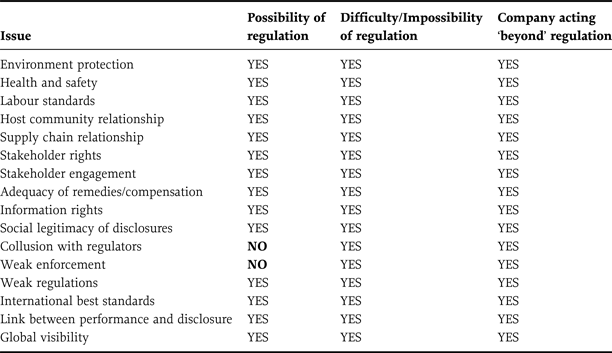
The ‘legal’ and ‘non-legal’ responsibility dichotomy is illustrated by responses to the 2010 Deepwater Horizon oil spill that caused environmental and other problems, and demonstrates that social responsibility issues are not easily described as exclusively legal or voluntary (see Table 1). Acting under existing laws, the US government conducted safety reviews of offshore installations and drilling rigs, and suspended existing and offshore deepwater drilling permits and undertook several other remedial actions (BOEMRE, 2011; Sheldon, Reference Sheldon2011). It took enforcement proceedings against BP and other companies for safety violations, to impose unlimited liability and remove the statutory $75 million compensation cap by proving gross negligence or wilful misconduct. It introduced fresh laws, improved health and safety rules, raised financial penalties for pollution, and reformed inadequate regulatory processes and weak enforcement agencies. Although triggered by the spill, the new legal obligations did not actually affect existing liability. BP therefore exceeded its strict legal obligations and considered social expectations in undertaking an immediate clean-up, pledging environmental restoration, allocating US$500 million for environmental and public health research, and expressing commitment to satisfying legitimate compensation claims (BP, 2011a, 2011b, 2011c).
Regulation issues in Deepwater Horizon oil spill.

Consequently, prescriptive CSR ought to consider the nature of responsibility required in certain circumstances in addition to recognising the legal versus non-legal classification of obligations, and clarifying the type of legal environment sought. This, for instance, avoids the conflation of the concepts of corporate responsibility, CSR and social reporting, which, although related, may not necessarily share identical scope and common goals. There is no conceptual difficulty in discussing corporate responsibility if the legal, instrumental, ethical or other basis is clarified. For example, ethical justifications for business involvement in poverty eradication and development issues (Bardy, Drew and Kennedy, Reference Bardy, Drew and Kennedy2012; Merino and Valor, Reference Merino and Valor2011) are not suggestive of ethical concerns as automatic legal standards or obligations. As a corollary of the components of corporate responsibility, instrumental CSR is part of ‘economic’ responsibility, but could be ‘legal’ if, for example, the law requires managers to pursue profit in certain situations. Ethical CSR which is ‘not-legal’ is therefore the antithesis of ‘legal’ responsibility. The upshot is that the absence of legal compulsion is integral to ethical CSR. At best, an ethical-type CSR encourages good practices and observance of social norms without imposing legal responsibility. It confuses, however, if ethical and legal responsibilities are assumed to be identical by proposing the legal compulsion of essentially voluntary activities appealing to instrumental, ethical or other considerations.
The ethical–instrumental distinction can support a case for regulating certain CSR issues. Ethical rationales may be more compelling than instrumental justifications by excluding economic efficiency arguments for socially objectionable and ‘financially harmless’ practices such as bribery of foreign public officials (Osuji, Reference Osuji2011) and insider dealing (Barnes, Reference Barnes2009; McVea, Reference Mcvea1995).Footnote 1 The instrumental–ethical dichotomy therefore applies a functional approach to the law–CSR relationship by distinguishing private morality from morality with ‘public’ elements to enable legal protection using criteria such as abuse/misuse of position and power, reasonable expectations of good faith, fulfilment of promises, and prevention of opportunistic exploitation of rules and enforcement. Having established that regulatory CSR is conceptually and practically possible within the boundaries of functionality, this paper will now scrutinise regulatory approaches in certain jurisdictions.
V. Regulatory CSR models
As Ho (Reference Ho2013, p. 388) argued, CSR regulatory models are ‘informed [by] each country's political, economic, and cultural context, as well as by existing relationships between business, government, and civil society’. Lozano et al. (Reference Lozano, Albareda and Ysa2008) are broadly supportive by suggesting that European regulatory models are partnership (Denmark, Finland, Sweden, the Netherlands), business in the community (the UK, Ireland), sustainability and citizenship (Austria, Belgium, France, Germany, Luxembourg), and agora (Greece, Italy, Portugal, Spain). Ho (Reference Ho2013, pp. 421–423), however, highlights market (the US) and relational (the EU) models as recognising limited ‘indirect mediating or reinforcing role’ for government, although the former supports market-driven voluntarism whilst the relational model encourages active collaboration between firms, the market and civil society. The state-centric model (China) reflects a socialist direct and extensive government's role.
Ho's three-model approach broadly reflects existing regulatory CSR traditions, but does not really display the diversity of tools and intensity levels. The global trend in regulatory CSR appears to favour economic/market instruments and reflexive law tools over prescriptive/command-and-control regulations (Grabosky, Reference Grabosky2013; Kingston, Reference Kingston2010, Reference Kingston2013; Richardson, Reference Richardson2009). This ‘regulatory capitalism’ (Barkay, Reference Barkay2009) prompted the European Commission's (Commission of the European Communities, 2011, p. 7) position that CSR ‘should be led by enterprises themselves’. The Commission (2011, p. 3) acknowledges that ‘[c]ertain regulatory measures create an environment more conducive to enterprises voluntarily meeting their social responsibility’ and largely prefers orchestration, which is the state's facilitation of private regulatory arrangements (Schleifer, Reference Schleifer2013). This orchestration is chiefly through non-financial disclosure recently confirmed by the 2011 Commission's Communication and 2014 Non-Financial and Diversity Information Directive.Footnote 2
Orchestration is also by using market instruments, particularly the Emissions Trading SchemeFootnote 3 and Eco-Management and Audit Scheme (EMAS) in the environment sector. Initially adopted under EEC Regulation 1836/93, the EMAS registration/compliance programme uses mainly financial and reputational incentives for voluntary commitments (Ho, Reference Ho2013, pp. 392–393; Zerk, Reference Zerk2006, p. 39). Its eight-step procedure includes environmental policy formulation, review, action programme and management system, audits, objectives, statements, independent verification, and reports to national authorities. Credibility concerns about EMAS and its role in environmental performance led to its amendment by Regulation EC 761/2001 (Wenk, Reference Wenk2004, p. 65).
The EU and UK disclosure systems are largely reflective of the business case CSR and at best consider ethical concerns to be incidental. Consequently, Sections 172 and 417 of the UK Companies Act 2006 establish ‘attractive’ (Stallworthy, Reference Stallworthy2006) procedural tools for mandatory disclosure that reflects reflexivity to the extent of requiring directors to empirically investigate facts and outcomes beyond statutory descriptive and instrumental justifications (Chiu, Reference Chiu2006, p. 267). It is a limited instrumental business case approach that links CSR and financial performance and can discourage CSR in areas such as environmental protection that are not easily financially measurable (Bradshaw, Reference Bradshaw2013, pp. 156–157). It regards social irresponsibility as a fiscal risk factor and almost automatically leads to support for corporate self-regulation (Hart, Reference Hart2010; Shamir, Reference Shamir2011, p. 330).
The US largely favours self-regulation and market-based approach to CSR, with little room for ‘public interest’ disclosure (Williams, Reference Williams2002). However, ‘global’ disclosure has gained momentum following ‘ethical’ concerns regarding the 1990s child labour and sweatshop scandals of overseas affiliates of garment companies. For example, Section 1502 of the Dodd-Frank Act 2010 employs global disclosure by requiring diamond and technology companies to provide annual reports of ‘due diligence on the chain and custody of’ conflict minerals. As discussed in the ‘Introduction’, the Act has very limited effectiveness because of the omission of stakeholder empowerment for challenging the adequacy of due diligence and verifying the quality and correctness of information disclosed (Amnesty and Global Witness, 2015b9). Similarly, California's Transparency in Supply Chains Act 2010 requires ‘large retailers and manufacturers’ to disclose anti-slavery and human trafficking efforts in their supply chains. This market-based statute assumes that disclosure influences ‘purchasing decisions’ and enables consumers to avoid ‘tainted’ supply chains (Section 2(h)), but omits stakeholder empowerment and enforcement provisions such as that exploited in Nike v. Kasky.Footnote 4
Although government's actions short of compulsion and sanctions can be ‘expressive’ of public policy and have communicative effects (Sunstein, Reference Sunstein1996), market-based models ignore CSR's governance and socio-economic development potentials and the role of modern corporate governance in matching corporate resources to the needs of society, particularly in developing countries. De Burca (Reference De Burca2010, p. 232) consequently observes that one reason for the emergence of new governance systems is the need to address ‘strategic uncertainty – [of] complex policy problems [such as poverty and socioeconomic problems] which have not shown themselves to be readily amenable to resolution whether through hierarchy, market, or otherwise’.
Using CSR as a socio-economic development tool is apparent in some prescriptive regulations, though it is doubtful whether its limitations are appreciated. Ho's (Reference Ho2013) state-centric explanation is reflected in certain common-law developing countries with less interventionist legal traditions than civil-law systems (Anderson, Welsh, Ramsay and Gahan, Reference Anderson, Welsh, Ramsay and Gahan2012, pp. 173–175) and showing a lack of awareness of the limited scope of regulatory CSR. First, Indonesia's Investment Law No. 25 requires investments to manifest principles of ‘openness, accountability, equal treatment without discriminating the country of origin, togetherness, impartial efficiency, sustainability, environmental friendly, and balance of progress and national economic unity’ (Article 3(1)). Investment objectives include ‘increasing national economic growth; creating job opportunity; improving sustainable economic development; improving competiveness of national business sphere; increasing the capacity and capability of national technology; encouraging people economic development; [and] improving the prosperity of the community’ (Article 3(2)). Investors must ‘apply principles of good company management, implement the company's social liability, [and] respect the cultural tradition of communities around the location of investment activity’ (Article 15); ‘preserve the environment; provide safety, health, convenience, and prosperity to workers; and comply with all of the rules of law’ (Article 16), and ‘allocate fund in stages for the recovery of location that fulfils the standard of environmental worthiness, whose implementation shall be in accordance with the rules of law’ (Article 17). The 2007 Limited Liability Company Law No. 40 defines ‘social and environmental responsibility’ as ‘the company's commitment to participate in sustainable economic development in order to improve the quality of life and beneficial environment, both for the company itself, the local community, and society in general’ (Article 1(3)). Article 74 requires natural resources companies ‘to carry out social and environmental responsibility’ as ‘budgeted for and calculated as a cost of the company, and which is implemented with attention to appropriateness’. Companies can be sanctioned for failing ‘to carry out social and environmental responsibility’.
An Indonesian court surprisingly rejected arguments that these broad provisions lack legal certainty, efficiency of economic justice and awareness of CSR's nature.Footnote 5 Despite the court's insistence that ‘[CSR] is a flexible concept which is subject to the interpretation of each country’ (Waagstein, Reference Waagstein2011, p. 456), conceptual and practical difficulties arise from not distinguishing instrumental and purely ethical CSR. Article 74 of Law No. 40, for example, is ‘too general’ and merely ‘inspirational in character’ and lacks automatic enforceability and clarity of goals, monitoring and implementation (Waagstein, Reference Waagstein2011, pp. 461–465). Although provoked by environmental and human rights abuses, particularly by multinational extractive companies (Kemp, Reference Kemp2002; Waagstein, Reference Waagstein2011, p. 460), the laws create a paradox by attempting to compel both legal and voluntary behaviour standards. The failure to acknowledge differences between legal precepts and socially ‘required’ conduct is fundamentally at odds with the instrumental and ethical CSR conceptions. Using ‘legal’ instruments to compel ‘voluntary’ standards is an arduous and ultimately impossible task which confuses CSR with corporate responsibility in the broadest sense.
Similar difficulties apply to Nigeria's Corporate Social Responsibility Bill SB27 2008, seeking to establish a supervisory body to create international CSR standards; implement social and environmental inspection regimes; engage in social performance ratings; develop CSR policies; ensure accountability to employees, trade unions, investors, consumers, host communities and the environment; impose sanctions; develop environmental guidelines; and implement local content policies (Clause 5). The bill is unlikely to become law, being an amalgam of incompatibility seeking in general terms to compel CSR without regard to its instrumental or ethical basis. Compelling companies to ‘respond to the needs of the host communities through strategic philanthropy, environmental protection, and community development’ contains an inaccurate assumption that CSR is legally prescribed codes of conduct.
In the Philippines’ ongoing controversy, House Bill 1224 and Senate Bills 1239 and 2747 entitled ‘An Act institutionalizing corporate social responsibility, providing therefor and for other purposes’ ‘mandated’ CSR, while House bills 4575 and 306 entitled ‘An Act encouraging corporate social responsibility, providing therefor and for other purposes’ ‘encourage’ CSR. Section 3 of House Bill 306 ‘encourage’ CSR observance by business organisations, and defines CSR as ‘the commitment of business to contribute on a voluntary basis to sustainable economic development by working with relevant stakeholders to improve their lives in ways that are good for business, sustainable development agenda and society at large’. Recognised CSR-related activities include ‘charitable programmes and projects, scientific research, youth and sports development, cultural or educational promotion, services to veterans and senior citizens, social welfare, environmental sustainability, health development, disaster relief assistance, and employee and worker welfare related CSR activities’. This narrow corporate philanthropy conception is contrary to the view that ‘CSR is not philanthropy, contributing gifts from profits, but involves the exercise of social responsibility in how profits are made’ (McBarnet, Reference Mcbarnet, McBarnet, Voiculescu and Campbell2007, p. 9). Business organisations will list their CSR activities in annual or regular reports to administrative agencies (Section 8). Section 4 amends the Philippines’ Corporation Code by prohibiting the retention of surplus profits exceeding paid-in capital stock except, among other grounds, ‘when justified by definite corporate expansion or corporate social responsibility projects and programs approved by the board of directors’. The Department of Trade and Industry will grant ‘national recognition and rewards … for outstanding, innovative and world-class CSR-related services, projects and programs’, and endorse candidates for international awards (Section 6), and local government units must extend necessary ‘assistance’ to companies in CSR performance (Section 7). Unlike House Bill 4575, which applies to all businesses including small and medium enterprises and does not permit deduction of CSR-related expenses, Senate Bill 2747 applies only to ‘large taxpayer corporations’ (Section 3) and contains tax deductibility (Section 4). Bill 2747 excludes activities already mandated by existing legislations from the definition of CSR activities (Section 3) and requires periodic reports to the SEC only (Section 6). The country's businesses challenge the proposed legislation, arguing that since ‘[e]thics, just like morals and taste, cannot be legislated’, CSR should be ‘left as a voluntary practice that organizations can take on’ (del Mundo, Reference Del Mundo2011). This objection alludes to the instrumental–ethical distinction discussed above. Substitution of philanthropy for CSR is another criticism.
In contrast, Section 135 of India's Companies Act 2012 requires companies having a certain net worth, turnover or profit to appoint a ‘CSR Committee’ of three or more directors, one of whom must be an independent director, for recommending CSR policies and expenditure to the Board of Directors and monitoring such policies. The Board must disclose CSR policies in directors’ reports and on corporate websites, and also ensure that activities in the policies are undertaken. Schedule VII provides that CSR activities include: ‘eradicating extreme hunger and poverty, promotion of education, reducing child mortality and improving maternal health, combating human immunodeficiency virus, acquired immune deficiency syndrome and other diseases, employment enhancing vocational skills, [and] contributing to the Prime Minister's National Relief Fund or any other fund set up by the Central Government or the State Government for socioeconomic development and relief.’ The ‘Companies (Corporate Social Responsibility Policy) Rules 2014’ exclude activities ‘undertaken in pursuance of normal course of business of a company’ (Sections 2(e), 4(1), 6(1)) or benefitting only a company's employees and their families (Section 4(5)), and contributions to political parties (Section 4(7)). This is a narrow philanthropy view of CSR, although it reflects traditional Indian understanding of CSR as corporate responsiveness to social expectations and contributions to social and development initiatives (Mitra, Reference Mitra2009). Companies are required to spend at least 2 per cent of average net profits of the three preceding financial years for CSR, giving preference to local areas of operations. There are no sanctions, although Section 135(5) requires directors’ reports to give reasons for non-compliance. Section 9 of the subsidiary legislation require the display of Board-approved CSR policies on corporate websites, suggesting that negative publicity is sufficient incentive for social responsibility.
The first issue arising from India's legislated CSR is the appropriateness of using CSR as a development tool, and the respective roles of states and corporations. Simply put, a key question is ‘What should be the role of government, and what should be the role of markets in proving desirable outcomes?’ (Fransen, Reference Fransen2013, p. 224). Ho (Reference Ho2013, p. 438) observes that state-centric regimes compel companies to contribute to development programmes. The fact that CSR is an illustration and evidence of ‘corporate political power’ (Wilks, Reference Wilks2013, p. 197) suggests that expectations of public governance functions are not far-fetched, notwithstanding Vogel's (Reference Vogel2010) warning that CSR cannot replace government and needs to be ‘reinforced by and integrated with state regulatory systems’. Franck (Reference Franck1995, p. 439), argues, however, that political systems can determine ‘key developmental priorities, cultural values and the distribution of social goods … within the larger quest for legitimate rules and institutions to promote development’ and, developing countries especially may include ‘a degree of state intervention in the terms of capitalization, production and earnings’. MNEs are the more likely candidates to satisfy the financial thresholds for India's compulsory CSR. By Section 3 of the subsidiary legislation, the CSR rules apply to companies with Indian branches or project offices. In that case, foreign companies may complain of a breach of general international investment law or specific bilateral investment treaties. However, international investment law only requires non-discriminatory and proportionate state interventions. Thus, Muchlinski (Reference Muchlinski2006, p. 549) argues that states can impose higher standards on corporations in addition to international CSR principles.
The second issue is the degree of command-and-control in the statutory CSR structure. Corporate organs are allowed discretion as to what activity to carry out and how it can be done, including the indication by Sections 4(2), 4(3) and 4(6) of the subsidiary legislation that CSR can be undertaken through registered trusts or societies, in collaboration with other companies, albeit with separate annual reports, and by employee capacity building. Section 5 requires CSR committees to establish ‘a transparent monitoring mechanism’ for undertaking projects. The legislation is therefore reflexive to an extent, unlike the purely prescriptive Indonesian and Nigerian statutes. However, the omission of sanctions, empowerment of stakeholders and representative public and private organisations, and lack of transnationalism reflecting the realities of globalisation is likely to affect the effectiveness of the legislated CSR. In view of the diverse regulatory experiences highlighted above, the next part of this paper therefore explores how regulatory CSR can be pursued effectively through inventive interventionism.
VI. Inventive interventionism
Unbounded prescriptive CSR equates improved corporate behaviour with greater regulation and fails to acknowledge that no regulation or legal system is entirely without loopholes and ambiguity. Legal interpretation may even be a social responsibility matter of avoidance or compliance with the spirit of the law (Zerk, Reference Zerk2006, pp. 34–37). Consequently, CSR strategies can be obstructionist (economic focus and rejection of ethical responsibility), defensive (passive legal compliance and rejection of ethical responsibility), accommodative (legal compliance plus minimalist and passive ethical responsibility), or proactive (active promotion of ethical responsibility) (Lee, Reference Lee2011, p. 286). This diversity of strategies demands appropriately designed regulatory CSR. Although greater regulation alone may not improve behaviour if avoidance is prevalent, ‘responsibility’ lacking a legal prop can have a neutral impact if corporations are not proactive. Therefore, a regulatory design that tackles avoidance and encourages proactivity may be more successful in encouraging CSR.
At least five reasons exist in favour of a symbiotic law–CSR linkage. First, reflexive law and responsive regulation show that law can support self-regulation in different ways. Second, CSR issues may be closely connected to legal obligations, including international human rights law (Buhmann, Reference Buhmann2011). As Table 1 illustrates, social issues and expectations can precipitate regulation if voluntary/self-regulated approaches falter in achieving desired behaviour. Third, voluntary CSR can create disunion between social demands, particularly ethical considerations, and the realities of corporate conduct. The Deepwater incident and other scandals confirm corporate inability to self-regulate in areas like environmental and financial probity (Ioannou and Serafeim, Reference Ioannou and Serafeim2011, p. 9). Fourth, strategic, defensive, altruistic or public-spirited reasons can shape corporate social practices but ‘business sense’ often compels corporations, particularly highly visible global brands, to engage voluntarily in CSR, confirming the dominance of the managerial and financial perspectives in unregulated CSR. Spaces therefore exist in the market for both socially responsible and irresponsible corporations (Vogel, Reference Vogel2005, pp. 2–4, 10–13, 16–74, 75–161, 165–66). Since voluntary programmes of different objectives exist because of lack of regulation, regulatory CSR can set minimum standards and limit the boundaries of the free-for-all field of the managerial and financial perspectives. Fifth, the stakeholder and institutional theoretical models demonstrate that external stimuli can increase the likelihood of social considerations in corporate agendas (Lee, Reference Lee2011). Law's coercive and other properties make it an unrivalled stimulus, prompting institutional theories’ support for using regulations to improve behaviour.
It is a question of whether to promote passive, restrictive or opportunistic legal environments. In passive domains, corporations act without specific considerations of legal provisions and may just happen to be compliant. Restrictive domains compel compliance with legal requirements, while opportunistic domains allow corporations to exploit weak standards and loopholes (Schwartz and Carroll, Reference Schwartz and Carroll2003). A ‘prescriptive-legislation-cures-all’ approach assumes the law can promote socially responsible behaviour only through compulsion of socially desirable activities, a narrow view reflexive law and responsive regulation theories rightly reject. Other intervention methods such as market, information and financial incentives can promote CSR (Leon and Moon, Reference Leon and Moon2007, p. 480; Hsueh and Prakash, Reference Hsueh and Prakash2012). Nonetheless, reflexive law and responsive regulation portend doubtful effectiveness in CSR by pushing the main agenda of compliance with legally prescribed standards (Deakin and Hobbs, Reference Deakin and Hobbs2007, p. 75). This demonstrates the need for inventive interventionism, since CSR really requires actors to exceed legal minimum standards that may be much lower than social expectations and stakeholder demands. Inventive interventionism can rely on a range of measures including incentives, recognition of self-regulatory bodies, and endorsement of guidelines issued by independent, public or private bodies, while recognising CSR's multiple stakeholder framework in regulatory design and enforcement. As detailed below, inventive interventionism applies a functional approach to overcome pitfalls associated with extreme prescriptive and voluntary models by requiring appropriate institutional support for regulatory CSR, recognising the distinctive features and goals of CSR and social disclosure and separating them in regulatory design, and linking performance and disclosure particularly through stakeholder empowerment.
6.1 Institutions
Prescriptive CSR can recognise ‘reciprocal and dynamic interactions between law and economic development, as well as the manifold functions of law beyond the protection of property rights’ (Desta and Hirsch, Reference Desta and Hirsch2012, p. 133). However, law and economic development require appropriate institutions to be effective, inspiring development scholarship's view that ‘markets and institutions are closely intertwined, and that markets do not exist in a vacuum but rather require an institutional framework’ (Desta and Hirsch, Reference Desta and Hirsch2012, p. 133). The new institutional economics school similarly demonstrate that ‘economic behaviour, whether by individuals or by firms, is affected by the institutional setting in which actors find themselves’ (Ohnesorge, Reference Ohnesorge2007, p. 268). The core components of institutions include ‘the rule of law and tackling corruption, property protection and government effectiveness’ (Desta and Hirsch, Reference Desta and Hirsch2012, p. 133). The legal system, including the quality of rules and enforcement, is particularly important to institutional economic development capacity (Dam, Reference Dam2006, pp. 5–6; Davies and Trebilcock, Reference Davies and Trebilcock2009, pp. 902–904).
Institutional support is related to the ability to regulate, a test developing countries sometimes fail. Some developing countries are ‘soft states … unwilling to impose obligations on the governed, and the corresponding unwillingness of the latter to obey rules laid down even by democratic procedures’ (Desta and Hirsch, Reference Desta and Hirsch2012, p. 133). The fact that the Philippines, Indonesia and Nigeria examples above resemble Ho's (Reference Ho2013, p. 382) ‘state-centric’ CSR model that ‘is unlikely to overcome existing governance gaps that impede the implementation of law’ suggests two lessons. First, regulatory CSR requires appropriate institutional support. Second, an approach may not work ‘effectively’ for particular jurisdictions. Regulatory CSR is a field where ‘the mismatch between pre-existing conditions and transplanted law, which weakens the effectiveness of the imported legal order’ is possible without institutional factors, and shows the need to exercise care if ‘the social, economic and institutional context often differs remarkably between origin and transplant country’ (Berkowitz, Pistor and Richard, Reference Berkowitz, Pistor and Richard2003, p. 171). Legal transplant analysis suggests that the importation/reception of legal concepts requires careful consideration of the operative systems’ conditions and environments (Arvind, Reference Arvind2010), including the importing jurisdiction's non-governmental actors such as individuals, corporations and other organisations (Naiki, Reference Naiki2014, p. 144).
Supporting legal and institutional infrastructure, including adequate enforcement and verification mechanisms, are required to ensure that responsibility is accompanied by ab ability and willingness to abide by the rules. Indonesia is an example. Although the predecessors to its CSR statutes contained wide-ranging provisions on typical CSR issues such as labour standards, environment and consumer protection, weak enforcement prevailed through lack of judicial mechanisms for accountability, corruption, legal uncertainty instigated by overlapping rules, and a race-to-the-bottom for foreign investment (Waagstein, Reference Waagstein2011, pp. 457–458). Despite requiring social and environmental disclosures in annual reports, the statutes may not fare any better than their predecessors, as there is no indication of renewed legal and institutional infrastructures, including facilities for ensuring the credibility of disclosures, reporting standards, stakeholder participation and external assurance (Utama, Reference Utama2011).
Inventive interventionism therefore advocates appropriate institutional capacity and other elements of effective legal systems to support regulatory CSR. In substance, this may require the establishment of CSR-specific regulatory, administrative and independent bodies to set standards, issue guidelines, co-ordinate the public sector and collaborate with the private sectors, engage in monitoring, inspection and verification, ensure external assurance, and apply sanctions. It may also require the reform of the adjudication process by, for example, reforming rules on making complaints and the institution of legal claims, public interest action by public bodies and private persons, collective action by interest groups, and application of remedies such as injunction, damages and apology. Thus, inventive intervention places regulatory CSR in an institutional framework that provides for CSR-related legal powers for public and independent agencies and rights for stakeholders, and enables the effective exercise of such powers and rights.
6.2 Decoupling CSR reporting
The unity model's matching of CSR with a ‘transparency and disclosure regime’ (Amao, Reference Amao2008, p. 89) conflates CSR and disclosure. A functional approach distinguishes CSR and disclosure by acknowledging natural disparities in juridification justifications (Osuji, Reference Osuji2012). CSR and social reporting may respectively refer to ‘activity’ and ‘reporting of activity’, and have dissimilar regulatory goals and legal consequences despite having a common origin. Justifications for disclosure regulation, including the consideration of social issues in decision-making, transparency and provision of evaluation mechanisms, differ from the desirability of the activity being disclosed, a key component of CSR. The multi-stakeholder counter-corruption Extractive Industries Transparency Initiative (EITI), which received legislative backing in the Nigerian Extractive Industries Transparency Initiative Act 2007 and the US Energy Security Through Transparency Act 2010, illustrates this distinction. EITI's set of reporting guidelines to companies, governments and interest groups for transparency of business-to-government payments implicitly separates CSR and reporting by requiring disclosure of payments without inquiring into fairness of amounts and other underlying issues.
Also applying this activity–reporting distinction are mandatory disclosure requirements in Denmark's Financial Statements Act 2008 (stand-alone reporting), South Africa's King Code of Governance Principles III 2009 (integrated financial and non-financial reporting), Sweden's guidelines (reporting by state enterprises), and the US Guidance Regarding Disclosure related to Climate Change 2010. In particular, Section 99a of Denmark's statute requires annual reports of large and state-owned companies to include their social policies and actions, previous year's initiatives and future expectations. The statute, first separates voluntary CSR from mandatory social reporting and does not compel performance of activities or behaving in particular ways, although whether corporate operations are socially responsible must be disclosed. Second, instrumental and ethical CSR are implicitly treated equally by requiring disclosure of activities reflecting either or both and not compelling corporations to espouse either approach. Denmark's approach reflects its instrumental labelling of CSR as a competitiveness issue of ‘the needs of business’ rather than ‘the needs of society’ (Gjølberg, Reference Gjølberg2010, pp. 211–212, 216–220).
This demonstrates that an inventive interventionist approach has to recognise the distinctiveness of the twin concepts of CSR and social disclosures and make informed decisions that suit the regulating jurisdiction, particularly in view of its socio-economic conditions and development needs. The decisions may relate to a jurisdiction-specific definition of CSR, preference for ethical or instrumental CSR, and what elements of CSR need to be disclosed. A jurisdiction can follow a different model by including ethical issues in CSR and, as India did, require disclosure of performance/non-performance of activities.
6.3 Performance-linked disclosure
Disclosure indirectly encourages CSR since it is preferable to disclose ‘good news’. Disclosure usually satisfies institutional and stakeholder pressure, suggesting its reputation-focused application (Spence, Reference Spence2011). However, voluntary disclosures and commitments to shared values alone may not improve social responsibility because of the ‘bluewash’ (Berliner and Prakash, Reference Berliner and Prakash2012, p. 151) of exaggerated social performance creating ‘frequently a gap between citizens’ expectations and what they perceive to be the reality of business behaviour’ (Commission of the European Communities, 2011, p. 9). Despite the proliferation of social reporting and rating agencies, negative reports largely lack the motivating element for improving decision-making and social performance, while damaging events such as administrative and judicial penalties, out-of-court settlements, environmental disasters and major health and safety issues are routinely ignored (Metcalf, Reference Metcalf2010, pp. 146–148; Scalet and Kelly, Reference Scalet and Kelly2010, p. 74).
Nevertheless, disclosure and information flow are critical components of regulatory CSR and require the acknowledgement that inadequate regulatory oversight of self-regulation is unhelpful to transparency. Disclosure can improve CSR commitments only if it facilitates objective performance measures that exclude ‘soft, unverifiable claims’ (Clarkson, Lie, Richardson and Vasvari, Reference Clarkson, Lie, Richardson and Vasvari2008, p. 309), a point highlighted well by the Deepwater spill. Apart from undermining BP's image as ‘a transnational’ and ‘perennial [CSR] leader’ (Matejek and Gössling, Reference Matejek and Gössling2014, p. 573; Metcalf, Reference Metcalf2010, p. 157), the spill indicted BP's ethical marketing and third-party ratings. BP's reputation-boosting campaigns had persisted despite credibility concerns from previous incidents, including deaths and injuries from the March 2005 explosion and fire incident at Texas City Refinery and inspections that revealed systemic poor health and safety standards. BP was fined a record $21 million for the 2005 incident and another record $87,430,000 in 2009 for health and safety violations (Balmer, Powell and Greyser, Reference Balmer, Powell and Greyser2011; Cherry and Sneirson, Reference Cherry and Sneirson2011; Kurtz, Reference Kurtz2011; Matejek and Gössling, Reference Matejek and Gössling2014; OSHA, 2009a, 2009b, 2009c).
Just as the Deepwater incident pushed the US to examine the need for mandatory environmental and social reporting, disclosure can act as collateral regulation if appropriately linked to performance (Clarkson et al., Reference Clarkson, Lie, Richardson and Vasvari2008). As Loss (Reference Loss1988, p. 33) rightly observed: ‘people who are forced to undress in public will presumably pay some attention to their figures.’ This requires legal substantive and procedural rights of stakeholders because ‘[t]o the extent that law focuses on companies’ internal responsibility processes rather than external accountability outcomes, law runs the risk of becoming a substanceless sham, to the delight of corporate power-mongers who can bend it to their interests’ (Parker, Reference Parker, McBarnet, Voiculescu and Campbell2007). It also involves recognising that stakeholders rely on ‘infomediaries’ such as the mass news media and industry and professional publications for information (Scheiber, Reference Scheiber2015, p. 559).
Therefore, stakeholder rights through inventive interventionism can, for example, include verification, complaints to administrative agencies, and judicial redress relating to corporate disclosures, third-party ratings and other matters. This may require substantive stakeholder rights encapsulated in a statutory tort that defines duties, rights and remedies. It may also require the reform of torts such as defamation and trespass to property to provide appropriate defences for stakeholders to enable them promote CSR in a balanced manner.
VII. Transnational inventive interventionism
While the preceding section has considered inventive interventionism within national boundaries, the flawed examples of regulatory CSR also demonstrate unawareness of the increasingly globalised CSR environment. Prescriptive CSR attempts to tackle the recondite issue of how to ‘persuade’ companies, including MNEs, to be socially responsible and apply international best standards despite legal obligations and institutional control in host jurisdictions, particularly developing countries. The state of international law, including an absent overarching international authority exacerbated by significant disparities in substantive regulations and enforcement among developing and developing countries, makes CSR a more practical alternative to legal control of MNEs. For instance, the Forest Stewardship Council's transnational certification scheme (FSC, 2015) appears to work reasonably well in developed countries in contrast to developing countries (Marx and Cuypers, Reference Marx and Cuypers2010; Schepers, Reference Schepers2010; Tollefson, Gale and Haley, Reference Tollefson, Gale and Haley2008).
Some factors help to galvanise support for prescriptive CSR in developing countries. One is the globalisation-created power shift enabling corporations to act as equals or stronger partners of governments of developing countries (Reed, Reference Reed2002) that often lack adequate institutional and stakeholder control of corporations (Stovall, Neill and Reid, Reference Stovall, Neill and Reid2009). Another is voluntary corporate codes of conduct, which emerged because of a lack of national and international regulatory instruments for MNEs, and are not often effective in improving corporate behaviour. Corporations are more likely to adopt CSR principles that are closely connected to regulations (Porter and Kramer, Reference Porter and Kramer2006). Furthermore, MNEs adopt obstructionist positions in developing countries with weak legal and institutional environments (Lee, Reference Lee2011, p. 289; Sethi, Reference Sethi and Sethi2011).
For example, the United Nations Environment Programme's (UNEP) (2011) environmental assessment of Ogoniland, Nigeria, revealed extensive environmental degradation, public health threats, and gross institutional and regulatory failures. The African Commission on Human and Peoples’ Rights (ACHPR) similarly noted that ‘pollution and environmental degradation to a level humanly unacceptable has made living in Ogoniland a nightmare’, and held that Nigeria's government acted contrary to treaty obligations and ‘internationally established principles’ in facilitating and giving the ‘green light’ to environmental destruction by multinational oil companies.Footnote 6 The Court of Justice of the Economic Community of West African States reached a similar decision in 2012.Footnote 7 Oil companies disregarded internal procedures, industry best practices, international standards and national regulations, including weak and inadequate remediation provisions. Regulators, who lacked relevant expertise and resources, colluded with MNEs to undermine environmental standards (UNEP, 2011). Regulators also tended to rely wholly on, and refrain from verifying, corporate-provided data, including attributing in a report to UNEP over 90 per cent of the Niger Delta's oil spillages to sabotage and criminal activities rather than unsafe equipment and negligent practices (Amnesty, 2009, 2013; Okeke, Reference Okeke2011). The data allegedly originated from Shell, a dominant MNE that regularly cited sabotage-related factors despite challenges from environment groups and host communities. A court confirmed that Shell provided no evidence for allocating to sabotage 28 per cent between 1989 and 1994, 70 per cent in 2007, and over 90 per cent in 2010.Footnote 8 Nigerian law's lack of primary and secondary liability for sabotage-related consequences probably provided incentives for false claims to avoid paying compensations to host communities (Amnesty, 2013; Frynas, Reference Frynas1999, p. 128).
Another example of low regulatory standards relating to competition for investments is Nigerian law's preferential treatment of oil companies. The Constitution's acknowledgment of an overriding common good objective in the exploitation of human and natural resources (Section 17(2)(d)) is part of Chapter 2's socio-economic provisions the courts firmly held to be declaratory policies and unenforceable (Nnamuchi, Reference Nnamuchi2008; Odinkalu, Reference Odinkalu, Gauri and Brinks2008).Footnote 9 The Constitution and statutes grant limited land rights to individuals and host communities and permit expropriation often exercised in favour of oil companies. Provisions encourage inadequate compensation for land used for oil exploration and production while oil companies, regulators and enforcement agencies routinely ignore pollution prevention, control and remediation provisions (Amnesty, 2009, 2013; Frynas, Reference Frynas2000, p. 170).Footnote 10 The judicial system tilts toward oil companies and practically denies host communities access to justice. For instance, Shell, which recently reached a $15.5 million settlement in the US over its Nigerian operations,Footnote 11 might not have settled the case had it been instituted in Nigeria. An injunction restraining Shell from environmental pollution was once declined because oil was considered critical to the economy (Idowu, Reference Idowu1999, p. 181). Despite its prohibition since 1984, ministerial permits for gas flaring in oil production and exploration if re-injection or utilisation is not possible created loopholes often exploited by MNEs, with the result that statutory conditions, including environment impact assessment and transparency, are frequently ignored (Amnesty, 2009, 2013; Ezeamalu, Reference Ezeamalu2014).Footnote 12 A regular ritual of extending deadlines exists, despite a 2005 court order for cessation of gas flaring for violating the constitutionally guaranteed fundamental rights to life, a healthy environment and human dignity, reinforced by the African Charter on Human and Peoples Rights.Footnote 13
While the laws of some developing countries are minimally consistent with international standards, inadequate enforcement means that regulation is really lacking even where it exists. One recent documented instance of this regulatory capture – leaked diplomatic cables indicating absolute control by multinational oil companies of Nigeria's regulatory and administrative authorities (Sahara Reporters, 2010) – explains why regulators undertake little enforcement. At the January 2011 Dutch parliamentary hearings, activists accused Shell of environmental pollution, gas flaring, double standards and flouting international good practices in Nigeria (EAW, 2011). Nigerian authorities failed to react, despite years of complaints from activists and local communities (Amnesty, 2013; Ezeamalu, Reference Ezeamalu2014).
Table 2 therefore shows the prevalence of opportunistic legal domains in some developing countries. The domains highlight the difficulty of separating CSR from host countries’ legal systems, and regulatory, cultural and other components of corporate operating environments. A related issue is how home countries can make MNEs recognise a ‘global public domain’ (Ruggie, Reference Ruggie2004, pp. 519–521; Hofferberth, Bruhl, Burkart, Fey and Pelter, Reference Hofferberth, Bruhl, Burkart, Fey and Pelter2011, p. 216) of shared values and expectations. Developed nations which generally profess commitment to environmental protection (Gainet, Reference Gainet2011, p. 214) may want companies to pursue this goal globally, as exemplified by the European Commission (Commission of the European Communities, 2001b) Strategy for Sustainable Development. The relative weakness of public international law norm-setting, implementation and enforcement mechanisms elevate such commitments to ‘complementary’ and ‘potentially important mechanisms for the transmission of public law norms in the global sphere’ (Metcalf, Reference Metcalf2010, pp. 155, 192, 199). Therefore, below are transnational approaches that channel international norms into corporate operations.
Governance issues in a developing country (the example of Nigeria)

7.1 Globalisation of standards
Captured in the concept of ‘CSR + ’ is the notion of obligations beyond national legal standards that are often weak in developing countries (Buhmann, Reference Buhmann2011, p. 150). CSR + conveys the idea of the internationalisation of best standards applicable everywhere. It promotes universalism of legal standards hindered by difficulties in achieving internationally co-ordinated actions and binding commitments of developed and developing countries (Posner and Weisbach, Reference Posner and Weisbach2010; Vandenbergh and Cohen, Reference Vandenbergh and Cohen2010). Consequently, soft laws ‘regulating’ MNEs as a first step to evolution into binding treaties and customary international law (Weissbrodt and Kruger, Reference Weissbrodt and Kruger2003, pp. 913–914; Zerk, Reference Zerk2006) include global-orientated CSR-related initiatives (Baines, Reference Baines2009; Davarnejad, Reference Davarnejad2011; Knudsen, Reference Knudsen2011; OECD, 2008). The UN Global Compact, for example, asks corporations to comply with and report on certain social principles in their global operations. Similar substantive and reporting initiatives such as the 2003 UN Norms on the Responsibilities of Transnational Corporations and Other Business Enterprises with regard to Human Rights, Global Reporting Initiative and AccountAbility, demonstrate that universalism of standards is not only possible but desirable, and international co-ordination can establish common standards for MNEs despite different CSR definitions and models. ‘Global’ rating systems such as the Council for Economic Priorities, Franklin Research and Development Corporation and Newsweek Green Rankings, the International Integrated Reporting Committee and the International Organization for Standardization's ISO 2600, suggest the existence of global consensus on some elements of CSR and social reporting (Ioannou and Serafeim, Reference Ioannou and Serafeim2011, pp. 10–11; Rahman and Post, Reference Rahman and Post2012).
Despite their prominence, voluntary action and soft-law initiatives may not achieve improved corporate behaviour, particularly in developing countries, because, first, the lack of enforceable international standards makes such countries susceptible to regulatory capture, poor regulations and ineffective enforcement. For example, international rules on the transboundary movement of hazardous electrical and electronic waste emerged when strict regulations in developed countries merely created export markets in developing countries (Boudier and Bensebaa, Reference Boudier and Bensebaa2011). Second, although an ideal solution to the disparity of standards is using international treaties to impose binding obligations on MNEs (Affolder, Reference Affolder2009), such as treaties on civil liability for nuclear damage and oil pollution (Halpern, Reference Halpern2008, pp. 172–173), a binding CSR treaty (Kuschnik, Reference Kuschnik2008; Zerk, Reference Zerk2006) is unlikely to materialise because of lack of interstate co-ordination. Nevertheless, soft instruments signpost internationally accepted practices that can form the basis of disclosure and other regulatory requirements for willing and able jurisdictions to insist on the best standards. The internationalisation of standards provides room for a global-focused inventive interventionism to hold ‘firms responsible for actions far beyond their boundaries, including the actions of suppliers, distributors, alliance partners, and even sovereign nations’ (Davis, Whitman and Zald, Reference Davis, Whitman and Zald2008, p. 32).
Inventive interventionism can be by, for example, referencing appropriate standards to international/industry best practices existing from time to time, and stipulating that standards in national law are not a defence to claims for breach of CSR-related obligations from administrative agencies, stakeholders and interest groups. For developing countries especially, that are more susceptible to regulatory capture and might lack the expertise and resources to determine the most appropriate standards, it allows an efficient fluid interpretative device to check the activities of MNEs and other corporations that are in an even better position to grasp and apply international/industry best standards.
7.2 Globalisation of disclosure
The Incorporation of global operations in reporting can resolve the difficulties of translating the globalisation of standards in disclosures of ‘global’ issues such as environmental protection. This ‘regulation by information’ (Backer, Reference Backer2008; Case, Reference Case2005; Metcalf, Reference Metcalf2010, pp. 146–155) can occupy the space created by an absent international authority for MNEs. It recognises that, irrespective of the nature and location of social issues, the source, stakeholders and targets of CSR disclosures are often global rather than nationally spatially restricted. No physical boundaries prevent using CSR disclosures for ‘differentiating a certain product or service on the basis of an environmental or social quality’ (Van de Ven, Reference Van De Ven2008, p. 348) to influence consumers and employees in developed and developing countries (Alniacik, Alniacik and Genc, Reference Alniacik, Alniacik and Genc2011; Du, Bhattacharya and Sen, Reference Du, Bhattacharya and Sen2010; Stanaland, Lwin and Murphy, Reference Stanaland, Lwin and Murphy2011). As the social legitimacy's link between positive image and corporate survival is largely determined by available information and how it is communicated (Wæraas and Ihlen, Reference Wæraas and Ihlen2009), a global view enhances the reliability of disclosures for consumers and stakeholders in different jurisdictions. It can also improve the credibility of third-party ratings and certifications, which have emerged as distinct arms of the CSR movement.
Home state social disclosure obligations (Cragg, Reference Cragg2010) are likely to be more effective than host developing nations, since the former are often developed countries with more effective institutions. This is demonstrated by a 1991 Memorandum of Understanding between Nigeria's government and multinational oil companies providing fiscal incentives known as reserve additional bonus (RAB), calculated from differences between oil reserve discoveries and actual production. In 2003, the government disallowed most of the allegedly falsified tax-deductible RAB claims. This prompted legal actions by the companies, later withdrawn after US and UK regulators respectively fined Shell US$120 million and £17 million in 2004. Shell later settled investors’ claims for falsifying its reserves level (BBC, 2007). Since transnational financial disclosure requirements enabled the US and the UK to sanction the multinational company, social disclosures can be more effective with global schemes than narrow national standpoints. The carbon emissions disclosure, for example, provides an incomplete picture if MNEs are only required to disclose emissions in developed countries and exclude activities in developing nations (Vandenbergh and Cohen, Reference Vandenbergh and Cohen2010).
Inventive interventionism therefore takes a global/transnational view of CSR, social disclosures and stakeholders/targets of disclosures by, for example, requiring disclosure on accessible platforms such as corporate and regulator websites, and regulating disclosures in wide-reaching and mass participation outlets such as blogs, online news outlets and social media. It can provide legal support to similar schemes to the voluntary factory/supplier disclosure in the apparel industries (Doorey, Reference Doorey2011) to identify supply and purchasing chains and enable global due diligence provisions similar to the two US social disclosure statutes discussed above. This is a useful technique for developed countries that are committed to the global application of international best standards, and also for developed countries that lack regulatory capacity and need corporate activities and disclosures to be visible to stakeholders and interest groups, including those beyond their borders and in more advanced countries.
7.3 Globalisation of enforcement and empowerment
Global approaches to social legitimacy issues in CSR disclosures are required to fill international enforcement gaps caused by disparities in rules. The credibility of mandatory reports is often linked to the level of enforcement and quality of social performance in both developing and developed countries (Ioannou and Serafeim, Reference Ioannou and Serafeim2011, pp. 4–5, 15–16; Markandya and Halsnæs, Reference Markandya and Halsnæs2002). Globalisation of enforcement is therefore necessary to encourage MNEs to promote globally shared values wherever they operate (Cahn and Gambino, Reference Cahn and Gambino2008). Pioneered in international human rights and humanitarian law, universal enforcement recently included in counter-corruption treaties enable the criminalisation of bribery of foreign public officials in national legislations such as the US Foreign Corrupt Practices Act 1977 and the UK Bribery Act 2010 (Horder, Reference Horder2011; Osuji, Reference Osuji2011). Universalism combines elements of international law and national enforcement to resolve global issues, particularly where governance structures, substantive rules and enforcement mechanisms are weak or non-existent.
National regulations lag behind the global reach of CSR reports by omitting enforcement rights for the targets of such disclosures. The gap leaves stakeholders, particularly consumers, unable to assess CSR claims and ratings because of ‘green washing’ (Parguel, Benoît-Moreau and Larceneux, Reference Parguel, Benoît-Moreau and Larceneux2011) and incapable of challenging false and misleading claims even when disclosures constitute an ‘explicit promise to the stakeholders and the general public that the corporation excels with respect to their [CSR] endeavours’ (Van de Ven, Reference Van De Ven2008, p. 345). The link between performance and disclosure can therefore be tightened to protect the global targets of disclosures.
What may be required under inventive interventionism are legal frameworks for the complementary regulatory efforts of stakeholders and interest groups. It needs to recognise global ethical identity reflecting, especially, the influence of corporate communications and marketing (Balmer et al., Reference Balmer, Powell and Greyser2011, pp. 1–2). National rules can enable public agencies and private persons, particularly in developed countries, to challenge CSR claims irrespective of their origin and factual background. This acknowledges that litigation and private remedies can be used to control MNEs and other corporations (Funk, Reference Funk2011; Muchlinksi, Reference Muchlinksi2009; Yandle, Dorchak and Morriss, Reference Yandle, Dorchak and Morriss2011). By promoting corrective and distributive justice and encouraging appropriate conduct, individual rights help the enforcement of rules, particularly when public agencies are reluctant. For example, a Californian statute enabled a private claimant to challenge Nike's claims and compel improved labour standards in its overseas practices and more credible disclosures.Footnote 14
VIII. Conclusion
The European Commission's (Commission of the European Communities, 2011, p. 5) acknowledgement of ‘the role that complementary regulation plays in creating an environment more conducive to enterprises voluntarily meeting their social responsibility’ has reinforced the need to examine the law–CSR relationship, a relatively unexplored field despite the vast body of literature on both CSR and regulation. Lacking systematic attention are analytical factors for assessing CSR's effectiveness as a national and global governance tool. Although contributions from diverse disciplines on regulation and alternative regulation underline the dynamic nature of law, little attention has been given to the theoretical and practical challenges CSR poses to regulation, including as an instrument of socio-economic development.
Imperative, therefore, is a new direction beyond existing approaches, including deeper consideration of the legal nature of CSR as a governance mechanism for correcting externalities, and a closer scrutiny of the law–CSR relationship and its national and global implications. This paper demonstrates that responsive regulation and reflexive law theories that acknowledge law's multidimensional and multidirectional nature, which is relevant to the law–CSR relationship, are not specifically targeted at CSR and are not completely suitable to CSR's unique multi-stakeholder framework in rule design and enforcement. Responsive regulation, for example, depends on legislative provisions of wide-ranging investigative tools and credible sanctions to regulators, and also does not consider the range of corporate responsibilities and the instrumental and ethical justifications for CSR.
Building on reflexive law, responsive regulation and regulatory CSR perspectives, this paper proposes inventive interventionism to disentangle the complex mixes of law, regulation, self-regulation, institutions and contexts in the CSR–regulation debate, and overcome difficulties associated with regulators’ capacity and powers. It therefore assesses the limits of the linear CSR regulation debate and how to transcend regulatory challenges. From a conceptual perspective, the paper contributes to the development of an analytical framework for CSR and reforming its national and global regulatory environments. The functional approach of inventive interventionism recognises different instrumental and ethical justifications for regulating CSR and social disclosures and, in particular, links performance and disclosure while advancing socio-economic goals. Inventive interventionism recognises that globalisation has introduced complexities to the twin questions of the scope of CSR commitments and control of corporations, particularly MNEs. Using CSR as a transnational governance tool for state and non-state actors helps to address one of the criticisms of the existing international system: the prevalence of fragmented and weak institutions that allow little input from developing countries in areas such as energy governance (Gunningham, Reference Gunningham2012). Inventive interventionism suggests that strategies for enhancing the effectiveness of regulatory regimes must reflect CSR's global multi-stakeholder nature and allows CSR to fill gaps in national and international corporate regulation by highlighting global reputation and complementary regulation by stakeholders and interest groups, including those outside the regulatory jurisdiction. This analytical approach proceeds on the assumption that CSR is both a product of the regulatory system and a phenomenon of business, and can provide processes for the transmission and transplantation of domestic and international norms to businesses.
This paper therefore reflects a transnational and comparative approach to regulatory CSR, demonstrating that existing prescriptive CSR is likely to be deviant rather than prototypical for being oblivious of complex regulatory issues in national and global contexts. It contributes to a better understanding of the complex nature of the law–CSR relationship and the interplay of law and regulation in promoting effective regulatory systems, demonstrating that regulatory CSR is conceptually and practically possible within the boundaries of functionality. An extreme voluntary or straight race-to-the-top prescriptive CSR cannot translate to appropriate behaviour without addressing the conceptual and practical challenges to its juridification. Inventive interventionism demonstrates that CSR can address public governance challenges, particularly in emerging and developing economies, when supported by institutional, political and social infrastructure for the globalisation of standards, disclosure, enforcement and stakeholder empowerment.