INTRODUCTION
Typically developing, English-speaking children acquire the grammatical morphemes responsible for finiteness marking in a predictable order and within a relatively short period of time. Until the child's grammar is fully matured, variable productions are common in English, as, for example, interchanging bare verb stems with correctly inflected forms (e.g. Abby *walk to school yesterday for Abby walked to school yesterday). One widely advanced maturational account of such variable productions for finiteness markers is the OPTIONAL INFINITIVE hypothesis (OI; Wexler, Reference Wexler, Hornstein and Lightfoot1994; Reference Wexler1998). The essential claim according to this account is the knowledge that underlies finiteness marking is emerging and initially incomplete, but undergoes maturation during the preschool period when variable productions are observed. Thus, variable productions observed during this time are the by-product of emerging/incomplete knowledge, with similar claims applied to children with Specific Language Impairment (SLI) who also show variability in their productions, but for a far more extended period of time, motivating an extended optional infinitive hypothesis (EOI; Rice, Wexler & Cleave, Reference Rice, Wexler and Cleave1995).
The goal of this research was to extend the OI and EOI accounts in new directions by considering the complementary contributions of word form variables as relevant to the distribution of optional infinitives by English-speaking children. Word form variables are components of a lexical item's representation, where the representation is defined as the abstract concept tied to words in the mental lexicon. A lexical representation entails multiple pieces of information relevant to the word that must be learned in acquisition, for example, phonological and semantic characteristics, but the representation does not include the surface forms of grammatical morphemes that are bound to the word form in production when relevant grammatical features are projected. Word form variables related to the lexical representation have only recently come to light as potentially relevant to the distribution of children's variable grammatical productions (Leonard, Davis & Deevy, Reference Leonard, Davis and Deevy2007a; Marshall & van der Lely, Reference Marshall and van der Lely2006). In this article, we build on these initial efforts by considering the neighborhood density of verbs as relevant to the variable productions seen in children with typical language development versus those with SLI. To motivate the work, we begin with a brief overview of finiteness markers in English, and discuss how the OI and EOI accounts explain their variability. Next, we review two studies that implicate word form variables as contributing to omission errors like those observed during the OI/EOI stage. We then consider neighborhood density as a potentially relevant factor for informing the distribution of children's omission errors and it is the key independent variable herein.
Finiteness and the Optional Infinitive account
In English, finiteness is an obligatory property of matrix clauses involving the projection of tense and person/number agreement features in the syntax. For English speakers, finite verb forms are marked for tense and agreement either with an overt morpheme or a zero marker. Speakers overtly mark finiteness on lexical verbs by the third person singular (e.g. Abby walks) and regular past tense (e.g. Abby walked) inflectional morphemes and also by the presence of non-lexical freestanding verbs: copula BE (e.g. Abby is happy), auxiliary BE (e.g. Abby is walking) and auxiliary DO in questions (e.g. Does Abby walk?). Additionally, morphophonological stem variations for irregular past tense verbs (e.g. Abby ran) are instances of finiteness marking in matrix clauses. Finite verb forms do not always carry an overt marker in English. This pertains to instances where tense and agreement are marked by a zero marker, for example, the verb ‘eat’ in the third person plural context, they eat cereal every morning, is finite, but it is not marked with an overt grammatical morpheme. Despite the different surface forms for overt finiteness markers, the commonality among sentences containing these structures is that they are all assumed to share the similar underlying grammatical features for tense and agreement that are consistently projected to the same clausal site in the syntax for speakers with the fully matured adult grammar.
For children, despite the different surface forms involved in overt finiteness marking, the morphemes cluster together in development in that they are observed to grow together over time (Rice, Wexler & Hershberger, Reference Rice, Wexler and Hershberger1998). Their onset in production marks the beginning of the acquisition period for finiteness and so prior to a child's first production of finiteness markers, the genetically timed development for this aspect of the grammar has yet to begin the process of maturation (Wexler, Reference Wexler, Levy and Schaeffer2003). For typically developing English-speaking toddlers, finiteness markers first emerge in spontaneous speech around two years of age (e.g. Hadley, Rispoli, Fitzgerald & Bahnsen, Reference Hadley, Rispoli, Fitzgerald and Bahnsen2011). Once finiteness markers emerge, typically developing English-speaking children progress through the Optional Infinitive (OI) stage, a normal stage of variability characterized by inconsistent omissions of overt finiteness markers. For example, omission of the third person singular finiteness marker on the lexical verb ‘walk’ is typical for a child in a third person singular context *Abby walk to school by herself. During the OI stage, finiteness marking is ‘optional’ because both finite and non-finite productions are observed in matrix clauses when overt finiteness marking is required by the adult grammar. Thus, children in the OI stage may project the grammatical features for tense and agreement for some of their sentences, resulting in finite verbs, but for others, they do not, and for those sentences, children produce optional infinitives. Importantly, incorrect uses of finiteness markers are seldom observed during the OI stage (e.g. *She is walked or *They walks).
The OI account acknowledges the potential for subtle developmental differences within finiteness markers because of variations in certain properties of the morphemes (Rice et al., Reference Rice, Wexler and Hershberger1998). For example, free-standing non-lexical verbs overtly move to the front of sentences in questions while lexical verbs with inflectional morphemes do not. In fact, in acquisition, growth of the third person singular inflectional morpheme lags slightly behind that of the free-standing non-lexical BE verb despite the developmental correlation between all finiteness markers (Ionin & Wexler, Reference Ionin and Wexler2002; Paradis, Rice, Crago & Marquis, Reference Paradis, Rice, Crago and Marquis2008). One explanation for this difference is that covert movement, like that inherent to the third person singular morpheme, is linguistically marked and consequently more difficult for children in acquisition (Ionin & Wexler, Reference Ionin and Wexler2002). Nevertheless, Wexler's OI account claims that optional finiteness marking for all finiteness morphemes is a normal consequence of a child's emerging knowledge for the grammatical features that underlie finiteness (1994; 1998). Taken together, during the OI stage finiteness markers are present in children's sentences with at least some degree of accuracy, thus reinforcing that maturation of this piece of the grammar has begun. The account is maturational in nature in that, for English, optional infinitives are allowed in sentences from the age of two to four years, but they eventually diminish once the grammar has matured to the adult-like state (Rice et al., Reference Rice, Wexler and Hershberger1998; Wexler, Reference Wexler1998).
Optional infinitives are observed in other languages, for example, French, Dutch and German, and Wexler's OI account has been extended to such languages (for a review, see Guasti, Reference Guasti2002). However, the timing of the OI stage and the percent of optional infinitives observed is not universal across languages. Timing of the OI stage appears to be related in part to the morphological richness of a language. In fact, finiteness markers emerge earlier, optional infinitives are used less frequently, and the OI stage is shorter in languages with rich morphological paradigms (Guasti, Reference Guasti2002). For example, in a morphologically rich language, like Spanish, optional infinitives are quite rare in child speech (e.g. Legate & Yang, Reference Legate and Yang2007). English, on the other hand, is an example of a morphologically impoverished language. Thus, typically developing English-speaking children's first emergence of finiteness markers is later, optional infinitives are more frequent and the length of the OI stage is longer compared to children learning a language like Spanish.
Finiteness and the Extended Optional Infinitive (EOI) account
The OI stage of typical language development in English is highly relevant to the study of SLI, a heritable condition characterized by language delays that are not the result of developmental delays, autism, hearing impairment or impaired cognition (Rice, Smith & Gayán, Reference Rice, Smith and Gayán2009). A key observation is that, like typical peers, English-speaking children with SLI also progress through a period of variability where they have difficulty acquiring and mastering finiteness markers, although their variability in use is far protracted and growth out of this stage is significantly challenging (Rice et al., Reference Rice, Wexler and Hershberger1998). Despite differences in the persistence of variability, output patterns associated with omission of finiteness markers are strikingly similar for children with SLI and younger typically developing children. In fact, Rice and Wexler hypothesized that optional infinitives for children with SLI in the EOI stage also reflect immature/emerging knowledge of the grammatical features underlying finiteness, but with optional infinitives still observed at eight years of age, the timecourse of immature knowledge is clearly extended compared to the OI stage for typical development (Rice, Reference Rice, Rice and Warren2004; Rice et al., Reference Rice, Wexler and Hershberger1998). Crucially, children with SLI do not show similar difficulties with morphology unrelated to finiteness, even when the surface form is phonetically similar, as in the case for the regular plural morpheme versus the third person singular finiteness marker (e.g. buses vs. pushes; Rice & Wexler, Reference Rice and Wexler1996).
While variability and its persistence are at the crux of the OI/EOI accounts, it is curious that additional contributing sources of this variability have yet to be established. One entry point for examining some of the variability in some of the morphemes involved in the OI/EOI stage is to focus on the structures that mark finiteness via inflectional morphemes bound to lexical verbs. The inflectional morphemes for finiteness, regular past tense -ed or third person singular -s, might be particularly promising because characteristics of the root form of lexical verbs could be directly examined with regard to the distribution of optional infinitives. For these inflectional morphemes, it would be particularly relevant to further characterizing the OI/EOI stage if it could be determined, for example, whether some lexical verbs are more likely to succumb to omission errors for inflectional finiteness markers because of differences across the root forms of the verbs as they are stored in the lexicon. With regard to characteristics of words, one avenue that has been relatively unexplored is to focus on differences that relate to phonological properties of the root form of lexical verbs (i.e. word form variables). Two recent studies provide a hint at how this might play out for the regular past tense inflectional morpheme. In particular, these two studies evaluated the role of phonotactics (i.e. statistical likelihood of individual sounds and sound patterns in words) in regular past tense omission errors (Leonard et al., Reference Leonard, Davis and Deevy2007a; Marshall & van der Lely, Reference Marshall and van der Lely2006).
Specifically, Marshall and van der Lely (Reference Marshall and van der Lely2006) demonstrated that children with SLI aged nine to sixteen years old made fewer regular past tense omission errors when the final cluster of an inflected verb form was also attested in monomorphemic words (e.g. st, as in crossed and frost) as opposed to unattested (e.g. md as in slammed, hummed, but never in monomorphemic words). Leonard et al. (Reference Leonard, Davis and Deevy2007a) further demonstrated that uninflected nonce verb forms comprised of common sound sequences, like kag and rith, were less likely to succumb to regular past tense omission errors compared to nonce verb forms comprised of rare sound sequences, like chong and shog, for children 4½ to 6½ years old with SLI. Interestingly, in both studies, the same effects were not borne out by typically developing children. In both studies, typically developing children's omission errors were not differentially influenced by phonotactics. This suggests that the processes by which children with SLI and typically developing children draw upon word form variables for finiteness marking might be a point of divergence.
Despite the fact that Marshall and van der Lely (Reference Marshall and van der Lely2006) and Leonard et al. (Reference Leonard, Davis and Deevy2007a) found phonotactics to affect regular past tense use, the accounts of these effects varied. Marshall and van der Lely took their findings to mean that more accurate regular past tense inflection for monomorphemically attested sound sequences supported a single mechanism account of inflection whereby children rely on storage and retrieval of past tense forms and that certain inflected phonological forms are more likely to be used. Still another proposal by Leonard et al. (Reference Leonard, Davis and Deevy2007a) was that children with SLI already have significant difficulty with knowledge of the grammatical features that underlie past tense inflection rules and that rare sound sequences and thereby low familiarity uninflected word forms significantly suppress correct use of past tense inflection rules. With no clear consensus for an explanation, the combined results show that word form variables might uncover a potential linkage between a word's lexical representation of the uninflected, base form and finiteness marking. This brings us to the present study of neighborhood density effects and omission errors, as an entry point into the role of lexical affixation in optional finiteness marking.
Neighborhood density and optional infinitives
Neighborhood density is a phonological property of word forms, but it is typically viewed as a lexical characteristic because it deals with the phonological quality of the whole lexical unit as it is stored in its base form in the mental lexicon (e.g. Storkel, Reference Storkel2009). The definition of neighborhood density that will be used in this research is the number of words (i.e. neighbors) that are phonologically similar to a given word based on a one phoneme substitution, addition or deletion (Luce & Pisoni, Reference Luce and Pisoni1998). For example, neighbors of the word cook include crook, could, hook, cake, among others. Words in the lexicon are hypothesized to be organized by similarity neighborhoods where some words like kick reside in a dense neighborhood because they have many similar forms, but other words like move reside in a sparse neighborhood because they have few similar forms (e.g. Vitevitch, Luce, Pisoni & Auer, Reference Vitevitch, Luce, Pisoni and Auer1999).
Importantly, neighborhood density is correlated with age of acquisition in that words from dense neighborhoods tend to be earlier acquired than those from sparse neighborhoods (Storkel, Reference Storkel2004a). Likewise, neighborhood density is hypothesized to index the phonological component of lexical representations for children such that dense words have more robust lexical representations than sparse (Storkel, Reference Storkel2002; Walley, Metsala & Garlock, Reference Walley, Metsala and Garlock2003). With regard to the more general notion of lexical representation, our view is that children store only one form of a word in the lexicon, namely the base form of the word. When a child creates an abstract lexical representation for a word, she must learn and store multiple pieces of information, such as phonological, semantic or syntactic information; eventually all of this information will be tied to the underlying representation of the word item in the lexicon. Neighborhood density is one way to measurably capture the phonological information of the word form tied to the representation, hereafter referred to as ‘the lexical representation.’ According to this view, grammatical inflections would not be stored with the lexical representation of words (e.g. third person singular -s inflection for a verb form). Rather, children will apply grammatical rules/knowledge (e.g. finiteness) to the base form of the word depending on the syntactic context in which it appears (e.g. overtly inflecting the base form of a verb with -s in a matrix clause with a third person singular subject).
While neighborhood density effects are highly associated with lexical development, its bearing on the acquisition of finiteness marking and thereby whether it is relevant to children's optional infinitives has not been established. Moreover, neighborhood density, as a word level variable, has yet to be entertained as integral to the OI/EOI stage of development for the finiteness markers that are inflectional morphemes bound to lexical verbs. Thus, the goal of this study was to evaluate neighborhood density of the base form of a verb as one factor that might explain optional infinitives for inflectional morphemes in children with typical development versus SLI above and beyond the effects of immature/emerging knowledge for the grammatical features underlying finiteness. We chose the third person singular inflectional morpheme because within the set of finiteness markers, patterns of growth in acquisition are slightly slower for this particular structure (e.g. Ionin & Wexler, Reference Ionin and Wexler2002; Paradis et al., Reference Paradis, Rice, Crago and Marquis2008; Rice et al., Reference Rice, Wexler and Hershberger1998). To accomplish our goal, we compared third person singular accuracy in two sentence production tasks for dense versus sparse words in two groups of children who were variable in using optional infinitives: (1) typical development and (2) SLI. We deliberately chose to examine only children from both groups who were past the point of first emergence for finiteness in order to ensure that maturation had begun for the grammatical knowledge underlying finiteness. Following, there were two levels of predictions: (1) a density/OI interface level that related to testing whether neighborhood density of the base form of the verb would inform the distribution of optional infinitives with lexical verbs; and (2) a group level of predictions that related to whether differences would be observed across the two groups included in this study.
Considering first the density/OI interface level, it was expected that sentences with dense verbs would be more accurate and consequently less vulnerable to third person singular optional infinitives because of the observation that the phonological component of the lexical representation for dense words is more robust compared to sparse words (Storkel, Reference Storkel2002; Walley et al., Reference Walley, Metsala and Garlock2003). Robust lexical representations inherent to dense words retrieved from the lexicon were expected to facilitate the pathway to accurate finiteness marking. The alternate hypothesis was that no difference in the distribution of optional infinitives would be observed for dense and sparse words because immature/emerging knowledge for the grammatical features underlying finiteness is the dominant source of variability during the OI/EOI stage of development. Support for the alternate hypothesis would weaken the role of word form variables, indicative of the phonological component of the lexical representation, as informing the distribution of optional infinitives for third person singular -s.
Turning now toward the group-level predictions, two possibilities appear. On the one hand, group differences were predicted for this study and traced to previous observations that the word form/OI interface might differ across the groups included in this study. The alternate prediction was that no difference was expected. This alternate prediction is bolstered by the essential claim of the OI/EOI account that typically developing children and children with SLI show similar overall omission patterns that are traced back to immature/emerging knowledge for finiteness regardless of the presence or absence of language impairment (Wexler, Reference Wexler, Hornstein and Lightfoot1994; Reference Wexler1998). The results may inform the OI/EOI accounts by revealing the power of word form variables to inform the distribution of optional infinitives for lexical verbs and whether the presence of language impairment leads to observable differences in the interface with neighborhood density.
METHODOLOGY
Participants
Forty children, twenty typically developing (TD group) and twenty with Specific Language Impairment (SLI group) were recruited from the surrounding areas of Lawrence and Kansas City, Kansas. The TD group (12 females, 8 males) ranged in age from 2 ; 11 to 3 ; 11 (M=3 ; 3) and the SLI group (7 females, 13 males) ranged in age from 4 ; 0 to 6 ; 1 (M=4 ; 9). Inclusionary criteria required all participants to be monolingual native speakers of Standard American English with finiteness marking consistent with either an OI or EOI profile. Because this study focused on production of the third person singular finiteness marker all participants were required to optionally use this structure on the Test of Early Grammatical Impairment (TEGI; Rice & Wexler, Reference Rice and Wexler2001) and/or during a spontaneous language sample. Optional use was defined as third person singular accuracy between 20% and 80% on either of these measures. Based on data from longitudinal studies examining finiteness markers in typical development and SLI, third person singular performance by children in the TD and SLI groups in the ages studied here was expected to fall within this range of accuracy (Rice et al., Reference Rice, Wexler and Hershberger1998). Inclusionary criteria further included normal non-verbal cognition (Reynolds Intellectual Assessment Scale; Reynolds & Kamphaus, Reference Reynolds and Kamphaus2003), normal hearing (American Speech Language Hearing Association Guidelines; ASHA, 1997), and no evidence of cognitive or neurological impairment or developmental delay as indicated by parent report.
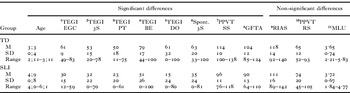
Typical language development for participants in the TD group was determined by performance that was within normal limits on standardized articulation (Goldman Fristoe Test of Articulation, 2nd edition (GFTA-2); Goldman & Fristoe, Reference Goldman and Fristoe2000), receptive vocabulary (Peabody Picture Vocabulary Test, 4th edition (PPVT-4); Dunn & Dunn, Reference Dunn and Dunn2007) and expressive language measures (TEGI; Rice & Wexler, Reference Rice and Wexler2001). The presence of SLI was determined by (1) prior identification of language impairment by a speech-language pathologist and (2) expressive grammatical performance that was below age expectations (Mean Length of Utterance (MLU); Leadholm & Miller, Reference Leadholm and Miller1992; TEGI; Rice & Wexler, Reference Rice and Wexler2001). Unlike the TD group, receptive vocabulary and articulation were allowed to vary among participants in the SLI group because delayed expressive grammatical ability was most pertinent to the research question. Importantly, all children demonstrated accurate production of word final /s/ and /z/, the sounds critical for overt third person singular marking, by passing the phonological probe of the TEGI. Independent samples t-tests revealed that the TD and SLI groups differed significantly on chronological age (t(38)=−9·5, p<0·001), elicited grammar composite of the TEGI (t(38)=7·7, p<0·001), all individual subtests of the TEGI (all ts(38) >3·5, all ps<0·001), PPVT-4 standard score (t(38)=5·4, p<0·001), GFTA-2 standard score (t(38) 3·6, p<0·001), and spontaneous third person singular accuracy from a language sample (t(37)=4·1, p<0·001). The TD and SLI groups did not differ significantly in terms of PPVT-4 raw score (t(38)=−1·7, p=0·103), MLU in words (t(38)=−0·3, p=0·768), or non-verbal cognition (t(38)=1·4, p=0·176). Table 1 shows a summary of these measures for both groups.
The Means (M), Standard Deviations (SD), and Range of ages, tests, and other measures for the typically developing (TD) and Specific Language Impairment (SLI) groups

notes: TEGI=Test of Early Grammatical Impairment. All TEGI scores represent percent correct.
1 TEGI EGC=TEGI Elicited Grammar Composite.
2 TEGI 3S=TEGI Third Person Singular Probe.
3 TEGI PT=Regular and Irregular Past Tense Probe.
4 TEGI BE=Copula and Auxiliary Be probe.
5 TEGI DO=Auxiliary Do probe.
6 Spont. 3S=Percent accuracy third person singular during a spontaneous language sample.
7 PPVT SS=Peabody Picture Vocabulary Test–4th Edition Standard Score (M=100; SD=15).
8 GFTA=Goldman Fristoe Test of Articulation – 2nd Edition Standard Score (M=100, SD=15).
9 RIAS=Reynold's Intellectual Assessment Scale Standard Score (M=100, SD=15).
10 PPVT RS=Peabody Picture Vocabulary Test Raw Score.
11 MLU=Mean Length of Utterance in words based on a 30-minute spontaneous language sample of complete and intelligible utterances.
Stimuli
Stimuli were comprised of thirty real verbs. Verbs were chosen based on the neighborhood density of their uninflected form. Neighborhood density was calculated using an online calculator based on a 5,000-word child corpus, sensitive to word length (Storkel & Hoover, Reference Storkel and Hoover2010). The number of neighbors of each verb was used to establish dichotomous experimental conditions. Given the correlation between neighborhood density and word length, a word length sensitive calculation of neighborhood density was obtained where dense and sparse words were not overlapping within a given word length (Storkel, Reference Storkel2004b). Accordingly, for words that were three phonemes in length, the ‘Dense’ verbs had a mean of nineteen neighbors (Range=14–26) whereas the ‘Sparse’ verbs had a mean of ten neighbors (Range=5–12), these values were statistically independent (t(13)=5·0, p<0·001). For words that were four phonemes in length, ‘Dense’ verbs had a mean of ten neighbors (Range=7–12) and ‘Sparse’ verbs had a mean of four neighbors (Range=1–5); these values were also statistically independent (t(13)=6·5, p<0·001). Additionally, other factors known to affect language processing (i.e. phonotactic probability, word frequency, syllable structure, verb argument structure and final allomorph resulting from the third person singular morpheme) were balanced and did not differ across ‘Dense’ and ‘Sparse’ conditions (all ts<1·6, all ps>0·141).
Following this, sentences five to six words in length were constructed around the target verbs. There were fifteen sentences per condition, each featuring the third person singular finiteness marker. These sentences are shown in ‘Appendix I’. The number of words, morphemes and syllables was equated across sentences of each condition and when possible the same set of agents and objects/locations was held constant across conditions. Verbs, agents, objects and locations were also embedded into the following template audioscript intended to elicit the third person singular structure:
Here is AGENT and this is OBJECT or LOCATION. The AGENT'S job is to INFINITIVE TARGET VERB+OBJECT OR LOCATION. Now you tell me what the AGENT does every day at his/her job. Everyday he/she_____
The resulting thirty sentences and thirty audioscripts were audio-recorded by a native speaker of Standard American English, digitized/edited (i.e. Computerized Speech Laboratory), equated for duration across conditions and independently verified by two listeners for accuracy as the intended stimuli. To complement the audio information, thirty colored illustrations were created. Illustrations depicted a person performing an action on an object (e.g. a woman kicking a ball) or in a location (e.g. a boy hiding behind a tree). ‘Appendix II’ shows sample illustrations used in the spontaneous elicitation task. Using experimental software (Direct RT; Jarvis, Reference Jarvis2006) test sentences, audioscripts and illustrations were prepared for automatic and random presentation by a laptop computer with auditory stimuli delivered through free field speakers at a comfortable listening level.
Experimental tasks
Two experimental tasks were designed to elicit third person singular productions: (1) sentence imitation and (2) spontaneous elicitation. Prior to administration of the tasks, children's familiarity of the verb meanings was verified through at least 80% accuracy on a receptive vocabulary probe that presented a picture of each target verb along with a phonological and semantic foil. All children also passed a brief training cycle where they were taught how to complete each production task. In the first production task, sentence imitation, children were instructed to repeat a sentence exactly as they heard it immediately following an audio presentation. For the second production task, spontaneous elicitation, children were shown a picture and asked to tell the examiner something about the picture after hearing the previously described audioscript intended to elicit the third person singular structure. The training cycles for both tasks included four practice items and all children successfully passed all four items of the training cycles. The experimental test items were not included in the training set items.
Following training, children completed the sentence imitation task in accordance with the standard procedures typically used for this task. Specifically, children heard thirty prerecorded sentences and repeated each sentence immediately after it was presented. For the spontaneous elicitation task the standard audioscript presenting target verbs was played with a simultaneous display of the corresponding illustrations. The order of the experimental tasks was counterbalanced across participants and children completed the tasks on separate testing days.
Experimental task scoring
There were two steps to scoring productions from each task: (1) determining which sentences to include in the analysis and (2) calculating accuracy of those sentences. In terms of the first step, for a response to be scored: (1) a third person singular subject had to be present and (2) the target verb had to be present. If either one of these criteria was not met, the sentence was set aside and excluded from all analyses. In all, 8% of the data from sentence imitation were excluded and 9% from spontaneous elicitation were excluded.
In terms of the second step, accuracy of the resulting sentences was then judged as correct based on the presence of the third person singular subject, production of the target verb, and correct use of the third person singular structure. Given that the audioscript in the spontaneous elicitation task automatically provided participants with the third person singular subject of the sentence, productions excluding the subject, but including the target verb and third person singular morpheme in this task only were still scored as correct. All other productions were scored as incorrect. The computation of accuracy was completed separately for dense versus sparse verbs.
Reliability of scoring was computed for 20% of the data by an independent reliability judge. Inter-judge agreement in scoring for the sentence imitation task was 97% (SD=2%, Range=94–100%) for the SLI group and 92% (SD=2%, Range=90–95%) for the TD group. Inter-judge reliability for the spontaneous elicitation task was 95% (SD=2%, Range=92–97%) for the SLI group and 95% (SD=4%, Range=90–100%) for the TD group. Reliability of spontaneous language transcription was computed for 20% of the data by a second independent reliability judge. Word agreement and grammar coding agreement were both calculated. Inter-judge reliability for word agreement was 90% (SD=4%, Range=85–94%) for the SLI group and 90% (SD=3%, Range=86–94%) for the TD group. Inter-judge reliability for the grammar coding agreement was 89% (SD=2%, Range=87–91%) for the SLI group and 89% (SD=2%, Range=88–91%) for the TD group.
RESULTS
Percent accuracy of third person singular production in both tasks, as the dependent variable, was compared across dense versus sparse verbs, as was performance by the TD versus SLI groups. Levene's Test of Equality for Error Variances for all analyses is reported below. We interpreted the results from Levene's test according to the guidelines of Glass, Peckham and Sanders (Reference Glass, Peckham and Sanders1972) who show that the ANOVA test for groups with equal sample sizes is robust to violations of homogeneity of variance when the variance ratio for the violation in question is smaller than 3·2:1. Our data violated Levene's test in one instance, but the variance ratio in question was smaller than 3·2:1 and thus we determined that the use of parametric statistics throughout was appropriate. Accordingly, data were analyzed using a three-way mixed ANOVA: neighborhood density (2) × task (2) × group (2). Comparisons of interest were the main effect of neighborhood density and the interaction between group and neighborhood density. To interpret significant interactions involving group, the effect of neighborhood density on third person singular accuracy for dense versus sparse words was explored separately for each group.
Omnibus ANOVA
For the three-way mixed ANOVA: neighborhood density (2)×task (2)×group (2), Levene's Test of Equality of Error Variances was significant for third person singular accuracy in sparse verbs in the sentence imitation task (F(1, 38)=4·19, p=0·048 (TD group variance=0·023; SLI variance=0·064; Variance Ratio: 2·8:1)). However, with equal sample sizes for the two groups and a variance ratio less than 3·2:1, this violation was not a concern (Glass et al., Reference Glass, Peckham and Sanders1972). Equal variances were observed for third person singular accuracy on sparse verbs in the spontaneous elicitation task (F(1, 38)=2·08, p=0·157), and for dense verbs in sentence imitation (F(1, 38)=0·19) and spontaneous elicitation (F(1, 38)=1·13, p=0·294). There were significant main effects of neighborhood density (F(1, 38)=27·83, p<0·001, ηp2=0·423) and group (F(1, 38)=11·66, p=0·002, ηp2=0·235). The main effect of task was not significant (F(1, 38)=1·55, p=0·221, ηp2=0·039). Main effects were qualified by significant interactions between neighborhood density and group (F(1, 38)=11·23, p=0·002, ηp2=0·228) and between task and group (F(1, 38)=4·36, p=0·043, ηp2=0·103). Because both interactions involved group, the effect of neighborhood density on third person singular accuracy was examined in each task separately for each group using a follow up two-way mixed ANOVA: neighborhood density (2)×task (2). Figure 1 shows third person singular accuracy by task for both groups with accuracy for dense verbs and sparse verbs represented by striped and solid bars respectively.
Mean third person singular accuracy for dense verbs (striped bars) versus sparse verbs (solid bars) by task (sentence imitation and spontaneous elicitation) for each group (TD and SLI). Error bars indicate standard error of the mean.

Follow-up analysis for TD group
For the TD group, follow-up analyses showed a significant main effect of neighborhood density (F(1, 19)=28·64, p<0·001, ηp2=0·601). Neither the main effect of task (F(1, 19)=0·35, p=0·561, ηp2=0. 018), nor the interaction between neighborhood density and task, were significant (F(1, 19)=0·19, p=0·666, ηp2=0·010). It can be seen in Figure 1 that third person singular accuracy in the TD group was significantly greater for dense verbs than for sparse verbs in both the sentence imitation and spontaneous elicitation tasks. In the sentence imitation task, third person singular accuracy averaged 65% (SD=27%, 95% CI [54%, 77%]) for dense verbs versus 50% (SD=15%, 95% CI [44%, 57%]) for sparse verbs. Likewise, in the spontaneous elicitation task, third person singular accuracy averaged 68% (SD=24%, 95% CI [57%, 78%]) for dense verbs versus 55% (SD=22%, 95% CI [45%, 65%]) for sparse verbs.
Follow-up analysis for SLI group
In the analysis for the SLI group, neither the main effect of neighborhood density (F(1, 19)=2·64, p=0·120, ηp2=0·122), nor the interaction between task and neighborhood density were statistically significant (F(1, 19)=0·01, p=0·939, ηp2=0·000). Only the main effect of task was significant (F(1, 19)=5·64, p=0·028, ηp2=0·229). For the SLI group, it can be seen in Figure 1 that third person singular accuracy was essentially the same for dense and sparse verbs in both tasks. In the sentence imitation task, third person singular accuracy averaged 48% (SD=29%, 95% CI [35%, 60%]) for dense verbs versus 45% (SD=25%, 95% CI [34%, 56%]) for sparse verbs. Likewise, in the spontaneous elicitation task, third person singular accuracy averaged 33% for dense verbs (SD=29%, 95% CI [20%, 45%]) versus 30% (SD=29%, 95% CI [17%, 42%]) for sparse verbs. The main effect of task can also be seen in Figure 1 in that overall accuracy averaged 46% (SD=26%, 95% CI [35%, 58%]) for sentence imitation versus 31% (SD=28%, 95% CI [19%, 44%]) for spontaneous elicitation.
Group difference follow-up analyses
Follow-up analyses were conducted to confirm that the lack of significant neighborhood density effects for the SLI group was not the result of heterogeneous group performance or floor effects in the data. To rule out the first possibility difference scores were computed for all children in the SLI group. Because children in the TD group showed significantly greater third person singular accuracy for dense verbs, difference scores were computed by subtracting third person singular accuracy for sparse verbs from that of dense verbs. Positive difference scores indicated performance that matched the TD group whereas negative difference scores indicated performance that opposed the TD group. A difference score of 0 indicated that children's third person singular accuracy was equivalent for dense and sparse verbs.
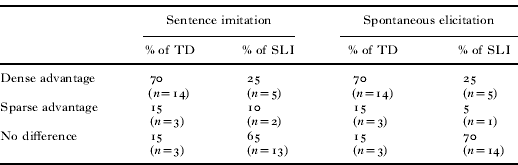
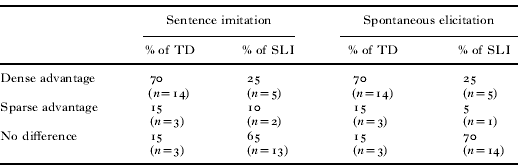
Beginning with performance in sentence imitation, thirteen of twenty children in the SLI group showed a difference between −10% and +10% in third person singular accuracy for dense and sparse verbs (M=0·03, SD=0·14), noting essentially no difference based on neighborhood density. Five children in the SLI group showed positive difference scores between 11% and 40%, indicating a pattern similar to the TD group. The remaining two children in the SLI group showed a negative difference score, indicating better performance for sparse verbs. The pattern was much the same for spontaneous elicitation where fourteen of twenty children showed no difference in third person singular accuracy for dense and sparse verbs (M=0·03, SD=0·10). Five showed positive difference scores patterning similar to the TD group and one showed a negative difference score with better performance for sparse verbs. These findings are even more striking when pitted against the difference scores of the TD group as summarized in Table 2. Notice in Table 2 that the majority of children in the SLI group showed no difference in third person singular accuracy for dense and sparse verbs whereas the majority of children in the TD group showed a dense advantage with higher third person singular accuracy for dense verbs. Very few children in either group showed a sparse advantage. Thus, third person singular production was more accurate with dense verbs for the majority of the TD group whereas the majority of the SLI group did not show differential accuracy for dense or sparse verbs, a point that will be returned to in the ‘Discussion’ section.
Percentage of participants showing each neighborhood density pattern
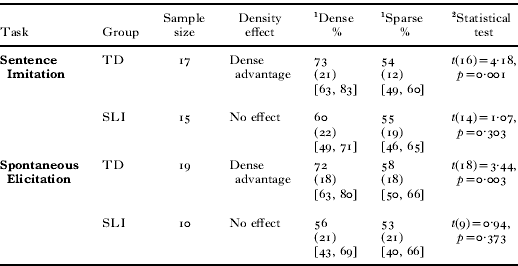
Next, we examined whether floor effects contributed to the lack of neighborhood density effect in the SLI group. To accomplish this, we selected a subset of children in the SLI and TD group that was matched in overall third person singular accuracy because the main effect of group was significant in the main ANOVA showing that children with SLI were generally less accurate in both production tasks. The effect of neighborhood density was first re-examined in the sentence imitation task only for children whose third person singular accuracy on this task was at least 30% in both groups and follow-up group comparisons were planned. This criterion eliminated five children from the SLI group and three children from the TD group. Third person singular accuracy was 64% (SD=15%, 95% CI [56%, 71%]) in the subset of children in the TD group and 57% (SD=19%, 95% CI [48%, 67%]) in the subset of children in the SLI group. Homogeneity of variance for third person singular accuracy was observed (F=2·24, p=0·145), and an independent samples t-test showed that overall third person singular accuracy was statistically equivalent in the TD and SLI groups (t(30)=−1·02, p=0·315). Data from this subset of children were analyzed using a two-way mixed ANOVA: neighborhood density (2)×group (2). Homogeneity of variance was observed for third person singular accuracy with dense (F(1, 30)=0·21, p=0·648) and sparse verbs (F(1, 30)=3·59, p=0·068) in the sentence imitation task. The significant main effect of neighborhood density (F(1, 30)=14·15, p=0·001, η2=0·320) was qualified by a significant interaction between group and neighborhood density (F(1, 30)=5·42, p=0·027, η2=0·153). The group by neighborhood density interaction was explored as planned by comparing third person singular accuracy for dense and sparse verbs separately for each group using paired samples t-tests. Consistent with the main ANOVA, children in the accuracy-matched TD subgroup were significantly more accurate on the third person singular structure with dense verbs than sparse (t(16)=4·18, p=0·001). Also, consistent with the main ANOVA, children in the accuracy-matched SLI subgroup showed no difference in third person singular accuracy on the sentence imitation task for dense and sparse verbs (t(14)=1·07, p=0·303).
Floor effects were addressed in the same way for the spontaneous elicitation task and findings were much the same as they were for sentence imitation. The third person singular accuracy criterion eliminated only one child from the TD group and ten from the SLI group in the spontaneous elicitation task. Third person singular accuracy was 65% (SD=16%, 95% CI [58%, 72%]) in the subset of children in the TD group and 54% (SD=21%, 95% CI [41%, 67%]) in the subset of children in the SLI group. Homogeneity of variance was observed (F=0·26, p=0·614), and an independent samples t-test showed that third person singular accuracy for the groups was statistically equivalent (t(27)=−1·52, p=0·140). Data from this subset of children were analyzed using a two-way mixed ANOVA: neighborhood density (2)×group (2). Homogeneity of variance was observed for third person singular accuracy with dense (F(1, 27)=0·12, p=0·737) and sparse verbs (F(1, 27)=0·01, p=0·934) in the spontaneous elicitation task. Only a significant main effect of neighborhood density was observed (F(1, 27)=7·80, p=0·01, η2=0·224), with greater third person singular accuracy for dense compared to sparse verbs. Although the group by neighborhood density interaction was not significant (F(1, 27)=3·13, p=0·088, η2=0·104), it was explored as planned. Third person singular accuracy for dense and sparse verbs was compared separately for each group using paired samples t-tests. Consistent with the main ANOVA, children in the accuracy matched TD group were significantly more accurate on the third person singular structure with dense rather than sparse verbs (t(18)=3·44, p=0·003) whereas children in the SLI group showed no difference for third person singular accuracy with dense and sparse verbs (t(9)=0·94, p=0·373). Table 3 shows a summary of the analysis for the subset of children who were more closely equated on overall third person singular accuracy.
Follow-up analysis for children with greater than or equal to 30% accuracy on a task

notes: 1 Values represent means, standard deviations in parentheses and 95% confidence intervals in square brackets, respectively, for the raw third person singular accuracy data for each condition in each task.
2 Paired samples t-tests comparing dense and sparse third person singular accuracy on a given task for each group.
In sum, the follow-up analyses indicate that the lack of a neighborhood density effect for the SLI group could not be attributed to heterogeneous neighborhood density effects nor could it be attributed to globally poor performance across the two tasks. Specifically, similar performance by the SLI group for dense and sparse verbs was noted when individual participant data were examined and when children with very low accuracy were eliminated from the analysis.
DISCUSSION
The goal of our research was to extend the OI/EOI account of Wexler and Rice and colleagues by testing whether neighborhood density, indexing the phonological component to a word's lexical representation, interacts with children's immature/emerging knowledge of finiteness to inform the distribution of optional infinitives beyond the contribution of immature/emerging grammar as the primary explanation. Two levels of predictions were tested: (1) a density/OI interface level between finiteness and word form variables of the verb and (2) a group-based level comparing typical development to SLI. To interpret our findings we first discuss the density/OI interface level and its implications for the OI/EOI account for English. Following, we discuss the group-based comparisons and implications for further characterizing language delays in SLI. We conclude by recommending future studies necessary to advance this new line of research for children in the OI/EOI stages.
Density/OI interface prediction
Our results showed that neighborhood density was relevant in part to explaining the distribution of optional infinitives. Specifically, in both tasks, TD three-year-olds used third person singular more accurately with dense than sparse verbs. From the optional infinitive perspective, this result could be restated as TD three-year-olds used significantly fewer optional infinitives with dense versus sparse verbs. Our expectation that third person singular optional infinitives in sentences with dense verbs would be less frequent was motivated by evidence highlighting a special facilitory status in lexical acquisition for dense verbs. We focused on the nature and quality of lexical representations for the base form of verbs, indexed by neighborhood density, and how the nature of the representation of the base form in turn was relevant to finiteness marking. The particular import of this finding is that it melds the research in optional infinitives for inflectional morphemes with that of neighborhood density, sending both lines of inquiry in new directions. Our results imply that optional infinitives for inflectional morphemes and neighborhood density may work in tandem in contexts where finiteness is overtly marked on a lexical verb (e.g. third person singular context versus non lexical BE verb context).
Why would neighborhood density emerge as influential, and more specifically why would children be less likely to use third person singular optional infinitives in sentences when the base form of the verb was dense? The basic notion underlying the nature of lexical representations for dense and sparse verbs is that similarity with many other words in the developing lexicon induces pressure to refine the phonological information tied to the representation in a finer-grained manner compared to words that are similar to only a few other words in the lexicon (e.g. Walley et al., Reference Walley, Metsala and Garlock2003). Our hypothesis is that the process of refining the phonological information tied to the lexical representation would be similar for all words in the lexicon, regardless of syntactic class (e.g. noun versus verb) and that it would occur for the uninflected base form of words (e.g. kick as opposed to kicks). This idea is in line with theories of the lexicon hypothesizing that children store one form of a word, in particular the base form, and that when children produce inflected forms it is the result of projecting the relevant grammatical features (e.g. Pinker, Reference Pinker1984). The notion that dense words undergo phonological refining sooner than sparse, thereby resulting in more robust representations earlier, has been experimentally validated with preschool children. In particular, preschool children make similarity judgments of dense words that are based on finer-grained segmentation principles (Storkel, Reference Storkel2002). Likewise, children are more adept at manipulating dense words during phonological awareness tasks (De Cara & Goswami, Reference De Cara and Goswami2003; Hogan, Reference Hogan2010). These combined studies highlight the facilitory nature of dense words in various linguistic abilities. The results of our study now show that finiteness marking on lexical verbs in the third person singular context is also differentially influenced by the facilitory nature of the base form of dense verbs.
In line with Wexler's OI account for finiteness, we regarded optional infinitives to reflect instances where the child failed to project the relevant grammatical features for finiteness. Recall that all children in this study passed a receptive vocabulary probe testing receptive knowledge of the words' meanings. Thus, considering the fundamental role of the verb stem in finiteness marking, it is not surprising that when children have equal access to word meanings a priori differences in underlying lexical representations stored for the base form of the verb would show a rippling effect into finiteness marking similar to the rippling effects that are observed for phonological awareness. The resulting options for the child are (1) using a verb with a known meaning where the phonological information tied to the lexical representation of the base form is rudimentary or (2) using a verb with a known meaning where the phonological information tied to the lexical representation of the base form is robust. We thus propose that in the immature finiteness system, for words that have known meanings, the phonological information of the word form tied to dense verbs could provide a faster path to finiteness marking while sparse verbs would be more likely to slow the system and prevent it from operating correctly (i.e. projecting the relevant grammatical features necessary for producing the inflectional morpheme). This was our observation for the TD group.
The results from the TD group raise two new implications for typical language development. First, these results show that word form variables, like neighborhood density, can explain some of the variability captured by the OI stage for inflectional finiteness markers bound to lexical verbs. This finding is particularly interesting because optional infinitives are observed to decline with maturation regardless of child-centered variables like parent education and non-verbal intelligence (e.g. Rice, Reference Rice, Colombo, McCardle and Freund2009a; Rice, Redmond & Hoffman, Reference Rice, Redmond and Hoffman2006; Wexler, Reference Wexler, Levy and Schaeffer2003). Importantly, this study showed that word form variables that reflect some of the phonological information tied to the lexical representation of the word's base form informs some of the distribution of optional infinitives in TD English-speaking children. The full extent to which word form variables inform the distribution of optional infinitives is a matter requiring future inquiry. In fact, we propose that additional linguistic factors that have yet to be identified as influential to the OI stage are also likely to be informative of the distribution of optional infinitives as opposed to a single explanatory factor. Additional factors that could work for or against the effects of neighborhood density and further interact with a child's familiarity of a word meaning will need to be tested. These results also inform the growing literature on neighborhood density effects in language development. Until now, no study has bridged neighborhood density with grammatical morphology or syntax. The fact that neighborhood density explained some of the variation in patterning of optional infinitives for inflectional morphemes gives rise to new lines of research that could clarify variation in children's rate of omission characteristic of the OI/EOI stage, as it pertains to lexical affixation.
Group comparison prediction
The second level of prediction in this study appealed to the idea of identifying group differences between typical development and SLI. Children in the TD and SLI groups were selected for this study because they both used optional infinitives. The presence of optional infinitives in both groups essentially equated their presumed knowledge of finiteness, in spite of age differences. Recall that, according to Wexler's maturational account for finiteness, interchanging optional infinitives with bare verb stems is evidence that the developmental timing associated with finiteness has begun. Despite variability in their correct use of finiteness markers, the TD group was on the expected trajectory to mastering finiteness whereas the SLI group showed knowledge of finiteness compatible with children nearly two years below their chronological age. In other words, children with SLI seem to be ‘stuck’ in the phase where optional infinitives are acceptable in the grammar. The presence of language impairment thus created a fundamental source for potential differences between the two groups. Consistent with the results of two recent studies evaluating the effect of phonotactics on regular past tense optional infinitives, the prediction that the pattern of effects for typical development and SLI would diverge in this study was supported (Leonard et al., Reference Leonard, Davis and Deevy2007a; Marshall & van der Lely, Reference Marshall and van der Lely2006). Specifically, the SLI group was equally likely to use third person singular optional infinitives with dense and sparse verbs in contrast to the observation that children in the TD group were less likely to use optional infinitives with dense verbs.
While the group-level difference in this study is consistent with Marshall and van der Lely (Reference Marshall and van der Lely2006) and Leonard et al. (Reference Leonard, Davis and Deevy2007a), the actual pattern of effects is at odds with these prior studies. Recall that children with SLI in these prior studies used fewer optional infinitives when faced with common sound sequences as opposed to rare (i.e. phonotactics), but children with SLI in this study failed to differentially use optional infinitives with dense and sparse verbs (i.e. neighborhood density). One possibility for this difference is that children with SLI were not sensitive enough to the effect of neighborhood density such that children would be more likely to project the grammatical features of finiteness in sentences with dense verbs. In the current study, the mere presence of language delay could explain the group difference, potentially indicating that dense and sparse verbs do not show the same division of representation in the lexicon as they do for typical development. This hypothesis seems unlikely for at least two reasons. The first is that despite the extended nature and significantly lower rate of growth out of an OI stage for SLI, the overall growth trajectory for finiteness parallels that of younger typically developing children (Rice et al., Reference Rice, Wexler and Hershberger1998). In other words, patterns of finiteness marking in SLI generally do not deviate from typical development, rather the timescale of growth is out of sync compared with typically developing children at a similar MLU level (Rice, Reference Rice, Rice and Warren2004; Reference Rice and Gathercole2009b). A second reason is that the only other known studies comparing neighborhood density effects across groups showed converging neighborhood density effects for word recognition and word definition (Mainela-Arnold, Evans & Coady, Reference Mainela-Arnold, Evans and Coady2008; Reference Mainela-Arnold, Evans and Coady2010). Taken together, it is somewhat surprising that the SLI and TD groups in this study did not show a converging pattern of neighborhood density effects.
Two major methodological differences between the current study and the studies by Marshall and van der Lely (Reference Marshall and van der Lely2006) and Leonard et al. (Reference Leonard, Davis and Deevy2007a) are the more likely source of these differences. The most notable difference is that Marshall and van der Lely (Reference Marshall and van der Lely2006) and Leonard et al. (Reference Leonard, Davis and Deevy2007a) evaluated the role of phonotactics as the word form variable informing the distribution of optional infinitives. Despite a natural correlation in the language between phonotactics and neighborhood density, the two variables are hypothesized to index different components of a word's representation. Specifically, phonotactics is most often highlighted as indexing the representation of individual sounds and sound sequences in words, while neighborhood density is thought to index the phonological quality of the lexical representation as an integrated whole word form. Additionally, phonotactics and neighborhood density differentially affect early and later word learning stages in adults, which could be a critical differentiation in how these two word form variables pattern with optional infinitives (Storkel, Armbruster & Hogan, Reference Storkel, Armbruster and Hogan2006). Moreover, preschool children show a complex pattern of interactions between neighborhood density and phonotactic probability that is likely to play out with optional infinitives if both variables are manipulated (Hoover, Storkel & Hogan, Reference Hoover, Storkel and Hogan2010). In this study, for reasons of logic and design, the dense and sparse verbs were equated for phonotactic probability, thereby ruling out a direct comparison. Future studies are needed to fully discern the individual and combined contributions of these two word form variables in addition to other potentially informative characteristics of the verb.
A second noteworthy methodological difference is the amount of exposure to verb items used to test neighborhood density effects in the current study. The sentence imitation task provided a single exposure to each dense and sparse inflected form of the verb, and the spontaneous elicitation task provided only a single exposure to each dense and sparse uninflected verb. This brief exposure is in contrast to Marshall and van der Lely (Reference Marshall and van der Lely2006) and Leonard et al. (Reference Leonard, Davis and Deevy2007a). Children in Marshall and van der Lely (Reference Marshall and van der Lely2006) heard a direct contrast between the regular past tense form of the verb and the bare stem form of the verb immediately before they were asked to inflect it using the past tense morpheme. Similarly, Leonard et al. (Reference Leonard, Davis and Deevy2007a) provided three exposures to bare verb stems per item immediately before asking children to use the past tense inflected form of the verb. Based on this observation it is possible that our study gave children with SLI too few exposures to the base form of the lexical items to effectively trigger robust neighborhood density effects that would mirror those of the TD group, especially given the particularly fragile nature of finiteness knowledge for SLI. Making the distinction explicit between a verb in the infinitival context and the finite context immediately prior to the child's production opportunity, as Marshall and van der Lely provided, could have also benefited the SLI group. Taken together, our production tasks appeared to be insufficient in tapping a neighborhood density effect for the SLI group. Other work shows that children with SLI tend to exhibit a slower speed of processing compared to typically developing peers that might further impact their language abilities (e.g. Leonard, Ellis Weismer, Miller, Francis, Tomblin & Kail, Reference Leonard, Ellis Weismer, Miller, Francis, Tomblin and Kail2007b). For example, during a novel word learning task, children with SLI required several additional exposures to linguistic forms to mirror the performance of their typically developing peers (Rice, Oetting, Marquis, Bode & Pae, Reference Rice, Oetting, Marquis, Bode and Pae1994). Additionally, recent evidence from preschool children with SLI showed that optional infinitives were decreased differentially for dense/sparse verbs but only when massed exposure to the inflected form and the bare verb stems was provided over a six-week period (Hoover, Reference Hoover2009). Thus, the brief exposure to dense and sparse verbs in this study may have been insufficient to activate lexical representations that would in turn be necessary for the SLI group to garner the benefits of dense neighborhoods. Coupled with the especially fragile representation of finiteness for children with SLI, the lack of neighborhood density effect in this study now emerges as less surprising for this age range. As a result, the precise nature of neighborhood density effects in SLI might be best reconciled through paradigms varying the rate of exposure to inflected forms and bare verb stems. Designs such as this might have the further potential to identify the point at which neighborhood density effects in SLI become apparent and parallel those of typically developing children.
CONCLUSION
This study provided one way to investigate optional infinitives by children in the OI/EOI stage by examining a possible role for verb neighborhood density in lexical affixation. The TD children in this study were significantly less likely to use optional infinitives with dense verbs in the third person singular context. These results show that the facilitory status of dense verbs in lexical acquisition has a rippling effect into other emerging linguistic abilities, namely lexical affixation for finiteness marking for children in the OI stage. Despite the presumably similar knowledge status of finiteness marking (i.e. emerging), indexed by optional infinitives, in the two groups here, the groups did not converge in neighborhood density effects. For the SLI group, neighborhood density did not differentially influence children's likelihood to produce an optional infinitive, in the face of additional evidence showing neighborhood density effects in other paradigms for children with SLI (Hoover, Reference Hoover2009; Mainela-Arnold et al., Reference Mainela-Arnold, Evans and Coady2008; Reference Mainela-Arnold, Evans and Coady2010). The presence of group differences observed here warrants future studies designed to examine the precise patterning of neighborhood density effects by children with SLI. Studies of this nature will provide more complete comparisons of the variability in finiteness marking observed for children in the OI and EOI stages.
Importantly, this study considered just one of the English finiteness markers, third person singular. Recall that the third person singular finiteness marker clusters with other finiteness morphemes that have different lexical and phonological properties in the OI/EOI period. These lexical and phonological properties, along with other syntactic properties that distinguish the use of finiteness forms from one another (e.g. overt movement for non-lexical BE in questions vs. covert movement for third persons singular), will need to be evaluated in terms of neighborhood density effects. Thus, this initial study shows how careful consideration of neighborhood density of lexical verb stems for finiteness marking through third person singular affixes can illuminate some of the interactions involved in the inflectional morpheme omissions characteristic of the OI/EOI stage in English. Future studies will be needed to consider whether there are similar interactions with the remaining English finiteness markers. It will also be important to continue considering whether other factors might similarly inform the distribution of optional infinitives and how such factors might relate to the neighborhood density effects observed here. These studies will not only be needed for English, but for other languages where the OI stage is at work during development. Continuing this line of research will be needed to address not only the way these interactions can play a role in typical acquisition, but also whether they have a possible facilitative role in treatment for young children with SLI.
APPENDIX I: SENTENCE STIMULI

APPENDIX II: SAMPLE ILLUSTRATIONS FOR SPONTANEOUS ELICITATION TASK