Introduction
Multivariate analyses of epidemiological samples studied both cross-sectionally (Krueger, Reference Krueger1999; Krueger et al. Reference Krueger, McGue and Iacono2001) and longitudinally (Krueger et al. Reference Krueger, Caspi, Moffitt and Silva1998) suggest that the distribution of common psychiatric and drug abuse disorders, and the observed patterns of co-morbidity, can be largely explained as resulting from two broad psychopathologic dimensions typically called ‘internalizing’ and ‘externalizing’. Population-based twin studies in Virginia and Norway have verified the existence of these dimensions and found that they result largely from the operation of genetic factors (Kendler et al. Reference Kendler, Prescott, Myers and Neale2003, Reference Kendler, Aggen, Knudsen, Roysamb, Neale and Reichborn-Kjennerud2011). A range of prior studies have attempted to define the boundaries of these spectra from a phenotypic perspective (e.g. Krueger et al. Reference Krueger, Markon, Patrick, Benning and Kramer2007; Venables & Patrick, Reference Venables and Patrick2012). One large-scale twin study reported a multivariate genetic analysis of the relationship between internalizing disorders and the personality trait of neuroticism (Hettema et al. Reference Hettema, Neale, Myers, Prescott and Kendler2006). However, we are unaware of a previous focused effort to define which disorders and traits are central versus more peripheral to genetically defined internalizing and externalizing spectra. This is an important question because it addresses how, for genetic, epidemiological or clinical studies, we might be best able to assess in patients or subjects their overall genetic propensity to internalizing or externalizing psychopathology.
In this study, to address this question, we examined whether the pattern of loadings of disorders and traits on these spectra differ across the two sexes, which we know differ substantially in the overall prevalence of internalizing versus externalizing disorders (Wender, Reference Wender1971; Kessler et al. Reference Kessler, McGonagle, Zhao, Nelson, Hughes, Eshleman, Wittchen and Kendler1994, Reference Kessler, Berglund, Demler, Jin, Merikangas and Walters2005). After optimally assessing a core set of disorders or traits for each spectrum, we then examined the correlation between their genetic liabilities.
Method
Sample
Participants derived from two inter-related studies of Caucasian same-sex twin pairs from the Virginia Adult Twin Study of Psychiatric and Substance. Use Disorders (VATSPSUD; Kendler & Prescott, Reference Kendler and Prescott2006). Subjects were ascertined from the population-based Virginia Twin Registry formed from a review of all birth certificates in the Commonwealth of Virginia. Female–female (FF) twin pairs, born 1934–1974, were eligible if both members responded to a mailed questionnaire in 1987–1988. Nearly all the variables used in these analyses were collected at the fourth interview wave (FF4), conducted in 1995–1997, with cooperation in earlier waves ranging from 88% to 92% (Kendler & Prescott, Reference Kendler and Prescott2006). For this wave, we succeeded in interviewing 85% of eligible twins.
Data on the male–male pairs (MM) came from a sample (birth years 1940–1974) initially ascertained, with a 72% cooperation rate, directly from registry records. The first interview (MM1) was completed largely by telephone in 1993–1996 and was followed by a second wave of interviews (MM2), conducted in 1994–1998, with a response rate of 83%. The third wave (MM3) was completed from 1998 to 2004 in 77.8% of the eligible sample. Zygosity was determined by discriminate function analyses using standard twin questions validated against DNA genotyping in 496 pairs (Kendler & Prescott, Reference Kendler and Prescott1999). The mean (s.d.) age and years of education of the twins were 36.3 (8.2) and 14.3 (2.2) at the FF4 interview, and 37.0 (9.1) and 13.6 (2.6) at the MMMF2 interview.
Measures and sample sizes
Unless noted otherwise, the lifetime prevalence of psychiatric and substance use disorders was assessed at personal interview by trained mental health professionals, who were blind to the status of the co-twin, using modifications of the SCID and DSM-IV criteria (APA, 1994; Spitzer & Williams, Reference Spitzer and Williams1985). The names and abbreviations used for all the disorders and traits examined in this paper are given in Tables 1 and 2.
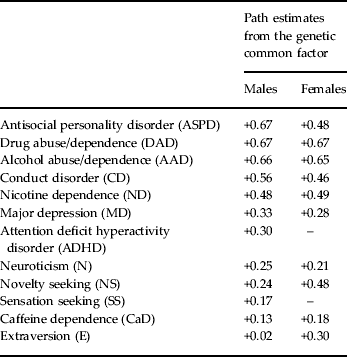
Loadings on externalizing disorders and traits from the genetic common factor in males and females from the AE independent pathway model

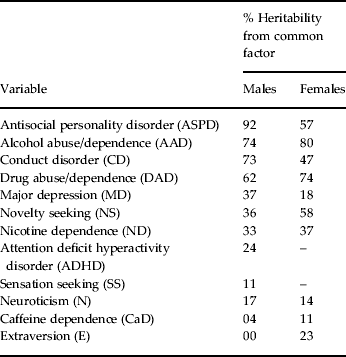
The proportion of heritability of the individual putative externalizing disorders and traits that is shared with the genetic common factor in the AE independent pathway model

MM twins
Lifetime major depression (MD) and self-esteem (SE) were obtained from the first wave data (n = 3483). The following disorders were assessed at the second wave interview (n ∼ 2900): alcohol abuse or dependence (AAD), drug abuse or dependence (DAD), nicotine dependence (ND), panic disorder (PD), generalized anxiety disorder (GAD); and five types of phobias: agoraphobia (AgP), social (SoP), situational (SiP), animal (AnP), and blood-injury (BiP). Both AAD and DAD were modeled as trichotomous variables: no disorder, abuse only, dependence (with or without abuse). ND was assessed by the Fagerström Test for Nicotine Dependence (Heatherton et al. Reference Heatherton, Kozlowski, Frecker and Fagerström1991) for the lifetime period of heaviest smoking. We trichotomized the scores: 0–3, 4–6 and ⩾7. Lifetime non-smokers were assumed to have a zero score. Phobias were assessed by modified DSM-III criteria (APA, 1980). For GAD we required a minimum duration of 1 month. Conduct disorder (CD), antisocial personality disorder (ASPD), neuroticism (N), extraversion (E) and novelty seeking (NS) were assessed by a self-report questionnaire associated with the MM2 study (n ∼ 2740). SE was measured by the Rosenberg scale (Rosenberg, Reference Rosenberg1965), N and E by the Eysenck Personality Questionnaire short-form (Eysenck et al. Reference Eysenck, Eysenck and Barrett1985), and NS by a shortened version of the Tridimensional Personality Questionnaire (TPQ) NS scale (Cloninger et al. Reference Cloninger, Przybeck and Svrakic1991). N was developed by Eysenck to reflect an individual's propensity to negative affect or emotionality. Typical items were ‘Are you the type of person (i) whose mood often goes up and down, (ii) whose feeling are easily hurt, and (iii) who is tense or highly strung?’ E was developed by Eysenck to reflect an individual's sociability and the pleasure obtained from interpersonal interactions. Typical items were ‘Are you the type of person (i) who is rather lively, (ii) who likes mixing with people, and (iii) who can get a party going?’ NS was developed by Cloninger to assess impulsiveness and the desire for high levels of stimulation. Two representative items were: ‘Are you the type of person (i) who often tries new things for the fun or thrills, even if most people think it is a waste of time, and (ii) who, when nothing new is happening, usually starts looking for something that is thrilling or exciting?’ Our ASPD measure assessed only adult antisocial traits.
Attention deficit hyperactivity disorder (ADHD), caffeine dependence (CaD) and sensation seeking (SS) were assessed only at the MM3 interview (n ∼ 1750). As outlined elsewhere (Edwards & Kendler, Reference Edwards and Kendler2012), ADHD was assessed retrospectively by 11 items that reflected DSM-IV criteria reported up to age 18 with the scores broken down into four approximately equal categories. As described previously (Kendler et al. Reference Kendler, Jacobson, Myers and Eaves2008), CD was assessed by 11 items from the Semi-Structured Assessment for the Genetics of Alcoholism (SSAGA) interview using a four-point scale (Bucholz et al. Reference Bucholz, Cadoret, Cloninger, Dinwiddie, Hesselbrock, Nurnberger, Reich, Schmidt and Schuckit1994) operationalizing DSM-III-R criteria, excluding the highly deviant A criteria 9 (forcing someone into sexual activity) and 13 (physically cruel to people). We used a criteria count for CD divided into four roughly equal groups. Caffeine dependence was defined using symptoms of caffeine tolerance from the SCID and caffeine withdrawal as defined by DSM-IV (Kendler et al. Reference Kendler, Myers and Prescott2007). SS was assessed by a shortened version of the Zuckerman scale, which, similar to the NS scale, attempts to assess an individual's propensity to seek out novel and exciting experiences (Zuckerman, Reference Zuckerman1994). Three representative items were (i) ‘I like wild uninhibited parties’, (ii) ‘I sometimes like to do “crazy” things just for fun’, and (iii) ‘I like doing things just for the thrill of it’.
FF twins
All of the variables chosen for analysis were obtained from the FF4 interview (n = 1900), with the exception of CD, ASPD and NS, which were assessed in the self-report questionnaire associated with the FF4 (n ∼ 1470); SE, which was assessed at the third wave interview (n = 1887); and panic disorder, which was assessed at the second wave interview (n = 1994). We had no measures of ADHD or SS in the FF twin pairs.
Statistical methods
The aim of these analyses was to apply, using structural equations, a model containing a single genetic common factor to putative externalizing and internalizing disorders, and traits in MM and FF twin pairs, to determine their relative loadings on the common factor. To improve our power, many of the diagnostic categories were treated as polychotomous rather than dichotomous, which allowed us to use information about subthreshold levels of symptoms. To ensure that this was a plausible model, we first tested the fit of an independent pathway model containing a single genetic and a single unique environmental common factor, in addition to genetic and unique environmental variable-specific loadings, against a model that contained only a single shared and a single unique environmental common factor (and shared and unique environmental variable-specific loadings). Analyses were performed in the Mx software package using full information maximum likelihood (Neale et al. Reference Neale, Boker, Xie and Maes2003). The fit of the models was assessed by Akaike's information criterion (AIC; Akaike, Reference Akaike1987), which performs well for models of intermediate complexity as used in this report (Williams & Holahan, Reference Williams and Holahan1994).
We then compared the fit of a model that constrained all parameters to equality across the sexes versus allowed them to differ. If the latter model fitted better, this meant that globally, across all the disorders and traits, males and females differed in the patterns of loadings on the internalizing and externalizing factors.
For computational reasons, we were limited to fitting nine variables at a time in our structural models. We therefore chose, for both the externalizing and internalizing spectra, nine a priori variables that reflected a broad range of potentially relevant disorders and traits. Once this first model was fitted, we then picked one variable with a relatively weak loading on the common factor and substituted for that variable, one at a time, other additional variables until we had exhausted the set of variables we wanted to examine. In this way, we were able to obtain results that should closely resemble those that we would find if we could fit simultaneously a single model encompassing all the variables of interest. Finally, we chose four high-loading variables on the genetic common factor for the internalizing and externalizing spectra, and fit a model examining the genetic and individual-specific environmental correlations between them.
Results
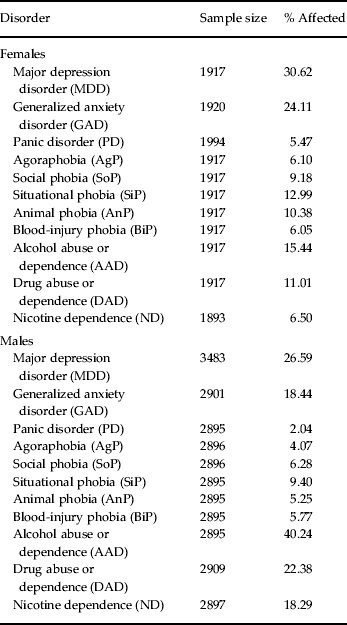
The lifetime prevalence rates for the major psychiatric and substance use disorders examined in this report are shown, separately for males and females, in Table 3. As expected, internalizing disorders are consistently more common in the female than in the male twins. The opposite pattern is seen for externalizing disorders.
The prevalence rates of the major internalizing and externalizing disorders used in these analyses in males and females

Externalizing spectrum
We examined the fit of an independent pathway model with additive genetic effects and individual specific environment (hereafter AE) (with the seven a priori externalizing disorders and traits assessed in both males and females: ASPD, AAD, DAD, CD, ND, NS and E). The fit of an AE model with separate parameters in males and females (AIC = –209.0) was substantially better than that of a model with shared and individual specific environment (hereafter CE) (AIC = −14.3) or an AE model that forced the parameters to be the same in males and females (AIC = −188.2). Therefore, in the following analyses, we examined AE models separately in MM and FF pairs. In subsequent versions of this model, we substituted the traits N, MD and CaD for E.
Table 1 shows the magnitude of the loading of these eight disorders and four personality traits for males on the genetic common externalizing factor. The three disorders of ASPD, DAD and AAD had nearly identical and high loadings (around +0.67), followed by CD (+0.56), ND (+0.48), MD (+0.33) and ADHD (+0.30). CaD had the lowest loading of any disorder (+0.13). The personality trait with the highest loading on the genetic common externalizing factor was N (+0.25), followed closely by NS (+0.24) and SS (+0.17). E was essentially uncorrelated with the externalizing genetic common factor.
An alternative way to characterize the degree to which individual disorders or traits reflect the genetic common factor is to calculate the percentage of their heritability shared with the common factor. These results are shown in Table 2. Using this measure, ASPD is the disorder most strongly related to the externalizing factor in males followed by AAD, CD and DAD. MD, ND and ADHD are distinctly lower on this index, and CaD is near zero. Of the personality traits, the highest value is obtained by NS, followed by N and SS. E scores a zero.
The estimated loadings of seven disorders and three personality traits on the genetic common externalizing factor in females are shown in Table 1. The two disorders of DAD and AAD had nearly identical and high loadings (around +0.66), followed by ND (+0.49), ASPD (+0.48) and CD (+0.46). CaD had the lowest loading of any disorder examined (+0.18). The personality trait with the highest loading on the genetic common externalizing factor was NS (+0.48), followed by E (+0.30) and N (+0.21).
We also examined, in Table 2, the proportion of the heritability of these disorders or traits that is shared, in women, with the externalizing genetic common factor. Using this measure, AAD is the best index of the genetic common factor in females, followed by DAD, NS and ASPD.
Internalizing spectrum
We examined the fit of an AE independent pathway model with nine a priori internalizing disorders and traits assessed in both males and females (MD, GAD, PD, AgP, SoP, SiP, AnP, N and E). The fit of an AE model assuming separate parameters in males and females (AIC = −41317.2) was substantially better than that of a CE model (AIC = −41240.6), and also better than that of an AE model that forces all the parameters to be the same in males and females (AIC = −41314.1).
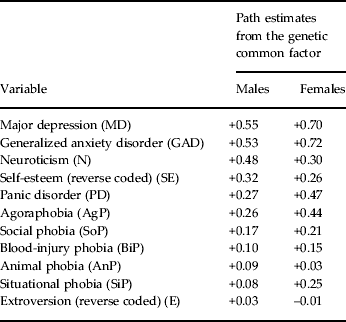
We therefore proceeded to examine the AE model separately in MM and FF pairs. To obtain parameter estimates from our two remaining internalizing variables (BiP and SE), we substituted these variables in two separate AE models for E. The parameter estimates of the AE model for all 11 variables in males are given in Table 4. The three variables MD, GAD and N stood out as having loadings in excess of +0.45 on the genetic common factor. Three further variables had more moderate loadings (0.25–0.35): SE, AgP and PD. All the other variables had fairly modest loadings on the genetic common factor (i.e. < +0.20).
Loadings on internalizing disorders and traits from the genetic common factor in males and females from the AE independent pathway model
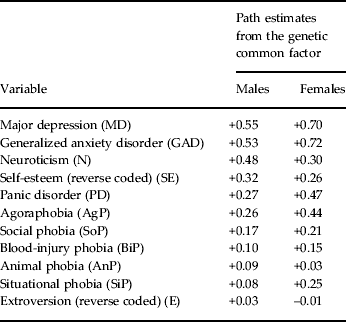
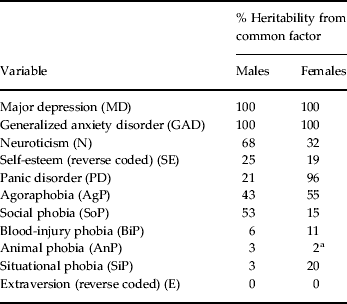
Table 5 shows the proportion of genetic risk for each trait or disorder that results from the genetic common factor in males. By this measure, MD and GAD were the best indices of the genetic common factor for the internalizing spectrum, with all of their genetic variance shared with the common factor. Only two other traits in males shared more than half of their genetic variance with the common internalizing factor: SoP and N.
The proportion of heritability of the individual putative internalizing disorders and traits that is shared with the genetic common factor in the AE independent pathway model

a Very low total heritability. Results somewhat suspect.
As shown in Table 5, for females, the two disorders of MD and GAD stood out as having by far the highest loading on the genetic common factor of around +0.70. Two other disorders had moderate loadings of around +0.45: PD and AgP. N and reverse coded SE had loadings of +0.25 to +0.30. In females, three disorders stand out with an especially high proportion (>90%) of their genetic risk deriving from the genetic common factor: MD, GAD and PD (Table 5). Two other disorders/traits share more than 30% of their genetic variance with the internalizing common factor in females: N and AgP.
Correlation between the internalizing and externalizing spectra
We indexed the externalizing spectrum in males by ASPD, DAD, AAD and CD, and the internalizing spectrum by MD, GAD, N and PD. Fitting an AE model to both spectra, the genetic and environmental correlations between the common factors of these spectra were estimated at +0.53 and +0.30 respectively. In females, we indexed the externalizing spectrum by of DAD, AAD, ND and ASPD, and the internalizing spectrum by MD, GAD, PD and AgP. The genetic and environmental correlations between the common factors of these spectra were estimated at +0.52 and +0.48 respectively.
Discussion
These analyses, conducted in a large general population twin sample, had three major aims. The first was to determine whether the broad structure of the disorders and the traits that index the genetic common factors underlying the externalizing and internalizing spectra were the same in males and females. The second aim was to characterize in detail the pattern of disorders and traits, and their loadings on these two genetic common factors. The third was to determine, once we knew how to index them, the correlation between the genetic common factors for the externalizing and the internalizing spectra. We review these results in turn.
For both the externalizing and internalizing spectra, we could not constrain the parameters of our multivariate twin model to equality across the sexes. In addition to the reliably observed large prevalence differences in the sexes for these two broad classes of condition (internalizing disorders are consistently more common in females than males and the reverse for externalizing disorders) (Wender, Reference Wender1971; Kessler et al. Reference Kessler, McGonagle, Zhao, Nelson, Hughes, Eshleman, Wittchen and Kendler1994, Reference Kessler, Berglund, Demler, Jin, Merikangas and Walters2005), the nature of the disorders and traits that optimally index the genetic and environmental liabilities to these spectra also differ in the sexes. These results are at odds with prior analyses of internalizing and externalizing disorder in our twins, where we found that the same parameters could be applied to both sexes (Kendler et al. Reference Kendler, Prescott, Myers and Neale2003). However, that study examined only seven disorders across both spectra and so had much less power to detect sex differences than the present investigation.
Several interesting results emerged from our efforts to characterize the disorders and personality traits that best reflected these two genetic spectra. First, contrary to expectations, psychiatric and drug use disorders consistently outperformed personality traits as indices for these genetic common factors. The two best-performing personality traits were N for the internalizing spectra (which had the third highest loading in males and the fifth in females) and NS for the externalizing spectra (which had the fourth highest loading in females but the ninth in males, behind N). If we consider instead the percentage of heritability shared with the genetic common factors, the results are similar.
Despite the presence in our analyses of personality traits widely seen as good indices of the internalizing and externalizing dimensions of psychopathology, the hypothesis that these spectra might be best captured at the level of personality or temperament was not supported empirically (Krueger & Tackett, Reference Krueger and Tackett2003; Clark, Reference Clark2005). This is unfortunate because such scales are more informative about the broad range of vulnerability than a dichotomous diagnosis, and easier and cheaper to measure. For the externalizing dimension, these results might have differed if we had had other personality measures that more directly assessed disinhibition/impulsivity or meanness/callousness (Patrick et al. Reference Patrick, Fowles and Krueger2009). Our results are also consistent with a prior multivariate twin analysis in the sample showing that a substantial proportion of the genetic variation for internalizing disorders was not captured by N (Hettema et al. Reference Hettema, Neale, Myers, Prescott and Kendler2006).
Second, interesting sex differences emerged in the externalizing spectra. ASPD and CD more poorly indexed the genetic externalizing dimension in females than in males. Whereas ASPD was the ‘anchoring’ phenotype for the genetic common factor for the externalizing spectrum in men, in women it was AAD and DAD. These results provide empirical support for the claim that the criteria for these disorders are ‘male-centric’ and do not optimally assess female externalizing behaviors (Hartung & Widiger, Reference Hartung and Widiger1998; Ohan & Johnston, Reference Ohan and Johnston2005).
Third, the degree to which the abuse/dependence of individual psychoactive substances indexed the externalizing genetic common factor differed dramatically across substances (Kendler et al. Reference Kendler, Myers and Prescott2007). In both males and females, DAD and AAD strongly, and ND moderately, reflected this genetic common factor. By contrast, in both sexes, CaD poorly indexed the genetic risk to the externalizing spectrum. It is intriguing to ponder the degree to which this difference arises from innate pharmacological features of the drugs themselves versus how they are viewed and controlled by our society (Courtwright, Reference Courtwright2001).
Fourth, less pronounced sex differences were seen in the internalizing spectrum than in the externalizing spectrum. In both men and women, the internalizing genetic common factor was best tapped by a lifetime history of MD and GAD. The largest sex difference was for PD, which was a much better index of the genetic risk for the internalizing dimension in women than in men. In addition, surprisingly, N was a better index of the genetic common factor for the internalizing spectra in males.
Fifth, of the five phobias we examined, only AgP loaded substantially on the internalizing genetic common factor. Consistent with prior studies that suggest that the internalizing spectrum may contain a second partially independent ‘fear-based’ factor (Krueger, Reference Krueger1999; Vollebergh et al. Reference Vollebergh, Iedema, Bijl, de Graaf, Smit and Ormel2001), we found that SoP, SiP, BiP and AnP made only very modest contributions to the overall internalizing genetic common factor. However, our results for PD, at least in females, were not fully consistent with this hypothesis.
Turning to the third aim of this study, we found very similar and substantial genetic correlations between the externalizing and internalizing genetic common factors in men and women. These correlations were higher than observed between the Axis I and Axis II internalizing and externalizing genetic factors identified in a recent multivariate analysis of a Norwegian cohort (Kendler et al. Reference Kendler, Aggen, Knudsen, Roysamb, Neale and Reichborn-Kjennerud2011) (estimated at +0.16 and +0.36 respectively). However, the correlations we observed were broadly consistent with phenotypic correlations between internalizing and externalizing common factors observed in the USA (+0.51) (Krueger, Reference Krueger1999), New Zealand (+0.45) (Krueger et al. Reference Krueger, Caspi, Moffitt and Silva1998) and The Netherlands (+0.56) (Vollebergh et al. Reference Vollebergh, Iedema, Bijl, de Graaf, Smit and Ormel2001).
The high genetic correlations between these two spectra might arise from a range of non-specific risk genes that broadly predispose to any form of psychopathology. Alternatively, part of these correlations might result from causal pathways through the clinical syndromes themselves. For example, internalizing risk genes might predispose to MD or GAD, which in turn might increase the risk for AAD or DAD. Alternatively, genetic variants for externalizing traits might predispose to ASPD or AAD, which often lead to major relationship and work problems that in turn increase the risk for MD or anxiety disorders.
We examined the relationship between individual disorders and traits, and the genetic common factors in two ways. The most common-sense approach, emphasized in our discussion, is the coefficient on the path from the common genetic factor to the disorder. However, we also presented the proportion of disorder or trait heritability due to the common factor because this measure has at least one conceptual and one practical advantage. Conceptually, our common-sense approach ignores the impact of genetic effects specific to the disorder. Consider two disorders. The first has a 0.5 loading on the common genetic factor (so that 0.52 = 25% of the variance is due to genes shared with the common factor) but also has 25% of its variance due to disorder-specific genes. The second disorder has the same 0.5 loading on the common genetic factor and zero disorder-specific genes. Although the two disorders have the same magnitude of path from the common factor, in some senses, the genetic risk for the second disorder is a ‘purer’ index of the genetic common factor than is the genetic for the first disorder. In practice, unreliability places an upper limit on any estimates of genetic effects. Thus the loading on the genetic common factor for disorder A may be higher than disorder B because we can measure disorder A much more reliably. Our second measure, the proportion of genetic variance shared with the common factor, ‘corrects’ for unreliability as its effects would be similar in the numerator and denominator of the ratio, hence canceling out.
These results can be usefully compared to two recent modeling studies of the externalizing spectrum. In the Minnesota twin family study, Hicks et al. (Reference Hicks, Krueger, Iacono, McGue and Patrick2004) examined four disorders as indices of a genetic externalizing spectrum and found a pattern of loadings not dissimilar to those found in our sample: ASPD (+0.79), followed by AAD (+0.72), DAD (+0.59) and CD (+0.56). In a large male prisoner sample, Venables & Patrick (Reference Venables and Patrick2012) compared various individual interview-based measures to the total phenotypic score of their extensive externalizing spectrum inventory (ESI). Their highest correlations (in order) were similar to those observed in our genetic analyses of the externalizing spectra: drug dependence, adult antisocial behavior and conduct disorder, followed by lower correlations with alcohol dependence and nicotine use disorder.
Although not a prime focus, the results from this study provide further support for dimensional models of psychopathology (Krueger & Tackett, Reference Krueger and Tackett2003; Clark, Reference Clark2005). A substantial proportion of the genetic risks for a relatively wide range of disorders and traits can be parsimoniously captured by two common genetic factors. These results raise the question of whether the focus for gene finding efforts for common psychiatric and substance use disorders should remain on the individual disorders or instead shift to focusing on broader spectra (Dick et al. Reference Dick, Aliev, Wang, Grucza, Schuckit, Kuperman, Kramer, Hinrichs, Bertelsen, Budde, Hesselbrock, Porjesz, Edenberg, Bierut and Goate2008).
Limitations
These results should be interpreted in the context of four potentially important methodological limitations. First, the subjects in this study were all white twins born in Virginia. The degree to which these results would extrapolate to other samples is currently unknown. Second, to improve our statistical power with several of our measures, we examined subthreshold symptom levels rather than only diagnostic dichotomies. Thus, a reasonable amount of the information we used was from individuals with subdiagnostic levels of symptoms. Third, the results of any multivariate analysis are keenly sensitive to the variables included. We lacked information on some potentially key diagnoses and personality traits. If we had been able to include information on obsessive–compulsive, bipolar illness or post-traumatic stress disorders, personality disorders such as avoidant or narcissistic or personality measures for psychopathy or impulsivity, our results might have differed meaningfully. Fourth, we used global model comparisons across the sexes and on that basis interpreted the resulting parameters as differing in males and females. However, we could have tested each individual parameter for equality across the sexes, letting the other parameters be free to differ. We did not do this because we were interested in global sex effects. Furthermore, with complex models like these, free parameters can sometimes ‘absorb’ the effects of constrained parameters, making interpretation of global changes in model fitting problematic. Thus, some of the individual factor loadings that we interpret as different across sexes might not have been significantly different had they been tested individually in this way.
Conclusions
We attempted, in this study, to identify those disorders and traits that optimally reflect the underlying genetic risk to internalizing and externalizing psychopathology. These results have potential practical implications in clinical or research settings where it might be of importance to assess an individual's vulnerability to these two important psychopathological dimensions. Disorders differed widely in the degree to which they indexed the underlying genetic risk. For the externalizing trait, the best indices were four disorders: ASPD, AAD, DAD and CD. For the internalizing trait, the best indices were two disorders: MD and GAD. Importantly, the disorders and traits that optimally indexed the genetic liability to externalizing and internalizing disorders in the general population differed meaningfully in men and women. Finally, in both sexes, these genetic spectra are better assessed by psychiatric disorders than by personality traits.
Acknowledgments
This work was supported in part by National Institutes of Health (NIH) grants P20 AA107828 and R37 AA011408. The Mid-Atlantic Twin Registry is supported by NIH grant UL1RR031990.
Declaration of Interest
None.