Implications
Nutritional restriction during winter is frequent in countries were sheep production is based on native pastures. This restriction when coincides with ewe’s pregnancy, may affect progeny live performance parameters, carcass and meat traits. If the restriction during the second third of pregnancy is moderate (energy restricted at 60% to 70% of the metabolizable energy (ME) requirements), the performance of the progeny will be affected and only can be ameliorated by allowing ewes to compensate BW during the last month of pregnancy by eating ad libitum.
Introduction
In the Southern Hemisphere, most of the breeding flocks are reared on natural pastures and nutritional restriction during winter is frequent due to reduced forage availability (Boggiano et al., Reference Boggiano, Zanoniani and Millot2005). This period corresponds to the middle and last third of ewe gestation, and may negatively affect the performance of their offspring during rearing and fattening. According to Kelly et al. (Reference Kelly2006), the periods when tissue and body functions develop and mature are critical in the sheep fetal life. Tissue structure and function are influenced by the levels of nutrients supplied to the fetus during gestation. For instance, proper fetal nutrition is essential for skeletal muscle development, as the number of muscle fibers is defined before the animal is born (Fahey et al., Reference Fahey, Brameld, Parr and Buttery2005).
Most muscle fibers are formed during the fetal stage, and myogenesis requires a large amount of nutrients (Rehfeldt and Kuhn, Reference Rehfeldt and Kuhn2006); therefore, muscle development during this stage is vulnerable to maternal nutrient deficiencies (Zhu et al., Reference Zhu, Ford, Means, Hess, Nathanielsz and Du2004). In addition, in nutrient partitioning, the priority of the skeletal muscle is lower compared with the brain and the heart, making it particularly sensitive to nutrient deficiencies (Bauman et al., Reference Bauman, Eisemann and Currie1982; Close and Pettigrew, Reference Close and Pettigrew1990; Zhu et al., Reference Zhu, Ford, Nathanielsz and Du2006). Moreover, the fetal period is critical because the number of muscle fibers does not increase after birth (Greenwood et al., Reference Greenwood, Hunt, Hermanson and Bell2000; Nissen et al., Reference Nissen, Danielson, Jorgensen and Oksbjerg2003; Bee, Reference Bee2004). According to Fahey et al. (Reference Fahey, Brameld, Parr and Buttery2005), myoblast proliferation in the sheep is before day 85, when the majority of muscle differentiation and fiber formation takes place. By day 105 (Du et al., Reference Du, Wang, Fu, Yang and Zhu2010), most fibers are already formed so nutrient restrictions after this period have no major effect on muscle fiber numbers (Du et al., Reference Du, Tong, Zhao, Underwood, Zhu, Ford and Nathanielsz2015). Therefore, nutrient restriction during early and mid-gestation may permanently reduce the number of muscle fibers, affecting the development of muscle mass, carcass conformation and future performance of the progeny (Stickland, Reference Stickland1978; Zhu et al., Reference Zhu, Ford, Means, Hess, Nathanielsz and Du2004). But, if the restricted-fed ewes are offered high planes of nutrition after restriction during late gestation, the animals can overcome those adverse effects (Greenwood et al., Reference Greenwood, Thompson and Ford2010). Although, the effect of such compensation on other important productive traits like carcass yield of valuable cuts or feed efficiency of progeny, has not been completely explored yet. There is growing concern to reduce production costs, particularly feeding costs. In this sense, the improvement of feed conversion ratio is of great interest because feeding costs account for 70% of the total production cost in beef cattle production systems, for instance (Ferrell and Jenkins, Reference Ferrell and Jenkins1984). Robinson et al. (Reference Robinson, Cafe and Greenwood2013) showed that slight nutrient restrictions of pregnant beef cows substantially contributed for the variation in the feed efficiency of their progeny. It should be noted that beef cattle are typically slaughtered at later physiological ages compared with lambs (at least twice the age). Beef steers usually have longer periods to recover or to compensate for the negative effects of growth restrictions during early life. However, the possible effects of energy restriction of ewes during gestation on lamb feed efficiency have not yet been correctly addressed. In addition, submitting ewes to energy restriction during gestation may affect the carcass and meat quality of their lambs or increase slaughter age.
Consequently, the aim of the present study was to evaluate feed efficiency, carcass and cuts yield, and carcass quality of lambs born to ewes submitted to energy restriction during the second third of gestation, followed by different re-feeding strategies during the last month of gestation.
Material and methods
Location and mob management
Two experiments were carried out at the Experimental Unit ‘La Estanzuela’ of INIA, Uruguay (35° S). The experimental procedures were approved by the Committee for Animal Ethics of INIA, number 2016.48. In both experiments, adult Polwarth ewes were heat-synchronized by using a double dose of 160 mg d-Cloprostenol (Veteglan Laboratorio Calier, Barcelona, Spain) and collectively mated in the second heat after synchronization using 6% Texel rams. The treatments were imposed to the ewes in order to obtain different restriction levels, non-restricted (NR) v. restricted (R) during the second third of gestation. In the first experiment (experiment I), dietary energy was restricted at 70% of the ME requirements until day 115, and then fed ad libitum until lambing. In the second experiment (experiment II), ewes were submitted to similar energy restriction (about 60% of their ME requirements), and fed to their energy requirements during the last month of gestation. During the application of the treatments, ewes were fed in uncovered collective pens, with an area of 30 m2/ewe. During lactation, all ewes grazed together on improved pastures, and lambs were weaned at average age of 109 days in experiment I and 104 days in experiment II. Ewes were weighed and their body condition scored (BCS) (Russel et al., Reference Russel, Doney and Gunn1969) biweekly from onset of treatments until lambing. After weaning, all lambs were lot fed until slaughter. Lamb birth, weaning and slaughter weight, growth rate, feed efficiency and carcass, and meat traits were measured.
Experiment I
In this experiment, 78 ewes (46.5±6.7 kg BW), bearing single (n=39) or twin lambs (n=39) were assigned to two treatments from day 45 to day 115 of gestation: R ewes were offered a total mixed ration (TMR) (876.5 g DM/kg; 173.6 g CP/kg dry matter (DM); 212.2 g ADF/kg DM, 359.0 g NDF/kg DM and 2.7 Mcal ME/kg DM), which supplied 70% of their ME requirements, and NR ewes were offered the same TMR supplying 100% of their ME requirements (Graz Feed™, 2010). Then, ewes were shorn, and grazed oat grass (154.6 g CP/kg DM, 327.1 g ADF/kg DM and 509.5 g NDF/kg DM) ad libitum (daily allowance: >12 kg DM/100 kg of live weight) until weaning.
Experiment II
In total, 83 ewes (46.5±6.8 kg BW), bearing single (n=54) or twin (n=29) lambs were allotted to two treatments on day 45 to day 115 of gestation: R ewes offered a TMR (863.2 g DM/kg, 137.2 g CP/kg DM, 237.6 g ADF/kg DM, 376.9 g NDF/kg DM and 2.6 Mcal ME/kg DM) supplying 60% of their ME requirements, and NR ewes received the same TMR to supply 100% of their ME requirements. Then, ewes were shorn and offered daily a controlled diet of 6 kg dry matter of oat grass (151.1 g CP/kg DM, 302.3 g ADF/kg DM and 495.2 g NDF/kg DM) per 100 kg of live weight until lambing, after which they were fed ad libitum until weaning.
Measurements at birth
At birth, lambs were identified with an ear tag, weighed and their sex was recorded. Lambs were then weighed biweekly until slaughter. The ewes were observed until they expelled the placenta. Only entire placentas were collected, weighed and the number of cotyledons counted. Placenta efficiency (PL; grams of lamb BW per grams of placenta) was calculated.
Post-weaning measurements
After weaning, 90 lambs from experiment I (47 lambs from R ewes and 43 from NR ewes; 34 single lambs and 56 twins from both treatments) were equally distributed as a function of sex, litter size and dam treatment into four pens. All lambs were fed ad libitum a finishing TMR, containing 887.9 g DM/kg, 155.3 g CP/kg DM, 253.7 g ADF/kg DM, 431.6 g NDF/kg DM and 2.6 Mcal ME/kg DM until slaughter. During an adaptation period of 15 days, lambs were fed alfalfa hay and increasing TMR levels until reaching 1.1 kg total feed allowance, starting with 0.4 kg TMR/lamb and gradually increasing this volume up to 0.9 kg. Total mixed ration allowance was managed to 10% feed refusal and was offered in three meals (0800, 1200 and 1600 h). Feed refusal was measured daily before adding the morning meal. Average daily gain (ADG) per pen was calculated.
In experiment II, 123 lambs (60 lambs from R ewes and 63 from NR ewes; 69 single lambs and 54 twins from both treatments) were used. In total, 40 lambs equally distributed according to mother’s treatment and sex were individually fed ad libitum to record feed intake (FI), weight gain (WG) and feed efficiency (FE=FI/WG). The remaining 83 lambs were divided as described above and allotted to three collective pens to determine ADG, and fed a finishing TMR containing 890.6 g DM/kg, 206.6 g CP/kg DM, 278.7 g ADF/kg DM, 380.3 g NDF/kg DM and 2.52 Mcal ME/kg DM.
Body fat thickness (BFT) and ribeye area (REA) of the lambs of both experiments were measured in the beginning and end of the fattening period, using an ultrasound scanner equipped with a 12-MHz linear transducer for sheep (Aloka 500, Aloka Co. Ltd., Tokyo, Japan). Ribeye area (longissimus thoracis muscle area) was measured between the 12th and the 13th rib, and BFT at the 12th rib, 11 cm from the dorsal midline.
Carcass and meat measurements
At the age of 173 and 151 days for experiment I and II, respectively, when the lambs attained a minimum average live weight at farm of 32 kg, a commercial criteria for premium young lambs. The lambs were humanely slaughtered, according to the Uruguayan legislation. Immediately after slaughter, samples of the longissimus lumborum muscle of 20 lambs of experiment I were collected to determine the composition of muscle fibers (oxidative, intermediate and glycolytic fibers) and oxidative index. Samples were fixed (frozen) in liquid nitrogen, and stored at −20°C until processing. All samples were fixed within 30 min of the animal’s death. Composition of fibers were performed at the Department of Morphology and Development, Veterinary Faculty of Uruguay using the thenicotinic adenine dinucleotide (reduced) tetrazolium reductase (NADH-TR) technique developed by Dubowitz and Brooke (Reference Dubowitz and Brooke1973) to classify fibers as oxidative (strongly stained), intermediate (weakly stained) or glycolytic (negatively stained).
The gastrointestinal tract, including rumen, reticulum, omasum, abomasum, small intestine and large intestine, of 20 lambs in experiment I and 40 lambs in experiment II were removed, drained and individually weighed. The liver, heart and abdominal fat (including the fat surrounding the heart, kidneys and peritoneum) were also individually weighed.
Live weight at slaughter, carcass weight and carcass yield were determined. After slaughter, carcasses were hanged for 24 h, deboned and the following traits were evaluated: fat depth, carcass and leg length, and weight and yield of both right and left frenched racks and legs (bone-in, chump-off).
Samples of the longissimus lumborum muscle were removed from the left half-carcass from the 13th rib toward the head, and cut up in steaks. Four steaks (2.5 cm thick) were evaluated for luminosity (L*), redness (a*) and yellowness (b*), according to Cañeque and Sañudo (Reference Cañeque and Sañudo2005), and Warner-Bratzler shear force, according American Meat Science Association (1995). The pH of steaks aged for 7 days at 0°C was measured. Shoulder oyster cuts of 40 lambs of experiment I were stored frozen until the dissection of muscles, bones and fat (subcutaneous and inter-muscular).
Statistical analysis
Live performance parameters, and carcass and meat traits were submitted to ANOVA using the PROC MIXED procedure of the software Statistical Analysis System (SAS), version 9.2 (SAS Institute, Cary, NC, USA). The model included the fixed effects of treatment, sex, litter size (single or twin), the sex×treatment and litter size×treatment interactions. For the analysis of carcass and meat traits, and FI and feed efficiency, slaughter weight and BW at the beginning and end of the finishing period, respectively, were included as linear covariates in the model. Means were compared by the test of Tukey. The data were presented as least square means±SEM. Probability values ⩽0.05 were considered significant.
Results
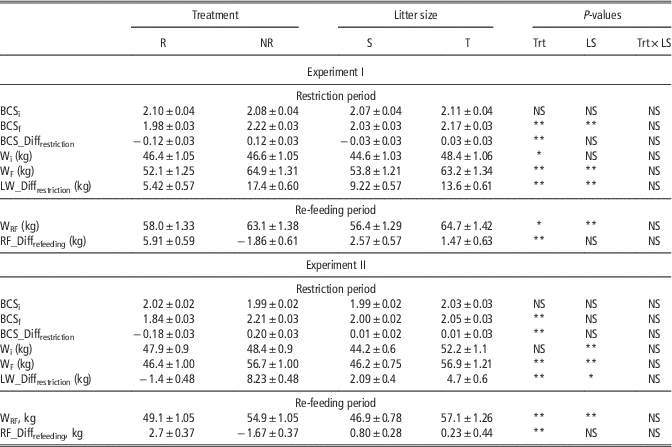
There were no significant interactions between treatment and sex or treatment and litter size for any of the analysed variables, and therefore, the results are not presented. The level of energy restriction imposed to the ewes (energy restricted at 70% or 60% of the ME requirements for experiment I and II, respectively) was similar so, from now, it will be considered no difference in level of restriction between years. At the end of the restriction period, higher BCS was observed in R ewes from experiment I compared with experiment II (Table 1); however, the level of restriction was not different between years as the variation in BCS as percentage of initial BCS in the restricted groups along the restricted period was similar (P=0.31; −5.1% and −8.5% for experiment I and II, respectively). In both experiments, NR ewes lost weight between the end of the restriction period and beginning of lambing. However, the R ewes gained weight during the same period, with higher gains in absolute values in experiment I compared with experiment II (Table 1), and also as percentage of final ewe weight at the end of restricted period (P<0.01; 11.3% and 5.8% for experiment I and II, respectively). In both experiments, energy restriction during gestation did not influence (P>0.05) any of the placenta measurements, such as placental weight, cotyledon number, cotyledon weight or PL (data not presented).
Effects of nutrition plane of ewes and litter size (mean±SE) on body condition score (BCSi and BCSf) and ewe BW (Wi and Wf) at the beginning and end of restriction period, difference between ewe BW (LW_Diffrestriction) and body condition score (BCS_Diffrestriction) at the beginning and end of restriction period, ewe BW at the end of re-feeding period (WRF) and difference between BW at the beggining and end of re-feeding period (RF_Diffrefeeding)

R=total mixed ration (TMR) to supply 70% or 60% of the metabolizable energy (ME) requirements for gestation in experiments I and II, respectively; NR=TMR to supply 100% of the ME requirements for gestation; S=single-born lamb; T=twin-born lamb; Trt=treatment; LS=litter size.
Significant differences for values within rows: *P<0.05, **P<0.01; NS, values within rows are not different.
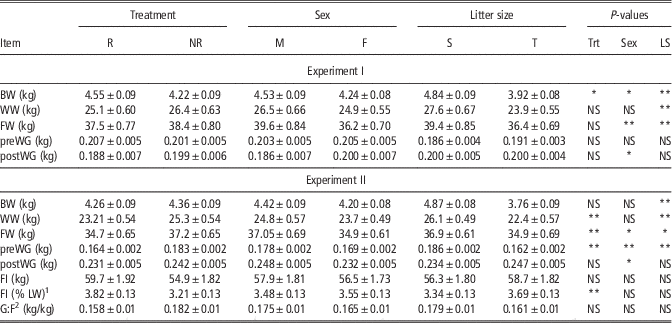
In experiment I, energy restriction during gestation affected lamb birth weight (P<0.05), but did not influence weaning and slaughter weight or BW gain (Table 2). Lambs born from R ewes were heavier at lambing than lambs from NR ewes. Single-born lambs were heavier than twins at birth, weaning and slaughter (P<0.01), but presented similar pre- and post-weaning BW gains. Male lambs were heavier than females at birth and slaughter (P<0.05), and gained more weight after weaning. In experiment II, ewe energy restriction affected (P<0.01) lamb pre-weaning WG and weaning and slaughter weights. Nevertheless, ewe feeding treatment during gestation did not influence (P>0.05) lamb birth weight or post-weaning WG. Male lambs presented higher pre- and post-weaning WGs and were heavier at slaughter (P<0.05) than females, but birth or weaning weights were not different between sexes. Single-born lambs were heavier than twins at all ages and gained more weight before weaning (P<0.05). Relative to feed efficiency-related traits, lambs from R ewes presented higher FI as % of LW than those from NR ewes. Lamb feed efficiency was not influenced by ewe feeding treatment, sex or litter size. However, lambs from NR ewes presented a trend (P=0.16) to be more efficient.
Effects of nutrition plane of ewes, sex and litter size (mean±SE) on BW, weaning (WW), and final live weights (FW), pre- (preWG) and post-weaning (postWG) weigh gain, feed intake (FI) and feed efficiency (G:F)

R=total mixed ration (TMR) to supply 70% or 60% of the metabolizable energy (ME) requirements for gestation in experiments I and II, respectively; NR=TMR to supply 100% of the ME requirements for gestation; M=male; F=female; S=single-born lamb; T=twin-born lamb; Trt=treatment; LS=litter size.
1 FI expressed as a percentage of live weight (LW).
2 Feed efficiency expressed as weight gain per kilogram of dry matter intake.
Significant differences for values within rows: *P<0.05, **P<0.01; NS, values within rows are not different.
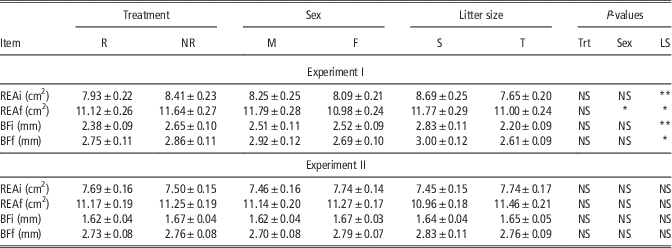
In experiment I, single-born lambs presented higher (P<0.05) REA and BFT values measured in the beginning and end of the finishing period than twin-born lambs (Table 3). Male lambs presented larger (P<0.05) REA at the end of finishing period compared with female lambs. Ewe feeding treatment had no effect (P>0.05) on any of the carcass traits studied. Lambs from R and NR ewes presented similar backfat thickness increments during the finishing period (P=0.33), of 0.36±0.10 mm and 0.21±0.11 mm, respectively. In experiment II, REA and BFT values measured at the beginning and end of the finishing period were not influenced by treatment, sex or litter size. As observed in experiment I, backfat thickness increase during the finishing period was similar (P=0.86) between lambs from R (1.10±0.07 mm) and from NR ewes (1.09±0.07 mm).
Effects of nutrition plane of ewes, sex and litter size (mean±SE) on initial (REAi) and final (REAf) ribeye area, and initial (BFi) and final (BFf) backfat thickness at longissimus muscle, measured by ultrasonography at the beginning and end of finishing period

R=total mixed ration (TMR) to supply 70% or 60% of the metabolizable energy (ME) requirements for gestation in experiments I and II, respectively; NR=TMR to supply 100% of the ME requirements for gestation; M=male; F=female; S=single-born lamb; T=twin-born lamb; Trt=treatment; LS=litter size.
Significant differences for values within rows: *P<0.05, **P<0.01; NS, values within rows are not different.
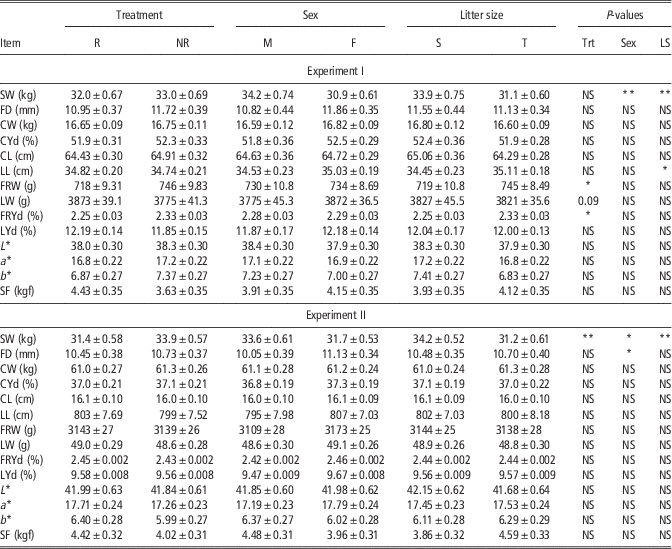
In both experiments, neither litter size nor ewe feeding treatment affected (P>0.05) gastrointestinal tract, abdominal fat, liver or heart weights (data not presented). The results of the ANOVA of carcass and meat traits are presented in Table 4. In experiment I, slaughter (final) weight was influenced by sex and litter size (P<0.05), but not by ewe feeding treatment (P>0.05). There was a significant (P<0.05) effect of treatment on the weight and yield of the frenched rack cut. Lambs born to R ewes presented lower frenched rack cut weight and yield compared with those from NR ewes. In addition, leg weight (P=0.09) and yield (P=0.12) tended to be higher in lambs born to NR ewes compared with those born to R ones. Although the effect of treatment on shear force was not significant (P=0.11), the meat of lambs born to R ewes tended to be tougher than that of lambs from NR ewes. In experiment II, treatment, sex and litter size significantly influenced slaughter weight, but had no effect on carcass yield or any other carcass or meat traits. It is important to highlight that any differences in the evaluated parameters (results not shown) disappeared in most carcass traits after the results were corrected for slaughter weight. Therefore, most of the differences observed between lambs from R and NR lambs were due to different growth rates after lambing, and consequently different final weight. Shoulder weight and tissue composition were not affected by treatment or litter size. However, male lambs showed higher level of inter-muscular fat than females (data not presented).
Effects of nutrition plane of ewes, sex and litter size (mean±SE) on slaughter weight (SW), fat depth (FD), carcass weight (CW), carcass yield (CYd), carcass length (CL), leg length (LL), frenched rack weight (FRW), leg weight (LW), frenched rack yield (FRYd), leg yield (LYd), luminosity (L*), redness (a*), yellowness (b*) and Warner-Bratzler shear force (SF)

R=total mixed ration (TMR) to supply 70% or 60% of the metabolizable energy (ME) requirements for gestation in experiments I and II, respectively; NR=TMR to supply 100% of the ME requirements for gestation; M=male; F=female; S=single-born lamb; T=twin-born lamb; Trt=treatment. LS=litter size.
Significant differences for values within rows: *P<0.05, **P<0.01; NS, values within rows are not different.
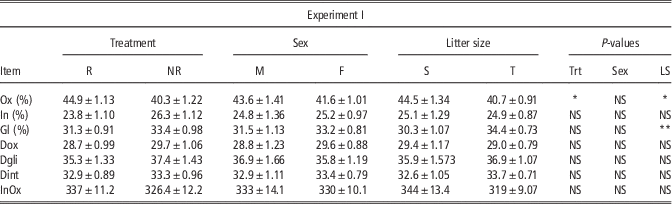
The percentage of oxidative muscle fibers was higher in lambs born to R ewes (P<0.05); however, no effects of the evaluated factors (P>0.05) on other types of fibers were observed (Table 5). The diameter of all muscle fibers and the oxidative index were not influenced by treatment. Except for the percentage of glycolytic fibers, sex did not affect fiber muscle composition, fiber diameter or oxidative index. Litter size had a significant influence (P<0.05) on the composition in fibers as shown by a decrease of the percentage of oxidative fibers and the increase in glycolytic fibers in female compared with males lambs.
Effects of nutrition plane of ewes, sex and litter size (mean±SE) on the percentage and diameter of oxidative (Ox, DOx), intermediate (In, Dint), and glycolytic muscle fibers (Gl, Dgli), and oxidative index (InOx), according to treatment (Trt), sex and litter size (LS)

R=total mixed ration (TMR) to supply 70% or 60% of the metabolizable energy (ME) requirements for gestation in experiments I and II, respectively; NR=TMR to supply 100% of the ME requirements for gestation; M=male; F=female; S=single-born lamb; T=twin-born lamb; Trt=treatment.
Significant differences for values within rows: *P<0.05, **P<0.01; NS, values within rows are not different.
Discussion
The present study described the effect of restricted maternal nutrition during middle gestation followed by different level of re-feeding on growth parameters, body and carcass composition, muscle and meat parameters and feed efficiency of 6-month-old lambs. Within the main novel results, we found that the level of re-feeding after energy restriction imposed to the ewes, affected the yield of some valuable meat cuts and lambs’ FI during the fattening period.
Regarding growth parameters, ewes fed ad libitum after the period of energy restriction produced heavier lambs at lambing compared with NR ewes; however these lambs presented similar growth until slaughter as those born to NR dams. On the other side, both groups of lambs from the experiment II, with their mother re-fed to requirements had similar weight at birth. However lambs were unable to compensate their growth after birth, specially pre-weaning growth. The latter results are in agreement with previous reports on the progeny of dams on low plane of nutrition during gestation, which presented slower growth rates, lower ADG or lighter BW than those from dams on higher planes of nutrition during mid-gestation (lambs: Nordby et al., Reference Nordby, Field, Riley and Kercher1987; rat pups: Beermann et al., Reference Beermann, Cassens and Hausman1978; steers: Greenwood and Café, Reference Greenwood and Cafe2007; Underwood et al., Reference Underwood, Tong, Price, Roberts, Grings, Hess, Means and Du2010). However, these growth and development differences disappeared after weight adjustment. Unfortunately, milk production was not measured, and therefore, no conclusion can be reached relative to its influence on weaning and final weights.
Evidence suggesting compensatory growth after the restriction period is related with placenta size and efficiency. In the present study, placental weight and other evaluated placental parameters, such the number and weight of cotyledons, were not affected by the restriction levels imposed to the ewes during gestation that can be the result of a compensatory increase in maternal nutrition over the remainder of pregnancy compared with non-restricted ewes. In general, this is not so since the capacity of the placenta is markedly affected by maternal nutrition during the middle third of gestation (30 and 107 days of pregnancy; Heasman et al., Reference Heasman, Clarke, Stephenson and Symonds1999). In this context, the majority of the studies have shown that placental weight was reduced when ewes were underfed whereas others have shown no effect (Kelly and Newnham, Reference Kelly and Newnham1990; Kelly, Reference Kelly, Greeff and Macleod1992). Indeed, non-restricted ewes lost weight between the end of the restriction period and beginning of lambing whereas restricted ewes gained weight during the same period. Moreover, lambs from restricted ewes were heavier or had similar weight to those of non-restricted ewes for experiment I and experiment II, respectively, and this again might be due to the higher compensatory increase in maternal nutrition observed in experiment I compared with experiment II.
Concerning to body and carcass composition, in experiment I, despite the compensation for possible in utero nutritional deficiencies, carcass and meat traits were not compensated. When they were adjusted for slaughter weight, more valuable cuts, especially frenched rack, were obtained from the lambs which dams were fed to the requirements compared with those born to restricted ewes. However, in the second experiment, when ewes were not fed ad libitum during the re-feeding period, the effect of in uterus undernutrition had a strong effect on most traits, with no compensation after birth or later. Therefore, the differences observed in most traits probably resulted from reduced body development and low final weight. In other words, the results obtained in experiment II indicate that there was a carry-over effect of ewe energy restriction during gestation on most growth traits. To the best of our knowledge, the results of experiment I is the first report showing that a group of muscles or particular valuable cuts present different development at constant slaughter weight in lambs born to dams submitted to energy restriction during gestation relative to non-restricted ones. Nordby et al. (Reference Nordby, Field, Riley and Kercher1987) showed a decrease in the weight of the semitendinosus muscle of lambs which dams were fed on a low plane of nutrition during gestation; however, those authors did not apply correction for slaughter weight as it was performed in the present study.
According to the results, fetal programming had no significant impact on final carcass composition in terms of degree of fatness, because the pattern of tissue deposition measured by ultrasonography from the beginning to the end of the finishing period was similar in lambs born both to R and NR ewes. Several studies have shown that animals that experienced dietary restrictions at early ages have higher rate of fat deposition during finishing. In this sense, Zhu et al. (Reference Zhu, Ford, Nathanielsz and Du2006) reported that lambs from dams submitted to nutrient restriction during mid-gestation were fatter and had lower carcass lean tissue to fat ratio than their counterparts. Similarly, Greenwood et al. (Reference Greenwood, Thompson and Ford2010) demonstrated that lambs born to R ewes during gestation presented higher adipose tissue deposition than those born to NR ewes. However, in the present study, ewe energy restriction during gestation was not associated with long-term increases in the adiposity of the offspring. This may be related to the intensity of the restriction, which was of 30% to 40% of energy requirements compared with 50% in the aforementioned studies.
Although the mass of the longissimus muscle (not measured per se, but predicted by REA) of the lambs was not affected by dam nutritional restriction, their muscle fiber composition (Dubowitz and Brooke, Reference Dubowitz and Brooke1973) was altered, with an increment of the proportion of oxidative muscle fibers. It is expected that this altered composition of muscle fiber would reduce sensitivity to insulin and glucose utilization (Zhu et al., Reference Zhu, Ford, Nathanielsz and Du2006). Similar findings were reported by Burt et al. (Reference Burt, Hess, Nathanielsz, Nijland and Ford2005) and Zhu et al. (Reference Zhu, Ford, Nathanielsz and Du2006). The ability of the skeletal muscle to utilize glucose and fatty acid is altered in energy restricted animals, predisposing their offspring to obesity. In these sense, the progeny born to dams submitted to feed restriction during gestation was fatter relative to the controls (Bispham et al., Reference Bispham, Gopalakrishnan, Dandrea, Wilson, Budge, Keisler, Pipkin, Stephenson and Symonds2003; Symonds et al., Reference Symonds, Pearce, Bispham, Gardner and Stephenson2004; Desai et al., Reference Desai, Gayle, Babu and Ross2005; Zhu et al., Reference Zhu, Ford, Nathanielsz and Du2006). Thus, it is expected that these changes in muscle type and degree of fatness of the offspring influence its nutrient utilization and feed efficiency. Although no statistical difference in backfat thickness gain (15% for R and 8% for NR) between lambs born to restricted and non-restricted ewes was observed in our study, it is well documented that fat tissue deposition is energetically costlier than muscle tissue accretion (Owens et al., Reference Owens, Gill, Secrist and Coleman1995). Increases in the proportion of oxidative fibers reduce the capacity of the muscle cell to metabolize glucose and to store glycogen. After slaughter, adequate muscle glycogen levels are essential to produce lactic acid in the postmortem period, which promotes faster and deeper pH drop, thereby resulting in higher protein degradation and consequently, higher meat tenderness. Despite the lack of significant effects of ewe feeding treatment on meat tenderness in experiments I and II, the meat of lambs born to R ewes in experiment I tended to be tougher, and presented a higher proportion of oxidative muscle fibers compared with their counterparts. The relationship between muscle fiber type and meat tenderness has been a subject of debate due to the contradictory results obtained in numerous experiments carried out in different countries, with different animal types and different cuts (Maltin et al., Reference Maltin, Balcerzak, Tilley and Delday2003), and therefore further research is warranted in order to understand the underlying mechanisms of these effects.
Among the factors that define carcass quality, the proportion of valuable meat cuts, carcass fat percentage (subcutaneous and inter-muscular) and meat tenderness are important factors to be considered (Glitsh, Reference Glitsh2000). In this sense, the results obtained in experiment I showed that it is possible to add value to the carcass, increasing the proportion of high-value cuts (frenched rack) by applying adequate ewe feeding management systems during gestation. Furthermore, meat tenderness and fat deposition are important attributes of meat quality. In this sense, Underwood et al. (Reference Underwood, Tong, Price, Roberts, Grings, Hess, Means and Du2010) showed that the steers born to cows with better nutritional status during mid- to late gestation produced higher beef tenderness, adipose tissue deposition and growth rate.
Respect to feed efficiency; we observed that, there was a strong trend for better feed efficiency in the lambs born to NR ewes respect to R ewes. Moreover, lambs born to R ewes consumed more feed during the finishing phase than their counterparts, which, from the practical point of view, implies in the need of more resources and investments to finish those animals. In the literature there is evidence that low birth lambs ate more and have a better feed efficiency up to 20 kg of live weight than high birth lambs (Greenwood et al., Reference Greenwood, Hunt, Hermanson and Bell1998). However, in that experiment feed efficiency was not adjusted for live weight so differences are mainly explained by lamb size. In a similar study to ours, Daniel et al. (Reference Daniel, Brameld, Craigon, Scollan and Buttery2007) observed no differences in FI and efficiency in lambs born to restricted ewes from birth to 24 weeks of age, compared with lambs born to non-restricted ewes.
Several studies in literature address the impact of fetal programming on the growth, development and tissue deposition of the offspring of meat species. Most studies have shown that feed restriction during gestation affects fetal development, and that carry-over effects in traits expressed by the offspring at maturity are observed. It is important to highlight that most of the differences observed between restricted and non-restricted dams were caused by growth variation, and were explained by BW differences. However, the results of the experiment I and II showed that differences between lambs from R and NR dams were still detected after adjustment for BW at slaughter. Weight differences between restricted and non-restricted animals are expected, because undernutrition during gestation may delay the growth of the offspring, and therefore, result in differences in traits correlated with BW. However, the effects of fetal programming go beyond differences in growth, as undernutrition may also affect the development of fetal tissues and body components, particularly of those tissues that have low priority during fetal development, such muscles and wool follicles. In these sense, the results of experiment I indicated that energy restriction during gestation influenced lamb muscle development and conformation. It should be noted that there are few studies in literature evaluating the effects of fetal programming on the feed efficiency and related traits of the progeny, and therefore, the results of this study contribute with new information on the effects of dam feed restriction on lamb feed efficiency. Moreover, the feeding management to which ewes were submitted after the energy restriction period is emphasized, as it may be as important as the intensity of nutrient restriction applied during the restriction period to which ewes are submitted during mid-gestation.
Conclusion
Maternal undernutrition from the second term of gestation can condition offspring weight at lambing and slaughter weight, and be detrimental for meat yield of valuable cuts. Re-feeding these ewes at 100% of their energy requirement during late gestation may enable producing lambs without carcass and meat major defaults even though slightly lighter. Re-feeding them ad libitum during late gestation may enable producing lambs with similar weight but reduced yield of some valuable meat cuts.