R1. Introduction
In our target article, we have proposed a network view of mental disorders, in which systematic covariation between symptoms is explained by direct relations between the symptoms themselves. The approach breaks radically with the dominant doctrine, in which disorders are considered to be common causes of their symptoms (i.e., the latent variable perspective). We were pleased to see that many commentators view the network approach as a potential substantive theory of mental disorders. Given the varied set of responses, many of which proposed worthwhile empirical research suggestions and theoretical extensions of the approach, we have fortunately succeeded in bringing together researchers from different fields to reconsider what disorders are and how we should investigate them.
One of the most surprising and noteworthy facts about the present set of commentaries concerns what they do not contain: Very few commentators attempt to defend the received view that underlies many current approaches to psychopathology: that is, the latent variable perspective. We take this to imply that the time is ripe for a change of perspective. In addition, the comments have strengthened our conviction that, with the necessary refinements and extensions, “‘inference to the best explanation” could ultimately lead us to the network approach as the substantive theory of mental disorders (Haig Reference Haig2009). Certainly, Rothenberger, Banaschewski, Becker, & Roessner (Rothenberger et al.) argue that the network approach is complex with its “manifold interactions between symptoms,” but we agree with them even more that this reflects reality. And as we will argue here, complex realities require complex theories.
In this response, we discuss the most important extensions, refinements, investigative tools, and objections voiced by the commentators according to the following themes. First, several commentators argued that network models can and necessarily must include latent variables (e.g., Haig & Vertue; McFarland & Malta). In section R2, we explain why some relations qualify for such a measurement model – and are thus likely to be incorporated into a network model – while others do not (e.g., depression as common cause of a cluster of symptoms). Other commentators provided excellent suggestions for refinement of the network model in order to include genetic, neurological, and cognitive levels of explanation (e.g., Rubinsten & Henik; Yordanova, Kolev, Kirov, & Rothenberger [Yordanova et al.]), which we discuss in section R3. Additionally, in section R4, we discuss ways to test the network model, as suggested by several commentators (e.g., Davis & Plomin; Fleeson, Furr, & Arnold [Fleeson et al.]; Van der Sluis, Kan, & Dolan [Van der Sluis et al.]). Section R5 investigates the possibility of extending the network approach to other disorders (e.g., Axis II personality disorders [Bornstein; Ross]). Section R6 focuses on an important question, posed by several commentators, as to what constitutes a mental disorder (Haslam; Hood & Lovett; Zachar). Finally, commentators raised methodological objections that claimed either to invalidate the network model we suggested (e.g., Danks, Fancsali, Glymour, & Scheines [Danks et al.]; Krueger, DeYoung, & Markon [Krueger et al.]), or to sustain a common cause view on mental disorders (e.g., Belzung, de Villemeur, Lemoine, & Camus [Belzung et al.]; Humphry & McGrane). In section R7, we discuss these issues and argue that – despite methodological difficulties that have to be addressed in the future – the network model should be viewed as the prime candidate to elucidate the origins of mental disorders.
R2. Latent variables in the network approach
Markus and Molenaar remark that, if the network approach is to move from a mere representation of the data to a possible representation of the underlying causal and functional relations between its components, one requires a way to deal with the fact that the observations (i.e., symptom reports) are likely to be imperfect indicators of these components (i.e., the actual symptoms). These commentators note that, if measurement error is neglected, relations between symptoms can be inaccurately represented because of attenuation effects. The only way to deal with this is to invoke latent variables into the model. Other commentators express this concern as well when discussing symptoms that should be measured in multiple ways (Krueger et al.; McFarland & Malta) or non-symptom causal processes that mediate the direct relations between symptoms (Belzung et al.; Danks et al.; Haig & Vertue; Humphry & McGrane). Our response is simply to acknowledge that this is the case; in fact, in our target article, we specifically hint at this idea in the last paragraph of section 4.
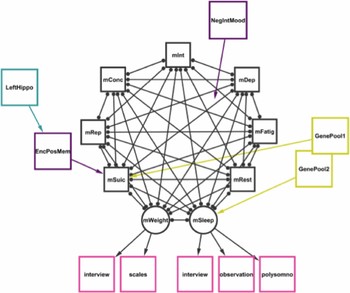
We construct the situation as follows: At the level of individual symptoms, we take symptom reports to be measures. If measurement error is to be accounted for at this level, one would indeed need multiple indicators per symptom and a parallel extension of the network model with latent variables; for example, a network model for depression could include sleep disturbances as a latent variable measured with three observable indicators (i.e., clinical interview, polysomnography, laboratory observation; see McFarland & Malta). Figure R1 depicts such a network model with sleep disturbances and weight problems as latent variables. Also, a model in which some non-symptom causal processes are latent because they are measured in multiple ways (e.g., “major life events” for depression) is easy to conceive, and we welcome the development of such extensions of the model (Belzung et al.; Danks et al.; Haig & Vertue; Humphry & McGrane).
A hypothetical network model for major depression. Circles represent latent variables, and squares represent observed variables. The nine symptoms of major depression are represented as dark gray squares/circles. The pink squares represent multiple measurements for latent symptoms (i.e., weight and sleep problems in this example; see sect. R2). The purple squares represent the cognitive level of the model, the blue square the neurophysiological level, and the yellow squares the genetic level.;>Abbreviations key: mInt, loss of interest; mDep, depressed mood; mFatig, fatigue; mRest, restlessness; mSleep, sleep disturbances; mWeight, weight problems; mSuic, (thoughts of) suicide; mRep, self-reproach; mConc, concentration problems; polysomno, polysomnography; EncPosMem, problems in encoding/retrieving positive autobiographical memories; NegIntMood, negative interpretation of bad mood; and LeftHippo, smaller volume of the left hippocampus.

The central tenet of our target article is, therefore, not to shun latent variables completely. For example, a measurement model that includes a latent variable makes perfect sense in case of the symptom “insomnia” with three indicators. This is because (1) a natural referent exists (i.e., not falling asleep/not staying asleep), of which we know (2) how it affects our three measurements (e.g., trouble with falling asleep will be measured as a long time lying awake before falling asleep for the first time during a nightly observation in the laboratory); and we know (3) that it explains the correlation between the three measurements (i.e., the common cause of measures obtained in a sleep laboratory and of ticking the box “long time to fall asleep” in a questionnaire).
In case of mental disorders, on the other hand, a latent variable model is an unlikely candidate for giving a truthful explanation of the associations between distinct symptoms of a disorder. In other words, we do not object to measurement models per se, but to the idea that the association between a mental disorder and its symptoms is one of measurement. First, many supposed latent variables in psychological science – such as depression or neuroticism – do not appear to have a natural referent (for an extensive elaboration on this point, see Borsboom et al. Reference Borsboom, Cramer, Kievit, Zand Scholten, Franić and Lissitz2009a). Second, without a natural referent, we have no idea how the supposed measurements would be affected by the latent variable, and we therefore cannot justify a common cause interpretation, where the disorder explains correlations between its symptoms. Thus, the things that render the relation between insomnia and three observed variables one of measurement are lacking in the case of, say, depression. Naturally, if one day we should find a natural referent for the hypothetical construct “depression,” and we could prove that referent to be the common cause of all depression symptoms, the network model would be disproved. But we doubt that day will ever come.
R3. Refining the network approach: Genetics, brain, and cognition
The network model in our target article is, naturally, not the end of the story (Ross). To the contrary, the network we presented for comorbidity between major depression and generalized anxiety represents a starting point. Refining this model in particular – and the network idea in general – should be the focus of future research in order to adequately (1) test the validity of the model and (2) generate hypotheses about the etiology of particular mental disorders (Johnson & Penke).
Johnson & Penke correctly state that an important goal of the network model is to help unravel the etiology of a wide variety of mental disorders. We acknowledge that a plethora of work has already been done in that regard, but, as we also argued in our target article, that work might be grounded in the wrong psychometric theory of mental disorders. As such, etiology is currently interpreted in terms of the development of a single vulnerability (i.e., the common cause) that causes a cluster of symptoms. For example, an evolving lack of serotonin may be hypothesized to cause the symptoms of major depression. However, if a network approach, rather than a latent variable model, correctly describes the system, the conceptualization of etiology and vulnerability radically changes, for we are no longer talking about one, but about a multitude of vulnerabilities at the genetic, neurological, and cognitive levels that may explain the onset of symptoms and the relationships between them (Fleeson et al.; Hyland; Rubinsten & Henik; Yordanova et al.). Figure R1 depicts such a hypothetical descriptive network model for the nine symptoms of major depression. The etiology may then be conceptualized in terms of the development of such a network over time; naturally, this process may differ over individuals.
Many mental disorders have a strong genetic component, as evidenced by high heritability estimates, but, despite numerous research efforts, the genetic culprits have not been found (Van der Sluis et al.). This poses a dilemma. Are the heritability estimates wrong – and is the genetic influence on mental disorders hence highly exaggerated – or is there something wrong with the methods we use to investigate this issue? Van der Sluis et al. suggest the latter and corroborate this by referring to the practice of correlating genes to the entire aggregate of symptoms. If the network model is accurate in describing the origins of mental disorders, this method provides limited prospects for success in gene hunting. Since, in this case, there simply is no common cause, its hypothesized proxy (i.e., a sum score) is an amalgam of distinct factors and will only capture the genetic components that are shared by the aggregated symptoms and relations between them. As we have argued in our target article, it is likely that different genes (or constellations of genes) influence different symptoms (and relations between them). For instance, it is not a wild guess to assume that the symptoms “sleep disturbances” and “thoughts of suicide” are controlled by a different set of genes (with some overlap; see Fig. R1). Multiple genes for each symptom separately does render the entire picture far more complex, and we agree with Van der Sluis et al. that the network model faces a challenge in that regard. Part of this complexity could possibly be tackled by examining the time series of symptom development and relating the patterns that emerge from such analyses to (constellations) of genes.
While we generally reject the idea of one common cause underlying a constellation of symptoms, we by no means dismiss the potential relevance of pathological mechanisms discovered by the quest of finding such causes. For example, a smaller left hippocampal volume has been consistently found in people with major depression (e.g., see Bremner et al. Reference Bremner, Narayan, Anderson, Staib, Miller and Charney2000). Although it appears unlikely that this mechanism causes all depression symptoms, it could be one of the vulnerabilities underlying one or more symptoms; for instance, thoughts of suicide (see Fig. R1). Also at the neurological level, Rubinsten & Henik argue that deficiencies along the intraparietal sulcus (IPS) – commonly associated with numerical cognition – are the common cause of the symptoms of developmental dyscalculia (DD). Although we agree that the evidence points to the relevance of IPS deficiencies, we are not so sure that those deficiencies are the common cause. Since DD involves deficiencies in a variety of complex abilities that require input from memory, attention, and spatial systems, a single underlying vulnerability is highly unlikely (e.g., see Cohen Kadosh & Walsh Reference Cohen Kadosh and Walsh2009; Landerl et al. Reference Landerl, Bevan and Butterworth2004). Thus, also in the case of DD, existing neurophysiological findings can be incorporated easily into a network perspective once one is willing to accept the demise of the “common cause” idea.
At the cognitive level, it is, for instance, well known that both major depression and generalized anxiety are intimately connected to negative beliefs, as is evidenced by the success of cognitive therapy in reducing depression and preventing relapse (DeRubeis et al. Reference DeRubeis, Hollon, Amsterdam, Shelton, Young, Salomon, O'Reardon, Lovett, Gladis, Brown and Gallop2005; Kuyken et al. Reference Kuyken, Byford, Taylor, Watkins, Holden, White, Barrett, Byng, Evans, Mullan and Teasdale2008; Papageorgiou & Wells Reference Papageorgiou and Wells2001; Paykel et al. Reference Paykel, Scott, Teasdale, Johnson, Garland, Moore, Jenaway, Cornwall, Hayhurst, Abbott and Pope1999; Wells & Carter Reference Wells and Carter2001; see also Hyland). We are skeptical about Hyland's view that those beliefs form an interconnected system that completely explains the onset of depression and/or generalized anxiety. Rather, we hypothesize that negative beliefs directly influence (1) symptoms – for example, negative thinking that causes a depressed mood; and (2) relations between symptoms – for example, an overly negative interpretation of one's depressed mood that results in making a suicide plan (see Fig. R1). Staniloiu & Markowitsch report another intriguing possibility: Problems in encoding and retrieving positive autobiographic memories could result in an inability to imagine an optimistic future, which may lead to the onset of the symptom “suicide attempt” (Markowitsch et al. Reference Markowitsch, Vandekerckhove, Lanfermann and Russ2003; Schacter & Addis Reference Schacter and Addis2009; Sharot et al. Reference Sharot, Riccardi, Raio and Phelps2007).
R4. How to investigate the network model? A research agenda
We have provided several arguments for the thesis that a network model paints a more realistic picture of mental disorders than the latent variable model does. Naturally, future research must determine whether the network model is also the better theory in reality, and several commentators have put forward some excellent suggestions for a research agenda (e.g., Davis & Plomin; Fleeson et al.; Tzur-Bitan, Meiran, & Shahar [Tzur-Bitan et al.]). Given the complexity of the network approach, such an agenda is necessarily comprehensive. As such, when Krueger et al. ask, “How would one use the information in Figure 4 to explain to a policy maker how we might go about spending public funds wisely in the service of working to ameliorate the burden of depression and anxiety? By funding hundreds of separate projects focused on understanding each line in the figure?” – our short answer is yes. For those skeptical of this answer, we suggest that the same question may be asked about, say, complex systems like the earth's climate. Should we really fund hundreds of projects investigating the diverse factors that influence climate change? The answer to that question is uncontroversially affirmative, and it has not proven difficult to persuade policy makers of this fact. We do not see why the situation would be different for mental disorders. Given this perspective, we think of three lines along which network research should ideally be aligned: (1) validating the network model, (2) elucidating the vulnerabilities underlying (relations between) symptoms (see also Fleeson et al.) and (3) tracking the developmental trajectories of symptom constellations.
R4.1. Validating the network model
Relations between symptoms represent an ideal opportunity to test the network model against the latent variable model: If no latent variable exists, one should find that experimentally manipulating one symptom results in change in another symptom. Some work has already been done in that regard; for example, unsurprisingly, one look at the literature reveals a direct effect of sleep deprivation on fatigue (e.g., see Durmer & Dinges Reference Durmer and Dinges2005). Other symptom relations, such as the one between loss of interest and worrying about multiple events in Figure 4 of our target article, appear less obvious and need experimental verification in the future. In a more indirect manner, the network model could be confirmed by the genetic association studies (GAS) on the individual symptoms, as proposed by Van der Sluis et al.; it would be especially interesting to execute such analyses on patterns found in time series that describe symptom dynamics. If the network model is true, this type of GAS should reveal constellations of genes that better account for the high heritability of mental disorders than GAS on a sum score. In the same vein, Davis & Plomin suggest multidimensional scaling as a method to reveal the genetic closeness of multiple symptoms. If such endeavors would point to the presence of direct relations between symptoms, the latent variable model could be put to rest in psychopathology.
R4.2. Elucidating vulnerabilities
Fortunately, there may be no need for funding “hundreds of projects,” as Krueger et al. fear, since many of such projects, aimed at understanding the inner workings of a variety of symptoms, have already been carried out; most symptoms in Figure 4 of our target article are associated with large scientific literatures (e.g., fatigue, anxiety). With regard to vulnerabilities underlying the relations between symptoms, not all edges are an a priori mystery to us; for example, the mechanisms that are involved in the influence of sleep deprivation on fatigue are well known (e.g., see Durmer & Dinges Reference Durmer and Dinges2005).
With regard to symptom relations whose underlying mechanisms are less well-known, insights from treatment rationales should further our understanding. For instance, mindfulness-based cognitive therapy offers a specific hypothesis with regard to the relation of depressed mood with the other symptoms of depression: Depressed mood triggers ruminative thinking, which – if not hindered by a successful intervention – could lead to other depression symptoms (e.g., see Ma & Teasdale Reference Ma and Teasdale2004; Nolen-Hoeksema Reference Nolen-Hoeksema2000; Segal et al. Reference Segal, Williams and Teasdale2002). Another example comes from the panic disorder literature in which renewed interpretation of bodily signals is used to break the link between having a panic attack and worrying about its consequences (“I will have a heart attack”; e.g., see Clark et al. Reference Clark, Salkovskis, Hackmann, Middleton, Anastasiades and Gelder1994). On a related note, several successful interventions are not primarily aimed at reducing or eliminating symptoms or the relations between them but, rather, at reinforcing so-called protective factors. For example, the relative success of the methadone program is attributable to reinforcing coping skills and finding work and housing (i.e., protective factors) while stabilizing the addiction with the methadone. Once a stable situation is created, addicts enter a total abstinence program (e.g., see Gossop et al. Reference Gossop, Stewart, Browne and Marsden2002; Van den Brink et al. 1999). Such treatment programs could provide some valuable insights into the mechanisms by which one progresses from a disordered to a healthy state.
R4.3. Tracking developmental trajectories
Much of the current literature reports research that involves interindividual research, often carried out cross-sectionally. Although such research can provide important insights, Wass & Karmiloff-Smith correctly suggest that it results in a snapshot of reality: an interindividual picture of mental disorders, frozen at a particular time frame. In reality, it is likely that, for instance, edge strengths differ across individuals, as well as across time. If so, another line of research is required to generate answers to two pivotal questions: (1) How do mental disorders develop, and (2) how does that development differ across individuals (Fleeson et al.; Rothenberger et al.). Such variations should be detectable through the intra-individual analysis of time series, as noted by various commentators (e.g., Fleeson et al.; Tzur-Bitan et al.; Van Geert & Steenbeek). In earlier times, it was quite difficult to obtain data suitable for such analyses. Fortunately, we now live in a time in which intensive time-series data can be gathered relatively easily (e.g., by letting patients report the status of symptoms through handheld devices, etc.). We think that, within a few years, it will become possible to analyze symptom development in real time, and to update network structures and parameters as the data come in. And when that time comes, we are confident that thorough investigation of the network approach will result in a better understanding of symptoms, their relationships, and their course in individuals over time.
R5. Extending the network approach to other disorders
In our target article, we introduced the network approach for two disorders that are prime examples of Axis I disorders in the Diagnostic and Statistical Manual of Mental Disorders (DSM-IV; American Psychiatric Association 1994). Any theory that presents itself as the potential substantive theory of mental disorders must be able to explain more than comorbidity between major depression and generalized anxiety disorder (Johnson & Penke). As a first step, we deem it necessary to evaluate to what extent the network approach fits a variety of other mental disorders (also see Cervone).
With regard to other Axis I disorders, some commentators have presented specific examples of (clusters of) disorders for which common causes are supposedly identified, thereby rendering the network approach invalid in those cases (e.g., Ross; Rubinsten & Henik). For example, Ross argues that addictions share a common cause: namely, hyperactivation of the dopamine reward circuit combined with weakened frontal and prefrontal serotonin and gamma-aminobutyric acid (GABA) circuits. We share Ross's view on the importance of these brain pathologies in addiction; however, we do not agree that such pathologies automatically qualify as the common cause of addictions. The most commonly reported consequences of the dysfunctional dopamine, serotonin, and GABA circuits are (1) the strong desire to consume salient targets, coupled with (2) difficulty resisting that desire. In other words, the brain pathologies that Ross mentions result in the core characteristics of an addiction. However, does this make those brain pathologies the common cause of addiction? To qualify as such, those pathologies should also cause the other symptoms of addiction. This is unlikely.
If we take a look at the DSM-IV criteria for substance abuse, for instance, we notice (1) the apparent inability of dysfunctional neurotransmitter circuits to explain “recurrent substance use resulting in a failure to fulfill major role obligations”; and (2) the undeniable possibility of direct relations between the symptoms of addiction: “Recurrent substance use in situations in which it is physically hazardous” (e.g., drunk driving) can cause “recurrent substance-related legal problems” (e.g., getting arrested for drunk driving). As such, we think addiction can potentially be envisioned as a causal chain of symptoms in which one symptom – desire to consume and inability to withstand this – may be triggered by dysfunctional dopamine, serotonin, and GABA circuits; thus, no common cause, but one pathological mechanism – in combination with other etiological factors – potentially results in a cascade of events in a network of addiction symptoms (i.e., the “fan-out” principle that Wass & Karmiloff-Smith mention). Such a chain of symptoms is also likely in panic disorder and other – very heterogeneous – Axis I disorders such as schizophrenia and attention-deficit hyperactivity disorder (ADHD). Hence, in these cases the network approach cannot be ruled out a priori (e.g., Borsboom Reference Borsboom2008).
Considering the extension of the network approach to Axis II disorders, Bornstein sees some roadblocks that need to be overcome in the case of personality disorders (PDs). First, patients with PDs tend to experience their symptoms as congruent with themselves. As a result, those patients have limited insight into their own condition. Bornstein rightly sees two resulting consequences: (1) Self-report measurements alone will not be adequate in assessing people with suspected personality pathology, and (2) the symptoms that patients cannot reflect on themselves are in a sense “latent.” However, we do not think these consequences pose serious problems for the network approach since – as we outlined in section R2 – it can easily deal with latent variables that have an established measurement relationship with a set of indicators, including tests that do not rely on self-assessment. Second, the revision of PD symptoms is founded on a desire to both increase diagnostic accuracy and reduce comorbidity. According to Bornstein (Reference Bornstein2003), this practice has resulted in simply removing symptoms from the diagnostic checklist, and, as Bornstein rightly claims, this poses a potential problem for the network approach; however, not in terms of its potential as substantive theory of mental disorders, but in terms of its practical applicability to PDs with potentially incomplete symptom inventories. So, in the case of Axis II PDs, we see no immediate problems that the network approach cannot surmount.
R6. What is a mental disorder?
In our target article, we argued that boundaries between mental disorders are necessarily fuzzy. In contrast, Haslam argues that boundaries between categories of the same disorder (e.g., “disordered” versus “not disordered”) are not fuzzy at all. To address this apparent dilemma properly, we dissect a disorder network in two components: (1) its structure and (2) its state. The structure of a disorder network refers to the strength of the relations between symptoms. As we show in Figure R1, those relations are controlled by a host of vulnerabilities (e.g., negative interpretation of one's mood resulting in a relatively strong relation between depressed mood and thoughts of suicide). Since those vulnerabilities probably differ across individuals, it is safe to assume that the resulting basic network structure is individually tailored as well. Now, pertaining to comorbidity, it is likely that, in some cases, individual network structures do not obey the DSM boundaries between disorders (nor any other fixed boundaries). It is likely, as well, that certain vulnerabilities influence relations between symptoms of different disorders: for instance, ruminative thinking may strengthen the relation between “depressed mood” and “chronic anxiety.” As such, the boundary between major depression and generalized anxiety for someone with a ruminative thinking style probably (1) does not equal the DSM-defined boundary (because of a strong relation between “depressed mood” and “chronic anxiety”) and (2) lies somewhere else than the boundary of someone without that thinking style. Thus, at the individual level, the line can be drawn practically anywhere and therefore we defend the notion of fuzzy boundaries in these cases. In other cases, a sharp boundary between two disorders might be more feasible; for instance, because relations between symptoms of these disorders are virtually nonexistent or negative. For example, large individual differences in the boundary between social anxiety and psychopathy are not very likely given the opposite nature of the symptoms of those disorders (e.g., “excessive self-consciousness and anxiety in everyday social situations” versus “grandiose sense of self-worth”; cf. Hare Reference Hare2003).
The state of a disorder network depends on how much symptoms are “on.” When adhering to a categorical perspective, disorder networks can be in two or more stable states. For example, with two stable states, one commonly distinguishes between a healthy state, in which few symptoms are “on,” and a disordered state, in which several symptoms are “on.” In these cases, a sharp boundary is needed to distinguish few from several. Now, we agree with Haslam that such sharp boundaries are theoretically possible and that evidence for two latent classes corroborates that hypothesis (provided that the analysis was conducted on a large and representative sample). However, as we already argued for a network's structure, it is unlikely that boundaries between states are invariant over persons; for, in subjective terms, some people feel depressed because they have sleep and concentration problems for two weeks, whereas others succumb to a full-blown depression only after a prolonged period of experiencing a multitude of symptoms. Therefore, in these cases, a more dimensional perspective might be in order; that is, no sharp boundaries between categories, but, instead, a continuum of network activation. Here, we think that symptom severity might be an excellent candidate for representing the degree of network activation (Markus): the more severe someone's symptoms are, the more that person is located toward the “disordered” end of the continuum.
In theory, any network with connected nodes (i.e., structure) that can be in different states could be taken to qualify as a mental disorder. As such, liberalism could be viewed as a mental disorder (Zachar): a set of connected political beliefs (e.g., if you believe in freedom of religion for everyone, then it is more likely that you are tolerant of minorities) that we call “liberalism” when a sufficient number of nodes are activated. In practice, though, we – and probably the majority of humankind with us – do not consider liberalism to be a mental disorder. Why? The DSM provides a sensible answer: The symptoms of any candidate mental disorder should cause “clinically significant distress or impairment in social, occupational, or other important areas of functioning” in the person who is experiencing those symptoms (American Psychiatric Association 1994). Although liberalism apparently causes distress in some other people (see Savage Reference Savage2005), it clearly does not satisfy the DSM's prerequisite. Thus, providing a sensible boundary between disorders and non-disorders, we would welcome this prerequisite as an extra node in the symptom space.
About 40% of people with major depression experience a new depressive episode after treatment (e.g., Paykel Reference Paykel2008). Any substantive theory of mental disorders must be able to explain such recurrence, a phenomenon that is very common in a host of mental disorders. In our opinion, the network approach is up to that task. Take, for instance, an alcoholic who, because of treatment, manages to stay sober, as a result of which the other symptoms of his or her substance abuse also subside. Also suppose that this person's network has strong connections between symptoms; that is, if one symptom turns on, it is likely that the other symptoms will turn on, as well. As such, we have a situation in which the substance abuse network is in a more or less healthy state (i.e., no symptoms are “on”) while the structure of the network is risky (and thus unhealthy). Now, this situation is exactly what makes a disorder likely to recur: If, for whatever reason, this person decides to drink one beer, it will likely result in a cascade of symptoms being turned on, and eventually the network will return to a disordered state. In other words, recurrence is most likely when the healthy state of a disorder network is unstable because of the strong connections between its symptoms. We think this is precisely what clinicians mean when they talk about silent disorders, and therefore we do not agree with Hood & Lovett that the network approach cannot accommodate such notions. On a final note, in the case of major depression, it is established that one of the most reliable predictors of recurrence is the presence of residual symptoms (e.g., Kennedy & Paykel Reference Kennedy and Paykel2004). But we also know that not every patient with residual symptoms experiences a subsequent recurrence. If we are right in suggesting that recurrence is most likely when the structure of the network is strong, residual symptoms in depression patients offer a way to prove this hypothesis: Of patients with residual symptoms, only those with strong connections between symptoms should eventually experience a new episode of major depression.
R7. Networks versus common causes: Methodological issues
Several commentators raise methodological issues regarding the network approach as opposed to latent variable models. In the following, we discuss criticisms according to the methodological topics mentioned by the commentators.
R7.1. Local independence
Many commentators question our criticism of the local independence assumption. In their opinion, a unidimensional model with local independence is unnecessarily strict (e.g., Humphry & McGrane; Markus; Molenaar). It is true that violations of local independence can be represented in a latent variable model, for instance, by allowing correlated residuals or direct relations between indicator variables. However, these modeling possibilities should not be given too much conceptual weight. Being more than a convenient restriction, local independence has the status of an axiom in measurement models used in psychometrics (e.g., Ellis & Junker Reference Ellis and Junker1997; Holland & Rosenbaum Reference Holland and Rosenbaum1986; Junker & Sijtsma Reference Junker and Sijtsma2001). This makes sense because psychometric models aim to give conditions under which composite scores (e.g., summed item scores) can be treated as measures of a latent variable. A prerequisite for this is that the item scores measure the same latent variable, which plausibly requires that the latent variable functions as a common cause; and the classical way of testing this is by testing whether the latent variable screens off the associations between the item scores. This is precisely what local independence requires. Thus, although it is statistically possible to allow for direct relations between indicator variables in a model, this should be considered a deviation from a psychometric norm (which in itself is reasonable in setting up a measurement model). As such, a unidimensional model with local independence is anything but a “straw man” (Danks et al.).
R7.2. Model equivalence
Several commentators raise the possibility that we may have overstated the difference between networks and latent variable models. Danks et al. note that cyclic graphs and latent variable models are closely related; Molenaar points to the fact that longitudinal factor models are equivalent to specific types of directed network models; and Humphry & McGrane indicate that latent variable models concern individual differences and, as such, may allow for individual level causal relations without violating the individual differences model.
It is true that latent variable models and network models are statistically indistinguishable in certain situations. A prominent example of such an exact indistinguishability is the mutualism model of intelligence proposed by Van der Maas et al. (2006), which is a network model that can produce data that are exactly equivalent to a single factor model. Similar relations are likely to exist for item response theory (IRT) models; Molenaar, in earlier work (see Molenaar Reference Molenaar2003, p. 82) has noted the close relation between Markov field models, such as the Ising model, and IRT models like those of Rasch (Reference Rasch1960) and Birnbaum (Reference Birnbaum, Lord and Novick1968). Indeed, one supposes that model equivalence may obtain as well in those cases.
Does this render the network model and the latent variable model equivalent in general? No, because the inability to distinguish between different possible generating models in a given data-set does not imply that the models are equivalent with respect to all possible data-sets or under all possible interventions. Thus, the advice in a model equivalence situation is to get better data, such as intensive time series (see sect. R4).
R7.3. Parsimony
Krueger et al. defend the latent variable model by emphasizing its superior parsimony relative to the network approach. First, latent variable models are not inherently more parsimonious than network models because the number of parameters of the latter can be made arbitrarily small. For instance, suppose that one has k observed dichotomous symptoms. If one assumes a completely connected network consisting of bidirectional relations of equal size, where these relations are functionally the same for any two nodes (e.g., logistic relations with equal intercepts and slopes, as in a Boltzmann machine; see Ackley et al. Reference Ackley, Hinton and Sejnowski1985), then, statistically speaking, one has an extremely parsimonious model even though it may consist of many – namely, k(k – 1)/2) – connections between variables.
Second, it should be recognized that even though parsimony is a useful criterion in choosing between statistical models, it will lead to truth only if reality itself is simple; if this is not the case, then we may deceive ourselves by overemphasizing parsimony. As Tryon (Reference Tryon1935, p. 428) remarked, “The ‘law’ of parsimony is not a natural law, but a rule agreed upon among men to simplify their thinking.” While simplifying our thinking is clearly useful in scientific investigation, complex realities will ultimately require complex models. In the case of mental disorders, we doubt that reality is simple given the likelihood of variation in network structure over individuals and time. As such, an extremely restricted model such as a Boltzmann machine – although favorable in terms of its parsimony – might not be particularly viable. Therefore, we think that the sword of parsimony should be wielded with caution, for we may accidentally kill promising candidate models through its use.
R7.4. Extensions of the network approach
Danks et al. provide one of the most critical analyses of our approach. First, they raise a number of questions concerning terminology and procedure. For instance, they criticize our use of the term centrality because “[centrality] is neither a causal nor a statistical notion.” This is obviously correct; it is a notion that comes from network analysis and has proved to be useful in many contexts (e.g., see Boccaletti et al. Reference Boccaletti, Latora, Moreno, Chavez and Hwang2006). Danks et al. also question our statement that observables in a standard psychometric latent variable model are exchangeable. In a measurement model, observables do not differ with respect to the property they measure; they are thus exchangeable in this sense. And it is this exchangeability that – among other things – renders the standard measurement model inappropriate in the context of psychopathology, for how could “weight loss” measure the same property as “suicide plans”?Footnote 1 Finally, Danks et al. indicate that the data we analyzed involved a great amount of missingness. We agree but refer to Note 6 of our target article, where we highlight an appropriate estimation approach we used to deal with the data, which is missing at random because of the skip structure of the interview schedule used in the National Comorbidity Survey Replication (NCS-R).
Second, Danks et al. state that we “do not engage what is known” about the investigation of causal relations, instead settling for an unsatisfactory and unrestrictive visualization method. They propose that causal inference algorithms should be used instead and report the outcome of an algorithmic search procedure. Perhaps ironically, the use of such procedures formed the starting point of our research. However, the search procedures as implemented in the program TETRAD (Scheines et al. Reference Scheines, Spirtes, Glymour, Meek and Richardson1996) returned causal structures that we felt were extremely hard to make sense of. This is also the case for the model suggested by Danks et al., in which, for instance, the core symptoms of depression and generalized anxiety (i.e., depressed mood and anxiety) are completely disconnected from the model. Our diagnosis of this situation is that two assumptions of the search algorithms in existence are not satisfied in the data at hand: (1) Individuals have the exact same causal structure and (2) resulting graphs are acyclic. In contrast, we think that the network structure of mental disorders (1) varies over individuals and (2) likely contains feedback loops. Therefore, we judge the implementation of causal search algorithms to be preliminary; it would be more sensible to gather time-series data on symptom dynamics and to fit models on an intra-individual basis. However, what we can do unproblematically, absent such intensive time-series data, is to provide a starting point for further investigations and hypothesis formation, based on the visualization of statistical associations that exist in the data, and this is what we aimed to do. This does not commit us to any particular type of modeling, while it serves the purpose of introducing and explaining the network approach extremely well. In conditions that justify their use, however, we acknowledge that causal modeling and search algorithms may be very useful.