Children with critical CHD are at high risk for developmental delay.Reference Ringle and Wernovsky 1 Among the developmental challenges they may experience, limitations in functional abilities have been reported in up to 40%.Reference Limperopoulos, Majnemer and Shevell 2 Functional abilities represent the set of skills that allow a person to perform activities of daily life.Reference Harrison and Oakland 3 Attainment of these abilities is one of the cornerstones of childhood,Reference Oakland and Algina 4 as they are essential to taking part in different life situations, including taking care of one’s self and building relationships with others. Functional abilities develop throughout a child’s life; they evolve and expand with age.Reference Harrison and Oakland 3 , Reference Oakland and Algina 4 As a result, repeated evaluation of functional abilities is a key component of the assessment of children at risk for developmental delays.Reference Harrison and Oakland 3
Such an evaluation may be particularly important after the Fontan operation. Generally, two open-heart surgeries, numerous life-saving therapies, and repeated hospital stays precede this final step in single-ventricle palliation. The added effects of these events place children undergoing the Fontan at high risk for developmental delay.Reference Gaynor, Ittenbach and Gerdes 5 Moreover, although post-Fontan survival rates are high,Reference Downing, Allen and Glatz 6 surviving children often face medicalReference Alsaied, Bokma and Engel 7 and emotionalReference Rempel, Magill-Evans and Wiart 8 challenges. In particular, children undergoing the Fontan are at high risk for stroke,Reference Barker, Nowak, King, Mosca, Bove and Goldberg 9 – Reference du Plessis, Chang and Wessel 12 which on its own can affect functional abilities.Reference Gordon, Ganesan, Towell and Kirkham 13 However, to date, little is known about the possible impact of the Fontan operation on functional abilities.
We hypothesised that deterioration of functional abilities is not uncommon after the Fontan operation, and that peri-Fontan stroke is often the event leading to this decline. The objectives of this study were to determine the frequency of a pre- to post-Fontan deterioration of functional abilities; to ascertain the frequency of peri-Fontan stroke among those with and without a deterioration of functional abilities; and to identify potentially modifiable variables that may predict this deterioration.
Materials and methods
This study was conducted with children registered in the Western Canadian Complex Pediatric Therapies Follow-up Program. This inception cohort project prospectively identifies and follows all infants born with CHD who undergo complex cardiac surgery at ⩽6 weeks of age at the Stollery Children’s Hospital (Edmonton, Canada). Even though the paediatric cardiac surgical care for western Canada is regionalised, the neurodevelopmental follow-up of the registered children is conducted in six sites across four provinces. Specific details of this programme have been previously reported.Reference Robertson, Sauve and Joffe 14 This study has approval from the health research ethics boards at each site. Children’s parents or legal guardians signed informed consent.
Participants
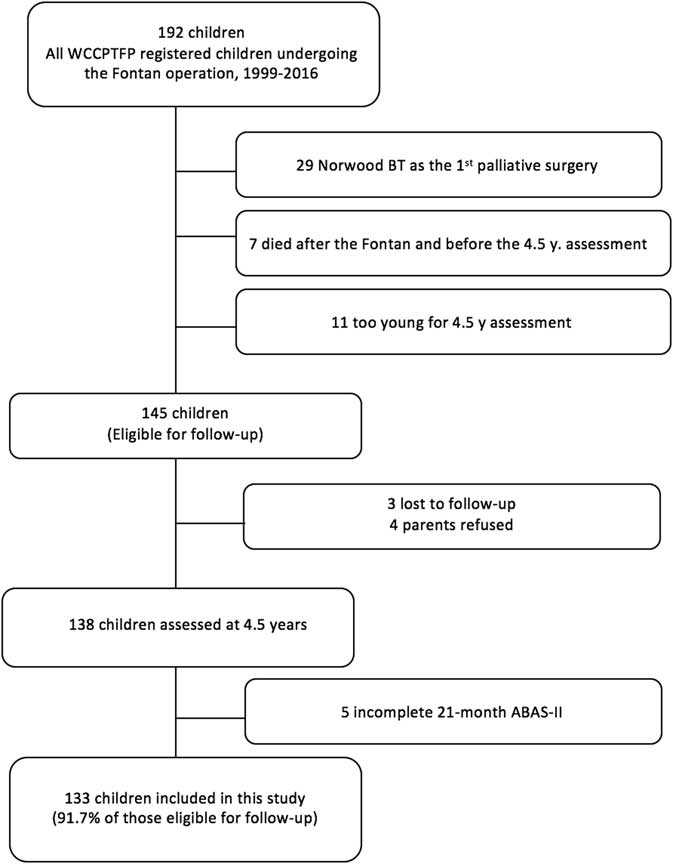
All children registered with the Western Canadian Complex Pediatric Therapies Follow-up Program who underwent a Fontan operation from 1999 to 2016 were eligible for inclusion. To reflect current practices at our institution, children who underwent a Norwood with a modified Blalock–Taussig shunt operation as their first stage palliation were excluded; those who died were also excluded. Finally, children lost to follow-up or who refused or had incomplete Adaptive Behavior Assessment System-IIReference Harrison and Oakland 3 questionnaires were excluded from the final analysis (Fig 1).
Flowchart of death, lost, excluded and assessed children undergoing the Fontan operation from 1999 to 2016. ABAS-II=Adaptive Behavior Assessment System-II; Norwood BT=Norwood with a modified Blalock-Taussig shunt; WCCPTFP=Western Canadian Complex Pediatric Therapies Follow-Up Program.

Childhood clinical assessments
All children registered with this follow-up programme undergo multidisciplinary assessment at ~21 months (pre-Fontan) and 4.5 years of age (post-Fontan).Reference Robertson, Sauve and Joffe 14 At each of these visits, the Adaptive Behavior Assessment System-II is completed to measure functional abilities. This tool specifically measures what an individual can do “without the assistance of others”.Reference Oakland and Algina 4 In the case of children, the child’s primary caregiver completes the Adaptive Behavior Assessment System-II. For the specific age group of 1–5 years, the Adaptive Behavior Assessment System-II evaluates functional abilities using 10 skill areas. Each skill area has a mean score of 10 and a standard deviation of 3. The skill areas of communication, functional pre-academics, and self-direction construct the Conceptual Adaptive Domain; the leisure and social skill areas construct the Social Adaptive Domain; and the self-care, home living, community use, and health and safety skill areas form the Practical Adaptive Domain. These three adaptive domains, combined with the motor skill area, provide a general adaptive composite score with a normative population mean of 100 and a standard deviation of 15.
Definitions
The presence of deterioration of functional abilities was defined as ⩾1 standard deviation decrease in the post-Fontan general adaptive score in comparison with the pre-Fontan score. Perioperative stroke was defined as clinical evidence of a brain insultReference Barker, Nowak, King, Mosca, Bove and Goldberg 9 happening anytime between the time of Fontan operation and the first 30 days postoperatively. To avoid missing the diagnosis, stroke was identified in several ways. All children’s acute medical records during the Fontan hospitalisation were retrospectively reviewed for any evidence of acute stroke. The identified strokes were cross-checked with the follow-up program’s database, which prospectively records “abnormal neuroimaging”, and with a review of all neuroimaging performed during the Fontan hospitalisation. A major postoperative complication was defined as any of the following: convulsions, cardiopulmonary resuscitation, sepsis, dialysis, need for urgent cardiac catheterisation, need for extracorporeal membrane oxygenation, or need for ventricular assist device. Accompanying neurologic impairments are recorded prospectively in the Follow-up Program database. Chronic neuromotor disabilityReference Ricci, Andersen and Joffe 15 was defined as the presence of permanent motor difficulties secondary to a diagnosis of cerebral palsy or acquired brain injury. Permanent sensory hearing impairment was defined as a sensorineural loss or auditory neuropathy bilateral loss of >25 dB HL from 500–4000 Hz. Seizure disorder was defined by the use of anti-epileptic medication at the time of the multidisciplinary assessment.
Data collection
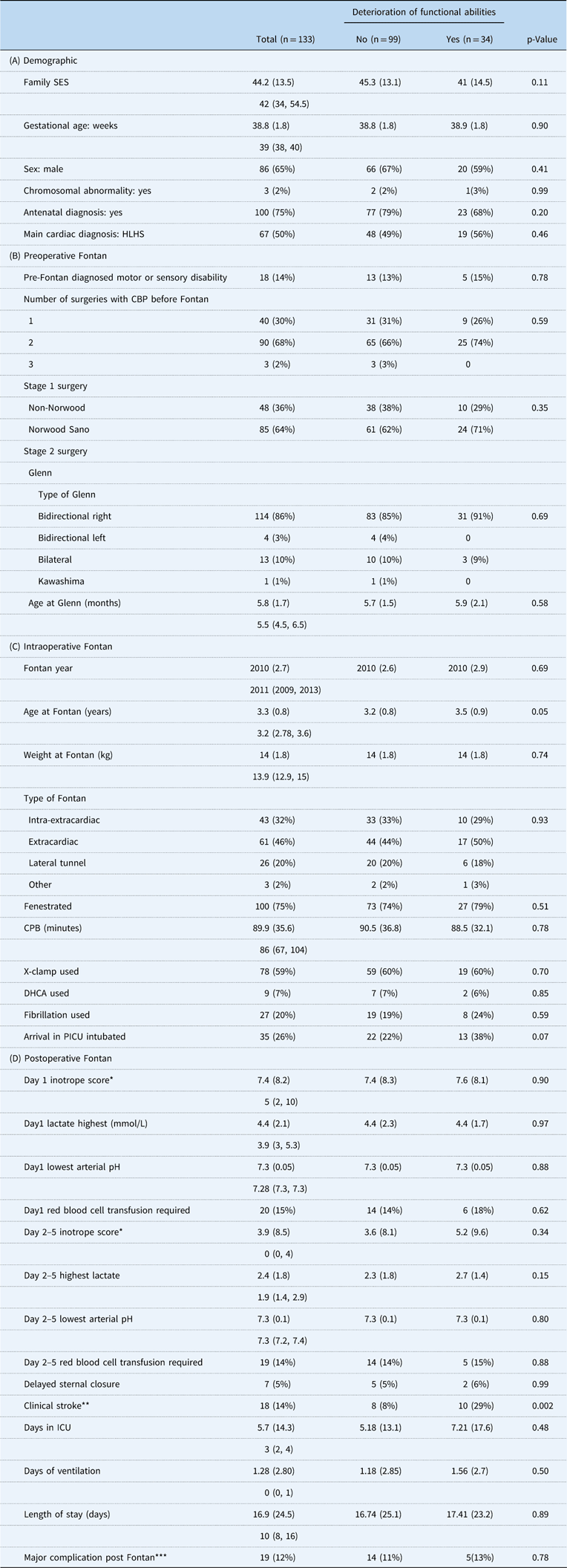
Demographic data collected prospectively for each child included gestational age, sex, chromosomal abnormality, antenatal diagnosis, main cardiac diagnosis of hypoplastic left heart syndrome, and family socio-economic status, as determined by the Blishen Index.Reference Blishen, Carroll and Moore 16 Pre-Fontan data recorded prospectively included the presence of recognised disability and number of surgeries with cardiopulmonary by-pass, stage 1 and stage 2 surgery type, and age at stage 2 surgery. Prospectively obtained acute care information in relation to the Fontan included the following: age and weight, type of Fontan, use of fenestration, use of aortic cross-clamp, use of deep hypothermic circulatory arrest and/or fibrillatory arrest; minutes of cardiopulmonary by-pass; arrival in intensive care intubated; postoperative day 1 and day 2–5 inotrope score,Reference Wernovsky, Wypij and Jonas 17 highest lactate, and red blood cells transfusion requirements; and delayed sternal closure, presence of major complication, days in ICU, days of ventilation, and total length of hospital stay including ICU and non-ICU days (Table 1).
Description of 133 children undergoing the Fontan operation in relation to deterioration of functional abilities: mean (standard deviation), median (interquartile rage), n (%).

CPB=cardiopulmonary by-pass; DHCA=deep hypothermic circulatory arrest; HLHS=hypoplastic left heart syndrome ; PICU=paediatric ICU; SES=socio-economic status
* Calculated as per Wernovsky et alReference Wernovsky, Wypij and Jonas 17 IS=dopamine dose (μg/kg/min)+dobutamine dose (μg/kg/min)+100×epinephrine dose (μg/kg/min)
** History of peri-Fontan stroke was present in 1/47 (2%) excluded children (1/7 died, 0/11 too young for assessment, 0/29 Norwood BT), and in 1/12 (8%) of the children with incomplete follow-up (1/5 incomplete 21-month Adaptive Behavior Assessment System-II, 0/4 parents refused, 0/3 lost to follow-up)
*** Major postoperative complication was defined as any of the following: convulsions, cardiopulmonary resuscitation, sepsis, dialysis, need for urgent cardiac catheterisation, need for extracorporeal membrane oxygenation, or need for ventricular assist device
Statistical analysis
Continuous variables are presented as means (standard deviation) or medians (interquartile range) and categorical variables as counts and percentages. Frequency of deterioration of functional abilities and peri-Fontan stroke are given as percentage of the assessed survivors with 95% confidence interval (CI). Comparisons between those with and without deterioration of functional abilities were completed using Student’s t-test for continuous variables and Fisher’s exact/χ2 test for categorical variables. Potential predictors of deterioration of functional abilities were analysed using multivariable logistic regression analysis. Variables with univariate p<0.10 were presented to the model. Using a likelihood ratio test, we examined the combination of covariates to find the best fit for our model. A conditional step-wise forward selection method was used to confirm the final model. Two-sided p-values<0.05 were considered statistically significant.
Results
Description of the cohort
During the study period, 192 children registered with the Western Canadian Complex Pediatric Therapies Follow-up Program underwent a Fontan operation at the Stollery Children’s Hospital. Of these, 145 were eligible for study inclusion; children were excluded because of having a Norwood with a modified Blalock–Taussig shunt operation (n=29), being too young for 4.5-year-old multidisciplinary assessment (n=11), or dying before 4.5 years (n=7). In addition, three children were lost to follow-up, the parents of four children refused to participate, and five children had incomplete data at the 21-month assessment. The final study cohort comprised 133 children, comprising 92% of eligible children (Fig 1).
For the 133 children, mean age at the time of the Fontan operation was 3.3 (0.8) years (median, 3.2) and mean weight was 14 (1.8) kg. In total, 67 (50%) children had hypoplastic left heart syndrome, 61 (46%) had an extra-cardiac Fontan, whereas 100 (75%) had a fenestrated Fontan. Mean ages at pre- and post-Fontan multidisciplinary assessment were 22 (6) months and 4.6 (0.5) years, respectively. Mean pre- and post-Fontan general adaptive composite scores were 90.6 (17.5) and 88.3 (19.1) (Table 1).
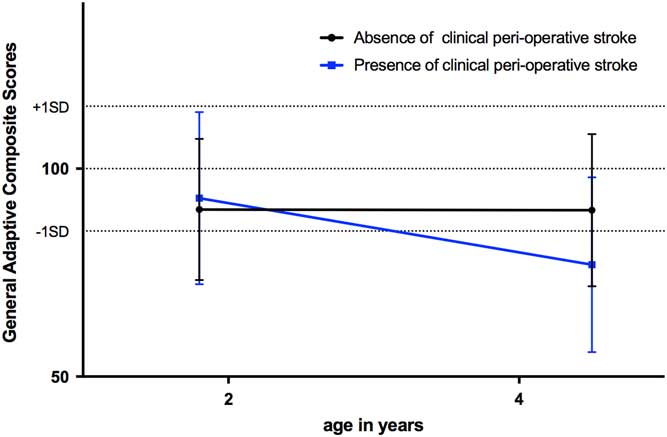
A total of 18 (13.5%) children had clinical evidence of peri-Fontan stroke. Mean post-Fontan general adaptive composite score for all 18 children with stroke was 76.9 (21) versus 90.1 (18.3) among children without stroke (p=0.01) (Fig 2).
Stroke leads to deterioration of functional abilities (n=133). Pre- and Post-Fontan general adaptive composite scores (mean and standard deviation) – for those without clinical peri-operative stroke: 90.2 (17) to 90.1 (18.3); for those with clinical peri-operative stroke: 92.9 (20.7) to 76.9 (21).

Deterioration of functional abilities
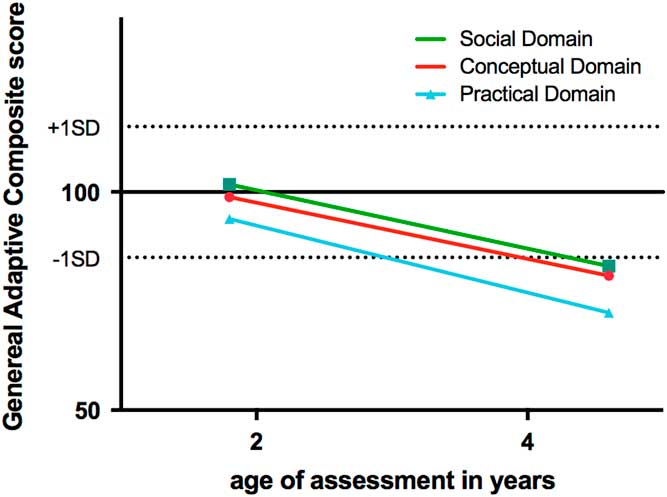
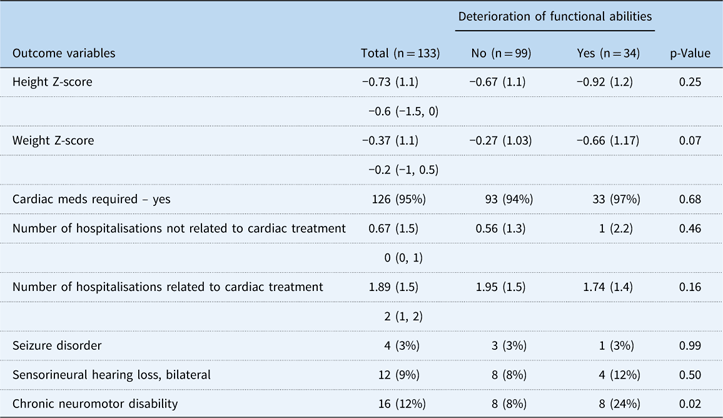
Pre- to post-Fontan deterioration of functional abilities occurred in 34/133 (26%) children. Of those with deterioration, 19 (56%) had hypoplastic left heart syndrome, 20 (59%) were male, 17 (50%) underwent an extra-cardiac Fontan, and 27 (79%) children had a fenestrated Fontan. Mean pre- to post-Fontan decline was 21.8 points (7.1), 96.3 (17.5) to 74.5 (16.6). Figure 3 shows the trajectory of each of the three adaptive domains among those with a deterioration of functional abilities; the practical domain showed the largest decline. Mean age at pre- and post-Fontan multidisciplinary assessment was not statistically different among children with and without deterioration. At the time of their 4.5-year multidisciplinary assessment, children with deterioration of functional abilities were more likely to have a chronic neuromotor disability (p=0.02); otherwise, the groups were similar (Table 2).
The trajectory of the three adaptive domain scores for children with Deterioration of Functional Abilities (n=34). Pre- and Post-Fontan scores (mean and standard deviation) for each domain were as follows. Social Domain: 101.7 (18.3) to 83 (15.5), Conceptual Domain: 98.8 (17.8) to 80.8 (17.4), Practical Domain: 93.8 (17.2) to 72.3 (15.5).

Childhood profile in relation to deterioration of functional abilities following the Fontan operation: n=133, mean (standard deviation), median (interquartile range), n (%).

Deterioration of functional abilities and stroke
Evidence of peri-Fontan stroke was found in 10/34 (29%) of children with deterioration of functional abilities, and in 8/99 (8%) of children without this deterioration (p=0.002). The most common clinical presentations of stroke were hemiparesis, which occurred in 12/18 (67%) children, two of whom also had associated aphasia, and seizures, which occurred in 5/18 (28%) children. One child presented with isolated decreased level of consciousness. A total of 15 (83%) children had neuroimaging, confirming the presence of stroke; the parents of three children refused to complete in-hospital neuroimaging, but paediatric neurologists interpreted the child’s clinical findings as stroke in the acute period. Most children, 16/18 (89%), were recognised to have had a stroke during the first 10 postoperative days, at a median of 6.5 days postoperatively. Two of the 24 children who had deterioration of functional abilities but no recognised perioperative stroke had surveillance neuroimaging later in life showing evidence of stroke; as timing was unknown, they were not considered as perioperative stroke in our study.
In those with deterioration of functional abilities, children with stroke had a mean decline in general adaptive composite score of 26.1 (9.6) points, compared with a mean decline of 20 (5.3) points among those without stroke (p=0.08). In addition, children with deterioration of functional abilities and stroke had a statistically significantly larger decline in the social domain when compared with those with deterioration of functional abilities but without stroke (25.6 (12) versus 16.9 (8.4); p=0.04). The differences in decline in the other two domains were not statistically significant. Finally, among those with deterioration of functional abilities, both children with and without stroke had their lowest mean composite scores in the practical domain.
Prediction of deterioration of functional abilities
In the univariable analysis, the presence of clinical stroke, arrival in intensive care intubated, and age at Fontan were associated with deterioration of functional abilities with a p value<0.1 (p=0.003, p=0.07, and p=0.05, respectively). However, in the multivariable logistic regression, only clinical stroke (multivariable odds ratio (OR) 5.00, 95% CI 1.74, 14.36; p=0.003) and older age at Fontan (per year of age, multivariable OR 1.67, 95% CI 1.02, 2.73; p=0.04) were significant predictors of deterioration of functional abilities. No other demographic, patient, or operative characteristics were significantly associated with deterioration of functional abilities.
Discussion
By assessing the trajectory of functional abilities in a large cohort of children undergoing the Fontan operation, we have found that more than one quarter have a pre- to post-Fontan deterioration of functional abilities. In addition, we found that this deterioration is frequently associated with peri-Fontan stroke. Overall, our cohort of children display pre- and post-Fontan general adaptive composite scores that are lower than the population mean, but still within one standard deviation from population normative values. Of concern, in those recognised as having a deterioration of functional abilities, the mean post-Fontan general adaptive composite score was almost 2 standard deviations below the normative mean.
Different authors have previously identified delays in functional abilities in children surviving open-heart cardiac surgery; Limperopoulos found limitations in functional abilities in up to 40%,Reference Limperopoulos, Majnemer and Shevell 2 Alton et al reported delays in functional abilities both at 21 months and 4.5 years of age,Reference Alton, Rempel, Robertson, Newburn-Cook and Norris 18 , Reference Alton, Taghados and Joffe 19 and more recently Brosig et al showed that functional abilities are a specific area of concern in these children.Reference Brosig, Bear and Allen 20 Although longitudinal changes in adaptive behaviour have been investigated in certain populations,Reference Willard, Qaddoumi and Chen 21 – Reference Warren, Brady, Fleming and Hahn 23 no authors have previously considered the trajectory of functional abilities in relation to the Fontan operation.
Much as cognitive development, functional abilities “are relative to one’s age”.Reference Oakland and Harrison 24 Acquisition of skills for daily living should develop steadily throughout the childhood years. As children grow and the demands of everyday life increase, functional abilities must expand rather than decline, as we found in 26% of our children.Reference Oakland and Harrison 24 Of the three domains that comprise the general adaptive composite score, we found that the practical domain had the greatest decline. This finding is consistent with that of Laraja et al; they studied 52 children who underwent fetal aortic valvuloplasty finding delays in functional abilities, with practical skills significantly lower than normative population values.Reference Laraja, Sadhwani and Tworetzky 25 Alton et alReference Alton, Rempel, Robertson, Newburn-Cook and Norris 18 have reported low self-care skills – part of the practical domain – in children surviving the Norwood operation. It has been proposed that while the learning process is represented in the conceptual domain, and the socialisation process in the social domain, the practical domain represents maturation.Reference Heber 26 This impact on maturation might partly explain why more than 50% of adult Fontan survivors are still living at home with their parents, and continue to have specific worries about their health, their abilities to work, and to live independently.Reference Pike, Evangelista, Doering, Eastwood, Lewis and Child 27
Overall, 13.5% of children in our study showed clinical evidence of perioperative stroke. This is similar to findings from Bellinger et al,Reference Bellinger, Watson and Rivkin 10 but higher than what has been reported by other authors.Reference Barker, Nowak, King, Mosca, Bove and Goldberg 9 , Reference Chun, Schamberger and Flaspohler 11 , Reference du Plessis, Chang and Wessel 12 Although these studiesReference Barker, Nowak, King, Mosca, Bove and Goldberg 9 , Reference Chun, Schamberger and Flaspohler 11 , Reference du Plessis, Chang and Wessel 12 include all children who underwent a Fontan, our study only included children who underwent the Fontan but who also had their first complex cardiac surgery at ⩽6 weeks (registration criteria). Thus, it is possible that our study may have selected children with a more complex cardiac lesion, which may explain the difference in our findings.
In addition, we found that stroke occurred in 29% of the children with deterioration of functional abilities. It is not surprising that stroke can affect functional abilities, as impairments in different functional skills have been described in children with strokeReference Gordon, Ganesan, Towell and Kirkham 13 and other types of brain injury.Reference Ponsford, Cameron, Fitzgerald, Grant and Mikocka-Walus 28 , Reference Catroppa, Anderson, Morse, Haritou and Rosenfeld 29 Although we initially hypothesised that the majority of deterioration of functional abilities would be secondary to stroke, we were unable to find a clear cause for the deterioration of functional abilities in more than half of the children. One explanation for this could be that stroke can explain more of the deterioration of functional abilities cases, but is often under-recognised. A recent study from Cheng showed that 41% of stroke diagnosis in children with heart disease was found only on surveillance imaging studies.Reference Cheng, Rajagopal and McDavitt 30 Similar findings were reported by Bellinger et al; they found that 40% of strokes in adolescents surviving the Fontan were initially missed by clinical assessment alone. In children, initial symptoms of stroke are often not clear,Reference Everts, Pavlovic and Kaufmann 31 , Reference Long, Anderson and Jacobs 32 and children with stroke often “grow into their deficits”.Reference Greenham, Gordon, Anderson and Mackay 33 The fact that among those with deterioration of functional abilities we identified two children with missed strokes of uncertain timing also reflects clinical under-recognition. There are other potential explanations for deterioration of functional abilities. Rempel describes that parents of children with hypoplastic left heart syndrome tend to normalise their children’s development as a response to the uncertainty about their children’s future.Reference Rempel, Harrison and Williamson 34 Generally speaking, at 21 months, children do not spend much time with peers. Parents may therefore be more prone to normalise development at that age, giving their children higher scores on the Adaptive Behavior Assessment System-II than they deserve. After the Fontan, children are older and gradually spend more time with peers, which might lead to less normalisation as parents are faced with the reality of what other children of the same age are capable of doing.
Importantly, we found that older age at Fontan predicts deterioration of functional abilities. This is not the first study to show that older age at Fontan may be associated with worse postoperative outcomes. Worse postoperative exercise capacityReference Shiraishi, Yagihara and Kagisaki 35 and lower cognitive abilitiesReference Martin, Ricci and Atallah 36 have been associated with older age at Fontan. Achieving the Fontan circulation later in life means the developing brain continues to be exposed to hypoxia for a longer period. The continuous effect of chronic hypoxia at a time characterised by rapidly increasing cognitive functions and emerging imaginationReference Dixon and Stein 37 might be particularly deleterious.Reference Bass, Corwin and Gozal 38
We endeavoured to construct a clinically relevant definition of deterioration of functional abilities. This would not only allow us to identify children within our own cohort who have experienced a substantive deterioration, but also allow for further research in this area. Although half a standard deviation difference has been described to recognise clinically significant changes in adult self-completed questionnaires,Reference Norman, Sloan and Wyrwich 39 in our study we considered that a full standard deviation decline would provide more interpretable results, in particular, considering that the Adaptive Behavior Assessment System-II used in this age group is not a self-completed but a parent-completed questionnaire. Moreover, a drop of 1 standard deviation places patients in a different descriptive classification – for example, from average to below average. Further work correlating deterioration of functional abilities with future skills and educational and career achievements will be important to lend credence to our definition.
Our study has several limitations. On average, the programme follow-up assessment took place 12.9 months after the Fontan operation. We would expect that most acute events and interventions that explain deterioration occur at the time of surgery; children are more likely to be in steady state in the year post-Fontan. However, it is possible that deterioration of functional abilities occurred owing to events we could not identify occurring well before or after the time of the Fontan operation. In addition, neuroimaging could not be obtained for all children with clinical evidence of stroke, and thus we could not confirm the diagnosis in three children. The data on stroke and its timing were confirmed retrospectively, and thus subject to ascertainment bias. As in any observational study, our results cannot prove cause and effect relationships. A number of children suffered a stroke but did not experience deterioration of functional abilities; the reasons why in certain cases stroke leads to deterioration of functional abilities, and not in others, needs to be further investigated. Our study also has several strengths. This is a large cohort of children having the Fontan operation, and long-term follow-up was obtained in 133/145 (92%) survivors. In addition, other than the diagnosis of stroke, all data on potential predictors of deterioration of functional abilities were obtained prospectively.
Conclusion
Our work shows that more than one quarter of children have deterioration of functional abilities after the Fontan operation. At this early stage in development, recognition of a deterioration of functional abilities can help understand future potential life challenges. More importantly, it can guide the use of interventions proven to improve the functioning of the child.Reference Oakland and Harrison 24 , Reference Dawson, Rogers and Munson 40 We identified two potentially modifiable independent predictors of deterioration of functional abilities after the Fontan operation: perioperative stroke and older age at Fontan. In addition to prevention of perioperative stroke, efforts should be made to recognise strokes when they occur to allow for earlier intervention. Finally, completion of the Fontan operation at a younger age may help reduce deterioration of functional abilities, and warrants further study.
Acknowledgements
The authors thank the children and their parents for their willingness to attend developmental follow-up. The authors also thank all individuals working at the developmental follow-up clinics of the Western Canadian Complex Pediatric Therapies Follow-up Group, located at: Stollery Children’s Hospital, Edmonton Alberta; Alberta Children’s Hospital, Calgary, Alberta; Winnipeg Children’s Hospital, Winnipeg, Manitoba; Kinsmen Children’s Centre and Royal University Hospital, Saskatoon, Saskatchewan; Regina General Hospital and Wascana Rehabilitation Centre, Regina, Saskatchewan; British Columbia Children’s Hospital, Vancouver, British Columbia.
Financial Support
Financial support was provided as grants for 1996–1999, 2014–2015, and 2016–2017 from the Glenrose Hospital Foundation-clinical Research Grant, and 2000–2006 by Alberta Health and Wellness, Government of Alberta. Ongoing support is provided by the hospitals of the Western Canadian Complex Pediatric Therapies Follow-up Group: Stollery Children’s Hospital, Edmonton Alberta; Alberta Children’s Hospital, Calgary, Alberta; Winnipeg Children’s Hospital, Winnipeg, Manitoba; Kinsmen Children’s Centre and Royal University Hospital, Saskatoon, Saskatchewan; Regina General Hospital, Regina, Saskatchewan; and British Columbia Children’s Hospital, Vancouver, British Columbia.
Conflicts of Interest
None.
Ethical Standards
The authors assert that all procedures contributing to this work comply with the ethical standards of the relevant national guidelines on human experimentation, “Canadian Institutes of Health Research, Natural Sciences and Engineering Research Council of Canada, and Social Sciences and Humanities Research Council of Canada, Tri-Council Policy Statement: Ethical Conduct for Research Involving Humans, December 2014” and with the Helsinki Declaration of 1975, as revised in 2008, and has been approved by the health research ethics boards at each of the Western Canadian Complex Pediatric Therapies Follow-Up Program sites: Stollery Children’s Hospital, Edmonton Alberta; Alberta Children’s Hospital, Calgary, Alberta; Winnipeg Children’s Hospital, Winnipeg, Manitoba; Kinsmen Children’s Centre and Royal University Hospital, Saskatoon, Saskatchewan; Regina General Hospital, Regina, Saskatchewan; British Columbia Children’s Hospital, Vancouver, British Columbia.