




No CrossRef data available.
Article contents
Kinetics of procalcitonin, interleukin 6 and C-reactive protein after cardiopulmonary-bypass in children
Published online by Cambridge University Press: 18 April 2005
Abstract
Cardiopulmonary bypass induces a generalized inflammatory response, with fever and leukocytes, which is difficult to differentiate from an infection. Recently, procalcitonin has been proposed as an early and specific marker of bacterial infection. The influence of cardiopulmonary bypass on production of procalcitonin, therefore, must be assessed before considering this molecule as a valuable marker of infection after cardiac surgery in children. With this in mind, we measured levels of procalcitonin, interleukin 6, and C-reactive protein before and 6 h, 1, 3 and 5 days after cardiopulmonary bypass, in 25 children undergoing cardiac surgery. Cardiopulmonary-bypass induced a transient increase in procalcitonin, with a peak at 24 h, with a median of 1.13 μg/l, a 25th and 75th interquartile of 0.68–2.25, and a p value of less than 0.001. The value had returned to normal in the majority of the children by the third day after surgery. Peak values correlated with the duration of cardiopulmonary-bypass, with a r-value of 0.58 and a p value of 0.003; cross-clamp time, with a r-value of 0.62 and a p value of 0.001; days of mechanical ventilation, with a r-value of 0.62 and a p value of 0.001; and days of stay in intensive care, with a r-value of 0.68, and a p value of 0.0003. The value returned to normal after 3 days in 83% of the patients. Levels of interleukin 6 and C-reactive protein also increased significantly after surgery, and remained elevated for up to 5 days.
Thus, in contrast to other markers, levels of procalcitonin in the serum are only slightly and transiently influenced by cardiopulmonary bypass, and may prove to be useful in the early recognition of an infection subsequent to cardiopulmonary bypass.
Information
- Type
- Original Article
- Information
- Copyright
- © 2003 Cambridge University Press
Cardiopulmonary bypass induces a generalized inflammatory response,1 which is thought to be triggered by the exposure of blood to artificial surfaces, and the development of ischemia and reperfusion injury.2, 3 This phenomenon is associated with the systemic release of proinflammatory cytokines, such as tumor necrosis factor α and interleukin 6, an activation of the complement system, and an increase in synthesis of C-reactive protein.2, 3 The post-bypass syndrome is further characterized by an increase in leukocyte count, fever, increased capillary permeability, and the accumulation of interstitial fluid. It may progress to dysfunction of multiple organs. Simultaneously, the risk of infection after cardiac surgery is increased because of nasotracheal intubation, indwelling catheters, and a transient deficiency of immunologic functions.3 Consequently, it is often difficult to differentiate the non-infectious systemic inflammation associated with cardiopulmonary bypass from an infection based on parameters such as fever, leukocytosis and increased values of C-reactive protein.
Procalcitonin is a new marker that is considered of value in differentiating severe invasive bacterial infections from non-systemic infections or non-infectious systemic inflammation.4–6 The mechanisms of induction of procalcitonin are so far not completely elucidated, but production of endotoxins may be one of the main stimuluses.7, 8 Accordingly, surgery should not induce an increase in levels of procalcitonin. Elevated levels of procalcitonin, nonetheless, have been reported post-operatively in the absence of systemic infections.9, 10
Before considering procalcitonin as a valuable marker of infection after cardiac surgery with cardiopulmonary bypass in children, it is necessary to assess the influence of cardiopulmonary bypass itself on its production. That was the purpose of our investigation.
Methods
Subjects
This was a prospective observational study without any intervention other than monitoring procedures. We enrolled 25 consecutive children, 10 girls and 15 boys, aged from 3 months to 17.5 years, with a median of 4.5 years, who were about to undergo elective cardiac surgery with cardiopulmonary bypass. Children who were critically ill prior to surgery, defined as requirement of inotropic support or mechanical ventilation, and children with a suspected preoperative infection, defined as fever of more than 38°C and/or leukocytes less than 12 g/l, or C-reactive protein more than 20 mg/l, were excluded. The operative procedure was accomplished in all patients through a midline sternotomy.
The institutional ethics committee of the Children's Hospital of Geneva approved the protocol for the study, and informed consent was obtained from the parents of all the enrolled children.
Anaesthesia
Patients were premedicated with oral midazolam (0.5 mg/kg) on the day of surgery. After preoxygenation, anaesthesia was induced with sevoflurane/isoflurane, fentanyl and pancuronium, and maintained with fentanyl and pancuronium. All patients were intubated, and ventilation was with a mixture of air and oxygen, using positive pressure to maintain an end-tidal partial pressure of carbon dioxide of 35–45 mmHg. Central venous and arterial lines were placed after induction of anaesthesia.
Cardiopulmonary bypass
Cardiopulmonary bypass was instituted with cannulation of the ascending aorta, and separate cannulation of the superior and inferior caval veins. Heparin, at a dose of 300 IU/kg, was given for anticoagulation before cardiopulmonary bypass. Additional doses were given to keep the activated clotting time greater than 450 sec throughout the entire period of bypass. Non pulsatile bypass was performed using a roller pump and a membrane oxygenator. We used the Midiflo D 705 for patients weighing more than 12 kg, Module 1500 for patients between 6 and 12 kg, and the D 901 Liliput 1 for patients weighing less than 5 kg (Dideco, Milano, Italy). A flow of 2.4 l/min/m2 was used for all the patients, and was decreased to 1.7 l/min/m2 for patients requiring deep hypothermia. The circuit was primed with Ringer's solution and 5% human albumin. Methylprednisolone, at a dose of 30 mg/kg, and mannitol at 0.5 mg/kg, were added to the priming solution. Packed red blood cells were added according to weight and preoperative values of haemoglobin. Further transfusion was administered only if the level of haemoglobin fell below 90 g/l was obtained with repeated boluses of cold crystalloid cardioplegia, using the St Thomas Hospital solution at a dose of 30 ml/kg, provided myocardial protection. The lowest temperature recorded ranged from 18 to 30°C depending on the surgery performed. Deep hypothermia, at a temperature below 20°C, was used in 4 patients, who also had a short period, from 14 to 20 min, of circulatory arrest. Before weaning from bypass, the temperature was increased to 36°C. Heparin was neutralized with protamine chloride after termination of cardiopulmonary bypass. Ultrafiltration, using the ultrafilter U 2000 Gambro, Dyalysatoren GmbH and Co, Hechingen, Germany, was performed during cardiopulmonary bypass. After cardiopulmonary bypass, the blood remaining in the circuit was salvaged by a centrifugation device (Cell saver 4, Hemonetics, Braintree, MA, USA) and retransfused to the patient. Duration of cardiopulmonary bypass and aortic cross-clamp time were recorded.
Collection of data
Blood samples were taken to measure procalcitonin, interleukin 6, the leukocyte count, and levels of C-reactive protein after induction of anesthesia but before cardiopulmonary bypass, and again 6 h, 1, 3 and 5 days after the cardiopulmonary bypass was terminated. Samples were collected from the radial arterial line, and from the central venous line when the former had been removed. The leukocyte count, and levels of C-reactive protein, were measured immediately, whereas serum for assay of interleukin 6 and procalcitonin was stored within 30 min at −20°C for later analysis. The maximal body temperature over each period, measured rectally, was retained for comparisons.
Laboratory tests
The concentration of procalcitonin in the serum was measured by a highly sensitive and specific commercially available immunoluminometric assay (LUMItest PCT, Brahms Diagnostica, Berlin, Germany), whose inferior detection limit is 0.1 μg/l. The interassay coefficients of variation of the assay were 7.2% at 1.24 μg/l, 6% at 4.97 μg/l and 3.2% at 51.9 μg/l. The cut off for an abnormal value in our laboratory is 1.1 μg/l.
Concentrations of interleukin 6 in the serum were measured by an immunoluminometric assay using the immulite interleukin 6 procedure (Diagnostic Products Corporation (DPC), Los Angeles, CA, USA), whose inferior detection limit is 2 pg/ml. The interassay coefficients of variation of the assay were 7.9% at 5.4 pg/ml, 9.7% at 455 pg/ml and 6.2% at 1560 pg/ml.
Levels of C-reactive protein in whole blood were measured by an immunometric test (NycoCard CRP whole blood, Nycomed Pharma AS, Oslo, Norway), whose inferior limit for detection is 10 mg/l.
The number of leukocytes was measured by resistance measurement using an automatic discriminator system (Sysmex SF 3000, TOA Medical Electronics Ltd, Kobe, Japan). The neutrophils were verified by manual counting.
Post-operative care
All patients were ventilated post-operatively, and were weaned from the ventilator the day after surgery when possible. Volume, inotropic support, and vasodilators were administered as clinically indicated by the staff of the intensive care unit, who were not involved in the study. Analgesia and sedation were obtained with continuous infusions of morphine and midazolam. All patients were given prophylactic cefazolin at a dose of 50 mg/kg every 12 h during the operation, and throughout the subsequent 48 h. Cultures of blood, urine, and bronchial secretions were performed as clinically indicated and recorded. Mortality, reoperation, days of ventilation and days of intensive care stay were recorded. The patients were divided into two groups according to the post-operative course:
- A complicated group defined as those dying or requiring reoperation within 5 days of surgery, needing more than 3 days of ventilation, and/or more than 5 days of care in the intensive care unit, and
- A non-complicated group, not fulfilling any of these criterions.
Statistical analysis
The data were computerized and analyzed using the GraphPad Prism 2.0 Software package (GraphPad Software, Inc, San Diego, CA, USA). Mean and median, 75th and 25th centiles, standard deviation, and standard error of the mean were calculated for all parameters. Results are expressed as the median unless otherwise stated. For each variable, Friedman's test for repeated measures was used, with Bonferroni corrections for all pairwise multiple comparisons. The relation between the variables and the duration of cardiopulmonary bypass, cross-clamp time, days of intubation and days of stay in the intensive care unit was studied using the Spearman correlation coefficient. The Mann–Whitney U test was used for comparison of levels of procalcitonin, interleukin 6, and C-reactive protein between the two groups. A p value of less than 0.05 was considered as significant for all tests.
Results
Patients, cardiopulmonary bypass, and post-operative care
Table 1 shows the diagnosis and surgical procedure performed in each patient.
Table 1. Demographic data, diagnosis, surgical procedure and peak levels of inflammatory parameters.

The median time for cardiopulmonary bypass was 120 min, with a range from 110 to 155 min. The period of aortic cross-clamping was 74 min, with a range from 54 to 110 min. In four of the 25 patients, we used a hypothermic circulatory arrest at less than 20°C of 14–20 min. One patient died on the first post-operative day, and another required a second surgical procedure with cardiopulmonary bypass on the third day. The first 18 patients undergoing surgery had a non-complicated postoperative course, compared to the last 7 in whom we experienced complications. Six patients needed blood culture during the study, and all were negative. Urine culture was performed in 4 patients, and was again negative.
Data concerning inflammation
All kinetics of the inflammatory variables were within normal values before cardiopulmonary bypass (Fig. 1). Levels of procalcitonin increased significantly from a median of 0.18 μg/l, with a range of 0.14–0.2, preoperatively to a peak of 1.13 μg/l, with a range of 0.68–2.25, at 24 h, with a p value less than 0.001, and then decreased to reach a level of 0.29 μg/l with a range of 0.26–0.42 at 5 days. On the third day, 83% (20/24), and on the fifth day 87% (21/23) of the patients had returned to normal values for procalcitonin (Fig. 2). Levels of interleukin 6 increased significantly, with a peak reached at 6 h, and then remained elevated until the fifth day. For C-reactive protein, the levels increased later, peaking at 3 days at levels of 70 mg/l, with a range from 30 to 105. In the majority of the patients, the values for interleukin 6 and C-reactive protein, in contrast to those for procalcitonin, did not normalize after 5 days.

Figure 1. Kinetics of procalcitonin, iunterleukin 6, and C-reactive protein. The boxes show the concentration of the data. The boxes extend from the 25th to the 75th percentile, with a horizontal line at the median. Whiskers extend down to the minimal value and up to the maximal value. Dotted lines define the cut off for an abnormal value of 1.1 μg/L. Repeated measures Friedman test: p < 0.001 for all data; *p < 0.05 versus baseline.

Figure 2. Individual values of procalcitonin over time. Patients suffering complications are represented by the open circles, and patients without complications with closed squares.
Peak levels of procalcitonin showed a positive correlation with:
- The duration of cardiopulmonary bypass duration with an r-value of 0.58 and a p value of 0.003;
- The time of aortic cross-clamping, with an r-value of r = 0.62 and a p value of 0.001;
- Days of intubation, with an r-value of 0.62 and a p value of 0.001 and;
- Days spent in the intensive care unit, at an r-value of 0.68 and a p value of 0.0003.
Peak levels of interleukin 6 did not correlate with any of these variables, whereas peak values for C-reactive protein correlated with the duration of cardiopulmonary bypass, at an r-value of 0.45 and a p value of 0.02, and the period of aortic cross-clamping, with an r-value of 0.5 and a p value of 0.01, but not with the other variables.
Peak values of procalcitonin were significantly higher in the group of children suffering complications, with a median of 6 μg/l and a range from 2.6 to 40.7, when compared to the children undergoing surgery without complications, in whom the median was 0.77 μg/l, with a range from 0.54 to 1.42, (p value of less than 0.001). In contrast, peak levels of interleukin 6, with a median of 52.9 and a range of 20.2–74.7 versus 21.2 with a range from 12.2 to 43.5 pg/l (p value of 0.26), and peak levels of C-reactive protein, with a median of 45 and a range from 40 to 70 versus 70 with a range from 40 to 120 (p value of 0.23), were not significantly different between the 2 groups of patients. Procalcitonin had peaked in 24 of the patients during the first day, whereas C-reactive protein peaked on the third day in 22 patients. Peak levels for interleukin 6 were more erratic, occurring in 14 at 6 h, 7 on the first day, once on the third day, and the other three on the fifth day.
In four patients, procalcitonin reached levels of more than 5 μg/l during the first day. In all of these patients, a blood culture was clinically indicated within five days of the study and was negative. All 4 patients had undergone hypothermic cardiopulmonary bypass with a short period of circulatory arrest. The kinetics for procalcitonin, however, were the same as in all other patients, with only a slightly elevated value on the fifth day. One of the patients required a second surgical cardiopulmonary bypass and did not have an assay on the fifth day.
Discussion
Our results show that production of procalcitonin can be influenced by cardiac surgery under cardiopulmonary bypass in children. The levels of procalcitonin in the serum were within normal values in all children prior to cardiopulmonary bypass, and peaked at 24 h. But, even though the levels were significantly increased from the baseline 24 h after cardiopulmonary bypass, the values remained far below the levels reported in septic or infected patients.9–11 They then showed a progressive decrease to normal values within 3–5 days in the majority of the patients. This finding is very similar to previous data reporting an increase in procalcitonin to 2 μg/l, in adults after cardiac surgery with cardiopulmonary bypass.9, 12–14 Interestingly, the levels in the children who had a period of cardiocirculatory arrest15 were markedly more increased. Recent reports from adults suggested that procalcitonin might be released into the circulation in response to severe trauma without infection or, to a minor degree after cardiac surgery, whether or not cardiopulmonary bypass was required.9 A transient increase in levels of procalcitonin has also been described after abdominal and thoracic surgery.9 All these results support the hypothesis that a non-infectious inflammatory reaction may transiently stimulate the production of procalcitonin.
The kinetics of procalcitonin as revealed by our study suggest activation by cardiopulmonary bypass, as we observed a peak at 24 h, and then a progressive decrease, indicating a half-life of about 20–30 h.5 While the origin of procalcitonin is thus far not completely understood, experimental and clinical data indicate that production of endotoxins may be one of the main stimuluses for its production.7, 8 Cardiopulmonary bypass is known to induce a systemic inflammatory response, in which translocation of endotoxins from the gut may be one of the initiating processes. The altered distribution of the flow of blood during cardiopulmonary bypass may impair intestinal perfusion and affect mucosal permeability. This phenomenon may be increased by periods of deep hypothermia and cardiocirculatory arrest. This will favour translocation of endotoxins through the gut mucosa and stimulate production of procalcitonin.16 Indeed, the levels correlated positively with the duration of cardiopulmonary bypass and aortic cross-clamping. In the 4 patients in whom circulatory arrest was used, levels of procalcitonin were higher. Because the levels returned to normal values, or showed at least a marked decrease after 3 days, it is possible that sustained elevation, or a re-increase, may well indicate the emergence of an infectious problem. This hypothesis requires further study.
Synthesis of C-reactive protein is non-specifically stimulated, and levels are always raised after major surgery.11, 17 In our study, all patients showed a peak during the third post-operative day, and the values remained elevated in most patients at the fifth day. It is known that C-reactive protein may remain elevated for 7–14 days after open-heart surgery in children.18 Our study confirms this previous finding. Assay of C-reactive protein, therefore, is not appropriate for the diagnosis of early infection after cardiac surgery with cardiopulmonary bypass.
Increased levels of interleukin 6 have also been reported after cardiac surgery in children.19, 20 We found the levels peaking in the first 6 h after termination of cardiopulmonary bypass, but we did not find any correlation with the duration of cardiopulmonary bypass. Previous results are conflicting in this respect.20–22 Levels of interleukin 6 are known to vary greatly between patients due to its short half-life and the technical difficulties encountered in its measurement.2, 21 Furthermore, its cost, limited availability and absence of standardization argue against its use in clinical practice.23 In contrast, procalcitonin shows a great stability at different conditions of sampling and storage, requires only 20 μl of plasma and results are available within 2 h.
Based on the described kinetics, we suggest that a further increase of procalcitonin after 24 h, or an absence of a rapid decrease after the third day, should raise suspicions of infection. Werra et al.24 reported that levels were increased in septic shock, but not in cardiogenic shock. This was in contrast to interleukin 6, which was elevated in both conditions.24 This may prove to be important for patients after cardiac surgery, where differentiation between these entities is sometimes particularly difficult. This may even be useful for patients showing a more pronounced increase in levels of procalcitonin early after cardiopulmonary bypass, as these patients presented a rapid decrease during the following days. This hypothesis is further supported by the fact that, after completion of this study, one patient presented with a systemic gram-negative bacterial infection and showed a second increase in levels of procalcitonin greater than 5.5 μg/l that returned to normal after treatment with antibiotics. Rothenburger et al.17 similarly found an increase in adults suffering an infection after cardiac surgery under cardiopulmonary bypass, whereas patients without infection experienced the same kinetics as ours. In our 4 patients with peak levels of more than 5 μg/l, nonetheless, a transient bacteriemia undiagnosed by blood culture cannot be excluded because of the standardized prophylactic use of cefazolin over 48 h.
We found that increased levels of procalcitonin correlated with a complicated post-operative course. Loebe et al.16 observed the same correlation in adults, and concluded that procalcitonin might serve as a prognostic marker in patients undergoing cardiopulmonary bypass with open heart surgery. Meisner et al.14 also showed recently that induction of procalcitonin occurs more frequently in adults at risk of developing various post-operative complications. In our group, the correlation with a complicated post-operative course may be explained by the correlation of levels of procalcitonin with the duration of cardiopulmonary bypass, and also by the fact that most of the patients with increased levels had undergone a period of cardiocirculatory arrest. These findings lend credence to the hypothesis that procalcitonin may not only be a marker of the severity of inflammation, but may also be a proinflammatory mediator, as suggested by Nylen et al.25 This points to the need for further studies to elucidate the origin and the role of procalcitonin in inflammation and infection.
Acknowledgement
The authors wish to thank Bernadette Mermillod BSc, Division of Medical Informatics, for her help in the statistical analysis of the data.
Footnotes
Source of support: Immunoluminometric assays for procalcitonin (LUMItest PCT, Brahms Diagnostica, Berlin, Germany) were provided by Brahms Diagnostica.
References
Kirklin JK, Westaby S, Blackstone EH, Kirklin JW, Chenoweth DE, Pacifico AD. Complement and the damaging effects of cardiopulmonary bypass. J Thorac Cardiovasc Surg 1983; 86: 856–857.Google Scholar
Butler J, Rocker GM, Westaby S. Inflammatory response to cardiopulmonary bypass. Ann Thorac Surg 1993; 55: 552–559.Google Scholar
Hall RI, Smith MS, Rocker G. The systemic inflammatory response to cardiopulmonary bypass: pathophysiological, therapeutic, and pharmacological considerations. Anesth Analg 1997; 85: 766–782.Google Scholar
Assicot M, Gendrel D, Carsin H, Raymond J, Guilbaud J, Bohuon C. High serum procalcitonin concentrations in patients with sepsis and infection. Lancet 1993; 3 (41): 515–518.Google Scholar
Oczenski W, Fitzgerald RD, Schwarz S. Procalcitonin: a new parameter for the diagnosis of bacterial infection in the peri-operative period. Eur J Anaesthesiol 1998; 15: 202–209.Google Scholar
Chiesa C, Pacifico L, Mancuso G, Panero A. Procalcitonin in pediatrics: overview and challenge. Infection 1998; 26: 236–241.Google Scholar
Dandona P, Nix D, Wilson MF, et al. Procalcitonin increase after endotoxin injection in normal subjects. J Clin Endocrin Metab 1994; 79: 1605–1608.Google Scholar
Brunkhorst FM, Heinz U, Forycki ZF. Kinetics of procalcitonin in iatrogenic sepsis. Intensive Care Med 1998; 24: 888–892.Google Scholar
Meisner M, Tschaikowsky K, Hutzler A, Schick C, Schüttler J. Postoperative plasma concentrations of procalcitonin after different types of surgery. Intensive Care Med 1998; 24: 680–684.Google Scholar
Mimoz O, Benoist JF, Edouard AR, Assicot M, Bohuon C, Samii K. Procalcitonin and C-reactive protein during the early postraumatic systemic inflammatory response syndrome. Intensive Care Med 1998; 24: 185–188.Google Scholar
Gendrel D, Assicot M, Raymond J, Moulin F, Francoual C, Bohuon C. Procalcitonin as a marker for the early diagnosis of neonatal infection. J Pediatr 1996; 128: 570–573.Google Scholar
Adamik B, Kubler-Kielb J, Golebiowska B, Gamian A, Kubler A. Effect of sepsis and cardiac surgery with cardiopulmonary bypass on plasma level of nitric oxide metabolites, neopterin, and procalcitonin: correlation with mortality and postoperative complications. Intensive Care Med 2000; 26: 1259–1267.Google Scholar
Hensel M, Volk T, Döcke WD, et al. Hyperprocalcitoninemia in patients with noninfectious SIRS and pulmonary dysfunction associated with cardiopulmonary bypass. Anesthesiology 1998; 89: 93–104.Google Scholar
Meisner M, Rauschmayer C, Schmidt J, et al. Early increase of procalcitonin after cardiovascular surgery in patients with postoperative complications. Intensive Care Med 2002; 28: 1094–1102.Google Scholar
Kilger ER, Pichler B, Goetz AE, et al. Procalcitonin as a marker of systemic inflammation after conventional or minimal invasive coronary artery bypass grafting. Thorac Cardiovasc Surg 1998; 46: 130–133.Google Scholar
Loebe M, Locziewski S, Brunkhorst FM, Harke C, Hetzer R. Procalcitonin in patients undergoing cardiopulmonary bypass in open heart surgery-first results of the procalcitonin in Heart Surgery Study (Prohearts). Intensive Care Med 2000; 26 (Suppl 2): S 193.Google Scholar
Rothenburger M, Markevitz A, Lenz T, et al. Detection of acute phase response and infection. The role of procalcitonin and C-reactive protein. Clin Chem Lab Med 1999; 37: 275–279.Google Scholar
Casey WF, Hauser GJ, Hannallah RS, Midgley FM, Khan WN. Circulating endotoxin and tumor necrosis factor during pediatric cardiac surgery. Crit Care Med 1992; 20: 1090–1096.Google Scholar
Aronen M, Leijala M, Meri S. Value of C-reactive protein in reflecting the magnitude of complement activation in children undergoing open heart surgery. Intensive Care Med 1990; 6: 128–132.Google Scholar
Aronen M. Value of C-reactive protein in detecting complications after open-heart surgery in children. Scand J Thorac Cardiovasc Surg 1990; 24: 141–145.Google Scholar
Hauser GJ, Ben-Ari J, Colvin MP, et al. Interleukin-6 levels in serum and lung lavage fluid of children undergoing open heart surgery correlates with postoperative morbidity. Intensive Care Med 1998; 24: 481–486.Google Scholar
Butler J, Chong GL, Baigrie RJ, Pillai R, Westaby S, Rocker GM. Cytokine responses to cardiopulmonary bypass with membrane and bubble oxygenation. Ann Thorac Surg 1992; 53: 833–838.Google Scholar
Cremer J, Martin M, Redl H, et al. Systemic inflammatory response syndrome after cardiac operation. Ann Thorac Surg 1996; 61: 1714–1720.Google Scholar
Werra I, Jaccard C, Corradin SB, et al. Cytokines, nitrite/nitrate, soluble tumor necrosis factor receptors and procalcitonin concentrations: comparison in patients with septic shock, cardiogenic shock and bacterial pneumonia. Crit Care Med 1997; 25: 607–613.Google Scholar
Nylen ES, Whang KT, Snider RH, Steinwald PM, White JC, Becker KL. Mortality is increased by procalcitonin and decreased by an antiserum reactive to procalcitonin in experimental sepsis. Crit Care Med 1998; 26: 1001–1006.Google Scholar
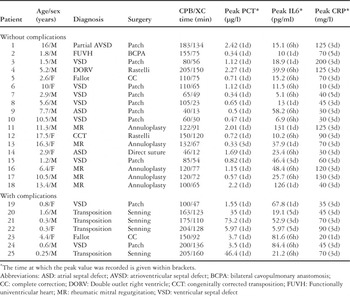
Table 1.

Kinetics of procalcitonin, iunterleukin 6, and C-reactive protein. The boxes show the concentration of the data. The boxes extend from the 25th to the 75th percentile, with a horizontal line at the median. Whiskers extend down to the minimal value and up to the maximal value. Dotted lines define the cut off for an abnormal value of 1.1 μg/L. Repeated measures Friedman test: p < 0.001 for all data; *p < 0.05 versus baseline.

Individual values of procalcitonin over time. Patients suffering complications are represented by the open circles, and patients without complications with closed squares.
 You have
Access
- 35
- Cited by